The Costs of Solitary Confinement

Originally published in The JHU Politik and then on WJHU Radio blog

Solitary confinement is a form of imprisonment that goes by many names, ranging from “administrative segregation” to “disciplinary confinement” to “security housing.” All of these titles describe the practice of subjecting a prisoner to approximately 22-24 hours per day of isolated lockdown in a tiny cell. I am not going to focus on the moral implications of solitary confinement. Instead, I argue that we need to eliminate or greatly reduce the use of solitary confinement simply because it is far too expensive for our nation to afford, and because of its clear connection to an increased rate of recidivism when individuals are released back into society.

Contrary to popular belief, the practice of solitary confinement in the United States is not simply used for the most dangerous and threatening prisoners. It is estimated that over 80,000 prisoners are currently held in some form of solitary confinement, the majority of them having some sort of mental illness or cognitive disability. As of today, prisoners can be placed in indefinite isolation for months or years not only for violent acts, but also for ignoring orders, possessing contraband, testing positive for drug use, or even for using profanity. Many are children that are kept in solitary for “protection.” Many are gay or transgender, Muslim, or senior citizens. Many have reported rape by prison officials, and many are sentenced for questionable political or religious beliefs. In Virginia, for example, a group of Rastafarian men were placed in solitary confinement because they refused to cut their hair on religious grounds.

If  the  use  of  solitary  confinement  were  limited  solely  to  the most treacherous and predatory of prisoners, then most supermax prisons—facilities designed solely to provide long-term, solitary confinement for inmates classified as the greatest threats to national and international security—would be relatively empty because there simply are not that many individuals in this extreme category. It is estimated, however, that at least 25,000 inmates are currently in supermax facilities.

Because the federal government wants to avoid appearing “soft on crime,” we have been spending exorbitant amounts of money, often without much oversight, to appear “tough” on security. One study, conducted by Jeffrey Ian Ross, a Research Fellow of the Center for International and Comparative Law, estimated that the average per-cell cost of housing an inmate in a supermax prison is $75,000, as opposed to $25,000 for an inmate in the general prison population. This is, in part, due to the higher staffing costs needed to monitor those in solitary confinement. Additionally, constructing supermax prisons is a very expensive endeavor; the construction costs, according to a study conducted by the Urban Institute, are two to three times more expensive than a maximum-security prison.

As state budget cuts are being applied across the country to education, healthcare, social programs, housing subsidies and more, we simply cannot afford to be spending such ridiculous sums of taxpayer money on solitary confinement units. This is especially true when research, like the study conducted in 2006 by the Commission on Safety and Abuse in America’s Prisons, shows that solitary confinement has been found to cause serious psychological damage to inmates. Consequently, this psychological damage has been contributing to an increase in recidivism when individuals are released directly back into the general population.

Some states are already leading the way to reform this expensive and unhelpful system. Recently, Mississippi has reduced the number of prisoners it holds in solitary from 1,000 to about 150, and it has closed down its supermax unit. According to the American Civil Liberties Union, the reforms are saving Mississippi’s taxpayers an estimated $8 million per year.

The financial costs attached to solitary confinement are clear and untenable. Even disregarding the shockingly high rates of suicide for prisoners in solitary confinement, and the fact that prisons have become the largest inpatient psychiatric centers over the past thirty years, we should work immediately to reduce the number of individuals in solitary confinement simply for the sheer economic savings it would bring – savings that we as a country greatly need.

———————————-
Much of the research for this article came from Solitarywatch.com where I am currently interning.

#PostModernProblems

Originally published 10/05/12 in The Forward.

This past summer, Anne-Marie Slaughter shook up the national feminist conversation with her provocative Atlantic piece “Why Women Still Can’t Have It All.” Writing about the challenges she faces balancing her role as a mother and a professional, she argued that systemic changes must be made in both the workplace and society for women to finally achieve equality with men. Her piece sparked a wide debate, naturally, and as I begin my junior year of college at Johns Hopkins, I can’t help but ask myself, where do I fall in all of this? What choices do I face as a 20-year-old Jewish American female student?

In one of my sociology classes this semester, we began to analyze the concept of “family through a post-modern perspective.” As a history and sociology major, I have encountered post-modernism many times, yet this was the first time that the theory struck an incredibly personal note.

Post-Modern theorists embrace the notion that the world has changed so much from previous eras, that today individuals must make choices about virtually all aspects of their lives. Before, choices were limited and one’s life was generally pre-determined from history, tradition and custom. Now, when it comes to questions of self-identity, we increasingly rely upon our own construction of reality to dictate who we are. These choices range from big life decisions about relationships, religion and careers to the most trivial questions — what should I tweet? What should my profile picture be?

In all of my years of schooling, and now in my time at college, I have been taught to work hard for success, to learn avidly, and to not settle for anything less than what I’m capable of achieving. I have been raised to respect those who use their talents to improve the world.

And like Ms. Slaughter, I also recognize the significance of where I stand in this moment of women’s history. First wave, second wave and third wave feminists have all fought for girls like me to vote, to be able to attend institutions like Johns Hopkins (a school without women until 1970), and then upon graduation, to compete in the job market with men. Even in 2009 with the signing of the Lily-Ledbetter Fair Pay Act, a law that helps women fight against gender-pay discrimination, I am reminded that women out there are continually making political sacrifices so that I can do more and be more than they once had the opportunity to be at my age.

I was also raised in the American Jewish community. I have been to Holocaust memorials in America, Israel and Germany. I write this piece cognizant of the fact that many of the Jewish people who lost their lives never even imagined there could be a world where they could live as freely and confidently as I do today.

The struggle to make sense of what I want to do in the future comes in part from knowing that these different identities are not always so compatible. It does not escape me that “continuity” is an oft-stressed priority of the Jewish community, including “marrying Jewish” or at the very least, “raising your kids Jewish.” And as Ms. Slaughter recognized, creating and raising a family often can come at the expense of an ambitious adult career.

Will I marry Jewish? I don’t know. Do I want to eventually start a family? Yes. Do I want to continue to help the feminist cause? Yes. Do I want to chase my professional dreams? Yes. Do I want the existence of the Jewish people to continue? Yes. But I have not figured out what all of this means for me personally.

In many ways, I know that these challenges are a blessing, a gift and a privilege. This confusion is something many have only wished to have. But I think it is important for people to try to understand how many girls my age are feeling — to realize that simply because we understand that having choices is a “gift” does not really make it easier or less confusing.

Many girls today are unsure about which path to take, nervous to let people down, and anxious about living up to our own potential because of the costs our dreams might have on our future families. We are nervous to not live up to our own potential.

Every day I continue to explore my options and choices. But often the process can seem all too intimidating. And when it does, I retreat to my safe, imaginary realities of fiction, Netflix and Facebook — avenues where the cost of a “wrong choice” comes with far less significant consequences to my future.

#PostModernProblems

In Response to a Defense of Voter ID Laws

Originally published 9/23/12 in the JHU Politik.

I write this piece in response to Christopher Winer’s opinion featured in last week’s issue entitled, “Making Your Vote Count Through Voter ID Laws.” Winer argues that Voter ID laws are “common sense”, that they would work to “inspire public confidence” in our electoral system, and that the laws really pose only a “minor problem” to voters who lack proper identification.

I beg to differ.

I am from Pennsylvania, a key battleground state in this upcoming election; Pennsylvania is also currently the state with the strictest Voter ID law in the country. While not all states with Voter ID laws have the same requirements, I will focus on Pennsylvania here because it’s often at the center of this national debate.

Winer insists that although these laws might at the most be a “minor infringement of freedom,” overall they are ultimately worth it.

First it is worth considering, why would they be hypothetically “worth it?” One might answer: these laws work to prevent in-person voter fraud. However Pennsylvania has already ruled in court proceedings that there has been no evidence of an issue with in-person voting fraud in the state. So these laws are quite a risky “preventative solution” to a non-existent problem.

For many, obtaining an ID is truly difficult. This summer I worked at home as an Organizing Fellow on the Obama re-election campaign; the confusing and continually revised Voter ID law was a key concern for voters and organizers on almost a daily basis. I recall one instance where a frustrated middle-aged man came into the Obama office, identified himself as a high school English teacher, and asked in exasperation, “Where can I find a DMV that actually issues these IDs? I moved here recently and I’ve driven to four different DMV centers today and none of them offer photo ID services!” This anecdote was extremely telling. This man, who had the money, time, and means to travel to at least five different DMVs, still struggled greatly to obtain an ID. A majority of individuals who lack proper identification have none of these three things.

In Pennsylvania, according to the Pennsylvania Budget and Policy Center, nine rural counties have no DMV centers at all. In an additional 20 counties containing 1.5 million people, Driver’s License centers are open three or fewer days a week. (13 counties have DMVs only open one day per week.) Also, only seven out of 67 total counties have more than one DMV center.

In the Pennsylvania lower-court decision on this issue, Judge Simpson wrote that the number of registered voters without valid voter ID falls “somewhat more than 1 percent and significantly less than 9 percent”, or in other words, anywhere from 100,000 to 500,000 registered Pennsylvanian voters.

I agree with Winer that we should clean up the voter registration rolls, among other things. We should be working to enforce laws for problems we have, not problems we don’t have. Stephanie Singer, chair of the Philadelphia City Commission (which runs elections in the city) argues that the voter ID law specifically creates more problems than it fixes. “If this legislature were serious about [voter fraud], they would be funding poll worker training, data forensics, [and] aggressive investigation of the voter registration lists,” Singer tells KYW Newsradio.

What I find most ironic about Winer’s piece was his suggestion that in order for the government to reimburse travel costs to the DMV, individuals should present a utility bill or a bank statement to prove they are who they say they are. Or in other words, the forms of identification that used to be acceptable and legitimate enough to vote now are only good enough to get reimbursed.

You know what would inspire public confidence in our electoral system for me? If we advocated for a system where registered American citizens were easily able to exercise their right to vote—ensuring that we really have moved past the dark days of poll taxes, literacy tests, and unabashed disenfranchisement of women and minorities. If people think we need Voter IDs in order to instill confidence, then over the next few election cycles let us work to phase that process in responsibly. But if we want to ensure that all registered citizens will be able to cast their ballot in the upcoming election, we must admit that there is no way this nation will be ready to handle the proposed ID laws by November 6th. It is simply logistically infeasible.

“Within the Family”

Joe Paterno was taking a walk in Brooklyn,
when he comes upon a Hasidic Rabbi.
“Hello there!” Joe calls to the Hasid
The Hasid nods and turns away.

Talia and Jacob buy their tickets to the football game
They’ve never been to such an event before!
They bring sunscreen and deodorant because
they don’t know what to expect.

Joe Paterno was lost and reached for his iPhone
but he couldn’t access an Internet signal.
Talia stares at the loud students eating hotdogs around her
She wonders what they’re studying in school.

Joe kept walking until he reached a corner deli
He went inside, realizing he was quite hungry.
“What do you think of this whole soda tax, pretty outrageous huh?” Joe asks.
The Hasid turns away.

Jacob couldn’t follow the game very well.
He noticed protesters near the field with signs: “You Should Be Ashamed!”
“What’s this all about?” Jacob asks a boy sitting next to him.
The student turns away.

Birthright’s Triumphs and Flaws

Op-ed published originally in JTA.
—————————————–

WYNNEWOOD, Pa. (JTA) – After being privileged last year to go on a Taglit-Birthright trip with 40 students from Johns Hopkins University, last month I traveled with 12 other student leaders to Israel and the West Bank with J Street U. Since then I’ve been reflecting a great deal on these two very different experiences.

Birthright helped to provide a stronger connection to my Jewish identity. After the trip, I began to take more Jewish studies courses and engage more with the campus Hillel. I took an internship with Hillel’s Peer Network Engagement Internship program and started organizing my own events.

I realize, though, that the Birthright model is not designed to instill a strong sense of responsibility in Diaspora Jews toward Israel. After all, it is rather easy not to feel responsible for issues that no one asks you to think about. Rather, the program focuses more upon fostering a general sense of connection. This dynamic often leaves students unable or uninterested in being the “ambassadors” that Birthright so often asks us to be back home.

Birthright prides itself on being apolitical, and indeed on the trip I learned little of substance about the Israeli-Palestinian conflict. I have heard arguments for why Birthright does not venture into exploring the conflict, and to an extent I understand why. The trip is targeting a broad-based group of Jewish people and there’s only so much that can be accomplished in 10 days.

But reflecting further, I can’t help but find it unsettling that Birthright takes tens of thousands of young, uninformed Jews to Israel without providing any real briefing or debriefing on pressing Israeli societal issues while all the while telling us to go home and “tell the truth about Israel” and “love Israel and be a proud Jew.”

We do fall in love with the land, with the Mediterranean Sea, with the food and with the Israelis we meet. We have energizing hikes and a lot of fun. Yet Birthright does not prepare us to engage with legitimate and difficult questions back at our college campuses and in our communities.

A few weeks after returning home from Birthright, I was telling some people about my exciting trip. A peer asked my opinion on the fact that any Jewish person like myself from anywhere in the world can travel throughout Israel with ease, but there are Palestinians who have been living on the land for generations that face burdensome restrictions of movement.

I had no idea what to say. I didn’t even know what checkpoints were.

“It’s the Jewish homeland?” I replied meekly, frustrated with my own ignorance. Not only wasn’t I able to defend Israel to people who challenged it, but I felt embarrassed and confused.

Several weeks later I was asked how I could defend a state that expanded settlements in the occupied West Bank. I had no idea what people were talking about with regards to “international law” and “illegal outposts.” Again I scratched my head and realized I knew so little of “the truth” that Israeli Prime Minister Benjamin Netanyahu asked me and thousands of other participants at Birthright’s Mega Event to relay back on campus.

In contrast, while at times on the J Street U trip I felt uncomfortable by the Israel I saw, I left feeling deeply committed to its future. I saw Israel not simply as a place to which I wanted to return but as a story of which I wanted to be a part.

On the J Street U trip we met with Israelis from Sderot and Netiv HaAsara who regularly face the threat of rockets from Gaza, Holocaust historians from Yad Vashem, an Israeli scholar specializing in deligitimization, leaders of the Palestinian Authority in Ramallah, Israeli university students, Jewish settlers in Gush Etzion, human rights activists and Palestinian citizens of Israel.

We met with two-staters, one-staters and those who advocate a constitutionally enforced binational state. We met with Palestinians and Jews living in the segregated city of Hebron. We wrestled with the role of Jews of the Diaspora. At the end of it all, we emerged exhausted, intellectually humbled and more motivated to work to help Israel.

J Street U refused to present Israel as what Ir-Amim founder Danny Seidemann called a “Jewish Disneyland.” And I’m grateful for that. I still love Israel, but confronting the challenging parts of the country compelled me to have a much deeper sense of responsibility.

If those same students from last year ask me questions now about Palestinian freedom of movement or settlement expansion, I’m not sure I would necessarily have all the answers. But I am positioned in a place where I am ready to seriously engage and grapple with the ideas, concerns, questions and consequences of the conflict. I am working to create a situation in which Palestinians, Israelis and I can all move more freely in peace and security, with self-determination for both peoples.

I am not suggesting that Birthright start distributing talking points on the conflict during their trips. But I am recommending that Birthright provide far greater opportunities for participants to struggle and engage with Israel’s real issues. Do not underestimate us. Then maybe we all can come home better equipped to be responsible ambassadors.

Günter Grass’s Bad Poem. Israel’s Troubling Response.

On April 4th, German Nobel Laureate Günter Grass published a controversial 69-line poem entitled “What Must Be Said.” It has since sparked world-wide debate.

Some quick background on Grass:
He is one of the leading literary figures of the 20th century; he has written a series of internationally acclaimed novels that explored both the origins and the implications of the crimes of the Third Reich. For a long time he was viewed as a thoughtful conscience of the German nation. In 2006, at 78 years old, (after he had won the Nobel Prize for Literature in 1999) he confessed that at 17, he served in the Waffen-SS at the end of World War II. This confession made many see Grass as a hypocrite, where they had once seen an important moral voice.

ImageGrass’s poem was published in the Munich-based newspaper Süddeutsche Zeitung.  The poem accused Israel of endangering “the already fragile world peace” by its warnings to Iran that it might strike their nuclear facilities. Mr. Grass contended that by supplying weapons to Israel, Germany risked being complicit in “a foreseeable crime.”

Two days after the poem was published, Grass clarified in an interview that he did not mean to vilify Israel as a whole, but to attack the policies of Israeli Prime Minister, Benjamin Netanyahu.

The international community’s condemnation of this poem was immediate and strong.

Israeli Foreign Minister, Avigdor Lieberman issued a statement saying that Grass’ poem is an example of, “egoism of so-called Western intellectuals, who are willing to sacrifice the Jewish people on the alter of crazy anti-Semites for a second time, just to sell a few more books or gain recognition.”

German leaders from across the political spectrum denounced the poem’s message, ranging from “ill-informed” to “outrageous” to “Anti-Semitic.” Many artists said it was simply a “bad poem.”

However, while Grass’s poem was cringe-worthy and deeply misguided, some responses to the poem have been seriously troubling.

Israeli Interior Minister, Eli Yishai has declared Grass a “persona non grata”, (which literally means an “unwelcome person”) thus barring Grass’s future entry into the state of Israel. He justified this by saying that Grass was making an, “attempt to inflame hatred against the State of Israel and people of Israel, and thus to advance the idea to which he was publicly affiliated in his past donning of the SS uniform.”

This response is worrisome. This type of measure sets a very dangerous precedent for Israel’s democracy. To ban individuals who say things that are critical or offensive from entering the state has raised serious concerns about the future of free speech.

“It’s dangerous when one politician can decide a poem is grounds for banning people. I’m sure there are quite a few short stories of mine that Yishai doesn’t like. I wouldn’t want him to prevent me from returning home next time I’m abroad,” said  Etgar Keret, an Israeli short-story writer.

Famous novelist and essayist, Salman Rushdie tweeted in response to all of this, “OK to dislike, even be disgusted by #GünterGrass poem, but to ban him is infantile pique. The answer to words must always be other words.”

Even Alan Dershowitz, one of Israel’s most vocal supporters in the United States called the move, “foolish and self-defeating.”

Dershowitz wrote in the Huffington Post last week that, “By misusing border controls to make a symbolic gesture of contempt against a writer, Israel’s Minister of the Interior weakens his nation’s otherwise strong case for excluding individuals who pose genuine threats to the physical security of Israeli citizens. Border controls should be reserved for real security threats.”

In other words, terrorists should be barred from Israel. Not poets.

The New PA Voter Law

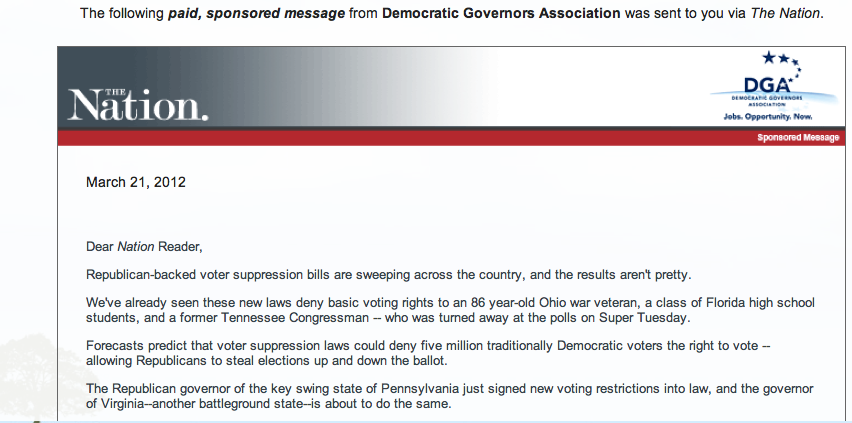
I’ve been hearing a lot of things lately about the new Pennsylvania Voter ID Law (or “Voter Suppression Law” as some call it.) This new law while championed by some as a civic necessity for ensuring safer and more valid democratic elections, is opposed by major organizations like the ACLU, NAACP and the AARP. They argue that this law adds more hurdles to voting and will thus ultimately infringe certain voters, particularly minorities and the elderly.

Image

(Received this in my inbox today)

I looked into it and this is what I’ve discovered:

So just generally:
With this new law, a voter must present a valid photo ID at the voting booth every time he or she votes. Prior to this law, photo ID was only required the first time a voter appeared to vote in their district. After that, they were allowed other forms of ID, including utility bills and government checks.

Types of acceptable identification from:
….the US Government (such as a passport)
….the Commonwealth of PA (such as a driver’s license)
… a PA care facility (such as a nursing home)
….a municipality to an employee, or
….a PA higher education institution (such as a college or university)

The ID must have an expiration date and it can’t be expired unless it’s a military ID, or if it’s a PA driver’s license, it can be expired up to one year.
(Jonah Mann sent me this article, that as of now under the current law, college IDs from Drexel, Penn State, Lasalle and Point Park universities cannot be used as identification for voting because they lack expiration dates.)

If you don’t have a photo ID at the time of voting, but you do possess one, (left it at home or something) you can still vote on a provisional ballot, and if you show up at the county board of elections office within 6 days of the election to show them your ID, they will count your vote.

Under this new law:
The PA government is required to issue free photo IDs to those that apply for them. The condition is that they must additionally have some alternate proof of identification (Passport, birth certificate, etc)
———————————————————————————————————————

People argue that this law is a good thing because it can prevent voter fraud. However, the amount of voter fraud is unclear.

For instance, there is voter fraud not related to voter impersonation, which photo IDs would not help to prevent. According to the Brennan Center, “It is more likely that an individual will be struck by lightning than that he will impersonate another voter at the polls.” They argue that most cases of voter fraud “can be traced to causes far more logical than fraud by voters,” including clerical or typographical errors, mismatched entries, and simple mistakes on both ends.

However, others argue there are indeed instances of voter impersonation. But the situation is ambiguous because the amount of voter impersonation convictions could very well be much less than what actually exists.

An example is the 1960 Presidential election between Richard Nixon and JFK where there was alleged to be a lot of voter fraud.  Here’s the full summary. Essentially convictions are hard to come by in our judicial system, and despite the lack of a single conviction, (over 650 were brought to trial) it doesn’t mean voting impersonation fraud didn’t exist or is unimportant. In fact, just the opposite. If Nixon had won two of the states that were being disputed, Illinois and Texas, he would have been President instead of Kennedy. So whether or not there was voter fraud, there was heated voter fraud controversy, and these new laws could help with situations like that.

Challenges with the Law:
So then why do groups like the the NAACP, ACLU and AARP oppose this law so much? The Obama campaign criticized the measure as “a costly bill to address a non-existent problem” and Democratic lawmakers and the American Civil Liberties Union vowed to challenge this law in court.

People argue the law will disenfranchise minorities who often can’t afford to make the trips to obtain necessary documents required to gain proper identification. This could also hurt the elderly, who often physically cannot make the trip to renew and update their exisiting photo identification. According to Karen Buck of the Senior Law Project, 18% of the elderly do not have photo i.d., but that number is surely higher if you also count those with expired photo IDs.

Stephanie Singer, chair of the Philadelphia City Commission (which runs elections in the city) argues with others that the law creates more problems than it fixes. She said, “If this legislature were serious about [voter fraud], they would be funding poll worker training, data forensics, aggressive investigation of the voter registration lists.”

Governor Corbett who signed the bill into law, described the new law as a preventive measure. The new law and photo requirement will be in full effect for the November 6th election.

————————————————————————————————————————————

It should be noted that a similar case for the state of Indiana was brought to the Supreme Court in 2008. The Supreme Court ruled that the voter ID law did not violate constitutional rights. The law “is amply justified by the valid interest in protecting ‘the integrity and reliability of the electoral process,'” Justice John Paul Stevens said in an opinion that was joined by Chief Justice John Roberts and Anthony Kennedy. But in dissent, Justice David Souter said Indiana’s voter ID law “threatens to impose nontrivial burdens on the voting rights of tens of thousands of the state’s citizens.”

In my opinion, if the government is requiring all of its citizens to have proper identification, then they should take on the responsibility of helping those who have difficulty getting them, get them. Democratic organizations are already gearing up on photo-ID education campaigns. But for something as important as this, I don’t think it should come down to partisan efforts, and should instead be a concerted national campaign, rather than a Democratic one. I also have serious doubts about how easily elderly folks will be able to get out to renew their expired identification.

photo credit: turnstilemusic.net

Joseph Kony and the Internet

I, like probably many others reading this, logged onto Facebook last night and saw: “Amy Smith and 45 other friends shared a link ____” Linking us to the now incredibly viral Kony video made by an NGO, called Invisible Children. Invisible Children’s mission is defined as “A movement seeking to end the conflict in Uganda and stop the abduction of children for use as child soldiers.” Well, who can argue with that?

photo credit: border7.com

I had a lot of mixed reactions after watching the video, and then watching it spread across all of my social media websites. I felt sad and outraged for the children in the video. I felt excited by the sheer explosion of positive, social justice messages I was reading everywhere.  But, as much as I hate to rain on the parade, I also felt uncomfortable by this giant social media “support.”

Remember SOPA and PIPA? The viral internet campaign to stop “evil” legislation that would “change the internet forever” ? I’ll be the first to say I signed that petition. The fact that Wikipedia was engaging in a political fight seemed incredibly motivating and exciting. Well, it wasn’t until a few days after everything blew over, the facebook statuses changed, the tweets switched topics, that I began to read some critical articles about the SOPA protests. (Here’s a good one)

What about the Planned Parenthood episode? That was the viral internet campaign of the beginning of February. I proudly signed that petition too. I shared in my fellow liberal peers’ indignation and anger at the audacity of Susan G. Komen’s foundation decision. I felt very sure of myself and my convictions that something very bad  just happened. And when the Komen Foundation reversed their decision, I went to bed at night happy and satisfied. Justice had been served.

photo credit: dailybeast.com

Well, it wasn’t until a few days after everything blew over, the Facebook statuses changed, the tweets switched topics, that I began to read some critical articles about the Planned Parenthood media coverage. (It’s not that I changed my opinion necessarily, I just had to admit I never really took the time to play a real devil’s advocate. ) Here’s a good one.

What have I learned from all of this?
1. Social media activism is a real, and powerful thing. It’s incredibly exciting and infectious.
2. Because it’s so easy to get swept up in the hype, critical thinking is very often put on the back burner.
————————————————————————–
Ok, now the Kony videos.
In a lot of ways I felt that same sort of excited, awestruck feeling I had with the SOPA and Planned Parenthood campaigns. Watching so many of my Facebook friends galvanized in support for a cause was great. It felt good to see Facebook and Twitter become tools for seemingly wonderful things.

But then I went and read more about Invisible Children, and found there’s actually a huge debate about all of this.

Visible Children, a Tumblr blog that has received a lot of attention, has questioned Invisible Children, asserting that its social media tactics aren’t the right way. “These problems are highly complex, not one-dimensional and, frankly, aren’t of the nature that can be solved by postering, film-making and changing your Facebook profile picture, as hard as that is to swallow.”

In November, a Foreign Affairs article challenged the methods used by Invisible Children that were trying to raise awareness in the region. “Such organizations have manipulated facts for strategic purposes, exaggerating the scale of LRA abductions and murders and emphasizing the LRA’s use of innocent children as soldiers, and portraying Kony — a brutal man, to be sure — as uniquely awful, a Kurtz-like embodiment of evil,” the magazine wrote

And here is another interesting perspective I read.  This guy says, “One problem: [The videos] fall into the trap, the belief that the problem is ignorance and the answer is education. When we tell more people about Kony and the LRA, something WILL happen. It’s not true. Bono, Bob Geldolf, Angelina Jolie and thousands of others have brought more attention, more education, more money to issues – it doesn’t solve them. White ignorance is not the problem… It is built on the idea that Africa needs saving – that it is the White man’s burden to do so. More education does not change the systems and structures of oppression, those that need Africa to be the place of suffering and war and saving.” He writes that if anything, this only further fuels our Western impression that Africa is a place just full of HIV, war, and famine.

We shall see what ultimately happens. I think that on one level its absolutely awesome that the world is banding together to rid the world of this terrible, immoral person. But I am also really hoping that this is not just the Internet flavor of the week. I am hoping that this is more than some sexy social justice cause. And I am also hoping that people who care about this issue will continue to read about it, think critically, and challenge institutions and even organizations like Invisible Children when they need to be challenged. It’s something I’m going to try to work on myself.

The Future of Pro-Israel

Today J Street launched its new national campaign: The Future of Pro-Israel

Photo Credit: Shereen Shafi

Hundreds of people, young and old, from all over the country, are writing short responses and recording videos about why they are the Future of Pro-Israel. Together we’re redefining the term. To be Pro-Israel no longer means you have to be “Anti-Palestinian” or place the conflict into a context of “good guys” and “bad guys”. People are smarter than that. People are tired of that. People know that for a complicated issue that has been going on for over sixty years, both sides have had their share of serious transgressions and mistakes. People want to start being intellectually honest, open and critical. People want to be Pro-Israel while still actively supporting a two-state solution.

Here are some videos from students I’ve met through my involvement with J Street U, that I’m proud to now call my friends. Maya Lee-Parritz from Bates college

Simone Zimmerman from UC Berkeley

Logan Bayroff from the University of Pennsylvania

Jenny Ferentz from Johns Hopkins University

Jacob Plitman from UNC

It’s incredibly important, empowering and necessary that J Street and J Street U are redefining what it means to be Pro-Israel in this politically frustrating country.