Obama Must Work Toward Two States

Published Originally in the JHU Politik on November 18, 2012.

Let us be clear: it is never a “convenient” time to work on the Israeli-Palestinian conflict. We live in a tumultuous world, with many serious foreign policy problems happening all at once.

And, unfortunately, due to the nature of our political system, an American president has only so much political capital, time, and space to act on a number of issues before the next election cycle approaches.

In his second term, President Obama will need to deal with the rising possibility of a nuclear-armed Iran, plan for the safe withdrawal of American troops from Afghanistan, decide how to proceed with his controversial drone-strike policies, secure strong economic and military interests in Asia, and address problems that have yet to materialize. However, the time to use vigorous U.S. diplomatic leadership to negotiate a two-state solution is now; it will not be any easier four years down the line. Many experts agree that the window to achieve such a peace deal, –a deal supported in principle by Israeli Prime Minister Benjamin Netanyahu, Palestinian Authority President Mahmoud Abbas, and every U.S. Administration since George H.W. Bush–is diminishing. Both sides know what the agreement would look like: what we now need is the political will to achieve it.

The relationship between Netanyahu and Obama is strained, yet it is imperative that the two leaders get past their political differences and work together for two states. The two-state solution is simply the only way for Israel to remain both a Jewish and democratic state, and for Palestinians to be freed from a 45-year military occupation and obtain the full political rights they deserve.

Negotiating peace is also a national security interest for the United States. We spend billions of dollars annually on Israeli security, but countries with clearly defined borders are more secure and better able to defend themselves against threats.

In 2009, Obama visited the Middle East, and Israelis understandably felt snubbed that he failed to stop to meet with leaders in Israel. But despite the lack of presidential speeches in Israel, actions speak louder than words. Under Obama’s leadership, Israeli Defense Minister Ehud Barak, Israeli President Shimon Peres and Deputy Foreign Minister Danny Ayalon, have all publicly stated that the security relationship between Israel and the United States has never been stronger. The amount of financial and military sup- port the Obama Administration has given to Israel is unprecedented.

Netanyahu received a lot of justly-deserved flack from Israelis and the international community during the U.S presidential election for intervening on behalf of Governor Mitt Romney. As Israeli Opposition Leader Shaul Mofaz, asked of Netanyahu in the Knesset, “Who are you trying to replace? The Administration in Washington or that in Tehran?” Netanyahu was open about his distrust of Obama’s strength, determination and capabilities, despite the praise that Obama had received from Israel’s intelligence and defense community.

On the Palestinian side, there is a partner for peace. Recently in an interview with Israel’s Channel 2, Abbas declared: “Palestine for me is the 1967 borders with East Jerusalem as the capital… The West Bank and Gaza is Palestine. Everything else is Israel.” Hold no illusions: if the Palestinian Authority collapses (as Israeli Foreign Minister Avigdor Lieberman pledged to ensure if the Palestinians seek upgraded non-member status at the U.N.), the next Palestinian leader will not be so moderate, or so inclined to work towards a two-state solution. An inability to reach an agreement with Abbas and the PLO will only strengthen the hand of Hamas, making it more difficult to deal with the situation in Gaza. Rocket fire from Gaza is not an example of why peace is impossible, but how the absence of negotiations and agreements perpetuates an endless cycle of violence that leads nowhere.

Obama must use some newly acquired political capital to revitalize the peace process. Netanyahu, Abbas, and Obama must move past rhetorical games and work to- gether for a long-term secure and just future. Early in 2013, I would hope that Obama travels to Israel and Palestine, making clear to both sides that the peace process will be a priority. The United States wants and needs their President to act forcefully and urgently, before it is too late.

The Importance of the Youth Vote

Originally published in the JHU Politik on 11/5/12

In 1971, Congress passed the 26th Amendment to the U.S. Constitution. This guaranteed that all American citizens ages 18 and older could vote in U.S. federal elections. Today there are 46 million people who fall into the so-called “youth voting bloc”—consisting of those between the ages of 18 and 29—and make up 21% of the eligible U.S. voting population. Take those numbers and compare them to the mere 39 million seniors who are eligible to vote.

In spite of our numerical advantage, youth are often disparaged for being apathetic and ill informed by politicians who do not believe in young peoples’ willingness to vote. However, the fact is that we represent a major subset of the electorate and should represent ourselves as such.

There is hope. Youth voting turnout has gone up in the past several election cycles. According to the Center For Information & Research on Civic Learning and Engagement, youth turnout in 2008 rose to 52%, an increase of 4 percentage points from the 2004 presidential election. We also know, thanks to research conducted by Richard Niemi and Michael J. Hanmer, that voting turnout among college students is traditionally higher than that of non-college educated youth. Despite these positive trends, youth turnout, college educated or not, still lags behind all other age demographics.

The question remains: Why? Why do so many young people choose not to not engage in our democratic process?

Some people argue that youth are engaging, albeit in different ways. For example, our generation volunteers in record numbers. According to a study conducted by the Corporation for National and Community Service, young people volunteer at nearly twice the rate of adults, 55% to 29%. Additionally, this study found that altruism is the driving motivator of youth volunteerism. Young people strongly agreed with statements such as, “I would like to help make the world a better place,” and “It’s important to do things for others.” We do want to improve our communities, but it seems that some want to bypass “politics” along the way.

For many young people who are volunteering but not voting, politics has come to be seen as something distasteful, smarmy, petty, and synthetic. Even readers of the JHU Politik, students that have an interest in politics, may still sympathize with the way many of our peers have come to view politics. Our political process is often characterized by financial corruption, thirst for power, and dishonesty.

Even if this position is understandable, it is not an excuse to disengage. For the sake of social change and for the sake of the survival of our democratic system, citizens have to take ownership of their responsibility to vote. The onus is partially on the politically active youth to do a better job of explaining to them why they should vote. However, ultimately as citizens it is our responsibility to participate.

As President Garfield said in 1877, “Now more than ever before, the people are responsible for the character of their Congress. If that body be ignorant, reckless and corrupt, it is because the people tolerate ignorance, recklessness and corruption. If it be intelligent, brave and pure, it is because the people demand these high qualities to represent them in the national legislature.”

The youth of this country need to demonstrate that if they want to change the world through altruistic aspirations, which we know they do, then it is impossible to do so without also engaging in the political process. Community service and volunteering is important, but, as the old truism goes, you cannot end world hunger by serving soup in a soup kitchen. We’ll never get stronger environmental conservation laws by cleaning up a park one day on the weekend. We’ll never shed the need for inner-city tutors unless we legislate serious educational reform. Those things have intrinsic value, but to make lasting changes we need to work within our existing, although imperfect, political system.

It is not only our responsibility to vote, but also to help make that message clear to all U.S. citizens. So tomorrow, please vote and help everyone you know to vote as well.

The Costs of Solitary Confinement

Originally published in The JHU Politik and then on WJHU Radio blog

Solitary confinement is a form of imprisonment that goes by many names, ranging from “administrative segregation” to “disciplinary confinement” to “security housing.” All of these titles describe the practice of subjecting a prisoner to approximately 22-24 hours per day of isolated lockdown in a tiny cell. I am not going to focus on the moral implications of solitary confinement. Instead, I argue that we need to eliminate or greatly reduce the use of solitary confinement simply because it is far too expensive for our nation to afford, and because of its clear connection to an increased rate of recidivism when individuals are released back into society.

Contrary to popular belief, the practice of solitary confinement in the United States is not simply used for the most dangerous and threatening prisoners. It is estimated that over 80,000 prisoners are currently held in some form of solitary confinement, the majority of them having some sort of mental illness or cognitive disability. As of today, prisoners can be placed in indefinite isolation for months or years not only for violent acts, but also for ignoring orders, possessing contraband, testing positive for drug use, or even for using profanity. Many are children that are kept in solitary for “protection.” Many are gay or transgender, Muslim, or senior citizens. Many have reported rape by prison officials, and many are sentenced for questionable political or religious beliefs. In Virginia, for example, a group of Rastafarian men were placed in solitary confinement because they refused to cut their hair on religious grounds.

If  the  use  of  solitary  confinement  were  limited  solely  to  the most treacherous and predatory of prisoners, then most supermax prisons—facilities designed solely to provide long-term, solitary confinement for inmates classified as the greatest threats to national and international security—would be relatively empty because there simply are not that many individuals in this extreme category. It is estimated, however, that at least 25,000 inmates are currently in supermax facilities.

Because the federal government wants to avoid appearing “soft on crime,” we have been spending exorbitant amounts of money, often without much oversight, to appear “tough” on security. One study, conducted by Jeffrey Ian Ross, a Research Fellow of the Center for International and Comparative Law, estimated that the average per-cell cost of housing an inmate in a supermax prison is $75,000, as opposed to $25,000 for an inmate in the general prison population. This is, in part, due to the higher staffing costs needed to monitor those in solitary confinement. Additionally, constructing supermax prisons is a very expensive endeavor; the construction costs, according to a study conducted by the Urban Institute, are two to three times more expensive than a maximum-security prison.

As state budget cuts are being applied across the country to education, healthcare, social programs, housing subsidies and more, we simply cannot afford to be spending such ridiculous sums of taxpayer money on solitary confinement units. This is especially true when research, like the study conducted in 2006 by the Commission on Safety and Abuse in America’s Prisons, shows that solitary confinement has been found to cause serious psychological damage to inmates. Consequently, this psychological damage has been contributing to an increase in recidivism when individuals are released directly back into the general population.

Some states are already leading the way to reform this expensive and unhelpful system. Recently, Mississippi has reduced the number of prisoners it holds in solitary from 1,000 to about 150, and it has closed down its supermax unit. According to the American Civil Liberties Union, the reforms are saving Mississippi’s taxpayers an estimated $8 million per year.

The financial costs attached to solitary confinement are clear and untenable. Even disregarding the shockingly high rates of suicide for prisoners in solitary confinement, and the fact that prisons have become the largest inpatient psychiatric centers over the past thirty years, we should work immediately to reduce the number of individuals in solitary confinement simply for the sheer economic savings it would bring – savings that we as a country greatly need.

———————————-
Much of the research for this article came from Solitarywatch.com where I am currently interning.

#PostModernProblems

Originally published 10/05/12 in The Forward.

This past summer, Anne-Marie Slaughter shook up the national feminist conversation with her provocative Atlantic piece “Why Women Still Can’t Have It All.” Writing about the challenges she faces balancing her role as a mother and a professional, she argued that systemic changes must be made in both the workplace and society for women to finally achieve equality with men. Her piece sparked a wide debate, naturally, and as I begin my junior year of college at Johns Hopkins, I can’t help but ask myself, where do I fall in all of this? What choices do I face as a 20-year-old Jewish American female student?

In one of my sociology classes this semester, we began to analyze the concept of “family through a post-modern perspective.” As a history and sociology major, I have encountered post-modernism many times, yet this was the first time that the theory struck an incredibly personal note.

Post-Modern theorists embrace the notion that the world has changed so much from previous eras, that today individuals must make choices about virtually all aspects of their lives. Before, choices were limited and one’s life was generally pre-determined from history, tradition and custom. Now, when it comes to questions of self-identity, we increasingly rely upon our own construction of reality to dictate who we are. These choices range from big life decisions about relationships, religion and careers to the most trivial questions — what should I tweet? What should my profile picture be?

In all of my years of schooling, and now in my time at college, I have been taught to work hard for success, to learn avidly, and to not settle for anything less than what I’m capable of achieving. I have been raised to respect those who use their talents to improve the world.

And like Ms. Slaughter, I also recognize the significance of where I stand in this moment of women’s history. First wave, second wave and third wave feminists have all fought for girls like me to vote, to be able to attend institutions like Johns Hopkins (a school without women until 1970), and then upon graduation, to compete in the job market with men. Even in 2009 with the signing of the Lily-Ledbetter Fair Pay Act, a law that helps women fight against gender-pay discrimination, I am reminded that women out there are continually making political sacrifices so that I can do more and be more than they once had the opportunity to be at my age.

I was also raised in the American Jewish community. I have been to Holocaust memorials in America, Israel and Germany. I write this piece cognizant of the fact that many of the Jewish people who lost their lives never even imagined there could be a world where they could live as freely and confidently as I do today.

The struggle to make sense of what I want to do in the future comes in part from knowing that these different identities are not always so compatible. It does not escape me that “continuity” is an oft-stressed priority of the Jewish community, including “marrying Jewish” or at the very least, “raising your kids Jewish.” And as Ms. Slaughter recognized, creating and raising a family often can come at the expense of an ambitious adult career.

Will I marry Jewish? I don’t know. Do I want to eventually start a family? Yes. Do I want to continue to help the feminist cause? Yes. Do I want to chase my professional dreams? Yes. Do I want the existence of the Jewish people to continue? Yes. But I have not figured out what all of this means for me personally.

In many ways, I know that these challenges are a blessing, a gift and a privilege. This confusion is something many have only wished to have. But I think it is important for people to try to understand how many girls my age are feeling — to realize that simply because we understand that having choices is a “gift” does not really make it easier or less confusing.

Many girls today are unsure about which path to take, nervous to let people down, and anxious about living up to our own potential because of the costs our dreams might have on our future families. We are nervous to not live up to our own potential.

Every day I continue to explore my options and choices. But often the process can seem all too intimidating. And when it does, I retreat to my safe, imaginary realities of fiction, Netflix and Facebook — avenues where the cost of a “wrong choice” comes with far less significant consequences to my future.

#PostModernProblems

In Response to a Defense of Voter ID Laws

Originally published 9/23/12 in the JHU Politik.

I write this piece in response to Christopher Winer’s opinion featured in last week’s issue entitled, “Making Your Vote Count Through Voter ID Laws.” Winer argues that Voter ID laws are “common sense”, that they would work to “inspire public confidence” in our electoral system, and that the laws really pose only a “minor problem” to voters who lack proper identification.

I beg to differ.

I am from Pennsylvania, a key battleground state in this upcoming election; Pennsylvania is also currently the state with the strictest Voter ID law in the country. While not all states with Voter ID laws have the same requirements, I will focus on Pennsylvania here because it’s often at the center of this national debate.

Winer insists that although these laws might at the most be a “minor infringement of freedom,” overall they are ultimately worth it.

First it is worth considering, why would they be hypothetically “worth it?” One might answer: these laws work to prevent in-person voter fraud. However Pennsylvania has already ruled in court proceedings that there has been no evidence of an issue with in-person voting fraud in the state. So these laws are quite a risky “preventative solution” to a non-existent problem.

For many, obtaining an ID is truly difficult. This summer I worked at home as an Organizing Fellow on the Obama re-election campaign; the confusing and continually revised Voter ID law was a key concern for voters and organizers on almost a daily basis. I recall one instance where a frustrated middle-aged man came into the Obama office, identified himself as a high school English teacher, and asked in exasperation, “Where can I find a DMV that actually issues these IDs? I moved here recently and I’ve driven to four different DMV centers today and none of them offer photo ID services!” This anecdote was extremely telling. This man, who had the money, time, and means to travel to at least five different DMVs, still struggled greatly to obtain an ID. A majority of individuals who lack proper identification have none of these three things.

In Pennsylvania, according to the Pennsylvania Budget and Policy Center, nine rural counties have no DMV centers at all. In an additional 20 counties containing 1.5 million people, Driver’s License centers are open three or fewer days a week. (13 counties have DMVs only open one day per week.) Also, only seven out of 67 total counties have more than one DMV center.

In the Pennsylvania lower-court decision on this issue, Judge Simpson wrote that the number of registered voters without valid voter ID falls “somewhat more than 1 percent and significantly less than 9 percent”, or in other words, anywhere from 100,000 to 500,000 registered Pennsylvanian voters.

I agree with Winer that we should clean up the voter registration rolls, among other things. We should be working to enforce laws for problems we have, not problems we don’t have. Stephanie Singer, chair of the Philadelphia City Commission (which runs elections in the city) argues that the voter ID law specifically creates more problems than it fixes. “If this legislature were serious about [voter fraud], they would be funding poll worker training, data forensics, [and] aggressive investigation of the voter registration lists,” Singer tells KYW Newsradio.

What I find most ironic about Winer’s piece was his suggestion that in order for the government to reimburse travel costs to the DMV, individuals should present a utility bill or a bank statement to prove they are who they say they are. Or in other words, the forms of identification that used to be acceptable and legitimate enough to vote now are only good enough to get reimbursed.

You know what would inspire public confidence in our electoral system for me? If we advocated for a system where registered American citizens were easily able to exercise their right to vote—ensuring that we really have moved past the dark days of poll taxes, literacy tests, and unabashed disenfranchisement of women and minorities. If people think we need Voter IDs in order to instill confidence, then over the next few election cycles let us work to phase that process in responsibly. But if we want to ensure that all registered citizens will be able to cast their ballot in the upcoming election, we must admit that there is no way this nation will be ready to handle the proposed ID laws by November 6th. It is simply logistically infeasible.

“Within the Family”

Joe Paterno was taking a walk in Brooklyn,
when he comes upon a Hasidic Rabbi.
“Hello there!” Joe calls to the Hasid
The Hasid nods and turns away.

Talia and Jacob buy their tickets to the football game
They’ve never been to such an event before!
They bring sunscreen and deodorant because
they don’t know what to expect.

Joe Paterno was lost and reached for his iPhone
but he couldn’t access an Internet signal.
Talia stares at the loud students eating hotdogs around her
She wonders what they’re studying in school.

Joe kept walking until he reached a corner deli
He went inside, realizing he was quite hungry.
“What do you think of this whole soda tax, pretty outrageous huh?” Joe asks.
The Hasid turns away.

Jacob couldn’t follow the game very well.
He noticed protesters near the field with signs: “You Should Be Ashamed!”
“What’s this all about?” Jacob asks a boy sitting next to him.
The student turns away.

Birthright’s Triumphs and Flaws

Op-ed published originally in JTA.
—————————————–

WYNNEWOOD, Pa. (JTA) – After being privileged last year to go on a Taglit-Birthright trip with 40 students from Johns Hopkins University, last month I traveled with 12 other student leaders to Israel and the West Bank with J Street U. Since then I’ve been reflecting a great deal on these two very different experiences.

Birthright helped to provide a stronger connection to my Jewish identity. After the trip, I began to take more Jewish studies courses and engage more with the campus Hillel. I took an internship with Hillel’s Peer Network Engagement Internship program and started organizing my own events.

I realize, though, that the Birthright model is not designed to instill a strong sense of responsibility in Diaspora Jews toward Israel. After all, it is rather easy not to feel responsible for issues that no one asks you to think about. Rather, the program focuses more upon fostering a general sense of connection. This dynamic often leaves students unable or uninterested in being the “ambassadors” that Birthright so often asks us to be back home.

Birthright prides itself on being apolitical, and indeed on the trip I learned little of substance about the Israeli-Palestinian conflict. I have heard arguments for why Birthright does not venture into exploring the conflict, and to an extent I understand why. The trip is targeting a broad-based group of Jewish people and there’s only so much that can be accomplished in 10 days.

But reflecting further, I can’t help but find it unsettling that Birthright takes tens of thousands of young, uninformed Jews to Israel without providing any real briefing or debriefing on pressing Israeli societal issues while all the while telling us to go home and “tell the truth about Israel” and “love Israel and be a proud Jew.”

We do fall in love with the land, with the Mediterranean Sea, with the food and with the Israelis we meet. We have energizing hikes and a lot of fun. Yet Birthright does not prepare us to engage with legitimate and difficult questions back at our college campuses and in our communities.

A few weeks after returning home from Birthright, I was telling some people about my exciting trip. A peer asked my opinion on the fact that any Jewish person like myself from anywhere in the world can travel throughout Israel with ease, but there are Palestinians who have been living on the land for generations that face burdensome restrictions of movement.

I had no idea what to say. I didn’t even know what checkpoints were.

“It’s the Jewish homeland?” I replied meekly, frustrated with my own ignorance. Not only wasn’t I able to defend Israel to people who challenged it, but I felt embarrassed and confused.

Several weeks later I was asked how I could defend a state that expanded settlements in the occupied West Bank. I had no idea what people were talking about with regards to “international law” and “illegal outposts.” Again I scratched my head and realized I knew so little of “the truth” that Israeli Prime Minister Benjamin Netanyahu asked me and thousands of other participants at Birthright’s Mega Event to relay back on campus.

In contrast, while at times on the J Street U trip I felt uncomfortable by the Israel I saw, I left feeling deeply committed to its future. I saw Israel not simply as a place to which I wanted to return but as a story of which I wanted to be a part.

On the J Street U trip we met with Israelis from Sderot and Netiv HaAsara who regularly face the threat of rockets from Gaza, Holocaust historians from Yad Vashem, an Israeli scholar specializing in deligitimization, leaders of the Palestinian Authority in Ramallah, Israeli university students, Jewish settlers in Gush Etzion, human rights activists and Palestinian citizens of Israel.

We met with two-staters, one-staters and those who advocate a constitutionally enforced binational state. We met with Palestinians and Jews living in the segregated city of Hebron. We wrestled with the role of Jews of the Diaspora. At the end of it all, we emerged exhausted, intellectually humbled and more motivated to work to help Israel.

J Street U refused to present Israel as what Ir-Amim founder Danny Seidemann called a “Jewish Disneyland.” And I’m grateful for that. I still love Israel, but confronting the challenging parts of the country compelled me to have a much deeper sense of responsibility.

If those same students from last year ask me questions now about Palestinian freedom of movement or settlement expansion, I’m not sure I would necessarily have all the answers. But I am positioned in a place where I am ready to seriously engage and grapple with the ideas, concerns, questions and consequences of the conflict. I am working to create a situation in which Palestinians, Israelis and I can all move more freely in peace and security, with self-determination for both peoples.

I am not suggesting that Birthright start distributing talking points on the conflict during their trips. But I am recommending that Birthright provide far greater opportunities for participants to struggle and engage with Israel’s real issues. Do not underestimate us. Then maybe we all can come home better equipped to be responsible ambassadors.

On the Israeli Occupation of the West Bank

There is a fundamental Catch-22 with the security rationale of the Israeli military occupation of the West Bank. When Palestinians respond in violence to their oppressed situation, be it through acts of terrorism or riots, Israel justifies the occupation as a national security need. The Palestinian people need to be governed by martial law, in order to protect the Israeli population from security threats.

But then when Palestinians renounce violence and switch their resistance tactics to more nonviolent demonstrations and protests, Israel justifies the occupation as a successful national security tool. The Palestinian people need to be governed by martial law, as evidenced by how improved the security of the Israeli population has been over the past half decade. We can’t stop now, or else they’ll just return to their violent ways.

Thus there is no end in sight. And in the meantime, Israel continues to expand settlements which make the prospects of a two state solution much more difficult to achieve. An occupation is supposed to be a temporary situation. It is a distinctive characteristic that separates occupation from annexation and colonialism. But the Israeli occupation has existed for over 45 years.

Beyond the problematic state of the occupation in a legal context, it is immoral and undemocratic to maintain the situation that exists today in the West Bank. You have Israeli settlers living in the same region as Palestinians, and if an Israeli commits a crime, they are subjected to Israel’s civil courts, like any other Israeli citizen living anywhere in Israel. But if a Palestinian commits the exact same crime, in the same exact spot, they are subjected to an entirely different set of laws and legal proceedings, and they’re sent to a military court.

First of all, there is no due process for the military courts. Second of all, the military courts have astonishingly high conviction rates. (99.74%) And thirdly, Palestinians don’t have a right to vote for the Israeli government, even though the government is the body that makes the decisions and appoints the individuals that control their lives.

So why doesn’t Israel just annex the West Bank, instead of occupying it? If Israel wants to continue to expand settlements and build up the West Bank, why don’t they just de-facto annex the territory, like they did with the Golan Heights?

There’s a simple and oft-cited calculation for this issue. It goes like this:
There are three variables. 1. Israel as a democratic state. 2. Israel where the majority of citizens are Jewish. And 3. Israel controlling all of the land.

^In any final scenario, Israel will ultimately have only two of these three variables.

To annex the West Bank would mean Israel would need to grant all the Palestinians living there citizenship, and give them the same rights as any other Israeli. Which they don’t want to do because they want to maintain a Jewish majority in Israel. Because of demographic realities, including the Palestinians in the citizenry would effectively end the Jewish majority. And to grant Palestinians citizenship but deny them equal rights would make Israel a patently undemocratic state. And so their solution for now is to continue to build up the West Bank with Jewish settlements, say they’re waiting for a “peace partner” (even though the current President of Israel has categorically said they already have one) and justify the occupation with “security concerns.” I’ll say it again. These Palestinians have been living under occupation for 45 years.

I care about the state of Israel. A lot. I spend an inordinate amount of my time reading and thinking about these issues. And I want the citizens of Israel to be safe and secure. Yet it really disturbs me when people, especially Jewish people, roll their eyes at the notion of “human rights”. Or even “democracy” and “dignity.” I really want to know, would all of the individuals who say the occupation is a necessary evil for security purposes, be able to look into a Palestinian’s eyes, as I did last week, and say to them, “I’m sorry but my need for safety is more important than your basic human rights.”

Image

Image

Image

Image

photo credit: Rachel Cohen

Final thought: in terms of history, and especially history of countries engaged in conflict–one thing I learn over and over in my history classes is, there is really no such thing as a status quo. 

Re: The “History” of Marriage

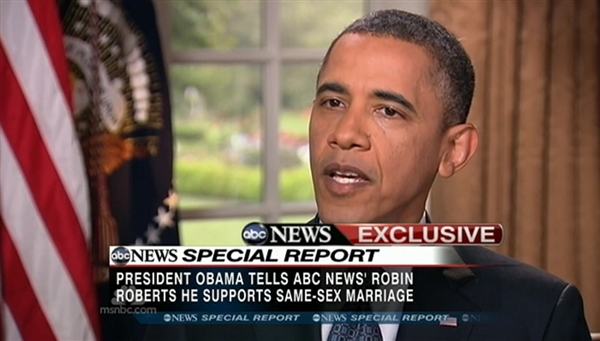
In the wake of President Barack Obama’s recent announcement that he supports same-sex marriages, quite a few reactions have flooded the opinion pages, cable networks and blog sites. Of course, people are entitled to their differing views on the subject; and President Obama’s announcement certainly can be seen as a divisive one. It angers not only many conservatives, but also groups that are considered at the base of the Democratic Party, specifically African-Americans and Latinos. However, at a time when Gallup polls report that 50% of all Americans support same-sex marriage, this public affirmation from the President of the United States marks an important moment in history.

Image

photo credit: msnbc.com

And yet, I almost refrain from using the word “history”, a term that opponents of same-sex marriage have so regularly abused and exploited. The word itself faces the threat of being rendered meaningless.

Republican Presidential nominee Mitt Romney declared in 2003, “I agree with 3,000 years of recorded history. I disagree with the Supreme Judicial Court of Massachusetts. Marriage is an institution between a man and a woman.” Recently Romney spoke at Liberty University, where he reaffirmed his position of nine years ago. He spoke of the “enduring institution of marriage,” one that defines itself as “a relationship between one man and one woman.”

He has other conservative supporters, of course. In January, Newt Gingrich boldly associated gay marriage with Paganism. Gingrich said, “It’s pretty simple: marriage is between a man and a woman. This is a historic doctrine driven deep into the Bible, both in the Old Testament and in the New Testament…the effort to create alternatives to marriage between a man and a woman are perfectly natural pagan behaviors, but they are a fundamental violation of our civilization.”

Conservative blogger, Erick Erickson writes, “In the past few decades, many people have decided that several thousand years of human history can be ignored in favor of unproven claims of happiness, fairness, progress, and an expanded notion of equality.”

It is imperative to do some fact checking of these ‘historical’ claims.

When Newt Gingrich invokes marriages from the Old and New Testament, is he counting the one where Jacob had two wives? Or where King David had eight wives? Or where King Solomon had 700 wives?

When Mitt Romney speaks about the “enduring institution” of marriage, does he mean the marriages of ancient Egypt where royal siblings would legally marry one another in order to keep their royal bloodlines pure? Or the marriages of the ancient Romans where daughters were human forms of currency, used to help form strategic alliances and strengthen the military position of the family?

Marriage is an evolving institution. It is both deceptive and manipulative to speak of the history of marriage as a stable, un-changing tradition. To be against gay-marriage is one thing; to depict marriage as a fixed institution is another.

Wedding vows, as we know them today certainly have not been around for “thousands” of years. The vows with the well known “to have and to hold, from this day forward, for better, for worse, for richer, for poorer” come from a man named Thomas Cranmer in 1549.

Society did not really even make the switch to marrying for love, a period known in sociology as “affective individualism”, until the Victorian Era. Prince Albert and Queen Victoria became the revered icons for a loving marriage. People began to grow distasteful of arranged marriages for economic purposes, and began to seek new meaning, namely love, in the institution of marriage.

When Erick Erickson argues that we’re ignoring “thousands of years of human history” I think the real question is which history is he referring to? Which marriage structure is he claiming we should fight to preserve? Arranged-marriages between a man and a woman? Polygamic marriages?

And if Erickson does mean marriages for love between a man and a woman—well, that is one of the most recent historical phenomena of them all.