When Abortions Are Hard to Get

Originally published in The American Prospect on April 13, 2016.
—-

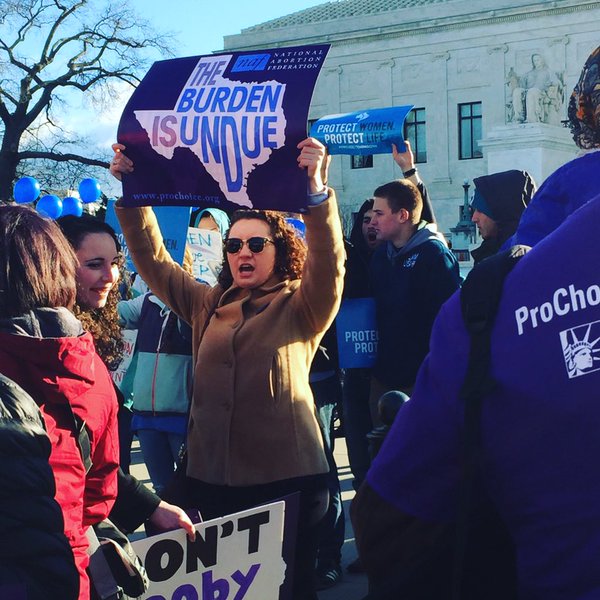
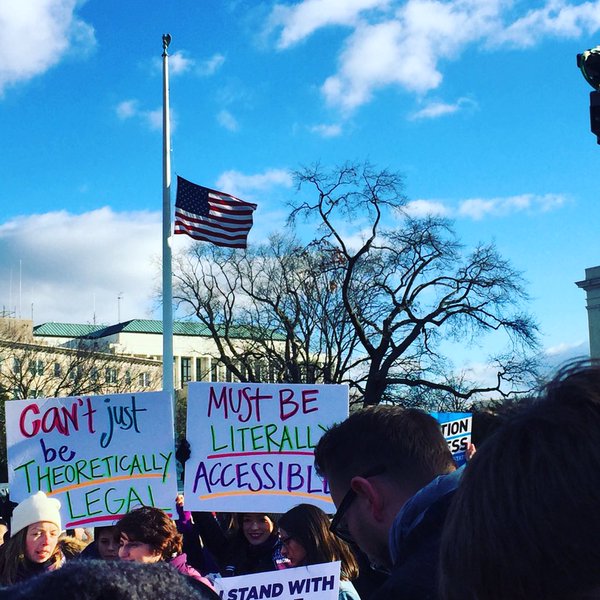
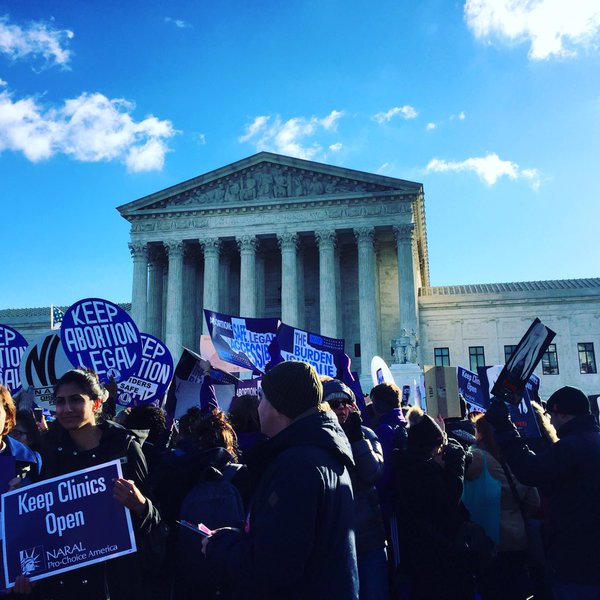
It’s been a rough couple of years for abortion access. State legislatures enacted 288 abortion restrictions between 2011 and 2015, and more than 330 have been introduced so far this year. Amid the onslaught of mandatory waiting periods, abortion clinic closings, and other prohibitive regulations, reproductive-rights advocates say that women’s constitutional right to end unwanted pregnancies is under threat. Last month, the Supreme Court justices debated whether the package of abortion restrictions passed by the Texas legislature in 2013 creates an unconstitutional burden for women to access safe and legal abortion. (A ruling is expected soon.) And just last week, Planned Parenthood and the ACLU filed suit against the state of Indiana for a new law that blocks women from obtaining abortions if sought for genetic abnormalities—another law the plaintiffs say is unconstitutional.

In addition to decreased access to safe and legal abortion, advocates worry that more and more women are resorting to unsafe, under-the-table methods to end their pregnancies. Making it harder for women to get abortions won’t end the practice, advocates say; it will just force women to find other ways to do it.

Quantifying the impacts of the new state abortion restrictions has been difficult—in part because the stigma surrounding abortion makes it very challenging for women to speak openly about their experiences. Still, a few studies suggest that, at the very least, policymakers and health advocates should be keeping their eye on the issue of self-induced abortions. Especially since some women are already being criminally punished for it.

In March, Seth Stephens-Davidowitz, a former Google data scientist, wrote a New York Times article entitled “The Return of D.I.Y. Abortion”—in which he reported that there were more than 700,000 Google searches for self-induced abortions in 2015. Moreover, the searches tracked closely with states that have passed abortion restrictions. Eight of the ten states with the highest Google search rates for self-induced abortions are ranked by the Guttmacher Institute as “hostile” or “very hostile” to abortion.

(Stephens-Davidowitz cautions that his work is preliminary and that it “will take years” before researchers can fully understand how to interpret this new information.)

In November, the Texas Policy Evaluation Project, a research initiative at the University of Texas at Austin,published a study that said between 100,000 and 240,000 women living in Texas ages 18 to 49 have attempted to terminate a pregnancy in their lifetimes. Of the women surveyed, 1.7 percent reported having attempted to self-induce an abortion, and 4.7 percent said they were sure or suspected their best friend had. The researchers also found that Latinas living near the Mexican border and women facing barriers to accessing reproductive health care were significantly more likely to try to self-induce an abortion or know someone else who had. The methods to self-induce an abortion most commonly used were home remedies like herbs, teas, and vitamins, and medications bought from Mexico, where a prescription is not required.

Daniel Grossman, one of the study’s lead investigators and professor of Obstetrics, Gynecology and Reproductive Sciences at the University of California, San Francisco, told The American Prospect that his study does not prove that the new abortion restrictions in Texas, specifically those that passed in 2013 being adjudicated now in the Supreme Court, caused an uptick in self-induced abortions. “We’re looking at these findings more like a baseline measure,” he explains.

In 2008, the Guttmacher Institute conducted a nationally representative survey of patients at abortion clinics and found that just 1.2 percent of patients seeking an abortion had used medication to induce a miscarriage, and 1.4 percent had attempted using other methods, like herbs or Vitamin C.

The figures seemed low, but this survey was not one of the general population, just of women who were already at abortion clinics seeking care. If a woman had successfully induced an abortion, she would be unlikely to head to an abortion clinic later as a patient.

“Overall, there’s been very little research looking at self-induced abortions among the general population,” says Grossman.

Self-induced abortions in 2016 are less likely to be the horrific coat-hanger operations in back alleys that were all too common before the procedure was legalized in 1973. The most effective way to self-terminate a pregnancy, researchers say, is to use misoprostol, an ulcer medication that can induce a miscarriage. Rachel Jones, a senior research associate at the Guttmacher Institute, says clinical studies show misoprostol is 70 percent to 94 percent effective when it comes to ending pregnancies.

Despite its success rate, there are still many reasons why women should not be taking the drug in secret and on their own. There are medical risks if a woman takes misoprostol too late in a pregnancy, particularly if she has had a prior C-Section. And if the woman does not take the proper dosage of the drug, then she might not have a complete abortion, which could lead to her child being born with defects.

“The woman may not have accurate information or know how to take the drug properly,” says Grossman.

For now, without solid data, advocates are left to rely on anecdotal evidence about the challenges that women face accessing safe and legal abortion; the surveys conducted so far likely do not capture the full picture of how many women self-induce and how they go about doing it. Stephens-Davidowitz also found there were still several thousand Google searches in 2015 for directions on how to abort using a coat hanger—so even the more gruesome methods may still be used in some parts of the country.

We don’t know enough about the state of self-induced abortions today, but we know enough to be concerned.

School Closures: A Blunt Instrument

Originally published in the Spring 2016 print issue of The American Prospect
—–

In 2013, citing a $1.4 billion deficit, Philadelphia’s state-run school commission voted to close 23 schools—nearly 10 percent of the city’s stock. The decision came after a three-hour meeting at district headquarters, where 500 community members protested outside and 19 were arrested for trying to block district officials from casting their votes. Amid the fiscal pressure from state budget cuts, declining student enrollment, charter-school growth, and federal incentives to shut down low-performing schools, the district assured the public that closures would help put the city back on track toward financial stability.

One of the shuttered schools was Edward Bok Technical High School, a towering eight-story building in South Philadelphia spanning 340,000 square feet, the horizontal length of nearly six football fields. Operating since 1938, Bok was one of the only schools to be entirely financed and constructed by the Public Works Administration. Students would graduate from the historic school with practical skills like carpentry, bricklaying, tailoring, hairdressing, plumbing, and as the decades went on, modern technology. And graduate they did—at the time of closure, Bok boasted a 30 percent–higher graduation rate than South Philadelphia High School, the nearby public school that had to absorb hundreds of Bok’s students.

The Bok building was assessed at $17.8 million, yet city officials sold it for just $2.1 million to Lindsey Scannapieco, the daughter of a local high-rise developer. On their website, BuildingBok.com, Scannapieco and her team envision repurposing the large Bok facility into “a new and innovative center for Philadelphia creatives and non-profits.” They describe the “unprecedented concentration of space” in the Bok building for “Do-It-Yourself innovators, artists, and entrepreneurs” to congregate.

In August 2015, Scannapieco launched Bok’s newest debut, a pop-up restaurant on the building’s eighth floor, which served French food, craft beers, and fine wines. The rooftop terrace was decorated with student chairs and other school-related items found inside the building. Young millennials dubbed the restaurant “Philly’s hottest new rooftop bar,” while longtime residents and educators called it “a sick joke.” Situated in a quickly gentrifying community where nearly 40 percent of families still have incomes of less than $35,000, there was little question about who would be sipping champagne and munching on steak tartare on Bok’s top floor.

When it comes to closing schools, Philadelphia is not alone. In urban districts across the United States—from Detroit to Newark to Oakland—communities are experiencing waves of controversial school closures as cash-strapped districts reckon with pinched budgets and changing politics.

The Chicago Board of Education voted to close 49 elementary schools in 2013—the largest mass school closing in American history. The board assured the distressed community that not only would the district save hundreds of millions of dollars, but students would also receive an improved and more efficient public education.

Yet three years later, Chicago residents are still reeling from the devastating closures—a policy decision that has not only failed to bring about notable academic gains, but has also destabilized communities, crippled small businesses, and weakened local property values. With the city struggling to sell or repurpose most of the closed schools, dozens of large buildings remain vacant, becoming targets of crime and vandalism throughout poor neighborhoods. “These schools went from being community anchors into actual dangerous spaces,” says Pauline Lipman, an education policy professor at the University of Illinois at Chicago.

African Americans have been hit hardest by the school closings in Chicago, Philadelphia, and elsewhere. While black students were 40 percent of Chicago’s school district population in 2013, they made up 88 percent of those affected by the closures. In Philadelphia, black students made up 58 percent of the district, but 81 percent of those affected by closures. Closure proponents insist that shutting down schools and consolidating resources, though certainly upsetting, will ultimately enable districts to provide better and more equitable education. It’s easier to get more money into the classroom, the thinking goes, if unnecessary expenses can be eliminated. But many residents see that school closures have failed to yield significant cost savings. They also view closures as discriminatory—yet another chapter in the long history of harmful experiments deployed by governments on communities of color that strip them of their livelihood and dearest institutions.

Today “the pain is still so raw, it’s not business as usual,” Reverend Robert Jones told me, speaking inside the Kenwood Oakland Community Organization, the oldest black grassroots center in Chicago. Indeed, threats of further closures have not abated since 2013. Jones was one of 12 local residents to go on a highly publicized hunger strike late last summer, starving himself for 34 days to prevent another beloved school from being shut down. Their dangerous efforts proved successful; the district reversed its decision and pledged to reopen Walter H. Dyett High School, located on the South Side of Chicago.

Rather than shutter schools, residents argue, districts should reinvest in them.

Rather than shutter schools, residents argue, districts should reinvest in them.They point to full-service community schools, a reform model that combines rigorous academics with wraparound services for children and families, as promising alternatives. The effort to fight back against school closures has grown more pronounced in recent years, as tens of thousands across the country begin to mobilize through legal and political channels to reclaim their neighborhood public schools.

TO TALK ABOUT SCHOOL CLOSURES, one must talk about school buildings. The average age of a U.S. public school facility is nearly 50 years old, and most require extensive rehab, repair, and renovation—particularly in cities. None of the school buildings constructed before World War II were designed for modern cooling and heating systems, and many schools built to educate baby boomers in the 1960s and 1970s were constructed hurriedly on the cheap. Studies find that poor and minority students attend the most dilapidated schools today.

But the federal government offers virtually no economic assistance to states and local districts trying to shoulder the costs of building repairs. And things don’t look much better on the state level, either. Jeff Vincent, the deputy director of the Center for Cities & Schools at University of California, Berkeley, says that state spending has failed to keep up with the needs in schools following the recession, leaving local districts to take on those capital costs even if they can’t afford to.

Despite contributing next to nothing toward school facility spending, the federal government encourages public-school closure and consolidation as a strategy to boost academic performance. Such school improvement interventions for “failing” schools began during the controversial No Child Left Behind era, but financial incentives to close schools and open charters really ramped up under the Obama administration.

“Our communities have been so demonized to the point that nobody thinks they’re good. But no, our institutions have been sabotaged,” says Jitu Brown, the executive director of Journey For Justice (J4J), an alliance formed in 2013 that connects grassroots youth and parents fighting back against school closures. “These districts—Newark, Chicago, Detroit—they all cry ‘broke’ as they shift major portions of their budget towards privatization while neglecting and starving neighborhood schools.”

Besides pointing to low performance, districts often justify closing schools on the basis of the facilities being “underutilized.” This refers to buildings deemed too large for the number of students enrolled, and thus too expensive for districts to operate. Critics of school closures say that how districts determine “utilization” insufficiently accounts for the variety of ways communities use and rely on school facilities. Moreover, Mary Filardo, executive director of the 21st Century School Fund, says that urban districts tend to “completely underestimate” how much space is needed for special education and early childhood learning.

“When you’re resource-starved, you tend to take a defensive approach,” says Ariel Bierbaum, a Ph.D. student in the Department of City and Regional Planning at UC Berkeley. “You’re in a crisis mode, you’re looking to balance your books, so you’re not necessarily thinking the most creatively” about how to use some of the seemingly excess facility space.

PUBLIC SCHOOLS HAVE ALWAYS impacted communities in ways that go beyond just educating young people. Well-maintained school facilities can help revitalize struggling neighborhoods, just as decrepit buildings can hurt them. And whether it’s attracting businesses and workers into the area, directly affecting local property values, or just generally enhancing neighborhood vitality by creating centralized spaces for civic life, research has long demonstrated the influential role schools play within communities.

Yet most existing research on school closures has failed to explore the ways in which shuttering schools impacts these civic spheres; instead researchers have adopted a narrower focus on how school closures impact school district budgets and student academic achievement. On both of these fronts, though, the record has not been impressive.

Researchers find that what districts promise to students, staff, and taxpayers when preparing to close schools differs considerably from what actually happens when they close. For example, most students who went to schools that were closed down in Chicago, Philadelphia, and Newark—whether for fiscal reasons or for low academic performance—were transferred to schools that were not much better, and in some cases even worse, than the ones they left. In Chicago, for example, 87.5 percent of students affected by closures did not move to significantly higher-performing schools. Children also frequently encounter bullying and violence at their new schools, while teachers are often unprepared to handle the influx of new students.

Moving students around can negatively impact student achievement, and closures exacerbate such mobility. In some cities, students have been bumped around two, three, four times—as their new schools were eventually slated for closure, too.

Not all research casts school closures in a uniformly negative light. One study found that New York City school closures had little impact—positive or negative—on students’ academic performance at the time the schools were shut down, yet “future students”—meaning those who had been on track to attend those schools before they closed—demonstrated “meaningful benefits” from attending new schools. Another study found that while most children experienced negative effects on their academic achievement during the year they transitioned to new schools, such negative effects were impermanent, and student performance rebounded to similar rates as their unaffected peers the following year. Essentially, researchers find that there can be substantial positive effects if students are sent to much better schools than they ones they left; however, the reality is that most students do not go to such schools.

In addition to overselling academic gains, districts also tend to overstate how much money they’ll save from shutting down schools. When Washington, D.C., closed down 23 schools in 2008, the district reported it would cost them $9.7 million. A 2012 audit found the price was actually nearly $40 million after taking into account the cost of demolishing buildings, transporting students, and the lost value of the buildings, among other factors. Another study conducted by the Pew Charitable Trusts in 2011 found that cost savings are generally limited, at least in the short term, and such savings come largely through mass employee layoffs.

Bierbaum, however, has been studying Philadelphia’s school closures from a broader community-development and urban-planning perspective to understand how school closures, sales, and reuses are related to larger issues of metropolitan-wide racial and class inequality. This means examining school closures in the context of neighborhood change, like gentrification or disinvestment, and in relationship to the city plans and policies that help facilitate that change.

In some cases, Bierbaum says that residents feel closures are “necessary” responses to dramatic demographic shifts, even if “draconian”; city officials are “doing the best they can to deal with things out of their control” in terms of fiscal management, she says. But in other cases, residents see closures as yet another manifestation of systemic oppression, closely related to other kinds of disinvestment within neighborhoods. “In this way, not only closures but also school building disposition is actually experienced as dispossession,” Bierbaum explains.

A majority of closed schools are converted into charter schools, with a second significant chunk repurposed into residential apartments. Other buildings are demolished or left vacant. Interviews with experts in several cities reveal that school district officials have not prioritized urban-planning questions, like those Bierbaum is asking, when deciding whether to close schools.

Clarice Berry, the president of the Chicago Principals and Administrators Association and member of a state legislative task force focused on Chicago school facilities, says the Chicago public school district was simply uninterested in discussing those sorts of civic topics. “At no time have they wanted to study that, or even been interested in discussing it,” she says. “The district spends all their time trying to keep us from getting data [on school closures] that could show us how they could make improvements.” While the task force has repeatedly asked the district to track kids who have been shuffled around from school to school, by and large Chicago and other urban districts have not carefully tracked how school closures have impacted students, families, and communities.

SHORTLY AFTER J4J BEGAN ORGANIZING, another network formed—the Alliance to Reclaim Our Schools (AROS)—comprising ten national organizations, including the American Federation of Teachers, the National Education Association, and J4J. Through weekly email newsletters and support for on-the-ground organizing, AROS has helped mobilize individuals looking to fight for public education. Parents and community groups hope they can agitate districts to think creatively about facility space, and invest more in neighborhood schools.

In mid-February, AROS helped stage the first-ever national day of “walk-ins,” where students, teachers, and parents at 900 schools in 30 cities across the country rallied in support of increased school funding, local schools with wraparound services, charter school accountability, and an end to harsh discipline policies, among other demands.

Their action built on momentum that’s been brewing over the past two years around the idea of “full-service community schools,” or schools that offer not only academics but also medical care, child care, job training, counseling, early college partnerships, and other types of social supports. This school model, which dates back more than a century, can be particularly beneficial for low-income residents who face challenges like accessing transportation.

In February, the Center for Popular Democracy released a report on the roughly 5,000 self-identified community schools across the country, lifting up particularly successful examples and offering strategies on how to replicate their success. One such school was Reagan High School, a poor and minority school in northeast Austin, Texas, which adopted a community schools strategy five years ago. In 2008, the local district was threatening to close Reagan due to its declining enrollment and its below–50 percent graduation rate. Parents, students, and teachers began organizing around a community schools plan to save Reagan from closure, and the district gave them permission to give it a shot. After expanding supportive services, like mobile health clinics and parenting classes, after changing its approach to discipline, and after expanding after-school activities, among other things, graduation rates at Reagan have now increased to 85 percent, enrollment has more than doubled, and a new Early College High School program has enabled many Reagan students to earn their associate’s degree before they graduate.

Implementing community schools can be difficult, particularly to the extent that it requires schools to adopt joint-use policies so that facility space can be shared with other public agencies and nonprofits, many of which have no prior experience working together. Some states and local districts have been much more amenable to these types of partnerships than others. “Yes, there’s complexity. But my response is ‘welcome to modern life.’ Stop whining, we know we can do this,” says Filardo of 21st Century School Fund.

Political support for full-service community schools is also on the rise.Philadelphia’s new mayor, Jim Kenney, has pledged to create 25 new community schools by the end of his first term. New York City Mayor Bill de Blasio aims to create 200 community schools during his tenure. The new federal education bill passed in December even authorizes grant-funding for community schools, which has incentivized many other cities and states to begin thinking about how to take advantage of this opportunity.

I sat down with Antoinette Baskerville-Richardson, a member of Newark’s elected advisory school board, to learn more about her interest in expanding community schools. With more than one-third of Newark’s children living in poverty, Baskerville-Richardson says local leaders have been looking for ways to address the harms of poverty while also supporting student achievement and school success. After five years of controversial education reforms pushed by Republican governor Chris Christie and his appointed superintendent, Baskerville-Richardson says the Newark community is just plain tired.

“There was a period when all our efforts were basically just fighting against these reforms being imposed on our communities,” she explains. “At the same time, we realized that the conversation could not just be about what we were against, and we had to mobilize around what we were for.” And so, a little over two years ago, public school leaders and local advocates began to really home in on the idea of full-service community schools.

“We began to do a lot of research, we got in touch with experts, talked with people from the Center for Popular Democracy, the Children’s Aid Society, and people involved on the national level,” Baskerville-Richardson recalls. “We also started visiting community schools like in Paterson, New Jersey—which is also a state-controlled district—[and] in Orange, New Jersey, which has similar demographics as ours. We visited Baltimore, New York City; some of our people visited Cincinnati; we talked to people in Tulsa, Oklahoma. … We’re really looking to dig into a model that has been proven to work.” Starting in the fall of 2016, five full-service community schools are set to open up in Newark’s South Ward, its poorest area.

ON THE 60TH ANNIVERSARY OF Brown v. Board of Education in 2014, parents and community organizations in New Orleans, Chicago, and Newark filed federal complaints under Title VI of the Civil Rights Act of 1964. They alleged that school closures in their cities have had a racially discriminatory impact on children and communities of color. The groups received legal assistance from the Advancement Project, a civil-rights organization.

Jadine Johnson, an attorney with the Advancement Project, says they chose to file Title VI complaints because they wanted to raise disparate impact claims. “When districts are making these decisions they don’t say ‘we’ll close black and Latino schools.’ They’ll say ‘we’ll close schools that are under-enrolled or under-achieving,’” she says. “But those decisions can still have discriminatory effects on black and brown students.” In Newark, for example, during the 2012–2013 school year, white students were nearly 20 times less likely than black students to be affected by school closures, despite what would be predicted given their proportions of student enrollment.

Ariel Bierbaum says her field research demonstrated that many Philadelphians understood school closures as symbols of continued and consistent disrespect and disinvestment for poor communities of color. “Many of my interviewees tied school closures to urban renewal, to their parents’ experience, … [to] the Jim Crow south and migrating north,” a legacy that dates back to slavery, she says. “For them, these closures are not a ‘rational’ policy intervention to address a current fiscal crisis. School closures are situated in a much longer historical trajectory of discriminatory policymaking in the United States.”

J4J has also helped to bring a racial-justice lens to the school-closure conversation, namely by forcing the public to discuss it within the context of discrimination, segregation, underfunding, and marginalization—both inside and outside of schools. In some respects, there’s a seeming irony around efforts to save schools in poor and racially segregated neighborhoods—these are the same schools that were treated as expendable during the desegregation era. But residents understand that their schools aren’t closing for integration purposes, and if one looks closer, it is clear that aims to create more diverse neighborhood schools are still very much on the table.

In December, the Office for Civil Rights (OCR) at the Department of Education reached a groundbreaking resolution with Newark Public Schools to aid those who may have been negatively impacted by Newark’s closures. Johnson, the Advancement Project attorney, says she believes the Newark OCR resolution “sends a loud message” to school districts that may be considering similar types of school closures. “We see this [as] a multi-year strategy,” she explains. “This resolution is hopefully the first of many agreements, and the first step to sounding the alarm for why public schools should remain public.”

Meeting with some parent activists who helped to file the Newark Title VI complaint, I wanted to see how they were feeling about the OCR resolution. Sharon Smith, the founder of Parents Unified for Local School Education (PULSENJ), thinks that irrespective of whatever remedies their superintendent proposes, it will take generations until Newark’s South Ward heals.

“It’s always very scary to me when people who are guilty of something, like the district is, say ‘Yes, we are guilty, but we’re going to fix this our own way without the input of the people who were hurt,’” says Darren Martin, another parent involved with PULSENJ. “We’re happy the OCR took our complaint seriously, but it feels almost like the police are policing themselves. How do you allow the person who helped design all these destructive policies [to] also design the remedy?”

IN FEBRUARY, I VISITED KELLY HIGH SCHOOL, a full-service community school on the southwest side of Chicago, serving a student body that’s more than 90 percent low-income. Kelly used to draw a large Italian, Polish, and Lithuanian population, but now predominately serves Hispanic students. With the help of the Brighton Park Neighborhood Council, a local community organization, Kelly offers all sorts of programs for parents and children, ranging from tax-prep classes and English-language instruction, to tutoring and political organizing. The academic improvement Kelly students have shown over the past decade has also been substantial—targeted interventions have helped more at-risk students stay on track to graduate, and the school is now ranked as a Level 2+ in the district’s rating system—where the highest possible score is a 1+ and the lowest is a 3.

But Kelly’s progress, both academically and as a civic institution, is threatened by increasing budget cuts, declining student enrollment, and the growth of charter schools in the surrounding area. In July 2015, the Noble Network of Charter Schools, the largest charter chain in Chicago, submitted a proposal to open a new high school a few blocks away from Kelly. Students, parents, and teachers began mobilizing against the proposal, concerned that this new project would siphon even more resources from their already-pinched school, which had been forced to slash programs and teaching positions over the last few years. In October, 1,000 Kelly High School students walked out of class to protest the proposed new school. Yet despite overwhelming local opposition, the unelected Chicago Board of Education voted unanimously to open the new charter.

It’s possible that over the next few years, Kelly High School’s fiscal strain will become just too much to manage, and the school will be slated for closure, too. “The narrative to close schools is essentially a budget one, which can be extremely powerful,” says Filardo. Even if the budget savings turn out to be fairly small, or nonexistent.

One way to reduce budgetary pressures on schools, thereby helping prevent school closures, would be for states and the federal government to pay more, particularly toward local capital budgets. Decades of social-science research have shown how unsafe and inadequate school facilities can negatively affect students’ academic performance—particularly when a school has poor temperature control, poor indoor air quality, and poor lighting. Researchers also find that the higher the percentage of low-income students in a district, the less money a district spends on the capital investments needed to keep school facilities in good repair. The most disadvantaged students tend to receive about half the funding for school buildings as their wealthier peers. And often, low-wealth districts spend more from their operating budgets on facilities—paying for large utility bills, more demanding maintenance for old systems, and the high costs of emergency repairs. It’s not a coincidence that affluent communities invest more in their public school buildings. “They improve and enhance their school facilities because it matters to the quality of education, to the strength of their community, and the achievement and well-being of their children and teachers,” says Filardo.

In other words, increasing state and federal spending could both help struggling urban schools, and also help fortify communities more broadly. Filardo thinks districts should be able to leverage up to 10 percent of their Title I funds to help pay for capital expenses—right now, Title I funds can only go toward local operating spending. Or, even better, Filardo thinks the federal government should start contributing at least 10 percent toward district capital budgets, just as it contributes 10 percent to district operating budgets.

“Schools belong to the entire community, and it should be the state and federal government’s job to find the right policy levers so that we can really advance our educational and economic development together in the best, most equitable way,” she says.

Battles about how best to save and improve public education are sure to intensify in the coming months and years. No researcher has been able to conclusively say what the optimal policy intervention is for students in terms of boosting academic achievement. And some individuals are certainly more sympathetic to closing schools, particularly if it means their children could attend higher-performing district schools or charters. Even on the question of school governance, researchers have reached no clear consensus on whether state takeovers or local control is better for student outcomes or fiscal management. Nevertheless, there’s consensus that any system which generates uncertainty and distrust is a recipe for disaster.

Reflecting on the past four years in her city, Lauren Wells, the chief education officer for Newark Public Schools, notes that reform-minded leaders expanded charter schools quickly without really taking into account the impact such decisions would have on existing schools. A recent report from the Education Law Center, a legal advocacy group, found that the combination of the state’s refusal to adequately fund New Jersey’s school aid formula, coupled with rapid charter-school growth, has placed tremendous strain on district finances, forcing Newark to make significant cuts to district programming and staff. “We really want to move the conversation away from charters versus district schools,” Wells says. “We’re trying instead to build a coalition around this idea that we are the guardians of all children. That should be the basis of any decision that we make.”

 

When the Poor Move, Do They Move Up?

Originally published in The American Prospect on April 6, 2016.
—-

When Martin Luther King Jr. was assassinated in April of 1968, the bill that would become the federal Fair Housing Act was at risk of stalling in Congress. King’s assassination, and the nationwide civil disturbances that ensued, helped the Act sail through the legislative process. Lyndon Johnson signed the bill into law just two weeks later; today, in recognition of these transformative events, April has been designated National Fair Housing Month.

But the battle over the underlying aims of fair housing remains unfinished. Walter Mondale, one the Fair Housing Act’s primary sponsors, declared its objective to be the creation of “truly integrated and balanced living patterns,” and federal courts have interpreted that phrase to indicate that the elimination of racial segregation is a key aim of the 1968 law. Yet, 48 years later, the federal government still does very little to incentivize racially and economically integrated neighborhoods—chiefly because of the political peril involved, but also because scholars and housing experts have failed to resolve whether promoting integrated neighborhoods would even be desirable or beneficial. A wave of new research, however, is helping to settle the experts’ debate, and may pave the way to fulfilling the Fair Housing Act’s original promise.

Eric Chyn, an economist at the University of Michigan, recently published a housing mobility study that takes a long-term look at children who were forced out of Chicago’s public housing projects in the 1990s. Three years after their homes were demolished, the displaced families lived in neighborhoods with 25 percent lower poverty and 23 percent less violent crime than those who stayed put. Chyn finds that children who were forced to move were 9 percent more likely to be employed as adults than those who remained in public housing, and had 16 percent higher annual earnings. He suggests this could be partly due to the fact that displaced children had fewer criminal arrests in the long run and were exposed to less violence growing up than their non-displaced peers.

His study provides stronger evidence for the idea that moving to higher-opportunity neighborhoods is beneficial for the poor. In particular, Chyn’s study addresses an issue that housing policy researchers have been grappling with since the Moving to Opportunity (MTO) initiative—a large-scale experiment that involved moving randomly assigned families out of high poverty neighborhoods into census-tracts with less than 10 percent poverty. The experiment, which ran from 1994-1998, was devised to see if moving families improved their life outcomes. While relocation substantially lowered parents’ rates of depression and stress levels, MTO did not significantly improve their financial situation. However, researchers found that children who moved under the age of 13 were more likely to attend college and earned significantly more than similar adults who never moved.

Social scientists were left to question why the positive effects of relocation only seemed to appear for younger children. They also wondered whether the families that moved through MTO—all of whom voluntarily applied for vouchers in a lottery—shared characteristics that families who never applied lacked. Just a quarter of all families eligible to move through MTO applied for vouchers, and perhaps the experiment had some selection bias, effectively skewing the results.

By looking at Chicago’s public housing demolitions, Chyn was able to study the impact of moving on all families forced to relocate, not just those who volunteered to do so. Within this less select grouping, he finds that all children, including those who moved past the age of 13, experienced labor market gains as adults. This finding helps to reconcile some tensions in the neighborhood effects literature and suggests that MTO’s findings may be less reliable than previously understood.

Chyn concludes that his paper “demonstrates that relocation of low-income families from distressed public housing has substantial benefits for both children (of any age) and government expenditures.” Based on his results, Chyn suggests that moving a child out of public housing by using a standard housing voucher would increase the lifetime earnings of that child by about $45,000. He also argues that this policy would “yield a net gain for government budgets” since housing vouchers and moving costs are similar to project-based housing assistance.

But Chyn’s study—which focuses on Chicago’s projects in the 1990s—does not tell the whole story. In particular, it tells us little about what would happen if we involuntarily moved families out of public housing to racially segregated, slightly less impoverished neighborhoods today.

A series of economic trends and public policies significantly aided the poor during the 1990s—trends and policies that are nowhere in evidence today. As Paul Jargowsky, the director of the Center for Urban Research and Urban Education at Rutgers, has shown, in the ‘90s, the Earned Income Tax Credit was just being implemented, the minimum wage was increased, and unemployment dropped to 4 percent for a sustained number of years, which lead to real wage increases. The number of people living in high poverty neighborhoods between 1990 and 2000 dropped by 25 percent—from 9.6 million to 7.2 million.

“This [Chyn article] is a nicely designed study, but if you want to understand it, you have to understand everything else that was going on during that time period,” says Patrick Sharkey, an NYU sociologist who studies neighborhoods and mobility. Sharkey buys the finding that in this particular context, a forcible move may have actually helped kids growing up in Chicago in the 1990s, but he says to extrapolate those findings even to the current situation in Chicago, let alone other cities, would be a mistake. Chicago’s public housing during that period was widely recognized as the most violent, and troubled, in the entire country.

In an interview, Chyn says he agrees that Chicago “has some particular features that may limit how we can generalize” his findings, and acknowledges that the city’s public housing in the 1990s “was a particularly disadvantaged system.” He says that his results would best inform policy in other cities that have “high-rise, very dense, particularly disadvantaged public housing.”

Whatever its limitations, Chyn’s study adds to a substantial body of research on the effects that neighborhoods have on the children who grow up in them and their families. Given that most families with vouchers moved to neighborhoods that were only slightly less poor and segregated than the ones they’d left, there is reason to suspect that the labor market gains observed in both Chyn’s study and MTO represent just the lower bound of potential mobility benefits.

For example, 56 percent of displaced families in Chyn’s study still wound up in neighborhoods with extreme poverty, meaning census tracts with poverty levels that exceed 40 percent. The rest, nearly 44 percent of those displaced, moved to neighborhoods that were, on average, 28 percent impoverished—a poverty rate lower than the others, but still roughly twice the national average.

The fact that those who moved did better is not grounds to conclude that they are doing well. The average adult-age annual earnings for Chyn’s sample of displaced children was only about $4,315, compared to $3,713 for non-displaced children. (These numbers factor in the incomes of those who are unemployed.) Displaced children with at least some labor income as adults earned $9,437 on average, compared to $8,850 for non-displaced children.

In other words, while the labor prospects and earnings have improved for those who moved as children, they still remain quite poor.

Writing in The New York Times, Justin Wolfers, an economist, and one of Chyn’s thesis advisers, said these findings“could fundamentally reshape housing policy.” At minimum, they reinforce the growing body of evidence that suggests people who move into lower-poverty, racially integrated neighborhoods do better on a variety of social indicators than those who live in high-poverty, racially segregated ones. If our housing policy moves in a more integrative direction, that would be a fundamental shift.

Both Chyn and Raj Chetty, the lead researcher on long-term labor outcomes for children in MTO, have touted the cost-savings potential of moving families with standard housing vouchers. More important than these savings, though, is the question of whether these findings could spur a new commitment to integrative housing.

We know, based on research from sociologists like Sharkey, Stefanie DeLuca, and others, that poor, minority families are unlikely to relocate to whiter, more affluent neighborhoods without serious housing counseling and support. This kind of mobility assistance requires time and money—which the federal government currently does little to promote.

Over the past decade and a half, there has been a steep increase in the number of high-poverty neighborhoods—whose populations nearly doubled from 7.2 million in 2000 to 13.8 million by 2015. As Jargowsky has shown, this increase began well before the start of the Great Recession, and the fastest growth in the black concentration of poverty has been in metropolitan areas with 500,000 to 1 million people, not in the country’s largest cities.

Researchers are still exploring if it’s possible to improve the life outcomes of families that live in racially segregated, high-poverty neighborhoods through investments in those neighborhoods. For now, the evidence suggests that such investments are much less effective than mobility and integration (though, as DeLuca has noted, many such experiments have been underfunded or poorly designed). Chyn’s auspicious findings, released just in time for National Fair Housing Month, bolster the idea that moving families to neighborhoods with greater opportunity could significantly help the poor.


Some thoughts on DeRay Mckesson’s campaign

According to newly released campaign finance forms, DeRay Mckesson, the national Black Lives Matter activist running for Baltimore mayor, has had far and away more individual donors to his campaign than any other candidate in the race. Over 4,500 people from across the country have helped him to raise nearly $223,000, and a majority were small donors.

Of that $223,000, though, just 4.2% came from Baltimore. By contrast, donors from four states—California, New York, Massachusetts, and Florida—contributed more than half of all his funds.

I have no issue with Mckesson running, and would argue that he’s introduced some pretty valuable policy ideas to the primary debates. Yet the way national media has largely ignored the other candidates, suggested he’s been the only person proposing police reform, and just failed to do any serious reporting on the race or the city, has been pretty frustrating to watch. (Local outlets have done a much, much better job.)

Anyway, on Tuesday Re/code reported on Mckesson’s campaign finance forms, and noted that he received a lot of money from tech executives.

Taking a look myself, I found that the biggest donors to Mckesson’s campaign were an assemblage of individuals involved in the education reform movement, working in the tech industry, alumni of Bowdoin College, celebrities, real estate developers, and a handful of others. (Some of these categories overlap; for example, some Bowdoin alumni work in the tech industry, and some tech CEOs support the education reform movement, etc.) I’ve put a list of notable donors at the bottom of this post.

I don’t have much to say for now, other than I’d love to learn more about why tech companies have taken such an interest in his campaign, and why real estate developers, especially those in Florida, have too. I’d also be curious to hear how his campaign is working on mobilizing Baltimore voters, since it was clear they hadn’t raised much money within the city. (He had about 250 donors from Baltimore as of March 15th.)

Earlier this week DeRay tweeted, “I’ve not taken money from the establishment funders who run Baltimore city politics.”

A day earlier he wrote,

His comments raise a really interesting question. Does taking money from companies and real estate developers in other states mean you have avoided establishment politics? I’m sure opinions would vary.

In early February I wrote a Slate piece saying that despite his national reputation with the Black Lives Matter movement, DeRay’s education reform ties would likely garner more attention in the Baltimore mayoral race. Education is politically fraught in the city, and all Democratic candidates were already open to, and talking about, police reform.

In the weeks thereafter, Baltimore residents pressed Mckesson to clarify his views on school reform. While the education policy platform he released in early February did not mention charter schools, unions, or Teach for America, voters continually asked him about these issues. Residents raised questions at candidate forums, journalists questioned him in interviews, and voters discussed and debated his education ties on social media.

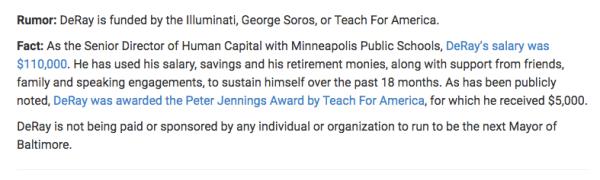
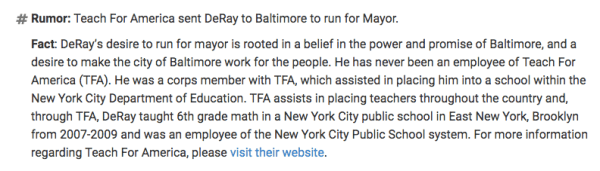
Towards the end of February, Mckesson’s campaign posted a lengthy “reality check” on its website—a response to some of the concerns and criticisms he had been receiving.

factcheck.png

Examples included:

tfa1tfa2

Though I certainly believe Mckesson does not work for Teach for America, and has decided to run because he genuinely wants to, I think it’s hardly conspiratorial to acknowledge that he is receiving thousands of dollars from them—from their PAC, their allies, and from a number of current and former TFA staffers across the country.

—————————

Education Reform:

  • Leadership for Education Equity PAC: $2000
    (Commonly known as LEE, the PAC to elect TFA alumni)
  • New Yorkers for Putting StudentsFirst: $500
  • Matthew Kramer, former CEO of Teach For America: $400
  • Jessica Kramer, Senior Managing Director of Alumni Engagement for Teach for America: $500
  • Leslie Miller Saiontz, Board Chairman of Teach For America in Miami: $2,500
  • Kwame Griffith, Executive Vice President of Regional Operations for Teach for America: $200
  • Brian Johnson, Vice President for Regional Impact at Leadership for Educational Equity: $1,000
  • Brianna Twofoot, Vice President for Diversity and Equity at Leadership for Educational Equity: $250
  • Bradford Derrell, Executive Director of NYCAN: $250
  • Kira Orange Jones, Executive Director Teach for America New Orleans: $250
  • William Graves, Executive Director at the John & Denise Graves Foundation: $250
  • Wendy Kopp, CEO and Co-Founder of Teach For All: $100
  • Jonathan Marker, CEO at Youth Leadership Institute: $250
  • Jessica Marker, Head of Knowledge Development for Teach for America: $250
  • Mark Fraley, Senior Advisor for Advocacy and Organizing at Leadership for Educational Equity (LEE): $100
  • Darin Yankowitz, Chief of Staff, Regional Operations at Teach for America: $100
  • Judy Wurtzel, Director of Education at the Charles and Lynn Schusterman Family Foundation: $200
  • Ifeyinwa Walker, The Offor Walker Group: $1,000

Tech:

  • Stewart Butterfield, co-founder of Flickr and Slack: $6,000
  • Esther R. Dickens, Google: $500
  • Malik Ducard, Global Head of Family and Learning at YouTube: $2,500
  • Myles Grant, Principal Engineer at Slack: $200
  • Reed Hastings, CEO of Netflix: $6,000
  • Ashley Mosley, Marketing and Sales Twitter: $500
  • Chris Kaminski, Fugue Inc, a venture­backed software startup: $500
  • Gisel Kordestani, Crowdpac: $6,000
  • Omid Kordestani, Executive Chairman at Twitter: $6,000

Celebrities:

  • Harrison Barnes, NBA player: $3,000
  • Rashida Jones, Actress: $2,000
  • Susan Sarandon, Actress: $600
  • Jesse Williams, Actor: $3,000
  • Sean Kleier, Actor: $350

Businesses/Developers:

  • Jeffrey Lamkin, the Retina Group of Northeast Ohio: $500
  • Beth Azor, of Azor Advisory Services, a Florida-based commercial real estate advisory and investment firm: $1000
  • Stephen H. Bittel, Terranova Corporation, a Florida-based commercial real estate firm: $2,500
  • Mark Friedland, an Aspen-based real estate developer, private investor and entrepreneur: $500
  • Gerson, Preston, Robinson & Company PA, a Florida-based public accounting firm: $1000
  • Kevin Letorneau, Online Buddies: $6,000
  • Katherine Vizas, Intercontinental Exchange, a network of regulated exchanges and clearinghouses for financial and commodity markets: $1000
  • Brooks Washington, Roha Ventures, a venture investment group that builds and launches companies across Africa: $1,000
  • Jason Weiss, Terrapin Palisades Ventures, a private investment firm focused on land-based assets: $500
    Melvyn Schlesser, Jameck Development Inc, a Miami-based property development and management company: $500
  • Michel LePage, real estate agent in Yarmouth: $250


Bowdoin College Alum:

  • Deborah Barker, Trustee: $1000
  • Alexandra Codina, Filmmaker: $500
  • Barry Mills, former college president: $6,000
  • Michael LoBiondo, Senior Director at Warner Brothers Records: $500
  • Jackson Wilkinson, website developer: $500

 Others:

  • Kim Coco Iwamoto, Commissioner on the Hawaii Civil Rights Commission: $6,000
  • Henry Louis Gates, Harvard Historian: $1,000
  • Suzanne Lehmann: $1,000
  • Aaron Sojourner, Economist at the University of Minnesota: $500
  • Eric Vittinghoff, Biostatistician at UCSF School of Medicine: $500
  • Ebonie Williams, Computer Scientist at the Defense Information Systems Agency: $500
  • Roger Luke DuBois, Associate Professor of Integrated Digital Media at NYU: $1,250
  • Margaret Savarino, Seattle-based writer: $750
  • Deborah Kaplan, Safari Books Online: $500


North Carolina Educators Fight Deportations of Central American Students

Originally published in The American Prospect on March 23, 2015.
——

Wildin David Guillen Acosta, a Durham, North Carolina, high school senior, was set to graduate from Riverside High School in June. Instead, he is being held at a federal detention center in Georgia. In late January, U.S. Immigration and Enforcement agents (ICE) apprehended the 19-year-old student as he was on his way to school. While languishing in the detention center, Acosta asked his teachers to send along his homework, so that if he gets released, he would still be on track for commencement. In late February, his teachers mailed him his assignments, but detention center officials refused to accept the package.

In January, the Obama administration authorized a series of raids to arrest, detain, and deport undocumented immigrants who came to the U.S. from El Salvador, Honduras, and Guatemala over the past two years. About 15,500 Central American mothers and children have received deportation orders since July 2014, and ICE is now ramping up its enforcement of those orders. More than 330 young people have been arrested nationwide so far. Although students do not comprise all the youths being targeted, local educators have been galvanized by the arrests. Teachers say the raids have had a chilling effect on other students, too.

The ICE raids, which involve barging into homes and picking up individuals off the streets, are reminiscent of Bush administration–era immigration enforcement tactics. While immigration officials avoid making arrests in “sensitive locations”such as churches and schools, immigration advocates say this policy hasn’t stopped ICE agents from detaining undocumented students on their way to school.

ICE agents picked up Yefri Sorto, a 19-year-old Charlotte high school student on his way to a bus stop in late January. Sorto came to the United States from El Salvador in 2014 as an unaccompanied minor. He says he fled his country because he feared gang violence and was finally reunited with his parents, who had been living in the U.S. for more than a decade.

“These raids are impacting not just the individuals we know of who have been picked up; there is wide and deep fear across the community,” says Allison Swaim, a Durham high school teacher.“Kids are not coming to school because they’re afraid, kids are dropping out because they don’t want to be picked up, or maybe they still have a legal process pending, or they’re trying to file for asylum—everyone has their own story.”

The majority of Central Americans who crossed the U.S. border were apprehended, or turned themselves in, hoping to apply for some type of asylum. Immigration advocates say these individuals should be treated as refugees, not as criminals, given the extreme violence found in their home countries. A Guardian investigation found that since January 2014, 83 people who were deported to Honduras, Guatemala, and El Salvador were murdered, some just a few days after they returned.

Swaim has been working to organize teachers statewide around what she calls a humanitarian crisis across the South. In Atlanta, ICE agents pulled over 19-year-old Kimberly Pineda Chavez, while she was driving to school. Kimberly arrived in Georgia from Honduras in 2014 with her mother and sister after receiving a series of threats from local police.

Swaim hopes that teachers across the region will collect data and anecdotes about how students are being affected by raids in their communities. Durham teachers held a conference call with U.S. Department of Education officials to express their concerns. “We’re asking federal officials, including Education Secretary John King, to get involved because part of their mission is to provide an equal education for all students, and that includes immigrant students,” Swaim says. “These raids are directly in contradiction with the mission of the Department of Education.”

Rebecca Costa, a Charlotte ESL teacher, says that educators in the Charlotte-Mecklenburg district are also trying to duplicate the Durham organizing efforts in their community. Two of Costa’s students stopped coming to school after Yefri Sorto was arrested, and have since gone into hiding. “It all felt very isolating, but now we realize this is happening all over North Carolina and we have to reach out and unite,” she says.

Obama immigration officials stress that ICE is not targeting anyone under 18. But many high school upperclassmen who are completing their secondary education are 18 or older. “My two kids that have gone into hiding were 18 and 19, both juniors,” says Costa.

Mayra Arteaga, a 20-year-old living in Charlotte, has been involved in immigration advocacy since she was in middle school. Mayra has been raising awareness about the deportation raids by rallying students, testifying at school board meetings, and helping to organize protests, like a recent Charlotte march.

“I think once teachers started noticing what was going on, the ball really started rolling,” Arteaga says, noting that these raids have mobilized a much more diverse group of people than immigration advocates typically see at their events.

Advocates worry that the undocumented immigrants are not receiving fair legal treatment, and say that deportation orders have frightened many. Tin Than Nguyen, a Charlotte immigration lawyer, has been working to try and help undocumented families in the city understand their legal rights. “The recent rounds of raids have truly sent shockwaves through the community and everyone is shuddering in fear,” he says.

According to the U.S. Justice Department, of the roughly 10,000 deportation orders given to unaccompanied minors since July 2014, roughly 87 percent were issued in absentia; advocates say many immigrants never received sufficient notice of their scheduled court hearings.

Meanwhile, North Carolina activists have appealed to federal lawmakers to help stop the raids. Representative G.K. Butterfield, a North Carolina Democrat who represents Durham, has been pressuring ICE to delay Wildin’s deportation, so that he can apply for asylum.

“Wildin Acosta and other young people like him fled extreme violence and mayhem in Central America in search of refuge and a better life in the United States,” said Butterfield in a statement. “I believe that U.S. Immigration and Customs Enforcement’s (ICE) limited resources would be better utilized focusing on dangerous criminals who pose a threat to our communities rather than high school students and teenagers trying to make better lives for themselves.”

“[Wildin] is being labeled as some kind of internal threat to the security of the United States,” Bryan Proffitt, president of the Durham Association of Educators told WNCN, a CBS affiliate. “He’s a kid sitting in a detention cell hoping to get his homework, so that he can graduate on time.”


Can Charlotte-Mecklenburg Desegregate its Schools … Again?

Originally published in The American Prospect on March 18th, 2016.
—–

It was not so long ago that Charlotte, North Carolina, was widely considered “the city that made desegregation work.” The Queen City first pioneered busing to desegregate schools in 1969, and when the Supreme Court upheld that strategy as a legal remedy for school segregation two years later in its landmark Swann v. Charlotte-Mecklenburg Board of Education ruling, districts across the South began busing students as well.

In the past 15 years, however, Charlotte has seen a rapid resurgence in segregated schooling. Following a late 1990s decision that said court-mandated integration was no longer necessary, Charlotte-Mecklenburg Schools (CMS) grew quickly divided by race and class, and the economic isolation continues to intensify with each passing year. Though CMS is still considered a relatively high-performing school system, a closer look at the data reveals deeply unequal outcomes among the district’s 164 schools.

For more than a decade, local residents ignored the demographic shifts taking place within CMS. Political leaders, as well, seemed to just have no energy left to expend on school diversity following their highly publicized school segregation lawsuits. Yet now, due to a district policy that requires school board members to revisit student assignments every six years, the Charlotte-Mecklenburg community finds itself facing a rather unusual opportunity. Wary of litigation, but troubled by the damning diversity data, Charlotte leaders have been working cautiously over the past year to see if there might be any popular support for breaking up pockets of poverty within CMS.

Their timing may be just right. In addition to sobering statistics on school segregation in Charlotte-Mecklenburg, new research out of Harvard University and the University of California at Berkeley found that Charlotte ranks dead last in the nation in terms of upward mobility, and that racial segregation and school quality are two main culprits behind this. Moreover, after years of lackluster results from other school turnaround efforts, resistance to shuffling students as a way to improve school quality is softening.

The political momentum in favor of school segregation in Charlotte is fairly new, but so is the backlash against it. Charlotte-Mecklenburg has seen a 15-year population surge, predominately in the county’s northern and southern regions. Many of the county’s newcomers missed Charlotte’s desegregation history, and see no real reason to bring it back. They moved into their communities, they say, largely for the schools. As more leaders explore how CMS might revamp student assignment, a growing number of parents have begun to raise objections—warning officials that they would not hesitate to send their children to private schools, or to the state’s notably segregated charter sector, if they had to.

Last summer, when it became clear that the CMS school board was thinking of revisiting student assignment, a group of pro-integration community members began organizing in support of the idea. And so back in July, OneMeck was born—a grassroots coalition of residents committed to making Charlotte-Mecklenburg a place where diverse individuals live, work, and attend school together. Through public forums, social media, and one-on-one conversations, OneMeck advocates began to make their case.

“We spent a few months figuring out what we were for and how we would structure ourselves, and we’re still evolving even now,” says Carol Sawyer, a co-founder of OneMeck. “But we have no intention of becoming a 501c(3); we really value our nimbleness and our ability to advocate as a community organization.”

Students also got involved. Through the organization Students for Education Reform, (SFER), CMS students began to strategize how they could best interject their personal experiences into an increasingly heated public debate over school segregation.

“Even though school board members said they wanted to hear from students, they weren’t actually invited to the table in any of these conversations,” says Kayla Romero, a former CMS teacher and current North Carolina SFER program coordinator. “This issue is going to directly impact students, they are the ones currently in the system, but people were not seeking their opinions out or intentionally bringing them to the table.”

OneMeck supporters say they are not advocating for any one specific policy, and that they believe there are a number of steps CMS could take to reduce racial and economic segregation. They are encouraging the school board to hire a national consultant who could come in and study the school district, and make recommendations on how to best legally, and strategically, diversify CMS schools.

Throughout the summer and fall of 2015, the public discussion in Charlotte revolved largely around issues of race and desegregation. But beginning in 2016, suburban families started to ramp up their efforts to shift the narrative. In February, hundreds of parents joined two new groups—CMS Families United for Neighborhood Schools and CMS Families for Close to Home Schools and Magnet Expansionwhich sought to reframe the conversation around the importance of neighborhood schools, and to express collective opposition to what they called “forced busing.” Some even began to sell T-shirts that read “#Close-To-Home-Schools #NOforcedbusing.”

Christiane Gibbons, a co-founder of the CMS Families United For Neighborhood Schools, (now renamed CMS Families for Public Education) says when she first learned that the school board was rethinking student assignments in early February, she felt compelled to alert local parents to the dangers of forced busing. I asked her if forced busing was on the table at this time. “Who knows?” she responded. “But it seemed like, for a lot of people, an option for alleviating pockets of poverty is to bus in and bus out.”

Advocates of diverse schools point out that CMS actually buses students more now than the district ever did at the height of desegregation. The CMS school board chairperson, Mary McCray, has also stressed that student assignments would be based on choice, and not on forced busing. Since 20,000 students already attend magnet schools throughout the district, integration advocates say figuring out how to improve and expand those models is one choice-based option CMS could consider.

“In some high-wealth suburban neighborhoods there’s been claims that OneMeck is pushing ‘forced busing,’ but that’s been sort of dog whistle politics,” says Sawyer. “We’ve never said anything like that, and neither has any board members. It’s a pure fabrication.”

Whatever the case, many parents began pressing the school board and other local political leaders to commit to “home school guarantees”—promises that no matter what else changes with student assignment, children could still attend the neighborhood schools that their parents have expected them to enroll in. In three towns north of Charlotte—Huntersville, Cornelius, and Davidson—political leaders passed resolutions affirming that they want every student guaranteed a spot within their neighborhood school. In two towns south of Charlotte—Matthews and Mint Hill—the mayors even floated the idea of splitting off from CMS if the school board goes forward with revamping student assignments.

“That’s not a realistic threat,” says Sawyer. “Though it makes good copy.”

Aside from discussions that smaller suburban towns may secede from the district, leaders take far more seriously the threat that parents may send their children to private schools or charter schools if their traditional public schools no longer seem desirable. Last year, researchers at Duke University published a study suggesting that white parents in North Carolina were already using charters as a way to avoid racially integrated public schools.

On the nine-person CMS school board, Rhonda Lennon, who represents northern Mecklenburg County, has been the fiercest critic of redrawing lines; for months she has emphasized that families would certainly leave CMS if the board interferes with student assignment, and that she might open her own charter school, if parents in her community lost their home school guarantee.

“I think it’s a valid fear that parents have; I don’t think this is ‘chicken little’,” says Amy Hawn Nelson, an educational researcher at UNC Charlotte. “When you look at the aggregate school level performance data in some high poverty racially segregated schools, it can look frightening. Every parent wants the best school for their child, and for parents that have a choice, they are going to choose a school that is high-performing.”

At the end of January, the school board released an online survey inviting parents, CMS staff members, and other Mecklenburg County residents to share their thoughts and opinions on student assignments. Board members said they would use the results—which were published in a 241-page report—to guide their decisions. The online survey, which ran from January 29 until February 22, garnered more than 27,000 responses.

In addition to the survey, the CMS school board voted in late February on a set of six goals to consider when re-evaluating student assignment. These included providing choice and equitable access to “varied and viable” programmatic options; maximizing efficiency in the use of school facilities, transportation, and other resources to reduce overcrowding; and reducing the number of schools with high concentrations of poor and high-needs children.

CMS has since put out a request for a proposal for a national consultant to help the district develop a plan. The consultant would consider, among other things, the board’s approved goals and the results of the countywide survey. CMS plans to make a hire sometime this month.

Some parents say the board is getting this all wrong, and that focusing on student assignments is a distraction from the district’s real problems. “What’s really disheartening about all this is that people are making it about ‘us versus them’ and about race and desegregation, but it’s not,” says Gibbons. She thinks there should be greater focus on improving individual schools, through strategies like increasing parent involvement and expanding after school programming. Gibbons says she does not see changing student demographics as a way to improve schools.

At the start of the 2012-2013 school year, CMS, along with local philanthropic and business communities in Charlotte launched Project LIFT—a five-year public-private partnership to boost academic achievement. The program selected nine low-performing Charlotte schools and infused them with an additional $55 million in private investment. Three years into the experiment, however, researchers have found only modest and mixed evidence of academic improvement.

“I think Project LIFT is a school reform effort to make segregation work, and it hasn’t,” says Sawyer, of OneMeck.

Gibbons disagrees. “I think it’s a great turnaround program, I think it’s obviously beneficial,” she says. “It was the first time they did it so it may need tweaks, I don’t know enough about the actual numbers, but I think those types of turnaround programs are what is going to really benefit the under-performing schools.”

Some of the SFER students that Kayla Romero works with attend Project LIFT schools. “When people say ‘oh we just need more money,’ it’s been helpful to use Project LIFT as an example,” she says. Though spending more money has undoubtedly helped in some ways—such as providing students with better technology, and enabling administrators to employ more strategic staffing—Romero says students recognize that it hasn’t been enough.

The disagreements taking place in Charlotte mirror those playing out in districts all over the country. How much does money matter? Can segregated schools be equal? How should we factor in school choice? How should we define diversity?

Proponents of desegregating Charlotte-Mecklenburg schools point to a significant body of research that says diverse schools provide better social and academic education for all children. OneMeck launched the #DiversityWorks campaign, where organizers asked CMS residents to submit videos explaining how they have benefited from attending diverse schools. They also point to research on economic opportunity that came out of Harvard and Berkeley last year, which found Mecklenburg County is the worst big county for escaping poverty after Baltimore; in 2013 the researchers ranked Charlotte as 50th out of 50 big cities for economic mobility.

Still, some CMS residents balk at OneMeck’s fervent advocacy. In Charlotte Observer op-ed, Jeremy Stephenson, who previously ran for school board, protested that those who push to use student assignment to break up concentrations of poverty “accept as gospel” that this will raise the achievement of all students. “They accept this diversity panacea as both empirical truth and an article of faith,” he writes, alleging that academia is “merging into advocacy” as it did with tobacco-funded cancer research. Stephenson argued that panel discussions “feature no diversity of thought; support for neighborhood schools is cast as xenophobic; and so postured, any questioning is heretical.”

Despite Charlotte-Mecklenburg’s historical legacy of school desegregation, hardly anyone describes that history as central to the conversations taking place today. Sandra Conway, an education consultant who has been working in conjunction with OneMeck, says she and her allies hope to mobilize Charlotte-Mecklenburg around a new, shared commitment to diverse schools.

“We’ve just really been trying to get people together to think about what kind of city we want to be,” says Conway. “We’ve grown so dramatically, we’re a Technicolor city, we’re a Southern city, and race is at play. But we need to have a new vision going forward, and if you don’t understand your history, and you don’t understand the data—that’s a problem. So we’ve just been working hard for over a year to get that out there.”

James Ford, awarded the 2014-2015 North Carolina Teacher of the Year, was a black CMS graduate during desegregation. As an educator today, Ford has been sharing his story to help raise support for reviewing student assignment. “As America becomes more brown, the question is not just whether or not we want integrated schools, but do we want to live in an integrated society? Are we an inclusive or exclusive community?” he wrote in Charlotte Magazine. “The answer depends on how we see ourselves.”

“I think for many kids growing up in Charlotte, segregation has just been the norm,” says Romero. “Some of them could live in this city for their whole lives and never come across white kids. However, some of their parents have had those experiences and do speak out about being part of the integration movement and the opportunities it created for them.”

The school board plans to continue reviewing student assignments throughout most of 2016, and any approved changes it makes would take effect no sooner than the 2017-2018 school year.

Tensions are high, but some school diversity advocates predict that the political landscape will calm down if and when a consultant presents the community with a real plan. “In the absence of a plan, you’ll have all sorts of fear mongering,” one activist confided. “It doesn’t matter how much we say that’s not the case, that there won’t be forced busing—until a plan is presented, people will continue to freak out.”

Even opponents of reassigning students have acknowledged that some of the current CMS boundaries are a bit peculiarly drawn. An article published in The Charlotte Agenda looked at various “gerrymandered” maps and found that it would be relatively easy to increase student diversity in schools without resorting to miles and miles of extra busing. Gibbons acknowledged “there are definitely some lines that don’t make sense” on the maps.

“OneMeck is feeling pretty energized,” says Sawyer. “We realize that we are facing tremendous fear, but we’re trying to show that we can make all our schools better for all our kids.”

Arrests and Suspensions Are Out of Control in Baltimore Schools

Originally published in VICE on March 9th, 2016.
—-

An eight-second video was released last week showing a Baltimore school police officer attacking an unarmed student while another cop stood by and watched. The clip went viral and spurred national outrage, as well as calls for a federal investigation. The two officers, Anthony Spence and Saverna Bias, turned themselves in Tuesday night to face second-degree assault and misconduct in office charges—Spence is also charged with second-degree child abuse—and had posted bail by early Wednesday. But with criminal trials still pending for the six cops charged over the death of 25-year-old Freddie Gray last year, the footage has stoked an already strained conversation around policing in Baltimore City.

Upon the clip’s release, politicians and advocates quickly began to criticize the city’s ill-defined school police policies, pointing out that there are no public arrest statistics, including who gets busted, why, and whether those incidents might have been handled outside the criminal justice system. There’s also little or no oversight of the school police budget and officers’ use of force. All of which is especially alarming given that policing aside, Maryland actually has some of the most progressive school discipline policies in the country—at least on paper.

Still, a lack of leadership and a persistent culture of criminalization within public schools have the city suspending, expelling, and arresting students too often—and in discriminatory fashion.

Baltimore’s unique place in America’s school discipline hierarchy emerged over the past decade. In 2004, the city’s school issued more than 26,000 suspensions in a school district of 88,000. Alarmed city advocates began speaking out, forming networks to push for disciplinary alternatives, and fighting for district leaders to reckon with the glaring suspension data. Research has long shown that excessive suspensions and expulsions are tied to higher rates of school absence, school drop-outs, and academic failure. Suspended students often sit around at home, or in low-quality alternative programs, falling further behind on their studies. There’s also evidence that school suspensions lead to higher rates of arrest and juvenile detentions, fueling what is commonly referred to as the “school to prison pipeline.”

In 2007, Baltimore hired a new school CEO, Andres Alonso, who began overhauling the district’s school discipline policies. He worked to scale back not only the scope of offenses that could warrant an out-of-school suspension, but also expanded the number of restorative alternatives to keep kids in class and on top of their school work.

The results were dramatic. During the 2009-2010 school year, the district issued fewer than 10,000 suspensions, a decrease of more than 50 percent from 2004. The suspensions were also significantly shorter, and graduation rates went up, particularly for young black men.

“One of the things that really sets us apart from other school districts is that students can no longer be suspended for low-level and ambiguous infractions, such as disrespect,” explains Karen Webber, director of the Education and Youth Development at the Open Society Institute-Baltimore, a local think tank and advocacy group. “Before, a child might say something edgy, and if an administrator didn’t appreciate what was said or how it was stated, that child could be sent home for five days.”

Advocates around the state began to push for similar reforms, and in 2014 the State Board of Education approved new regulations to reduce the numbers of suspensions and expulsions across Maryland. The new policies encouraged teachers and principals to keep students in the classroom whenever possible and to promote alternative disciplinary measures. And the feds took notice: In light of Baltimore’s substantial drop in suspensions, and the statewide work done around discipline reform, Secretary of Education Arne Duncan and Attorney General Eric Holder came to Baltimore in 2014 to unveil the first set of national school discipline guidelines.

But even as suspensions have plummeted, critics point to a series of disturbing school police scandals and argue that Baltimore City still hasn’t implemented many of the progressive policies passed statewide two years ago. The district hired a new CEO that year, Dr. Gregory Thornton, who has made less of a fuss about school discipline reform.

“You can have the most promising policies on the books but rules are only as good as their implementation,” says Monique Dixon, deputy director of policy at the NAACP Legal Defense Fund.

“While there’s been great work done to write these policies, those changes have not been filtered down to the staff level—nobody has been retrained,” adds Jenny Egan, a juvenile public defender in Baltimore.

For example, some suspended Baltimore students languish for months outside of school just because the district failed to make a final decision about their punishment. Neeta Pal, a legal fellow at the Maryland Public Defender’s office, says that when the district leaves students in this bureaucratic limbo—indefinitely suspended—it violates both state law and the US constitution.

One such student was 15-year-old Kuran Johnson, a ninth grader with a disability who was suspended this past October. Johnson spent four months in an alternative program, and was only allowed to return back to a traditional public school a few weeks ago after Nicole Joseph, an attorney with the Maryland Disability Law Center, threatened to sue. “This is their way to get rid of kids,” Sabrina Newby, Johnson’s grandmother, tells me over the phone. “They feel these kids are so easy to suspend, and then they wonder why kids end up dropping out or wind up in juvenile facilities.”

Following the standoff between students and police back during the April 2015 Freddie Gray protests, Karl Perry, a Baltimore high school principal, penned a memo in which he attributed the local uprising in part to their “soft code of conduct.” He promised a “return to zero-tolerance enforcement,” and within two months, he was hired to be the district’s Chief Supports Officer—overseeing, among other things, suspensions and school police.

Joseph wrote an op-ed in the Baltimore Sun criticizing Perry’s remarks, arguing that zero-tolerance policies “feed the school-to-prison pipeline” and increase the likelihood at-risk students will be excluded from school. She called for reforms like increasing the number of mental health providers, promoting positive behavior interventions, and increasing engaging curriculum and job skills training.

She points out that in Baltimore, despite all the changes and national attention, black students and those with disabilities are still suspended at higher rates than the general student population.

“Yes, suspension numbers have gone down, in almost every district across the state, but the disproportionately is not going down,” Joseph says in an interview. “Both by race, and also for students with disabilities, these minority groups are not experiencing the same reduction in harsh discipline that non-disabled and white kids are.”

Officials with the Baltimore City Public Schools did not return repeated requests for comment on Perry’s remarks, on students left in suspension limbo, and on whether the district feels it has adequately implemented the state’s discipline regulations. Meanwhile, critics see the suspensions, expulsions, arrests and abuse cases as part of the same problem—a school culture that tries to kick students out rather than engage them where they are, as they are.

“We know so many of our kids have serious challenges, and one of the goals of our schools should be to address them, to help them, and not to punish them,” Egan says. “We have to change the culture so that schools actually take kids as they come. We can’t just pass the buck.”

Future of Abortion Access Remains Unclear After Supreme Court Oral Arguments

Originally published in The American Prospect on March 2nd, 2016.

Cci7HgUUUAArYgnCci7ypuW8AAZiCcCci9T8bUAAEWco1

A deeply and now evenly divided Supreme Court heard oral arguments on Wednesday in the most consequential reproductive rights lawsuit to come before the high court in nearly 25 years.

The touchstone for the justices, who now number only eight since the death last month of Antonin Scalia, was the standard established by the high court in its 1992 ruling Planned Parenthood v. Casey, which found that abortion restrictions may not place an “undue burden” on women seeking to terminate a pregnancy.

At issue in the current case, known as Whole Woman’s Health v. Hellerstedt, is a package of abortion restrictions passed by the GOP-controlled Texas legislature in 2013. During oral arguments Wednesday, the eight justices seemed divided along predictable ideological lines. The Court’s four conservatives challenged whether the Texas restrictions impose an “undue burden” on women, and its four liberals questioned the medical necessity of the restrictions.

In Casey, the court ruled 5-4 that states may legally pass restrictions on abortion access so long as those restrictions do not create unreasonable obstacles for women who seek to exercise their constitutional right to safely terminate a pregnancy. InHellerstedt, reproductive rights supporters have set out to prove that Texas’s new restrictions indeed violate the standard established under Casey.

The Texas law, known as HB2, requires that all abortion providers in the state obtain admitting privileges at a local hospital, and that clinics meet ambulatory surgical center (ASC) building standards. A key argument from the plaintiffs challenging HB2 is that these requirements have led to the closure of roughly half the state’s abortion clinics.

Chief Justice John Roberts and Justices Samuel Alito and Anthony Kennedy all questioned whether there was sufficient evidence to make that claim. Stephanie Toti, the attorney representing Texas abortion providers, noted that in the five years prior to HB2’s passage, the number of abortion clinics in Texas stayed relatively constant. Once HB2 became law, however, eight clinics closed in anticipation of the restrictions, and 11 closed the day they went into effect.Toti argued that the timing of the closures, as well as testimony from the plaintiffs, provided ample evidence to show that the clinics closed as a result of HB2’s mandates. But the conservative justices seemed unconvinced.

The four liberal justices all pressed Texas Solicitor General Scott Keller on why the admitting privileges and the ASC requirements were medically justified. They pointed out repeatedly that Texas has not required other providers of such outpatient procedures as colonoscopies and liposuction to meet ASC standards, despite the fact that those procedures carry far greater medical risk. (The American College of Obstetricians and Gynecologists and the American Medical Association have also said there is “simply no medical basis to impose a local admitting privilege on abortion providers.”) Moreover, Justice Stephen Breyer noted that even if the Texas legislature thought it was improving women’s health care by putting these standards in place, there’s evidence that women now face more barriers to abortion access, which increases the likelihood for riskier late-stage or self-induced abortions.

Another disagreement centered on whether the few abortion clinics left in Texas are capable of providing service to everyone who needs reproductive care in the state. More than 70,000 women in Texas seek abortions each year, but Alito argued that it’s impossible to know for certain whether there are too few clinics because “we really don’t know” what the capacity is of the existing providers. Donald B. Verrilli Jr., the U.S. solicitor general, disagreed, arguing that it’s “common sense” that just eight, nine, or ten clinics in all of Texas would not be enough to meet the demand.

The case’s outcome rests largely with Kennedy, the justice who originally helped craft the vague “undue burden” standard in 1992’s Casey decision. If Kennedy sides with the state of Texas, that will presumably leave the high court deadlocked 4-4. That would leave in place the Fifth Circuit Court’s decision to uphold HB2. But it would also mean that the Hellerstedt ruling sets no new national precedent. Kennedy also signaled the possibility of sending the case back to the lower court for remand—or further fact-finding—to better determine whether the number of clinics left in Texas can meet the state’s demand for abortion. It’s possible that another version of Hellerstedt will return to the Supreme Court when a successor to Scalia is appointed. The Hellerstedt ruling is expected this summer.

Hundreds of reproductive rights supporters, dressed in purple, and anti-abortion activists, wearing blue, rallied energetically outside the Supreme Court this morning in the cold; holding up signs, chanting songs, and making speeches—at times drowning one another out. Some supporters camped outside the high court Tuesday night, while others arrived early in the morning by bus, from states like North Carolina and Georgia, and cities like Philadelphia and Cleveland.

Why DeRay Mckesson’s Mayoral Candidacy Will Be Defined Far More By Education than Policing

Originally published in Slate on February 12th, 2016.
—–

N
ews of mayoral runs usually don’t merit the attention that Black Lives Matter activist DeRay Mckesson got when he announced his candidacy for Baltimore’s top job last week. His campaign had leaked the story to the Washington Post, the New York Times, and the Guardian in advance, and within 24 hours, he had already crowd-funded $40,000.

National publications began speculating how Mckesson’s candidacy would elevate police reform onto Baltimore’s political agenda, the implication being that it wasn’t already a top priority in the race. It absolutely is: Nearly 10 months after the death of 25-year-old Freddie Gray in police custody, and after one of the most crime-ridden years Baltimore’s seen in decades, few topics are more prominent. So what, exactly, will Mckesson bring to the election?

Mckesson joins 12 other Democrats competing in April’s primary, the winner of which will almost certainly go on to win in November. But though Mckesson’s large Twitter following may be eager to see how he’ll carry his national Black Lives Matter work into Charm City, I suspect they’ll be in for a surprise. What’s going to distinguish Mckesson probably won’t be policing and criminal justice at all—it’ll be education.

Nationally, school reform is an issue that confounds political partisans, opening fault lines among progressive allies and uniting constituencies that typically never agree. Reform is even more complicated in Baltimore; the city stands as a distinctively unusual landscape for education politics next to other, similar urban centers.

Already, Mckesson has signaled that he plans to campaign on education, which isn’t surprising since that’s where the 30-year-old cut his professional teeth. After graduating college, he spent two years teaching sixth graders in Brooklyn followed by several stints with education nonprofits, reform organizations, and administrative district jobs. But Mckesson brings to the race some national baggage, which he’ll have to confront as he tries to make his case to Baltimore voters. Specifically, residents have already raised questions about his ties to national reform groups like TNTP and Teach for America, as well as his enthusiastic support for charter schools.

So far, Mckesson has largely dismissed these concerns. He’s reminded the public that he’s spent several years working with the Baltimore school district as an administrator focused on staffing personnel. Still, he’ll have to reckon with local education politics that have changed substantially since he left his job back in 2013.

For example, a few months ago a coalition of charter operators filed a lawsuit against the school district over funding—a highly controversial move that’s divided Baltimore public school families. The city is also in the midst of closing down more than two-dozen schools, and the next mayor will need to determine what becomes of the vacant buildings. Will they be sold off? Will they be leased to charter schools? Will they be repurposed into some other civic entity? These decisions are sure to intensify an already-fraught K-12 landscape.

The main thing to grasp about Baltimore’s education environment is that it’s pretty unique. All charter teachers are unionized, unlike most charter employees in other states. Moreover, Maryland charter schools—which are predominately mom-and-pop institutions, not larger charter-school chains—are subject to more oversight and regulation than charters elsewhere. While reformers say they’d like to see Maryland charters freed from these legal constraints, supporters of the status quo say that tougher oversight explains why Maryland charter schools have never wrought the kind of fraud, mismanagement, and abuse found in other jurisdictions.

What Mckesson will soon have to decide is whether he is committed to keeping Baltimore’s charter sector as is—with unionized teachers, a close relationship to the school district, and substantial oversight—or join the coalition of charter operators and national education reform groups that seek to significantly revamp chartering in Maryland. That decision may also force him to choose between competing groups that may try to back him. Some national charter networks have expressed disinterest in setting up shop in Baltimore, namely because they don’t want to work within the school district and employ unionized teachers. The National Alliance of Public Charter Schools, a D.C.-based organization, consistently ranks Maryland as the worst charter school state in the country, largely for these same reasons.

Yet within Baltimore, both traditional teachers and charter teachers alike strongly support Maryland’s charter law—and rallied together last year to protest reformers’ attempts to change it. The Center for Education Reform, another national group, hired lobbyists to push for loosening Maryland’s regulations. They were ultimately unsuccessful, but the fight is expected to resurface again soon.

On Friday, Mckesson released his education campaign platform—a substantive list of proposals ranging from expanding early childhood education to strengthening college and career readiness programs. He calls for increasing the school district’s transparency (a common theme among all the candidates) and more equitable state financing. He notably doesn’t mention anything about unions or charter schools, but Mckesson won’t be able to shy away from that charged debate for long.

When news broke that Mckesson would be running, some Baltimore activists, particularly those who have been fighting for police reform, protested on Twitter—a surprise to some outside the city, given his national stature within Black Lives Matter. Among other things, locals argue that Mckesson lacks sufficient relationships with the communities he now seeks to lead.

In many ways, their critiques mirror those that veteran public school educators level at Teach for America—that outside young teachers without roots in the cities they work in displace those who have more of a right, and need, to be there. And despite Mckesson’s early campaign efforts to brand himself as a “son of Baltimore,” some local activists have said they’ve rarely seen him fighting alongside them in the causes they’ve been invested in for years, like building independent black institutions and weakening the Maryland police union. (Mckesson defended himself against these charges, saying “there are many ways to engage in the work.”)

A few weeks ago, 11 Democratic candidates gathered together for a mayoral forum to discuss their political vision for Baltimore. One audience member asked the candidates, “How will you stop police from killing black people?” Answers varied somewhat, but all in all, they were broadly similar. The candidates spoke of strengthening civilian review boards, getting body cameras on all police, transforming the way Baltimore recruits and trains officers, establishing more transparent accountability systems, pushing for more police to formally live within the city, mandating cultural diversity training and regular psychiatric evaluations, and calling for convictions for those who break the rules.

In other words, Mckesson is entering a crowded field of candidates who likely share many of his police reform policy goals. Some hope that Mckesson’s candidacy will encourage others to articulate even sharper campaign proposals. Perhaps, and that would be a good thing. But it was already an issue that no candidate was really ignoring—and certainly one that no future mayor can expect to avoid.

So despite to Black Lives Matter’s national work, that aspect of his candidacy is unlikely to be too disruptive in the race. It’ll be where his campaign intersects with the school-reform movement, and specifically how local education politics rub up against his national ties, that could really shake things up.

On the state of school integration discussions

Originally published in The American Prospect on February 11, 2016.
—-
Yesterday the Albert Shanker Institute, a think tank affiliated with the American Federation of Teachers (AFT), hosted a panel discussion on school and housing segregation. Featuring Kimberly Goyette, a sociologist at Temple University, Amy Ellen Schwartz, an economist at NYU, Amy Stuart Wells, a sociologist at Columbia, and Richard Rothstein, a research associate at the Economic Policy Institute and former New York Times education columnist—the four speakers explored how best to provide children and families with opportunity.

The panel came on the heels of a few recent school integration developments. First, the Obama administration just released its 2017 budget, calling for $120 million to fund voluntary socioeconomic integration of schools. (Though largely symbolic,national advocates were enthusiastic, as it would more than double current levels of federal funding.) Second, the Century Foundation just released two new reports showing that the number of school districts and charter schools embracing voluntary integration has more than doubled in the past decade. (It’s still a small percentage, though.) And lastly, historian Matthew Delmont has just written a provocative book, Why Busing Failed, which challenges mainstream assumptions about “forced busing” as a tool for desegregation.

Yet despite increased attention, it’s evident that the school integration conversation suffers from a few problems. In many respects, people are talking past one another, disagree on basic terms and definitions, and have strongly different ideas about what the problems even are, let alone what the optimal policy solutions should be.

Are integrated schools something everyone should have, or should we just design “diverse schools” for parents and families who actively seek that? Are we pushing for integration because there’s a particular moral imperative, or has research demonstrated it improves student academic achievement? Are schools with high concentrations of racial minorities considered segregated if families choose to send their children to them? How should we be thinking about the rise of largely white charter schools? Do we talk about racism? Socioeconomic status? The Constitution?

On the panel, Richard Rothstein argued that the country has a long way to go in terms of fulfilling its constitutional obligation to desegregate schools—and that the first step must involve launching a national education campaign so that the public, and progressives in particular, can better understand their history. He called de facto segregation “a national myth”—one that allows Americans to sleep easy in the face of illegal discrimination.

“We have to get serious about desegregating the country, and I don’t just mean desegregating low-income families,” he said. “I mean lower-middle class areas too. We need a fundamental rethinking about our priorities.” Rothstein walked through the history of government-sponsored housing segregation, specifically looking at Ferguson, Missouri, which he’s also written about at length for The American Prospect.

Others were less impressed with his vision. Amy Ellen Schwartz quickly dismissed Rothstein’s ideas, and went on to list various strategies that advocates can employ right now to meet kids where they are. She touted school choice and expanding summer youth employment programs, and in general “strengthening all neighborhoods.” She didn’t spend much time exploring how past efforts at revitalizing poor black communities have worked out, however.

Amy Stuart Wells, a co-author of one of the Century Foundation’s recent reports, noted that one reason to be optimistic is that millennials have more racially tolerant attitudes. Several audience members I spoke with following the event expressed similar hopes. But according to the data, this doesn’t really seem to be true.

And even if it were true, even if surveys did show that millennials have less racist attitudes than previous generations, it’s likely that school segregation would still persist. Parents rely on racial composition as a signaling tool—those schools with higher concentrations of racial minorities tend to have fewer resources and suffer from more difficult challenges, like concentrated poverty. If parents want to provide their kid with the most opportunity, as most parents do, then even a white family fighting for the Black Lives Matter movement would be unlikely to send their child to a school in the ghetto, if they can avoid it. This is why, as Kimberly Goyette suggested, it’s hard to have integrated schools without integrated neighborhoods.

It’s a great thing to see a renewed national discussion around school integration. In a recent interview, former Education Secretary Arne Duncan admitted he would “give himself a low grade” on school desegregation, and said the country “can and should do more” on that front. Duncan’s successor, John King, has also signaled that he plans to prioritize racial and economic integration more on the federal level. “Research shows that one of the best things we can do for all children—black or white, rich or poor—is give them a chance to attend strong, socioeconomically diverse schools,” King said in a speech last month.

It’ll be interesting to see where this all leads. A few weeks ago I reported on a groundbreaking lawsuit in Minnesota—where lawyers are suing the state for allowing segregated schools to proliferate in the Twin Cities. It’s a controversial case, and one that specifically threatens the existence of publicly funded charter schools that cater to high concentrations of racial and ethnic minorities. It has divided the civil rights community, and sparked debates about segregated schooling in the 21st century, particularly within the era of school choice.

Sixty years after Brown v. Board of Education, our neighborhoods and schools are still deeply segregated; we rarely stop to talk about them, save for widely publicized crises, like the death of Baltimore’s Freddie Gray or the water scandal in Flint, Michigan. So bring on the debates, the reports, the panels, and the national discussion. These are all long, long overdue.