Teacher Unions Are ‘Bargaining for the Common Good’

Originally published in The American Prospect on June 16, 2016.
—-

This week, the Los Angeles school board voted to approve a new bargaining agreement with UTLA, the city’s teachers union. Local community organizations—like Los Angeles Alliance for a New Economy, Alliance of Californians for Community Empowerment, InnerCity Struggle, and the Advancement Project—hailed the “groundbreaking” agreement for directing more resources towards students in high-needs schools. Some specific items UTLA bargained for included hiring a Pupil Services and Attendance counselor for high-poverty high schools, and hiring a new teacher for the 55 most needy elementary schools in order to reduce class size. Union members voted overwhelmingly in support of this new contract a week earlier.

“We commend UTLA’s innovative leadership in leveraging its bargaining power to deliver real and impactful investments for low income communities of color,” said John Kim, the Advancement Project’s executive director, in a statement.

UTLA’s president, Alex Caputo-Pearl, said in an interview that his union sees collective bargaining as an important tool available to fight for equity and justice. “A lot of people consider teacher union contract negotiations to be about narrower issues like salaries, benefits, and work rules—and all of those are important and we deal with those—but we’re using these agreements to expand what the union goes to the table for.” Caputo-Pearl says UTLA can ultimately be a vehicle to push for collaborative policy alongside community organizations. “We’re bargaining for the common good,” he declared.

This idea of “bargaining for the common good”—and working in partnership with local allies—is not a new idea for labor unions, but its potential has never been fully realized, and past efforts have not gone deep enough. One major obstacle has been that labor law tries to limit unions to bargaining just over issues of wages and benefits.

“Unions have been significantly hobbled by the legal regime, and a lack of imagination to challenge it,” says Stephen Lerner, a longtime labor organizer.

But now, partly because of the historic action the Chicago Teachers Union took in 2012, when its members went on strike not just for themselves, but also for increased public services for the broader community, more and more unions have started to reconsider their fundamental roles and responsibilities. By expanding their bargaining demands beyond wages and benefits, unions are recognizing that they can more fully support, and engage their community partners—and get those community groups to support them in return.

“I think there’s a growing feeling that if you operate within the confines of the law, you restrict the things that potentially give you power,” says Lerner. “We have to be willing to go beyond what the law allows.”

In 2014, leaders from public sector unions and community organizations gathered at Georgetown University for a national conference, entitled “Bargaining for the Common Good,” aimed at charting this new path forward. Writing in Dissent, Joseph A. McCartin, the director of the Kalmanovitz Initiative for Labor and the Working Poor at Georgetown, said that three distinct priorities emerged from the proceedings: using the bargaining process as a way to challenge the relationships between government and the private-sector; working with community allies to create new, shared goals that help advance both worker and citizen power; and recognizing militancy and collective action will likely be necessary if workers and citizens are to reduce inequality and strengthen democracy.

The time had come, in sum, to politicize bargaining.

A burst of activity followed the Georgetown conference. “It’s been amazing to see how many unions, community groups, and people have adopted the ‘bargaining for common good’ frame and language,” says Lerner.

This past December in Minneapolis, a coalition of unions and community groups brought 2,000 people together to craft a collective agenda for social justice. “Participants highlighted the immense control wielded by a dozen huge corporations, including U.S. Bank, Target, and Wells Fargo, over Minnesota’s economy,” wrote McCartin, and “agreed to collaborate on an array of interlocking campaigns and direct actions in 2016.” Since then, the groups have already successfully pushed for paid sick leave in Minneapolis, and similar ordinances are on the horizon in Saint Paul and Duluth. Groups that can endorse candidates are also working together “with an eye toward building independent political power and wielding greater influence in state elections,” says Dan McGrath of TakeAction Minnesota.

Last summer in Seattle, teachers went on strike for five days—their first strike against the district in 30 years—winning not only cost-of-living increases, but also a guarantee for daily recess for all elementary school students, and the creation of “equity committees” to address the disproportionate discipline of black and brown students.

In Saint Paul, the teachers union began to rethink collective bargaining as far back as 2013, convening regular meetings with parents and community members to formulate a shared vision. When the school district refused to negotiate with the union over their community-driven proposals, insisting that teachers could only bargain on matters related to wages and benefits, the union stood its ground.

Teachers held “walk-ins,” launched social media campaigns, and threatened to go on strike. In the end, teachers won expanded preschool programming, reduced class sizes, reduced testing, and established more equitable access to nurses, librarians, counselors, and social workers. “I had negotiated almost a dozen previous contracts for the [union],” said Mary Cathryn Ricker, the former Saint Paul teachers union president. “But, for the first time, I felt that signing a contract was just one step in building a larger movement.”

Ricker now serves as executive vice-president for the American Federation of Teachers, but the work she started in Saint Paul continues. This year the union negotiated a new contract, filled with more community-oriented provisions, such as increased funding for alternatives to punitive discipline policies.

“For too many years we just dealt with the problems we saw from within the walls of our classroom, but now we understand that our contract is the most powerful document we have to improve the learning conditions for our students,” says Denise Rodriguez, the current Saint Paul local president, in an interview.

Caputo-Pearl cites the Alliance to Reclaim Our Schools, a network that formed in 2014 comprising ten national organizations, including the American Federation of Teachers and the National Education Association, as a key factor helping to drive this labor shift. “They’ve helped us reframe the conversation around bargaining and move this process forward,” he says.

Indeed, the effort is growing.

Last month, the NEA and the Center for Innovation in Worker Organization at Rutgers organized a two-day conference for teacher union locals across the Northeast region, focused on bargaining for the common good. It was the first geographic gathering of its kind. Participants explored how to bargain for issues like adequate nutrition for children, strong public libraries, longer recess, and smaller class sizes. A host of community organizations came, as well as representatives from the Seattle and Chicago teachers locals, who spoke about their own “common good” organizing.

“The members loved hearing about unions being on the offense, rather than the defense,” says Lerner.

“We offered locals a chance to think more deeply about their upcoming contract negotiations,” says Secky Fascione, NEA’s director of organizing. “We’re really watching these ‘a ha’ light bulb moments happen for members when they realize that bargaining can once again be a powerful tool for the issues most prevalent in our lives.”

Charter and Traditional Public Schools Fight Over Money

Originally published in The American Prospect on June 6, 2016.
—-

Last month, a teachers union-funded study in Los Angeles sparked a furor when it reported that the city’s charter sector—which educates 16 percent of L.A.’s public school students—drains upwards of $500 million a year from the district’s school budget.

In a brief accompanying the report, the teachers union and its allies charged that L.A.’s charter school explosion “limits educational opportunities” for more than 500,000 public school students, and “imperils the financial stability” of the district. Education reform advocate Peter Cunningham shot back in a blog post that the study’s premise that charters siphon money from traditional public schools “is like arguing that a younger child deprives an older child of parental attention.”

Such school budget fights are not just happening in Los Angeles. In cities all over the country—from Massachusetts, to Missouri, from Florida to Pennsylvania, from Washington state to Maryland—charters and local school districts are clashing fiercely over who gets what funding. Districts say charters steal their money, leaving them unable to properly educate the students who remain at their schools—very often those who are the most expensive to educate, like children with disabilities.

Charter advocates counter that districts’ financial woes began long before charters came on the scene, and students who seek alternatives shouldn’t have to suffer just because districts and unions face budget and organizational crises. Money should “follow the child” school choice supporters say, meaning per-pupil tax dollars should be directed towards whichever school system a student wishes to attend.

Charter school policy discussions often devolve into political battles that pit advocates armed with competing research studies against one another in arguments over academic impact. In some cities, like Boston and New Orleans, students attending charter schools have demonstrated significant test score gains. In others, the academic results have been no better than those in traditional public schools. And in some cases, charters have yielded worse results than the district schools.

The research examining charter schools’ academic effectiveness will continue indefinitely, but it is concerns about their fiscal impact that are becoming increasingly charged. As the pressure to expand charter schools continues to mount, and the budgetary health of local districts continues to decline, teachers, administrators, parents, and activists on both sides of the charter school divide are facing off over a dwindling resource: money.

Intensifying the heated political clash between charter schools and traditional school districts is that overall spending on public education, for all schools, has fallen. In 2015, the Center on Budget and Policy Priorities, a progressive think tank, found most states provide less financial support for public schools than they did before the Great Recession, and in some cases, much less.

“Even as we’ve come out of the recession, heels are dug in, and nobody is really considering putting in additional funds,” says Bruce Baker, an expert on school finance.

Funds are not only shrinking, but districts are hard pressed to manage costs that are “fixed” or “stranded” when students leave to attend charter schools, experts warn. Charter advocates say that as money follows the child, districts should figure out how to adjust to new fiscal realities. But it’s not always so easy to reduce certain expenses, at least right away, say researchers who have studied education funding. The cost of heating a building, for example, is the same for a classroom of 15 students as it would be for one of 18 students.

Similarly, a district that has lost only a few students from each grade can find it difficult to reduce the number of school employees. In 2013, Moody’s Investor Service, a bond credit rating agency, released a report which concluded that a small but growing number of school districts face severe financial stress as charter schools proliferate, specifically because these districts can’t reduce their costs as quickly as they lose revenue. This has forced already struggling districts to make further cuts to programs and services, and in some cases, to shut down schools entirely.

In 2014, education policy experts Robert Bifulco and Randall Reback co-authored a paper on the fiscal impact of charter schools, noting a dearth in existing research on the topic. They looked at Buffalo and Albany, two cities with relatively large concentrations of charter schools, and with public school districts facing stagnant, and shrinking student enrollments. The two concluded that charter school expansion produces negative fiscal impacts for school districts, yet that such harm can be somewhat mitigated by better coordination between charters, districts, and states. Bifulco and Reback found that, in general, closing schools can be the most effective way to manage some of the fiscal strain produced by charter growth, but that such closures are “politically contentious undertakings.”

Still, given that research shows money matters a great deal in education, many charter critics believe it is neither wise nor ethical to gamble that cost cuts will wind up improving student learning.

Still other academics suggest tight budgets may actually help boost student achievement. Ron Zimmer, an education researcher at Vanderbilt University, has said it’s possible that fiscal strain on district budgets could spur competition, potentially helping all students. Still, given that research shows money matters a great deal in education, many charter critics believe it is neither wise nor ethical to gamble that cost cuts will wind up improving student learning.

When the charter school expansion first started to take off, some states freed up transitional funds to help school districts cope with declining enrollments and fiscal fallout as students left for charters. Such transitional aid began “as a sort of compromise” between charters and district schools says Reback. Yet many of these compromise measures were reduced or eliminated once the recession hit.

For example, in Illinois, state law once provided a three-year, declining payment to districts to help them manage their budgets as charter enrollment grew. According to Kasia Kalata, the external affairs manager at the Illinois Network of Charter Schools, the state offered impact aid to support school districts with declining enrollments, but phased out the policy in 2009.

Similarly, in 2007, Michigan began to provide some categorical funding to districts with declining enrollments. But these allocations were never fully funded, and by 2012, the state eliminated them altogether. Michigan also lifted its charter school cap in 2011, leading to rapid charter growth.

“Right now you could open a charter school, for almost any reason, in any location, regardless of what that will do to district schools,” says Peter Joseph Hammer, a law professor at Wayne State University in Detroit. He says Michigan’s charter law, and the elimination of the state’s charter cap, has just been “devastating” to traditional public school finances. While the categorical grants that Michigan once offered provided some help, Hammer says even those measures were always “very small relative to the need” and mostly enacted to quiet critics.

Pennsylvania used to reimburse local districts up to 30 percent of their charter school costs, but in 2011, the state’s Republican governor eliminated these partial reimbursements. This was a loss of more than $240 million across the state, including over $110 million for Philadelphia alone.

Laws governing pension participation for charter school employees vary from state to state. Charters, though, have generally not been around long enough to accumulate their own unfunded pension liabilities. The question now is: do charters share responsibility to help pay down the pension legacy costs of area school districts?

Monique Morrissey, a pension expert at the Economic Policy Institute, a progressive think tank, says there is no reason to exempt charter schools from paying unfunded liabilities that are no more the public schools’ fault than they are the charters’. “In fact, I would say that even if charter schools are allowed to opt out of a pension system, they should be required to help pay down the legacy costs to maintain a level playing field,” she says. “Otherwise it creates a downward spiral, where every public school has an incentive to convert to a charter and/or every family has an incentive to choose a better-funded charter school, leaving fewer and fewer students—and less and less funding—in the regular school system to cover the legacy costs.”

In Morrissey’s view, the legacy costs are owed by taxpayers, not students in either regular public schools or charter schools. Thus, she says, “if funding is supposed to follow the students, legacy costs should be taken out of the equation and considered part of the overall budget, not something owed by certain schools and not others. Otherwise, students in regular public schools are effectively provided with less education funding than those in charter schools.”

There have always been disagreements between charters and traditional district schools, but Susan Spicka, the interim director of the advocacy group Education Voters of PA, says that losing those charter reimbursements in 2011 greatly exacerbated tensions between the two sectors. “We support the charter reimbursement and we think it’s a valid argument that, yes, you do have some costs you can’t get rid of right away just because you have fewer children,” Spicka says. “There should be some type of compensation [for districts] to handle those costs.”

Not everyone agrees. Such academics as Marguerite Roza and Jon Fullerton say that policies designed to help districts cope with the effects of shifting student enrollments “weaken the incentives that should drive change and adaptation.” Roza and Fullerton question the idea that schools have all these “fixed costs,” and argue that districts should think more seriously about cheaper alternatives like online schooling, defined-contribution plans, and modified tenure systems. Only by “adopting more nimble expenditure structures,” they have written, can districts feasibly adapt to a changing landscape.

Other “fixed costs” that tend to receive far less attention in conversations about the fiscal impact of charters are the billions of dollars owed by states and districts in pension obligations—and what effect the expansion of charter schools means for local districts saddled with these payments.

Unfunded pension liabilities are the estimated value of benefits earned by employees minus the assets set aside to pay them. Unfunded liabilities can arise because required contributions have not been made in full, or because actuarial assumptions have not been met. States and districts with large unfunded liabilities are now scrambling to find the dollars to pay up, resulting in painful cuts in other areas, including salary reductions for current teachers.

While some unfunded pension liabilities are due to market fluctuations, including sharp stock market declines in 2002 and 2008, leading economists say the most severe cases are due to politicians’ failure to keep up with employers’ share of pension payments over many years (most public-sector workers also contribute toward their own pensions). Instead of setting aside money for future retirees, political leaders opted to defer their responsibilities, borrowing against the next generation of public school students and taxpayers.

Though some education reform advocates have dismissed the idea that districts can’t sufficiently downsize when students leave for charters—they chalk the problem up to bureaucratic recalcitrance—many people acknowledge that such expenses as pension commitments simply cannot be scaled back when student enrollment shifts. “Lifetime health benefits and defined-benefit pensions, sometimes guaranteed decades ago, have created ongoing costs for districts that are unconnected to revenues and enrollment and cannot be easily reduced,” Roza and Fullerton write.

Others disagree.

“The approach of the incumbents—the unions, the administrators—is to chain new teachers to the Titanic because they don’t want to let anyone escape,” says Michael Podgursky, a school finance researcher at the University of Missouri. “These young teachers, charter school teachers, TFA teachers, are cross-subsidizing the pension plans, so [the incumbents] don’t want to let anyone escape.”

He acknowledges that leaving districts to handle those costs alone as charters expand might make things more difficult for traditional school districts. But he says charters “didn’t make this mess.”

Josh McGee, a prominent pension reform advocate at the Laura and John Arnold Foundation, also thinks it would be wrong to ask charters to help pay down legacy costs, though he says it’s true it could be “cumbersome” if local districts have to pay the bulk of those pension liabilities alone. “But charter schools didn’t contribute to that legacy debt, nor can they raise funds from local taxpayers,” McGee says. “Charging charters for the unfunded liabilities that they weren’t around for is just a way to tax them and reduce their state aid.”

McGee says there is an argument to be made that local taxpayers should bear some of the pension costs, but suggests that states pick up the bills in order to mitigate any financial harm to school districts. Currently, according to Keith Brainard, the research director for the National Association of State Retirement Administrators, the source of the employer contribution varies across the country, ranging from local districts paying the full cost, to states paying the full cost, to “everything in between.”

Still, Brainard says, it would be fairly unusual for states that don’t currently pay the employer contribution to absorb those costs back from districts, as McGee suggests, though they could increase aid in other ways. In some places where states do currently pay the pension costs, like in Illinois, legislators are even trying to unload their pension obligations right back onto the backs of local districts. (The only district Illinois does not pay the pension contributions for is Chicago Public Schools.)

Some charter operators have begun to explore how they might extricate themselves from their state pension plans. “Charter schools are a cash cow for the pension plans, and once you’re in, it can be hard to get out—which is what a lot of operators face now,” says Podgursky. “As the costs are going up and up and up, many are saying ‘hey, we want out of here’—though generally escaping is hard.” In an effort to avoid adverse selection, pension plans do not typically allow individual schools to opt out.

As a result, some charter operators are turning to the courts. In 2013, charters in Georgia argued to the state supreme court that they shouldn’t be responsible to help pay down debt they didn’t create. Georgia’s high court agreed, and ruled that charters cannot be asked to share in the burden of paying down unfunded pension liabilities.

To complicate things still further, the question of whether charter employees should be eligible to participate in state pension plans remains unsettled. “They’re private employees for some things, like collective bargaining, but public for other things, like pensions,” notes Podgursky. Since 2011, the Internal Revenue Service and the Treasury Department have been scrutinizing this issue, and working to determine whether private charter teachers are “governmental” enough to participate in state plans. Asked to check on the status of this guidance, the IRS told The American Prospect that, five years later, it still has not been finalized.

For districts saddled with pension payments, the consequences can be severe.

“If the total payroll of the pension plan is slower than expected, by virtue of slow growth in the number of employees or slower growth in salaries, then there are fewer dollars available to fund the plan,” explains Brainard. Essentially, if charter schools do not participate in their state plan, either by not contributing to it as employees or not helping to pay down legacy costs, then there are fewer available dollars to pay down existing debts—obligations that cannot be “downsized” through layoffs or school closures.

In the absence of increased state and federal funding, tense battles over school spending are likely to be handled in piecemeal—and controversial—fashion. In 2015, for example, the Philadelphia School Partnership, a local philanthropic education reform group, offered to pay the Philadelphia School District $25 million in order to take the issue of stranded costs “off the table.” Partnership leaders wanted to push for more charter schools, without having to contend with school district worries about their fiscal impact. But the school district said the group’s offer was too low—generous, but insufficient to cover the yearly stranded costs they’d bear if more students were to leave for charters. Local advocates also protested the organization’s offer on democratic grounds.

“It would be a terrible mistake to take the money,” Susan Gobreski, the former executive director of the Education Voters of PA, told Newsworks at the time. “We cannot let benefactors make decisions like that. I’m very concerned about how much pressure is being put on the district to make decisions that are not in the best interest of the district or most of the kids in Philadelphia, and certainly not in the interest of Philadelphia as a community. This is ideology gone wild.

Tensions surrounding funding for the charter and traditional public school systems are not going away, and indeed are likely to grow more serious over time. While Bifulco and Reback offer some policy suggestions for ways to help mitigate financial stress as charter schools expand—such as constraining when students may enroll in charters in order to help districts plan their budgets more systematically—right now ideological divisions have left the two sectors at a stalemate. Charters market themselves as ways to “escape” failed school districts, touting their autonomy and independence. Traditional school districts resent charters for wooing away their students, and now fear charters are hollowing out their budgets. The bitter divide between education sectors has blocked cooperation and solutions. As the bickering over money continues, more and more public school students will likely cram into overcrowded classrooms, studying in schools without basic resources like textbooks, computers, teachers, and guidance counselors. With fewer and fewer dollars to go around, the price for policymakers’ impasse will invariably be paid by students.
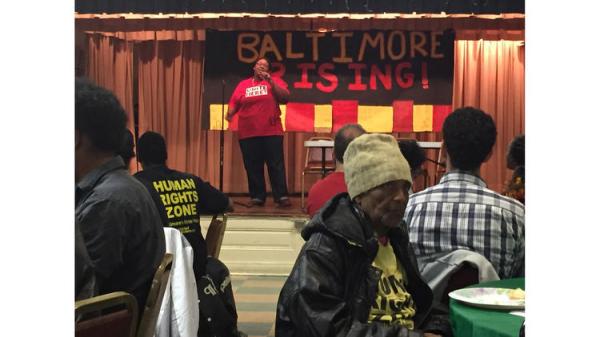


United Workers organize for fair development in Baltimore

Originally published in Baltimore City Paper on May 25, 2016.
——

bcp-052516-mob-united-workers-20160525-001

Alberta  Palmer, UNITE HERE organizer | Photo Credit: Rachel Cohen

In mid-November, residents from all over City Council District 9 packed into the basement of the Metropolitan United Methodist Church to launch the Baltimore Rising campaign. Seated at dozens of tables throughout the basement, eating home cooked mac and cheese, fried chicken, and string beans, the crowd was enthusiastic.

Freddie Gray happened in our faces, we saw that right in our face,” said Alberta Palmer, a UNITE HERE organizer, from the stage. “The vacant houses, how many of you can walk out the door and there [they are], right in your face. They beat us down, but one thing I do know is that when people get together, they can beat us down. But they can’t defeat us.”

The crowd cheered.

“That’s what we saw happen in April, we became Stephanie [Rawlings-Blake]’s problem. We’ve gotta keep moving, we’ve gotta keep pushing, we have to organize our homes, our jobs, our blocks, our families, and get this thing done…we’re playing defense. Let’s defend. Organize means get together as one, one voice.”

The crowd clapped and hollered.

“We don’t have all the money in the world, oh they’re making sure of it. But we have power if we’re together. How many people believe this can be done? It can, it has.”

UNITE HERE, the union representing hospitality staff, was co-hosting the event with United Workers, a group that first came about in 2002. Peter Sabonis, a lawyer and co-founder of the Homeless Persons Representation Project, wanted to figure out how to help homeless day laborers fight for better working conditions. “These guys would go to these temporary staffing agencies at 4:30 in the morning, where they’d wait for an assignment, like a construction job, and the agencies would transport the homeless across the region to work for a day as temporary employees,” explained Sabonis. “You’d come back at the end of the day and get paid, and there’d be all these deductions, and a lot of exploitation.”

Sabonis reached out to Todd Cherkis, a man living in Washington D.C., who had previously organized day laborers in Atlanta.

“Peter was really interested in figuring out a way to use our legal muscle to change things,” recalled Cherkis. “Exploitation of day laborers is a legal problem. But it’s more of a power problem, and what we really needed to do was organize workers because where we had most of our leverage wasn’t necessarily with the laws on the books.”

After Cherkis came on board, United Workers began to hold two-hour weekly meetings in a homeless shelter, located in a converted firehouse on Eutaw Street. People would come, organizers would serve pizza, and together the group would study the temp industry and strategize.

Soon they began taking trips—like bus tours across the country with the Poor People’s Economic Human Rights Campaign, and down to Florida to meet with the Coalition of Immokalee Workers, a human-rights organization focused on farmworker labor standards.

In 2003, United Workers joined over a thousand people for a three-day, 34-mile march from Fort Lauderdale to Miami, calling for free trade policies that respect human rights and the environment. When United Workers returned to Baltimore, they decided to take on free trade from a local perspective, ultimately creating a video focused on Sparrows Point and the crippled manufacturing industry.

Despite their name, United Workers is not a labor union.

“They’ve always called themselves a human rights organization, and at first the distinction didn’t mean a lot to me,” said Sabonis. But now, he said, he appreciates the strategic value of working outside the confines of traditional labor law, which has been severely weakened over the past forty years.

Their first big organizing victory came after a three-year effort to push Camden Yards to pay its workers—most of whom were homeless day laborers—a living wage. They pitched the campaign as a way to put the needs of the low-wage staff ahead of the profits of the temp agencies. The workers, who threatened to stage a hunger strike, went from earning $4.50 an hour in 2003, to $11.30 an hour by 2007.

Bill Barry, the former director of Labor Studies at the Community College of Baltimore County, said the homeless workers engaged in the campaign were “just really inspiring.” Following their Camden Yards victory, Barry invited them to his class to meet his students.

The next year, United Workers switched gears to focus on the Inner Harbor, which Cherkis described as “essentially a privatized public park for tourists—paid for with money from public sources—that creates anti-union, low-wage, and seasonal jobs.” Beginning in 2008, the organization launched its Fair Development Campaign, and called for the 1,500 workers in the Inner Harbor to earn a living wage and receive subsidized healthcare and education.

Their campaign had mixed success. In 2011, United Workers, in partnership with the National Economic & Social Rights Initiative, published a report—”Hidden in Plain Sight”—which documented Inner Harbor worker abuses like wage theft, sexual harassment, and erratic scheduling. It was the first investigation of its kind.

They hoped to publicly pressure General Growth Properties, Inc. (GGP), the company that owns Harborplace, and David Cordish, the developer who owns Power Plant. Modeling organizing strategies pioneered by the Coalition of Immokalee Workers, United Workers focused on the “top of the profit chain” of the Inner Harbor, rather than individual restaurants like the Cheesecake Factory.

Though in the end, public pressure was not enough. Sabonis says United Workers just didn’t really have the infrastructure to make that sort of campaign work, and, in retrospect, underestimated how hard it would be to organize those workers.

“It was an emotional, good campaign, but making it a moral crusade doesn’t necessarily get you anywhere,” said Bill Barry.

United Workers came away from the experience slightly discouraged, but with a much closer relationship to UNITE HERE. United Workers decided it was time to look beyond individual workplaces and take their fair development efforts into neighborhoods; a year later, in 2013, the group released its Fair Development principles for city-wide policy: commitments for universality, equity, participation, transparency, and accountability.

Following Freddie Gray’s death, United Workers began doing a lot of internal assessment, putting together a fair recovery plan and drafting more materials to talk about equitable solutions.

“We discussed human rights budgeting, a campaign for permanently affordable housing, and we laid out a plan of where we felt this was coming from and where we needed to go,” said Rachel Kutler, an organizer with the group.

In an op-ed in The Baltimore Sun a few weeks after the riots, Todd Cherkis and Peter Sabonis called for greater public sector investment. The city has the money for it, they argued, given that it approved $558 million in municipal bond spending over the last 11 years, on top of millions in tax increment financing, abatements, and exemptions. United Workers advocated for a $200 million municipal bond to deal with vacant housing around the city—specifically to rehabilitate at least 3,300 of the city’s 40,000 vacants, and to put unemployed residents back to work in the process. The group also called for community land trusts, affordable housing, and good jobs.

Are the goals of United Workers and those of local activists fighting for police reform mutually exclusive? Todd Cherkis vehemently says no. “We had a protest planned for April that we spent most of last year getting ready for, but then it happened to be right when there was also a protest for Freddie Gray starting,” he said. “We told our leadership and our members, if you want to go to the other protest we will provide you with rides and support to get there, if you want to do both we’ll help you do that, too. We’re not going to have people choose one injustice over another. You can’t have economic justice and not deal with racism.”

Last summer, United Workers canvassed more than 5,000 homes, speaking with over 1,300 people to learn about the local issues that most concern them. By November, the group had launched its Baltimore Rising campaign, in partnership with UNITE HERE, to galvanize support for quality jobs, affordable housing, and fair development. (The campaign has since been renamed “The Power of Our Potential” after a conservative political advocacy group also named Baltimore Rising formed several months later.) Throughout the campaign, members have been promoting a “20/20 Vision”—a call for $20 million annually invested in public bonds for community land trusts, and $20 million annually invested in public bonds to hire the unemployed to help deconstruct vacants.

“We realized this is an opportune moment with the upcoming election and local primaries to pursue something like this and push for a real city-wide agenda,” said Cherkis. As a nonprofit, United Workers won’t endorse any specific candidates, but will aim to educate politicians about the issues to focus on.

In January, when Governor Hogan announced his $700 million initiative to demolish vacants and redevelop poor neighborhoods, community advocates were quick to point out that he was actually putting forth very little new money, and no new funds for affordable housing. Removing vacant properties can either be a really great thing, they argued, or it can be the first step to displacing the poor, if nothing else is done to address the speculative pressures on the housing market.

And now, as the city sorts through details surrounding Port Covington and Under Armour’s half-billion dollar tax-increment-financing deal that subsidizes the developer, United Workers is stepping up its advocacy.

“I think we have made a difference in changing the development conversation, and that’s a step in the right direction,” said Cherkis. “But where we stand is, well, what is the agenda that communities want?”

Calling for serious public investment to create legal entities like community land trusts, United Workers said it is asking city officials to place Baltimore residents at the center of development decision-making, for what would really be the first time in more than 60 years.

When Affordable Housing Bypasses the Poor

Originally published in The American Prospect on May 19th, 2016.
—-

It’s no secret that finding safe, affordable housing has become a major challenge for millions of Americans. The U.S. homeownership rate has neared a 48-year low, and declining vacancy rates have sent rents soaring. According to Harvard’s Joint Center for Housing Studies, the situation is particularly stressful for low-income renters: The number of vacant units with rents under $800 dropped by more than 12 percent between 2013 and 2014. Just a quarter of low-income families eligible for federal rental assistance even receive it.

As the obstacles surrounding housing affordability continue to mount, new research and legal developments have also invigorated discussions of fair housing. The Fair Housing Act, which bars housing discrimination and requires recipients of federal funds to promote housing integration, was bolstered by a 2015 Supreme Court decision stating that housing policies that reinforce segregation—regardless of policymakers’ intent—must be avoided. Shortly thereafter, HUD released a new federal rule that provides communities with tools to ensure they meet their fair housing obligations.

Amidst this housing policy landscape comes a provocative new report from the Institute of Metropolitan Opportunity (IMO), a research and advocacy organization associated with the University of Minnesota, which looks at what they call a new category of subsidized housing—one catering to whiter and comparatively more affluent people than the typical residents of affordable developments. IMO says that while many of these projects, which rely on federal Low Income Housing Tax Credits (LIHTC), may advance public policy goals like historic preservation and economic development, they also worsen racial and economic segregation and likely violate fair housing laws. Coining these developments Politically Opportune Subsidized Housing—or “POSH”—IMO suggests that affordable housing development can create segregation not only within and between communities, but also within the subsidized housing system itself.

The report focuses primarily on the Twin Cities—the most segregated predominately white metropolitan area in the United States—but the authors also explore how similar subsidized development projects have proliferated around the country. While many of these projects are marketed specifically to artists, using a special exemption that developers lobbied for from Congress during the recession, other similar projects target teachers and veterans. Such projects carry decided political appeal, as millions of middle class families struggle with housing costs, too.

But these POSH units, which come with a host of fancy amenities, are extraordinarily expensive. In the Twin Cities, IMO finds the average per-unit total development cost of a POSH project to be $347,500, compared to $266,000 per-unit for traditional subsidized housing. For POSH projects specifically designated as artist housing, per-unit costs can reach as high as $670,000. POSH projects are, they say, likely the most expensive subsidized housing developments in Minnesota’s history.

The residents in POSH housing also look quite different than those who live traditional subsidized housing. While over 70 percent of residents in Twin Cities Low Income Housing Tax Credit projects are nonwhite, more than 65 percent of Twin Cities POSH residents are white. In some buildings, the resident percentages top 80 and 90 percent white.

IMO suggests that these POSH projects may violate federal fair housing laws. Some artist housing, for example, imposes screening mechanisms, many of which could create discriminatory hurdles for low-income minority applicants. IMO quotes a legal aid attorney saying, “You have to try really, really hard to find 80 or 85 percent white people in the poor population of Minneapolis. You have to have a really good sorting system.”

The rental prices within POSH buildings are also prohibitively expensive for many low-income renters who rely on federal housing choice vouchers. While LIHTC-funded units have to accept voucher holders, many buildings are priced at such a level that they often preclude voucher holders from even applying. And this is on top of steep application fees required by some POSH landlords—costs generally unassociated with traditional subsidized housing.

With HUD and the federal courts now beginning to crack down on fair housing violations, the future of POSH projects may be murky. Last week, news broke about a groundbreaking fair housing settlement that could dramatically alter affordable housing construction throughout the Twin Cities. The settlement requires St. Paul and Minneapolis to thoroughly review their fair housing performance and take steps to address any documented problems. This comes on the heels of a similar fair housing agreement signed in Baltimore County, aiming to address decades of housing discrimination. The county will, among other things, expand affordable housing and relocate 2,000 families into areas of higher-opportunity.

The IMO document “is a very important and powerful report,” says Elizabeth Julian, the president of the Inclusive Communities Project and the former Assistant Secretary of Fair Housing and Equal Opportunity at HUD. “I would say this is one of those truth-to-power kind of pieces; it takes everyone out of their comfort zone which unfortunately is what has to be done because we have become way too comfortable with our segregated state.”

When I asked Julian if she thought the POSH projects violated fair housing laws, she said that it would be up for a judge to decide, but that she thinks “what’s happening here just cries out for some fair housing advocacy and attention.”

The POSH developers defend their housing policies. “Our projects are diverse, racially, ethnically, age-wise, income-level and they are very reflective of the communities in which they’re located,” says Melodie Bahan, the vice president of Communications for Artspace, a leading national developer of subsidized artist units. Noting that the report fails to sufficiently distinguish between nonprofit organizations like Artspace, and for-profit companies, Bahan says her organization would never charge application or holding fees for units, and would never try to convert the buildings into market-rate rentals once their affordability contracts have ended. “Artspace has never done that, never intends to do that. We are committed to providing sustainable affordability for artists,” she says.

The IMO report acknowledges that subsidized housing construction is often the only lever communities have to support economic development within neighborhoods targeted for revitalization. But concentrating large numbers of poor racial minorities together, they say, often depresses neighborhoods further.

“There’s nothing wrong with public policy that wants to use subsidized housing money to leverage economic development,” says Julian. “But it can’t perpetuate segregation, that’s the key. If you say we’ve got to perpetuate racial segregation in order to achieve these other benefits—well that’s not a deal that can be made.”

The kinds of projects highlighted in IMO’s report began to appear several decades ago, but the authors say that the “pace and scale” of their development has quickened. Indeed, the kind of teacher housing development the Prospect reported on in November is also spreading more rapidly. IMO claims these kinds of construction projects create politically palatable opportunities, which helps to explain why local officials have been eager to give their stamp of approval, despite their high costs. Similar POSH projects have opened up in St. Louis, New York, and New Orleans, among other cities. “After all, Minneapolis and Saint Paul are not the only cities experiencing an influx of young white residents, nor are they only places with empty former commercial or industrial space in need of conversion or reuses,” the IMO report states.

“For a long time cities have tried to use affordable housing funding to solve problems that aren’t about housing—in this case those problems are historic preservation, supporting the arts, and revitalizing city centers,” says Will Stancil, an attorney at IMO and one of the report authors. “These new developments have started cropping up because cities and developers have figured out that repurposing funding gets a lot easier when you stop worrying about causing segregation or trying to serve the neediest people. But these aren’t tradeoffs we can make.”

The Freddie Gray Trials Are (Finally) Starting Again in Baltimore

Originally published in VICE on May 11th, 2016.
—–

More than a year after the death of Freddie Gray, the 25-year-old who suffered a fatal spinal cord injury while in Baltimore police custody, not one of the six cops charged with his death has been successfully tried, much less convicted of a crime. But after a mountain of procedural postponements, the first verdict could come down as soon as next week.

The first city officer to go on trial was William Porter, the cop who checked on Gray while he was caged in a police van on April 12, 2015. Porter was charged with manslaughter, second-degree assault, reckless endangerment, and misconduct in office in a proceeding last December, but when jurors were unable to come to an agreement on any of the charges, the judge declared a mistrial.

Leading up to that first go-around, there was plenty of controversy over whether the trials should even take place within Baltimore proper. The defense argued their clients would not receive fair trials given the highly publicized—and deeply controversial—nature of Gray’s death. Still, Judge Barry G. Williams, a black man who once prosecuted police misconduct cases for the feds, wanted to at least try to hold the trials locally, the idea being that it’s essential citizens be tried by their peers in America’s criminal justice system.

Porter’s re-trial is now scheduled for June. Jumping to the front of the pack in his place is Officer Edward Nero, one of the bike patrol cops who initially made eye contact with Gray on the street that day, and ultimately arrested him. Nero’s trial starts Thursday for second-degree assault, reckless endangerment, and misconduct charges, but he won’t be contending with a jury. Instead, at his own request, the officer is receiving a bench trial—which is to say the only person he has to convince of his innocence is Judge Williams.

There are a handful of reasons a cop might opt for a bench trial over a jury trial, according to David Jaros, a law professor at the University of Baltimore. For starters, it’s possible judges are more sympathetic towards cops, given that they regularly work with police and see themselves as part of the same criminal justice system.

The defendant might also prefer a bench trial simply because he thinks the jury won’t be fair.

And while some Baltimore denizens might be miffed at the idea of a cop avoiding a regular jury, Jaros says that “at the end of the day, it’s important to remember that the rights and interests of defendants come first in our system.” If Nero thinks a jury would never give him a fair hearing, then a bench trial—where one judge makes the call—is his legal right.

If nothing else, bench trials tend to be much faster than jury trials; no time has to be spent finding and prepping a jury—America got fresh insight into how crazy this process can be in the recent miniseries The People v. OJ Simpson: American Crime Story. And as Jaros points out, even the mechanics of offering evidence and objecting to which facts merit consideration are simpler in bench trials.

For its part, the prosecution is expected to argue Nero lacked probable cause to arrest and detain Gray in the first place. Indeed, based on legal filings reported by theBaltimore Sun, the prosecution is making the novel case that Nero’s conduct was “objectively, criminally unreasonable”—that the initial cuffing was a crime.

The defense can be expected to counter that Nero had reasonable suspicion to arrest the man. Attorneys will likely also point out officers found a knife, which was allegedly clipped to Gray’s pants. (The prosecution and defense disagree over whether carrying around this knife was illegal.

Nero could face at least 15 years in prison.

Peter Moskos, a former Baltimore City cop and professor at John Jay College of Criminal Justice, suspects the prosecution’s strategy won’t work. And if Nero does get convicted, Moskos says, the result would “drastically change policing” because it would suggest “you’re not immune from making an honest mistake, a good-faith error.”

It’s true that American cops generally operate with a great deal of discretion. Which makes most experts deeply skeptical Judge Williams would actually issue a guilty verdict. “The first thing to remember is that even having an officer charged with a crime is rather unusual,” Jaro, the law professor, says. “As we saw in Ferguson, and with Eric Garner in Staten Island, there wasn’t even an indictment of those officers in the end. It’s rare that we even get to this point.”

According to Boston College Law Professor Robert Bloom, probable cause is a pretty subjective kind of assessment. “Given that officers are given a great deal of discretion, it really has to be egregious for there to be criminal action,” he tells me. While Bloom thinks Nero did not have probable cause to make the arrest, that doesn’t mean he will—or should—receive criminal sanctions over it.

But is it really fair for cops in the United States to complain about lacking support from the government? While Baltimore State Sttorney Marilyn Mosby received national attention for indicting all six officers last years, Moskos notes another prosecutor could have “just as easily not charged any of the cops.”

Some Baltimore residents see things very differently.

Michael Wood, a former city cop turned police reform activist, argues that it’s a “fundamental false idea” that the state attorney should back the police. “An officer who believes he’s in fear can do anything that a ‘reasonable officer’ can do, up until, and including, killing someone,” he says. “While that might sound okay if an officer is judged by another reasonable officer, what if all the officers are unreasonable?”

Wood adds that it should be civilians who determine the reasonableness of police conduct, not other cops or law enforcement figures. He thinks citizens would still fundamentally side with the cops, but that it could represent a big improvement from the status quo. “You’re not going to regulate Wall Street properly with another banker,” he says.

The trials come on the heels of one of Baltimore’s most violent years. There were 344 homicides in 2015, a per-capita record, and as of Tuesday, there had been 90homicides so far this year. (During the week of the Baltimore Uprising anniversary last month, there were ten homicides, along with three police-involved shootings, including a fourteen-year-old boy who was shot while holding a BB gun.)

While political momentum for police reform was massive a year ago, today there’s mixed sentiment about how far the city has come—and will ultimately go.

Wood thinks real change won’t come about until civilians play a more significant and meaningful role in shaping how policing is handled and monitored. “That’s the fundamental change that must occur,” he tells me. For now, the former cop thinks the police department is basically where it was. “Your big change in criminal justice reform is helping white kids who overdosed in the suburbs.”

But reformer Diana Morris, director of the Open Society Institute-Baltimore, is cautiously optimistic. She points to some recent policy changes, like bringing civilians into the trial review board, and limiting the length of time accused officers can wait before speaking with investigators, among others changes. The state legislature recently passed a billthat would prioritize drug treatment over prison, improve parole practices, and end mandatory minimum sentences for nonviolent drug offenses.

“But frankly the real [impetus] for change is going to come out of the DOJ investigation,” Morris tells me. The Department of Justice commissioned a federal probe into the Baltimore Police Department last May, and their findings of fact should come out soon. “That will be a very important next step because that serves as the basis that recommendations or changes that require a consent decree will weigh on,” she says.

Some veteran cops like Moskos, however, take a grim view on the future of violence in Baltimore, officer-involved or otherwise.

“You’ve got police worried about doing their job and being put on jail for it,” he says. “Liberals say if crime is going up then police aren’t doing their jobs, but those people never admitted that cops mattered before. That’s the factual part that people don’t agree on. What’s the role of police and crime prevention?”

Learning from History: The Prospects for School Desegregation

Originally published in The American Prospect on May 10th, 2016.
—-

In a new book, Making the Unequal Metropolis: School Desegregation and Its Limits, Teachers College, Columbia University historian Ansley Erickson explores the legal and political battles surrounding the desegregation of public schools in Nashville. By 1990, almost no school within Nashville’s metropolitan school district had high concentrations of black or white students—making it one of the most successful examples of desegregation in the 20th century. However, since being released from court-ordered busing in the mid-1990s, schools have quickly resegregated, concentrations of poverty have intensified, and academic scores for black students in Nashville have suffered.

Erickson shows that desegregation was not all rainbows and butterflies, and it often created new challenges that families were forced to wrestle with. She also shows how school segregation had been no accident. Rather, it was a result of deliberate choices made by politicians, parents, real estate developers, urban planners, and school administrators—ranging from funneling subsidies to build schools in suburban areas, to privileging white families when making zoning and student assignment decisions.

And yet for all the challenges that desegregation entailed, Erickson also lets us hear the voices and positive experiences of students who went through desegregation—voices that were routinely ignored during the heated debates of the 20th century.

The point of recognizing the flaws within one of desegregation’s best-case scenarios is not, she says, to conclude that it’s ultimately a fruitless project. Rather, it serves as a guide for those who might want to figure out how to start anew. What follows is an edited transcript of our conversation.
——

Rachel Cohen: Your book makes the point that while desegregation challenged some inequalities, it also “remade” inequality in new forms. Are all inequalities equal, so to speak? Can we evaluate the challenges and still decide whether the needle moved overall in one direction or another in terms of progress?

Ansley Erickson: I think that desegregation absolutely was necessary, and I think that busing for desegregation was, in sum, a positive—and in some ways ambitious—effort to counteract persistent segregation. We can recognize that even as we notice desegregation’s limits and problems. I say this not only because of the stories that students who experienced desegregation tell, and not only because of the positive test score impact. It’s also because busing made segregation a problem within local political landscapes and put questions about historic inequality in front of people to grapple with.

RC: In the conclusion of your book you say that desegregation, mandated by a Supreme Court that recognized schooling’s crucial function in our democracy, has rarely been shaped by, or measured for, its potential impact on the making of democratic citizens. If it were to be, what could that look like?

AE: In Carla Shedd’s new book, Unequal City, she explores how students who attend segregated schools versus more diverse ones perceive inequality. She finds that those in more highly segregated schools have a less developed sense of inequality—they are less informed about it because they have less to compare their own experience to.

Schools are not just about whether you can read or calculate; they are about how robustly you perceive the world around you. Even if you go to high-performing schools, segregated white or segregated black schools, it can still be difficult for kids to understand the world they inhabit. They need to have some understanding of their community, and not just their immediate community, but in the broader sense. Work like Shedd’s points to how segregation can get in the way of that understanding.

Today, economic goals and justifications for schooling seem to be valued over all others. Nashville has invested very heavily in career and technical education. Its big comprehensive high schools have been redesigned as career academies, targeting jobs like being a pharmacist or working in hospitality. The goal is to help prepare kids for jobs, to sustain local businesses. At the same time, Nashville is a place that doesn’t have a local living wage, has a skyrocketing cost of living, an affordable housing crisis. Schools are clearly focused on helping to make students workers. But what is their responsibility in making citizens who can address big and pressing questions, including about the economy and about work? What’s a reasonable and just compensation for a person’s labor? What are workers’ basic rights? To me, helping kids be ready to participate in those debates matters just as much as helping students earn a certification in a certain vocational skill area.

RC: You wrote a lot about how “growth agendas” helped fuel inequality and new kinds of segregation. Can you talk a little bit about what that means and how it worked?

AE: This question connects to the themes we were just discussing. History can help bring some nuance to today’s often oversimplified rhetoric about how education and economic growth relate. It’s been popular recently to talk about schools as providing skills that leverage economic growth. But links between education and economic growth have worked in other ways, too.

In Nashville, in the name of economic growth, big urban renewal and public housing construction projects sharpened segregation in housing and in schooling. In the name of increasing property values, suburban developers appealed for segregated schooling by class as well as by race. And in the name of economic growth, schools focused on vocational education—often furthering segregation inside schools even as buses transported students for desegregation.

RC: While combining city and suburbs into one school district is not without its challenges—the dilution of black voting power was one you explored in the context of Nashville—do you think the benefits outweigh the costs?

AE: Nashville would not have had extensive statistical desegregation without consolidation. Nashville was highly residentially segregated and the old city boundary was quite small, like many U.S. cities. By the time busing began, the people living in the old city boundary were predominately African American. Had desegregation taken place only within the old city boundaries, the district would have had a much less diverse pool of students to draw on and a less diversified tax base. Having a consolidated city-county school district didn’t prevent “white flight,” but it did slow it and make it more onerous. But consolidation did not ensure equal treatment for all parts of the metropolis, either.

RC: In your book you show how back in Nashville in the ‘60s and ‘70s, some black communities felt as if advocacy for integration suggested that students of color are inferior and need to be around white kids in order to succeed. We see similar concerns today. Integration carries many important social and civic benefits for all students, but in modern education policy discussions the impact on student test scores gets the most attention—and that significant positive impact is by and large just for students of color. Though the test score gains are huge, could a narrow focus on student achievement dilute political support for integration?

AE: I think about this a lot, as I consider how history might inform today’s nascent conversation about segregation and desegregation. Other scholars have shown striking test-score improvements from desegregation. But if your ultimate goal is test score parity, then there will always be multiple ways to get there. If the goal is also preparing citizens for a diverse democracy, it’s harder for me to see how that happens without some measure of desegregation.

RC: You note that when it came to busing, residents decried state intervention as government overreach, an illegal intrusion into their private lives. But when it comes to the state playing a heavy role in facilitating economic growth, they welcomed the government’s help. Did you find there were people back in Nashville who were pointing out this contradiction?

AE: I didn’t find anyone who was pointing it out then. Then, as now, many people did not perceive how government action was shaping their lives, especially white suburbanites’ lives, in ways that benefited them but that they did not see. People wanted to draw sharp boundaries between what was public and private. White homeowners in particular liked to talk about their housing decisions as private choices they made within a free market. What they didn’t recognize was how enabled they were by their government-backed mortgage, their low-gas-tax subsidized commutes on new highways. Public policy supported what they wanted to cast as a private choice. When asked to recognize the segregation in their cities and schools, they wanted to call it “de facto segregation”—as if it had roots only in private action. But in fact, many layers of state action and policy were involved as well. There wasn’t a coherent small-government conservatism then. Like today, the question is what people thought government power should be used for.

RC: You explored school closures and the loss of black teaching jobs as a result of desegregation. Today we see similar trends, with schools closings, charter school expansions, and the increase in non-union jobs targeted to a whiter, and shorter-term teaching force. What, if any, historical lessons can we glean?

AE: There’s a lot of good scholarship on the history of desegregation and job loss—particularly by Michael Fultz and Adam Fairclough. I didn’t make that a huge focus in my book, but there is an important broader question here about how we think about education. Schools often account for around half of municipal budgets; they are huge municipal expenditures, and they do represent a big source of employment. Historically this employment has been an important step towards middle class existence for lots of American communities. Women of Irish, Italian, Jewish descent moved into the middle class by becoming schoolteachers in the early- and mid-20th century. Similarly, African American educators have attained, or preserved, middle class status through education jobs for a long time. Somehow we have been unable to find a way to talk about the teaching profession recognizing that it is both labor and employment that matters for communities and a crucial factor in students’ lives.

Baltimore’s Next Mayor Doesn’t Want to Talk About Racism

Originally published in Slate on April 29th, 2016.
—-

Following Tuesday night’s primary, Catherine Pugh is now the presumptive next mayor of Baltimore, having captured 37 percent of Democrats’ votes. Hers is a city that remains deeply impoverished and racially segregated, and in the wake of the death of 25-year-old Freddie Gray it has become central to the growing national focus on police violence. Yet race is the one topic Pugh has shown herself strangely hesitant to talk about.

Last month, Pugh’s campaign released an ad featuring a supporter—Francis X. Kelly, a former Maryland state senator—discussing why Pugh would be the best candidate to lead the city. Kelly enthused about Pugh’s ability to bring people together. “There’s too much talk of racism going on now,” he told voters. “The word racism has got to be erased from our vocabulary.”

Pugh’s campaign was criticized for the ad—including by upstart mayoral candidate and Black Lives Matter figure DeRay Mckesson, who asked Pugh on Twitter if this meant she was afraid to talk about racism. Whether or not she fears it, over the course of her campaign, Pugh, who is black, demonstrated clearly that she has little desire to directly confront the racism afflicting the city. While other candidates spoke about the need to reduce racial bias among Baltimore’s police force, Pugh’s policy platform was filled with platitudes like “recognize the uniqueness of each community and provide strategies for reducing crime that offers results.”

Aside from being a Maryland state senator, Pugh leads a public relations consulting firm and has said one of her top mayoral priorities is to improve Baltimore’s image. She’s advocated for a marketing campaign to “Celebrate, Celebrate, Celebrate the greatness that is Baltimore.” She wants to “help us understand” that every neighborhood and person matters. She wants us to champion the city’s “diversity.”

There’s a lot that’s wonderful about Baltimore, but the fact is that almost every major issue facing the city today is a racial one. Not even a PR professional like Pugh can expect to avoid that. When she likely becomes mayor of this heavily Democratic city—where being born black correlates with significantly worse life outcomes—she’ll have to contend with the growing anger and frustration that’s been percolating across the city.

Baltimore’s not an outlier, but in some ways it experiences economic inequality and racism more dramatically than other cities in the United States. More than 7 percent of the city is unemployed, but for young black men, that figure hits 37 percent. Baltimore had a per-capita record of 344 homicides in 2015, one of the highest murder rates in the country. New research released last spring by Harvard economists found that of the nation’s 100 largest counties, Baltimore ranked dead last when it comes to facilitating upward mobility. For every year a poor boy spends growing up in Baltimore, the economists said, his earnings as an adult fall by 1.5 percent.

This week, Baltimore commemorated the one-year anniversary of Freddie Gray’s funeral, and the notorious riots that scarred the city that very same night. The criminal trials for the six officers charged with the death of Freddie Gray are set to resume next month and continue until at least October. There will likely be more protests if locals feel justice hasn’t been sufficiently served in the courtroom. If ever Baltimore needs leaders who can talk frankly about racism, it will be when those verdicts come down.

As Baltimore faces a critical juncture, with residents still reeling from the riots last spring, Pugh has largely ignored these realities. She claims running for mayor is her “calling”—but her campaign platform is vague, her political record is unclear, and her notable lack of interest in reckoning with racism is worrisome. It’s a trait that won’t just hamper her on highly visible issues like police violence.

Pugh had few words to say on the campaign trail about the abandoned light rail project that Maryland’s Republican governor, Larry Hogan, canceled last summer—a mass transit initiative that was widely anticipated to improve mobility for some of Baltimore’s most poor and isolated residents. In December, the NAACP filed a federal civil rights complaint, alleging that canceling the light rail was racially discriminatory, as the governor diverted funds intended for the project to roads and bridges elsewhere. But Pugh has said she wants to “take the politics out of transit funding”—which has never happened for Baltimore and probably never will.

Catherine Pugh wants to make Baltimore a more “business-friendly” place and “promote [the] downtown core”—the same downtown core that has benefited from hundreds of millions of dollars in tax breaks and subsidies over the decades, with little profit trickling back into Baltimore’s black and beleaguered neighborhoods. Thus far, Pugh has not demonstrated that she plans to alter the city’s inequitable approach to development, which matters as city leaders will soon have to decide if they should issue more than half a billion dollars in tax increment financing to apparel company Under Armour, which wants to construct new headquarters in the city.

There are still seven months before Pugh is expected to win the general election, and one hopes she will continue to face pressure from voters and the press about her record and her intentions. Does she really think we should “erase racism” from our vocabularies? Was it ethical to collect campaign contributions from lobbyists who appeared before her as she served on the Senate Finance Committee?

A year ago, Baltimore’s current mayor, Stephanie Rawlings-Blake, called those protesting Freddie Gray’s death in West Baltimore “thugs” who were “trying to tear down what so many have fought for.” Catherine Pugh hasn’t used such explicitly ugly rhetoric, but she also she hasn’t convinced the public that she wouldn’t.

For a country that has been largely absorbed in presidential politics over the last 15 months, paying attention to a mayoral race in a midsize city might not seem so important. But if inequality is one of the most significant issues facing America today—and 75 percent of voters who lean Democratic say it is—and if concerns about racism and race relations in the U.S. are rising—which they are—then there may not be a city more important to watch than Baltimore, Maryland.

St. Louis Public and Charter Schools Fight Over Desegregation Taxes

Originally published in The American Prospect on April 27, 2016.
—-

The St. Louis Public Schools and the St. Louis NAACP recently filed litigation in U.S. District Court for the Eastern District of Missouri against the Missouri Board of Education, claiming that state officials have diverted millions of dollars to charter schools over the past decade, in violation of a court-ordered desegregation settlement.

The suit alleges that those funds should have been allocated to traditional public school desegregation programs. Public school officials want to see more than $40 million returned to the district’s coffers. But charter school advocates argue that giving back those funds would harm their students and undermine school choice in Missouri.

The St. Louis case is unique, but it also illustrates some of the broader funding issues faced nationwide by state and local education officials as they navigate the thorny challenges posed by trying to finance two public school systems with fewer tax dollars.

The legal dispute hinges on whether public charter schools are entitled a portion of the revenues raised from a local “desegregation tax.” As part of a 1999 federal settlement, St. Louis voters approved a two-thirds of 1-cent sales tax to fund district desegregation programs. In Missouri, charters and traditional public schools are funded separately, so the independent public charters that opened in St. Louis beginning in 2000 did not receive any of these so-called “desegregation tax” revenues.

But in 2006, Missouri revamped the state education funding formula to allocate local tax revenues to charter schools on a per-pupil basis. The desegregation sales tax was included in the new local funding calculation. St. Louis public school district officials, who did not learn that desegregation tax funds were going to charter schools until two years later, argue that those funds should be allocated only to traditional public schools, not to charters.

In January, public school officials, the NAACP, and others asked the state of Missouri to return the desegregation tax revenues to the district. They also requested an additional $8.8 million in desegregation tax revenues that charters are scheduled to receive for the 2015-2016 school year. But in March, a state education department attorney told the group that the desegregation tax is, in fact, being distributed in accordance with state law and the 1999 court agreement.

In an interview with The American Prospect, St. Louis NAACP President Adolphus Pruitt says that since charter schools were not included in the 1999 court-ordered settlement, charters are not entitled to the tax revenues. Moreover, they are not obligated to use the funds for desegregation programs. Pruitt stresses that the federal litigation is not an attack on charter schools, but an effort to ensure that the state abides by its legal obligations. He adds that St. Louis voters approved the sales tax specifically to fund the district’s desegregation programs. “Let’s be clear,” Pruitt says. “We can’t continue to provide programs if the state continues to divert the money, and we cannot allow the taxpayer money to go where it was not intended.”

Since charters now educate a third of all St. Louis public school students, school choice advocates argue that the traditional public schools should receive a smaller portion of the desegregation tax revenues.Pruitt counters that current desegregation programs may end if the district cannot access the full pot of money.

Attorney Ronald Norwood of Lewis Rice, the law firm representing the St. Louis public schools, declined to comment on the case.

Charter advocates say the desegregation tax revenues belong to St. Louis public school students, not the school district. Two weeks ago, parents, students, and other supporters of the charter effort launched a social media campaign to pressure the school district and the plaintiffs to back down. Douglas Thaman, the executive director of the Missouri Charter Public School Association, has argued that if the St. Louis public schools were to prevail in federal court, then many charter schools in the city may have to close. The remaining charter school students could see their annual funding cut by more than $800 per student. Currently, St. Louis charter schools spend roughly $8,000 per student.

The city’s tumultuous school desegregation legal battles began in 1972 when a group of African American parents in St. Louis challenged certain patterns of segregation in the city’s public school system. Eleven years later, the U.S. District Court in St. Louis ordered the state to fund programs to remedy the negative effects of segregation. Under the court’s supervision, Missouri helped the St. Louis public schools finance early-childhood education, capital improvements to city school buildings, vocational education, magnets, and a voluntary inter-district transfer plan with the St. Louis County schools, a separate school system that is predominately white. The St. Louis schools are more than 80 percent black.

In 1996, Missouri officials asked the federal court to declare that St. Louis public schools had achieved “unitary status,” meaning that the school district had made reasonable progress in eliminating most of the past effects of segregation and should be released from court-ordered directives. But the U.S. District Court in St. Louis did not agree, and instead opted to restart negotiations with state and school district officials to devise an alternative agreement. Three years later, the court approved a new settlement that required the school district to continue funding desegregation programs, such as all-day kindergarten and transportation to the county schools.

School district officials agreed to use a combination of state and local funding to pursue desegregation remedies: The state would contribute at least $40 million per year and St. Louis voters approved a new sales tax to raise approximately $20 million annually to fund specific desegregation programs. According to Pruitt, since 1999, the state has contributed nearly $900 million to fund desegregation efforts. While the city continues to collect the desegregation sales tax, the state’s annual court-ordered contributions have ended.

Yet the St. Louis school system may see some additional fiscal relief. This month, St. Louis voters overwhelmingly voted to increase their property taxes, the first such increase in 25 years. Nearly $30 million annually will go to both charter and district schools. Charters expect to start receiving their share of the new funds, about one-third of the revenues, in 2019.

Pruitt, who believes he’s doing the right thing by trying to direct all the desegregation tax money to traditional public schools, insists he’s also committed to increasing funding for charters. He points to the new property tax revenues as a prime example. “I’ll fight just as hard as I am now to make sure charters get their share of that money,” says Pruitt.

Teachers Look to Unionize at Another New Orleans Charter School

Originally published in The American Prospect on April 26, 2016.
—-

Earlier this month, teachers at Lusher Charter School, an arts-based K-12 school in New Orleans, went public with their intent to unionize. Sixty percent of teachers, teacher assistants, and other Lusher staff signed a petition in support, but over the weekend the Lusher board voted 6–5 against recognizing their union. Now the teachers will ask the National Labor Relations Board to hold an election.

If the teachers prevail, Lusher would become the third charter school to unionize in New Orleans, the city with the highest density of charter schools in the country. The first two—Benjamin Franklin High School and Morris Jeff Community School—formed their unions last year. Ben Franklin staff signed the first collective-bargaining agreement for New Orleans teachers since Hurricane Katrina.

Lusher teachers began organizing in secret about a year ago. They waited until they had a majority of teachers in support before they went public, they explain, because they worried they’d lose their jobs or face other negative consequences unless most of the teaching staff was with them.

“I’ve been in a union pretty much all my career and I think it’s a great way to give voice to teachers, and a great asset to a school,” says Julie Sanders, a Lusher social science teacher. This is Sanders’s second year at Lusher, and her 17th year teaching in Louisiana public schools.

Since going public, Lusher teachers have been working to explain to parents and community members why they feel a union is right for them. Some parents wondered if collective bargaining would disrupt Lusher’s unique school culture, or if students’ educations would somehow be harmed. Unionized educators at Ben Franklin and Morris Jeff have also been helping to assuage the concerns of Lusher parents by telling them what having a union has meant for their schools.

Michael Masterson, a teacher who serves as a union representative at Ben Franklin, attended a Lusher community meeting last week to share his experience. “When someone says there are teachers who may have been tricked into agreeing to a union, or someone else says this is going to hurt kids,” Masterson says, “I can raise my hand and say, well, at Ben Franklin we also had people who were really worried about unionizing and it’s turned out okay, the kids are fine, our fundraising is actually up, our applications are steady, nothing bad has happened, and things have been calm.”

Indeed, U.S. News and World Report recently ranked Ben Franklin as the 53rd-best public high school in the United States, and the nation’s 15th-best charter. Ben Franklin’s rankings actually went up 27 spots over the past year.

Lusher is also considered one of the best schools in the state, and Morris Jeff has received national recognition for its approach to creating a diverse student body. This has led some people to wonder why it’s New Orleans’s top schools that are opting to unionize, not others.

Peter Cook, a vocal education reformer based in New Orleans, wrote that it is “apparent that the AFT and its state and local affiliates have been quietly lurking on the sidelines looking for opportunities to eat the city’s charter schools, presumably in an effort to eat away at the city’s reforms from the inside out.” Noting that the American Federation of Teachers has invested nearly half a million dollars into New Orleans charter organizing over the past year, Cook wrote that “we shouldn’t fool ourselves into thinking” the union wouldn’t ruin all the progress reformers have achieved “if we gave them the opportunity to do so.”

Randi Weingarten, the president of the AFT, said in a statement to The American Prospect that the AFT is excited that three New Orleans charter schools “have formed unions and want contracts that give them a voice on the job, resources for their students and treat them fairly.” The AFT currently represents 225 charter schools in 15 states, and Weingarten says “we’re working with educators at other charters in the Crescent City and across the country who want a voice at their school.”

Masterson told the Prospect that “there are definitely other schools” in New Orleans that are organizing unions, but none of them are public yet.

When asked why they think it’s been the more elite, high-performing charter schools that have unionized in New Orleans, both Masterson and Sanders say they believe the stability at their schools plays a significant role.

“Schools with teachers that are stable with their employment are going to be the first to unionize,” says Masterson. “It’s not that the elite schools get to have a union and others don’t. It’s that stability is absolutely key to getting a majority, and having people feel comfortable to come together and not be scared.”

Schools with high teacher turnover—a condition that describes many New Orleans charter schools—can be difficult places to organize unions. “If teachers start having conversations with each other about unionizing, but the next year half the teachers are gone, then that process breaks down more easily,” Masterson says. Other charters, he adds, might be filled with teachers who are not necessarily looking to stay in the profession beyond a couple years, which can make it harder to motivate people to go through the unionization process.

Sanders notes that Lusher has far less turnover year to year than some other charters in New Orleans. She points to Richard Ingersoll, a University of Pennsylvania education researcher who has found that one of the main factors influencing whether teachers stay at or leave a school is how much voice they have in making decisions that affect their job. Increasing teacher voice, job security, and transparency, Sanders believes, will help to keep her school stable and strong.

“We’re trying to be proactive here; the union doesn’t come out of anger or spite,” she explains. “This is just teachers coming to together saying, ‘What would it take to attract and retain the best people?’”

Interview with Representative Donna Edwards

Originally published on April 25th in In These Times as part of a larger interview series with progressive political challengers.
—–

DONNA EDWARDS

BACKGROUND: U.S. Representative for Maryland’s 4th District since 2008, attorney, and first executive director and co-founder of the National Network to End Domestic Violence

THE RACE: U.S. Senate, Maryland

Donna Edwards, 57, is facing off against fellow Congress member Rep. Chris Van Hollen in the April 26 primary. Of the two, only Edwards voted in favor of the Congressional Progressive Caucus 2016 budget. Unlike Hillary Clinton, Edwards was not endorsed by the famously corporate-friendly Congressional Black Caucus PAC. In response to that failure to endorse, the racial justice group Color of Change began circulating a petition in March asking people to call on the CBC PAC to remake their board, because the current board is dominated by lobbyists who represent corporations “that are notorious for mistreatment and exploitation of Black people, including private prisons, big tobacco and the anti-worker companies that make up the National Restaurant Association.”

KEY ENDORSEMENTS: Progressive Democrats of America and Democracy for America, UNITE HERE, International Association of Machinists, NOW
——

Why are you running for Senate?

DONNA EDWARDS: I’m running for the Senate to give a voice to average working people in Maryland. People like single moms and young men who maybe messed up and want to restart their lives, and our seniors and veterans and small businesses and women and minority-owned businesses who need a voice at the table where public policy is made. And my life experience as a working person gives me an important voice that’s missing from the United States Senate.

What are the three most important issues facing America today that should be addressed in the Democratic Party platform and how are you proposing to address those issues?

You start with an education system that’s very flawed, in which depending on what zip code you’re in, you get a better education than the next kid. That hampers your ability to get a job and get a start in the economy and earn your way into the middle class. We have to create jobs and opportunity through investing in our transportation and our infrastructure, and jobs for the 21st century, and stop trading them away to our competitors. We have trade policies that really disadvantage average American workers.

And we have to deal with changing the economic processes in our urban communities. That goes from improving law enforcement and pursuing community-based relationships, to getting guns off of our streets, to educating and training and creating jobs in the urban core. If we do that, we will strengthen the rest of the country.

How have social movements like Black Lives Matter, Occupy and climate change activism influenced your campaign?

I’ve always believed in outside movements, because I think that government doesn’t move effectively and elected officials don’t move effectively unless they have a big push from the outside. Black Lives Matter, for example, has certainly changed the conversation when it comes to mass incarceration, law enforcement and improving young black men and women’s prospects.

Look at climate change. We would not elevate these concerns about climate change if the young people around this country didn’t say “we want an earth that’s available to all of us and for future generations,” and really compel us to act. So I very much believe in organizations pushing the envelope for policymakers, holding us accountable. That will make me a better senator, and it will get us better policies.

Bernie Sanders campaign has galvanized young progressive voters across the country and attracted a lot of independent support. What are the lessons here for the Democrats and for your campaign in particular?

My campaign has focused on energizing and organizing people who sometimes sit outside the political process because they don’t believe it’s about them. We have let them know that I intend to have their voice in the United States Senate. And they’re responding to that.

We’ve done that by pushing against this party establishment that really just wants to anoint and appoint the next successor to [incumbent Maryland Sen.] Barbara Mikulski, and people are standing up and saying “no, that’s not the way we do it.” We want to make sure that the voices of working women, black women, young people, our seniors and our veterans are heard in public policy. And they’re showing up in waves of volunteers and small donors.

What is your campaign doing to bring more people into the political process?

We’ve spent a lot of time getting to know people who are running community-based organizations that are under the radar—like those working with ex-offenders and registering ex-offenders, who can now vote in the state of Maryland, so they have a voice. We’ve spent time with single moms and working moms who are struggling to make ends meet. We’ve reached out to some people who say, “You know, I’ve never voted before,” or “I only vote sometimes, but I believe in you and I believe in us and I’m prepared to vote.” And we’ve been organizing and working on college campuses to draw in young people, to make sure that they feel like they’re part of this campaign. All of those things are why I’m ahead in the polls.

Democrats have lost their majorities in both the House and Senate. What do you think the Democratic Party needs to do to gain them back?

Number one, we should not run away from who we are as Democrats and the values that we share. We should be the party standing up to protect and expand Social Security and Medicare; we should be the party that’s creating middle-class jobs and making sure that college is affordable so that our young people can realize their aspirations. We need to be the Democratic Party that works for working people. When we do that, people respond.

I go back to Shirley Chisholm; when she was first elected to the House of Representatives, she said, “If they don’t put a seat at the table, bring your folding chair.” And so we’re going to take folding chairs into the Senate so the voices of ordinary working people get heard.

Why do you think you’re a more qualified candidate than Chris Van Hollen, the U.S. representative from Maryland who is also running for Mikulski’s seat?

In addition to being a lawyer and having worked in the private sector as a systems engineer and analyst for Lockheed Martin, I’m a mom who has raised a child alone. I understand the struggles of working people. Mr. Van Hollen and I have very similar voting records. But we have different priorities. I prioritize fighting against bad trade deals that trade away jobs and opportunities for the American people, fighting to protect Social Security and Medicare from dangerous cuts, standing up to the National Rifle Association to pass sensible gun laws to get these guns off our streets so that 88 people a day don’t lose their lives to senseless gun violence. I’m going to be a fighter for working people.

Republicans have managed to secure important down-ticket and off-year electoral victories; how can Democrats build strong state and local party organizations?

We can start by electing people who understand how to organize and galvanize our electorate, and how to stand for something, so that people know that there is somebody in there who has got their back. I’m that kind of candidate. And when I win that Senate seat, that’s going to translate into down-ballot victories all across our state, in the off-year, off-cycle election.

We lose elections because our voters stay home. So our challenge is to make sure that people are mobilized and organized and energized on Election Day, because we have candidates out there who are speaking to their concerns, speaking to their needs and willing to go to bat for them. When voters know that, they’re willing to come to the polls on Election Day.

Sanders has struggled with winning over people of color and a generation of women who find inspiration in the Hillary Clinton’s struggles and accomplishments; Clinton has struggled with youth voters and the party’s left base. What sort of bold, progressive platform can unite these constituencies in November and in years to come? 

I think the primary race and the battle that is being fought in the Democratic Party is one that’s about substance and values. I’m absolutely confident that if either of the two candidates wins the nomination, that they will win the general election in November because they do have bold ideas. Sometimes they differ, and this primary race has really brought to the fore some of those really bold ideas—on college affordability, on how to bring back jobs and opportunities to the middle class, on how to deal with income inequality. So I feel really confident about our candidates, about their messages, and about the boldness of the ideas that they have.

I endorsed Hillary Clinton. I believe in her candidacy, and frankly, I believe in the candidacy and the power of women. I am running for the U.S. Senate; there are 100 senators, and 20 are women, and only one is a woman of color. There hasn’t been a black woman in the Senate in 22 years, since Carol Moseley Braun. I am proud that she [Braun] has endorsed me and supports my campaign, and I am going to be the next one.

We need more women, not fewer, in political power, and I would like to see that in the highest office in the land, the presidency.

When the Democratic Party chooses its nominee in Philadelphia, the party will come together for the November election. What stands in the way of Sanders supporters and Hillary supporters working together under the Democratic Party big tent?

Nothing. We have a set of shared values as Democrats that are really about fighting for the interests of middle-class families and people who have struggled to enter the middle class. Senator Sanders carries that commitment, and Secretary Clinton carries that commitment. Come November 2016, not only are we going to be on the same page, but we’re going to be winning an election for working people.