Can Charlotte-Mecklenburg Desegregate its Schools … Again?

Originally published in The American Prospect on March 18th, 2016.
—–

It was not so long ago that Charlotte, North Carolina, was widely considered “the city that made desegregation work.” The Queen City first pioneered busing to desegregate schools in 1969, and when the Supreme Court upheld that strategy as a legal remedy for school segregation two years later in its landmark Swann v. Charlotte-Mecklenburg Board of Education ruling, districts across the South began busing students as well.

In the past 15 years, however, Charlotte has seen a rapid resurgence in segregated schooling. Following a late 1990s decision that said court-mandated integration was no longer necessary, Charlotte-Mecklenburg Schools (CMS) grew quickly divided by race and class, and the economic isolation continues to intensify with each passing year. Though CMS is still considered a relatively high-performing school system, a closer look at the data reveals deeply unequal outcomes among the district’s 164 schools.

For more than a decade, local residents ignored the demographic shifts taking place within CMS. Political leaders, as well, seemed to just have no energy left to expend on school diversity following their highly publicized school segregation lawsuits. Yet now, due to a district policy that requires school board members to revisit student assignments every six years, the Charlotte-Mecklenburg community finds itself facing a rather unusual opportunity. Wary of litigation, but troubled by the damning diversity data, Charlotte leaders have been working cautiously over the past year to see if there might be any popular support for breaking up pockets of poverty within CMS.

Their timing may be just right. In addition to sobering statistics on school segregation in Charlotte-Mecklenburg, new research out of Harvard University and the University of California at Berkeley found that Charlotte ranks dead last in the nation in terms of upward mobility, and that racial segregation and school quality are two main culprits behind this. Moreover, after years of lackluster results from other school turnaround efforts, resistance to shuffling students as a way to improve school quality is softening.

The political momentum in favor of school segregation in Charlotte is fairly new, but so is the backlash against it. Charlotte-Mecklenburg has seen a 15-year population surge, predominately in the county’s northern and southern regions. Many of the county’s newcomers missed Charlotte’s desegregation history, and see no real reason to bring it back. They moved into their communities, they say, largely for the schools. As more leaders explore how CMS might revamp student assignment, a growing number of parents have begun to raise objections—warning officials that they would not hesitate to send their children to private schools, or to the state’s notably segregated charter sector, if they had to.

Last summer, when it became clear that the CMS school board was thinking of revisiting student assignment, a group of pro-integration community members began organizing in support of the idea. And so back in July, OneMeck was born—a grassroots coalition of residents committed to making Charlotte-Mecklenburg a place where diverse individuals live, work, and attend school together. Through public forums, social media, and one-on-one conversations, OneMeck advocates began to make their case.

“We spent a few months figuring out what we were for and how we would structure ourselves, and we’re still evolving even now,” says Carol Sawyer, a co-founder of OneMeck. “But we have no intention of becoming a 501c(3); we really value our nimbleness and our ability to advocate as a community organization.”

Students also got involved. Through the organization Students for Education Reform, (SFER), CMS students began to strategize how they could best interject their personal experiences into an increasingly heated public debate over school segregation.

“Even though school board members said they wanted to hear from students, they weren’t actually invited to the table in any of these conversations,” says Kayla Romero, a former CMS teacher and current North Carolina SFER program coordinator. “This issue is going to directly impact students, they are the ones currently in the system, but people were not seeking their opinions out or intentionally bringing them to the table.”

OneMeck supporters say they are not advocating for any one specific policy, and that they believe there are a number of steps CMS could take to reduce racial and economic segregation. They are encouraging the school board to hire a national consultant who could come in and study the school district, and make recommendations on how to best legally, and strategically, diversify CMS schools.

Throughout the summer and fall of 2015, the public discussion in Charlotte revolved largely around issues of race and desegregation. But beginning in 2016, suburban families started to ramp up their efforts to shift the narrative. In February, hundreds of parents joined two new groups—CMS Families United for Neighborhood Schools and CMS Families for Close to Home Schools and Magnet Expansionwhich sought to reframe the conversation around the importance of neighborhood schools, and to express collective opposition to what they called “forced busing.” Some even began to sell T-shirts that read “#Close-To-Home-Schools #NOforcedbusing.”

Christiane Gibbons, a co-founder of the CMS Families United For Neighborhood Schools, (now renamed CMS Families for Public Education) says when she first learned that the school board was rethinking student assignments in early February, she felt compelled to alert local parents to the dangers of forced busing. I asked her if forced busing was on the table at this time. “Who knows?” she responded. “But it seemed like, for a lot of people, an option for alleviating pockets of poverty is to bus in and bus out.”

Advocates of diverse schools point out that CMS actually buses students more now than the district ever did at the height of desegregation. The CMS school board chairperson, Mary McCray, has also stressed that student assignments would be based on choice, and not on forced busing. Since 20,000 students already attend magnet schools throughout the district, integration advocates say figuring out how to improve and expand those models is one choice-based option CMS could consider.

“In some high-wealth suburban neighborhoods there’s been claims that OneMeck is pushing ‘forced busing,’ but that’s been sort of dog whistle politics,” says Sawyer. “We’ve never said anything like that, and neither has any board members. It’s a pure fabrication.”

Whatever the case, many parents began pressing the school board and other local political leaders to commit to “home school guarantees”—promises that no matter what else changes with student assignment, children could still attend the neighborhood schools that their parents have expected them to enroll in. In three towns north of Charlotte—Huntersville, Cornelius, and Davidson—political leaders passed resolutions affirming that they want every student guaranteed a spot within their neighborhood school. In two towns south of Charlotte—Matthews and Mint Hill—the mayors even floated the idea of splitting off from CMS if the school board goes forward with revamping student assignments.

“That’s not a realistic threat,” says Sawyer. “Though it makes good copy.”

Aside from discussions that smaller suburban towns may secede from the district, leaders take far more seriously the threat that parents may send their children to private schools or charter schools if their traditional public schools no longer seem desirable. Last year, researchers at Duke University published a study suggesting that white parents in North Carolina were already using charters as a way to avoid racially integrated public schools.

On the nine-person CMS school board, Rhonda Lennon, who represents northern Mecklenburg County, has been the fiercest critic of redrawing lines; for months she has emphasized that families would certainly leave CMS if the board interferes with student assignment, and that she might open her own charter school, if parents in her community lost their home school guarantee.

“I think it’s a valid fear that parents have; I don’t think this is ‘chicken little’,” says Amy Hawn Nelson, an educational researcher at UNC Charlotte. “When you look at the aggregate school level performance data in some high poverty racially segregated schools, it can look frightening. Every parent wants the best school for their child, and for parents that have a choice, they are going to choose a school that is high-performing.”

At the end of January, the school board released an online survey inviting parents, CMS staff members, and other Mecklenburg County residents to share their thoughts and opinions on student assignments. Board members said they would use the results—which were published in a 241-page report—to guide their decisions. The online survey, which ran from January 29 until February 22, garnered more than 27,000 responses.

In addition to the survey, the CMS school board voted in late February on a set of six goals to consider when re-evaluating student assignment. These included providing choice and equitable access to “varied and viable” programmatic options; maximizing efficiency in the use of school facilities, transportation, and other resources to reduce overcrowding; and reducing the number of schools with high concentrations of poor and high-needs children.

CMS has since put out a request for a proposal for a national consultant to help the district develop a plan. The consultant would consider, among other things, the board’s approved goals and the results of the countywide survey. CMS plans to make a hire sometime this month.

Some parents say the board is getting this all wrong, and that focusing on student assignments is a distraction from the district’s real problems. “What’s really disheartening about all this is that people are making it about ‘us versus them’ and about race and desegregation, but it’s not,” says Gibbons. She thinks there should be greater focus on improving individual schools, through strategies like increasing parent involvement and expanding after school programming. Gibbons says she does not see changing student demographics as a way to improve schools.

At the start of the 2012-2013 school year, CMS, along with local philanthropic and business communities in Charlotte launched Project LIFT—a five-year public-private partnership to boost academic achievement. The program selected nine low-performing Charlotte schools and infused them with an additional $55 million in private investment. Three years into the experiment, however, researchers have found only modest and mixed evidence of academic improvement.

“I think Project LIFT is a school reform effort to make segregation work, and it hasn’t,” says Sawyer, of OneMeck.

Gibbons disagrees. “I think it’s a great turnaround program, I think it’s obviously beneficial,” she says. “It was the first time they did it so it may need tweaks, I don’t know enough about the actual numbers, but I think those types of turnaround programs are what is going to really benefit the under-performing schools.”

Some of the SFER students that Kayla Romero works with attend Project LIFT schools. “When people say ‘oh we just need more money,’ it’s been helpful to use Project LIFT as an example,” she says. Though spending more money has undoubtedly helped in some ways—such as providing students with better technology, and enabling administrators to employ more strategic staffing—Romero says students recognize that it hasn’t been enough.

The disagreements taking place in Charlotte mirror those playing out in districts all over the country. How much does money matter? Can segregated schools be equal? How should we factor in school choice? How should we define diversity?

Proponents of desegregating Charlotte-Mecklenburg schools point to a significant body of research that says diverse schools provide better social and academic education for all children. OneMeck launched the #DiversityWorks campaign, where organizers asked CMS residents to submit videos explaining how they have benefited from attending diverse schools. They also point to research on economic opportunity that came out of Harvard and Berkeley last year, which found Mecklenburg County is the worst big county for escaping poverty after Baltimore; in 2013 the researchers ranked Charlotte as 50th out of 50 big cities for economic mobility.

Still, some CMS residents balk at OneMeck’s fervent advocacy. In Charlotte Observer op-ed, Jeremy Stephenson, who previously ran for school board, protested that those who push to use student assignment to break up concentrations of poverty “accept as gospel” that this will raise the achievement of all students. “They accept this diversity panacea as both empirical truth and an article of faith,” he writes, alleging that academia is “merging into advocacy” as it did with tobacco-funded cancer research. Stephenson argued that panel discussions “feature no diversity of thought; support for neighborhood schools is cast as xenophobic; and so postured, any questioning is heretical.”

Despite Charlotte-Mecklenburg’s historical legacy of school desegregation, hardly anyone describes that history as central to the conversations taking place today. Sandra Conway, an education consultant who has been working in conjunction with OneMeck, says she and her allies hope to mobilize Charlotte-Mecklenburg around a new, shared commitment to diverse schools.

“We’ve just really been trying to get people together to think about what kind of city we want to be,” says Conway. “We’ve grown so dramatically, we’re a Technicolor city, we’re a Southern city, and race is at play. But we need to have a new vision going forward, and if you don’t understand your history, and you don’t understand the data—that’s a problem. So we’ve just been working hard for over a year to get that out there.”

James Ford, awarded the 2014-2015 North Carolina Teacher of the Year, was a black CMS graduate during desegregation. As an educator today, Ford has been sharing his story to help raise support for reviewing student assignment. “As America becomes more brown, the question is not just whether or not we want integrated schools, but do we want to live in an integrated society? Are we an inclusive or exclusive community?” he wrote in Charlotte Magazine. “The answer depends on how we see ourselves.”

“I think for many kids growing up in Charlotte, segregation has just been the norm,” says Romero. “Some of them could live in this city for their whole lives and never come across white kids. However, some of their parents have had those experiences and do speak out about being part of the integration movement and the opportunities it created for them.”

The school board plans to continue reviewing student assignments throughout most of 2016, and any approved changes it makes would take effect no sooner than the 2017-2018 school year.

Tensions are high, but some school diversity advocates predict that the political landscape will calm down if and when a consultant presents the community with a real plan. “In the absence of a plan, you’ll have all sorts of fear mongering,” one activist confided. “It doesn’t matter how much we say that’s not the case, that there won’t be forced busing—until a plan is presented, people will continue to freak out.”

Even opponents of reassigning students have acknowledged that some of the current CMS boundaries are a bit peculiarly drawn. An article published in The Charlotte Agenda looked at various “gerrymandered” maps and found that it would be relatively easy to increase student diversity in schools without resorting to miles and miles of extra busing. Gibbons acknowledged “there are definitely some lines that don’t make sense” on the maps.

“OneMeck is feeling pretty energized,” says Sawyer. “We realize that we are facing tremendous fear, but we’re trying to show that we can make all our schools better for all our kids.”

Why DeRay Mckesson’s Mayoral Candidacy Will Be Defined Far More By Education than Policing

Originally published in Slate on February 12th, 2016.
—–

N
ews of mayoral runs usually don’t merit the attention that Black Lives Matter activist DeRay Mckesson got when he announced his candidacy for Baltimore’s top job last week. His campaign had leaked the story to the Washington Post, the New York Times, and the Guardian in advance, and within 24 hours, he had already crowd-funded $40,000.

National publications began speculating how Mckesson’s candidacy would elevate police reform onto Baltimore’s political agenda, the implication being that it wasn’t already a top priority in the race. It absolutely is: Nearly 10 months after the death of 25-year-old Freddie Gray in police custody, and after one of the most crime-ridden years Baltimore’s seen in decades, few topics are more prominent. So what, exactly, will Mckesson bring to the election?

Mckesson joins 12 other Democrats competing in April’s primary, the winner of which will almost certainly go on to win in November. But though Mckesson’s large Twitter following may be eager to see how he’ll carry his national Black Lives Matter work into Charm City, I suspect they’ll be in for a surprise. What’s going to distinguish Mckesson probably won’t be policing and criminal justice at all—it’ll be education.

Nationally, school reform is an issue that confounds political partisans, opening fault lines among progressive allies and uniting constituencies that typically never agree. Reform is even more complicated in Baltimore; the city stands as a distinctively unusual landscape for education politics next to other, similar urban centers.

Already, Mckesson has signaled that he plans to campaign on education, which isn’t surprising since that’s where the 30-year-old cut his professional teeth. After graduating college, he spent two years teaching sixth graders in Brooklyn followed by several stints with education nonprofits, reform organizations, and administrative district jobs. But Mckesson brings to the race some national baggage, which he’ll have to confront as he tries to make his case to Baltimore voters. Specifically, residents have already raised questions about his ties to national reform groups like TNTP and Teach for America, as well as his enthusiastic support for charter schools.

So far, Mckesson has largely dismissed these concerns. He’s reminded the public that he’s spent several years working with the Baltimore school district as an administrator focused on staffing personnel. Still, he’ll have to reckon with local education politics that have changed substantially since he left his job back in 2013.

For example, a few months ago a coalition of charter operators filed a lawsuit against the school district over funding—a highly controversial move that’s divided Baltimore public school families. The city is also in the midst of closing down more than two-dozen schools, and the next mayor will need to determine what becomes of the vacant buildings. Will they be sold off? Will they be leased to charter schools? Will they be repurposed into some other civic entity? These decisions are sure to intensify an already-fraught K-12 landscape.

The main thing to grasp about Baltimore’s education environment is that it’s pretty unique. All charter teachers are unionized, unlike most charter employees in other states. Moreover, Maryland charter schools—which are predominately mom-and-pop institutions, not larger charter-school chains—are subject to more oversight and regulation than charters elsewhere. While reformers say they’d like to see Maryland charters freed from these legal constraints, supporters of the status quo say that tougher oversight explains why Maryland charter schools have never wrought the kind of fraud, mismanagement, and abuse found in other jurisdictions.

What Mckesson will soon have to decide is whether he is committed to keeping Baltimore’s charter sector as is—with unionized teachers, a close relationship to the school district, and substantial oversight—or join the coalition of charter operators and national education reform groups that seek to significantly revamp chartering in Maryland. That decision may also force him to choose between competing groups that may try to back him. Some national charter networks have expressed disinterest in setting up shop in Baltimore, namely because they don’t want to work within the school district and employ unionized teachers. The National Alliance of Public Charter Schools, a D.C.-based organization, consistently ranks Maryland as the worst charter school state in the country, largely for these same reasons.

Yet within Baltimore, both traditional teachers and charter teachers alike strongly support Maryland’s charter law—and rallied together last year to protest reformers’ attempts to change it. The Center for Education Reform, another national group, hired lobbyists to push for loosening Maryland’s regulations. They were ultimately unsuccessful, but the fight is expected to resurface again soon.

On Friday, Mckesson released his education campaign platform—a substantive list of proposals ranging from expanding early childhood education to strengthening college and career readiness programs. He calls for increasing the school district’s transparency (a common theme among all the candidates) and more equitable state financing. He notably doesn’t mention anything about unions or charter schools, but Mckesson won’t be able to shy away from that charged debate for long.

When news broke that Mckesson would be running, some Baltimore activists, particularly those who have been fighting for police reform, protested on Twitter—a surprise to some outside the city, given his national stature within Black Lives Matter. Among other things, locals argue that Mckesson lacks sufficient relationships with the communities he now seeks to lead.

In many ways, their critiques mirror those that veteran public school educators level at Teach for America—that outside young teachers without roots in the cities they work in displace those who have more of a right, and need, to be there. And despite Mckesson’s early campaign efforts to brand himself as a “son of Baltimore,” some local activists have said they’ve rarely seen him fighting alongside them in the causes they’ve been invested in for years, like building independent black institutions and weakening the Maryland police union. (Mckesson defended himself against these charges, saying “there are many ways to engage in the work.”)

A few weeks ago, 11 Democratic candidates gathered together for a mayoral forum to discuss their political vision for Baltimore. One audience member asked the candidates, “How will you stop police from killing black people?” Answers varied somewhat, but all in all, they were broadly similar. The candidates spoke of strengthening civilian review boards, getting body cameras on all police, transforming the way Baltimore recruits and trains officers, establishing more transparent accountability systems, pushing for more police to formally live within the city, mandating cultural diversity training and regular psychiatric evaluations, and calling for convictions for those who break the rules.

In other words, Mckesson is entering a crowded field of candidates who likely share many of his police reform policy goals. Some hope that Mckesson’s candidacy will encourage others to articulate even sharper campaign proposals. Perhaps, and that would be a good thing. But it was already an issue that no candidate was really ignoring—and certainly one that no future mayor can expect to avoid.

So despite to Black Lives Matter’s national work, that aspect of his candidacy is unlikely to be too disruptive in the race. It’ll be where his campaign intersects with the school-reform movement, and specifically how local education politics rub up against his national ties, that could really shake things up.

On the state of school integration discussions

Originally published in The American Prospect on February 11, 2016.
—-
Yesterday the Albert Shanker Institute, a think tank affiliated with the American Federation of Teachers (AFT), hosted a panel discussion on school and housing segregation. Featuring Kimberly Goyette, a sociologist at Temple University, Amy Ellen Schwartz, an economist at NYU, Amy Stuart Wells, a sociologist at Columbia, and Richard Rothstein, a research associate at the Economic Policy Institute and former New York Times education columnist—the four speakers explored how best to provide children and families with opportunity.

The panel came on the heels of a few recent school integration developments. First, the Obama administration just released its 2017 budget, calling for $120 million to fund voluntary socioeconomic integration of schools. (Though largely symbolic,national advocates were enthusiastic, as it would more than double current levels of federal funding.) Second, the Century Foundation just released two new reports showing that the number of school districts and charter schools embracing voluntary integration has more than doubled in the past decade. (It’s still a small percentage, though.) And lastly, historian Matthew Delmont has just written a provocative book, Why Busing Failed, which challenges mainstream assumptions about “forced busing” as a tool for desegregation.

Yet despite increased attention, it’s evident that the school integration conversation suffers from a few problems. In many respects, people are talking past one another, disagree on basic terms and definitions, and have strongly different ideas about what the problems even are, let alone what the optimal policy solutions should be.

Are integrated schools something everyone should have, or should we just design “diverse schools” for parents and families who actively seek that? Are we pushing for integration because there’s a particular moral imperative, or has research demonstrated it improves student academic achievement? Are schools with high concentrations of racial minorities considered segregated if families choose to send their children to them? How should we be thinking about the rise of largely white charter schools? Do we talk about racism? Socioeconomic status? The Constitution?

On the panel, Richard Rothstein argued that the country has a long way to go in terms of fulfilling its constitutional obligation to desegregate schools—and that the first step must involve launching a national education campaign so that the public, and progressives in particular, can better understand their history. He called de facto segregation “a national myth”—one that allows Americans to sleep easy in the face of illegal discrimination.

“We have to get serious about desegregating the country, and I don’t just mean desegregating low-income families,” he said. “I mean lower-middle class areas too. We need a fundamental rethinking about our priorities.” Rothstein walked through the history of government-sponsored housing segregation, specifically looking at Ferguson, Missouri, which he’s also written about at length for The American Prospect.

Others were less impressed with his vision. Amy Ellen Schwartz quickly dismissed Rothstein’s ideas, and went on to list various strategies that advocates can employ right now to meet kids where they are. She touted school choice and expanding summer youth employment programs, and in general “strengthening all neighborhoods.” She didn’t spend much time exploring how past efforts at revitalizing poor black communities have worked out, however.

Amy Stuart Wells, a co-author of one of the Century Foundation’s recent reports, noted that one reason to be optimistic is that millennials have more racially tolerant attitudes. Several audience members I spoke with following the event expressed similar hopes. But according to the data, this doesn’t really seem to be true.

And even if it were true, even if surveys did show that millennials have less racist attitudes than previous generations, it’s likely that school segregation would still persist. Parents rely on racial composition as a signaling tool—those schools with higher concentrations of racial minorities tend to have fewer resources and suffer from more difficult challenges, like concentrated poverty. If parents want to provide their kid with the most opportunity, as most parents do, then even a white family fighting for the Black Lives Matter movement would be unlikely to send their child to a school in the ghetto, if they can avoid it. This is why, as Kimberly Goyette suggested, it’s hard to have integrated schools without integrated neighborhoods.

It’s a great thing to see a renewed national discussion around school integration. In a recent interview, former Education Secretary Arne Duncan admitted he would “give himself a low grade” on school desegregation, and said the country “can and should do more” on that front. Duncan’s successor, John King, has also signaled that he plans to prioritize racial and economic integration more on the federal level. “Research shows that one of the best things we can do for all children—black or white, rich or poor—is give them a chance to attend strong, socioeconomically diverse schools,” King said in a speech last month.

It’ll be interesting to see where this all leads. A few weeks ago I reported on a groundbreaking lawsuit in Minnesota—where lawyers are suing the state for allowing segregated schools to proliferate in the Twin Cities. It’s a controversial case, and one that specifically threatens the existence of publicly funded charter schools that cater to high concentrations of racial and ethnic minorities. It has divided the civil rights community, and sparked debates about segregated schooling in the 21st century, particularly within the era of school choice.

Sixty years after Brown v. Board of Education, our neighborhoods and schools are still deeply segregated; we rarely stop to talk about them, save for widely publicized crises, like the death of Baltimore’s Freddie Gray or the water scandal in Flint, Michigan. So bring on the debates, the reports, the panels, and the national discussion. These are all long, long overdue.

School Desegregation Lawsuit Threatens Charters

Originally published in The American Prospect on January 26, 2015.
—-

Alex Cruz-Guzman, who came to the United States from Mexico as a teenager, lives in a poor, minority neighborhood in St. Paul, Minnesota. Determined to provide his five children with a quality education, he and his wife were able to send their two oldest daughters—who are now in college—to desegregated St. Paul schools. But it’s become more difficult to find such schools in St. Paul today, and the Cruz-Guzmans were told they would likely be unable to send their three younger children to integrated institutions, even when they offered to transport their kids themselves.

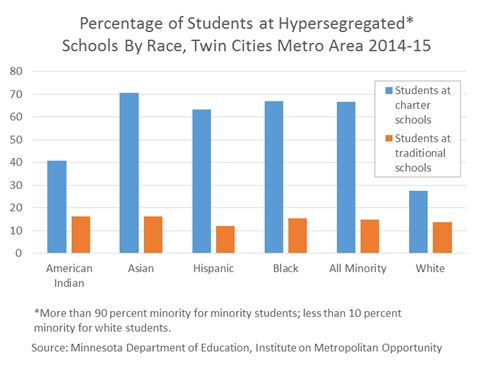
So Cruz-Guzman became a plaintiff in a lawsuit—one that may shape the future of American education. Filed against the state of Minnesota by two veteran civil rights attorneys, Daniel Shulman and his son John Shulman, the suit accuses the state of allowing schools with high concentrations of poor and minority students to proliferate. A 2015 Minneapolis Star Tribune analysis found that elementary school students in the Twin Cities attend more racially segregated schools than they have in a generation. Children who attend such schools, the lawyers argue, achieve far less than their peers in integrated institutions. The lawyers also say that the growth of charter schools, which are even more racially segregated than traditional public schools, have exacerbated these trends.

The Shulmans are seeking a metro-wide integration plan to satisfy what they argue is the state’s constitutional obligation to prevent segregated schooling. They cite the state constitution’s education clause, equal protection clause, due process clause, and the Minnesota Human Rights Act to make their case.

Not everyone agrees that this kind of integration is legally necessary or the best way to meet children’s needs. Some see the suit as a threat to parents’ right to choose the schools that would best serve their children. This is particularly true for parents of color, who sometimes send their children to charters in the hopes of avoiding what they see as hostile traditional schools.

John Cairns, one of the most experienced charter school attorneys in the nation, is working against the lawsuit. “If the state is going to do anything, then they’d have to attack parental choice,” says Cairns. “While the plaintiffs are inexplicit about what their remedy would be, in our view, they’re explicit that their remedy would address charter school enrollments. The only way they could do that is to have some conclusion that parental choice is unconstitutional.”

Daniel Shulman sees in this argument an echo of Plessy v. Ferguson. He thinks charter school advocates are arguing, in effect, that separate schools can be equal. “We don’t think that’s true or the law. If they follow the law, they’ll say separate is not equal, and not equal is inadequate,” he says. “All the data will support that … test scores, graduation
rates. School segregation is a national tragedy and disgrace.”


It’s fitting that this fight would take
 place in Minnesota
, which is both the birthplace of the charter school movement, and a longtime champion of civil rights.

Minneapolis enacted the nation’s first fair housing and fair employment ordinances, and Minnesota passed one of the first state laws banning housing discrimination. In 1948, it was an impassioned speech to the Democratic National Convention by Minneapolis Mayor Hubert Humphrey that led the Democratic Party to pass its first civil rights platform plank. In the early 1970s, under a court order, Minneapolis moved to integrate its public schools. This prompted the state to issue desegregation rules applicable to schools across the state. By the early 1990s, Minneapolis and St. Paul had not a single racially segregated school, and the Twin Cities metropolitan area was one of the most desegregated regions in the United States.

“We had no segregated schools because we had strong civil rights laws and we enforced them,” says Myron Orfield, a law professor at the University of Minnesota and the director of its Institute on Metropolitan Opportunity.

Today, the educational landscape looks quite different. While the number of people of color living in the Twin Cities metropolitan region—defined as Minneapolis, St. Paul, and the surrounding suburbs—has increased considerably over the past two decades, integration advocates say that demographic shifts alone are insufficient to explain the growth of segregated schooling in Minnesota.

And grown it has. Since 2000, the number of elementary schools in St. Paul educating more than 90 percent students of color grew from 2 to 18, while the overall percentage of students of color in the district rose only 11 percent. Similar shifts occurred in Minneapolis. In 1995, the Minneapolis School District was 63 percent nonwhite, but had only two elementary schools that were 90 percent segregated. Today the district has 13 such elementary schools, and 26 percent of district students attend schools with over 90 percent students of color.

MPS SPPS demograpic change chart FIXED.png

The demographics of the 164 charter schools in Minnesota—which roughly 50,000 students attend—have also impelled the state to argue, for the first time, that charters should no longer be exempt from state integration laws. (An administrative judge will rule on this separate dispute in late February.)

The resegregation of the region’s schools, critics say, was the product not just of demographic change but also of conservative pressure in the 1990s to weaken desegregation mandates, coupled with the rise of a charter sector that targeted specific races and ethnicities, thereby accelerating the isolation of poor and minority students. The growth of charter schools, they add, also created new opportunities for white children to congregate in separate schools. Charters attended by predominately white students grew by 40 percent between the 2007-08 school year and the 2012-13 one. Researchers found that more than half of these white charters are located in attendance zones with racially diverse traditional schools.

Opponents of the state’s proposal, and of the Shulmans’ lawsuit, argue that their proponents—state officials, Myron Orfield, and his allies—misapply the label of  “segregation” when talking about charter schools. “I find it offensive and insulting to compare parents of color making choices to send their kids to schools that are better addressing the academic needs of their kids with segregation, a system that was set up by white supremacists decades ago to force students of color to inferior schools,” testified Alberto Monserrate, the first Latino ever elected to the Minneapolis School Board, in early January.

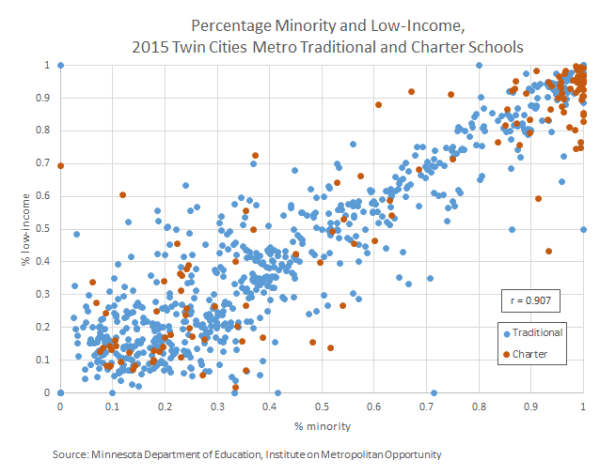
Whether or not one thinks these schools should be considered segregated, the rise of schools with high concentrations of racial minorities—both in traditional schools and in charters—means an increase in the number of schools serving high concentrations of poor students. Researchers at the Institute on Metropolitan Opportunity find the poverty rate at Twin Cities minority-segregated schools to be two-and-a-half times greater than the poverty rate at integrated schools, and five times greater than the poverty rate at predominantly white schools. They also find that math and reading test scores for black students at highly segregated schools are lower than test scores for black students at less segregated schools. Suspension rates, too, are substantially higher in racially segregated elementary schools than in less segregated ones.

IMO.png

“Yes, there’s a difference between segregation that’s imposed by the state versus segregation that is through choice, the first is worse than the second,” says Richard Kahlenberg, a senior fellow at The Century Foundation and a longtime researcher of school integration. “However, the negative effects of concentrated poverty obtain even when concentrated poverty is a matter of constrained choice.”


This is not Daniel Shulman’s first time filing a school segregation lawsuit against the state. In 1995, Shulman sued Minnesota, arguing that segregated schools in the Twin Cities metropolitan area violated both the state and federal constitutions. The case settled five years later, and as part of the settlement, Minnesota established a voluntary integration program between Minneapolis and ten neighboring suburban districts. Most participants were poor minority students who enrolled in predominately white suburban schools.

“But the segregation in Minneapolis and St. Paul is worse today than when I started the first case 20 years ago,” says Shulman. “That’s why I brought the case again, and I’m sorry I waited this long to do it.”

Shulman’s legal strategy rests on a theory that, at this point, is still very much untested. In the past few decades, it’s become increasingly difficult for civil rights advocates to win federal school desegregation lawsuits. Following the 1978 Supreme Court case Milliken v. Bradley, courts began to draw sharper distinctions between de jure and de facto segregation; the Supreme Court said unless it could be shown that a district deliberately sought to discriminate against students by race, it could not be held responsible for school segregation.

“Federal desegregation rulings are about racial discrimination, which looks at intent to discriminate,” says Derek Black, a professor at the University of South Carolina School of Law, who studies education law and policy. “Since the 1980s and 1990s, it’s become more and more difficult to prove intent, which means more and more districts have been released from their desegregation obligations.”

By suing the state, rather than the federal government, the Shulmans aim to bypass all those sticky questions about intent. “What they’re saying is that the actual existence of segregated schools creates an educational harm, and the state ought to correct that harm, regardless of why it came about,” explains Black.

Their strategy has been tried once before, in a 1989 Connecticut lawsuit known as Sheff v. O’Neill. The plaintiffs argued their constitutional rights were violated because the concentration of African-American students in a particular district was a violation of the state’s right to equal education.

The case made its way up to the state Supreme Court, and in 1996, the justices ruled that Connecticut had an affirmative obligation to provide its students with equal educational opportunity. This constitutional right, they concluded, necessitated providing students with integrated educations, and so the state moved to establish an array of voluntary integration options.

Though Sheff is not controlling law in Minnesota, it is expected that Minnesota judges would consider it if they adjudicate the Shulmans’ suit. “I think the more courts that say an idea is a good one, the more likely it is that courts that follow after them will agree,” says Black, pointing to school funding lawsuits as an example. However, Sheff was notably litigated before the rise of charter schools.

In 1993, Minnesota’s Supreme Court ruled that all students are guaranteed a fundamental right to an adequate education. In their new suit, the Shulmans seek to argue that no education could possibly satisfy the state’s adequacy requirement given the highly segregated environments.

Lawsuit opponents argue that “adequacy” should be measured not by the composition of student bodies, but by demonstrated achievement. “What we’re saying is the first thing to look at is whether kids are learning, not who is sitting in the classroom,” says Cairns, the attorney representing the charters. “And once you establish that kids are learning, then that’s the measure of an effective and adequate education.”

Derek Black says most states do consider achievement “outputs” when determining whether students are receiving adequate educations. Such outputs could be scores on standardized tests, graduation rates, or college readiness measures. Though variance exists from state to state, Black says most courts would look at both outputs and inputs. “The question would be whether the failure to provide certain inputs is the cause of an inadequate education, as measured by various outputs,” he says. If Minnesota’s judiciary takes up this groundbreaking case, they will have to decide whether racially and economically integrated schools are necessary inputs.

“I think there’s an increasing recognition that equal education is the constitutional responsibility of state governments, and therefore [states] have to promote policies to avoid racial and economic segregation,” says Phil Tegeler, the executive director of the Poverty & Race Research Action Council, and a leader in the National Coalition on School Diversity. Tegeler hopes lawyers in other states will follow the Shulmans’ lead. “We really need to see more creative, affirmative litigation,” he says.

“This is huge, you could potentially have 50 state lawsuits on this issue,” says Kahlenberg.

Opponents of the lawsuit, and of the state’s plan to include charters under statewide integration rules, say that there’s been a fundamental misinterpretation of what segregation is. They deny that charter schools targeting specific races or ethnicities are illegal or unjust. Rather, they say, these schools provide students with “culturally affirming” environments in which to learn.

Bill Wilson founded one such “culturally affirming” charter in St. Paul—known as Higher Ground Academy. Though Higher Ground’s student body is more than 90 percent East African immigrant and low-income, it’s one of the highest performing schools in the region. Advocates say the school’s success is due to its unique, and culturally sensitive education strategies. “I know people who brought this lawsuit against the state use the word ‘desegregation’ but let’s find the intentional action,” Wilson says. “I won’t call this segregation, I won’t call it racial isolation, because it’s not true.”

“It’s a false analysis that’s being applied to culturally specific charter schools, that tends to consider those schools to be segregated,” testified Nakima Levy-Pounds, the president of the Minneapolis NAACP chapter. “That flies in the face of civil rights history and also the fact that we have historically black colleges and universities around the country that are specifically designed to affirm, enrich, and enhance the educational experiences of African-Americans who we know have faced historical discrimination throughout our time in this country.”

Darrick Hamilton, an urban policy professor at The New School, says his research suggests there certainly could be instances where predominately black schools may be better learning environments for black students. Quoting W.E.B. Du Bois, he says, “The Negro needs neither segregated schools nor mixed schools. What he needs is Education.”

Even among those in the Twin Cities who advocate for integration, the civil rights community remains torn over how to think about charter schools.While the St. Paul NAACP welcomes the Shulmans’ new lawsuit, for example, its leaders have not taken a position on their charter school argument, or on whether charters should be exempt from statewide integration laws.

“It’s hard enough to get a broad coalition of people to say we want to integrate the schools, and when you add the charter school issue, the politics just become much more challenging,” says one Twin Cities civil rights leader. “There are definitely some advocates who say we should focus on desegregating the traditional schools, and if the districts can get their act together then demand for charters will [naturally] go down, because parents will trust that traditional schools can take care of their kids.”

But researchers at the Institute on Metropolitan Opportunity say that segregated charter schools perform even worse than segregated traditional schools. With the exception of a few high performing networks—including Bill Wilson’s Higher Ground Academy—they find that most charter schools that serve high concentrations of impoverished racial minorities produce poorer academic results than traditional schools, even after controlling for variables like poverty and race. The Minnesota Star Tribune also found that slightly more than half of all students in Minnesota charter schools were proficient in reading, compared to 72 percent in traditional public schools.

Defenders of “culturally-affirming” institutions don’t spend much time talking about white charter schools. Yet white charters are on the rise.

“One of the problems with allowing culturally-focused schools to become single-race enclaves is that, once you create a legal justification for these schools, it becomes very difficult to prevent white parents from adopting the same language to create white segregation,” says Will Stancil, an attorney with the Institute on Metropolitan Opportunity. “Integration isn’t about exposing kids to some magic aura of whiteness, it’s about the importance of universal inclusion in education: providing all children full access to the teaching, resources, and networks that the most privileged kids currently have.”

IMO Charters.png

Those who do support including charters in the lawsuit and under statewide integration rules point to a “Dear Colleague” letter that former Secretary of Education Arne Duncan sent around in 2014. Duncan’s federal guidance said charters must be included in court-mandated or state-administered desegregation plans.

“You just can’t exempt charter schools from the basic civil rights laws of the state, they’re supposed to be publicly funded public schools, and they should be subject to the same civil rights requirements as other public schools,” says Phil Tegeler. Myron Orfield says Minnesota is the only state that he knows of that explicitly exempts charters from its civil rights laws.

The rhetoric surrounding these legal battles will likely grow even more charged in the coming weeks and months. By the end of February an administrative law judge should make her final decision on whether charters will be exempt from statewide integration rules. However, if the Shulmans ultimately win their lawsuit, some say this could render any charter school exemptions moot.

“I think ultimately the lawsuit could trump the rule,” says Derek Black. “It could require the state to do a whole variety of things.

Daniel Shulman isn’t worried about what the judge will decide with regards to charters and the state rule. “It would be nice if there were a rule that effectively desegregated Minnesota’s schools—that’s one way the state could begin to remedy the result of its past constitutional violations,” he says. “But this rule is not going to effect the lawsuit.”

The state of Minnesota has filed to dismiss Shulman’s lawsuit, and a judge will consider this motion in a hearing in April. (A spokesperson for the Minnesota Department of Education told The American Prospect that they cannot comment on the case, but is “committed to helping every student achieve academic success.”) If the case is not thrown out—and it can be appealed, if it is—then the trial will likely be scheduled for late 2017.

“I know for a lot of leaders it’s convenient to not do anything or to not talk about these issues, but for the children who are kept separate, it’s wrong,” says Cruz-Guzman. “We feel we’re doing the right thing by bringing the lawsuit.”

Minnesota is not the first state to wrestle with the challenges of balancing school choice and desegregation. And it surely won’t be the last. Cairns, who serves on a litigation panel for the Alliance of Public Charter School Attorneys, says that he and his colleagues recognize the “wide-ranging implications” of this case. Though it’s not a federal suit, Cairns believes its outcome will be “hugely important to provide direction” to the rest of the country.

New York City Tackles School Segregation

Originally published in The American Prospect on December 9, 2015.
—–

Six decades after the Supreme Court ruled that segregated schools are “inherently unequal,” integration may finally be coming to New York City.

With 1.1 million students, New York City is home to one of the nation’s largest public school systems; it’s also one of its most economically and racially segregated.

For decades, nobody in the city besides a few die-hard activists seemed to care much. Over the past year and a half, however, a perfect storm of provocative research studiesnews reportsrezoning fights, and public advocacy have forced public officials to take notice.

Last month the New York City Department of Education announced that at the start of the 2016-2017 school year, seven public elementary schools will participate in a new pilot program designed to diversify student bodies. Each of the seven schools will be permitted to set aside a certain percentage of seats to give priority enrollment to various student populations, including English language learners and those living in poverty.

Though some advocates have expressed concern that the pilot program is too little, too late, there are signs that that even bigger desegregation efforts are yet to come.

This pilot represents the first concrete step taken by New York City Mayor Bill de Blasio’s administration towards desegregating the city’s public education system. Despite de Blasio’s reputation as a progressive, his administration has so far failed to tackle the segregation issue head-on.

As an example of his administration’s half-measures, earlier this fall, New York City Schools Chancellor Carmen Fariña suggested that instead of desegregating schools in poor neighborhoods, public schools could diversify by pairing students in wealthy schools with kids in low-income schools to share resources, meet in person, and become pen pals. Fariña also said school diversity could be promoted by teaching students about world religions in their classrooms.

These proposals drew fire from school equity advocates, but de Blasio defended them, and suggested that promoting school choice and high-quality schools are more pressing priorities than desegregation. Critics faulted de Blasio for perpetuating the policies of his predecessor, Michael Bloomberg, who also did little to tackle segregation.

“The whole idea of us voting Bill de Blasio into office, with his mixed family, was for him to usher in a new agenda—a progressive agenda,” says Jose Vilson, a New York City math teacher and prominent social justice activist. “But what we’ve seen is that he still has to deal with the old politics defined by Giuliani and Bloomberg.”

De Blasio also took heat for failing to follow up on the few steps toward integration that Bloomberg’s administration did take. At the start of the 2013-2014 school year, P.S. 133, an elementary school located in a gentrifying part of Brooklyn, unveiled the city’s first-of-its kind admissions program to reserve spots for English language learners and low-income students. Bloomberg’s then-school chancellor, Dennis Walcott, hailed the innovative program as a potential model for other schools.

But de Blasio failed to follow through once in office, and officials within his administration told principals who wanted to establish diverse admissions policies that the city lacked the legal authority to approve their requests. School equity advocates cried foul—pointing to federal Education Department guidance posted in 2011, which affirmed school districts’ legal right to promote diversity through admissions.

Now that de Blasio has come around, advocates make sure to point out that they had been right all along. David Tipson, the executive director of New York Appleseed, an organization that promotes equity in schools, says that the de Blasio administration’s recent pilot announcement “represents a complete and utter rejection of those bogus legal arguments” that they had used for so long.

MOST SCHOOL INTEGRATION ADVOCATES have hailed the seven-school pilot program, but warn that de Blasio’s one-school-at-a-time approach has pitfalls. There are more than 1,700 public schools in the city, and if desegregation efforts are not carefully coordinated, then desegregating one school can have the adverse effect of exacerbating segregation at another.

To really foster school integration, advocates say, the city needs to adopt what’s known as “district-wide controlled choice”—a desegregation model used in other cities, such as Cambridge, Massachusetts, and Champaign, Illinois—that aims to balance parental choice with diversity. Parents rank their top school choices within a particular district, and then the district assigns students in a way that accounts for those preferences while also ensuring that each school has an integrated student body. (In New York City, this would mean assigning students within the system’s 32 separate school districts.)

“There’s always a fear with incremental change that the most recent increment is your last—that maybe this is as much as we’ll ever get, but I think this [pilot announcement] is really just breaking the seal,” says Tipson, who notes that this is the first time the de Blasio administration has acknowledged that gentrification must be managed at the school level, and not just through housing policy.

The school integration debate will only intensify in New York City, where gentrification and school overcrowding are both growing issues. This past May, the New York City Council passed a new law known as the School Diversity Accountability Act that requires the city to annually publish detailed student demographic data and make clear what steps it has taken to advance school integration. The first report generated by the new law will be published at the end of December.

“I think the pilot program is a good first step, and I hope more schools will do it, but I also agree that in a city with 1,700 schools we have a lot more steps to take,” says City Council member Brad Landers, a co-sponsor of The School Diversity Accountability Act. “We have to keep pushing forward, and the most important and most immediate next steps need to be moving towards district-wide diversity.”

Julie Zuckerman, a principal at Castle Bridge, a Washington Heights-based elementary school participating in the diversity pilot, says when she first founded Castle Bridge six years ago, nobody was interested in discussing integration. She tried to get the city’s permission to prioritize diversity in their admissions lottery, but officials were not supportive. Now under the pilot program, Castle Bridge will be able to ensure that at least 60 percent of its student body qualifies for free or reduced-price lunch, and that the school educates at least 10 percent of kids with incarcerated parents.

Zuckerman says she also plans to build off the momentum from this pilot program to push for district-wide solutions. She currently serves alongside a half dozen other principals on a city superintendents’ advisory panel, where she intends to make the issue a priority.

“This [pilot] is not even a drop in the bucket, and yet it’s the first acknowledgement by the city that it doesn’t have to be the tail wagging the dog on gentrification,” she says. “Let’s harness gentrification instead of being determined by it.”

The seven schools in the pilot program all happen to be progressive schools—that is, institutions that test innovative, often experiential curricula in ways that appeal to middle-class parents. Though many of the progressive schools started out with diverse student populations, teachers and administrators say they have recognized that their school demographics have started to shift in recent years, as more affluent families apply, and poorer families find they can no longer afford to live in the city.

Jia Lee, a teacher at The Earth School, another diversity pilot participant, notes that over the last few years, her school has grown “much more white and middle class” and that it no longer feels “reflective of the community.” She says the school’s new set-aside policy, which will reserve 45 percent of its seats for low-income students, will help ensure that their school can educate a diverse student body in the years to come.


ONE OF THE BIGGEST POLITICAL CHALLENGES for advocates of district-wide controlled choice is garnering support from parents who send, or intend to send, their children to public schools that already have mostly white and affluent students. Last month, de Blasio told Chalkbeat NY: “You have to respect families who have made a decision to live in a certain area oftentimes because of a specific school.” In effect, he suggested that given the investments parents have already made to send their kids to certain schools, it would be wrong to try and modify those institutions after the fact.

His comments immediately garnered pushback. “Is it not disrespectful, in fact, to tell low-income families that they can’t go to a certain school because they couldn’t buy a several million-dollar co-op?” wrote Donna Nevel, a local educator and activist in an open letter published in The Huffington Post.

Experts say that the set-aside policies will work to prevent more schools from “slipping”—a term used to denote formerly diverse schools that have become heavily gentrified. If fewer schools “slip,” then there may be less political opposition to larger, systemic policy change.

Dao Tran, a parent of a third grader at Castle Bridge, says that while she doesn’t believe desegregation is something that can be solved school by school, she thinks advocates “have to start by showing certain integrated models that work.” In that sense, Tran believes the success of this pilot program could help to persuade skeptical parents.

“To me, these are all steps along the way, and I agree if we just stopped with this pilot then we have not done anywhere near enough,” says Landers, of the City Council. In a statement, the city’s education department also said the pilot program “remains one piece of a larger effort” to expand diversity across city schools.

The next step, advocates say, will be building a political consensus behind real change.

“It’s almost easier to talk about police brutality than it is to talk about school integration,” says Landers, noting that a swirl of of guilt, resignation, parents’ concerns for their own kids, and racism all work together to make school segregation a tough issue for people to reckon with.

But Ujju Aggarwal, a New York City education researcher and activist, voices optimism. In her 15 years in the district, Aggarwal says she has never seen school integration discussed so broadly until now.

“What’s increasingly clear is that this city has to take a stand respond to the crisis of inequality and segregation that is particularly pronounced in our education system,” she says. “I’m hopeful that with the increased visibility of this issue the city will respond in a more systemic way.”

Can Affordable Housing Help Retain Teachers?

Originally published in The American Prospect on November 18, 2015.
——

On December 1, Allison Leshefsky, an elementary school gym teacher in San Francisco, will be evicted from the rent-controlled apartment she’s lived in for the past ten years. She and her partner pay $2,000 a month in rent, but if their place were put on the market, it would likely go for at least $5,000 a month—far more than any public school teacher could afford. As of August 2015, one-bedroom apartments in San Francisco rented for an average of $2,965 a month, and two-bedrooms for $3,853. Leshefsky’s landlord, who manages and partially owns nine San Francisco properties, has gained notoriety for evicting or allegedly forcing tenants out, in order to rent their units for more money.

Leshefsky has decided to finish out the school year teaching in San Francisco, even if that means paying jacked up prices for an air mattress she finds on Craigslist. “I’m making a commitment to get through the rest of the year regardless of whose couch I’m on or whose overpriced house I’m in,” she says. “I’m making a commitment to my students to finish this out.” But then, she says, she’ll have to leave.

In recent years, a growing number of researchers, policymakers, and philanthropists have directed their attention to the relationship between housing instability and student achievement. A great deal of evidence has shown how homelessness and housing insecurity can negatively impact a student’s behavior, which creates problems not only for them but for their classmates and teachers as well. A host of educational interventions are being tried in conjunction with local housing authorities, and some cities are even tying housing vouchers to specific struggling schools—in the hopes that such requirements will reduce student turnover and increase school performance.

Yet despite the perennial quest for top-notch teachers, less attention has been paid to the relationship between educators and their housing. It doesn’t require a great stretch of the imagination to think that teachers’ instructional capacities could be impacted by conditions they face outside the classroom, such as high rents, or unsafe housing. “There is no possible way the city can recruit talented people and maintain them with the housing crisis here,” says Leshefsky. “Students deserve teachers that are secure in their homes, and when a teacher is not secure, they can’t be the most effective educator.”

The city of San Francisco seems to agree. Last month, San Francisco’s mayor announced a new plan, formed in partnership with the school district and the teachers union, to provide housing assistance to some 500 public school teachers by 2020. Elements of the plan include forgivable loans, rental subsidies, housing counseling services, and the development of affordable housing specifically for teachers. This month, 73 percent  of San Francisco voters approved a ballot measure that will help make this plan a reality.

Across the country, other variants of teacher housing developments have cropped up, or are in the works—though the motivations for them, and allies behind them, differ from city to city. From San Francisco, to West Virginia, to Philadelphia, the efforts to attract, or retain, teachers through subsidized housing is growing more pronounced, and debates over how such projects impact their surrounding communities are likely to intensify in the coming years.

MATTHEW HARDY, the communications director for the San Francisco teachers union, says the union has a three-pronged strategy to deal with the city’s housing crisis. The first involves fighting for higher wages. In December 2014, the union negotiated a substantial salary increase for teachers and aides—a raise of more than 12 percent over three years. “But if we just limited ourselves to that, we’re not going to be successful,” says Hardy, which is why the union has also been pushing for teacher housing—using surplus district property—and for broader affordable housing policies for all city residents.

“Of course San Francisco is a wonderful place, and some people are willing to make immediate sacrifices to get their foot in the door, but it gets to a point where teachers start to wonder if they should continue paying $1,500 a month for a tiny room or move to the suburbs [where salaries are higher and housing is cheaper] and make $15,000-$20,000 more,” says Hardy. “We need to find ways to support teachers early in their careers, but also those who are more experienced and might want to start a family or buy a home.”

“If affordable brick-and-mortar teacher housing were actually here right now, and not several years in the future, then there would be no doubt in my mind that I would have continued to stay in the district,” Leshefsky said, wearily.

A very different sort of housing crisis plagues McDowell County, West Virginia—a poor, rural area, with a population that’s fallen by 80 percent since the 1950s. Teachers aren’t being priced out, but few want to move there, and those who might be so inclined struggle to find attractive housing options.

In 2011, former West Virginia First Lady Gayle Manchin asked Randi Weingarten, the president of the American Federation of Teachers (AFT), to help her figure out a way to improve McDowell’s school system. They started to organize a coalition of public and private organizations to tackle not only educational issues, but also regional poverty. In a speech given in 2012, Weingarten called this effort “solution-driven unionism.” Rather than shut down a school that’s struggling, she argued, unions can push to strengthen them with wraparound services. Then “learning improves, the school improves, community schools become more attractive than private or charter schools, people return to them with new confidence, home values increase and communities are renewed.”

Part of the McDowell plan includes not just wraparound services for community members, but also new apartments to attract teachers who might not otherwise want to move to McDowell County. As the lead coordinator involved in the teacher housing complex told Governing, “You can’t expect someone to leave life on a college campus for an isolated area where they live in the middle of nowhere and don’t know anybody.”

“What we’re constructing is the first multiple-story building in the area in decades,” said Weingarten in an interview. “The housing will address three big issues: the high teacher vacancy rate, the dearth of available housing, and the need for economic development.”

WHILE McDOWELL COUNTY’S “teacher village” won’t be the nation’s first, others are generally found in urban areas, and have been constructed largely without the involvement of the local teachers unions. In fact, partners more closely aligned to the educational reform movement have led them—those with ties to charter school networks and organizations like Teach for America.

In 2012, then-Mayor of Newark Cory Booker, New Jersey Governor Chris Christie, leaders from Google and Goldman Sachs, and others gathered to break ground on the Newark Teachers Village—a downtown Newark development that houses three charter schools, a daycare facility, more than 200 subsidized teacher apartments, and nearly two dozen retail shops. The project received tens of millions of dollars in tax credits. (The Wall Street Journal reported on the event with the headline: “Viewing Newark as a ‘Blank Canvas’”.) The real estate development group that spearheaded the project, RBH Group, is listed as a Teach for America corporate sponsor, and one of RBH’s founding partners, Ron Beit, is the chairman of the board of TFA’s New Jersey chapter.

The Newark Teachers Union, an affiliate of the AFT, originally backed the Newark Teachers Village—though Newark teachers say that their now-deceased president, Joseph Del Grosso, did so without consulting union members. The AFT is an affiliate member of the AFL-CIO, a federation of labor organizations that includes construction unions, and some think Del Grosso supported the plan because it carried the potential to create new construction jobs, not because it was actually in the teachers’ interest. However, despite Del Grosso’s initial support, the union was ultimately uninvolved with the project.

“They basically shut out the public school teachers and the public school union,” said Weingarten in an interview. “Just like they shut out the community from their reform efforts, they shut us out too. Initially we had conversations [about the Teachers Village], and then we were stonewalled.” Had the AFT been involved, then the union likely would have invested pension funds into the project, which may have broadened, and diversified, the project’s mission, and given more stakeholders a say in shaping its development. The union could have also pushed to bring on different types of asset managers, like the AFL-CIO Housing Investment Trust, which they used in West Virginia and San Francisco. Ron Beit did not return repeated requests for comment.

Over the past couple years, similar teacher housing projects have opened up in other East Coast cities. In 2009, the Seawall Development Corporation established Miller’s Court in Baltimore, using millions of dollars in local, state, and federal tax credits—and another, Union Mill, a few years later. The lead developer, Donald Manekin, was a former board member of Teach For America, and said he originally got the idea to build teacher villages when he saw 100 new TFA members arriving in Baltimore each year. “We’d sit at the end of these board meetings and say wouldn’t it be great if there was a great place for teachers new to the city?” He made these remarks to Newsworks in 2013, as his company prepared to build another teacher housing complex in Philadelphia.

Teach For America’s vice president for administration, Matt Gould, told The New York Times that his organization backs the projects because they “allow [teachers] to have safe, affordable housing. It’s a recruiting tool.” Teach For America is also reportedly looking into New Orleans and Washington as additional cities to expand teacher housing.

I spoke with Thibault Manekin, Donald Manekin’s son, and co-founder of Seawall Development Corporation, about his work building teacher housing. “Really our goal was to provide Class-A apartments and space for teachers doing the most important work in our city, which is helping kids get an education,” he said. To do this, the Manekins provide teachers with a free fitness center, free parking, reduced rent, lounge space, and other amenities that one might find in a more expensive apartment building. (Their website describes the buildings as “an urban oasis”.) Manekin says his company is in the middle of a similar project in Springfield, Massachusetts, and helping others think through comparable developments in other cities. “Yeah, I think you’ll start to see this spread more,” he said.

I asked him if he thought Baltimore teachers had struggled to find safe or affordable housing before he and his father embarked on their projects. “I think the challenge was that teachers, often new to Baltimore, and new to the classroom, weren’t living with like-minded people, and so might be making bad decisions on where to live,” he said. “As a result of that it makes the job that much harder. We just wanted to provide them with a world class space at a significant discount.”

While safe and affordable housing was available, he went on, “you wouldn’t really be living with people in the same boat as you.” They wanted to establish a space where teachers could lean on one another outside of the workplace.

Weingarten says the union was not included in the Philadelphia project, and was only cursorily consulted with for the Baltimore developments.

BRANDEN RIPPEY, a Newark public school teacher who has been working in the district for 18 years, said he acknowledges that Newark needs to build better housing to attract high-quality teachers. “Newark isn’t San Francisco. You do need to work to draw people in, and some of the housing we have here is in bad neighborhoods, and there is crime,” he says. As well, most of Newark’s teachers live outside of the city, so the idea of enabling teachers to establish roots as residents within the community is something he also likes. “I support the idea of creating good, affordable housing for working class people. The problem is that [the Newark Teachers Village] is clearly designed for white, young professional types, at a time when we desperately need more housing for poor people of color.”

Rippey notes that the Teachers Village is located close to other redevelopment projects in downtown Newark. “It’s just becoming a little yuppie commercial district,” he says. “The reality is they have a vision for gentrifying the whole downtown.” Rippey believes that these projects serve as a way to easily import TFA teachers, and by extension, weaken union power. Whereas developers like Beit and Manekin see the teacher housing complexes as positive ways to build communal spaces for local educators, Rippey thinks they can serve as a vehicle to isolate new and relatively young teachers from the union and the broader community. “It’ll keep those teachers residentially, and almost culturally, segregated,” he says.

IN A WAY, these Teachers Villages function as sort of a camp experience. You may be making a two-year commitment to live and work in an unfamiliar city, one that perhaps you, or your family, worry is unsafe. You know that you’re going to be working hard, long days—and so living in close quarters with people going through similar experiences might be quite comforting. All in all, it appears to be a pretty good deal—you’ll be afforded lots of amenities and discounts, you’ll live in a place you know is secure, and you’ll have the chance to develop friendships with other “like-minded” individuals.

In 2013, Mark Weber, a public school teacher and an education policy doctoral student, wrote some strong critiques about these new teacher housing projects.

It’s the perfect scheme: Beit and his private investors get tens of millions of dollars in tax credits to finance the development. He then turns around and rents his commercial units to charter schools, which drain tax revenues away from the neighboring public schools (which could sorely use the money to shore up their crumbling infrastructures). Those schools then pay their young teachers, recruited from TFA, who then turn around and pay rent to Beit. So Beit’s managed to develop three revenue streams—tax credits, charter school rents, and teacher residence rents—all made possible by the proliferation of charters and TFA.

And here’s the real beauty part: If the neighborhood gets gentrified and property values rise, the increases accrue to the property owners—like Beit—but not the people who actually live in the neighborhood. Think about it: If these teachers were buying brownstones and condos, the rising property values would accrue to them. But, because they’re renters, and not owners, they don’t see any of the increase. Their presence will raise the value of the neighborhood’s properties, but they’ll get none of the reward (assuming everything goes according to plan).

I called Weber to discuss some of his thoughts in greater detail. He sounded skeptical that these subsidized projects had much value at all: Will they really help attract lifelong educators into the profession, or will they just serve as a nice perk for young teachers who wouldn’t stay in the classroom beyond a few years anyway?

“If these charter schools need young people who are willing to work long hours and do the career for just a couple years, then things like teacher villages are almost custom-made, because you’re not going to be buying condos, and it’s close to your work,” he said. “Is that sustainable? I would argue no if we’re trying to build a workforce that sees teaching as a lifetime career. We could continue to build, or we can ask ourselves if we’re paying teachers enough money. If you can’t comfortably live here without staying in subsidized housing, maybe that’s a problem.”

Others have also questioned whether this whole subsidized housing deal isn’t just a misplaced way to avoid paying teachers significantly higher salaries. An individual used to feel more comfortable entering the teaching profession—despite its lack of prestige or big paychecks—given the relative stability if offered: a middle-class life, solid health care benefits, and a stable pension to live on during retirement. Today, however, those sorts of guarantees are beginning to fall by the wayside.

“If you’re not going to offer good health care benefits, what are you going to offer to get people to join the profession?” asked Weber. “Some modest rent control in hip neighborhoods? That’s not going to help the neighborhood much, and that’s not going to be much of an incentive to go into teaching.”

MAYBE SUBSIDIZED HOUSING that targets young professionals won’t be what it takes to help attract career educators, yet it’s clear that cities do want to help recruit and retain educators who actually live in the communities in which they serve—an effort that may require more than just a salary increase (though that would help.) Whether it’s a Teach for America participant looking for a supportive communal space, or a mid-career educator with a family who wants to live closer to his or her workplace, thinking about the intersections between housing and teaching is something that even the most progressive unionists, like Rippey, believe we should be doing more of.

Weingarten defended the AFT’s McDowell and San Francisco projects, and contrasted them with the ones in Baltimore, Newark, and Philadelphia. “We’re not looking to create a boutique pipeline for some people to work in different communities, it’s not that,” she said. “It’s about creating affordable housing so people can establish roots in the cities in which they live.”

Still, even teacher villages more closely aligned to the reform movement are helping young teachers, and local nonprofit organizations, forge better ties with the communities in which they serve. “The amount of teachers that have actually stayed in the classroom and in Baltimore, and then gone out and bought homes has been really inspiring to see,” said Thibault Manekin. Of the 30 homes he and his father have built in Baltimore, he says 20 have been sold to former tenants of Miller’s Court and Union Mill.

Would Leshefsky be willing to live outside San Francisco and continue working at her school with a longer daily commute?

“No, I would not be willing to do a two-hour commute just to serve a community that I don’t belong to,” she said. “I’m one of the most constant people in my students’ lives right now, and I don’t think someone who lives outside the city can necessarily connect with their students in the same way. We’re all going through very similar struggles.”


Sorry, Walmart: Charter Schools Won’t Fix Poverty

Originally published in The American Prospect on June 30th, 2015.
——-

Last week, the American Federation of Teachers (AFT) and In the Public Interest released a highly critical report on the Walton Family Foundation’s K-12 education philanthropy, which ended with a call for increased transparency and accountability in the charter sector. The gist of the report is that the Walton Family Foundation—which has kick-started about one in four charters around the country—“relentlessly presses for rapid growth of privatized education options” and has opposed serious efforts to regulate and monitor fraud and abuse. While the foundation supports rapidly scaling up charter networks that have produced promising results, the AFT and In the Public Interest cite a 2013 Moody’s Investment Services report which found that dramatically expanding charter schools in poor urban areas weakens the ability of traditional schools to serve their students, forcing them to lay off teachers, increase class sizes, and cut programs to make ends meet.

A month earlier, Philamplify, an initiative of the National Committee for Responsive Philanthropy (NCRP), published its own report on the Walton Family Foundation’s impact, and found that although they have achieved meaningful results through their environmental philanthropy, “an overreliance on specific market-based vehicles” hinders their ability to create “sustainable and equitable” improvements in education. Philamplify also criticized the Walton Family Foundation for “insulating itself among like-minded peers rather than connecting with the broader field.”

While the Walton Family Foundation did not return my request for comment, Education Week reported that their spokesperson, Daphne Moore, defended their commitment to high-quality schools. Education Week also cites Greg Richmond, the president of the National Association of Charter School Authorizers (NACSA)—an organization that receives funding from the Walton Family Foundation—who argued that the foundation has long demonstrated a commitment to accountability and transparency.

This discussion is sure to continue over the coming months, but what was particularly striking was something in the Walton Family Foundation’s response to the Philamplify report—a statement that has been reiterated by the foundation many times over the past several years. Marc Sternberg, the foundation’s K-12 program director, said, “Education is the set of work we can support that will most directly end the cycle of poverty and change the trajectory of young people’s lives.”

The notion that education is needed to break the cycle of poverty is a popular mantra of the education reform movement. The problem is, it is simply not true at all. The most direct way to break the cycle of poverty is actually to give poor people more money, something that high-quality educations, even college degrees, do not in any way guarantee. So when it comes to the question of redistribution—an integral component to any comprehensive anti-poverty program—the political work of the Walton family deserves far greater scrutiny.

Waltons, Walmart, and Politics

The Walton family heirs own a majority of public shares in Walmart, the U.S.’s largest private employer, which easily makes them some of the richest people on earth. Today, the Walton family has more wealth than 49 million American families combined. The six Walton heirs together have a net worth of at least $148.8 billion.

The Walton family engages in quite a bit of political work outside of its environmental and education philanthropy—much of it to advance conservative legislative goals. In the 2014 electoral cycle, Walmart spent $2.4 million through its PAC and individual donations, and $12.5 million through lobbying. According to the Center for Responsive Politics, Walmart was far and away the biggest big-box retail spender in the election cycle, and has been ranked among the top 100 political donors since 1989. Demos looked at the Walton family’s political contributions between 2000 and 2014 and found that their $7.3 million in campaign contributions heavily favored Republican candidates over Democrats.

Outside of political campaigns, Walmart employs an array of Washington, D.C., lobbyists to advocate on issues like labor, taxes, and trade. Up until May 2012, Walmart was a longtime member of the right-wing American Legislative Exchange Council (ALEC), which works to promote an ideologically conservative agenda around the country. Moreover Walmart has given millions to the Republican State Leadership Committee, the Republican Governors Association, and other organizations that push right-wing policies.

Their animus towards union and labor is no secret, and Walmart has fought strengthening labor law in Washington, D.C., as well as supporting efforts to expand right-to-work laws in state legislatures. In addition, as veteran labor reporter Steven Greenhouse reported for The Atlantic this month, Walmart “maintains a steady drumbeat of anti-union information at its more than 4,000 U.S. stores”—much of which is patently false.

Beyond their efforts to elect conservative candidates and promote right-wing causes, the Waltons also fight against efforts to promote a greater redistribution of wealth through taxation. According to Treasury Department estimates, closing just two estate tax loopholes that the Waltons use would raise more than $2 billion annually over the next decade—but they have long lobbied against any effort to do so. Americans for Tax Fairness, a coalition of 400 national and state organizations that seeks to promote progressive tax reform, found that Walmart and the Walton family benefit from an estimated $7.8 billion in annual tax breaks, loopholes, and subsidies—much of which stems from the fact that so many of Walmart employees earn meager wages and are forced to rely on public assistance.

After years of worker organizing and public pressure, Walmart recently announced that it would raise its hourly wages to $9 an hour by April and $10 an hour by February 2016. While encouraging, such measures alone are unlikely to mitigate the economic hardship most Americans face—especially when, at this point, many cities are pushing for a minimum wage of $15 an hour.

Economic Inequality and Public Education

The evidence that shows impoverished kids are disadvantaged in school is well-documented—and yet many education reformers insist that despite this, we can still provide every child with a high-quality education so that everyone succeeds. We shouldn’t use poverty as “an excuse,” they say.

The idea that we can redesign education to be excellent and equitable without reducing poverty and economic inequality certainly sounds politically pleasant, but we know it’s just not true. That’s why the education agenda of the Walton Family Foundation has so many internal contradictions. The Waltons say they want to create more high-quality schools to help kids in poverty, but they back candidates who support eroding the already crumbling social safety net and fight against paying their fair share of taxes. And while the Waltons continue to advocate aggressively against unions, the Economic Policy Institute has found that the decline in unionization has mirrored the rise in inequality “to a remarkable extent.”

Not only does poverty hurt one’s chance for success in school, but growing levels of economic inequality also further exacerbate these issues—problems that the Walton heirs do not seem interested in addressing. Stanford sociologist Sean Reardon found that the rich-poor gap in test scores is about 40 percent larger now than it was 30 years ago—though the academic performance of poor students has not declined during this time. He also found that before 1980, affluent students had little advantage over middle-class students when it came to academic performance, but “the rich now outperform the middle class by as much as the middle class outperform the poor.” In other words, growing economic inequality has contributed to disparities in academic achievement across the board, even for those not living in poverty. Other researchers have found that the rich now have much greater access to extracurricular opportunities than the poor. In districts across the country, enrichment programs like art, music, journalism, and athletics are being cut—creating even greater divides between the haves and the have-nots in education.

If we want to reduce poverty and economic inequality—things we know hurt student achievement and life outcomes—then we have to address how the education aims of the Walton Family Foundation are incongruous with their political agenda elsewhere. Closing the achievement gap, as Demos analyst Matt Bruenig points out, will not even reduce poverty; it would merely change the distribution of it. In the education-reform world, unfortunately, grantees are unlikely to criticize foundations because they fear they will be blacklisted or de-funded. This makes sense, as there are incredible power imbalances in the philanthropic sector and money is scarce.

The Walton Family Foundation talks a lot about creating high-quality schools. If Walmart, with its billions of dollars in profits, created high-quality jobs with living wages and benefits, children would be far less likely to grow up in poverty and would perform far better in school. Relatedly, if the Waltons backed candidates who supported a more equitable distribution of wealth and stronger social-welfare policies, then children would be far less likely to grow up in poverty, and perform far better in school. It’s certainly true that every child deserves a high-quality education. How to get there, however, is not rocket science.

Teaching Character: Grit, Privilege, and American Education’s Obsession with Novelty

Originally published in The American Prospect on April 17th, 2015.
————————-

Twice a week for 30 minutes, fifth graders at KIPP Washington Heights, a charter school in New York City, attend “character class.” Each lesson is divided into three parts, according to Ian Willey, the assistant principal who teaches it. First, students find out what specific skill they’ll be focusing on that day. “This morning we’re going to learn how to set a long-term goal,” Willey might tell them. Next, students are asked to practice the skill. In this case, students may imagine they have a long-term project to complete, and then work to construct a timeline with incremental deadlines. In the final part of the lesson, students would take time to collectively reflect. “What was hard about this exercise?” Willey might ask. “What went well? Did anyone feel nervous? What did you do when you felt nervous?” And because part of KIPP’s mission is to help build character, the students would then classify their new skill as one or more of KIPP’s seven targeted character goals. In this example, the students were learning “grit.”

Few ideas inspire more debate in education circles than grit, which means having dedication to and passion for long-term goals. Angela Duckworth, a psychologist at the University of Pennsylvania, first popularized the concept in 2007; she believes that if we can teach children to be “grittier” in schools, we can help them achieve greater success. Paul Tough, a journalist who published a 2012 bestseller, How Children Succeed: Grit, Curiosity, and the Hidden Power of Character, also brought grit into the national spotlight. Many policymakers and school leaders have since jumped at the idea. Secretary of Education Arne Duncan praised Tough’s “fantastic book”—arguing that teaching skills like grit “can help children flourish and overcome significant challenges throughout their lifetimes.” Districts all over the country are exploring how they can incorporate grit into their curriculum. In 2013, Duckworth was awarded $625,000 by the MacArthur Foundation to continue researching ways to cultivate grit in schools.

Despite grit’s enthusiastic boosters, a growing movement has sprung up in opposition. Some psychologists and policy analysts question the methodology behind Duckworth’s research—which has chiefly relied on students answering questionnaires on how gritty they think they’ve been. (For example, a survey question might read: “New ideas and projects sometimes distract me from previous ones,” and students would report how much that statement resonates with them.) Some critics argue that grit places too much weight on individual student behavior, and as a result, crucial attention is directed away from the structural forces that inhibit academic success. Some researchers think that emphasizing grit can even produce negative outcomes, like killing creativity.

The excitement towards and resistance to this new field illuminates a great deal more about American education and its obsession with novelty than the grit research itself—which is still in its infancy.

The Background on Grit

Grit researchers begin with the conviction that grit is malleable: They believe that if we could design the right interventions, we could probably increase students’ grit levels, too. Duckworth admires the work of Carol Dweck, a psychologist whose research on “academic tenacity”—a mindset that helps students focus on and persevere towards long-term goals—suggests that cultivating grit may be possible. Grit research also builds on the work of Martin Seligman, who pioneered the field of positive psychology, focused on positive human flourishing. Duckworth is Seligman’s former student.

Schools, politicians, and news organizations have embraced grit, excited by its possible implications. The New York Times Magazine ran a cover story about grit’s potential. KIPP charter schools, like the one Ian Willey works for, have incorporated inculcating grit and other “character strengths” such as optimism, self-control and gratitude into their mission statement. In 2013, the Association for Supervision and Curriculum Development (ASCD), a global education organization, published a book entitled “Fostering Grit.”

Dan McGarry, an Assistant Superintendent for Upper Darby School District—located in a township adjacent to West Philadelphia—read about Duckworth’s work in 2011 and grew fascinated by character education. “I truly believe that this is going to change the world,” he told The Philadelphia Inquirer. His district has since formally partnered with Duckworth’s lab, allowing Penn researchers to both provide professional development to their staff and conduct experiments on their students. McGarry hopes that teaching character will reduce discipline problems and raise student achievement.

Backlash

Advocates insist that the benefits of teaching grit are just as important for affluent kids growing up in hypercompetitive communities as they are for low-income students growing up in poverty. Yet as grit hype grows, critics have started speaking out against what they see as an attempt to gloss over the uniquely debilitating effects of poverty. Paul L. Thomas, an education professor at Furman University, argues that reformers have embraced grit precisely because it presents them an opportunity to ignore material solutions. Indeed, in How Children Succeed, Paul Tough wrote, “There is no antipoverty tool we can provide for disadvantaged young people that will be more valuable than the character strengths … [such as] conscientiousness, grit, resilience, perseverance and optimism.” 

David Meketon, a research liaison from the Duckworth Lab, acknowledges that social class impacts everyone throughout their lives. But “we think our work and understanding can help mitigate those possible preconditions,” he says.

Eldar Shafir, a professor of Psychology and Public Affairs at Princeton is skeptical that teaching grit can diminish the effects of poverty. He recently co-authored an influential book with Sendhil Mullainathan, a Harvard economist, on “scarcity”—which is the psychological effect of struggling to manage with less than you need. “I have no problem with the idea that whoever you are, having grit will be better than not having grit,” Shafir says. “But my intuition is that the kinds of problems that are so pressing that it’s very hard to put them out of your mind, like whether or not you will have food to eat, or whether your parent is going to prison or will lose their job, those stresses are much harder to ignore than the stresses facing the affluent, like which prestigious college will you go to.”

“To be perfectly honest, I’m very reluctant to ask the American poor to spend more time doing yoga,” Shafir answered.

I asked Dr. Shafir what he thought about teaching students yoga and mindfulness—popular ideas that the Duckworth Lab and other proponents of grit are exploring. “To be perfectly honest, I’m very reluctant to ask the American poor to spend more time doing yoga,” Shafir answered. “I think the impact of giving kids after school programs, transportation, and childcare for their parents would be much greater than trying to figure out how to include meditation in schools.” 

In late January, some progressive educators discussed the racial implications of grit at “EduCon 2.7,” a Philadelphia-based conference designed to explore digital learning. (The panel was called “Grit, Galton, Eugenics, Racism, Calvinism.”) “We keep [hearing] this narrative that the only way children in poverty are going to succeed is by working harder than their peers who are middle-class,” said Pamela Moran, a superintendent of a large public school district in Virginia. “We have to think about our own cultural biases, why grit appeals to us, and why we want to focus on it in our schools.”

Jeff Snyder, an education historian at Carleton College, thinks that while it’s “patently absurd” to argue—as some of his colleagues do—that teaching grit is inherently racist, there are some problems with how it is being applied in the real world. “[KIPP co-founder Dave] Levin, Duckworth, they all say that character education should be for everyone. But the way that it turns out is that KIPP-based character education is overwhelmingly for poor kids of color,” says Snyder. Referring to the “culture of poverty thesis”—the controversial idea that the urban poor are disadvantaged not due to racism and discrimination but because they harbor certain cultural pathologies—Snyder says it’s understandable that people would resist a new theory that seems to suggest academic failure is rooted in individual behavior. 

Perhaps the most outspoken critic of grit culture is Alfie Kohn, an education writer who published The Myth Of The Spoiled Child in 2014. “There is no pretense of objectivity in [Duckworth’s] work; [she] is selling grit rather than dispassionately investigating its effects,” Kohn writes. “Proponents of grit tend to focus narrowly on behavior, ignoring motive,” he adds. “Do kids love what they’re doing? Or are they driven by a desperate (and anxiety-provoking) need to prove their competence? As long as they’re pushing themselves, we’re encouraged to nod our approval.”

Ironically, Kohn and Duckworth both insist they are looking out for “the whole child”—the idea that schools should not just be for children’s academic development, but for their moral, social, and physical development as well. “If we’re interested in the whole child—if, for example, we’d like our students to be psychologically healthy—then it’s not at all clear that self-discipline should enjoy a privileged status compared to other attributes. In some contexts, it may not be desirable at all,” Kohn argues. In an interview with ASCD, Duckworth says, “standardized tests … are limited in their ability to pick up things like grit and self-control … gratitude, honesty, generosity, empathy for the suffering of others, social intelligence, tact, charisma. … We’re now seeing a pendulum swing away from the single-minded focus on standardized testing and toward a broader view of the whole child.”

Is Grit Science Reliable?

In 2012, the University of Chicago Consortium on Chicago Schools Research published a comprehensive literature review detailing all the existing evidence on how these “non-cognitive factors” like grit, motivation, and perseverance shape school performance. They found that most of the existing research is correlational, not causal—making it unclear the extent to which these factors can be developed in classrooms, and raising questions about whether changing them would actually even improve school performance. They also found little evidence to suggest that improving students’ academic behavior would narrow racial and ethnic achievement gaps.

One criticism of grit research is that it has relied mostly on the students’ self-reported questionnaires and surveys. Two sets of problems accompany these measures—one is “social desirability bias” and the other is “reference bias.” The former is a well-documented phenomenon where people tend to inaccurately report their experiences or memories on surveys in order to present themselves in the best possible light. They seek to present themselves in a socially desirable way, thus skewing the results. “Reference bias” is a less obvious issue, but perhaps more detrimental. To answer a survey question that asks “Are you a hard worker?” you’d typically conjure up an image of what you envision hard workers look like, and then compare yourself to them. “Am I hard worker compared to the other kids in my class?” you might ask. In effect, the results of these surveys can tell us very little about how you’ll do compared to people outside of your own peer group.

Martin R. West, of Harvard’s Graduate School of Education, has been researching the limitations of self-reported assessments, and finds evidence that the school climate in which a student answers these questions can significantly affect what answer they will give. “In a rush to embrace non-cognitive skills as the missing piece in American education, policymakers may overlook the limitations of extant measures,” West writes, urging researchers to develop alternatives that are valid across a broader range of settings. The Duckworth Lab’s Meketon says his team is now focusing on creating more activity-based tests, such as computer games, in the hope that this will ameliorate some of the concerns people have about the lab’s surveys and questionnaires.  

Avi Kaplan, a psychology professor at Temple University who studies student motivation and self-regulation, finds the public rhetoric around grit research to be extremely political. “Grit is a paradigm that gives people certainty, and that’s what people are looking for—absolute truth.” He argues that there have always been those in his field who aspire, mistakenly, to treat psychology like a natural science. “But human beings are all so different, and people develop and change at such different points in their lives.”

Education Policy’s Ebb and Flow

This is not the first time we’ve recognized that success is not exclusively about IQ or raw talent. In 1961, psychological theorist David McClelland published The Achieving Society, which argued that cultivating the need for achievement, often through early childhood experiences, plays an integral role in one’s chance for life success. In 1990, journalist Dan Goldman published Emotional Intelligence: Why it Can Matter More Than IQ, which argued that self-awareness, altruism, personal motivation, empathy, and the ability to love and be loved are the greatest indicators of success.

This is not even the first time our country has tried to teach character or seen it as integral to education—far from it. Writing in The New Republic, Snyder of Carleton College traces the history:

From the inception of our public school system in the 1840s and 1850s, character education has revolved around religious and civic virtues. Steeped in Protestantism and republicanism, the key virtues taught during the nineteenth-century were piety, industry, kindness, honesty, thrift, and patriotism. During the Progressive era, character education concentrated on the twin ideas of citizenship and the “common good.” As an influential 1918 report on “moral values” put it, character education “makes for a better America by helping its pupils to make themselves better persons.” In the 1960s and 1970s, meanwhile, character education focused on justice and working through thorny moral dilemmas.

With this in mind, the discussion around grit actually fits quite snugly within a long tradition of American education. First comes an idea, and initial excitement. Then there is a backlash, followed by an uneasy period where ideas are implemented and critiqued. “And then ultimately there’s the sad truth with education research and millions of dollars that you will always end up with mixed results,” says Snyder. “You will never do an educational experiment with real live human beings that give you dramatic results.”

Duckworth’s Meketon thinks the grit backlash might be partly steeped in resentment towards the research’s popularity. “The cynical part of me says that if you find someone who is getting a lot of attention, you go against them and attack them,” he says. But Meketon acknowledges that perhaps a simpler explanation is that educators have short attention spans. “I was an educator for 40 years and I’ve watched the evolution of various ideas and best practices in education come and go.”

Snyder disagrees; he thinks it is administrators, policymakers, and philanthropists—like Bill Gates—who have short attention spans, not the educators themselves. “It’s the people who fund the type of research being done by Duckworth that tend to get bored more quickly, because they are excited by innovation in and of itself.” Snyder expects that in ten years we’ll see people excited about new ideas, or old ideas that are billed as new.

Ultimately, we just don’t know that much about grit yet. Even Angela Duckworth has admitted she doesn’t know if we can actually teach it in schools. Her lab is only just now beginning to develop tools that don’t rely predominately on self-reported assessments. Prior research suggests that we’re not all that good at teaching character in school. In 2010, the largest federal study on school-wide character education programs found that these programs largely fail to produce improvements in student behavior or academic performance.

This is not to say this is all pointless. The University of Chicago researchers did find plenty of evidence that supporting positive academic mindsets can help students develop better learning strategies, and in turn, improve their grades—learning strategies like breaking up long-term projects with incremental deadlines, which is what Willey tries to teach in his classroom.

Stefanie DeLuca, a sociologist at Johns Hopkins University, sees grit’s academic value, and defends teaching it in schools. (“Learning how to be persistent at an unpleasant task, it’s hard to argue that doesn’t matter,” she says.) But ultimately DeLuca worries about where the public conversation is going. “On the one hand, there’s a hopefulness that grit offers us. It’s an American narrative that’s really appealing, and it tells us that poor kids are not lost causes,” says DeLuca, who notes that too many policymakers just give up on kids in poverty. “But what happens with really popular ideas that have simple and compelling solutions is that you can run with them, and if things don’t change, then you start to think things can’t ever change.” By not confronting social structure directly within the grit narrative, we may be setting up these kids for failure. “At the end of the day,” says DeLuca, “poor kids—gritty or not—are still navigating within a profoundly unequal geography of opportunity.”