The Growing Movement to Restore Voting Rights to Former Felons

Originally published in The American Prospect on August 7th 2015.
—————–

Rachel M. cohen

SEIU 1199 

Rachel M. Cohen


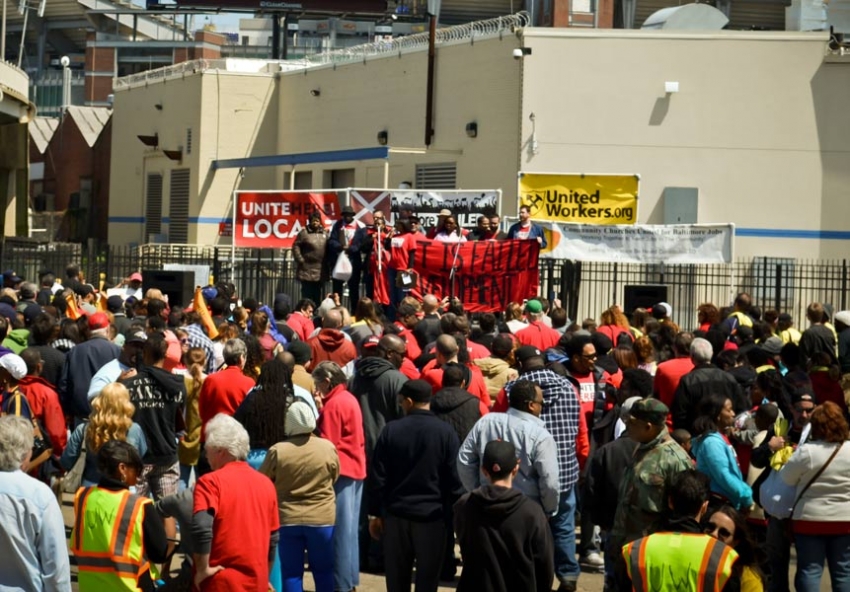
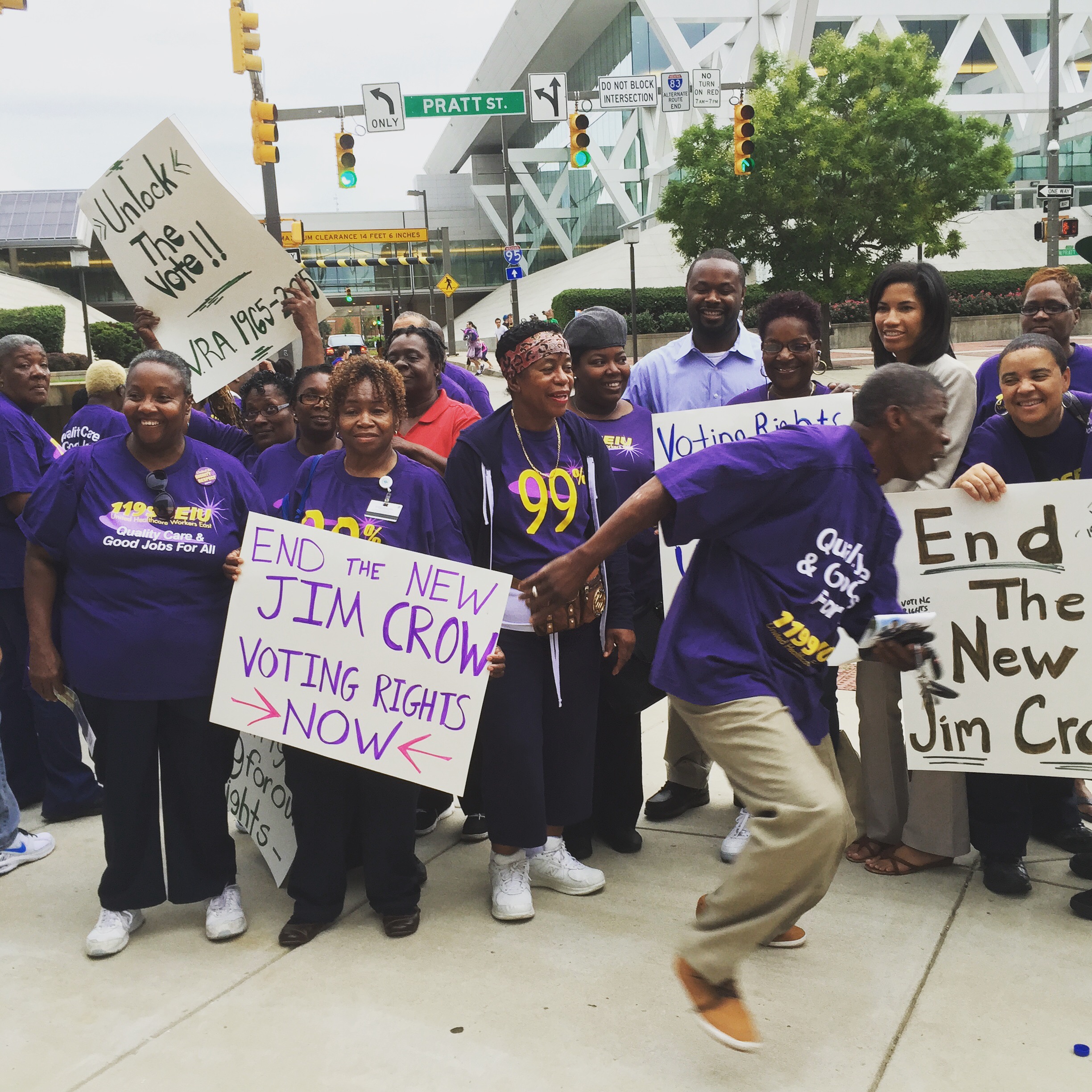
On August 6, the 50th anniversary of the Voting Rights Act, dozens of Baltimore ex-felons rallied and marched alongside community members to protest their disenfranchisement. In May, Maryland Governor Larry Hogan vetoed a bill which would have granted ex-felons the right to vote when they return home from prison, rather than making them wait until after their probation and parole sentences have been completed (some sentences can last for decades). Holding up signs that read, “We Want Taxation with Representation!” and “End the New Jim Crow!” protestors made clear that they understand the racial implications of the status quo. Had Hogan signed the bill into law, 40,000 more Maryland residents—a majority of them black Baltimoreans—would have been able to cast a ballot in the next election. “Override! Override! The veto! The veto!” protestors shouted together as they marched down the street.

The crowd, well over 100 people, eventually gathered around a statue of Thurgood Marshall, not far from Baltimore’s Inner Harbor. “We picked that spot because he’s one of the greatest symbols of justice and fairness,” explained Perry Hopkins, an ex-felon who now works as an organizer with Communities United, the social justice group that planned Thursday’s rally. Fifty-four-year-old Hopkins has never voted.

While Baltimore has made national headlines this year for its police brutality scandals and its spiking murder count, the gathered crowd recognized that these issues cannot be separated from the societal exclusion African-Americans experience every day.

One woman who came to the rally was Robinette Barmer, who has had two children and one grandchild locked up in jail. Barmer has been fighting for ex-felon voting rights all year, and traveled to Annapolis last spring to push for the bill’s passage. “I try to tell ex-cons that their voices do still matter,” she said.

Greg Carpenter, a 62-year-old black man who served 20 years in prison for an armed robbery, also has a 20-year parole sentence. Although Carpenter has been out of jail for 12 years now, he worries he won’t ever get to vote again in his lifetime.

Governor Hogan said that requiring ex-felons to finish their parole and probation sentences before voting “achieves the proper balance” between repaying one’s obligations to society and restoring citizens’ rights. Ex-felons point out that they are both working and paying taxes within their communities, and thus should also have the right to vote.

Social science research suggests that removing voting restrictions would provide positive benefits to both ex-offenders and society at large. The American Probation and Parole Association also says there is no credible evidence to suggest that disenfranchising people who have returned home from prison serves any legitimate law enforcement purpose.

According to the Sentencing Project, a criminal justice advocacy group, there are roughly 5.85 million disenfranchised American citizens with felony convictions, and 2.2 million of them are black. That’s one out of every 13 African-Americans.

The Voting Rights Act was passed in 1965 to end discriminatory voting barriers but the courts have disagreed on whether the VRA should apply to felon disenfranchisement laws. Maryland activists aren’t waiting around for the courts, though. At Thursday’s rally, organizers prepped the crowd for next year’s legislative season where they hope to push for an override. “We need you to show up and come out with us to Annapolis,” said Nicole Hanson, an ex-offender who works with Out4Justice, a group that politically mobilizes ex-offenders. “There’s only 90 days of [the legislative] session, so we’ll need you to make some sacrifices.”

Eighteen states considered loosening ex-felon voting restrictions this year, up from 13 states in 2014. But passing legislation, as Maryland activists witnessed first hand, is difficult. Only one state—Wyoming—ended up successfully loosening its restrictions.

Still, there has been demonstrable progress. The Sentencing Project estimates that nearly 800,000 citizens have regained the right to vote through voting reforms enacted between 1997 and 2010. Last month, President Obama even said that, “If folks have served their time, and they’ve reentered society, they should be able to vote.”

“This is a very peaceful rally, but this issue is personal,” Hopkins said in an interview. “We’re going to flip power, and we’re going to empower. We’re going to show the governor who’s the boss. We’re the boss! We’re the people.”

Rachel M. Cohen

Perry Hopkins at the podium                   

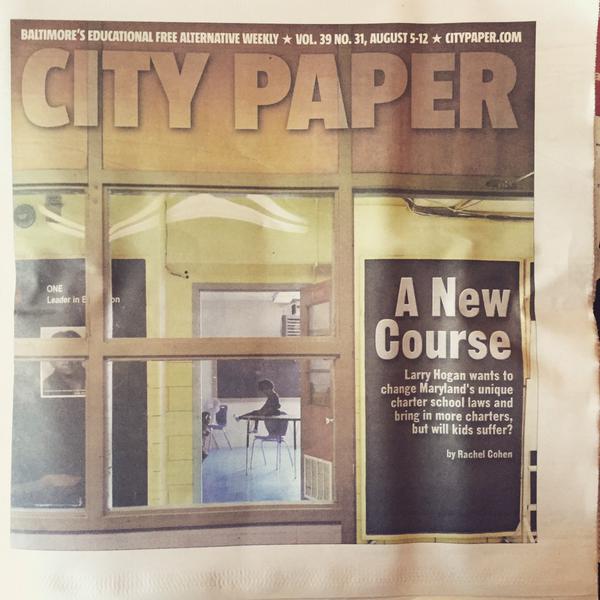
A New Course: Larry Hogan wants to change Maryland’s unique charter school laws and bring in more charters, but will kids suffer?

Originally published in Baltimore City Paper on August 5th, 2015.
__________

Baltimore City Paper cover

Baltimore City Paper cover story

At the end of 2014, just weeks after Larry Hogan won a surprise victory in the gubernatorial race, the governor-elect announced that he would push to expand Maryland charter schools once in office.

“We shouldn’t be last in the nation in charter schools,” Hogan declared—referring to Maryland’s spot in the state ranking system designed by the National Alliance for Public Charter Schools (NAPCS), an advocacy organization that promotes charter schools around the country. According to NAPCS, Maryland has the nation’s “worst” charter law. The Baltimore Sun editorial board, echoing NAPCS, has said Maryland boasts one of the “weakest” charter laws in the United States.

In late February and early March, legislators in Annapolis listened to testimony related to charter reform bills that Gov. Hogan introduced in the House and Senate. Supported by the Hogan administration, a coalition of charter school operators, and national education-reform advocates, the bills met fervent opposition from teachers, principals, and community members.

“I don’t care what the National Alliance for Public Charter Schools, a lobbying group out of Washington, D.C., has to say about the charter school law in Maryland or where they rank Maryland relative to their own biased standards. Neither should you,” testified Megan Miskowski, a speech language pathologist at Patterson Park Public Charter School. It’s Maryland’s strong law, she argued, that explains why Maryland charters have never wrought the level of fraud and abuse so prevalent in places such as Minnesota and Louisiana—states that receive high marks from NAPCS. “Who are they to define what is best for Maryland children?” Miskowski asked. “We do not answer to them.”

The Maryland Charter School Act passed in 2003 and the first state charter schools opened their doors in 2005. A decade later roughly 18,000 students attend 47 Maryland charters—34 of them concentrated in Baltimore City. A version of the Public Charter School Improvement Act eventually passed, but it was substantially watered down from Hogan’s original proposal, and many believe he’ll push a stronger law again next year. The heart of the debate centers on competing visions for the future of public education, and whether one believes Maryland has the best charter law in the country or the worst.

The publicly funded but independently managed schools known as charters have grown significantly since the first one opened in Minnesota 23 years ago. Today more than 6,700 charters exist in 42 states and Washington, D.C. and their numbers are climbing. Albert Shanker, then-president of the American Federation of Teachers (AFT), first proposed the charter school idea in 1988; the influential union leader imagined a new kind of school that could serve as a laboratory for innovative and experimental education practices. The hope was not only to serve kids within charters who might benefit from alternative educational models, but also to carry newly discovered best practices back into traditional schools for all students to enjoy. In Shanker’s vision, charter teachers would still be unionized district employees, but certain labor regulations would be relaxed to promote greater innovation.

Maryland’s charter culture sets it apart from most other states in several ways. First, under the law all Maryland charter teachers are considered public school employees and represented under their district-wide collective bargaining unit. While this actually most closely resembles what Shanker had imagined, few states today adopt this particular model. According to the Center for Education Reform (CER), just 7 percent of all charter school teachers nationwide are unionized.

Another distinctive characteristic of Maryland charters has been a general commitment to innovate within the district, as opposed to outside of it. In other states, the law may allow for multiple charter authorizers, such as churches, universities, or nonprofits. In Maryland, however, only the local school board can authorize charter schools. “I’d say the strong desire [of Maryland charters] to work within the school district is fairly unique,” says Joceyln Kehl of the Maryland Alliance of Public Charter Schools, a newly formed coalition of charter operators around the state. “Maryland is hugely pro-union and Democratic, so that’s just our context,” she adds.

Additionally, Maryland charters must comply with a greater number of state and local regulations than charter schools in other states. While detractors of Maryland’s law argue that this creates an inflexible environment for the independent schools to operate in, supporters point out that Maryland has not had any of the kinds of problems related to fraud, abuse, and mismanagement that charter schools in states with decreased regulation have had. “It is true that Maryland charter school law provides more oversight than many other states,” testified Deborah Apple, a charter school teacher at the Baltimore-based Wolfe Street Academy. “It is also true, however, that our charter school system is more effective than most.”

A stronger level of oversight, a close relationship with the school district, and unionized charter teachers illustrate the uniqueness of Old Line State charters. The vast majority of schools are considered “mom and pop” charters, meaning parents or former local educators founded them, as opposed to some of the larger national charter management organizations (CMOs) that have developed presences in other cities. According to an Abell Foundation report released this year, many high-performing CMOs have expressed reticence or disinterest in coming to Maryland given the conditions in which they’d have to operate. While the Maryland charter law has facilitated the growth of strong schools with little to no fiscal and academic issues, the question is whether such growth is sufficient, and whether the state’s law should change in order to entice more CMOs to expand into Maryland.

Baltimore’s 34 charter schools educate 13,000 of the district’s 84,000 students. Bobbi Macdonald, co- founder of the City Neighbors Charter School, is one of Charm City’s veteran operators. City Neighbors was one of the first charters to open up in 2005, and since then Macdonald has opened two more schools. Reflecting on the evolving dynamics between Baltimore charter operators and the district, Macdonald describes years of intentional relationship building. “I don’t believe that school systems are made out of steel, they’re made out of people,” she says.

In 2004, after the charter law passed and before the first schools opened, Baltimore’s new charter operators formed a coalition to organize and advocate for their collective interests. This coalition grew increasingly formalized as the years went on. “The work of the coalition became really focused on defending our autonomy and the rights of children in charter schools,” says Macdonald, who served as the coalition’s co-chair for the first six years.

Many charter operators spoke favorably, even nostalgically, of Dr. Andrés Alonso’s six-year tenure as city superintendent, which ended at the end of 2012-2013 academic year. “Dr. Alonso had a clear vision of wanting to provide a portfolio of school options for families, and to create opportunities for innovation and then replicate those practices,” says Allison Shecter, the founder of the Baltimore Montessori Public Charter School, one of the city’s most popular charters. “I think when Dr. Alonso was here we had a really strong relationship and participated in a lot of ways on many different levels,” says Macdonald.

Since Alonso’s departure, the relationship between charter operators and the district has grown more strained. “I’d say it’s a challenging relationship. It’s not a partnership unfortunately,” Shecter says. “We’d like it to be a partnership but in order for it to be a partnership there needs to be consistent and ongoing communication back and forth around policies that may impact charters.” Many operators say they feel the district is neither accountable nor transparent, which fuels growing levels of distrust.

One issue charter operators repeatedly raise is that they believe the district short-changes them when it comes to per-pupil funding. Under state law, the district must provide “commensurate” funding between traditional schools and charters. Currently, the district allocates $7,300 per traditional school student, and $9,400 per charter student—which is supposed to take into account that Maryland charters have to pay for the cost of their facilities, programming, salaries, and other school-level costs, which the district pays for in traditional schools. However, the formula that the district uses to come up with these amounts is unclear, and operators are convinced that what they’re getting is too low. Charter operators believe that they should be getting closer to $14,000 per pupil. Debates around these dollar amounts grow very charged.

Not everyone at charters agrees the district is shirking its funding responsibilities. “Charters still receive more per pupil, even after those extra costs are covered,” says Matthew Hornbeck, the principal at Hampstead Hill Academy, a charter located just south of Patterson Park. “Everyone, with the exception of some of the charter operators, knows that.” Hornbeck, who has served as his school’s principal for 12 years, has been outspoken about what he sees as a district funding formula that unfairly favors charters.

“I was a charter operator and I absolutely knew we were getting more than traditional public schools,” adds Helen Atkinson, the executive director of Teachers’ Democracy Project, a local organization that helps teachers engage in public policy and develop more social justice curricula.

Jon McGill, the director of academic affairs for the Baltimore Curriculum Project, the city’s largest charter operator, describes the relationship between charters and the school district headquarters on North Avenue as “overall harmonious” but says he does wish the district would be more transparent about how about how exactly it spends its slice of per-pupil funding. He thinks charters “lose the PR game” because the public sees them as always asking for more money. One reason the funding issues get so heated, McGill suggests, is because some operators have taken huge personal risks to open charter schools, and feel they need more reassurance that the district truly supports their efforts. “Some people have 30-year mortgages to worry about,” he says.

While for the past decade the story of Baltimore charters has mostly been an intra-district struggle, Gov. Hogan’s rise to power signified a turning point for the Maryland school-choice movement.

The legislation Hogan introduced would have dramatically changed the charter law passed in 2003. His proposals included provisions to exempt charter school employees from the district bargaining unit, as well as from many state and local requirements such as teacher certification. Hogan’s bill would have enabled charter schools to compete against traditional schools for state public construction money, and the bill would have required districts to explicitly define “commensurate funding” to mean that charters should get 98 percent of the per-pupil amount that traditional public school students receive, leaving 2 percent left over for district administrative expenditures.

“It did take us by surprise,” says Kehl. “As a charter sector, we were not expecting legislation this year, and we’re grateful that Governor Hogan finally wanted to cast an eye on the charter sector.” While charter operators around the state met with legislators and held school meetings to discuss why they supported Hogan’s bill, Kehl acknowledges that their advocacy “wasn’t as robust an effort had we been really prepared for it.”

Once news of Hogan’s charter bill went public, Maryland charter teachers began to organize together in new ways. In Baltimore, teachers convened and decided to form the Baltimore Charter School Teacher Coalition. Educators broke up into committees to strategize and implement an organized political response to the bill.

Corey Gaber, a sixth-grade literacy teacher at Southwest Baltimore Charter School who was active in the coalition, says part of the reason they formed their group was because they were dissatisfied with the pace and quality of the Baltimore Teachers Union’s (BTU) response. “We felt like we needed to reach out and inform teachers about what was going on and we didn’t feel like the union was doing it effectively,” he says. Gaber acknowledges that among Baltimore charter teachers there exists a “constant contradiction of feelings”—in some ways they are dissatisfied with the current union leadership, but on the other hand, teachers are proud to be being unionized district employees and deeply value their protections. With fellow charter teacher Kristine Sieloff, Gaber wrote an Op-Alt for City Paper (“The injustice of a two-tiered education system in Baltimore City,” March 31) and Gaber created and helped to circulate a petition that garnered hundreds of signatures from both charter and traditional public school teachers.

“The interests of traditional teachers in charters and public are exactly the same right now,” says McGill, who thinks the proposed bill would have created deep divisions between Baltimore educators.

The BTU helped circulate another petition for charter teachers and charter educational support personnel, roughly 740 people in total, and more than 90 percent of eligible petitioners signed. “I spoke with every teacher I know, teachers were universally against [the legislation],” Gaber says.

In addition to local educators who worried about losing their collective bargaining rights and allowing non-certified teachers to work with kids, other leaders pushed back against what they saw as a deeply inequitable funding structure embedded into Hogan’s legislation.

“Charter advocates rely on the premise that as money flows from a regular school to a charter school, the costs of the regular school go down proportionately. Sounds good; it’s just not true,” wrote David W. Hornbeck in a Baltimore Sun op-ed published in February. Hornbeck “recommended the approval of more than 30 charter schools” while serving as Philadelphia’s superintendent of schools from 1994 to 2000, and he now believes he made a grave mistake. Hornbeck, who also served as superintendent of Maryland schools from 1976 to 1988 (and is the father of Hampstead Hill principal Matt Hornbeck), pointed out that Pennsylvania’s charter law is ranked much higher than Maryland’s and “yet its charter growth is contributing significantly to a funding crisis that includes draconian cuts to teachers, nurses, arts, music and counselors in Philadelphia.”

Bebe Verdery, the director of the Maryland ACLU Education Reform Project, also submitted testimony against the bill, arguing that the proposed funding formula would result in severe cuts to traditional schools. “Simply put, students without any special needs would get funding the state formula intended for others,” she said. Verdery also objected to a provision that would have allowed public capital repair funds to go toward private buildings that housed charter schools, saying, “this would further strain an already insufficient pool of state resources for addressing the state’s $15 billion school repair and construction backlog.”

Hogan’s legislation said “commensurate funding” should mean that charters get 98 percent of what traditional public schools receive because a 2005 State Board of Education ruling determined that districts needed only 2 percent of per-pupil funding to cover central administrative costs. But when the Department of Legislative Services (DLS) surveyed local school systems later on, it found that administrative expenditures make up closer to 10-14 percent of per-pupil spending. Critics argued that if 98 percent were legally guaranteed for charters, but necessary administrative work still had to be done, then money would be taken from traditional public school students, potentially leading to increased class sizes, special educators with enormous case loads, or cuts to after- school programming, gym, and art.

Local charter operators insisted that their goal was not to bankrupt the district, but simply to fight for parity. “We believe strongly that we can achieve this without harming funding for other schools,” testified Ed Rutkowski, the executive director of Patterson Park Public Charter School.

The watered-­down bill that Hogan ultimately signed was a grassroots victory for some, and a major disappointment for others. The Center for Education Reform, which hired several lobbyists to push for the bill’s passage, was so dismayed with the final result that it actually urged the governor to veto it, insisting that this would be a step back for Maryland school choice, not one forward.

The final bill ended up removing mostly all provisions that had generated controversy. It grants greater autonomy to charters that have demonstrated five years of success, and it provides for increased flexibility with student enrollment. The bill also authorizes the Maryland State Department of Education (MSDE) and the DLS to complete a study by the end of October 2016 to determine what a more appropriate figure should be for districts when it comes to commensurate funding.

“The law that passed was more subtle and more evolutionary rather than revolutionary,” said Hampstead Hill’s Hornbeck. “It did not trash a good law, like the governor’s proposal tried to do.”

Given that the governor still had support from MarylandCAN, a pro-charter advocacy organization that helped to craft the original legislation, Hogan went ahead and signed the bill into law. It’s an imperfect bill, but it creates “the pathway” to expand charters and it grants more flexibility to existing ones, said Keiffer J. Mitchell Jr., Hogan’s special adviser on charter schools.

“As the state with the most restrictive charter law in the country, these small steps forward, while welcomed, are not enough,” said Jason Botel, the executive director of MarylandCAN, in a statement. “They must be the start, not the end, of our work to dramatically reform charter school policy in our state.”

Kara Kerwin, the president of CER, believes MarylandCAN is mistaken to think that they can just go back and improve on the new law later. She points out that the new law clarifies that only the local district board—not the Maryland State Board of Education—can authorize new charters, and that online charter schools are now explicitly prohibited from operating within Maryland.

In an interview, Kerwin describes online charters as “one of the biggest innovations right now that’s helping so many students who aren’t brick and mortar types.” However, several studies have found that online charter schools tend to provide a lower-quality education than traditional schools, and a 2011 New York Times investigation found that K12 Inc., one of the nation’s largest online charter school operators, “tries to squeeze profits from public school dollars by raising enrollment, increasing teacher workload and lowering standards.”

Most people interviewed for this story do not believe the new law will lead to an expansion of Maryland charter schools, one of Hogan’s top policy priorities. “The final bill that passed was very limited in scope, it doesn’t have a whole lot of changes,” Macdonald says. “But it’s a step in the right direction.”

So what does this all mean for the future of Maryland charters?

“I have no doubt that this was round one and [the operators] are going to try again as long as Hogan’s governor,” Gaber says. “We’re going to keep fighting. We started this teacher coalition knowing that this is a long-term fight and we need to be organized and ready before the next time comes.”

Kehl thinks that the Maryland Alliance of Public Charter Schools, which just officially emerged as a statewide group in July, will focus on building a more unified policy voice and cultivating a stronger presence in Annapolis. “Our charter sector has matured,” she says. “If you believe that schools shouldn’t be one size all, then you have to create a system that supports that. I don’t see how you can make change if you keep everything the same.”

Whether new legislation will be introduced next year is an open question. Kerwin of CER thinks such an effort would be futile, even if they tried. Todd Reynolds, the political coordinator for Maryland’s American Federation of Teachers, says some legislators might decide it makes sense to wait until after the new MSDE/DLS study is completed.

While the emerging landscape appears fraught with tensions between the district and the charter sector, there still remains a possibility that Maryland charters will chart a different sort of future than that of other states.

Even though Macdonald of the City Neighbors Charter School supported Hogan’s legislation, she acknowledges that some parts made her feel ambivalent. While she feels strongly that Maryland charters need more autonomy and bureaucratic relief, she also wants to preserve collective bargaining rights for charter teachers. “I feel like Maryland is so unique in our stance,” she says. “I haven’t yet seen the bill I would really fight for.”

In a few months, on Oct. 22, the Teachers’ Democracy Project will be hosting a big meeting between teachers, charter operators, politicians, union officials, and school board members to try and figure out a way forward that doesn’t require another heated legislative fight. Atkinson believes the current law is good, but that Baltimore teachers—charter and non-charter alike—should be organizing for more money for all schools. “We’re going to try to hold an open conversation about what people’s concerns are,” said Atkinson. “The operators are reasonable, they’re not right-wing, they’re not trying to get charters to take over the world. Their main frustrations are with the union contract and some of the ways the district controls things.”

McGill thinks that a more collaborative push for charter reform from the district, teachers, and charter operators “would be the ideal” solution but worries things are growing too polarized for that to materialize. Gaber, however, says that the Baltimore Charter School Teacher Coalition has also discussed how they want to stand for something, and not just against reform. “I think it would be a good idea for us to be more proactive,” adds Reynolds of the AFT. “We should get back to what charters were intended to in terms of offering innovation that can then be brought into traditional schools.”

The question of whether some of the larger CMOs would be interested in setting up schools in Maryland remains uncertain. Kehl says it’s important to help facilitate more attractive operating conditions because “there’s a certain point where you tap out your local leadership” and if you “can’t attract national talent” into Maryland, then you’ve just closed the door on quality options for kids.

Others see luring CMOs as a less urgent priority, especially given how the state increasingly underfunds public education. In his latest budget, Hogan increased state education funding by 0.4 percent, but cut Baltimore City’s funding by 3.3 percent. Attracting those CMOs—which would likely be into Baltimore—might mean redirecting funds toward charter facility expenses or pushing harder to restrict collective bargaining. Maryland might also experience some of the financial strain that rapid charter growth in other states has placed on traditional schools.

Testifying last spring, CEO of Baltimore City Public Schools Dr. Gregory E. Thorton said Hogan’s bill would work “to the benefit of large out-of-state charter organizations—to the detriment of Maryland’s most vulnerable student populations.”

While the Baltimore City School District might need to work harder to collaborate with its local charter sector, and the teacher unions may need to re-examine some provisions within their contracts, it’s not yet clear that Maryland’s unique charter culture is headed out the door.

State law currently allows charters to negotiate waivers and exemptions from certain aspects of the district-wide collective bargaining unit. That’s how Baltimore’s KIPP charter school was able to extend its school week; KIPP had to agree to pay its staff more money for the increased number of working hours. Theoretically charter operators could sit down with union leaders to discuss some of their most pressing concerns around staffing, innovation, and autonomy. “It’s not meant to be a one-size-fits-all situation,” says Reynolds. “You can sit down with the union and negotiate a Memorandum of Understanding. We have done that, and I think that’ll continue.”

“I think it would be amazing to sit down with the union and really roll up our sleeves,” says Macdonald. “I do think it’s really important for teachers to be unionized, to collectively bargain, and to get paid well, but I also think if we want to innovate and serve the children of Baltimore, we really have to allow [for] some more flexibility.”

In Hot Water: Volunteers reach out to people whose water has been shut off

Originally published in Baltimore City Paper on May 26th, 2015
—————–

CFOa1HyUsAAtLVo

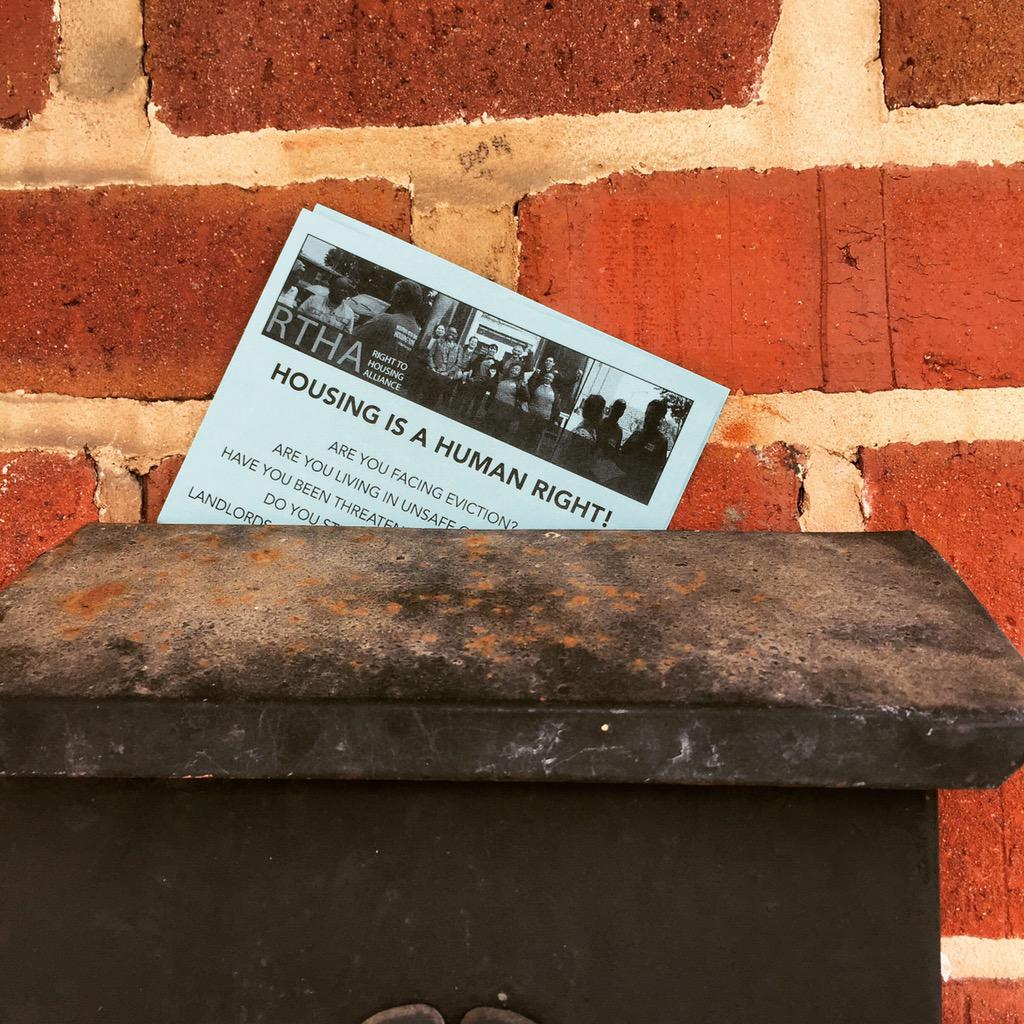
Flyers left at residents’ door | Photo Credit: Rachel Cohen

On March 26, the Department of Public Works (DPW) announced that 25,000 customers with unpaid water bills would have their water service turned off. But it wasn’t until mid-May that there was a list of which residential addresses would be or had already been targeted. On May 16, volunteers with the Right to Housing Alliance (RTHA), a local human rights organization, canvassed homes on the list.

On May 17, the second day of canvassing, a group of 10 volunteers met up at RTHA’s headquarters on Holliday Street, near Fallsway under I-83. It was a humid, hot day, the kind where you don’t head outside without bringing water—which, for the volunteers, drove home the importance of access to water.

Though nearly 90 percent of the shutoffs have been in Baltimore County, RHTA is focusing, for now, on the 170 homes on the list in Baltimore City. After Saturday and Sunday, canvassers had reached just over 50 homes.

Jessica Lewis, a lead organizer with RTHA, went over some canvassing basics before the volunteers hit the streets in small groups. If someone answers the door, Lewis instructed, make sure to ask if this address has had a water shutoff.

“We’re not going out to ask if they themselves did anything wrong, make your question passive,” she said. Ultimately, the volunteers’ main “ask” would be to invite residents to come to RTHA’s Tuesday night meeting, where individuals impacted by water shutoffs can brainstorm collectively on a potential response. “Don’t be afraid to agitate them a little,” said Lewis. “You can ask them if they think having their water shutoff is fair.”

The Baltimore Sun reported that businesses, government offices, and nonprofits owe $15 million in outstanding water bills, more than one third of the total $40 million that DPW seeks to collect. Yet six weeks into the water shutoffs, no delinquent commercial properties have been targeted by DPW. By contrast, more than 1,600 residents have lost service.

Half of Baltimore City residents rent their homes, and the water shutoff situation is particularly worrisome for tenants. According to Matt Hill and Zafar Shah, attorneys with the Public Justice Center, low-income tenants cannot get their own water accounts, and DPW does not allow them to challenge inaccurate bills because the water accounts are not listed in their name. “Public Works’ new policy is short-sighted and downright inhumane to low-income renters who are often caught in between the water company and their landlords,” Shah and Hill wrote in a Baltimore Sun op-ed. “At the very least . . . the city should allow renters to open accounts in their own names and permit them to challenge inaccurate billings and leaks.”

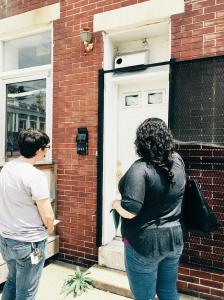
The RTHA volunteers split up into small canvassing groups. One group, including Molly Amster, the director of the Baltimore Jews United for Justice, and Sara McClean, a dietician with Moveable Feast, spent most of the day in Edmondson Village, though no one answered most of the doors they knocked on. At one house on Culver Street, a woman opened the door, closed it quickly, and then had her son come out to talk. He seemed ambivalent about discussing his water situation, but he took the resources offered back inside.

CFOS8KpW0AALyOw

Canvassing | Photo Credit: Rachel Cohen

Lewis told volunteers that many of these homes may turn out to be abandoned, and indeed many addresses that volunteers visited appeared to be vacant properties. Volunteers took notes after each visit, documenting, among other things, the building type, whether or not they had a conversation with a tenant, and whether the property looked occupied or vacant. Volunteers left blue RTHA flyers outside most of the doors they visited that listed information on how to get support and more involved in organizing.

Another small group of canvassers met a man on Edgewood Street who described the hurdles he had to jump through to keep water on in his house, a particularly stressful situation because he has asthmatic children. He told the canvassers that he paid almost $400, including payments for water bills and jugs and bottles of water for his family.

Earlier in April, RTHA launched an online MoveOn petition calling for a moratorium on the water shutoffs. As reported in The Baltimore Brew, Tony Simmons, an organizer with RTHA, said that they will be organizing and petitioning City Council until there is more clear information about what’s going on; many residents are skeptical that their bills are even correct. The Rawlings-Blake administration says the shutoffs are necessary to pay for infrastructure improvements around the city. By Sunday night, RTHA had collected more than 2,000 petition signatures, and announced that it will be organizing more canvassers at its offices every evening that week. As of press time, they have collected more than 3,000 signatures.

What’s Behind the Recent Plague of Shootings in Baltimore?

Originally published in VICE on May 20th, 2015.
——-

While the national film crews have packed up and left Baltimore, losing interest in the place now that there are no more burning pharmacies and vandalized cop cars, Charm City residents are left to reckon with one of the most violent months they’ve seen in years. As the Baltimore Sun reports, homicides are up nearly 40 percent compared with this time last year, and nonfatal shootings are up 60 percent. From mid April to mid May, 31 people were killed, the Washington Post reports, with 39 more wounded by gunfire. The Sun adds that, as of late Tuesday, there had been 170 nonfatal shootings so far this year.

To put all this in perspective, the last time Baltimore saw 30 homicides in one month was in June 2007.

The spike in violence has received less attention outside of Baltimore than Freddie Gray’s death, but within the city, leaders, police, and community members are struggling to figure out what exactly is going on.

One theory floating around is that the weeks of unrest after Gray’s demise in police custody have daunted cops, leaving them unable or unwilling to control violent crime. The police union and some legal experts are upset at the criminal charges that the city’s top prosecutor, Marilyn Mosby, has leveled at six members of the Baltimore Police Department (BPD)—among them murder and manslaughter. This, coupled with a formal Justice Department investigation launched in cooperation with local officials to examine police practices, has left the BPD in a state of agitation.

Lieutenant Kenneth Butler, a longtime BPD veteran and president of the Vanguard Justice Society, a group for black officers, told the Washington Post that rank-and-file cops feel alienated, vilified, and afraid to do their job. “In 29 years, I’ve gone through some bad times, but I’ve never seen it this bad,” Butler added in comments to the Baltimore Sun, referring, in part, to officers who feel as though Mosby “will hang them out to dry.”

While beat cop reticence could be a factor, Daniel Webster, director of the Johns Hopkins Center for Gun Policy and Research, points out that homicides and shootings in West Baltimore were on the rise before the Freddie Gray unrest, though the pace has since accelerated. Webster thinks that among other things, the protests just strained the cops’ capacity.

“The police have been less active in proactive policing, less likely to engage individuals on the street,” Webster says, adding that resources were diverted to addressing the riots and in turn disrupted patrol and detective work. Leads from residents that detectives use to make arrests—though already quite difficult to come by—were further reduced during this time, he said, citing conversations with officers. Moreover, Operation Ceasefire, an anti-violence initiative begun by the city early last year, has been running without a program manager for the past several weeks. (The mayor’s office has indicated a new program manager will be hired soon.)

Webster believes another factor at play here may be that the Freddie Gray protests emboldened criminals. “We just had a huge display of lawlessness and disrespect for law and law enforcement,” he explains. “That mindset can spread easily and affect behavior.”

Dayvon Love, the co-founder of Leaders of a Beautiful Struggle (LBS), a grassroots organization that advocates for the interests of black people in Baltimore, doesn’t buy the connection between the protests and violence—one he calls an “easy deflection” of systemic issues.

“This [surge in violent crime] is a natural outgrowth of the conditions in which shooting and violence occurs,” Love says. Scapegoating the protests and the Mosby charges, Dove thinks, is particularly convenient for those unenthused with critiques of law enforcement and institutional racism. And it’s true that high rates of poverty, unemployment, and drug addiction all consistently correlate with high homicide rates. Love also argued that Baltimore’s had all kinds of violence for a long time—including sexual abuse and discriminatory housing policies—though it’s only when guns are fired that leaders start to panic.

Perhaps a simpler explanation for the increase in shootings is just that it’s getting hotter outside. Baltimore Bloc, another local grassroots organization, say that they don’t think the protests had anything to do with the recent violence, and that in their experience, violence always surges in the city as summer approaches. Lester Spence, a Johns Hopkins political scientist, agrees that homicides usually rise and fall significantly with the seasons, with the fewest occurring during the winter. “It’s no coincidence that homicides are spiking right now when the weather is getting warmer,” Spence says.

The violence that occurs when competing gangs fight over turf to operate their drug operations also generally escalates in the warmer weather. “People are suggesting that the spike we’ve witnessed over the past few weeks represents something new, but summer is just starting,” Spence adds. “It might be a blip or it might continue. We don’t know what’s going to happen.”

Baltimore PD Spokeswoman Sarah Connolly told VICE in an email, “We are investigating each incident as a singular incident while examining any trends and patterns to ensure that we are deploying our officers and resources effectively while being proactive and engaging the community. While we have developed investigative leads in a number of cases, we continue to ask the community’s assistance in calling with any information they may have.”

Meanwhile, some Baltimore community groups are taking the opportunity to organize anti-violence demonstrations. Coinciding with the 90th birthday of Malcolm X, the NAACP held a “Stop the Violence ‘By Any Means Necessary'” rally Tuesday night at their office in the Sandtown neighborhood. Another group committed to decreasing gun violence in Baltimore, the 300 Men March, is holding an “Occupy Our Corners” anti-violence rally on Thursday evening to honor the recent homicide victims.

“We the PEOPLE, are not blaming anyone but ourselves for failing to create a safe environment within our city,” their rally flyer reads. “Recognizing this, WE STAND, as a community of all people, regardless of RACE, RELIGION, SEX, CULTURE OR BACKGROUND.” According to the Sun, Munir Bahar, one of the group’s founders, is calling for 30 men in ten Baltimore neighborhoods to become block leaders in the fight against crime.

Love doesn’t expect the organizing work that LBS, Baltimore Bloc, and other grassroots groups are doing will change much in light of the increased violence. “Because doing that,” Love explains, “would take away from the larger objective, which is ultimately about systemic change.”

We Can’t Talk About Housing Policy Without Talking About Racism

Originally published in The American Prospect on May 20th, 2015.
————————–

Over the past year, unrest in places like Baltimore and Ferguson has inspired a nationwide debate on how to best combat systemic inequality and injustice. In the wake of high-profile police violence cases in these cities and elsewhere, this conversation has contributed to a renewed understanding of how federal and local housing policies helped create the inequality and racial injustice urban America confronts today. Yet lost in this discussion has been the complicated record of more recent desegregation efforts and what they can teach us about undoing generations of systemic racism and persistent segregation.

A case-in-point is HUD’s Clinton-era Moving to Opportunity (MTO) program, the subject of a new study by Harvard economists Raj Chetty, Nathan Hendren, and Lawrence Katz. Focusing on MTO’s long-term economic impacts, the study sheds more positive light on a program long considered to be a failure.

Running from 1994-1998, MTO was a housing experiment that involved moving individuals out of high-poverty neighborhoods with vouchers and into census-tracts with less than 10 percent poverty to see if this would improve their life outcomes. The results were mixed. While critics of the program have dubbed it a failure for not significantly improving children’s school performance or the financial situation of their parents, there was a lot about it that proved successful. MTO yielded significant gains in mental health for adults, for instance, including decreased stress levels and lower rates of depression. It also greatly lowered obesity rates and improved the psychological well being of young girls.

The new Harvard study further bucks the notion that MTO failed. Instead of looking at MTO’s economic impact on parents, it looks at the adult earnings of their children. Such an analysis simply wasn’t possible to do a decade ago, given that the kids were still too young. Researchers now find that poor children who moved into better neighborhoods were more likely to attend college and earned significantly more in the workforce than similar adults who never moved. The researchers also ranked which cities were “the worst” in terms of facilitating upward mobility. Out of the nation’s 100 largest counties, the authors found, Baltimore came in dead last.

Many writers were quick to make the connection between Baltimore’s low chances for social mobility and the recent bouts of unrest surrounding the death of Baltimore’s Freddie Gray. However, few seemed interested in connecting the new Harvard study with the politics of why we have segregated communities and concentrated poverty in the first place.

Emily Badger’s Washington Post write-up of the study framed the ills people face in Baltimore as a city failure, rather than a state or federal one. She discusses the “downward drag that Baltimore exerts on poor kids” and says that Baltimore “itself appears to be acting on poor children, constraining their opportunity, molding them over time into the kind of adults who will likely remain poor.” Badger acknowledges that maybe this has to do with struggling schools and less social capital. “Change where these children live, though,” she writes, “and you might well change their outcomes.”

In The Wall Street Journal, Holman W. Jenkins Jr. looks at the new Harvard study and concludes, “Neighborhoods themselves are clearly transmitters of poverty. The problem for residents isn’t racism: it’s where they live.”

Such narrow portrayals of Baltimore and its residents are only possible if we exclude decades of state and federal policy from our frame of analysis. Richard Rothstein of the Economic Policy Institute wrote something I suggest reading in its entirety. But to quote:

In Baltimore and elsewhere, the distressed condition of African American working- and lower-middle-class families is almost entirely attributable to federal policy that prohibited black families from accumulating housing equity during the suburban boom that moved white families into single-family homes from the mid-1930s to the mid-1960s—and thus from bequeathing that wealth to their children and grandchildren, as white suburbanites have done.

Slate’s Jamelle Bouie traces not only how efforts to segregate Baltimore succeeded, but also how there’s never been a sustained attempt to undo them.

The simple fact is that major progress in Baltimore—and other, similar cities—requires major investment and major reform from state and federal government. It requires patience, investment, and a national commitment to ending scourges of generational poverty—not just ameliorating them.

Expanding housing choice vouchers is a good thing. We should have subsidies available to ensure that everyone has similar opportunities for mobility. That said, moving millions of impoverished families out of high-poverty areas would be nothing short of a logistical nightmare. In effect, mass relocation efforts would require low-poverty communities to relinquish some of their gatekeeping discretion—no small political fight. MTO tracked 4,600 families in five U.S. cities. As Reihan Salam put it, “It’s not at all clear that an MTO-style approach would work if we scaled it up to, say, 40,000 families in one city.” Nothing is impossible, but we cannot have a serious discussion about housing mobility as a broad anti-poverty strategy without frankly discussing the politics of racism and segregation. 

Investing In Better Mobility Vouchers

So what does a more effective mobility strategy look like? A look to MTO’s own weaknesses may provide some clues. Indeed, for sociologists Stefanie DeLuca and Peter Rosenblatt, one problem with MTO was that it simply didn’t go far enough. Ina 2010 paper, they argue that while some students undoubtedly benefited from moving to wealthier communities, a lack of social capital, support, and resources, combined with housing vouchers that did not cover the cost of living in low-poverty communities, kept many students out of the highest-performing schools. At the same time, many families found that the obstacles created by poverty—like health problems and the chaotic nature of low-wage work—tended to follow them even as they left impoverished communities, and in turn contributed to poor student performance.

For DeLuca and Rosenblatt, there’s plenty that MTO did right but confronting endemic poverty and segregation requires a more systematic approach. That is, something perhaps more akin to the Baltimore Mobility Program (BMP), through which 2,400 Baltimore families have relocated since 2003. Whereas MTO offered housing search counseling to program participants, BMP provided that plus post-move counseling, second move counseling if necessary, and financial literacy and credit repair training. In another study released last year, DeLuca followed 110 BMP participants for nearly a decade, and found that over two-thirds of these families were still living in their integrated, low-poverty communities one to eight years after moving.

If MTO were to be a truly successful intervention, then expanding the program’s available services—including educational assistance, housing counseling, job support, and transportation help—would be important. We can’t know how the MTO participants would have fared if they had been given increased support, but we do know that additional services helped to make the transitions more surmountable and lasting for BMP families.

From “Finding Home: Voices of the Baltimore Housing Mobility Program,” a report by The Century Foundation.

This chart by The Century Foundation shows how the MTO and BMP compare with Section 8 vouchers and the Gautreaux Project, a desegregation experiment that ended in 1990 and helped inspire MTO.

Needless to say, high-quality BMP vouchers are more costly than MTO and traditional Section 8 vouchers. Excellent mobility programs will require a real financial investment. As it is, there are long Section 8 waiting lists around the country, and local housing authorities currently receive fixed amounts from HUD to support voucher participants. Unless we significantly scale up funding, moving more people to affluent neighborhoods would mean moving fewer people overall through vouchers.

The findings from the new Harvard study are useful. They allow us to ask new kinds of questions. But in terms of policy, we must be wary of those who now suggest that simply uprooting families and planting them into new communities is the responsible thing to do—especially if we’re not ready to provide the supports that research has shown makes these types of moves more successful.

For example, in The National Review Jonah Goldberg writes, “Consider Baltimore. If you’re poor, it is a very bad idea to raise your kids there if you can avoid it.” He implicitly suggests that if you’re a good parent, if you care about your kid’s future, then you will leave Baltimore, or Detroit, or Philadelphia if you can. Let us hope that this policy conversation does veer into an ugly, parent-blaming one. Housing mobility vouchers are good options, but our best anti-poverty interventions shouldn’t have to demand that people abandon their social networks, churches, and communities if they want to stay. We should make high-quality vouchers available, but we should vigorously invest in the communities where poor people already live.

As Daniel Kay Hertz, a senior fellow at City Observatory pointed out to me, the Harvard study provides some new ammunition against those who have long doubted the effectiveness of a housing policy that puts integration front and center. Now there is some pretty strong empirical evidence that shows that children’s life chances were significantly affected by growing up within integrated environments. Additionally, these findings come on the heels of Robert Putnam’s new book, Our Kids, which traces the growing opportunity gaps between wealthy and poor children around the country. In light of these new high-profile studies, perhaps policymakers will more readily accept the idea that your access to the American Dream has everything to do with your race, class, and geographic location.

At the end of the day, Baltimore ranks last in the Harvard mobility study not because poor, black people live there, but because leaders in power made choice after choice, year after year, to ensure that poor blacks’ opportunities would be overwhelmingly constricted. We can and must make new choices now.
Baltimore Jews join Freddie Gray protests – but it’s complicated

Originally published in Haaretz on May 5th, 2015
________________
After a tumultuous couple of weeks in Baltimore, in which protests, marches and riots raged through Charm City following the death of 25-year-old Freddie Gray — the Jewish community moved to raise funds, organize volunteers and engage in interfaith outreach. But in Baltimore, which has a complicated, and often fraught, history of Jewish-black relations, there is both a commitment to fight inequality and a reluctance to ruffle long-established relationships with city officials and the police.

The Baltimore Jewish Council, which represents about 55 local congregations and institutions, issued a statement that called for Jews to “stand beside our African American partners to combat racism and economic inequality.” Arthur Abramson, BJC’s executive director for the past 25 years, says his organization “has not hesitated for one moment” to stand up for injustice.

But he was frank about the challenges that remain for Jews seeking to combat racism. “Look, Maryland is a southern state. It was a slave state. In general, it’s not what I would describe as a place where African Americans and Jews sit around and sing ‘Kumbaya,’” he said.

Throughout the decades there have been plenty of instances of Jewish racism and black anti-Semitism in the city. Still, Abramson feels proud of the improved relations the BJC has helped to build over the past 25 years, which he attributes to concerted engagement, dialogue and programs involving the two communities.

Rabbi Etan Mintz, who leads Baltimore’s oldest and continually active synagogue, B’nai Israel, spent much of last week – as protests spread in the city and elsewhere following the death of Gray, for which six police officers have been charged – working with other local clergy.

“It’s a very powerful experience just to listen to people, to pray with people, and to be a presence face-to-face with one another,” Mintz said. He noted what he called the “outrageous reality” of poverty, inequality and mass incarcerations, but also stressed that the majority of police officers in the city are “peace-loving individuals who are trying to protect us on a daily basis.” He is concerned about a phenomenon of “guilt by association” — linking the broader police force to a few bad officers who acted inhumanely.

Mintz’s synagogue, which is Orthodox, is located downtown near the Inner Harbor, the former epicenter of Baltimore Jewish life. Now B’nai Israel, which is the last of what were once 20 synagogues in this area, is sometimes nicknamed “the Masada of East Baltimore.”

Jews began moving out toward the suburb of Pikesville in the 1950s and ’60s, and Mintz says the real “nail in the coffin” of inner-city presence was the 1968 riots, where many Jewish businesses were looted and destroyed. The latest disturbances, he adds, have sparked difficult memories for some of his congregants.

Solidarity events

Another organization, Jews United for Justice, (JUFJ) has taken a more demonstrably public role in supporting African-American protestors. The group was formed in late 2014 to provide an outlet for Jews, mostly in their twenties and thirties, to engage in social justice work. Many of these activists turned out for Ferguson solidarity events earlier in the year, so it was not surprising to see 30 JUFJ members marching on April 25th in Baltimore with black-and-white picket signs that called for #JusticeForFreddie.

Last Friday, the day Baltimore’s State Attorney Marilyn Mosby announced that the six policemen would face criminal charges, the number of JUFJ members who turned out to march rose to 100.

“I think this reflects the growing interest,” says JUFJ member Owen Silverman Andrews. “[We have] created a space where people can plug in within their own communities in a way that is still connected to the larger struggle.”

Marc Terrill, the president of The Associated: Jewish Community Federation of Baltimore, says he is pleased with the fast response the Jewish community took, and continues to take, in showing solidarity with the Freddie Gray protests. He says that ultimately there needs to be an agenda, both with short-term and long-term goals.

In the short term, the Associated has helped to organize volunteers and raise funds for food, toys and other supplies in order “to rebuild the communities torn asunder by wide-spread looting and vandalism,” according to its website. In the long term, Terrill mentions the need to promote greater access for city residents to health care, job training, education, counseling and mentoring programs, and to contribute to an overall greater push for societal integration.

“Our relationship with the African-American community is collaborative,” Terrill says. “Not everything is good, but we have the will and desire to work at it.”

While the Jewish community is presenting a relatively united front for now, the question of how and if its members will come together around the issue of police reform remains unclear. This community is one of the more politically conservative Jewish communities in the United States. And the established relationships Jewish leaders have cultivated with city and state officials — which have helped ensure enhanced security and support for Jewish groups and institutions — are very important.

The BJC did not come out strongly for any of the police reform bills that were being considered in Annapolis this past legislative season, despite months of organizing and campaigning by local activists. By contrast, members from JUJF, including Rabbi Daniel Burg, who leads an egalitarian synagogue in Reservoir Hill, offered testimony in support of legislation that would alter the Law Enforcement Officers’ Bill of Rights.

Jewish communal leaders have all expressed a commitment to tackle the “deeper issues” provoked by the Freddie Gray protests – specifically with regards to economic inequality and poverty. However, whether they will be able to do so without inserting tension into some of their long-standing political relationships remains to be seen.

Baltimore’s Criminal Justice System Is Seriously Overloaded Thanks to the Arrest of Protesters

Originally published in VICE on May 1, 2015.
_____________

Four days after Maryland Governor Larry Hogan declared a state of emergency, and three nights into the citywide 10 PM to 5 AM curfew, Baltimore lawyers and activists are beginning to grapple with exactly how the official response to unrest over the death of Freddie Gray has impacted protesters’ constitutionally protected legal rights.

Perhaps the most controversial decision of the past few days came on Tuesday, when Hogan suspended a state rule that requires an individual to be brought before a judicial officer or released from jail within 24 hours following their arrest. The decree paved the way for arrestees to languish in jail for up to 47 hours without charges. The Maryland Public Defender’s Office issued a statement Wednesday challenging Hogan’s legal authority to tell the judiciary what to do.

That night, 101 of the 201 arrested protesters were released from jail without charges. At a press conference earlier Wednesday, Baltimore Police Captain Eric Kowalczyk said his department had struggled to file formal charges against the protesters because officers were so busy responding to emergencies elsewhere; he insisted that charges would still be filed at a later date.

“On a normal day, if I’m a patrol officer and I was filing a charge, it could take upwards of two hours,” Sarah Connolly, a Baltimore Police spokeswoman, told VICE. “But when you’re having multitudes of arrests, and when you are working to ensure the preservation of life and property, which was paramount, it just wasn’t possible [to file all the charges.]”

Natalie Finegar, the Baltimore Deputy District Public Defender, told VICE that Hogan’s order is a clear instance of the executive branch overstepping its legal bounds. She notes that there is already a judicial provision within the Court of Appeals to change the 24-hour detention rule in the case of an emergency. Hogan’s executive order, Finegar contends, demonstrates disregard for the checks and balances of the legal system.

Other experts point out that holding uncharged people in jail is simply bad policy regardless of the legality, especially in this fraught political moment. “If the citizens of Baltimore are reacting [on the streets] to longstanding systemic issues, then dealing with arrestees in a systematically unfair manner, like leaving people in jail without charges, doesn’t really seem to be an effective response,” said Cherise Fanno Burdeen, the executive director of the Pretrial Justice Institute, a nonprofit committed to pretrial justice reform.

Another reason few charges were filed this week is because Baltimore’s district courts closed after Monday’s riots. In Baltimore City, courts close fairly frequently for all sorts of reasons, including snow days; the judiciary decides when to close the courts. On Tuesday, none were open, and on Wednesday just one out of four was operational—creating a serious backlog for cases that would have normally been divvied up. (By Thursday, all four district courts had reopened.)

“Courts are not supposed to shut down, especially when you’re arresting hundreds of people in a moment of crisis,” said Alexandra Natapoff, a professor at the Loyola Law School in Los Angeles. If people are being arrested, courts should be open to handle the cases. The wheels of justice should continue to spin equally for everyone at all times.”

In light of Hogan suspending the 24-hour rule, Finegar told VICE that her office filed 82 habeas corpus petitions on behalf of detained arrestees. (The Guardian had previously reported that Hogan had effectively suspended the state’s habeas corpus law, but this is misleading, as state and federal habeas corpus laws—which gives detainees the ability to seek relief from unlawful imprisonment—are unchanged.) However, before those habeas corpus petitions could be ruled upon, the city released the remaining uncharged protesters in a nod to the fact that they no longer had the authority to detain them. Finegar believes that many who were released on Wednesday were illegally held in the first place.

Another issue is that many arrested protesters were given extraordinarily high bail amounts. Some were apparently even asked to pay their bail all at once, in cash—which is notable given that detainees usually have the option to pay deposits or to take out loans from bondsmen.

“For my clients, a $50,000 cash-only bail is tantamount to no bail,” said Finegar. “I’m a nice middle-class public servant and even I couldn’t post something like that.”

“What is unconstitutional is using money to detain and deprive an individual of due process,” Burdeen added. “And yet that is essentially what is happening here.” TheGuardian reported on one case where a 19-year-old had bail set at half a million dollars. The defendant, who failed to produce the money, was then sent to jail. Generally speaking, if a detainee cannot make bail and cannot take out a loan, then they will essentially serve a jail sentence before even being found guilty of a crime. According to Finegar, that could mean sitting in jail for anywhere from 30 days to a year.

On Thursday afternoon, ACLU-Maryland’s legal director Deborah A. Jeon sent a letterto Baltimore Mayor Stephanie Rawlings-Blake calling for an end to the citywide curfew. “We have a right to demand policy changes of our government…. and we have a constitutionally protected right to do so on the streets and sidewalks of Baltimore.” Jeon added that at this point the curfew’s “unnecessary restrictions” seemed to do more to stoke community resentment than to ensure public safety.

The curfew is a First Amendment issue more so than a criminal one. And First Amendment decisions are often seen as balancing acts between the need for public safety and to protect one’s right to protest, move, and assemble. “It has to be a reasonable balance, and whether this curfew is a reasonable one is subject to debate,” said Eve Brensike Primus, a University of Michigan law professor.

In a Thursday evening press conference, Baltimore Police Commissioner Anthony Batts said that despite the city’s relative calm, they would not be lifting the curfew this weekend because there are large protests planned. “We have a lot more protests that are popping up by the minute, and even if we didn’t, we have other cities that have large protests and their activities impact our city too,” said Batts.

The argument that Baltimoreans should be kept under curfew because protests are happening in other cities certainly raises some serious constitutional questions.

Activist groups are responding to these issues; the Ferguson Legal Defense Committee is operating a jail support hotline. On Wednesday night, the Public Justice Center (PJC), a Baltimore-based legal advocacy organization, held an event to train lawyers, law students, and legal experts in jail support and legal observing for demonstrations. Nearly 50 people showed up, which, according to PJC attorney Zafar Shah, was beyond the group’s expectations. “There wasn’t enough seating,” he said. In addition, Maryland Public Defender Paul B. DeWolfe issued a call for private lawyers to help represent the 201 protesters arrested on Monday night. DeWolfe told the Daily Record that many private attorneys have offered their services.

Of course, it’s safe to say a few well-intentioned lawyers are unlikely to change the game here.

“Yes there will be lawsuits, and appropriately so, but we can’t rely on them to fix the underlying problem,” said Natapoff. “We have to look beyond the law if we want to really reform the criminal justice system. That’s why these protests all over the country are so important.”

Inside the Chaos, Rage and Confusion That Consumed Baltimore Last Night

Originally published in VICE on April 28, 2015.
_______

10996095_3087979085951_8514579901023162352_n

 photo credit: Rachel Cohen

As I walked through the streets of West Baltimore on Monday evening, small bright green opiates littered the sidewalk, pills left over from when the local CVS pharmacy was looted hours earlier. The air felt thick and musty—police had fired teargas canisters near the Penn-North subway station. By 6:15 PM, clouds of smoke were pouring out of the empty pharmacy, which filled with flames. At one point, protestors cut the hose that was being used to put out the fire.

Except for a few young activists hoisting “Justice 4 Freddie Gray!” picket signs, most people hanging around were not protestors. The majority of Baltimoreans on the streets were just snapping photos and watching the events unfold as spectators. Unlike Saturday’s protests, where thousands proudly marched, chanted, and gave speeches about accountability and justice for Freddie Gray, a 25-year-old black Baltimore resident who suffered a fatal spinal cord injury while in police custody earlier this month, Monday felt perilously chaotic.

By the corner of North Avenue and Pennsylvania, just a half-mile down from where Freddie Gray’s funeral took place earlier that day, two Maryland Transit Administration vehicles were burning. A wrecked police car sat in the middle of the street a few hundred feet down—every one of its windshields and windows cracked and shattered. Broken glass lay by its tires. By 9 PM, Maryland Governor Larry Hogan had deployed National Guard troops, Mayor Stephanie Rawlings-Blake announced there would be a weeklong 10 PM curfew, and all public schools were cancelled for Tuesday. The city was officially declared to be in “a state of emergency.”

Saba Nazeer, a local resident who works with the Right to Housing Alliance, a Baltimore housing justice organization, came out to watch one standoff unfold between high school students and the police. The cops knew to meet the teenagers because a flier circulating earlier on social media called for students to meet for a “purge” out by the mall after school. (Frederick Douglass High School is across the street from Mondawmin Mall.) Dozens of cops were ready to meet the 75 or so students that showed up. Things escalated quickly. Students hurled bricks, rocks, and bottles at the police; cops sprayed mace and teargas. Fifteen officers were injured in clashes around the city, six seriously, and two were hospitalized Monday evening.

“These kids were going to fight for their neighborhoods, and they want justice not just for Freddie Gray but for all those who have died at the hands of police in their communities,” Nazeer said, defending the students. “I’ve been seeing it all day, the police try to put fear in the communities, they harass and bully. They’ve been doing it for decades. And people are tired of it.”

10386269_3087980605989_3794526195910937202_n

photo credit: Rachel Cohen

Speaking out Monday night, hours after the funeral, Freddie Gray’s mother Gloria Darden pleaded for the violence to end. “I want you all to get justice for my son,” she said. “But don’t do it like this here.”

A national conversation on police brutality broke out after the deaths of Michael Brown and Eric Garner last year, but local cops’ excesses have been a major political issue in Baltimore for a while now. A Baltimore Sun investigation released in September found that the city paid out $5.7 million in judgments and settlements in cases related to alleged police brutality and civil rights violations since 2011. Even before Gray’s death, the city was haunted by two recent high-profile incidents of unarmed Baltimore black men dying in police custody— Tyrone West in 2013 and Anthony Anderson a year earlier. Cops faced no charges following the deaths of either men.

Since West’s death in July 2013, Baltimore community members have convened outside City Hall every Wednesday to call for the police to be charged with homicide. (These weekly demonstrations are locally referred to as “West Wednesdays.”) Activists keep count— Monday marked day 648 since West’s death. While an independent review issued in August determined that the police did not use excessive force, some still insist they saw cops kick West in the head, yank him by his dreadlocks, and beat him with batons.

In September, an alarming video surfaced that showed a Baltimore cop repeatedly punching a man. Unable to ignore the damning footage, Mayor Rawlings-Blake vowed to develop a “comprehensive” plan to address police brutality in the city. A few months later, however, she vetoed a bill that would have required city police to wear body cameras. Rawlings-Blake has said she supports the measure, but felt the specific legislation proposed was not within the City Council’s authority.

Freddie Gray was arrested on April 12 after making eye contact with police and taking flight, but more than two weeks later the public has still not been given any meaningful details about how he sustained his fatal injury. (He died on April 19.) Last week, Baltimore Police Commissioner Anthony Batts admitted Gray was unbuckled when police placed him in a van despite being shackled and handcuffed, and noted that Gray’s multiple requests for medical attention were ignored. Other findings from the department’s internal investigation, however, have not been made public. More information will be released on May 1— a deadline Batts set to share findings with Baltimore’s State Attorney.

“This is one case where body cameras certainly would have been useful,” said Peter Moskos, a former Baltimore City Police Officer and professor at John Jay College of Criminal Justice. “We’d have a lot better idea of what actually happened, and we’d know far more quickly.” (A bystander’s mobile footage showed Gray writhing in agony as police carried him away.)

11203050_3087978045925_2724119197233361859_n

photo credit: Rachel Cohen

Baltimore Bloc, a grassroots activist group in Baltimore, has announced that they are planning another protest for Freddie Gray Tuesday afternoon at 3 PM. They told me that while their collective has been in “emergency response mode” for the past two weeks, eventually they will begin to outline more long-term plans. The “pace and emotion [has] left us with less space than we normally have to strategize,” they explained. But soon, they will join with other local organizing groups to “turn our attention to the next steps, including legislative strategy at the state level and organizing here at home for the 2016 city elections.”

Speaking at a press conference in the evening, Mayor Rawlings-Blake referred to the Monday rioters as “thugs” who were senselessly “trying to do tear down what so many have fought for.” Some 200 arrests were made by Tuesday morning. Brandon Scott, a city councilman, said, “We can’t let this be a repeat of 1968″—referring to the violent Baltimore riots that followed Martin Luther King Jr.’s assassination. “Adults have to step up and be adults.”

Tensions between political leaders, police, and community members are unlikely to abate any time soon, but multiple community cleanup efforts are being organized on social media today in West Baltimore. One group will be meeting back by the Penn-North subway station at 10 AM, and another will start at 2 PM by the University of Baltimore. Organizers have asked individuals to bring their own gloves, trash bags, brooms, and food.

On International Women’s Day: Baltimore Marches

Originally published in Baltimore City Paper on March 9th, 2015.
———

1

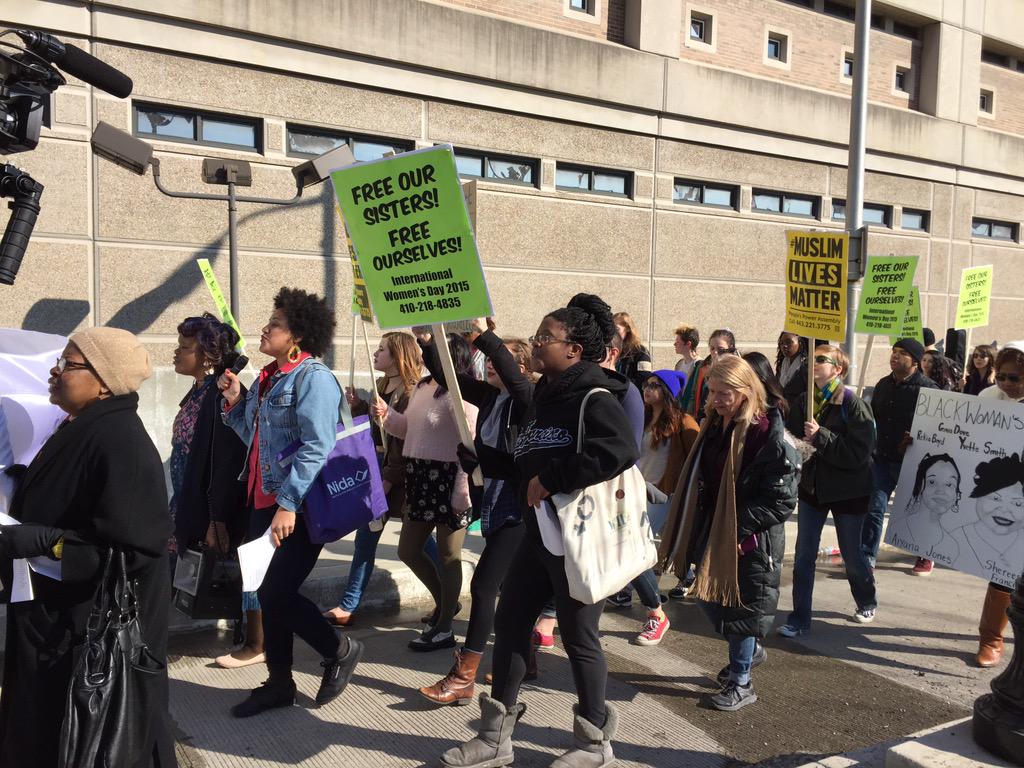
Photo Credit: Rachel Cohen | March 8, 2015

4

Photo Credit: Rachel Cohen | March 8, 2015

When global corporations such as BP and Accenture become vaunted sponsors of International Women’s Day, it’s easy to worry that the holiday—first organized by early 20th-century socialists—has lost its radical roots. But for the 50 Baltimore citizens who convened on Sunday to celebrate, commemorate, and mobilize fellow women activists, the revolutionary spirit was alive and well.

The Baltimore People’s Power Assembly and the Baltimore chapter of Fight Imperialism, Stand Together (FIST) organized the three-hour event, which included a march that began at the corner of Hillen and Fallsway and ended with a rally outside of the Baltimore City Detention Center. Gathering at 3 p.m. on an unusually warm and sunny afternoon, the organizers were clear about their objectives for the day.

“We have to remain vigilant about reclaiming and remembering the black female victims of police brutality because black women and girls’ lives matter too,” said Lynae Pindell, a 23-year-old activist with the Baltimore People’s Power Assembly. “We have only framed [police violence] as a black male problem.” Pindell spoke of the need to “move beyond that sexist lens” which renders invisible the racial profiling, sexual harassment, strip searches, rape, and other acts of gender-based violence that women and girls are regularly subjected to. Reading off a list of black women and girls who have died at the hands of police—including Yvette Smith, Shereese Francis, and Aiyana Jones—Pindell pointed out that all of these women received far less media attention than Trayvon Martin, Eric Garner, and Michael Brown.

Colleen Davidson, an activist with FIST, reminded the crowd that their International Women’s Day march was coinciding with the 50th anniversary of “Bloody Sunday”—the famous civil rights march in Selma, Alabama. The fight against racism, she stressed, is deeply intertwined with their battle against patriarchy, neoliberalism, capitalism, and police brutality. “More communities are mobilizing, and the struggle is growing,” Davidson said enthusiastically.

Before the march began, the crowd was encouraged to shout out names of women who are important to them. “Ella Baker! Mother Jones! Nina Simone! Coretta Scott King! Harriet Tubman! Leslie Feinberg! Billie Holiday! Sojourner Truth! Audre Lorde!”

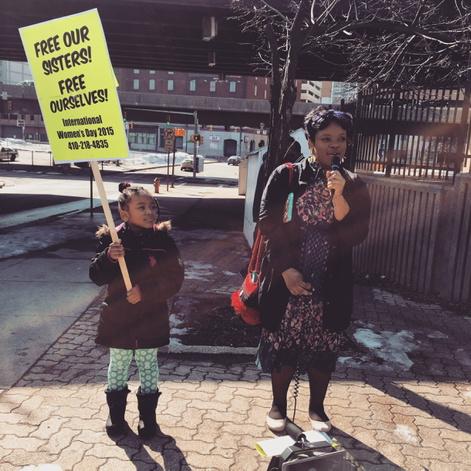
When the diverse crowd finally began to march—with women leading in the front, and men instructed to hang in the back—activists lifted banners and bright green picket signs, chanting, “Free our sisters! Free ourselves!”

Jessye Grieve-Carlson, a sophomore at Goucher College, was there with fellow members of the Goucher Feminist Collective. She said she was looking to do more off-campus activism and engage with local organizers. Another marcher, Ellen Barfield, said she dreams of a time when there will be an International Men’s Day because that will mean that women will have gained power. Barfield, an army veteran and longtime peace activist, co-founded the Baltimore chapter of Veterans for Peace, but notes that the group is largely male. “Even though they’re well-meaning for the most part,” she says, “they’re still pretty blinded by the patriarchy.”

When the group arrived outside of the Baltimore City Detention Center, standing beneath the tall barbed-wired fence, activists took turns making speeches, reading poems, and singing songs. Central to the speeches were calls for economic justice—specifically for better jobs with living wages, increased access to affordable housing, and an end to mass incarceration.

According to the Justice Policy Institute and the Prison Policy Initiative, “Maryland taxpayers spend nearly $300 million each year to incarcerate people from Baltimore City.”

“We are not just out here marching for Planned Parenthood and abortion rights,” said Sharon Black, a 65-year-old activist with the Baltimore People’s Power Assembly. “We are here for our real liberation.” Pointing her finger at the bleak-looking detention center, Black urged, “People don’t need to be locked behind bars and treated like animals. Our sisters deserve better.”

After the rally concluded, the activists left East Baltimore and relocated to the church hall of the First Unitarian Church in Mount Vernon, marching along with chants like, “No justice! No peace! No sexist police!”

Waiting for them in the church was a big buffet of chili, macaroni and cheese, salad, sandwiches, desserts, and other snacks prepared by the Baltimore People’s Power Assembly and IWW union members. Local activists, like Tawanda Jones—the sister of Tyrone West and a leader in Baltimore’s fight against police brutality—were recognized by the organizers and given awards. Other honorees included Palestinian activist Laila El-Haddad, Black Lives Matter protest organizer Sara Benjamin, and Tiffany Beroid, a leader pushing for Wal-Mart to grant pregnant workers their rights.

So what’s next for these women and men?

“We’re not looking to form a new organization, because a lot of us are already involved in so many groups,” Black told me. “But we want to help unite everyone, so that next year we’ll be more poised to take collective action.”

Black reiterated this sentiment when she addressed the crowd, suggesting that maybe everyone would consider reconvening quarterly, to strategize for more sophisticated city and statewide efforts. She also made a plug for the Fight for 15 movement’s next national day of action, which is scheduled for April 15. Though the Fight for 15 movement has not been as strong in Baltimore as it has been elsewhere, the organizers hope to at least plan a march in solidarity with the fast food strikers in other cities.

Tawanda Jones also encouraged everyone to come to Annapolis March 12, where the Maryland legislature will be considering several bills that address police accountability reform. “We can’t bring Tyrone back but we can stop another family from feeling the same,” said Jones. “That’s why we do what we do—justice for all victims of police brutality.”

The Wrong Way to Revitalize A City

Originally published in the February 2015 print issue of In These Times Magazine.
_______________________

cohen_8674935607_9c7e86ed52_oweb_850_592

Baltimore workers rally for fair urban development near the Horseshoe Casino construction site on April 20, 2013.

The pro-corporate American Legislative Exchange Council (ALEC) has come up with yet another strategy to bolster the power of big business. Republican lawmakers in Michigan plan to introduce an ALEC-backed bill that would ban “community benefits agreements” (CBAs), one of the few options local activists have to fight for equitable development. A CBA is a contract between community groups and developers of publicly subsidized projects. In exchange for community support, a developer might agree to offer quality jobs, living wages, affordable housing or environmental protections. ALEC’s CBA ban, which specifically prohibits a local minimum wage, would be unprecedented.

The contrasting stories of Baltimore and Buffalo, New York, two economically depressed cities that launched ambitious development plans, show what happens to workers and the poor when safeguards like CBAs are–and aren’t–in place.

The Inner Harbor myth

Baltimore was one of the first U.S. cities to rebrand itself as a tourist and entertainment hotspot in response to the painful post-war impact of deindustrialization and white flight. Beginning in the 1950s, Baltimore poured millions of dollars, through tax breaks and subsidies, into building up its Inner Harbor entertainment district and other attractions. By the early 1980s, these projects were bringing more than 18 million visitors to the city annually, leading many politicians and pundits to proclaim that Baltimore was in the midst of a terrific revival.

But it was never an equitable one. Between 1959 and 1995, Baltimore lost 75 percent of its industrial jobs, and by 2008, the city had lost a third of its population. Despite the tall, shiny buildings and bustling shopping centers downtown, blight and abandonment plague many corners of Charm City. As anthropology professor David Harvey wrote in 1992, “If people could live on images alone, Baltimore’s populace would have been rich indeed.” Instead, in 2012, more than 25 percent of the city lived in poverty, including 37 percent of the city’s children.

Meanwhile, the Inner Harbor is still drawing 14 million visitors a year and remains a point of pride for local leaders. In 2013, the city released plans to build up the Harbor even more over the next few decades. “Anything that’s great for tourists is great for locals,” Tom Noonan, CEO of Visit Baltimore, told the Baltimore Business Journal.

The approximately 1,500 restaurant and retail workers at the Inner Harbor might disagree. In 2011, United Workers–a human-rights organization led by low-wage workers–and the nonprofit National Economic & Social Rights Initiative co-published a report on Inner Harbor’s labor conditions that documented abuses such as chronic wage theft. The report profiled many workers, including Nadja Martens, a server at Hard Rock Café, and Jason Bandy, a server at Capitol City Brewing Company. Both saw big paycheck decreases during the winter months, when tourism was slow and tips were scarce. “During … November, December, January, February, 100 percent of the time I was not paid minimum wage,” said Bandy.

This report was the first investigation of its kind. “The formal measure of success for these public investments [in the Inner Harbor] has been a superficial assessment of whether a rundown area has been ‘cleaned up,’ whether customers are happy, whether businesses and investors are making money,” the report stated. “Job creation has been addressed as a simple matter of quantity–how many jobs are created–not of quality.”

Todd Cherkis, a Baltimore organizer with United Workers, puts it this way: “There’s the myth about the Inner Harbor, and then there’s the reality.”

A different approach

In 1994, in response to the bleak conditions, Baltimore citizens mobilized the nation’s first grassroots living wage campaign, fighting to establish higher wage standards for businesses that receive government subsidies. The campaign was historic, but activists won a watered-down victory: The new requirements applied only to city contractors, not all publicly subsidized developers.

Since 1994, more than 120 other municipalities have seen their own living wage campaigns, inspired by the original Baltimore activists. One was Los Angeles, which enacted a living wage ordinance in 1997. A year later, LA residents pushed for what would become the nation’s first CBA–a labor agreement tied to an incoming Hollywood shopping mall and entertainment complex. Dozens of cities have since negotiated their own CBAs; 28 were in effect nationwide as of 2012.

The story of the waterfront development in Buffalo, New York, provides a strong contrast to Baltimore’s. In 2004, the state-run Erie Canal Harbor Development Corporation (ECHDC) embarked on a plan to transform Buffalo’s waterways into a Great Lakes version of the Inner Harbor. Using a $350 million grant from the New York Power Authority, the ECDHC planned to give approximately $40 million in public subsidies to outdoor-sporting goods store Bass Pro, to be the anchor tenant, and Benderson Development, to build the retail store.

“When we found out about all this, we were really concerned about the size of public subsidies for private businesses, particularly for Bass Pro, a low-wage employer,” says Andy Reynolds, a communications organizer with the Buffalo-based non-profit Coalition for Economic Justice (CEJ). “We began to learn about community benefits agreements as a best practice, so we started a coalition to launch one of our own.” The result was the Canal Side Community Alliance, a coalition of more than 60 community organizations launched in 2009 to put public pressure on both developers and local political leaders. By 2013, the Canal Side Community Alliance was able to get the state to agree to a CBA. The project is still underway, but with less emphasis on retail and a greater commitment to local needs like good jobs, Buffalo’s Inner Harbor–in theory–will look quite different from Baltimore’s.

To be sure, CBAs are no panacea. If developers do not hold up their end of a CBA agreement, the community coalition must hold them accountable, which in many cases means going to court. Such sustained oversight is challenging and sometimes unsuccessful. And, as Peter Marcuse, professor emeritus of urban planning at Columbia University, writes, “CBAs … often provide only a limited reach for alternative means of making the planning process truly democratic.”

Still, CBAs are far better than nothing, and the fact that they are in ALEC’s crosshairs is a testament to their efficacy. As Matthew Raffol writes in Advocates’ Forum, “By organizing residents of low-income communities and granting them access to development planning processes, CBA coalitions transform these residents from objects of urban development policy to subjects who actively shape development decisions [and] exact a price on private capital that it would not otherwise incur.” In other words, when faith, labor and community groups come together to make demands on municipal projects, they shift the dynamics of urban power and set the stage for further demands.

Hope yet for Baltimore

In April 2013, hundreds of Baltimoreans rallied at the site of the new Horseshoe casino to celebrate a deal that local unions, with the help of Maryland state officials, had brokered with Caesars Entertainment Corp. The 1,200 permanent casino staff would be allowed to organize without management opposition, using a simple-majority “card check” process.

That victory is being used to fuel a push for fair development throughout the city. In October 2014, a new group called One Baltimore United–comprised of labor, faith and community organizations–rallied outside City Hall for higher-wage jobs, improved schools and better public services. “Our goal is to show that the Inner Harbor model is outdated,” says United Workers’ Cherkis. The coalition is keeping a close watch on future development projects and sees CBAs as one tool in its arsenal.

Cherkis expresses cautious optimism: “The landscape to address these issues is definitely changing.”