The Uphill Battle of Unionizing a Philly Charter School

Originally published in The American Prospect on June 4th, 2015.
—————
O
n April 30th, faculty at North Philadelphia’s Olney Charter High School voted 104-38 in favor of forming a union, an NLRB election that Olney’s charter operator, ASPIRA, has since announced they’re challenging. Olney’s union campaign is only the latest in a small but rapidly growing wave of charter union drives nationwide. But few efforts have been as contentious, or as revealing, as this one. Ever since the campaign began three years ago, ASPIRA has pumped tens of thousands of dollars into an elaborate union-busting effort, even as the beleaguered district it’s funded by struggles with massive debt. Unionizing Olney also threatens to shine light on ASPIRA’s questionable finances, at a time when authorities at the state and district level have failed to act. More broadly, the union drive in Philadelphia reveals how charter management organizations can use lax regulation to dodge financial accountability.

ASPIRA took over Olney, along with John B. Stetson Middle School in 2011 through Philadelphia’s “renaissance” school turnaround project, whereby charter operators are given the opportunity to improve the academic performance of struggling district schools. As part of the renaissance conversion, remaining educators at Olney and Stetson lost their union membership.

It wasn’t easy for Olney staff to reach their April 30th election; for the past three years they have dealt with an administration intent on suppressing union organizing efforts. Tactics have included threatening teachers with layoffs and cuts to benefits, putting anti-union literature in teachers’ mailboxes, and instating new discipline policies, which included barring employees from criticizing ASPIRA on social media. The NLRB sided with educators in three of the four unfair labor practice complaints they filed in response to these measures.

Other tactics that have garnered criticism, including from Philadelphia Councilwoman Maria Quiñones-Sanchez—who once served as ASPIRA’s Executive Director—relate to services ASPIRA has employed, with public dollars, to fight the union effort. In August 2014, Philadelphia City Paper reported that ASPIRA paid a law firm with experience in fighting unionization efforts at least $72,163. This past April, the chair of the Olney school board signed a contract with consultants to lead self-described “union avoidance” meetings for Olney staff, as well as to help ASPIRA design and implement a campaign to fight unionization. The cost for these consultants was $25,000 and the contract stipulated that that figure “does not include any time that may be spent in responding or defending any charges filed by the union at the NLRB.”

Stetson educators recently launched their own organizing drive, and ASPIRA is sending consultants and lawyers there, too. Moreover, ASPIRA sent their consultants to lead a mandatory meeting at Eugenio Maria de Hostos Charter School, another one of ASPIRA’s five charters, to reportedly “pre-empt an organizing effort.”

The budget problems plaguing Philadelphia public schools have forced the district to close dozens of schools, to lay off thousands of workers, to reduce transportation services, and more. How then, do we get to a point where charters are able to spend such significant sums of public dollars to fight union efforts? Who, if anyone, gets to have a say?

Are Charter Employees Public or Private?

Charters, which have been around for a quarter century, are publicly funded but independently managed schools. In education circles there’s a fierce debate over whether these schools are truly “public”—charter proponents insist that they are, while others see charters as a means to privatize education.

Aside from whether charter schools are public or private, another question is whether charter school employees are public or private—important distinctions not only for union formation but also for labor rights more broadly. The courts have taken the position that there is no clear-cut answer for charter employees, and each situation must be determined on a case-by-case basis depending on individual state laws and regulations, as well as the composition of each charter organization. But in one significant case from 2012, the NLRB ruled that educators at the Chicago Mathematics & Science Academy Charter School (CMSA) were private employees mainly because no government entity has the authority to appoint or remove CMSA board members, and no board members are directly accountable to public officials. In 2013, citing the CMSA ruling, the Pennsylvania Labor Relations Board effectively disclaimed jurisdiction over charter labor disputes in the state, concluding that such matters should be dealt with at the NLRB.

Which brings us back to Olney and Stetson. Despite previously stating that it would respect the results of an NLRB election, ASPIRA now claims Olney teachers are in fact public employees, and thus not subject to the NLRB’s jurisdiction. Stetson educators also recently filed for their own union election and ASPIRA challenged them, too. While the NLRB held a regional hearing and determined that Stetson educators are in fact covered under the NLRB, no determination has yet been made for Olney educators. However, since the legal arguments are the same for both renaissance schools, one can assume that the NLRB will ultimately uphold jurisdiction.

Many view ASPIRA’s NLRB challenge as a stalling tactic, but their action is not illegal. Wilma Liebman, a former chairman of the NLRB, told me that jurisdiction challenges are permitted at any stage of the election process. But considering that ASPIRA has not dropped their Olney challenge despite losing their Stetson one, many wonder how far ASPIRA will go before they agree to collectively bargain, and how expensive the legal bills are going to be.

In theory, if the regional NLRB rules in favor of Olney educators, ASPIRA could appeal to the national NLRB board in Washington, D.C. If ASPIRA loses all possible appeals, and they still refuse to bargain, then the NLRB will have to take them to District Court. Such cases are extremely expensive. “If they still refuse to bargain past a District Court ruling, then they’d be found in contempt,” said Liebman.

Other Questionable ASPIRA Expenditures

One reason ASPIRA so staunchly opposes unionization may be that the collective bargaining process could shed light on the organization’s suspicious finances.

One reason ASPIRA so staunchly opposes unionization may be that the collective bargaining process could shed light on the organization’s suspicious finances. Over the past several years, evidence suggests that ASPIRA has engaged in other instances of questionable financial behavior. The Philadelphia Daily News found that ASPIRA has borrowed nearly $3.5 million from its charter schools, though the public doesn’t know where that money went. Journalists also found that school staff used debit cards without providing receipts, and that bank loans were signed where one charter school would guarantee the debt of another. Under the law, each charter is supposed to function as an independent entity.

Lauren Thum of the Philadelphia School District’s Charter Office told Newsworks that the district couldn’t confirm whether ASPIRA is spending its charter school dollars in the schools themselves, or whether money is being siphoned off for other things. Part of the complication stems from the fact that although each of ASPIRA’s five charters is organized as an independent nonprofit, they all share the same board of trustees through their parent organization, ASPIRA, Inc. of Pennsylvania. And although the school district worries that ASPIRA charters may be improperly shuffling money around, they have thus far been denied access to the parent organization’s financial records. “It’s very difficult to follow the financial trail when there are so many complicated, connected entitles, and money flowing throughout them,” Thum said. In the meantime, ASPIRA continues to deny any financial wrongdoing. ASPIRA also declined to be interviewed and several school board members did not return requests for comment.

In 2010, the Philadelphia City Controller released a report criticizing a practice common amongst Philly charters whereby the schools use public funds to pay rent to parent organizations or subsidiaries; this is what ASPIRA does with ASPIRA, Inc. of Pennsylvania. “Properties that are being paid for with taxpayer funds are being either transferred [to] or controlled by nonprofits with no accountability to the school district or taxpayers,” the report concluded. However, five years later, the practice continues.

Under the law, unions are entitled to see the financial information that pertains to their bargaining unit. (This includes things like health insurance costs, salaries, etc.) And if during negotiations management shoots down a union’s proposal by claiming they have an inability to pay, then the union is legally entitled to access more financial information to verify management’s claim. “In my opinion, I think the real issue is ASPIRA doesn’t want a union poking around in their finances,” a Philadelphia School District official told me. “Having a union gives them the right to do that in order to bargain in good faith, and [ASPIRA] doesn’t want anyone looking at anything.”

And so far, no one really has. As millions of dollars move around between the charter schools, the parent organization, and ASPIRA’s two property-management entities, the school district’s ability to challenge ASPIRA’s financial behavior remains unclear. In January, the district sent a letter to ASPIRA outlining 17 conditions the nonprofit would need to meet if they want to have their Stetson charter renewed. Conditions include reorganizing Stetson’s school board so that the parent organization doesn’t directly control it and getting a treasurer with a background in finances and audits.

Since then, ASPIRA has complied with some of the district’s requests, and has challenged others. Notably, they have so far refused to provide access to relevant financial information of its parent organization, though conversations between ASPIRA and the district are still ongoing.

“Nobody has enough power or enough money to really stay on top of things, so it becomes really easy for things to end up in a big mess,” said Susan DeJarnatt, a Temple University Law School professor who studies Pennsylvania charter law. “I frankly don’t think the state legislature thought ahead about the financial ramifications in any serious way. It’s [as] if everyone thought ‘oh this is a great idea, oh there will be cool new schools.’”

A Need for Greater Oversight

ASPIRA’s accountability problem is similar at the district level. “We just don’t have time right now to oversee [all that] we’re supposed to oversee,” the Philadelphia district official told me, who added that they need far more resources and manpower to do comprehensive charter investigations. And, as the situation with ASPIRA suggests, perhaps school districts need to be granted explicitly clearer legal authority to track where charter dollars go. Though charters are premised on a model of increased accountability, the public, as it stands, is unable to hold these schools accountable.

Beyond tracking the unclear money, what about the costs that are clear, like the lawyers and consultants? When I asked David Lapp, an attorney with the Philadelphia-based Education Law Center whether the school district could protest ASPIRA spending public dollars to fight a union he said it would be unusual, though not necessarily illegal. “Generally speaking, the charter authorizer, which in Pennsylvania is the school district, has the general duty to oversee that charter schools are following the law,” he said. “I’ve never seen a school district give any sort of opinion to a charter school about labor law issues, but whether they could seems to be an open question.”

Regardless, as ASPIRA will find, there’s only so long that an employer can delay negotiating with a staff that’s committed to forming a union.

Our Auto Recall System is Broken. Here’s How Not to Fix It

Originally published in The American Prospect on May 28th, 2015.
——–

I
n October 2004, 24-year-old Raechel Houck rented a Chrysler PT Cruiser from Enterprise Rent-A-Car in Capitola, California, 75 miles south of San Francisco. Driving north along Highway 101 later that same day, Raechel and her sister Jacqueline were killed when the car hit an 18-wheeler and burst into flames. Unbeknownst to Raechel or her sister, 435,000 PT Cruisers, including the one they had just rented, had been recalled the previous month. The recall notice cited a leaky power steering hose, which could cause a fire.

A year later their parents, Cally and Charles Houck filed a wrongful death lawsuit against Enterprise Rent-A-Car of San Francisco. After a long legal battle, a jury awarded the Houcks $15 million in 2010 and got the nation’s largest rental car company to admit that their negligence “was the sole proximate cause of the fatal injuries.” Since then the Houcks have joined other safety advocates to push for federal legislation that would more tightly regulate the safety recall process. But with federal efforts stalled, a pair of state-level bills in California and New Jersey could actually make it harder for victims to hold manufacturers and dealers accountable for cars that have been recalled but not repaired.

The nation’s safety recall system is broken. Nearly 64 million vehicles were recalled in 2014—a new record—and Carfax, a company that provides vehicle history reports, estimated that 46 million cars with unfixed safety recalls were still on the road. While it has long been against federal law for new cars to be sold with safety recalls, there is no similar legislation to protect individuals who drive used or rental cars. Reformers want to change this, and make it illegal to sell or lease all recalled vehicles until they have been repaired.

However, despite some promising bills introduced in Congress, and despite the Obama administration coming out in support of recall reformers’ efforts—an unprecedented move from any White House administration—the federal legislation, opposed by auto dealers, has failed to gain traction. In the meantime, auto dealers have shifted their attention to state legislatures, where lawmakers in California and New Jersey are now considering bills that would require car dealers to disclose whether a used car has an open safety recall at the time of purchase. While car dealers insist this would mark a positive step forward, consumer groups, civil rights groups, and labor groups, are all fighting back—arguing that these bills would not only deter more substantial reforms in the future, but actually rollback existing consumer protections.

Testifying in Sacramento this past spring, Cally Houck said, “If this bill before you today had been in effect in 2004, it would not have saved my daughters.” She insisted that her girls, 20 and 24 years old, “with no engineering or mechanical experience, skills or knowledge, and no awareness of other fatalities associated with that defect” would not have been able to appropriately assess the risks involved. She called on elected officials to oppose the “terrible” legislation that serves the interest of car dealers, not consumers.

Better Than Nothing, or is it Actually Worse?

After the extraordinarily high number of recalls issued in 2014, many more people are recognizing the urgent need to get recalled cars off the road. Currently, no law requires that recalled vehicles must get repaired—a key challenge which I explore in the fall issue of The American Prospect.  Given this reality, would California and New Jersey’s recall disclosure bills actually be a productive step towards fixing unsafe cars? Or would they just shift the legal liability onto consumers who may not understand the risks?

Rosemary Shahan, president of Consumers for Auto Reliability and Safety (CARS), does not believe the state-level bills will help keep the most dangerous recalled cars off the road. California’s disclosure bill, for instance, would only bar dealers from selling recalled vehicles when manufacturers issue “Do Not Drive” warnings or when a recalled used car is the same make as the new car dealer’s franchise. According to Auto Alliance data submitted to the National Highway Traffic Safety Administration (NHTSA), between 2000 and 2013, auto manufacturers issued “Do Not Drive” warnings for a mere 1 percent of all safety recalls, and those were not even for the most unsafe defects. The Chrysler PT Cruiser that killed the Houck sisters, for instance, had not been issued a “Do Not Drive” warning. 

Other consumer advocates worry that the New Jersey and California bills will make it harder to pass more serious reforms later on. “Our feeling is that a half-measure is worse than nothing,” Elisa Odabashian, the West Coast director of Consumers Union, the advocacy arm of Consumer Reports, told Automotive News. “It means you can’t go back and try to get a bill that tries to actually protect people. The legislators would say: ‘We already did that. We fixed it.'”

Even though it’s been difficult to pass legislation in Congress, Shahan says they’re still committed to sticking with a Congressional approach, because having clear and consistent federal regulations, like those that exist for new cars, is better than a patchwork of state laws that could leave some consumers at great risk.

On the other hand, Brian Maas, president of the California New Car Dealers Association (CNCDA), believes the disclosure bill would be better than the status quo. (CNCDA is sponsoring California’s bill). “I think everyone would prefer to see more recalled cars repaired; the question is understanding where the law is [now],” Maas told me. “There is no regulation of recalled used cars today, there’s no obligation to tell consumers about anything, so how do we incrementally make it better tomorrow than it is today?”

When I asked Maas how he feels about the fact that all other consumer advocates working on recalls oppose his bill, he noted that the federal government is unlikely to move forward on this issue in the near future. And since CNCDA thinks it’s unreasonable to ground all recalled vehicles until they’re repaired, Maas said they’re trying to “forge a path in the middle. Stop some of the most serious recalls, and use disclosures for everything else.”

Though Maas says no laws currently exist to protect consumers who buy recalled used vehicles, some attorneys and activists emphatically dispute this fact.

Bernard Brown, a founding member of the National Association of Consumer Advocates, a consumer attorney organization that opposes New Jersey and California’s bills, feels it is misleading to argue that these disclosure bills are better than the status quo. “The reason for these bills is to effectively make it legal to sell recalled cars,” Brown said. While there may not be a specific statute around the sale of recalled used vehicles, Brown continued, there is anti-fraud, misrepresentation, negligence, or other laws in every state that consumers can sue under if a dealer knowingly sells a car with an undisclosed and unperformed safety recall defect that causes injury or death. “These [disclosure] bills would greatly undermine existing protections. On its face it may seem like they’re better, but they’re not,” said Brown. “They’re decidedly worse.”

“These laws are effectively ‘Get Out of Jail Free’ cars for dealers,” concurred Taras Rudnitsky, a former car safety engineer who now works as a lawyer for victims of vehicle defects. Under current negligence law, dealers have to demonstrate that they have acted in a reasonable and prudent way—which victims can argue includes selling safe vehicles to consumers. Introducing disclosure notices, Rudnitsky believes, could become the new legal burden a prudent dealer must meet in court.

Had Enterprise Rent-A-Car of San Francisco issued Raechel and Jacqueline a disclosure form, Cally and Charles Houck might not have been able to get Enterprise to admit they were negligent. I asked Brian Maas how the Houck parents could have received $15 million in damages if there were no existing laws to protect consumers. He responded:

I haven’t read the lawsuit, but my understanding is that the Houck family was able to prevail because Enterprise knew it had a recalled vehicle, it owned the car, had the opportunity to repair it, and put it in commerce. They got a civil recovery for engaging in behavior the jury felt was inappropriate, that doesn’t mean it’s illegal.

“Brian Maas may as well have said it’s ‘not illegal’ for a pilot to fly his passenger-carrying airliner into a mountain,” Brown said in an email, about Maas’ explanation. “Well, in a very stretched sense he could squirm around and disingenuously say it’s ‘not illegal’ because there presumably isn’t any statute specifically saying a pilot can’t fly his plane into a mountain. But you can rest assured it’s very ‘illegal’, as in violation of a number of more general laws and legally-enforceable duties.”

Business Concerns and Real Information Gaps

Aside from liability questions in the courtroom, the recall disclosure bills would certainly help car dealers and rental car companies stay in business in the event of unexpected recall announcements. Assemblyman Paul D. Moriarty, a primary sponsor of New Jersey’s disclosure bill, told The Record that he had originally planned to prohibit the sale of used cars with open recalls, but he changed his mind after realizing that used car dealers could lose a lot of money. “Theoretically, you could wake up one morning and have half of your inventory unsalable,” he said. “If they’ve got 100 cars that need to be fixed by Honda, how fast do you think the Honda dealer is going to take care of those cars when [Honda has its] own customers to take care of?”

“What good is a used car if you can’t sell it?” Alex Fitzgerald, the founder of Fitzgerald Auto Malls, which sells used and new cars at nine locations, asked me.

Brown acknowledges that banning the sale of recalled cars could be economically catastrophic for some businesses. “I hope that as more and more information comes out, at some point we’ll get to a place where manufacturers will have far fewer recalls, and society will have much better legal provisions,” Brown says. “But right now there is a great big transitional problem with massive consequences.”

For Fitzgerald, focusing on car dealerships ignores the larger problems related to manufacturer malpractice. And he’s right when he says that reforming manufacturer behavior is a necessary component in any comprehensive plan to address our recalled-but-not-repaired crisis. That means figuring out how to force manufacturers to come clean about safety defects far earlier than they do now.

Under federal law, a manufacturer must pay the full recall repair cost for vehicles that are less than ten years old on the date the defect is determined. (Reformers are trying to get rid of this 10-year limit, which they deem arbitrary, especially since the average car is on the road for 11.4 years.) Research has shown that the newer a vehicle is when a recall is announced, the more likely a driver is to take it in to get repaired. This system can incentivize a manufacturer to put off making recall announcements for years, in order to keep down repair costs.

The government has recently started to crack down on manufacturers that wait around to announce recalls. In March 2014, the Department of Justice fined Toyota $1.2 billion for hiding known safety defects from the public—the largest criminal penalty ever imposed on a carmaker. In January 2015, NHTSA fined Honda $70 million for failing to report death and injury data in a timely way—the largest civil penalty ever levied against an carmaker—and the Justice Department may also launch a criminal investigation into Honda’s behavior. And just last week, the New York Times reported that the Justice Department has identified criminal wrongdoing in General Motors’ failure to disclose information about its failed ignition switch and will impose a penalty that is expected to be even higher than the $1.2 billion Toyota paid. This comes on top of billions of dollars already paid by GM related to their recall scandal. Whether these hefty penalties will impact manufacturers’ future behavior remains to be seen.

“It’s a disgrace,” said Fitzgerald, in reference to manufacturers not promptly reporting safety issues to NHTSA. “I really believed they were taking care of the issues, but in reality, they weren’t doing that at all.”

It will be several months before the outcome of either New Jersey or California’s recall disclosure bill is final. “We’re in full battle mode,” Shahan told me. Needless to say, if the legislation passes, other states are likely to follow suit and introduce similar bills. “Pretty soon you could have millions and millions of consumers with little defense against negligent dealers,” Rudnitsky warned. And as these fights rage on, the federal bills remain stuck in Congress, without a vote.


In Hot Water: Volunteers reach out to people whose water has been shut off

Originally published in Baltimore City Paper on May 26th, 2015
—————–

CFOa1HyUsAAtLVo

Flyers left at residents’ door | Photo Credit: Rachel Cohen

On March 26, the Department of Public Works (DPW) announced that 25,000 customers with unpaid water bills would have their water service turned off. But it wasn’t until mid-May that there was a list of which residential addresses would be or had already been targeted. On May 16, volunteers with the Right to Housing Alliance (RTHA), a local human rights organization, canvassed homes on the list.

On May 17, the second day of canvassing, a group of 10 volunteers met up at RTHA’s headquarters on Holliday Street, near Fallsway under I-83. It was a humid, hot day, the kind where you don’t head outside without bringing water—which, for the volunteers, drove home the importance of access to water.

Though nearly 90 percent of the shutoffs have been in Baltimore County, RHTA is focusing, for now, on the 170 homes on the list in Baltimore City. After Saturday and Sunday, canvassers had reached just over 50 homes.

Jessica Lewis, a lead organizer with RTHA, went over some canvassing basics before the volunteers hit the streets in small groups. If someone answers the door, Lewis instructed, make sure to ask if this address has had a water shutoff.

“We’re not going out to ask if they themselves did anything wrong, make your question passive,” she said. Ultimately, the volunteers’ main “ask” would be to invite residents to come to RTHA’s Tuesday night meeting, where individuals impacted by water shutoffs can brainstorm collectively on a potential response. “Don’t be afraid to agitate them a little,” said Lewis. “You can ask them if they think having their water shutoff is fair.”

The Baltimore Sun reported that businesses, government offices, and nonprofits owe $15 million in outstanding water bills, more than one third of the total $40 million that DPW seeks to collect. Yet six weeks into the water shutoffs, no delinquent commercial properties have been targeted by DPW. By contrast, more than 1,600 residents have lost service.

Half of Baltimore City residents rent their homes, and the water shutoff situation is particularly worrisome for tenants. According to Matt Hill and Zafar Shah, attorneys with the Public Justice Center, low-income tenants cannot get their own water accounts, and DPW does not allow them to challenge inaccurate bills because the water accounts are not listed in their name. “Public Works’ new policy is short-sighted and downright inhumane to low-income renters who are often caught in between the water company and their landlords,” Shah and Hill wrote in a Baltimore Sun op-ed. “At the very least . . . the city should allow renters to open accounts in their own names and permit them to challenge inaccurate billings and leaks.”

The RTHA volunteers split up into small canvassing groups. One group, including Molly Amster, the director of the Baltimore Jews United for Justice, and Sara McClean, a dietician with Moveable Feast, spent most of the day in Edmondson Village, though no one answered most of the doors they knocked on. At one house on Culver Street, a woman opened the door, closed it quickly, and then had her son come out to talk. He seemed ambivalent about discussing his water situation, but he took the resources offered back inside.

CFOS8KpW0AALyOw

Canvassing | Photo Credit: Rachel Cohen

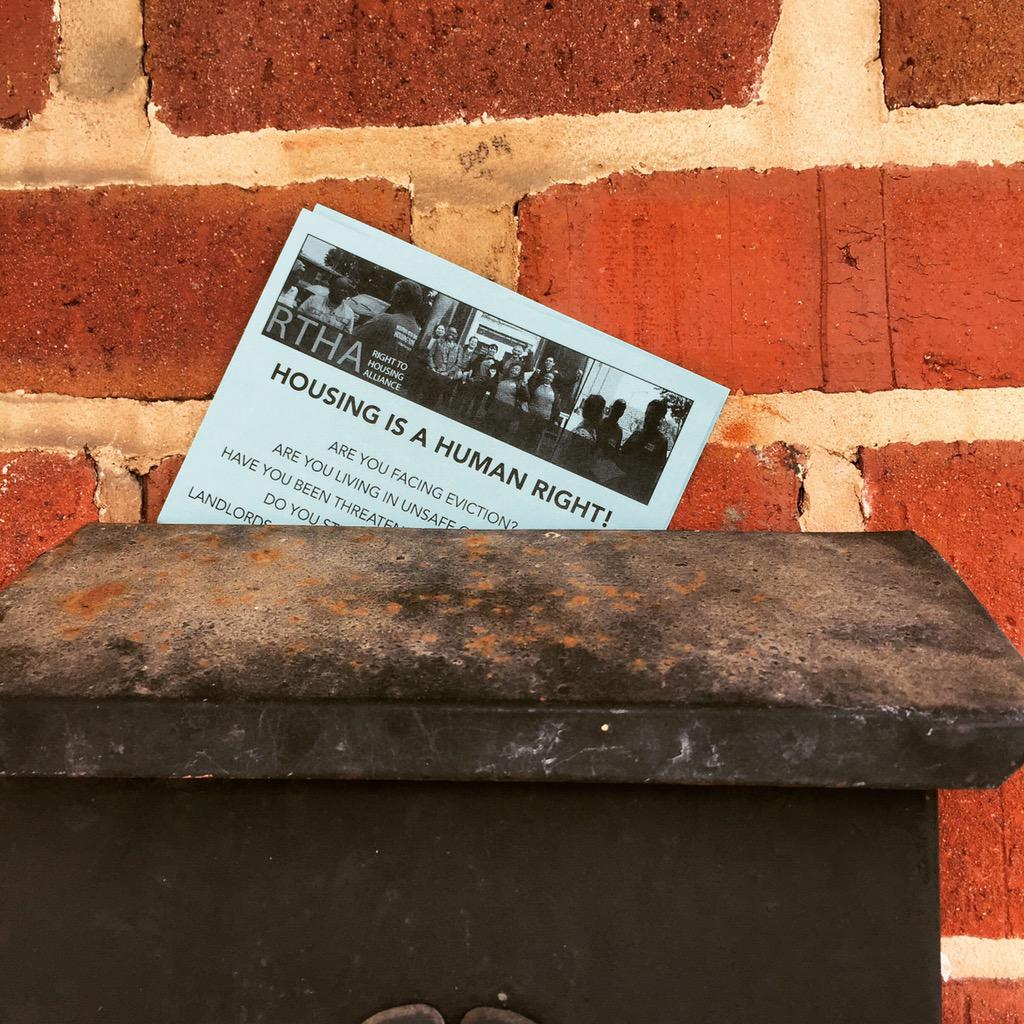
Lewis told volunteers that many of these homes may turn out to be abandoned, and indeed many addresses that volunteers visited appeared to be vacant properties. Volunteers took notes after each visit, documenting, among other things, the building type, whether or not they had a conversation with a tenant, and whether the property looked occupied or vacant. Volunteers left blue RTHA flyers outside most of the doors they visited that listed information on how to get support and more involved in organizing.

Another small group of canvassers met a man on Edgewood Street who described the hurdles he had to jump through to keep water on in his house, a particularly stressful situation because he has asthmatic children. He told the canvassers that he paid almost $400, including payments for water bills and jugs and bottles of water for his family.

Earlier in April, RTHA launched an online MoveOn petition calling for a moratorium on the water shutoffs. As reported in The Baltimore Brew, Tony Simmons, an organizer with RTHA, said that they will be organizing and petitioning City Council until there is more clear information about what’s going on; many residents are skeptical that their bills are even correct. The Rawlings-Blake administration says the shutoffs are necessary to pay for infrastructure improvements around the city. By Sunday night, RTHA had collected more than 2,000 petition signatures, and announced that it will be organizing more canvassers at its offices every evening that week. As of press time, they have collected more than 3,000 signatures.

What’s Behind the Recent Plague of Shootings in Baltimore?

Originally published in VICE on May 20th, 2015.
——-

While the national film crews have packed up and left Baltimore, losing interest in the place now that there are no more burning pharmacies and vandalized cop cars, Charm City residents are left to reckon with one of the most violent months they’ve seen in years. As the Baltimore Sun reports, homicides are up nearly 40 percent compared with this time last year, and nonfatal shootings are up 60 percent. From mid April to mid May, 31 people were killed, the Washington Post reports, with 39 more wounded by gunfire. The Sun adds that, as of late Tuesday, there had been 170 nonfatal shootings so far this year.

To put all this in perspective, the last time Baltimore saw 30 homicides in one month was in June 2007.

The spike in violence has received less attention outside of Baltimore than Freddie Gray’s death, but within the city, leaders, police, and community members are struggling to figure out what exactly is going on.

One theory floating around is that the weeks of unrest after Gray’s demise in police custody have daunted cops, leaving them unable or unwilling to control violent crime. The police union and some legal experts are upset at the criminal charges that the city’s top prosecutor, Marilyn Mosby, has leveled at six members of the Baltimore Police Department (BPD)—among them murder and manslaughter. This, coupled with a formal Justice Department investigation launched in cooperation with local officials to examine police practices, has left the BPD in a state of agitation.

Lieutenant Kenneth Butler, a longtime BPD veteran and president of the Vanguard Justice Society, a group for black officers, told the Washington Post that rank-and-file cops feel alienated, vilified, and afraid to do their job. “In 29 years, I’ve gone through some bad times, but I’ve never seen it this bad,” Butler added in comments to the Baltimore Sun, referring, in part, to officers who feel as though Mosby “will hang them out to dry.”

While beat cop reticence could be a factor, Daniel Webster, director of the Johns Hopkins Center for Gun Policy and Research, points out that homicides and shootings in West Baltimore were on the rise before the Freddie Gray unrest, though the pace has since accelerated. Webster thinks that among other things, the protests just strained the cops’ capacity.

“The police have been less active in proactive policing, less likely to engage individuals on the street,” Webster says, adding that resources were diverted to addressing the riots and in turn disrupted patrol and detective work. Leads from residents that detectives use to make arrests—though already quite difficult to come by—were further reduced during this time, he said, citing conversations with officers. Moreover, Operation Ceasefire, an anti-violence initiative begun by the city early last year, has been running without a program manager for the past several weeks. (The mayor’s office has indicated a new program manager will be hired soon.)

Webster believes another factor at play here may be that the Freddie Gray protests emboldened criminals. “We just had a huge display of lawlessness and disrespect for law and law enforcement,” he explains. “That mindset can spread easily and affect behavior.”

Dayvon Love, the co-founder of Leaders of a Beautiful Struggle (LBS), a grassroots organization that advocates for the interests of black people in Baltimore, doesn’t buy the connection between the protests and violence—one he calls an “easy deflection” of systemic issues.

“This [surge in violent crime] is a natural outgrowth of the conditions in which shooting and violence occurs,” Love says. Scapegoating the protests and the Mosby charges, Dove thinks, is particularly convenient for those unenthused with critiques of law enforcement and institutional racism. And it’s true that high rates of poverty, unemployment, and drug addiction all consistently correlate with high homicide rates. Love also argued that Baltimore’s had all kinds of violence for a long time—including sexual abuse and discriminatory housing policies—though it’s only when guns are fired that leaders start to panic.

Perhaps a simpler explanation for the increase in shootings is just that it’s getting hotter outside. Baltimore Bloc, another local grassroots organization, say that they don’t think the protests had anything to do with the recent violence, and that in their experience, violence always surges in the city as summer approaches. Lester Spence, a Johns Hopkins political scientist, agrees that homicides usually rise and fall significantly with the seasons, with the fewest occurring during the winter. “It’s no coincidence that homicides are spiking right now when the weather is getting warmer,” Spence says.

The violence that occurs when competing gangs fight over turf to operate their drug operations also generally escalates in the warmer weather. “People are suggesting that the spike we’ve witnessed over the past few weeks represents something new, but summer is just starting,” Spence adds. “It might be a blip or it might continue. We don’t know what’s going to happen.”

Baltimore PD Spokeswoman Sarah Connolly told VICE in an email, “We are investigating each incident as a singular incident while examining any trends and patterns to ensure that we are deploying our officers and resources effectively while being proactive and engaging the community. While we have developed investigative leads in a number of cases, we continue to ask the community’s assistance in calling with any information they may have.”

Meanwhile, some Baltimore community groups are taking the opportunity to organize anti-violence demonstrations. Coinciding with the 90th birthday of Malcolm X, the NAACP held a “Stop the Violence ‘By Any Means Necessary'” rally Tuesday night at their office in the Sandtown neighborhood. Another group committed to decreasing gun violence in Baltimore, the 300 Men March, is holding an “Occupy Our Corners” anti-violence rally on Thursday evening to honor the recent homicide victims.

“We the PEOPLE, are not blaming anyone but ourselves for failing to create a safe environment within our city,” their rally flyer reads. “Recognizing this, WE STAND, as a community of all people, regardless of RACE, RELIGION, SEX, CULTURE OR BACKGROUND.” According to the Sun, Munir Bahar, one of the group’s founders, is calling for 30 men in ten Baltimore neighborhoods to become block leaders in the fight against crime.

Love doesn’t expect the organizing work that LBS, Baltimore Bloc, and other grassroots groups are doing will change much in light of the increased violence. “Because doing that,” Love explains, “would take away from the larger objective, which is ultimately about systemic change.”

We Can’t Talk About Housing Policy Without Talking About Racism

Originally published in The American Prospect on May 20th, 2015.
————————–

Over the past year, unrest in places like Baltimore and Ferguson has inspired a nationwide debate on how to best combat systemic inequality and injustice. In the wake of high-profile police violence cases in these cities and elsewhere, this conversation has contributed to a renewed understanding of how federal and local housing policies helped create the inequality and racial injustice urban America confronts today. Yet lost in this discussion has been the complicated record of more recent desegregation efforts and what they can teach us about undoing generations of systemic racism and persistent segregation.

A case-in-point is HUD’s Clinton-era Moving to Opportunity (MTO) program, the subject of a new study by Harvard economists Raj Chetty, Nathan Hendren, and Lawrence Katz. Focusing on MTO’s long-term economic impacts, the study sheds more positive light on a program long considered to be a failure.

Running from 1994-1998, MTO was a housing experiment that involved moving individuals out of high-poverty neighborhoods with vouchers and into census-tracts with less than 10 percent poverty to see if this would improve their life outcomes. The results were mixed. While critics of the program have dubbed it a failure for not significantly improving children’s school performance or the financial situation of their parents, there was a lot about it that proved successful. MTO yielded significant gains in mental health for adults, for instance, including decreased stress levels and lower rates of depression. It also greatly lowered obesity rates and improved the psychological well being of young girls.

The new Harvard study further bucks the notion that MTO failed. Instead of looking at MTO’s economic impact on parents, it looks at the adult earnings of their children. Such an analysis simply wasn’t possible to do a decade ago, given that the kids were still too young. Researchers now find that poor children who moved into better neighborhoods were more likely to attend college and earned significantly more in the workforce than similar adults who never moved. The researchers also ranked which cities were “the worst” in terms of facilitating upward mobility. Out of the nation’s 100 largest counties, the authors found, Baltimore came in dead last.

Many writers were quick to make the connection between Baltimore’s low chances for social mobility and the recent bouts of unrest surrounding the death of Baltimore’s Freddie Gray. However, few seemed interested in connecting the new Harvard study with the politics of why we have segregated communities and concentrated poverty in the first place.

Emily Badger’s Washington Post write-up of the study framed the ills people face in Baltimore as a city failure, rather than a state or federal one. She discusses the “downward drag that Baltimore exerts on poor kids” and says that Baltimore “itself appears to be acting on poor children, constraining their opportunity, molding them over time into the kind of adults who will likely remain poor.” Badger acknowledges that maybe this has to do with struggling schools and less social capital. “Change where these children live, though,” she writes, “and you might well change their outcomes.”

In The Wall Street Journal, Holman W. Jenkins Jr. looks at the new Harvard study and concludes, “Neighborhoods themselves are clearly transmitters of poverty. The problem for residents isn’t racism: it’s where they live.”

Such narrow portrayals of Baltimore and its residents are only possible if we exclude decades of state and federal policy from our frame of analysis. Richard Rothstein of the Economic Policy Institute wrote something I suggest reading in its entirety. But to quote:

In Baltimore and elsewhere, the distressed condition of African American working- and lower-middle-class families is almost entirely attributable to federal policy that prohibited black families from accumulating housing equity during the suburban boom that moved white families into single-family homes from the mid-1930s to the mid-1960s—and thus from bequeathing that wealth to their children and grandchildren, as white suburbanites have done.

Slate’s Jamelle Bouie traces not only how efforts to segregate Baltimore succeeded, but also how there’s never been a sustained attempt to undo them.

The simple fact is that major progress in Baltimore—and other, similar cities—requires major investment and major reform from state and federal government. It requires patience, investment, and a national commitment to ending scourges of generational poverty—not just ameliorating them.

Expanding housing choice vouchers is a good thing. We should have subsidies available to ensure that everyone has similar opportunities for mobility. That said, moving millions of impoverished families out of high-poverty areas would be nothing short of a logistical nightmare. In effect, mass relocation efforts would require low-poverty communities to relinquish some of their gatekeeping discretion—no small political fight. MTO tracked 4,600 families in five U.S. cities. As Reihan Salam put it, “It’s not at all clear that an MTO-style approach would work if we scaled it up to, say, 40,000 families in one city.” Nothing is impossible, but we cannot have a serious discussion about housing mobility as a broad anti-poverty strategy without frankly discussing the politics of racism and segregation. 

Investing In Better Mobility Vouchers

So what does a more effective mobility strategy look like? A look to MTO’s own weaknesses may provide some clues. Indeed, for sociologists Stefanie DeLuca and Peter Rosenblatt, one problem with MTO was that it simply didn’t go far enough. Ina 2010 paper, they argue that while some students undoubtedly benefited from moving to wealthier communities, a lack of social capital, support, and resources, combined with housing vouchers that did not cover the cost of living in low-poverty communities, kept many students out of the highest-performing schools. At the same time, many families found that the obstacles created by poverty—like health problems and the chaotic nature of low-wage work—tended to follow them even as they left impoverished communities, and in turn contributed to poor student performance.

For DeLuca and Rosenblatt, there’s plenty that MTO did right but confronting endemic poverty and segregation requires a more systematic approach. That is, something perhaps more akin to the Baltimore Mobility Program (BMP), through which 2,400 Baltimore families have relocated since 2003. Whereas MTO offered housing search counseling to program participants, BMP provided that plus post-move counseling, second move counseling if necessary, and financial literacy and credit repair training. In another study released last year, DeLuca followed 110 BMP participants for nearly a decade, and found that over two-thirds of these families were still living in their integrated, low-poverty communities one to eight years after moving.

If MTO were to be a truly successful intervention, then expanding the program’s available services—including educational assistance, housing counseling, job support, and transportation help—would be important. We can’t know how the MTO participants would have fared if they had been given increased support, but we do know that additional services helped to make the transitions more surmountable and lasting for BMP families.

From “Finding Home: Voices of the Baltimore Housing Mobility Program,” a report by The Century Foundation.

This chart by The Century Foundation shows how the MTO and BMP compare with Section 8 vouchers and the Gautreaux Project, a desegregation experiment that ended in 1990 and helped inspire MTO.

Needless to say, high-quality BMP vouchers are more costly than MTO and traditional Section 8 vouchers. Excellent mobility programs will require a real financial investment. As it is, there are long Section 8 waiting lists around the country, and local housing authorities currently receive fixed amounts from HUD to support voucher participants. Unless we significantly scale up funding, moving more people to affluent neighborhoods would mean moving fewer people overall through vouchers.

The findings from the new Harvard study are useful. They allow us to ask new kinds of questions. But in terms of policy, we must be wary of those who now suggest that simply uprooting families and planting them into new communities is the responsible thing to do—especially if we’re not ready to provide the supports that research has shown makes these types of moves more successful.

For example, in The National Review Jonah Goldberg writes, “Consider Baltimore. If you’re poor, it is a very bad idea to raise your kids there if you can avoid it.” He implicitly suggests that if you’re a good parent, if you care about your kid’s future, then you will leave Baltimore, or Detroit, or Philadelphia if you can. Let us hope that this policy conversation does veer into an ugly, parent-blaming one. Housing mobility vouchers are good options, but our best anti-poverty interventions shouldn’t have to demand that people abandon their social networks, churches, and communities if they want to stay. We should make high-quality vouchers available, but we should vigorously invest in the communities where poor people already live.

As Daniel Kay Hertz, a senior fellow at City Observatory pointed out to me, the Harvard study provides some new ammunition against those who have long doubted the effectiveness of a housing policy that puts integration front and center. Now there is some pretty strong empirical evidence that shows that children’s life chances were significantly affected by growing up within integrated environments. Additionally, these findings come on the heels of Robert Putnam’s new book, Our Kids, which traces the growing opportunity gaps between wealthy and poor children around the country. In light of these new high-profile studies, perhaps policymakers will more readily accept the idea that your access to the American Dream has everything to do with your race, class, and geographic location.

At the end of the day, Baltimore ranks last in the Harvard mobility study not because poor, black people live there, but because leaders in power made choice after choice, year after year, to ensure that poor blacks’ opportunities would be overwhelmingly constricted. We can and must make new choices now.

Baltimore Jews join Freddie Gray protests – but it’s complicated

Originally published in Haaretz on May 5th, 2015
________________
After a tumultuous couple of weeks in Baltimore, in which protests, marches and riots raged through Charm City following the death of 25-year-old Freddie Gray — the Jewish community moved to raise funds, organize volunteers and engage in interfaith outreach. But in Baltimore, which has a complicated, and often fraught, history of Jewish-black relations, there is both a commitment to fight inequality and a reluctance to ruffle long-established relationships with city officials and the police.

The Baltimore Jewish Council, which represents about 55 local congregations and institutions, issued a statement that called for Jews to “stand beside our African American partners to combat racism and economic inequality.” Arthur Abramson, BJC’s executive director for the past 25 years, says his organization “has not hesitated for one moment” to stand up for injustice.

But he was frank about the challenges that remain for Jews seeking to combat racism. “Look, Maryland is a southern state. It was a slave state. In general, it’s not what I would describe as a place where African Americans and Jews sit around and sing ‘Kumbaya,’” he said.

Throughout the decades there have been plenty of instances of Jewish racism and black anti-Semitism in the city. Still, Abramson feels proud of the improved relations the BJC has helped to build over the past 25 years, which he attributes to concerted engagement, dialogue and programs involving the two communities.

Rabbi Etan Mintz, who leads Baltimore’s oldest and continually active synagogue, B’nai Israel, spent much of last week – as protests spread in the city and elsewhere following the death of Gray, for which six police officers have been charged – working with other local clergy.

“It’s a very powerful experience just to listen to people, to pray with people, and to be a presence face-to-face with one another,” Mintz said. He noted what he called the “outrageous reality” of poverty, inequality and mass incarcerations, but also stressed that the majority of police officers in the city are “peace-loving individuals who are trying to protect us on a daily basis.” He is concerned about a phenomenon of “guilt by association” — linking the broader police force to a few bad officers who acted inhumanely.

Mintz’s synagogue, which is Orthodox, is located downtown near the Inner Harbor, the former epicenter of Baltimore Jewish life. Now B’nai Israel, which is the last of what were once 20 synagogues in this area, is sometimes nicknamed “the Masada of East Baltimore.”

Jews began moving out toward the suburb of Pikesville in the 1950s and ’60s, and Mintz says the real “nail in the coffin” of inner-city presence was the 1968 riots, where many Jewish businesses were looted and destroyed. The latest disturbances, he adds, have sparked difficult memories for some of his congregants.

Solidarity events

Another organization, Jews United for Justice, (JUFJ) has taken a more demonstrably public role in supporting African-American protestors. The group was formed in late 2014 to provide an outlet for Jews, mostly in their twenties and thirties, to engage in social justice work. Many of these activists turned out for Ferguson solidarity events earlier in the year, so it was not surprising to see 30 JUFJ members marching on April 25th in Baltimore with black-and-white picket signs that called for #JusticeForFreddie.

Last Friday, the day Baltimore’s State Attorney Marilyn Mosby announced that the six policemen would face criminal charges, the number of JUFJ members who turned out to march rose to 100.

“I think this reflects the growing interest,” says JUFJ member Owen Silverman Andrews. “[We have] created a space where people can plug in within their own communities in a way that is still connected to the larger struggle.”

Marc Terrill, the president of The Associated: Jewish Community Federation of Baltimore, says he is pleased with the fast response the Jewish community took, and continues to take, in showing solidarity with the Freddie Gray protests. He says that ultimately there needs to be an agenda, both with short-term and long-term goals.

In the short term, the Associated has helped to organize volunteers and raise funds for food, toys and other supplies in order “to rebuild the communities torn asunder by wide-spread looting and vandalism,” according to its website. In the long term, Terrill mentions the need to promote greater access for city residents to health care, job training, education, counseling and mentoring programs, and to contribute to an overall greater push for societal integration.

“Our relationship with the African-American community is collaborative,” Terrill says. “Not everything is good, but we have the will and desire to work at it.”

While the Jewish community is presenting a relatively united front for now, the question of how and if its members will come together around the issue of police reform remains unclear. This community is one of the more politically conservative Jewish communities in the United States. And the established relationships Jewish leaders have cultivated with city and state officials — which have helped ensure enhanced security and support for Jewish groups and institutions — are very important.

The BJC did not come out strongly for any of the police reform bills that were being considered in Annapolis this past legislative season, despite months of organizing and campaigning by local activists. By contrast, members from JUJF, including Rabbi Daniel Burg, who leads an egalitarian synagogue in Reservoir Hill, offered testimony in support of legislation that would alter the Law Enforcement Officers’ Bill of Rights.

Jewish communal leaders have all expressed a commitment to tackle the “deeper issues” provoked by the Freddie Gray protests – specifically with regards to economic inequality and poverty. However, whether they will be able to do so without inserting tension into some of their long-standing political relationships remains to be seen.

Baltimore’s Criminal Justice System Is Seriously Overloaded Thanks to the Arrest of Protesters

Originally published in VICE on May 1, 2015.
_____________

Four days after Maryland Governor Larry Hogan declared a state of emergency, and three nights into the citywide 10 PM to 5 AM curfew, Baltimore lawyers and activists are beginning to grapple with exactly how the official response to unrest over the death of Freddie Gray has impacted protesters’ constitutionally protected legal rights.

Perhaps the most controversial decision of the past few days came on Tuesday, when Hogan suspended a state rule that requires an individual to be brought before a judicial officer or released from jail within 24 hours following their arrest. The decree paved the way for arrestees to languish in jail for up to 47 hours without charges. The Maryland Public Defender’s Office issued a statement Wednesday challenging Hogan’s legal authority to tell the judiciary what to do.

That night, 101 of the 201 arrested protesters were released from jail without charges. At a press conference earlier Wednesday, Baltimore Police Captain Eric Kowalczyk said his department had struggled to file formal charges against the protesters because officers were so busy responding to emergencies elsewhere; he insisted that charges would still be filed at a later date.

“On a normal day, if I’m a patrol officer and I was filing a charge, it could take upwards of two hours,” Sarah Connolly, a Baltimore Police spokeswoman, told VICE. “But when you’re having multitudes of arrests, and when you are working to ensure the preservation of life and property, which was paramount, it just wasn’t possible [to file all the charges.]”

Natalie Finegar, the Baltimore Deputy District Public Defender, told VICE that Hogan’s order is a clear instance of the executive branch overstepping its legal bounds. She notes that there is already a judicial provision within the Court of Appeals to change the 24-hour detention rule in the case of an emergency. Hogan’s executive order, Finegar contends, demonstrates disregard for the checks and balances of the legal system.

Other experts point out that holding uncharged people in jail is simply bad policy regardless of the legality, especially in this fraught political moment. “If the citizens of Baltimore are reacting [on the streets] to longstanding systemic issues, then dealing with arrestees in a systematically unfair manner, like leaving people in jail without charges, doesn’t really seem to be an effective response,” said Cherise Fanno Burdeen, the executive director of the Pretrial Justice Institute, a nonprofit committed to pretrial justice reform.

Another reason few charges were filed this week is because Baltimore’s district courts closed after Monday’s riots. In Baltimore City, courts close fairly frequently for all sorts of reasons, including snow days; the judiciary decides when to close the courts. On Tuesday, none were open, and on Wednesday just one out of four was operational—creating a serious backlog for cases that would have normally been divvied up. (By Thursday, all four district courts had reopened.)

“Courts are not supposed to shut down, especially when you’re arresting hundreds of people in a moment of crisis,” said Alexandra Natapoff, a professor at the Loyola Law School in Los Angeles. If people are being arrested, courts should be open to handle the cases. The wheels of justice should continue to spin equally for everyone at all times.”

In light of Hogan suspending the 24-hour rule, Finegar told VICE that her office filed 82 habeas corpus petitions on behalf of detained arrestees. (The Guardian had previously reported that Hogan had effectively suspended the state’s habeas corpus law, but this is misleading, as state and federal habeas corpus laws—which gives detainees the ability to seek relief from unlawful imprisonment—are unchanged.) However, before those habeas corpus petitions could be ruled upon, the city released the remaining uncharged protesters in a nod to the fact that they no longer had the authority to detain them. Finegar believes that many who were released on Wednesday were illegally held in the first place.

Another issue is that many arrested protesters were given extraordinarily high bail amounts. Some were apparently even asked to pay their bail all at once, in cash—which is notable given that detainees usually have the option to pay deposits or to take out loans from bondsmen.

“For my clients, a $50,000 cash-only bail is tantamount to no bail,” said Finegar. “I’m a nice middle-class public servant and even I couldn’t post something like that.”

“What is unconstitutional is using money to detain and deprive an individual of due process,” Burdeen added. “And yet that is essentially what is happening here.” TheGuardian reported on one case where a 19-year-old had bail set at half a million dollars. The defendant, who failed to produce the money, was then sent to jail. Generally speaking, if a detainee cannot make bail and cannot take out a loan, then they will essentially serve a jail sentence before even being found guilty of a crime. According to Finegar, that could mean sitting in jail for anywhere from 30 days to a year.

On Thursday afternoon, ACLU-Maryland’s legal director Deborah A. Jeon sent a letterto Baltimore Mayor Stephanie Rawlings-Blake calling for an end to the citywide curfew. “We have a right to demand policy changes of our government…. and we have a constitutionally protected right to do so on the streets and sidewalks of Baltimore.” Jeon added that at this point the curfew’s “unnecessary restrictions” seemed to do more to stoke community resentment than to ensure public safety.

The curfew is a First Amendment issue more so than a criminal one. And First Amendment decisions are often seen as balancing acts between the need for public safety and to protect one’s right to protest, move, and assemble. “It has to be a reasonable balance, and whether this curfew is a reasonable one is subject to debate,” said Eve Brensike Primus, a University of Michigan law professor.

In a Thursday evening press conference, Baltimore Police Commissioner Anthony Batts said that despite the city’s relative calm, they would not be lifting the curfew this weekend because there are large protests planned. “We have a lot more protests that are popping up by the minute, and even if we didn’t, we have other cities that have large protests and their activities impact our city too,” said Batts.

The argument that Baltimoreans should be kept under curfew because protests are happening in other cities certainly raises some serious constitutional questions.

Activist groups are responding to these issues; the Ferguson Legal Defense Committee is operating a jail support hotline. On Wednesday night, the Public Justice Center (PJC), a Baltimore-based legal advocacy organization, held an event to train lawyers, law students, and legal experts in jail support and legal observing for demonstrations. Nearly 50 people showed up, which, according to PJC attorney Zafar Shah, was beyond the group’s expectations. “There wasn’t enough seating,” he said. In addition, Maryland Public Defender Paul B. DeWolfe issued a call for private lawyers to help represent the 201 protesters arrested on Monday night. DeWolfe told the Daily Record that many private attorneys have offered their services.

Of course, it’s safe to say a few well-intentioned lawyers are unlikely to change the game here.

“Yes there will be lawsuits, and appropriately so, but we can’t rely on them to fix the underlying problem,” said Natapoff. “We have to look beyond the law if we want to really reform the criminal justice system. That’s why these protests all over the country are so important.”

Inside the Chaos, Rage and Confusion That Consumed Baltimore Last Night

Originally published in VICE on April 28, 2015.
_______

10996095_3087979085951_8514579901023162352_n

 photo credit: Rachel Cohen

As I walked through the streets of West Baltimore on Monday evening, small bright green opiates littered the sidewalk, pills left over from when the local CVS pharmacy was looted hours earlier. The air felt thick and musty—police had fired teargas canisters near the Penn-North subway station. By 6:15 PM, clouds of smoke were pouring out of the empty pharmacy, which filled with flames. At one point, protestors cut the hose that was being used to put out the fire.

Except for a few young activists hoisting “Justice 4 Freddie Gray!” picket signs, most people hanging around were not protestors. The majority of Baltimoreans on the streets were just snapping photos and watching the events unfold as spectators. Unlike Saturday’s protests, where thousands proudly marched, chanted, and gave speeches about accountability and justice for Freddie Gray, a 25-year-old black Baltimore resident who suffered a fatal spinal cord injury while in police custody earlier this month, Monday felt perilously chaotic.

By the corner of North Avenue and Pennsylvania, just a half-mile down from where Freddie Gray’s funeral took place earlier that day, two Maryland Transit Administration vehicles were burning. A wrecked police car sat in the middle of the street a few hundred feet down—every one of its windshields and windows cracked and shattered. Broken glass lay by its tires. By 9 PM, Maryland Governor Larry Hogan had deployed National Guard troops, Mayor Stephanie Rawlings-Blake announced there would be a weeklong 10 PM curfew, and all public schools were cancelled for Tuesday. The city was officially declared to be in “a state of emergency.”

Saba Nazeer, a local resident who works with the Right to Housing Alliance, a Baltimore housing justice organization, came out to watch one standoff unfold between high school students and the police. The cops knew to meet the teenagers because a flier circulating earlier on social media called for students to meet for a “purge” out by the mall after school. (Frederick Douglass High School is across the street from Mondawmin Mall.) Dozens of cops were ready to meet the 75 or so students that showed up. Things escalated quickly. Students hurled bricks, rocks, and bottles at the police; cops sprayed mace and teargas. Fifteen officers were injured in clashes around the city, six seriously, and two were hospitalized Monday evening.

“These kids were going to fight for their neighborhoods, and they want justice not just for Freddie Gray but for all those who have died at the hands of police in their communities,” Nazeer said, defending the students. “I’ve been seeing it all day, the police try to put fear in the communities, they harass and bully. They’ve been doing it for decades. And people are tired of it.”

10386269_3087980605989_3794526195910937202_n

photo credit: Rachel Cohen

Speaking out Monday night, hours after the funeral, Freddie Gray’s mother Gloria Darden pleaded for the violence to end. “I want you all to get justice for my son,” she said. “But don’t do it like this here.”

A national conversation on police brutality broke out after the deaths of Michael Brown and Eric Garner last year, but local cops’ excesses have been a major political issue in Baltimore for a while now. A Baltimore Sun investigation released in September found that the city paid out $5.7 million in judgments and settlements in cases related to alleged police brutality and civil rights violations since 2011. Even before Gray’s death, the city was haunted by two recent high-profile incidents of unarmed Baltimore black men dying in police custody— Tyrone West in 2013 and Anthony Anderson a year earlier. Cops faced no charges following the deaths of either men.

Since West’s death in July 2013, Baltimore community members have convened outside City Hall every Wednesday to call for the police to be charged with homicide. (These weekly demonstrations are locally referred to as “West Wednesdays.”) Activists keep count— Monday marked day 648 since West’s death. While an independent review issued in August determined that the police did not use excessive force, some still insist they saw cops kick West in the head, yank him by his dreadlocks, and beat him with batons.

In September, an alarming video surfaced that showed a Baltimore cop repeatedly punching a man. Unable to ignore the damning footage, Mayor Rawlings-Blake vowed to develop a “comprehensive” plan to address police brutality in the city. A few months later, however, she vetoed a bill that would have required city police to wear body cameras. Rawlings-Blake has said she supports the measure, but felt the specific legislation proposed was not within the City Council’s authority.

Freddie Gray was arrested on April 12 after making eye contact with police and taking flight, but more than two weeks later the public has still not been given any meaningful details about how he sustained his fatal injury. (He died on April 19.) Last week, Baltimore Police Commissioner Anthony Batts admitted Gray was unbuckled when police placed him in a van despite being shackled and handcuffed, and noted that Gray’s multiple requests for medical attention were ignored. Other findings from the department’s internal investigation, however, have not been made public. More information will be released on May 1— a deadline Batts set to share findings with Baltimore’s State Attorney.

“This is one case where body cameras certainly would have been useful,” said Peter Moskos, a former Baltimore City Police Officer and professor at John Jay College of Criminal Justice. “We’d have a lot better idea of what actually happened, and we’d know far more quickly.” (A bystander’s mobile footage showed Gray writhing in agony as police carried him away.)

11203050_3087978045925_2724119197233361859_n

photo credit: Rachel Cohen

Baltimore Bloc, a grassroots activist group in Baltimore, has announced that they are planning another protest for Freddie Gray Tuesday afternoon at 3 PM. They told me that while their collective has been in “emergency response mode” for the past two weeks, eventually they will begin to outline more long-term plans. The “pace and emotion [has] left us with less space than we normally have to strategize,” they explained. But soon, they will join with other local organizing groups to “turn our attention to the next steps, including legislative strategy at the state level and organizing here at home for the 2016 city elections.”

Speaking at a press conference in the evening, Mayor Rawlings-Blake referred to the Monday rioters as “thugs” who were senselessly “trying to do tear down what so many have fought for.” Some 200 arrests were made by Tuesday morning. Brandon Scott, a city councilman, said, “We can’t let this be a repeat of 1968″—referring to the violent Baltimore riots that followed Martin Luther King Jr.’s assassination. “Adults have to step up and be adults.”

Tensions between political leaders, police, and community members are unlikely to abate any time soon, but multiple community cleanup efforts are being organized on social media today in West Baltimore. One group will be meeting back by the Penn-North subway station at 10 AM, and another will start at 2 PM by the University of Baltimore. Organizers have asked individuals to bring their own gloves, trash bags, brooms, and food.

Teaching Character: Grit, Privilege, and American Education’s Obsession with Novelty

Originally published in The American Prospect on April 17th, 2015.
————————-

Twice a week for 30 minutes, fifth graders at KIPP Washington Heights, a charter school in New York City, attend “character class.” Each lesson is divided into three parts, according to Ian Willey, the assistant principal who teaches it. First, students find out what specific skill they’ll be focusing on that day. “This morning we’re going to learn how to set a long-term goal,” Willey might tell them. Next, students are asked to practice the skill. In this case, students may imagine they have a long-term project to complete, and then work to construct a timeline with incremental deadlines. In the final part of the lesson, students would take time to collectively reflect. “What was hard about this exercise?” Willey might ask. “What went well? Did anyone feel nervous? What did you do when you felt nervous?” And because part of KIPP’s mission is to help build character, the students would then classify their new skill as one or more of KIPP’s seven targeted character goals. In this example, the students were learning “grit.”

Few ideas inspire more debate in education circles than grit, which means having dedication to and passion for long-term goals. Angela Duckworth, a psychologist at the University of Pennsylvania, first popularized the concept in 2007; she believes that if we can teach children to be “grittier” in schools, we can help them achieve greater success. Paul Tough, a journalist who published a 2012 bestseller, How Children Succeed: Grit, Curiosity, and the Hidden Power of Character, also brought grit into the national spotlight. Many policymakers and school leaders have since jumped at the idea. Secretary of Education Arne Duncan praised Tough’s “fantastic book”—arguing that teaching skills like grit “can help children flourish and overcome significant challenges throughout their lifetimes.” Districts all over the country are exploring how they can incorporate grit into their curriculum. In 2013, Duckworth was awarded $625,000 by the MacArthur Foundation to continue researching ways to cultivate grit in schools.

Despite grit’s enthusiastic boosters, a growing movement has sprung up in opposition. Some psychologists and policy analysts question the methodology behind Duckworth’s research—which has chiefly relied on students answering questionnaires on how gritty they think they’ve been. (For example, a survey question might read: “New ideas and projects sometimes distract me from previous ones,” and students would report how much that statement resonates with them.) Some critics argue that grit places too much weight on individual student behavior, and as a result, crucial attention is directed away from the structural forces that inhibit academic success. Some researchers think that emphasizing grit can even produce negative outcomes, like killing creativity.

The excitement towards and resistance to this new field illuminates a great deal more about American education and its obsession with novelty than the grit research itself—which is still in its infancy.

The Background on Grit

Grit researchers begin with the conviction that grit is malleable: They believe that if we could design the right interventions, we could probably increase students’ grit levels, too. Duckworth admires the work of Carol Dweck, a psychologist whose research on “academic tenacity”—a mindset that helps students focus on and persevere towards long-term goals—suggests that cultivating grit may be possible. Grit research also builds on the work of Martin Seligman, who pioneered the field of positive psychology, focused on positive human flourishing. Duckworth is Seligman’s former student.

Schools, politicians, and news organizations have embraced grit, excited by its possible implications. The New York Times Magazine ran a cover story about grit’s potential. KIPP charter schools, like the one Ian Willey works for, have incorporated inculcating grit and other “character strengths” such as optimism, self-control and gratitude into their mission statement. In 2013, the Association for Supervision and Curriculum Development (ASCD), a global education organization, published a book entitled “Fostering Grit.”

Dan McGarry, an Assistant Superintendent for Upper Darby School District—located in a township adjacent to West Philadelphia—read about Duckworth’s work in 2011 and grew fascinated by character education. “I truly believe that this is going to change the world,” he told The Philadelphia Inquirer. His district has since formally partnered with Duckworth’s lab, allowing Penn researchers to both provide professional development to their staff and conduct experiments on their students. McGarry hopes that teaching character will reduce discipline problems and raise student achievement.

Backlash

Advocates insist that the benefits of teaching grit are just as important for affluent kids growing up in hypercompetitive communities as they are for low-income students growing up in poverty. Yet as grit hype grows, critics have started speaking out against what they see as an attempt to gloss over the uniquely debilitating effects of poverty. Paul L. Thomas, an education professor at Furman University, argues that reformers have embraced grit precisely because it presents them an opportunity to ignore material solutions. Indeed, in How Children Succeed, Paul Tough wrote, “There is no antipoverty tool we can provide for disadvantaged young people that will be more valuable than the character strengths … [such as] conscientiousness, grit, resilience, perseverance and optimism.” 

David Meketon, a research liaison from the Duckworth Lab, acknowledges that social class impacts everyone throughout their lives. But “we think our work and understanding can help mitigate those possible preconditions,” he says.

Eldar Shafir, a professor of Psychology and Public Affairs at Princeton is skeptical that teaching grit can diminish the effects of poverty. He recently co-authored an influential book with Sendhil Mullainathan, a Harvard economist, on “scarcity”—which is the psychological effect of struggling to manage with less than you need. “I have no problem with the idea that whoever you are, having grit will be better than not having grit,” Shafir says. “But my intuition is that the kinds of problems that are so pressing that it’s very hard to put them out of your mind, like whether or not you will have food to eat, or whether your parent is going to prison or will lose their job, those stresses are much harder to ignore than the stresses facing the affluent, like which prestigious college will you go to.”

“To be perfectly honest, I’m very reluctant to ask the American poor to spend more time doing yoga,” Shafir answered.

I asked Dr. Shafir what he thought about teaching students yoga and mindfulness—popular ideas that the Duckworth Lab and other proponents of grit are exploring. “To be perfectly honest, I’m very reluctant to ask the American poor to spend more time doing yoga,” Shafir answered. “I think the impact of giving kids after school programs, transportation, and childcare for their parents would be much greater than trying to figure out how to include meditation in schools.” 

In late January, some progressive educators discussed the racial implications of grit at “EduCon 2.7,” a Philadelphia-based conference designed to explore digital learning. (The panel was called “Grit, Galton, Eugenics, Racism, Calvinism.”) “We keep [hearing] this narrative that the only way children in poverty are going to succeed is by working harder than their peers who are middle-class,” said Pamela Moran, a superintendent of a large public school district in Virginia. “We have to think about our own cultural biases, why grit appeals to us, and why we want to focus on it in our schools.”

Jeff Snyder, an education historian at Carleton College, thinks that while it’s “patently absurd” to argue—as some of his colleagues do—that teaching grit is inherently racist, there are some problems with how it is being applied in the real world. “[KIPP co-founder Dave] Levin, Duckworth, they all say that character education should be for everyone. But the way that it turns out is that KIPP-based character education is overwhelmingly for poor kids of color,” says Snyder. Referring to the “culture of poverty thesis”—the controversial idea that the urban poor are disadvantaged not due to racism and discrimination but because they harbor certain cultural pathologies—Snyder says it’s understandable that people would resist a new theory that seems to suggest academic failure is rooted in individual behavior. 

Perhaps the most outspoken critic of grit culture is Alfie Kohn, an education writer who published The Myth Of The Spoiled Child in 2014. “There is no pretense of objectivity in [Duckworth’s] work; [she] is selling grit rather than dispassionately investigating its effects,” Kohn writes. “Proponents of grit tend to focus narrowly on behavior, ignoring motive,” he adds. “Do kids love what they’re doing? Or are they driven by a desperate (and anxiety-provoking) need to prove their competence? As long as they’re pushing themselves, we’re encouraged to nod our approval.”

Ironically, Kohn and Duckworth both insist they are looking out for “the whole child”—the idea that schools should not just be for children’s academic development, but for their moral, social, and physical development as well. “If we’re interested in the whole child—if, for example, we’d like our students to be psychologically healthy—then it’s not at all clear that self-discipline should enjoy a privileged status compared to other attributes. In some contexts, it may not be desirable at all,” Kohn argues. In an interview with ASCD, Duckworth says, “standardized tests … are limited in their ability to pick up things like grit and self-control … gratitude, honesty, generosity, empathy for the suffering of others, social intelligence, tact, charisma. … We’re now seeing a pendulum swing away from the single-minded focus on standardized testing and toward a broader view of the whole child.”

Is Grit Science Reliable?

In 2012, the University of Chicago Consortium on Chicago Schools Research published a comprehensive literature review detailing all the existing evidence on how these “non-cognitive factors” like grit, motivation, and perseverance shape school performance. They found that most of the existing research is correlational, not causal—making it unclear the extent to which these factors can be developed in classrooms, and raising questions about whether changing them would actually even improve school performance. They also found little evidence to suggest that improving students’ academic behavior would narrow racial and ethnic achievement gaps.

One criticism of grit research is that it has relied mostly on the students’ self-reported questionnaires and surveys. Two sets of problems accompany these measures—one is “social desirability bias” and the other is “reference bias.” The former is a well-documented phenomenon where people tend to inaccurately report their experiences or memories on surveys in order to present themselves in the best possible light. They seek to present themselves in a socially desirable way, thus skewing the results. “Reference bias” is a less obvious issue, but perhaps more detrimental. To answer a survey question that asks “Are you a hard worker?” you’d typically conjure up an image of what you envision hard workers look like, and then compare yourself to them. “Am I hard worker compared to the other kids in my class?” you might ask. In effect, the results of these surveys can tell us very little about how you’ll do compared to people outside of your own peer group.

Martin R. West, of Harvard’s Graduate School of Education, has been researching the limitations of self-reported assessments, and finds evidence that the school climate in which a student answers these questions can significantly affect what answer they will give. “In a rush to embrace non-cognitive skills as the missing piece in American education, policymakers may overlook the limitations of extant measures,” West writes, urging researchers to develop alternatives that are valid across a broader range of settings. The Duckworth Lab’s Meketon says his team is now focusing on creating more activity-based tests, such as computer games, in the hope that this will ameliorate some of the concerns people have about the lab’s surveys and questionnaires.  

Avi Kaplan, a psychology professor at Temple University who studies student motivation and self-regulation, finds the public rhetoric around grit research to be extremely political. “Grit is a paradigm that gives people certainty, and that’s what people are looking for—absolute truth.” He argues that there have always been those in his field who aspire, mistakenly, to treat psychology like a natural science. “But human beings are all so different, and people develop and change at such different points in their lives.”

Education Policy’s Ebb and Flow

This is not the first time we’ve recognized that success is not exclusively about IQ or raw talent. In 1961, psychological theorist David McClelland published The Achieving Society, which argued that cultivating the need for achievement, often through early childhood experiences, plays an integral role in one’s chance for life success. In 1990, journalist Dan Goldman published Emotional Intelligence: Why it Can Matter More Than IQ, which argued that self-awareness, altruism, personal motivation, empathy, and the ability to love and be loved are the greatest indicators of success.

This is not even the first time our country has tried to teach character or seen it as integral to education—far from it. Writing in The New Republic, Snyder of Carleton College traces the history:

From the inception of our public school system in the 1840s and 1850s, character education has revolved around religious and civic virtues. Steeped in Protestantism and republicanism, the key virtues taught during the nineteenth-century were piety, industry, kindness, honesty, thrift, and patriotism. During the Progressive era, character education concentrated on the twin ideas of citizenship and the “common good.” As an influential 1918 report on “moral values” put it, character education “makes for a better America by helping its pupils to make themselves better persons.” In the 1960s and 1970s, meanwhile, character education focused on justice and working through thorny moral dilemmas.

With this in mind, the discussion around grit actually fits quite snugly within a long tradition of American education. First comes an idea, and initial excitement. Then there is a backlash, followed by an uneasy period where ideas are implemented and critiqued. “And then ultimately there’s the sad truth with education research and millions of dollars that you will always end up with mixed results,” says Snyder. “You will never do an educational experiment with real live human beings that give you dramatic results.”

Duckworth’s Meketon thinks the grit backlash might be partly steeped in resentment towards the research’s popularity. “The cynical part of me says that if you find someone who is getting a lot of attention, you go against them and attack them,” he says. But Meketon acknowledges that perhaps a simpler explanation is that educators have short attention spans. “I was an educator for 40 years and I’ve watched the evolution of various ideas and best practices in education come and go.”

Snyder disagrees; he thinks it is administrators, policymakers, and philanthropists—like Bill Gates—who have short attention spans, not the educators themselves. “It’s the people who fund the type of research being done by Duckworth that tend to get bored more quickly, because they are excited by innovation in and of itself.” Snyder expects that in ten years we’ll see people excited about new ideas, or old ideas that are billed as new.

Ultimately, we just don’t know that much about grit yet. Even Angela Duckworth has admitted she doesn’t know if we can actually teach it in schools. Her lab is only just now beginning to develop tools that don’t rely predominately on self-reported assessments. Prior research suggests that we’re not all that good at teaching character in school. In 2010, the largest federal study on school-wide character education programs found that these programs largely fail to produce improvements in student behavior or academic performance.

This is not to say this is all pointless. The University of Chicago researchers did find plenty of evidence that supporting positive academic mindsets can help students develop better learning strategies, and in turn, improve their grades—learning strategies like breaking up long-term projects with incremental deadlines, which is what Willey tries to teach in his classroom.

Stefanie DeLuca, a sociologist at Johns Hopkins University, sees grit’s academic value, and defends teaching it in schools. (“Learning how to be persistent at an unpleasant task, it’s hard to argue that doesn’t matter,” she says.) But ultimately DeLuca worries about where the public conversation is going. “On the one hand, there’s a hopefulness that grit offers us. It’s an American narrative that’s really appealing, and it tells us that poor kids are not lost causes,” says DeLuca, who notes that too many policymakers just give up on kids in poverty. “But what happens with really popular ideas that have simple and compelling solutions is that you can run with them, and if things don’t change, then you start to think things can’t ever change.” By not confronting social structure directly within the grit narrative, we may be setting up these kids for failure. “At the end of the day,” says DeLuca, “poor kids—gritty or not—are still navigating within a profoundly unequal geography of opportunity.”

With New Protections Tied Up in the Courts, Home Health Care Workers Aren’t Waiting Around

Originally published in The American Prospect on April 3rd, 2015.
______

Almost two years after the Obama administration extended historic labor protections to the nation’s 1.79 million home healthcare workers, those new rights remain in limbo. In September 2013, the Department of Labor (DOL) announced plans to amend a longstanding regulation that has excluded them from earning the federal minimum wage, overtime pay, and compensation for travel on the job. For home healthcare workers in the United States—a group that is nearly 90 percent female—this move marked a significant step towards setting a floor of decent labor standards.

But the rule-change, which was set to go into effect on January 1st, now faces a challenge in federal court, and critics say state legislators are using the ongoing litigation as an excuse to avoid implementing the new protections. At the same time, given that most home healthcare workers are paid through Medicaid and Medicare—two underfunded public programs—many also worry that states will respond to the rule-change by curtailing consumers’ access to quality care. Activists across the country are working to pressure their lawmakers to reckon with these new standards and avoid potential calamity.

Four decades ago, Congress decided that home healthcare workers should be classified more like babysitters who provide “companionship,” rather than as workers entitled to basic protections. Nursing home employees, by contrast, are fully covered under the Fair Labor Standards Act (FLSA), despite performing many of the same tasks. As home healthcare has ballooned in recent years, these occupational distinctions have become harder to justify.

According to the Bureau of Labor Statistics, the U.S. will need one million new home healthcare workers by 2022. But the work is draining, the pay is paltry, and turnover is high. When adjusted for inflation, home healthcare workers’ average hourly wages have declined by nearly 6 percent since 2004. In 2013, the average earnings of home healthcare workers totaled just $18,598. 2013 was also the year that the Obama administration decided it was well past time to update FLSA’s policy. Because the DOL has the authority to amend federal regulations, it was able to enact this change without seeking Congress’s approval.

Though the new DOL rule-change would most directly benefit home healthcare workers, it carries implications for all domestic workers, including nannies and housekeepers. “By improving the conditions and protections in one area, you’re broadly boosting the sense that this is dignified work,” says Elly Kugler, an attorney with the National Domestic Workers Alliance, (NDWA) a group representing domestic workers in the United States.

Whether that change will actually be implemented is another question. Last year three industry groups filed a lawsuit against the DOL rule-change, insisting that it would have a “destabilizing impact” on home healthcare and hurt millions of elderly individuals. On December 22, 2014, a D.C. district judge vacated the rule for third-party employers, arguing that the executive branch cannot make such a regulatory change. A few weeks later, the same judge also vacated FLSA’s revised definition of “companionship services.” The DOL filed a challenge in appeals court, and arguments will be heard later this spring. Some suspect this may ultimately make its way to the Supreme Court.

Then, on March 20th, Labor Secretary Tom Perez sent a letter out to all 50 governors, urging them to focus on budgeting the minimum wage and overtime protections now, “to ensure that [they] will prepared if the Department prevails” in appeals court. Across the country, activists are also pressuring their representatives to focus on these issues. Yet many lawmakers are using the litigation as an excuse to avoid reckoning with the thorny budgetary questions. This means workers may not see minimum wage, overtime, and travel pay increases anytime soon.

“In Georgia, we’re seeing that our lawmakers are not talking about these issues,” says Tamieka Atkins, who leads Atlanta’s chapter of NDWA. “They have the attitude that we’re not going to move on this until the lawsuit comes down.” In response, Atkins’ group launched a campaign to lobby lawmakers and health agency commissioners in advance of their next legislative session. They also started a petition—“Governor Deal: All Eyes Are On Georgia”—asking for gubernatorial support towards minimum wage and overtime.

Activists in Texas are also applying pressure to their leaders. In January, domestic workers launched a home healthcare campaign, bringing together consumer groups, disability rights organizations, and labor unions. The following month—for the first time ever—domestic workers traveled to Austin to share their personal stories and lobby state legislators. “It was a really great opportunity because we agitated on different levels,” says Mitzi Ordonez, a domestic worker organizer at the Fe Y Justicia Worker Center in Houston.What we found is that many of the lawmakers just didn’t know about these [DOL] changes.”

Compared to Texas and Georgia, some states have made greater progress towards implementing the new labor protections. California, which already pays its home healthcare workers minimum wage, allocated new funds for overtime pay in its 2014-2015 budget, and was prepared to pay workers more at the start of 2015. But after learning about the federal lawsuit, California Governor Jerry Brown decided to postpone the overtime pay, even though there is nothing legally obligating him to do so. Frustrated activists have launched a campaign in protest; they organized meetings with state legislators, held rallies and candle light vigils, and even set up a“Justice for Homecare Tribunal”—a mock trial against the state. “The best thing for us to do is to not rest on our laurels,” says Doug Moore, the executive director of the United Domestic Workers of America. “The governor wants this to go through the courts, but we will use pressure to change his position.” Moore says that if the DOL rule-change is upheld in appeals court, they will then move to demand retroactive overtime pay back to January 1st.

Yet for some states that have reckoned with the rule-change, the results haven’t always been encouraging. “What we have been seeing, unfortunately, is that you can equally comply with FLSA by paying overtime and travel time, or by setting caps on the number of working hours,” says Alison Barkoff, the Director of Advocacy at the Bazelon Center for Mental Health Law. This scenario is playing out in states like Arkansas, which is looking to cap homecare workers to just 40 hours per week, and to limit each worker to just one customer per day. In effect, this would enable states to avoid paying workers overtime and travel costs. But such measures will hurt employees who make their living by piecing together multiple part-time jobs. It may also impact consumers who need more than 40 hours of care, or who may have a harder time finding someone willing to work for just a few hours per day.

Some hope that the Americans With Disabilities Act (ADA) and the Olmstead v. L.C. Supreme Court case, both of which protect disabled individuals from discrimination and unjustified segregation, will help consumers fight back against cuts to healthcare services. “The ADA and Olmstead provide important protections to consumers, but they won’t completely prevent a state from implementing restrictive policies,” Barkoff explains. “The laws do not prohibit a state from capping worker hours, so long as the state has a process for exempting individual consumers who will be seriously harmed. Most consumers will have to shift the way their care is provided.”

Meanwhile, labor activists maintain that their interests are not at odds with those of healthcare consumers, because quality care depends on creating sustainable working conditions. Many in the disability community have also signed amicus briefs in support of extending minimum wage, travel time, and overtime protections to home healthcare workers. “I think it’s important to know that there isn’t just one disability rights community,” says Sarah Leberstein, an attorney with the National Employment Law Project. “Many groups are very supportive, but they’re also really concerned about states taking it seriously and implementing the rules in a thoughtful way that doesn’t result in cuts to services.”

Even if upheld, the DOL rule-change may be hard to enforce. In New York City—a place that has instituted a progressive domestic workers’ bill of rights and a paid sick leave policy—activists have learned first-hand how enforcing these types of laws can be quite challenging.

“It’s really hard to be reliant on a complaint-driven process where workers have to come forth, but still fear retaliation,” says Irene Jor, a New York organizer with NDWA. Many domestic workers are also isolated in private homes, without much regular interaction with other workers who might provide them with moral support to raise grievances. Even once complaints are filed, not all are likely to be dealt with. “The Department of Labor, both on the federal and state level, is incredibly underfunded and does not have enough investigators,” says Leberstein. “So often they can’t simply respond quick enough, and they can’t do targeted enforcement.”

Nevertheless, if the DOL rule-change were upheld, it would be an important achievement. Some businesses would certainly have to adjust their operations to accommodate the new labor protections, but supporters of the rule-change insist that the industry’s opposition is overblown. According to national surveys, less than 10 percent of home healthcare workers even report working more than 40 hours a week. “We’ve also got many examples of big home care agencies that have figured out ways to pay workers properly, and still provide good care,” says Leberstein, who points out that many organizations already operate in states that require minimum wage and overtime protections. “So they’ve either figured out a way to do it and still earn profits, or they’re admitting to violating the laws in their state.”

Asking the public to pick between providing quality care and treating workers fairly is ultimately a false choice wrought through a political culture of austerity. States could avoid this by increasing funds towards Medicare and Medicaid, which would help ensure that the disabled and elderly can access the high-quality and flexible care without compromising national labor standards and worker dignity.

Though the future of the law is still unknown, one thing is clear. This is an issue that cannot be put on hold—thousands of health homecare workers live in poverty and 10,000 more baby boomers turn 65 every single day.