Small Farms, Already Stressed and Underfunded, Struggle for Coronavirus Relief

Originally published in The Intercept on April 29, 2020.
——

BEFORE CORONAVIRUS HIT, farmers in the U.S. were already hurting from years of falling food prices, severe weather, and, more recently, President Donald Trump’s trade war. “We’ve had a record number of farm bankruptcies [in the U.S.], total farm debt is at $425 billion, [and farmer] incomes have fallen by about half since 2013,” said Eric Deeble, policy director at the National Sustainable Agriculture Coalition, which supports small and mid-sized family farms.

Now, with the global pandemic closing factories and restaurants and disrupting supply chains, already stressed farms are grappling with lower demand and fewer markets to sell in, as well as a presidential administration that favors relief for big businesses over small. Small farmers in particular — those who sell directly to farmers markets, schools, and other local food hubs — are facing an existential crisis, as they face slim odds of accessing competitive federal stimulus money.

They have reason to be pessimistic. In recent years, federal subsidies to help struggling farmers have flowed almost exclusively to large corporate farms. Of the roughly $28 billion the Trump administration has distributed to food producers to offset losses from his trade wars, almost all went to big farms.

Advocates for small farmers say this is driven in part by the preference of Trump’s agriculture secretary, Sonny Purdue, who has encouraged farmers to get bigger farms if they wanted to stay in business. “Big get bigger and small go out … and that’s what we’ve seen,” he told a group of Wisconsin dairy farmers in 2018, echoing Richard Nixon’s agriculture secretary, who infamously told farmers in the 1970s to “get big or get out.” While 91 percent of U.S. farms are small — defined by the federal government as an operation with gross cash income under $250,000 — large farms account for 85 percent of the country’s farm production.

The public health crisis has already had a devastating impact on agriculture across the country. A report released in mid-March by the National Sustainable Agriculture Coalition estimated that small farms would see a $689 million decline in sales from March to May this year due to Covid-19, leading to a payroll decline of $103 million and a total loss to the economy of $1.3 billion. Now, as the pandemic shows no sign of slowing, the coalition worries that the impact for small farmers will be even more substantial — which could lead many small farms to permanently close.

Under pressure from groups like the National Sustainable Agriculture Coalition and the National Farmers Union, Congress did work to address some of the needs of small and direct-market farmers in the $2 trillion Coronavirus Aid, Relief, and Economic Security, or CARES, Act, signed into law on March 27. While lawmakers did not include all that advocates pressed for — like emergency food purchases from small processors and direct payments to small farms — the CARES Act did allocate $9.5 billion to farmers and said some (unspecified portion) of that amount should go to “producers that supply local food systems, including farmers markets, restaurants, and schools.”

But in the weeks following the CARES Act, farmers struggled to access any relief, as the agriculture aid stalled and many farmers found themselves ineligible for the Small Business Administration emergency loans. On April 10, 33 senators sent a bipartisan letter to Purdue, urging the USDA to follow the CARES Act and distribute federal aid to small farmers specifically. A week later, when the USDA finally announced how it planned to allocate the $9.5 billion from the CARES Act, it appeared that no money would be reserved specifically for small farmers.

In a statement provided to The Intercept, a USDA spokesperson said the department planned to provide assistance to “most farms” that experienced at least a 5 percent loss. To ensure that funding will help small farms, the USDA said it “is utilizing payment limits and [adjusted gross income] eligibility criteria that were used by Congress when developing the 2018 Farm Bill” — the same bill that left small farmers in the lurch over the last two years. The spokesperson also said that the USDA planned to use a $900,000 AGI limit for those who do not make 75 percent or more of their income from farming — a notably high threshold considering that small farmers earn between $1,000 and $250,000 from their farms.

“Bailout money always goes to the big farmers, the people who produce soy and crops and sell into commodity markets,” said John Peck, executive director of Family Farm Defenders, a national organization that supports sustainable agriculture. “This is all part of our country’s cheap food policy where we basically subsidize capital-intensive, large-scale industrial farming.”

Farmers who sell directly to consumers or participate in regional food hubs typically don’t rely on federal subsidies.

“Small diversified farmers are pretty effective at doing what they do, which is finding markets and filling them, and haven’t required a lot of support,” said Deeble. “But the flip side is if you’re usually good in normal times and don’t rely much on the government, it can be harder to get government help when you need it.”

J.D. Scholten, a Democratic House candidate running in Iowa’s 4th Congressional District, said there’s still a lot of uncertainty about how the federal stimulus money will be allocated, “but what we’ve seen [since the trade wars] is that Secretary Purdue gets to dictate who gets bailed out and who doesn’t, and there’s not a lot of oversight.”

Colby Ferguson, a small farmer and the director of government and public relations for the Maryland Farm Bureau, defended the bulk of federal subsidies flowing to large farms. “They should get most of the money since they generate the most volume of our food supply,” he said. “If we didn’t help the big guys, that would also affect the small guys.”

The Farmers Market Coalition, a nonprofit that supports local markets across the country, has also been pushing for emergency aid and a federal declaration that farmers markets should be allowed to operate as essential businesses. (California has deemed farmers markets essential, but other states have shut them down or left it more ambiguous.) Advocates say open-air markets can serve as a safer way to buy groceries during the pandemic.

“If farmers markets go out of business that means local farmers lose access to those consumers,” said Ben Feldman, executive director for the Farmers Market Coalition. While American food purchasing has swiftly shifted during the pandemic from restaurants to grocery stores, it is typically much harder for small farmers to sell their products to large grocery stores.

“I don’t want to be alarmist, because farmers market operators, like the farmers who sell to them, are very resilient and adaptable and do an incredible amount with very limited resources,” said Feldman. “But this could definitely force markets to close.”

According to the USDA, local food sales more than doubled between 2012 and 2017. But profit margins for small farmers remain low or nonexistent, and most small farmers also have other jobs.

Peck of Family Farm Defenders said he worries this pandemic will be exploited by big corporations to crush the local food movement and correspondingly wreak further damage on the climate. “To feed the world and cool the planet, we need to move away from industrial agribusiness,” he said.

Some advocates say they’re cautiously optimistic that the next stimulus bill could offer more help to small farmers and noted that there’s been growing public awareness of the risks posed by our global supply chain and the need to invest in a more resilient food system.

Scholten, who has been sounding the alarm for years about the risks of monopolized agriculture, said the pandemic exposes how “dangerously dependent” we are on imports. “We’ve had these ‘get big or get off the farm’ policies for years,” he said. “But I think there’s huge potential now to regionalize our food production, localize it.”

“In the 4th District of Iowa, the second-most agricultural producing district in the nation, we have only two farm-to-table restaurants; we have small towns losing their grocery stores because Dollar General is coming in and undercutting them, but they don’t sell fresh produce and meats, and we have farmers not making a dime,” he said. “So who are we doing this [production] all for?”
As Democrats Push Vote-By-Mail Measures, Local Governments Are Leading The Charge on Safe Voting

Originally published in The Intercept on April 20, 2020.
——

ON TUESDAY NIGHT, jurisdictions in two pivotal swing states are set to approve new vote-by-mail measures to help ensure citizens can safely cast ballots amid the global coronavirus pandemic. The initiatives — which come in spite of the Republican-held state legislatures in Wisconsin and Pennsylvania that have refused to cancel in-person voting — can serve as a road map for other progressive cities and counties looking to take quick action as the November election nears.

Ensuring  people don’t have to choose between their health and voting has become a top priority for leaders seeking to reduce the spread of Covid-19. From a political standpoint, Democrats also see the expansion of vote-by-mail as necessary to beat Donald Trump, where they believe higher voter turnout will redound to their benefit. Wisconsin and Pennsylvania, along with Michigan, are key to that strategy, as those are the states that delivered the 2016 election to Trump. The president, too, seems to understand the potency of vote-by-mail, as he has recently been spreading lies about it, despite himself having voted absentee this past March and in the 2018 midterms.

“It is critical and time-sensitive that localities and states implement vote-by-mail in advance of upcoming elections and they must get adequate federal funds to do so,” said Sarah Johnson, director of Local Progress, a national network of progressive municipal elected officials.

In Milwaukee, the largest city in Wisconsin, nearly 19,000 people voted in-person in the state’s infamous April 7 primary, with some having to wait hours in line to do so, a situation that was all but guaranteed to contribute to the spread of coronavirus. Now, a winner of that election is leading the charge for safe voting in the city during primary elections in August, as well as the November general election.

Marina Dimitrijevic, a former county supervisor and the former state director of the Wisconsin Working Families Party, was elected as an alderman on Milwaukee’s Common Council. On Tuesday night, at the first meeting of the council’s new term, Dimitrijevic will be introducing legislation to mail absentee ballot applications to the city’s roughly 300,000 registered voters, along with a prepaid postage envelope to mail the applications back in. The legislation, which is already supported by 13 of Milwaukee’s 15 aldermen, also has the endorsement of Milwaukee Mayor Tom Barrett and Gov. Tony Evers, whose efforts to postpone the April primary were blocked by the Republican legislature and the courts.

Dimitrijevic’s idea is modeled off a successful program deployed by two small and wealthier Milwaukee suburbs, Whitefish Bay and Bayside, which mailed absentee voter applications to all their registered voters ahead of the April 7 primary. According to state data, roughly 60 percent of Whitefish Bay voters cast absentee ballots for that election, more than any other city in the state.

While Milwaukee voters will have to pay for postage for their actual ballots, Dimitrijevic plans to push for an expansion of secure lockboxes around the city where voters could drop off ballots if they didn’t have stamps, a number of which were already in place for the April 7 election. (The bill gives city leaders 30 days to hash out details for the program.)

According to Dimitrijevic, the safe-voting measure will cost Milwaukee between $100,000 and $150,000 — primarily the cost of postage — which the aldermen and mayor hope federal stimulus money could help cover.

“This will protect the lives of the 300,000 registered voters in Milwaukee and undercuts the Republican assault on Wisconsin’s democracy,” Dimitrijevic, who started working on the bill within 24 hours of her April 13 victory, told The Intercept.

Priscilla Bort, a Wisconsin Working Families Party organizer, said she expects to see other localities follow suit throughout the state, pointing to Madison as one city that already is planning similar legislation. “We see this as a critical pathway to win in November,” she said.

In Pennsylvania, council members in Allegheny County, the second most populous county in the state, are also set to vote Tuesday night to send absentee ballot applications and prepaid postage to all registered voters.

The applications would be to vote in Pennsylvania’s upcoming primary on June 2. The legislation would require all mail-in ballot applications to be sent to registered voters by May 8, and would have a deadline to return them by May 26. Voters who return the applications would receive ballots in the mail along with prepaid postage.

The ordinance, drafted by Allegheny County Councilperson Bethany Hallam, has the support of Allegheny’s influential County Executive Rich Fitzgerald. The council is composed of 12 Democrats and three Republicans, and the Democratic majority almost always passes measures that have Fitzgerald’s backing.

Republicans in Pennsylvania’s state legislature recently rejected a provision, proposed by a Democratic state representative from Philadelphia, to mail all registered voters absentee ballot applications. Democrats outnumber Republicans in the state by a 5-4 margin, and Trump won the state narrowly by 0.72 percentage points. Meanwhile, the Republican National Committee has been mailing Pennsylvania Republican voters absentee ballot applications, and despite Trump’s denouncements, has been calling vote-by-mail “easy, convenient, and secure.”

While Hallam’s ordinance would only apply to the primary on June 2, she told The Intercept her hope is that it will eventually be extended to the general election, and that it would become  a permanent fixture for Allegheny County.

“I think it’s on us as elected officials to make it as easy as possible and I think this is something we need to do every single election,” she said.

There are roughly 894,000 registered voters in Allegheny County, and Hallam said about 360,000 voted in the 2016 primary. In terms of ballpark cost, she said they’re estimating bulk mail rates of 30-33 cents a person. With prepaid postage, she noted, the government only pays the cost if the application or ballot is actually sent back in.

THERE ARE SIGNS similar measures will expand across the United States. In Broward County, the second-most populous county in Florida, officials have also recently committed to sending vote-by-mail request forms with prepaid postage to registered voters who haven’t already asked for them. Like Wisconsin, Florida held its presidential primary in-person on March 17, over the objections of public health officials who urged state officials to postpone it; two poll workers in Broward County later tested positive for coronavirus. The Broward County absentee request forms would be for Florida’s August primary, which includes school board and judicial races, and the November presidential election. According to the Sun Sentinel, other Florida counties like Palm Beach and Miami-Dade are considering similar measures.

Maurice Mitchell, the national director of the Working Families Party, said his group is talking to leaders all over the country about expanding vote-by-mail initiatives. “From a national standpoint we’re attempting to ensure that Congress put aside at least $4 billion in a new stimulus package for a robust vote-from-home program,” he said. “But where we’re able to pull those levers like in Milwaukee, we will.”

The political pressure is so high that even in New Hampshire — a state that has both downplayed the risks of coronavirus and long fought efforts to make voting easier — Republican Gov. Chris Sununu recently announced that voters would be able to do mail-in voting for November’s election.

Last year Sununu vetoed a bill that would have allowed no-excuse absentee voting in New Hampshire, something permitted in two-thirds of all states. New Hampshire election officials have agreed to allow concerns about Covid-19 to qualify as a “disability” under the state’s authorized excuses this year. In 2016, Hillary Clinton beat Donald Trump in New Hampshire by a margin of just 0.4 percentage points.

Bernie Sanders Is Staying On the Ballot To Get More Delegates, But He And His Supporters Aren’t Investing Much Into That Effort

Originally published in The Intercept on April 17, 2020.
————

WHEN BERNIE SANDERS ended his presidential bid last week, he conceded that he could not feasibly catch up to Joe Biden’s 300-some delegate lead to win the nomination but told supporters that he would stay on the ballot in all the remaining state primaries. “While Vice President Biden will be the nominee, we must continue working to assemble as many delegates as possible at the Democratic convention, where we will be able to exert significant influence over the party platform and other functions,” he said in a livestreamed video address.

At the time, Sanders had 911 delegates to Biden’s 1,226. Sanders picked up 24 more from Wisconsin’s controversial in-person election — which was held the day before he dropped out but whose results were announced this week — with the Vermont senator taking just 31 percent of the vote. He got seven more delegates from Alaska, where he won 45 percent of the vote. Alaska’s vote-by-mail primary was the first contest held after Sanders had dropped out, but only 15 out of the 3,979 total pledged delegates were up for grabs. Roughly 1,600 delegates remain, according to NBC News’s delegate tracker.

The party platform will be decided at the Democratic National Convention, which was postponed from July to August due to the coronavirus pandemic. To have more influence over shaping it, Sanders will need at least 1,200 elected delegates, which will require winning at least 15 percent of the vote in the remaining primaries. Some delegate-rich states are still up for grabs, like Ohio, New York,  Pennsylvania, and Georgia. (Many of the votes in Ohio have already been cast by mail; GOP Gov. Mike DeWine postponed the in-person election that had been scheduled for March 17.)

But it’s unclear how hard the Sanders campaign — or what’s left of it — will be working to get those delegates. Sanders has already said he would not actively campaign or spend money on advertising in any of the remaining contests, and he has made clear that he will be campaigning for Biden.

The Sanders campaign, which has laid off the vast majority of its organizing staff, told The Intercept that there’s “a team that works on delegates that is working the strategy” but declined to provide further detail, including how many staffers are staying on to do that.

As the senator deliberated the future of his campaign in recent weeks, Larry Cohen, chair of Our Revolution, urged Sanders to stay in the race all the way to the convention. He warned that if Sanders failed to amass at least 25 percent of the total, then all the democratic reforms his supporters had fought for after 2016, such as reducing the power of superdelegates and making caucuses more transparent, could be lost.

“The reforms were only put in place for one cycle,” Cohen told The Intercept. “It’s not what we set out to do, but it’s what we could get passed at the time.”

While Our Revolution, the group that formed from the remnants of Sanders’s 2016 campaign, says it’s prioritizing turning out voters to rack up Sanders’s delegate count, most of the other national groups that backed Sanders’s candidacy aren’t planning to direct much, if any, resources to that effort.

Our Revolution will be doing personal outreach to its most active supporters in the remaining states with requests that they volunteer to send get-out-the-vote texts to other voters. The group is not running any independent expenditures for Sanders.

Other Sanders-supporting groups don’t have plans to get involved or are planning to do just minimal outreach over email and social media. Evan Weber, political director for the Sunrise Movement, which endorsed Sanders in January, told The Intercept that the group hasn’t determined whether it will be phone-banking or doing other kinds of GOTV work for the remaining primaries. “It’s not in our organizing plans as they are developed thus far,” he said.

A spokesperson for the Democratic Socialists of America said that since Sanders has left the race, the organization has “shifted our work to focus on down ballot races,” naming a handful of local, state, and congressional candidates it is supporting.

Justice Democrats will also be focusing on down-ballot primaries, said spokesperson Waleed Shahid, and the Center for Popular Democracy Action is also not investing more in getting out the vote for Sanders. Jennifer Epps-Addison, co-executive director of CPD Action, said its stance is “folks can choose to vote for Sanders in the remaining primaries, and Biden should see those votes as an endorsement of the progressive agenda he’ll need to make room for to motivate key voting blocs needed to defeat Trump.” The group’s biggest focus now though, she said, is “defeating Trump and advancing bold progressive ideals.”

The Working Families Party, which originally endorsed Sen. Elizabeth Warren but then endorsed Sanders several days after she dropped out, will be encouraging members to vote for Sanders through email and social media, but is not planning to run a big persuasion effort. “We’re going to urge WFP members in the remaining primary states to cast a vote for Sanders, in order to send as many progressive delegates as possible to the convention,” said WFP’s national campaigns director, Joe Dinkin.

THERE IS historical precedent for a losing candidate to focus on influencing their party’s convention even when their nomination was out of reach. When Jesse Jackson ran for president in 1984 and 1988, he also used his position to push for rules reform in the Democratic nominating process, which he argued had unfairly hurt black candidates and other outsiders running as progressives. Jackson successfully pushed for abolishing the “winner-take-all” delegate standard, and now delegates are divided up proportionally according to a candidate’s share of the vote. It was these reforms that enabled Barack Obama to win his presidential primary in 2008.

Sanders reaching the 25 percent threshold is important, said Cohen, because under current Democratic Party rules, if a candidate has at least 25 percent, then those delegates can introduce minority resolutions on the floor — a sometimes long and dramatic process that convention leaders work very hard to avoid. The goal is always to reach a compromise among committee members beforehand so as to avoid that scenario. Sanders supporters say that having the leverage to bring issues to the floor, even a virtual floor, will be key to winning concessions from the centrist wing.

Five days after dropping out, Sanders endorsed Biden and has since emphasized that he will work to support the former vice president in the general election. “I will do everything I can to help elect Joe,” Sanders told the Associated Press on Tuesday. “We had a contentious campaign. We disagree on issues. But my job now is to not only rally my supporters, but to do everything I can to bring the party together to see that [Trump] is not elected president.”

Regardless of whether Sanders is able to reach the delegate threshold he seeks, Biden is facing greater pressure to unify the party and court Sanders supporters than Hillary Clinton did in 2016. This week the two men announced that they will be forming task forces to work on issues like education, immigration, health care, criminal justice, and climate change. On Tuesday night, during an Instagram Live conversation with rapper Cardi B, Sanders said Biden was “moving in the right direction” on immigration and criminal justice reform.

Under pressure to unify the party, it’s unlikely that Biden would come out explicitly against the rules reforms the DNC Unity Commission agreed to in 2017 — especially as Biden’s campaign manager Jen O’Malley Dillon co-chaired that commission. The Biden campaign did not return a request for comment.

Cohen, though, has his eye not just on maintaining those reforms, but expanding them and pushing the party to adopt more progressive positions. Examples of platform stances he said Sanders delegates could push for include allowing employers to join Medicare, which is how South Korea eventually got to single payer, and allowing Medicare to negotiate prescription drug prices, like the U.S. Department of Veterans Affairs can.

Anti-vaxxers are ready to pounce if the furious push for a COVID-19 fix runs into trouble

Originally published in The Daily Beast on April 12, 2020.
——–

Scientists are racing to develop a vaccine for the novel coronavirus, and anti-vaxxers are waiting in the wings.

COVID-19, the disease caused by the virus, is killing hundreds of Americans every day. So it was reason for optimism on Monday when Inovio Pharmaceuticals became the second U.S company to move a vaccine candidate into clinical trials, following Moderna, a biotech company which started clinical trials in mid-March.

“Getting [Moderna’s candidate] into phase one in a matter of months is the quickest that anyone has ever done literally in the history of vaccinology,” Dr. Anthony Fauci, director of the National Institute of Allergy and Infectious Diseases, testified before Congress last month.

Naturally, the global movement of vaccine opponents and skeptics—who organize under banners of “choice” and “informed consent”—reacted differently. In recent weeks, they’ve been raising the alarm over expedited development. Larry Cook, one of the top anti-vaccine activists on Facebook, has called COVID-19 a “plandemic” that governments are using to “usher in mandatory testing, tracking, and vaccination.” #ResistThePlan, he’s urged his followers.

Activists like Cook have amassed considerable political power over the last several decades, and scientists say their propaganda is a major reason the U.S. has seen a recent resurgence of measles. In 2019, the World Health Organization ranked “vaccine hesitancy” as one of the top 10 global health threats, and earlier this year Gallup found 84 percent of Americans said it was important for parents to vaccinate their children, down from 94 percent in 2001.

Dr. Fauci has said a vaccine could be ready for public distribution in the next year and a half or less, though the estimate may prove too optimistic. Typically vaccine clinical trials take 10 to 15 years, and require a significantly higher safety bar to clear than other drugs, since vaccines are injected into healthy people.

Urgent as the need is, public health leaders warn, moving too quickly could have disastrous consequences not only for reining in COVID-19, but for vaccines more broadly. If a vaccine is released that doesn’t work well or yields dangerous side effects—especially in the face of an historic pandemic—it could empower anti-vaccine activists and reduce support for other longstanding vaccines that have gone through rigorous and exhaustive testing.

“There have been times in the past where vaccines have been justifiably rolled out and they haven’t measured up,” said Dr. William Schaffner, a professor of preventive medicine and infectious diseases at Vanderbilt’s School of Medicine. “And that set vaccinology, vaccine acceptance, and confidence in government way back.”

Not exactly assuaging concerns is the fact that the Trump administration has dramatically reduced the role of science in federal policymaking over the last three years. The president holds a lot of power to waive various safety standards, and by invoking the Food and Drug Administration’s so-called Emergency Use Authorization, “the federal government has an incredible amount of latitude to accelerate the regulatory review,” according to Dr. Jason Schwartz, an assistant professor at the Yale School of Public Health who studies vaccine development.

Finding ways to hasten the process is a stated priority of the president, though Dr. Schaffner said that was not inherently a worrying thing. “Speeding things up does not mean cutting corners. You can try to run the quarter-mile faster,” he told The Daily Beast. “There are ways to do that, some of which are scientific, and some of which are simply expensive.”

Schwartz added that while “there can be interference and political intrusions in the scientific process” the day-to-day work is still being handled by “long-serving, dedicated career public servants” who believe in “evidence and rigor.”

Suffice it to say vaccine holdouts aren’t buying it.

Del Bigtree, CEO of the anti-vaccination group Informed Consent Action Network, told The Daily Beast he had grave concerns about the coronavirus vaccine process. “It’s one of the most dangerous things we can think of, injecting people with products where the science was rushed,” he said. Bigtree, who has no medical training, said if a vaccine proves safe, then it should be “made available” to high-risk individuals, but that everyone else should be permitted to “develop natural, stronger, more thorough herd immunity” to coronavirus without a vaccine.

The idea behind herd immunity is that people will develop broad protection thanks to inoculation or past infection in a critical threshold of the population. Perhaps most infamously, the government of British Prime Minister Boris Johnson appeared to embrace such hopes of immunizing people by allowing them to get infected with COVID-19. It’s a goal the government has since retracted, and Johnson later landed in the ICU with a coronavirus case himself, though he has since shown signs of recovery.

A spokesperson for another anti-vaccine group, the Pennsylvania Coalition for Informed Consent, pointed to Dr. Paul Offit, co-inventor of the rotavirus vaccine and a prominent critic of anti-vaxxers. Offit, who supports the development of a COVID-19 vaccine, has warned about moving too quickly. “The history of medicine is littered with tragedy,” he said in a recent interview. “I don’t think [it’s] going to happen, but I do think we need to prove that it doesn’t happen before we give this vaccine to tens of millions, or hundreds of millions.” Ideally, Offit said, a vaccine will be tested on tens of thousands of people before it is licensed.

According to a recent LX/Morning Consult poll, 75 percent of U.S adults said they’d likely get a coronavirus vaccine if it passed clinical trials. But whether that’s enough to provide herd immunity remains unclear. When it comes to measles, 90 to 95 percent of the population has to be vaccinated to guarantee sufficient protection, research has shown.

Elected officials have generally not yet weighed in on whether approved coronavirus vaccines should be mandatory. But any requirement to do so would surely be met with fights by the anti-vax crowd. In an interview, Denise, a volunteer with the Indiana Coalition for Vaccination Choice—who refused to give her last name because, she said, anti-vaxxers are attacked too much—promised resistance. She argued “best practices for medical care respect the inherent dignity and uniqueness of every individual.”

Best-case scenario, experts say, is a coronavirus vaccine is developed quickly, works well, is heavily promoted, and the anti-vax movement loses ground—reversing a decades-long trend. But that’s just one possibility.

As Dr. Schaffner of Vanderbilt summed it up bluntly: “The stakes really are high.”

Climate Advocates Are Gearing Up for the Next Stimulus Package

Originally published in In These Times on April 9, 2020.
—–

With Congress planning to reconvene later this month to hash out another coronavirus stimulus bill, climate activists have begun discussing how they might assert themselves more successfully into the next federal package.

Progressive climate advocates tried to shape the debate leading up to the $2 trillion Coronavirus Aid, Relief, and Economic Security (CARES) Act signed into law on March 27. A few days before the president signed it, dozens of climate groups, including 350.org, Sunrise Movement and the BlueGreen Alliance, joined in coalition with hundreds of left-leaning organizations in releasing “Five Principles for Just Covid-19 Relief and Stimulus.” The fourth of these five principles called for creating good jobs while tackling “the climate crisis that is compounding threats to our economy and health.” Their demands—grouped under the banner of a “People’s Bailout”—included new federal investments in rebuilding the nation’s infrastructure, expanding wind and solar, and restoring wetlands and forests. The organizations also called for requirements that industries reduce their climate emissions and pollution in exchange for aid.

Soon after, a coalition of scientists, academics and wonks released a “Green Stimulus to Rebuild Our Economy”—a detailed “policy menu” that lays out specific climate and inequality-conscious ways to spend new federal investment. The ideas draw from proposals put forward from nine Democratic presidential candidates, including Jay Inslee, Bernie Sanders and Elizabeth Warren. “Most of the physical work proposed here cannot begin immediately,” their letter acknowledges. “We must focus on halting the spread of deadly illness. However, we can do all the preparatory work now to make green projects ‘shovel ready.’”

Daniel Aldana Cohen, a University of Pennsylvania sociology professor and one of the 11 co-authors of the Green Stimulus, told In These Times that many of the drafters were influenced by Naomi Klein’s 2007 book, The Shock Doctrine, which centers on how leaders often exploit national crises to advance destructive policies when citizens are too distracted to fight back.

“During a crisis people turn to ideas lying around, and the oil CEOs are not waiting for the virus to stop before pushing their ideas,” Aldana Cohen said. “We knew we had to get something out more quickly.” Their thinking was maybe their climate proposals would influence discussions around the CARES Act, also known as “Stimulus 3”—but more likely their proposals could help influence subsequent stimulus packages that lawmakers have signaled they plan to negotiate. Knowing that it can take much longer for organizations to sign on to detailed policy agendas (rather than to broad principles), Aldana Cohen said Green Stimulus authors sought to “mobilize as wonks” and then invite climate leaders to sign on as individuals.

Stimulus 3 ended up being tough for climate advocates, not only because they emerged winning none of their more visionary demands, but also because Republicans attacked them for politicizing the crisis and stalling relief.

A central fight ended up being over whether Congress should require airlines to cut their emissions to 50% below 2005 levels by 2050 in exchange for billions in rescue aid. The airline industry has committed to this target voluntarily, but climate advocates want it stipulated in law.

Such legally-mandated conditions have precedent. During the 2008 auto industry bailout, General Motors and Chrysler had to accept new fuel-efficiency standards in exchange for federal aid. But lawmakers in late March said they wanted to focus on getting immediate relief out to workers, hospitals, and businesses—and publicly charged climate advocates with derailing that effort.

“[Democrats] are holding up voting for this emergency bill to help the American people in terms of the economy and in terms of our health care over solar panels and wind turbines, a green new deal about airline emissions,” said Republican Senator John Barrasso in a speech on the floor.

“Democrats won’t let us fund hospitals or save small businesses unless they get to dust off the Green New Deal,” accused Republican Senate Majority Leader Mitch McConnell.

Democrats countered by pointing to Senate Republicans who, in the midst of negotiations, inserted a $3 billion provision for the Strategic Petroleum Reserve, which are federally-owned oil stocks stored underground along the coastline of the Gulf of Mexico. After this, climate advocates ramped up pressure for aid to clean energy industries, Melinda Pierce, the legislative director for the Sierra Club, told In These Times.

In the end, the $3 billion for the oil industry was scrapped, as were tax breaks for wind and solar, and demands for airline emission reductions. Climate advocates were left bruised from the fight.

“The airline conversation ended up being a debate about [carbon] offsets which is not the terrain that Green New Deal advocates want to be fighting on,” said Aldana Cohen, who urged for more focus around job creation and job protections. “We should be focusing on investments that lift up workers and communities,” he said.

Pierce said she and other climate advocates understood their demands for clean energy aid “were outside the scope of what leadership thought consisted emergency relief” and that enviros had originally been “very much aligned” with the idea that Stimulus 3 should focus primarily on swift aid to workers, families, healthcare and frontline businesses.

“Yet when the oil industry tried to inject $3 billion to fill the Strategic Petroleum Reserve, we were activated beyond those goal about workers to make sure [lawmakers] weren’t providing corporate bailouts,” she said, noting enviros also fought for accountability for billions granted to the Federal Reserve for corporate assistance. “We were fighting those battles because oil and gas were bellying up to the bar to their cronies in Congress,” Pierce said.

While some Congressional Democrats touted the accountability measures they managed to win, Lukas Ross, a senior policy analyst with Friends of the Earth, said the end result was a disaster.

“The guardrails for workers and communities are weak, and the guardrails for climate are nonexistent,” he said. “As a result of the stimulus bill we are all entering an even stranger and more frightening world.” Ross specifically noted how the new federal aid could potentially give cash-strapped drillers a fresh injection of subsidized credit.

Looking ahead

Though climate advocates failed to win green demands in Stimulus 3, many are looking ahead to future stimulus packages, where they believe they could be more successful. President Trump and House Speaker Pelosi initially indicated the next bill could focus on infrastructure investment, though more recently Pelosi has walked that back.

On March 31, four days after signing the CARES Act, President Trump tweeted that, “With interest rates for the United States being at ZERO, this is the time to do our decades long awaited Infrastructure Bill. It should be VERY BIG & BOLD, Two Trillion Dollars, and be focused solely on jobs and rebuilding the once great infrastructure of our Country! Phase 4.”

The following day, Pelosi proposed reviving House Democrats’ $760 billion infrastructure bill released in January, which would include new investments in things like rail, transit, and broadband. However just two days later she signaled she had changed her mind, and maybe infrastructure should not be Democrats’ next priority. “I’m very much in favor of doing some of the things that we need to do to meet the needs of clean water, more broadband, and the rest of that,” she said on April 3. “That may have to be for a bill beyond this.”

Ross of Friends of the Earth thinks climate advocates should be careful in how they move forward, and focus their efforts on securing aid for people and preventing bailouts for polluters. “The question isn’t how to invest in climate, the question is how to invest in workers and a more resilient society,” he said. “That certainly has implications for climate, but at this moment of unprecedented immediate suffering, it likely shouldn’t be first on anyone’s mind.”

Pierce of the Sierra Club said if polluting industries need more federal aid in subsequent stimulus packages, they will continue to push for conditions. “We fully expect the airline industry is going to need an additional tranche of support and if we’re funneling tax dollars, we truly believe we should be funneling tax dollars in a way that is building industry of the future,” she said.

How intently climate advocates should push a “Green New Deal” remains in dispute, as the phrase itself has become deeply polarizing in Congress, even though the specific ideas undergirding it are broadly popular.

Aldana Cohen said he and his collaborators deliberately opted for “Green Stimulus” over “Green New Deal.” He pointed to Data for Progress polling showing Republican support for Green New Deal-like ideas when they’re not labeled as such.

“I think our view is you don’t want to have the vocabulary prejudge an argument that you believe you otherwise win,” he said. “You want to go in and focus on the substance.”

Not all Green New Deal supporters are ready to scale back on the slogan, with some saying now is precisely the time to elevate it, and resist the GOP’s bad-faith mischaracterizations.

“This is a pivotal moment to grapple with the fact that our economy was not working well and was not resilient in the face of crisis,” said Lauren Maunus, the legislative manager for Sunrise Movement. “Republicans are using the Green New Deal as a wedge issue and villainizing it, and it’s our utmost priority to clarify that the Green New Deal has always been about a plan to fight economic inequality and create millions of good family-sustaining jobs to put our country on a path to a safer, and healthier future.”

How Trump Could Dismantle Workers’ Rights with Another Four Years

Originally published in the April/May/June 2020 issue of The Washington Monthly
——–

From the perspective of the liberal policy establishment, Donald Trump has launched an aggressive and unprecedented assault on workers’ rights and the labor movement. From the perspective of the right, Trump has governed on labor almost exactly as any other Republican president might have.

“When he was first elected, I ventured his administration might be different from traditional Republicans in a few ways, including in its relations with unions,” Walter Olson, a labor policy expert at the libertarian Cato Institute, said. One of the president’s first meetings in 2017 was with leaders of the building trades, Olson noted. “But in the end, they have been very much in line with what you would have expected from, say, Carly Fiorina.”

In many respects, Trump’s administration has followed in the footsteps of Ronald Reagan and his acolytes, who pioneered the Republican playbook on weakening unions. From stacking his administration with anti-union ideologues to firing more than 11,000 striking air traffic controllers during his first year in office, Reagan set in motion a pro-corporate agenda that Trump has continued to push forward. In case there was any doubt about how the Trump administration regarded the conservative icon’s labor record, in August 2017 then Labor Secretary Alexander Acosta announced that Reagan would be inducted into his agency’s Hall of Honor.

One way Trump has taken aim at unions is through the National Labor Relations Board, or NLRB, which is the federal agency tasked with protecting the rights of private-sector workers and encouraging collective bargaining. Private-sector workers are barred from bringing workplace grievances through the courts themselves, so filing complaints with the NLRB—which has more than two dozen regional offices spread across the country—is how employees can seek redress if they feel their rights have been violated. If an issue can’t get settled at the regional level, it gets kicked up to the agency’s five-person panel in D.C., which issues a decision.

Trump’s NLRB has kept busy, handing down a spate of decisions that align with employer interests and overturn Obama-era decisions. In early 2017 the Chamber of Commerce, a powerful business lobby, published a wish list of 10 policies it wanted to see changed under the Trump administration. In less than three years, the NLRB addressed all 10 items on the list, even going beyond what the lobby requested in some instances. For example, new NLRB decisions make it harder for workers and union representatives to discuss issues on employer property, and give employers more power to unilaterally change collective bargaining agreements. Decisions like these tend to have modest immediate impact but become far more consequential as they have more time to take effect.

“Unfortunately, how the three Republicans on the NLRB seem to view their job is to weaken the law as it pertains to workers’ rights, but also amp up scrutiny of unions and penalties against them,” Lynn Rhinehart, a senior fellow at the left-leaning Economic Policy Institute (EPI), said.

Republicans say the flurry of Trump administration actions is a natural response to what they viewed as aggressive rule making by the Obama administration. “The perception on the Republican side is that Obama hit so many balls across the net, so [the administration] is responding by swatting balls back now,” Olson, the Cato Institute expert, said. “Generally, I think the business community just wanted to get some relief from all the new rules imposed by the prior administration.”

But beyond playing ping-pong with Obama-era dictates, the Trump administration has also been working to hollow out the NLRB. According to an EPI analysis, the number of full-time employees working in the agency dropped by 10 percent during Trump’s first two years in office, including 17 percent fewer regional field staff. Given that the nation’s roughly 129 million private-sector workers can’t bring their grievances through the courts, the fewer NLRB staff available to process their complaints, the fewer opportunities workers ultimately have to get justice.

Perhaps the clearest example of the Trump administration’s attitude toward unions is its treatment of federal workers. Over the past three years, with the strong encouragement of the president, agencies have taken steps to strip federal workers of their union rights and undermine their negotiated contracts.

“I have to admit federal workers have suffered,” Everett Kelley, the national president of the American Federation of Government Employees, said. “We’ve seen federal worker contracts just ripped up and replaced with contracts written by management that had no negotiations at all,” he said. Civil servants have been forced out, Kelley continued, while staff vacancies have been left unfilled.

Last October, the Trump administration instructed agencies to move as fast as possible to restrict unions in federal workplaces. One of the first, practical consequences was that many union reps, who for years had access to government agencies, were no longer welcome inside. In late January, the president took another step, issuing a memo that gave Defense Secretary Mark Esper the power to end collective bargaining for the Pentagon’s civilian workforce of roughly 750,000 people, more than half of whom are in unions. It’s not yet clear what Esper will do with that power.

A second term for Trump would likely bring more of the same, said Donald Kettl, a professor of public policy at University of Texas at Austin and an expert on the federal government. While past Republican presidents have tried to diminish federal unions, he said, few presidents have been as successful as Trump. “He’s skillfully found a way to use these issues to energize the [Republican] base,” Kettl continued, and he’s pursued tactics that don’t require legislative action. Trump has latched on to recurring conservative themes—his “deep state” attacks on bureaucrats are not radically different from Nixon’s “enemies list”—but his push has been “a more focused, concerted, and successful effort than the anti-bureaucracy campaigners have been able to muster in the past,” Kettl said.

If Trump’s first term was focused on making it tougher for workers to unionize, both conservatives and liberal policy wonks agree that a second term would likely mean more attention directed toward regulating gig workers. Generally, gig workers—like Uber drivers—aren’t afforded the protections of traditional employees, like minimum wage, overtime, unemployment insurance, and the right to join a union. Increasingly, though, labor advocates are building a case that many of these workers have been shortchanged; they’re functionally employees and should be protected as such.

It’s clear that the Trump administration disagrees. In one 2019 decision, the NLRB reversed an Obama-era ruling to find that SuperShuttle drivers were independent contractors, not employees. The agency’s general counsel, Peter Robb, another Trump appointee, reinforced that decision, issuing a memorandum declaring the same thing about Uber drivers. That sends a strong message to gig workers to not bother bringing any new cases to the NLRB on this topic.

Meanwhile, blue states have been pushing in the opposite direction. At the start of 2020, a sweeping new law known as AB5 went into effect in California, taking aim at the problem of misclassifying employees as independent contractors. Other states, like New York and New Jersey, are now following suit with their own versions of the law, and the Democrat-controlled House of Representatives passed its own bill in February that similarly would make it harder for employers to classify their workers as contractors. Other states, like Washington, are considering bills to allow for so-called “portable benefits”—where workers, regardless of whether they are employees or contractors, could accrue benefits on a per-hour basis, and these would be fully portable, like Social Security. (The Washington Monthly has championed this idea.)

Rachel Greszler, a labor policy expert at the conservative Heritage Foundation, said that while Republicans are interested in addressing some of the concerns faced by contractors and gig workers, their proposed reforms differ from laws like AB5. She suggested policies making it easier for contractors to pool together to finance their health insurance, using what are known as “association health plans.” Greszler also pointed to universal savings accounts, which would function similarly to employer-administered 401(k) accounts. The Trump administration supports both of these policies and has already taken steps to make association health plans available more broadly.

The decisions already issued by Trump’s NLRB could weaken the impact of California’s new labor law by confusing workers and deterring other states from moving forward with their own solutions. “I think it is probably very confusing to hear that you are not an employee and don’t have a right to collectively bargain under federal law, but that you are an employee for the purposes of California law,” said Sharon Block, an Obama Labor Department official and now a labor expert at Harvard Law School. “When labor rights are more complicated it makes it less likely that they will be invoked. It’s good lawmakers are moving forward in California, but this counter-signal from the federal government could have a chilling effect on workers who might otherwise assert their rights.”

Another four years of Trump, said Shaun Richman, a labor expert at SUNY Empire State College, would mean an even greater effort by the NLRB to try to stop federal labor law from adapting to “the modern workplace.”

“They are closing their minds to the ways that business models actually work, they don’t want the National Labor Relations Act to adapt to the fissured workplace,” he said. “It’s not an exaggeration to say four more years is an existential threat.”

Competitors or Collaborators: Some School Closure Orders Look to Restrict Virtual Charters to Protect Brick-and-Mortar Schools During Coronavirus Crisis

Originally published in The 74 on April 6, 2020.
—–

While virtual charters have typically earned headlines for struggling academic performanceallegations of enrollment fraud and influential lobbying, the coronavirus pandemic has put the online schools in a new position: as uniquely well-suited to provide education to students amid the global crisis.

Whereas most teachers across the nation are learning for their first time how to virtually educate children — confronting barriers like lack of home internet access and a dearth of online curricula — virtual charters have been able to operate largely unimpeded.

This familiarity with providing remote instruction has raised concern among some public education advocates that families might flock en masse to cyber charters, further disrupting the finances of brick-and-mortar public schools. So far, though, virtual charter leaders have not reported a major surge in enrollment and have stressed publicly that they’re not focused on capitalizing on the crisis. At least some schools, however, have been running new ads on social media, encouraging families to enroll.

As governors ordered public schools closed for the pandemic, most did so in ways that allowed virtual charters to continue operating. For example, Arkansas’s order clarified that just schools with “onsite instruction” will close, and Florida’s guidance shuttered only school “campuses.” Jeff Kwitowski, a senior vice president for K12 Inc., a publicly traded management company for virtual charters, pointed to hurricanes in Florida and Louisiana and wildfires in the West as past examples of when schools closed but virtual charters stayed open.

“It’s very difficult, if not impossible, to close brick-and-mortar school buildings but continue full operations, instruction and student services,” he said. “However, that is feasible for online schools.”

Yet in a handful of states, there was more confusion and outcry, with some closure rules that virtual education providers saw as overly blunt at best.

In Oregon, for example, the state education department announced that their governor’s public school closure order applied to virtual charters too, and it raised concerns about what would happen if too many families switched quickly to the online schools.

Oregon then clarified that its 20 virtual charters could continue their operations but could not enroll new students after March 26. Oregon Department of Education spokesperson Marc Siegel told The 74 that “the primary reason” for this is to ensure that students can access supports they need “without creating further school funding disruptions that would be created by the transfer of students from one school to another.” As of October, 14,047 students were enrolled in Oregon virtual charters, according to Siegel.

Some school choice advocates were outraged, disappointed that Oregon would deny families options at a critical moment — although at least some virtual charters in the state had already reached enrollment capacity by March 26 or were planning to close enrollment regardless.

Shawn Farrens, a vice principal at the Baker Web Academy in Oregon, told The 74 they were always planning to close enrollment by March 30. “Some virtual schools accept kids very late into the school year, but for us, with 10 or 11 years’ worth of experience, we find that if kiddos come in late, it’s not the best scenario for them,” he said. About 2,200 students attend Baker, and had the state not issued its moratorium, Farrens said, they would have accepted just 100 more.

Farrens applied to transfer his own 7-year-old son into Baker from a brick-and-mortar when the state’s closure was first announced in mid-March. “We wanted him to continue with formalized education because my kiddo is easily distracted, so for him to miss out on a few extra weeks of school would be detrimental,” he explained. Now that Oregon’s school closures have been extended even longer, Farrens says he and his wife are “really happy” with their decision and aren’t sure whether they’ll send their son back to his old school when the crisis ends.

Nicholaus Sutherland, the executive director of Oregon Virtual Academy, said his school had reached peak capacity due to 97 new students enrolling between March 16 — when Oregon’s school closure order first took effect — and March 26. Although their enrollment period typically extends to late April, Sutherland told The 74, “Even if enrollment had not been cut off by the state, we would have had to close it due to reaching capacity earlier than anticipated.”

The executive director of Oregon Connections Academy, Allison Galvin, said that “their enrollment pipeline grew quickly from 700 to 1,600,” but that does not mean all those families were then stymied by the moratorium since, as Galvin said, typically not all families complete enrollment. “Many start just because they are interested in exploring their options and want to find out what it takes to enroll. I will say the families that did enroll in the last few weeks seem to be just very engaged and already finding success with us.”

There was also outcry from virtual education advocates in Oklahoma, where the state closed public schools — including virtual schools — between March 17 and April 6. “We are a state system of public education, and we need to be operating together with a uniform approach and with a unified voice,” said State Superintendent of Public Instruction Joy Hofmeister.

But all Oklahoma schools began administering online instruction this week. Shelly Hickman, an assistant superintendent at EPIC, a virtual charter network in Oklahoma, said that while students will be dealing with increased stress at home, “fortunately we’ll be able to provide them with almost everything we’ve given them prior to the crisis.”

In Pennsylvania, the governor ordered all public schools to close on March 13, and virtual charters, which enroll roughly 37,000 students in the state, interpreted that to mean they could continue operating. The following week, the Pennsylvania Association of School Administrators lobbied the governor to place a moratorium on new virtual charter enrollment, with PASA’s executive director telling WHYY he worried how an abrupt loss of funds could hinder brick-and-mortar schools from responding to the pandemic.

So far no moratorium has been issued, but emergency legislation passed by the Pennsylvania legislature on March 25 does say that charter school tuition payments will remain fixed as of March 13, regardless of any additional enrollment.

Ana Meyers, the executive director of the Pennsylvania Coalition of Public Charter Schools, blasted PASA for trying to block families from enrolling in virtual charters. “I think it’s become obvious that a lot of school districts in Pennsylvania were fairly unprepared to continue to educate, and they should not try to prevent the schools that are ready and willing to do so,” she said.

The reports about PASA and Oregon’s funding concerns have led to a flurry of misinformation in subsequent online posts. The Wall Street Journal ran an editorial on March 31 falsely blaming “the Oregon Education Association and its labor allies” for pressuring the state into blocking new virtual charter enrollment. But an OEA spokesperson said the union didn’t lobby state officials on this, and even Sutherland of Oregon Virtual Academy said there was “no unionized uprising.”

On March 26, an analyst at Commonwealth Foundation, a conservative Pennsylvania think tank, accused the Pennsylvania State Education Association (PSEA) of lobbying to block money for virtual charters during the pandemic. It excerpted an email from an unnamed Northeast, Pennsylvania, union leader describing what the union was looking into on members’ behalf, including “how can we prevent mass numbers of students from enrolling in cyber schools.” The Commonwealth writer uses that anonymous email to say that it reveals union president Rich Askey’s “legislative intent.” Later that day, citing the Commonwealth’s post, a columnist for the conservative Townhall news site falsely attributed the email quote about blocking cyber charter enrollment to Askey, not to the unnamed union leader.

Chris Lilienthal, a spokesperson for PSEA, told The 74 the organization was “not involved” in lobbying to freeze charter funding. “We’re comfortable with the provision — it was to provide stability, but it was not something that was at the top of our list,” he said, adding that their focus was on waiving both standardized tests and the 180-instructional-day requirement and ensuring that school maintenance staff had proper protective gear.

For now, many virtual charters have not reported a surge in new students trying to enroll.

“I think most families in this country are really just dealing with Maslow’s hierarchy of needs,” said Hickman, of EPIC. Although students can enroll in Oklahoma virtual schools at any time, Hickman said her network, which enrolls nearly 30,000 students, is not encouraging that, and cited supply chain issues for laptops and other digital resources.

Chandre Sanchez-Reyes, executive director of Indiana Connections Academy and Indiana Connections Career Academy, said her virtual schools are not enrolling any new students this year and “not too many families” have contacted her about fall enrollment.

“It’s not going to be helpful to the school if all of a sudden you take a surge of 1,000 kids,” said Kwitowski of K12 Inc. “Teachers would be overloaded, and it’s not clear all those students will get funded.”

But some virtual charters have been running new ads encouraging sign-ups for their schools. On March 25, Century Cyber Charter School in Pennsylvania launched a new Facebook ad encouraging enrollment for this school year, and on March 30, the Virtual Learning Academy in New Hampshire started advertising, emphasizing that “there is NO admissions process [and] students can enroll anytime.” K12 Inc. has also been running new ads for fall enrollment.

“I haven’t seen a surge, but I’m pretty sure it’s coming,” said Sutherland, whose Oregon Virtual Academy is a K12 Inc. affiliate. “I think a lot of people will want to make a move to where their student can continue without disruption.”

Virtual charter leaders, for their part, are saying they want to use this opportunity to share what they know with brick-and-mortar schools and in no way profit off COVID-19. Many are offering free training and webinars to brick-and-mortar educators and complimentary access to their digital learning tools.

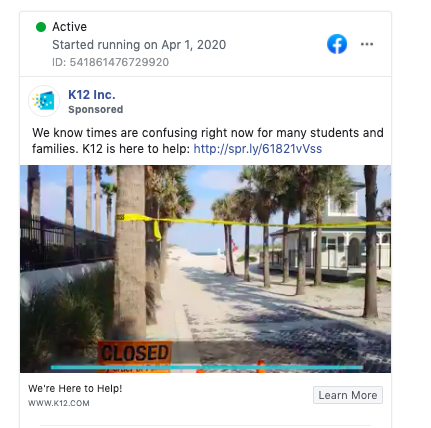
The lines can get blurry, though. One K12 Inc. ad, which launched April 1 and ran for several days last week, linked to a page with both free educational resources and steps to enroll in virtual charters. “We know times are confusing right now for many students and families. K12 is here to help,” the ad says, illustrated with a video montage about coronavirus school closures.

Last week, Sanchez-Reyes co-hosted a webinar advising Indiana charter colleagues on virtual compliance with special education laws, and this week she’s hosting another one on social and emotional learning.

“Most of us came from brick-and-mortars ourselves,” she said, “so it’s been nice to collaborate.”

Liberty University is resisting pressure from students to refund room and board costs during the coronavirus crisis

Originally published in Business Insider on March 27, 2020.
—–

Earlier this week, Jerry Falwell Jr., the president of Liberty University, announced that students would be welcome to return back to campus after spring break, despite the worsening COVID-19 pandemic. Classes will be held online, but academic and residential buildings are open.

“Our thinking was, ‘Let’s get them back as soon as we can—the ones who want to come back,” he said in a statement on Monday. About 1,700 students were on the Lynchburg, Virginia campus by Wednesday, according to a spokesperson.

Falwell’s move sparked immediate backlash from state and local officials, including Virginia Governor Ralph Northam, who has limited public and private gatherings in his state to ten people, and Lynchburg Mayor Treney Tweedy, who called the decision “reckless.”

Liberty University, a private evangelical college, is one of the largest Christian colleges in the world. More than 15,000 students are enrolled at its Lynchburg campus, with an additional 94,000 students enrolled virtually across the country.

Many observers, including Liberty University students, have argued that Falwell’s latest decision is politically motivated, as he’s long been one of President Trump’s most ardent and high-profile supporters. Two weeks ago Falwell went on “Fox and Friends” to suggest the media’s focus on the pandemic was just a new tactic to bring down the president. Earlier this week Trump made it clear he’d like to see America’s economy back up and running by Easter, in mid-April.

Yet recent statements from Falwell and other university officials suggest the decision might be less about standing in solidarity with Trump and more about protecting the university’s cash flow.

Across the country as colleges and universities have closed in response to COVID-19 and required students to go home, families have been calling for meal plan and housing refunds. While most higher-education institutions have signaled they won’t be refunding tuition since they’re still offering online instruction, many have said they will move to refund room and board where possible.

But so far, despite pleas from Liberty University families, Liberty has bucked pressure to offer any direct refunds.

On Sunday the school released a statement saying “there is no obligation to generally offer pro-rated refunds for unused room and board.” The university added that while officials are considering if and how Liberty could financially assist students, “many operational costs for the university do not decrease with fewer students on campus.” (On Friday this statement was taken down.)

Over the last week on a Facebook page for Liberty University parents, many have argued that Falwell’s latest move to open residential halls was designed to make it easier to reject calls to refund families the cost of room and board. They pointed to a campus-wide email sent on March 17, during Spring Break, by Liberty’s office of residential life. “While students are currently allowed to return to live in the residence halls, we are encouraging you to consider staying home,” the email said. However three days later, as The Daily Beast reported, the office sent a new email that said: “[T]he intent of encouraging students to consider remaining at home was to simply advise students to think carefully about their choice and discuss the matter with their parents. It was not an endorsement or recommendation of that particular course of action.”

“It seems as if they are leaving the loophole of ‘allowing’ students to come back just to be able to not give refunds saying that you ‘elected’ to stay home,” wrote Debbie Turkington Schoeffler, a Liberty University parent, on the Facebook page. “Saying ‘we’re open so it’s your choice’ to come back or not as a way to keep from refunding room and board fees is truly awful,” Kaysie Durden Routh added.

“We, as Christ followers, are to be examples of His love, generosity and compassion,” Melissa Burkholder commented. “In my opinion, this is horrible that the university stands to profit on this as they will have far fewer mouths to feed, rooms to heat/cool, perhaps lower labor costs all because of something that was not the fault of these students. LU, with its endowments and other funding received can stand to shoulder the burden of this far easier than many of the families.”

On Wednesday a verified Liberty University Facebook moderator responded to some of the concerns raised by parents, saying that, “LU is still considering things.” By Friday morning, the school announced it would give just a $1,000 credit toward the fall semester, and nothing to students who choose not to return in the fall. Housing and dining plans range between $8,700 and $12,450, according to the university website.

“I was not trying to be rude or start drama on the page it is just lots of families are asking about it and we were told they are just not giving any refunds,” Schoeffler, the mother of a Liberty freshman, told Business Insider. “These kids pay thousands and thousands of dollars to go to [L]iberty and a big chunk of that is room and Board which they are not even able to use for the last two months.” Routh and Burkholder did not return requests for comment.

Students mounting protest

Students on campus also have been organizing for refunds. Liberty student Nathan Todd launched a Change.org petition five days ago calling for a fall semester credit, like the one Liberty just agreed to, but also for a refund for those who do not return in the fall. Calum Best, a member of the Liberty University student government, posted the petition on his Facebook page and urged his college to “make the responsible, caring move and provide refunds to affected students.”

Liberty spokesman Scott Lamb did not comment on the concern that residential halls may be open so the university could more easily deny families refunds. A spokesperson for the university’s Student Service Center also did not respond to Business Insider.

In a statement released on Wednesday, Liberty said, “Our students are part of the Lynchburg community! They work jobs, have apartments, make economic contributions and pay taxes. That they should be banned or discouraged from choosing to utilize the shelter and food sources that they paid for in a time of crisis is unthinkable.” And on Monday Falwell told the Richmond Times-Dispatch that he believes “we have a responsibility to our students—who paid to be here, who want to be here, who love it here—to give them the ability to be with their friends, to continue their studies, enjoy the room and board they’ve already paid for.”

Robert Kelchen, a professor of higher education finance at Seton Hall University, told Business Insider that in general, colleges “with more money, more resources, will be able to offer refunds quickly.” Less wealthy private colleges and many public colleges may take longer to come up with the funds, or they may have to get approval from a governing board.

But all universities, he said, are trying to determine how to get through this crisis in the best financial position possible. “Colleges are concerned that even if things open back up as scheduled next year, will students want to go? Will they want to stay close to home?”

Falwell’s public comments suggest these concerns have influenced his decision to welcome students back to campus now. “We think Liberty’s practices will become the model for all colleges to follow in the fall if coronavirus is still an issue,” he said.

To Develop A COVID-19 Vaccine, Pharma And The Federal Government Will Have To Break Old Patterns

Originally published in The Intercept on March 27, 2020. Story was produced in partnership with the Open Markets Reporting Fund.
—–

IN 2016, AFTER years of effort and millions of dollars in government investment, a team of Texas scientists finally developed a promising vaccine for SARS, the deadly strain of coronavirus that had infected over 8,000 people worldwide in the early 2000s. But the outbreak that triggered the research had begun and ended, and no one was contracting new cases of the disease anymore. Private industry and governments responded to the request to fund the human clinical trials with unanimity: not interested. And so the SARS vaccine was shelved. “If investments had been made previously, we potentially could have a [coronavirus] vaccine ready to go now,” lead scientist Dr. Peter Hotez told Congress earlier this month.

Scientists are now racing to develop a vaccine for Covid-19, the strain of coronavirus that has quickly upended the world. At least a dozen companies have joined the effort, from multinational giants like GlaxoSmithKline, Sanofi, and Johnson & Johnson, to smaller biotech firms like Inovio and Moderna. The latter became the first to give its working vaccine to a healthy adult last week, entering clinical trials with unprecedented speed. The public discourse has revolved mainly around how soon a vaccine could feasibly be ready (at least 18 months) and how much it would cost (unclear).

But if and when a vaccine candidate does get approval from the Food and Drug Administration — or even multiple get approved — then what? Will distributing a vaccine resemble the embarrassing efforts to distribute coronavirus tests? Does the government even have the capacity to manufacture a vaccine as quickly and widely as needed? Sen. Mitt Romney, R-Utah, asked this question in a coronavirus hearing on March 3, and the answers weren’t encouraging.

Dr. Robert Kadlec, the Health and Human Services assistant secretary for preparedness and response, testified that the U.S. lacks the capacity for manufacturing the kinds of Covid-19 vaccines the federal government is currently pursuing. “We’d have a longer than a six-month wait to basically produce vaccines on scale,” he told Romney.

Dr. Anthony Fauci, director of the National Institute of Allergy and Infectious Diseases added that it will essentially come down to the pharmaceutical companies. “The federal government is not going to be able to make hundreds of millions of doses,” he said.

IN SOME WAYS, we’ve been here before.

In October 2004, as Americans began gearing up for flu season, Britain announced that it would be suspending the license for Chiron Corporation, one of just two flu vaccine manufacturers for the United States. British regulators had found bacterial contamination in Chiron’s Liverpool factory, just as the U.S. had been waiting for it to ship 48 million doses over the Atlantic. In one fell swoop, America’s vaccine supply was cut nearly in half. Policymakers were left scrambling, but there was little they could do. The director of the Centers for Disease Control and Prevention apologized and said the scarce supply would be prioritized for those who were at a particularly high risk of getting sick.

What came next was vaccine price gouging, long waiting lines for the elderly and chronically ill, and threats by the government to jail or fine doctors who vaccinated those deemed not high-risk. Federal prosecutors launched an investigation into Chiron, and the shortage became a late-stage crisis for George W. Bush on the campaign trail.

Relying on just two companies to produce the seasonal flu vaccine had left the U.S particularly vulnerable. (Britain, by contrast, used five different suppliers.) And despite warnings for years about the dwindling number of U.S vaccine manufacturers, the federal government had done little to intervene. According to a report released by the Institute of Medicine, in 1973, 25 companies produced vaccines for the U.S, but three decades later just five remained. It was a classic market failure: Many drug companies had decided that vaccines were not profitable enough — they were too costly to develop and too underpriced to sell.

Following the colossal 2004 shortage and pressure resulting from SARS, the federal government vowed to take action. In December 2004, Congress approved $99 million for flu vaccine production and in 2005, Congress passed a law to provide vaccine manufacturers with immunity from tort lawsuits. By 2006, Congress passed the Pandemic and All Hazards Preparedness Act, which created the new assistant secretary for preparedness and response in HHS, the same role Kadlec has today. It also established the Biomedical Advanced Research Development Authority, which works with industry to develop so-called medical countermeasures against public health and bioterrorism threats.

“The Bush-era initiatives to improve vaccine availability and medical surge capacity domestically were good starts but underfunded, as are most public health initiatives,” said Dr. Adva Gadoth, an epidemiologist at UCLA Fielding School of Public Health.

The weaknesses were evident by 2009, the next time the U.S. grappled with an embarrassing vaccine shortage. H1N1 — also known as swine flu — emerged that spring in Mexico, and the U.S government promised a vaccine would be ready by October to blunt a second wave of infections.

But when October rolled around, U.S. health leaders were only then waking up to the fact that their expected supply was not on schedule to arrive. CDC officials hadn’t realized vaccine yields were lower than expected, because the tests used to measure those yields had also been delayed. The new machines that manufacturers installed to put the H1N1 vaccines into vials also ended up being glitchy, which caused more bottlenecks.

The rollout was complicated further by the fact that patients were asked to get both the H1N1 flu vaccine, on top of their seasonal flu vaccine, which weren’t ready at the same time. And when it became clear that the H1N1 shipments would be delayed, manufacturers halted producing the seasonal vaccine to help ramp up H1N1 production.

“Having two flu vaccines to receive was confusing enough to patients — usually there’s only one cocktail vaccine delivered per season — and staggered timing in their availability made things worse,” said Gadoth. “We ended up with a lot of lopsided protection: Those who visited their doctors early in the season and couldn’t return were only protected against seasonal flu, and those who visited once the H1N1 vaccine became available could no longer access the seasonal flu vaccine.”

One of the major lessons of the H1N1 shortage, says Dr. William Schaffner, a professor of preventive medicine and infectious diseases at Vanderbilt’s School of Medicine, is to under-promise and over-deliver. “When the first batches of vaccine finally came off the line, the public health community was trying to communicate who should get it and where to go, but that message was completely drowned out because all the media focused on was that the vaccine was late,” he said. “It undercut the whole introduction and confidence in the government response.”

In August 2010, prompted by the vaccine problems from H1N1, President Barack Obama’s team of science advisers released a report outlining ways the government could speed up production in the future. This had come a year after Sen. Susan Collins, R-Maine, successfully stripped $870 million in flu pandemic preparation money out of the 2009 stimulus. The administration recommended spending roughly $1 billion per year for the next several years to implement its ideas, which included developing faster potency tests and better machines to do vial-filling. This joined a separate 2010 HHS review, which had concluded that the U.S. “lacks the domestic manufacturing capacity to rapidly produce and package a vaccine for the American public in the face of a pandemic.”

But many of those Obama-era proposals were never fully executed, and four new vaccine manufacturing sites the federal government did invest in beginning in 2012 have barely been utilized to respond to Covid-19. The Washington Post reported recently that two of the four sites are currently taking no role in developing a vaccine, and the other two only have plans to conduct “small-scale” testing.

The U.S. government has been relatively successful though in attracting more private vaccine manufacturers, through a combination of financial incentives and accelerated pathways to approval. “We tried to entice manufacturers who might have additional capacity that were manufacturing for other parts of the world, and we tried to make it easier for them to get FDA approval,” said Jesse Goodman, who served as FDA’s chief scientist between 2009 and 2014 and led the Obama administration’s H1N1 response.

In 2005, only three of the top 10 pharmaceutical companies had significant investments in vaccines. But by 2012, that was up to eight out of 10, including players like Pfizer and Johnson & Johnson. Companies began realizing they could bring more expensive vaccines to market faster.

Dr. Ken Kaitlin, director of the Tufts Center for the Study of Drug Development, said the increase in companies focused on vaccines was partly driven by the growth of immuno-oncology drugs, which target a patient’s immune system to fight cancer. “Those drugs stimulated broader interest among firms in the immune system, and scientists realized there were other diseases they could focus on using similar techniques,” he said. The Human Genome Project, which was finished in 2003, also spurred new interest. “That increased our understanding of disease and allowed scientists to search for vaccines in areas that previously seemed intractable,” Kaitlin said.

Yet more pharmaceutical companies being interested in vaccines is no guarantee that a Covid-19 vaccine would be affordable, as vaccine prices have soared over the years. While Democratic politicians are sounding the alarm, saying that any coronavirus vaccine should be free or very affordable, pharmaceutical execs have already been questioning that.

“Nobody is going to embark as a large company if there is not a certain return that you can get for your investment and the risks you have been taking,” said David Loew, an executive vice president at Sanofi, in an interview with Financial Times last week.

And given how little we currently know about Covid-19, if the outbreak peaks and panic wanes, investors and the government could lose interest in funding further stages of Covid-19 clinical trials, just as they did for SARS in 2016.

“We’re still very, very reactive when it comes to what we pour research dollars into and sustain,” said Dr. Jason Schwartz, a professor at the Yale School of Public Health who studies vaccine development. “When the immediate need dissipates, those research efforts can drop off quickly.”

ASSUMING THAT COVID-19 continues to spread, research dollars don’t disappear, and a vaccine or two or three is eventually approved, there are some things we can expect now about how that delivery process will play out.

One is that no matter how many pharmaceutical companies work to produce the coronavirus vaccine, and even if the federal government’s four manufacturing sites do end up assisting with production, there simply will not be as many doses as needed in the beginning. The vaccine will come in waves, in a series of shipments.

“Leaders will have to decide who gets it first, and where to send it, and whoever does that should do it very transparently,” said Schaffner.

While the federal government will likely set broad guidelines and principles, each state will be tasked with designing their own vaccine distribution system, a process spearheaded by the directors of immunization who work in each state’s health department.

Dr. Kelly Moore was working as Tennessee’s director of immunization during the H1N1 outbreak, a role she was particularly well suited for after having served for years as her state’s pandemic influenza planning coordinator.

The first step for vaccine distribution in an emergency, Moore said, is figuring out which medical providers will give it — including who wants to give it and who has clinics equipped to store it.

“Any vaccine that comes out for Covid-19 I anticipate will be distributed through existing federal vaccine distribution channels, namely the Vaccines for Children program,” Moore said. The Vaccines for Children program, administered by every state, provides federally funded vaccines to volunteer clinics to give to basically any child who doesn’t have private health insurance. “In an emergency we’d much rather build off what already exists than create something from scratch, and all states already manage partnerships with private clinics, health departments, and hospitals to give vaccines to children, so they’re already used to the ordering and the distribution,” she explained.

Each provider that participates in VFC typically orders vaccine doses through an online portal managed by their state, and Moore said it would not be difficult to add coronavirus vaccines to those portals.

But since right now only clinics that serve children are part of the VFC system, each state would need to enroll more adult providers and pharmacies that might be able to help administer coronavirus vaccines. In 2009, Moore had invited interested H1N1 vaccine providers to sign up on Tennessee’s online registry and also made separate distribution arrangements with big pharmacy chains like CVS and Walgreens.

Back then, using pharmacies to administer vaccines was relatively uncommon, and most people still went to their doctors’ office or state health department to get vaccinated. “But our experience of working with pharmacies was so great, and we realized how valuable it is for people to just be able to walk in without making an appointment,” said Moore.

In the decade since, most states have passed new laws to make it easier for pharmacies to administer vaccines — something physician groups had long fought for territorial reasons. “We have more than 360,000 pharmacists who have completed training in vaccinations and immunizations across the lifespan and are ready to help when a coronavirus vaccine becomes available,” said Mitch Rothholz, chief strategy officer from the American Pharmacists Association.

From an access point, pharmacies will surely play an important role in distributing any Covid-19 vaccine. Nearly 95 percent of the U.S. population lives within 5 miles of a pharmacy, and many people feel more comfortable walking into one than setting up a doctor’s appointment.

Some states may also opt for a more centralized vaccine distribution system compared to what was used in Tennessee. In 2009, for example, Rhode Island set up H1N1 clinics at every public school, and Chicago had mass clinics at its six city colleges. Dr. Bruce Y. Lee, a professor of health policy and management at the City University of New York who has studied vaccine supply chains said some states may decide that they need bigger channels to get the vaccine out, like churches or Central Park. “You can start preparing now,” said Lee. “You know where the population is and that some people will vary significantly in terms of how reachable they are.”

Immunization program managers began talking about these state distribution plans on a conference call last week, according to Claire Hannan, executive director of the Association of Immunization Managers. “We’re encouraging them to start looking into this, to determine what their coronavirus tracking system will look like, and to begin reaching out to providers who will help administer the vaccine.”

EARLIER THIS MONTH, reports emerged that President Donald Trump had offered a Germany-based biopharmaceutical company money to secure a Covid-19 vaccine that would be exclusively for the United States. The U.S denied the reports, but senior German government officials confirmed them and stressed that any vaccine would be for the entire world, not for individual countries.

While the U.S. does have some domestic manufacturers, most giant pharmaceutical companies — with the real muscular production capacity — are multinational. “If we need a large-scale rollout, how are those initial hundreds of thousands or millions of doses distributed?” asked Schwartz.

Past history doesn’t lend the most encouraging examples of equity, as rich countries have dominated the marketplace and most countries have prioritized national sovereignty over international fairness. In 2009, developed countries placed large advance orders on H1N1 vaccines and purchased nearly all the doses companies could produce, leaving low-income countries, including Mexico, in the lurch. Under pressure, a group of at least nine countries offered to donate a percentage of their H1N1 doses to poorer nations, but some then backtracked when faced with unexpected shortages. The U.S., for example, pledged in September 2009 to donate 10 percent of its 195 million doses, but about five weeks later said it would wait until all at-risk Americans had access first.

“Pandemics really call for global health solidarity, to determine where the outbreak is most active, and where those vaccine doses can do the most good and prevent the most suffering,” said Schwartz. “But it could be every country for itself.”

State Workers Seek to Protect Labor Rights As Coronavirus Spreads

Originally published in The Intercept on March 21, 2020.

On Tuesday, a week after declaring a state of emergency due to the spread of Covid-19, Minnesota’s Democratic Gov. Tim Walz signed an executive order pertaining to his state’s 50,000 executive branch employees. The order extended paid leave to all state employees for absences like caring for children due to school closures, and authorized agency heads to waive parts of collective bargaining agreements so as to more easily deploy workers where and when needed. Minnesota law grants the governor such powers during such emergencies.

Publicly, unions representing these workers praised Walz for his action on paid leave, and offered only muted concerns about the collective bargaining measures — stressing they will monitor the situation to ensure employers do not abuse their new authorities.

Privately, though, unions were taken off guard by the governor’s actions, and were unable to get the state to agree to establishing guardrails in the order itself around preventing employer abuse.

Workers are concerned that other states, especially less labor-friendly ones, may follow Minnesota’s lead, and use the pandemic as a pretext to weaken unions in the long term. In California, some employers have been lobbying for a similar executive order, to free themselves of public-sector bargaining restraints. While state employees have made clear they’re committed to flexibly responding to the crisis, unions understand anti-labor managers have wielded emergencies to their benefit in the past.

On Thursday March 12, state union representatives had an in-person meeting with the Minnesota Management and Budget — an agency that governs personnel and finance issues — to check in about the novel coronavirus. In that meeting, which was described as “friendly and nonproductive” by an individual involved who was not authorized to speak about the discussions, union reps talked primarily about paid leave, and also raised concerns around telework, and safety equipment for health and correctional workers.  There was no discussion then of potentially waiving aspects of collective bargaining, and they all planned to meet again on Tuesday, March 17.

But on Monday, March 16, with less than an hour’s notice, the MMB emailed the unions an invitation for a conference call. It was on that call that state officials announced the draft of their forthcoming order, though they did not provide anyone on the call with a written copy of the text.

“It was received as a great surprise,” said one of the participants on the call. “A lot of questions were thrown out, and because we did not have the physical document in front of us, a lot of the questions were just like, ‘What did you say? What’s that phrase?’”

A few hours later union senior staff organized another call among themselves to discuss how to respond. They were less concerned about Walz and far more worried about how agency heads below him might interpret their new broad authorities. Many leaders of individual state agencies have been in charge since Republican Gov. Tim Pawlenty’s tenure, and are not supportive of unions. Under the new order, employers can change schedules, work locations, or work assignments without notice, whereas in the past employees were given a notice period to rearrange their lives.

On Monday evening, union leaders emailed MMB officials and Walz’s chiefs of staff to request the administration publicly commit to “working with union representatives to swiftly and fairly address issues that may come up as a result” of this proposed order. The unions specifically requested a sentence be added to this effect, and that the administration commit to saying this in a press conference.

But all they were able to win was the addition of a vague line saying, “When circumstances allow, Minnesota Management and Budget will work in partnership with the labor unions affected by any adjustments to the provisions of collective bargaining agreements or memoranda of understanding.”

When the executive order was signed on Tuesday, union leaders largely bit their tongues. “We are thankful for the Governor’s action in authorizing this new policy specifically to address COVID-19 leave,” stated the Inter Faculty Organization, which represents employees at Minnesota’s seven state universities. Walz was elected in 2018 with strong union support, and the IFO praised the paid leave measure for “setting the standard for the rest of the nation.”

The executive directors of American Federation of State, County and Municipal Employees Council 5 and the Minnesota Association of Professional Employees also issued a joint statement that recognized the “magnitude” of the executive order. “We won’t stand in the way of the state’s powerful response to the crisis, but we won’t idly sit by if that power is abused,” they said. The unions emphasized they had “worked with the State” to ensure the changes would be only limited to dealing with Covid-19.

In an emailed statement MMB Commissioner Myron Frans said his agency “is working in strong partnership with our union partners during this rapidly evolving emergency situation. We continue to work together with the shared goals of preventing the spread of COVID-19, keeping employees healthy, and providing critical services to the people of Minnesota.”

So far, rank-and-file members have not reacted negatively to the order — and have been focused more on the new expansive rights around paid leave, which they are happy with. Union leaders suspect the rubber will hit the road if and when cases of coronavirus ramp up in Minnesota, and working conditions start to change.

“We’re particularly concerned about things like conditions in prisons, where workers already deal with severe understaffing,” said the union source. And while their grievance procedures are technically unaffected by the executive order, the reality is the standard grievance process doesn’t move quickly enough during emergencies, meaning workers could be left without recourse in the event of employer abuse.

Some unionized state workers in California were recently threatened that their collective bargaining rights were soon to be waived too.

Ashley Payne, a state worker in Contra Costa County, one of the nine counties in the Bay Area, has been increasingly alarmed by the lack of safety protections for workers like herself who have been required to come into the office. She works in her county’s Employment and Human Services division, where she helps administer welfare.

As an elected officer for her union, SEIU Local 1021, Payne has been fielding concerns from colleagues about the lack of hand sanitizer, disinfectant wipes, and masks — including for social workers who have to do home visits.

On Wednesday, Annie Barrett, the division manager for Payne’s department, emailed staffers about working conditions under Covid-19, and said they were “exploring temporary telecommuter opportunities.” Payne forwarded the email to Jeffrey Bailey, her county’s labor relations manager, to say that while her union strongly supports this step, she wants to make it clear in writing that SEIU 1021 does not agree to making this change permanent. “We will not allow the County to exploit this crisis as a pretext for ushering in permanent changes,” she wrote. “We continue to expect timely notice of upcoming changes so we can Meet and Confer over changes to wages, benefits, and working conditions.”

In his emailed response, Bailey agreed the assignment of staff to work from home was temporary, but emphasized that things “are different” under emergency conditions (Emphasis in original).

“Furthermore,” Bailey wrote, “the state of California has informed us that the Governor intends to pass an executive order to temporarily suspend many of the provisions of the MMBA [Meyers-Milias Brown Act, the state law governing public sector collective bargaining] during this emergency period.”

Upon receiving this email, Payne reached out to her local’s leadership, who reached up the chain to the state level. Soon after Rene Bayardo, a lobbyist with SEIU California, emailed to say his team had looked into this threat, and suggested Bailey was wrong. “The indication from the [Newsom] administration is that public employers are asking to suspend MMBA but this is NOT under consideration,” Bayardo wrote.

Payne, who has worked at her job since 2014, said her employer has grown far less responsive to union concerns since the Janus v. AFSCME decision in June 2018. “Knowing what their track record is I’m not surprised they’re trying to bust the union,” she said. Rather than distancing itself from unions during the pandemic, Payne added, local government should lean into “much closer collaboration because we know our work best and we know how best to ensure safety.”

Bailey told The Intercept that he doesn’t have “any direct knowledge” of California Gov. Gavin Newsom’s plans with respect to MMBA. “I heard about it, as we say, ‘through the grapevine,’” he wrote in an email. “This has been discussed widely among public agencies, but I don’t have any specifics or inside information. … We are all assuming that the suspension would apply to things like the meet and confer obligations and notice requirements.”

Crystal Page, a spokesperson with California’s Labor & Workforce Development Agency, said Newsom “has been clear that California needs flexibility to respond” and that he “understands the importance of collective bargaining and the need to ensure workers have a voice on the job.”

Nelson Lichtenstein, a labor historian at University of California, Santa Barbara told The Intercept he hadn’t heard anything about moves to suspend collective bargaining in California, though acknowledged it is certainly not unprecedented for anti-union leaders to try and exploit crises to weaken labor.

Lichtenstein pointed to the aftermath of 9/11, when Congress created the Transportation Security Administration. Using legislative authority, a George W. Bush-appointed TSA administrator denied the 40,000 TSA workers collective bargaining rights, claiming it was necessary for national security. It wasn’t until 2011, under a new Obama appointee, that TSA workers finally won the right to bargain.

Another example was following Hurricane Katrina, when Bush unilaterally suspended federal law governing workers’ pay on federal contracts in areas of Alabama, Florida, Louisiana, and Mississippi. Bush justified his move by calling Katrina a “national emergency” and said ignoring federal rules around construction costs “will result in greater assistance to these devastated communities.”

“People were outraged, it was just so obvious he was using it opportunistically,” said Lichtenstein. About six weeks later, in response to the backlash, the White House reversed course.

Payne said she worries that if labor-friendly California does follow Minnesota’s example, it would quickly motivate many other states to follow, particularly Republican-controlled states. “This is why I feel we have to hold the line,” she said. “If California does it, then everyone else will be like, ‘We should have been doing this a long time ago.’”