How Did Brooke Pinto Win the Ward 2 Council Primary?

Originally published in Washington City Paper with Mitch Ryals on June 11.
——
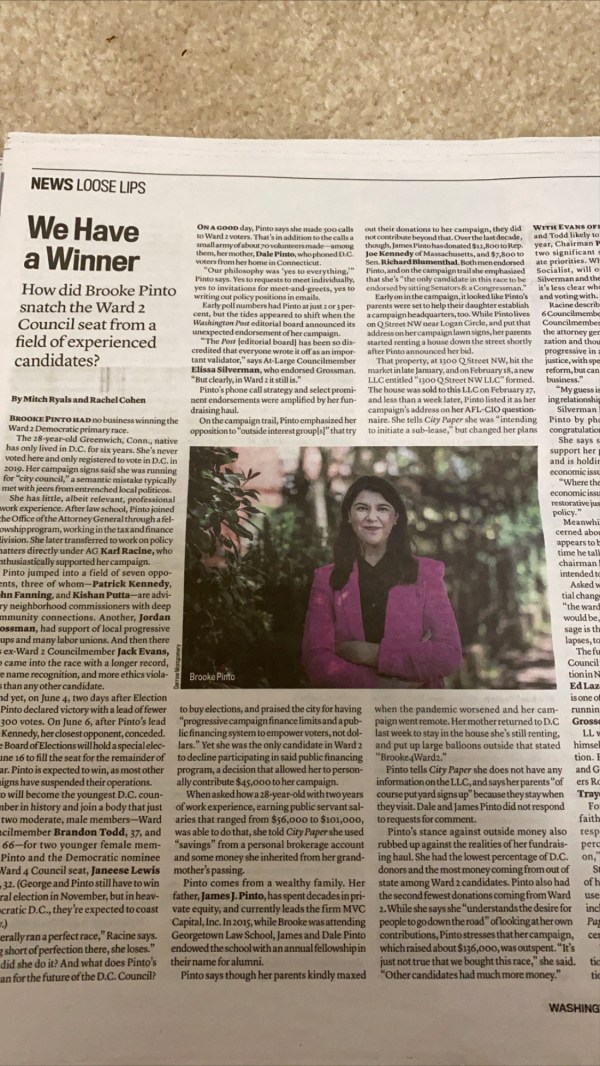
5E2C202A-7698-4FFF-BAD9-47DC461B96DC

Brooke Pinto had no business winning the Ward 2 Democratic primary race.

The 28-year-old Greenwich, Conn., native has only lived in D.C. for six years. She’s never voted here and only registered to vote in D.C. in 2019. Her campaign signs said she was running for “city council,” a semantic mistake typically met with jeers from entrenched local politicos.

She has little, albeit relevant, professional work experience. After law school, Pinto joined the Office of the Attorney General through a fellowship program, working in the tax and finance division. She later transferred to work on policy matters directly under AG Karl Racine, who enthusiastically supported her campaign.

Pinto jumped into a field of seven opponents, three of whom—Patrick KennedyJohn Fanning, and Kishan Putta—are advisory neighborhood commissioners with deep community connections. Another, Jordan Grossman, had support of local progressive groups and many labor unions. And then there was ex-Ward 2 Councilmember Jack Evans, who came into the race with a longer record, more name recognition, and more ethics violations than any other candidate.

And yet, on June 4, two days after Election Day, Pinto declared victory with a lead of fewer than 300 votes. On June 6, after Pinto’s lead grew, Kennedy, her closest opponent, conceded.

The Board of Elections will hold a special election June 16 to fill the seat for the remainder of the year. Pinto is expected to win, as most other campaigns have suspended their operations.

Pinto will become the youngest D.C. councilmember in history and join a body that just traded two moderate, male members—Ward 4 Councilmember Brandon Todd, 37, and Evans, 66—for two younger female members in Pinto and the Democratic nominee for the Ward 4 Council seat, Janeese Lewis George, 32. (George and Pinto still have to win the general election in November, but in heavily Democratic D.C., they’re expected to coast to victory.)

“She literally ran a perfect race,” Racine says. “Anything short of perfection there, she loses.”

So how did she do it? And what does Pinto’s victory mean for the future of the D.C. Council?

On a good day, Pinto says she made 500 calls to Ward 2 voters. That’s in addition to the calls a small army of about 70 volunteers made—among them, her mother, Dale Pinto, who phoned D.C. voters from her home in Connecticut.

“Our philosophy was ‘yes to everything,’” Pinto says. Yes to requests to meet individually, yes to invitations for meet-and-greets, yes to writing out policy positions in emails.

Early poll numbers had Pinto at just 2 or 3 percent, but the tides appeared to shift when the Washington Post editorial board announced its unexpected endorsement of her campaign.

“The Post [editorial board] has been so discredited that everyone wrote it off as an important validator,” says At-Large Councilmember Elissa Silverman, who endorsed Grossman. “But clearly, in Ward 2 it still is.”

Pinto’s phone call strategy and select prominent endorsements were amplified by her fundraising haul.

On the campaign trail, Pinto emphasized her opposition to “outside interest group[s]” that try to buy elections, and praised the city for having  “progressive campaign finance limits and a public financing system to empower voters, not dollars.” Yet she was the only candidate in Ward 2 to decline participating in said public financing program, a decision that allowed her to personally contribute $45,000 to her campaign.

When asked how a 28-year-old with two years of work experience, earning public servant salaries that ranged from $56,000 to $101,000, was able to do that, she told City Paper she used “savings” from a personal brokerage account and some money she inherited from her grandmother’s passing.

Pinto comes from a wealthy family. Her father, James J. Pinto, has spent decades in private equity, and currently leads the firm MVC Capital, Inc. In 2015, while Brooke was attending Georgetown Law School, James and Dale Pinto endowed the school with an annual fellowship in their name for alumni.

Pinto says though her parents kindly maxed out their donations to her campaign, they did not contribute beyond that. Over the last decade, though, James Pinto has donated $12,800 to Rep. Joe Kennedy of Massachusetts, and $7,800 to Sen. Richard Blumenthal. Both men endorsed Pinto, and on the campaign trail she emphasized that she’s “the only candidate in this race to be endorsed by sitting Senators & a Congressman.”

Early on in the campaign, it looked like Pinto’s parents were set to help their daughter establish a campaign headquarters, too. While Pinto lives on Q Street NW near Logan Circle, and put that address on her campaign lawn signs, her parents started renting a house down the street shortly after Pinto announced her bid.

That property, at 1300 Q Street NW, hit the market in late January, and on February 18, a new LLC entitled “1300 Q Street NW LLC” formed. The house was sold to this LLC on February 27, and less than a week later, Pinto listed it as her campaign’s address on her AFL-CIO questionnaire. She tells City Paper she was “intending to initiate a sub-lease,” but changed her plans when the pandemic worsened and her campaign went remote. Her mother returned to D.C last week to stay in the house she’s still renting, and put up large balloons outside that stated “Brooke4Ward2.”

Pinto tells City Paper she does not have any information on the LLC, and says her parents “of course put yard signs up” because they stay when they visit. Dale and James Pinto did not respond to requests for comment.

Pinto’s stance against outside money also rubbed up against the realities of her fundraising haul. She had the lowest percentage of D.C. donors and the most money coming from out of state among Ward 2 candidates. Pinto also had the second fewest donations coming from Ward 2. While she says she “understands the desire for people to go down the road” of looking at her own contributions, Pinto stresses that her campaign, which raised about $136,000, was outspent. “It’s just not true that we bought this race,” she said. “Other candidates had much more money.”

With Evans officially off the Council and Todd likely to be gone by the end of the year, Chairman Phil Mendelson will lose two significant supporters of his moderate priorities. While George, a Democratic Socialist, will ostensibly fit in alongside Silverman and the Council’s progressive wing, it’s less clear who Pinto will end up aligning and voting with.

Racine describes her as a cross between Ward 6 Councilmember Charles Allen and At-Large Councilmember Robert White. According to the attorney general, Pinto has Allen’s organization and thoughtfulness and, like White, is progressive in areas around social and racial justice, with special attention to criminal justice reform, but can be “more center in areas around business.”

“My guess is that she’ll have a positive working relationship as well with the mayor,” he adds.

Silverman largely agrees. She spoke with Pinto by phone Sunday evening to offer congratulations.

She says she expects Pinto to generally support her priorities for working families, and is holding her breath when it comes to economic issues.

“Where the real rubber hits the road is on the economic issues,” Silverman says. “You can’t do restorative justice without progressive economic policy. ”

Meanwhile, Mendelson says he’s not concerned about losing control of a Council that appears to be drifting further to his left. By the time he talked with LL Monday afternoon, the chairman hadn’t spoken to Pinto, but said he intended to call.

Asked what Pinto’s victory says about potential changes in Ward 2, the chairman notes that “the ward is not as far to the left as some said it would be, but more importantly, the bigger message is the ward resoundingly rejected ethical lapses, to put it politely.”

The full effect of the 2020 election cycle on the Council will become clear after the general election in November. Ultra-progressive policy wonk Ed Lazere, who Mendelson thumped in 2018, is one of more than a dozen declared candidates running for At-Large Councilmember David Grosso’s seat.

LL will note that Racine is likely counting himself among the winners in the primary election. Both of his endorsed candidates, Pinto and George, will likely join former Racine staffers Robert White and Ward 8 Councilmember Trayon White on the Council dais in 2021.

For now, Pinto says she wants to restore faith in the ward. “I take very seriously the responsibility … that everything be … 100 percent above board and followed through on,” she tells LL.

Still, she’s off to a so-so start with some aspects of her campaign finance reports. Stickers she used to feature her Post endorsement were not included on her May 26 filings, and she tells City Paper “we are working with our compliance officer to determine why” that was.

“Please always feel free to ask if you have questions,” she adds. “I am confident that every question has an answer.”


In the Midst of the Unemployment Crisis, Why Not Guarantee Jobs?

Originally published in In These Times on June 10, 2020.
——

Later this month, Pavlina Tcherneva, an economics professor at Bard College and a research scholar at the Levy Economics Institute, is publishing a book entitled The Case for a Job Guarantee. The book details a policy idea that she’s been thinking about and developing throughout her career. It’s gained momentum in recent years, with senators like Kamala Harris (D-Calif.), Cory Booker (D-N.J.), and Bernie Sanders (I-Vt.) embracing it, and many activists have described it as an integral part of any Green New Deal. But what is a Job Guarantee, and how would it work? Contributing writer Rachel Cohen talked with Dr. Tcherneva about her forthcoming book, and how we should be thinking about a policy for guaranteed employment amid our current economic crisis. This interview has been lightly edited and condensed.

Rachel Cohen: Reading your book, as I understand it, a job guarantee is a promise that a job, paying at least $15 an hour, will be given to anyone who wants one. If someone doesn’t want to be unemployed, they will be able to access a living-wage job through this program. Can you be fired from this job—for poor performance, co-worker complaints, or something else?

Pavlina Tcherneva: Yes, they can be firedIf someone is harassing people in the workplace, surely. A job guarantee is a promise that a job will be there, but it’s not a promise that belligerent workers will be tolerated. But the way we think about ‘belligerent’ just changes completely when you start thinking with a real person in mind.

So I sometimes equate a job guarantee to public libraries. You can assume that you can walk into a public library and get a book, and our libraries have services beyond books that librarians help you with. People may have all sorts of challenges and difficulties that prevent them from holding onto whatever private-sector job they have, but with a job guarantee, we would help those individuals with wraparound services, and our aim and interest is to help people be successful—like in a public library.

And just like with libraries—maybe you are escorted out at some point for bad behavior, but you’re not denied access if you return.

Rachel: You trace the Job Guarantee’s historical roots. It was affirmed in the Universal Declaration of Human Rights and it was in Franklin D. Roosevelt’s proposed Economic Bill of Rights. It was a signature issue for civil rights activists in the ’60s and it’s been etched into many nations’ constitutions. Has it ever existed anywhere in practice?

Pavlina: We have never had a law anywhere that guarantees everyone the legally-enforceable right to employment permanently. We’ve had one that comes close, in India, but it’s only for rural employment and just for up to 100 days per year. We’ve had situations where countries have achieved very low unemployment rates—in Japan, for example, their industrial labor and market policies produced unemployment at 1% to 2% for much of the post-war era. But I’m not talking about whether we can have policies that produce low unemployment. I’m talking about a codified right to employment to provide not just the legal, but also the institutional support for guaranteeing that right over the long-term. Because even in those countries that have been successful at getting us to 1 to 2% unemployment, they are not able to sustain it. So the Job Guarantee idea is to create a new legally-assured safety net.

Rachel: Your book went to print in December 2019, when U.S unemployment was at 3.5%, but it talks a lot about how unemployment can spread like a virus. It felt really poignant reading your book as unemployment is now 16.3%, and a real infectious virus is spreading. If 10 years ago we had passed a Job Guarantee program, what role do you think it could play to buffer the kind of mass unemployment we’re seeing today with coronavirus?

Pavlina: Had we put a Job Guarantee in place 10 years ago we would have had institutional infrastructure that would be ready to employ folks now. However, if you were working at a Job Guarantee job, just like if you were working any other job, you might need to stay home and you might need to be paid to socially distance. But because the Job Guarantee I’m envisioning would be aimed at filling certain public service gaps, it would also be able to, for example, mobilize people to check in on the elderly, to deliver meals, to provide teacher assistance.

Now I’d prefer that we respond to Covid-19 like they did in Denmark, where the government protects the private-sector jobs by paying the payrolls of the workers. That way you wouldn’t have this flood of unemployed people. But surely a Job Guarantee could help. I’m not an idealist, and I know this wouldn’t function totally smoothly. But just like any other institution that we consider important, we would make it work.

Rachel: Can you talk about what you’ve learned with respect to the unique harms of unemployment?

Pavlina: Economists will talk about the ‘scarring effects’ of unemployment, but that’s normally limited to what are the wages you lost, and you didn’t replace. But there are many other costs economists tend to ignore. An unemployed person experiences higher physical and mental health costs, they are sicker and weaker. Unemployment also negatively impacts a person’s net-worth, their connections, social capital. Unemployment creates so many conditions that make it harder to be re-employed later. And this then impacts families and children. If we were to add all those costs, we would not tolerate unemployment even when it’s very low. And I reject the idea that there is a “natural” rate of unemployment, just like we don’t accept a natural rate of homelessness.

Rachel: What kinds of lessons about unemployment did we learn from the Great Recession?

Pavlina: One irony of our economic system is that we have normalized the idea of ‘jobless recoveries.’ What we’ve learned from the Great Recession is that firms do not want to hire the unemployed. That’s the problem we have to solve. The folks who earn low wages are the first to be fired during economic downturns—we see this very clearly. And this has a racial dimension; unemployment always shoots up for African Americans more, it’s always higher for them and they recover more slowly. People with disabilities also saw their unemployment rate recover last after the recession. What we learn is that the official numbers do not tell the full story.

Rachel: In your book you talk a lot about green jobs. How do see the Job Guarantee as connected to the Green New Deal?

Pavlina: That is the promise, that for the person who loses their fossil fuel job, that they will find a job through the Green New Deal. This has been a challenge for the environmental movement—we have not been able to articulate clearly how will we protect people if they lose their jobs from oil rigs and mines or all of that. It’s the missing piece of the puzzle and it ensures a just transition, that the most vulnerable folks will have access to a living wage.

Rachel: Will it be just though if those workers are used to making $40 an hour and now can only get a $15-an-hour job?

Pavlina: Well other people have structured their Job Guarantee proposals with tiered wages. In my vision, the primary, overriding objective is to secure a firm, living-wage floor. And folks who are more highly-skilled typically don’t have the absolutely most horrific unemployment conditions. Maybe the floor has to be $17 an hour, or $20, but the point is we want to shore up that floor. In my ideal world, a Job Guarantee would be as small as possible. I’d much prefer to see permanent public services provided that are well-paid for, but there will always people who fall through the cracks and they deserve a living wage with guaranteed benefits, too.

The way I think about it is we literally are constrained with two choices. We either continue to accept unemployment as normal, or we have a Job Guarantee. The world with unemployment is simply worse than the one where we guarantee employment.

Rachel: What kinds of green jobs are you envisioning?

Pavlina: When I talk about green jobs, I’m not just talking about traditionally environmental jobs. To me ‘green’ is conservation of community and conservation of people, so it also includes care work. To me there’s no limit to the kinds of creative projects we could imagine. I think in addition to caring for people, we also could have jobs that involve caring for the environment like cleaning up parks, urban farming, planting trees, and doing preventative work for natural disasters.

Rachel: My last question: Are there any policy downsides you see to the Job Guarantee?

Pavlina: While I don’t see this as a downside to my proposal, traditionally many job programs have been done in punitive terms, like work-fare in the post-Reagan era. And with the rise of authoritarian governments, there’s always the risk of them awakening to the idea of providing employment and doing so in a punitive way. There’s always a risk of a policy being bastardized, but that just means we have to say vigilant.


A Progressive Challenger Was Attacked For Calling To Defund The Police. She Won Anyway.

Originally published in The Intercept on June 4, 2020.
——–

CALLS TO DEFUND the police have become a focal point of nationwide protests following the police killing of George Floyd in Minneapolis, with local politicians from New York City to Los Angeles weighing new budget cuts to their police departments. While some critics dismiss the idea as politically untenable, a city council election in Washington, D.C., this week offers lessons on how politicians can succeed while pushing bold positions on policing.

Janeese Lewis George, a 32-year-old democratic socialist, decisively won an election in D.C.’s Ward 4 — the northernmost part of the city — despite facing weeks of attacks from her opponent that she was too radical on policing. She ousted the moderate incumbent, a protege of D.C. Mayor Muriel Bowser, by a margin of 54-46 percent.

Lewis George, a Ward 4 native, ran on a platform of expanding affordable housing, creating higher-paying jobs, fighting money in politics, and supporting criminal justice reform. She also campaigned on demilitarizing the police and reallocating portions of the Metropolitan Police Department’s budget toward social services and violence prevention initiatives — a position that drew the ire of backers of her opponent, Brandon Todd.

Democrats for Education Reform-DC, a pro-charter school advocacy group that endorsed Todd, sent out a series of mailers in the weeks leading up to the Tuesday election taking Lewis George’s comments out of context and smearing her as being anti-police.

“It was very disheartening for me that they were trying to use my message of demilitarization to say I don’t care about safety when the exact reason I spoke out was because I believe we need to be safe,” she told The Intercept.

Todd, a moderate and former Republican, by contrast has called for putting more cops on the streets, and praised the mayor for proposing an increase to the MPD’s budget. He has also consistently voted against some of the most progressive bills to cross the council’s desk. He was one of four lawmakers to vote against the city’s paid leave law in 2016, and he voted to repeal a ballot measure that would have gradually eliminated the city’s tipped minimum wage. (A majority of voters in his ward backed the measure.)

Like many insurgent candidates, Lewis George’s challenge to Todd was an uphill battle from a fundraising perspective. But through amassing robust grassroots support, she was able to overcome that by participating in D.C.’s first year of publicly financed elections, where candidates eschew PACs and corporate donations and have their local contributions matched 5:1. Todd declined to participate in the program, arguing public dollars were better spent elsewhere.

Lewis George urged other politicians considering whether it’s safe to back bold police reforms to step up.

“This time is not the time for political leaders to be in a place of comfort but to be in a place of courage,” she said. “If you stand with the people, the people will come out and show up for you.”

LEWIS GEORGE HAS been particularly attuned to criminal justice issues since her time as a student at Howard Law School, where she learned about the immense discretionary power that prosecutors hold. She took this knowledge with her when she went to work as an assistant district attorney in Philadelphia, where she says she spoke out against what she saw as harsher punishments for the same offense when committed by black people. In 2016, she came back to D.C. to work for the city’s attorney general office, leading efforts in the Juvenile Section of their Public Safety Division that encouraged alternatives to jail time.

As a candidate, she urged an end to mass incarceration and the militarization of the police, ending cooperation with Immigration and Customs Enforcement, and decriminalizing drugs and sex work.

It was these positions that drew attacks from DFER-DC. One mailer funded by the group misrepresented a tweet Lewis George posted in October, which promised to divest from the local police department and put money into “violence interruption” programs.

The DFER-DC funded mailer sent to Ward 4 voters claimed Lewis George “BRAGGED: ‘I WILL DIVEST FROM MPD!” It warned against letting Lewis George bring her “harmful ideas” to the city council and claimed she was looking to cut police officers.

Image-1-copy

Another mailer funded by DFER-DC pulled answers Lewis George had given to a Metro DSA questionnaire out of context.

The questionnaire had asked about whether she supported efforts to “demilitarize and disarm” police departments. Lewis George said yes, and explained “We’re told the institution of policing is intended to protect all of us from some suspicious menace, but the fact is that crime is a public health problem, not a battle of military opponents. The transformation of American police departments, especially the MPD, into military units trained to occupy the very communities promised protection is one of the greatest dangers to the future of urban life.”

The DFER-DC mailers read “Our police officers have dedicated their lives to keeping Ward 4 families safe. But Janeese Lewis George calls them ‘one of the greatest dangers to the future of urban life,’” suggesting she was denigrating officers specifically, not the militarization of their departments.

DFER-DC’s director Ramin Taheri declined to comment on the mailers or on Lewis George’s win, but said in an email that his group stands in support of the police brutality protesters organizing in the wake of Floyd’s death. “Our mission has always been to elect candidates who will fight to reverse the educational inequities that too many Black children face, and like many, we are reflecting on how we can be a better ally in dismantling systemic racism in the District.”

He previously told Washington City Paper that his group crafted its mailers based on recent polling that most Ward 4 voters were less likely to vote for someone who wanted to cut police officers from the force. The telephone poll, which was conducted by Garin-Hart-Yang Research in late April, also said Todd had a 22 percentage point advantage over Lewis George, and that she was unlikely to win a majority of the 25 percent of then- undecided voters. Taheri told City Paper they quoted Lewis George correctly in their ads.

In an interview, Lewis George blasted DFER-DC and emphasized that cutting the police budget isn’t synonymous with cutting officers.

“The fact that they saw my platform as a weakness instead of a conversation to have in the community about what it means to be safe speaks to their ultimate goal which is not reforming education but retaining power within our political system,” she said. Lewis George also noted that when D.C. Councilmember and Education Chair David Grosso spoke out about the militarization of the police both in 2017 and as recently as a few days ago, DFER-DC did not object.

THE SUBJECT OF DFER-DC’s attacks on Lewis George have become especially relevant as the call to defund the police has gone mainstream over the last week amid nationwide police brutality protests. While activists have long called for the same types of reforms Lewis George champions, elected officials across the country are now taking note. On Wednesday, the president of the Los Angeles City Council introduced a measure asking city staff to find up to $150 million in possible cuts to the local police department, and to reinvest those funds into poor communities and communities of color. In New York, state Sen. Julia Salazar recently argued for cutting the New York Police Department’s $6 billion budget and transferring those dollars to nonprofit organizations and mental health services.

In D.C., a growing chorus of activists have been calling to defund the MPD, which is one of the 10 largest police departments in the nation. The city council is currently reviewing Bowser’s budget proposal, which would increase police funding by 3.3 percent — resulting in a budget of over $500 million — coupled with an 11 percent cut to violence prevention programs.

“I think it’s easy for people to lean on doing the same things again and again out of comfort,” said Lewis George, when asked about the proposed budget. “But the point has to come when you realize that doing the same thing over and over isn’t going to produce the results you want.”

Makia Green, a local organizer with the Working Families Party who embedded herself in Lewis George’s campaign, told The Intercept that she believes the negative mailers backfired.

“They were a complete failed attempt at misleading voters and putting forth scare tactics,” she said. “They tried to mislead about Janeese’s record, plans and support we have and instead I think it helped strengthen people’s resolve, and turn more passive supporters into active ones.”

Lewis George notably had the backing of not just DSA and WFP, but labor unions like the Washington Teachers Union, Unite Here Local 25, and SEIU Local 500.

Black Lives Matter DC and Sanctuary DMV also backed Lewis George — their first political endorsements ever. “We do not take making endorsements lightly,” April Goggans, an organizer with Black Lives Matter DC said in November. “Janeese[‘s] policy and budget priorities around public safety, policing, and addressing intra-community violence are informed by values and principles that not only align with ours but will result in real safety.”

Benjy Cannon, a spokesperson for Unite Here Local 25, called Lewis George’s win a victory for organized labor and workers. “Her campaign showed that when we’re united, a powerful coalition of workers, tenants, progressive advocacy groups, and grassroots activists can defeat even the most deep-pocketed corporate interests,” he said.

D.C. Ranks in Bottom Quintile of New Save the Children Childhood Report

Originally published in Washington City Paper on June 2, 2020.
——

Save the Children, an international humanitarian group, published a new report today ranking states and counties across the U.S according to where children are “most and least prioritized and protected.” The rankings are based on four factors Save the Children says “ends” childhood: malnutrition, poor education, teen pregnancy, and early death to ill-health, accident, murder, or suicide. To measure these, the group looked at infant mortality rates, child homicide and suicide rates, child food insecurity rates, the rate of children not graduating high school in four years, and teen births.

D.C., which was one of the more than 2,600 counties and county-equivalents surveyed, fell in the bottom quintile for all counties, and ranked 1,008 out of 1,120 urban counties. While D.C. was not formally treated as a state in Save the Children’s report, its top researcher re-ran the numbers as if it were and tells City Paper if D.C. were a state it would fall in the bottom half of states on all indicators, and the bottom ten on child food insecurity (43rd), on time to graduate (50th), and child homicides and suicides (51st, or last).

Nikki Gillette, the lead report researcher, explains their U.S. index was built as a companion to their international index, which came first. That index, which was also updated today and first published in 2017, evaluates 180 countries based on “childhood enders” that are similar to the U.S indicators, but also include child marriage, child labor, stunting, and forcible displacement by conflict. The U.S. “badly trails” nearly all other advanced countries in helping children reach their full potential, the report says, coming in 43rd place—tied with China and Montenegro.

“We wanted to take a rights-based approach, looking at the rights of children codified and guaranteed in the [U.N] Convention on the Rights of the Child,” says Gillette. “In that, there is this really shared vision of childhood where children grow up safe from harm, surrounded by friends and family, and are able to play and learn. There are slight variations around the world, but that vision of what childhood is really is the same.” All the data was collected prior to the outbreak of the COVID-19 pandemic.

Gillette says D.C. students were most at-risk relative to other urban counties and states when it comes to graduating on time. “It’s a 135 percent higher failure rate than the urban county average,” she says, basing her assessment on the 2016-17 school year, the most recently available data at the time of analysis. On childhood poverty, D.C’s rate stands at 25 percent, higher than the urban county average of 18 percent, and the rural county average of 23 percent. D.C.’s teen birth ranking is 19 births per 1,000 girls ages 15 to 19, just slightly better than the urban county average of 20 births per 1,000.

While the rankings offer a novel tool for comparison, they are not the only numbers to look at to understand what’s going on in D.C. According to data from the Office of the State Superintendent of Education, the four-year graduation rates for black, white, Asian, and Hispanic students in D.C. have all improved over the last decade, though major disparities still exist. More than 90 percent of white and Asian students graduated in four years in 2019, compared to 68 percent of black students, and just 60 percent of Hispanic students. Far more black and Hispanic students in D.C. do not graduate high school in four years than black and Hispanic students do nationally. By contrast, the percentage of white students in D.C. not graduating on time (11 percent) is the same as the percentage of white students not graduating on time nationally.

Teen births have steadily declined in D.C. over the last decade. In 2009, the rate was 48 births per 1,000 teen girls. While the teen birth rate has declined in all eight wards, rates are still higher in wards 7 and 8.

“With many indicators of well-being, on average we’re doing better, ” says Kimberly Perry, the executive director of DC Action for Children. “But when we pull back the curtain, we see that even with improvement, black and brown children are not being served as well as their white peers, and often children who face multiple systemic challenges, such as living in low-income households and having a disability, are still falling especially behind.”

Eleni Towns, the associate director for No Kid Hungry, a national advocacy group, tells City Paper that while child food insecurity rates are higher in D.C. than they are nationally, D.C. has made some improvements over the last few years, particularly around increased participation in federal programs like the National School Lunch Program and the Subsidized Nutrition Assistance Program.

Ten years ago, D.C. passed the Healthy Schools Act—the first legislation of its kind in the nation—which requires schools to offer free breakfast to all students, and requires schools with high concentrations of poverty to offer free breakfast later in the school day. Since the bill was implemented, according to a new scorecard from the Food Research & Action Center, D.C. has ranked in the top four for school breakfast participation in the country.

Hunger and food insecurity, Towns says, is just “part and parcel” of low-income instability.

“What we see with families living at the brink of poverty or below is any sort of loss of income or lowering of employment or challenge really causes food insecurity to increase,” she says. “Food is one of those things that’s ‘easier’ for a family to take a hit on rather than not paying a medical bill or getting gas. We see parents skipping out on meals or eating less if they’re in trouble because it has less immediate implications than not paying rent or an electricity bill.”

Towns says her organization is bracing for food insecurity rates to spike amid the pandemic, but praises D.C. for working hard to provide families with school meals and notes Congress recently made it easier for SNAP beneficiaries to use their food stamps online.

New Census data released last week indicate that half of D.C. households with children were not at all confident, or only somewhat confident, in the ability to afford food over the next four weeks.

And while D.C. is renowned for its universal pre-K program, which began in 2009, raising children in D.C. is still incredibly difficult for families, with a top barrier being the cost of childcare. According to the Economic Policy Institute, the average annual cost of infant care in D.C is $24,243—or $2,020 per month.

“D.C. is one of the most expensive [places] in the country when it comes to the cost of infant and childcare—that’s a real pressure point,” says Rachel Metz, the data and research manager at DC Action for Children. “Our turnover-rate of childcare providers is also extremely high, likely in large part due to the low wages early educators receive for the high-skill work they do, and that also can impact the quality of care.”

One longtime early-childhood expert in D.C. who was not authorized to speak publicly, tells City Paper the problem in the city is not a lack of resources, but an uncoordinated, segmented government. They pointed to the fact that D.C. Public Schools just lost out on $14 million in federal Head Start funds, money that would have gone to providing comprehensive services for low-income children, after failing to comply with Head Start’s safety requirements.

The Birth-to-Three For All DC Act, which passed in 2018, is a comprehensive law that advocates hope will help address these challenges around cost and uncoordinated services. Advocates who organize with the Under 3 DC coalition are still pushing to fully fund that legislation, but in the wake of the pandemic, have been pressing Mayor Muriel Bowser and the Council to provide emergency relief to early childhood providers, including the roughly 20-30 percent of licensed providers who typically don’t receive government subsidies. Advocates have requested $10 million to get those providers through the summer months, stressing that the city’s already strained childcare system can’t afford to lose any more seats.

Mission-driven and worker-driven: Inside the wave of nonprofit organizing

Originally published in Strikewave on May 28, 2020.
—–

In April, six nonprofits based in the nation’s capital — ranging from the National Women’s Law Center and J Street, to Friends of the Earth and Groundwork Collaborative — announced their plans to unionize with the Nonprofit Professional Employees Union (NPEU), a D.C.-based affiliate of the International Federation of Professional and Technical Employees (IFPTE). Meanwhile, workers at the ACLU of Northern California were laying the groundwork for their own unionization drive, which they announced at the beginning of May. When the vaunted civil liberties organization declined to voluntarily recognize its workers, they quickly filed for an NLRB election.

“A lot of these campaigns were going on before this whole pandemic, but I think the uncertainty has really brought into clear relief the need for a collective voice in both things like safety and PPE when we eventually come back to the workplace, and how funding cuts and all that is going to be dealt with,” said Paul Thurston, the organizing director for IFPTE. “It’s just getting people to the realization that you’re better off in an uncertain situation when you have the ability to advocate for yourself as opposed to whatever your boss dictates.”

Nonprofit workers organizing — and even striking — is not new. Labor unions like AFSCME and SEIU have long seen opportunity for growth in the nonprofit sector, a sector which expanded significantly in the second half of the twentieth century with a predominantly female and highly-educated workforce. Unions even once viewed organizing nonprofits as a central way to slow the privatization of public services; this was in part because they thought if wages went up in nonprofits then public entities might be less motivated to contract out. “In general that hasn’t really happened because nonprofit wages — union or not — haven’t kept pace with government wages,” said Jan Masoaka, the CEO of the California Association of Nonprofits. “And the other motivating factor for contracting — having greater control to hire and fire — has become more important to employers.”

As of 2017, according to federal labor statistics, there were nearly 12.5 million nonprofit workers  across the U.S, working in a range of organizations from hospitals and charter schools, to direct-service providers and museums, to advocacy groups and research institutions. The government does not track union density among nonprofits specifically. But just as there’s been recent momentum for new organizing in sectors like digital media and tech, the college-educated, millennial workforce toiling at nonprofits have taken notice, and inspiration.

“Having done this work for thirty years, I can say the workers we’ve been in contact with recently have more confidence in standing up for what’s right, and demanding their working conditions reflect the values of their own agencies,” said Cindy Schu, the organizing director for Nonprofit Employees United (NEU), an affiliate of the Office and Professional Employees International Union. “I do think a lot of it is coming from an increase in activism among younger workers who are devoted to social change.” In the last six months, Schu’s union has organized five new nonprofits — including a food bank in San Francisco, an organization supporting at risk-homeless LGBTQ youth in Little Rock, and another homeless youth service provider in Seattle. They represent “many dozens” of nonprofits, she said.

Thurston said it’s “been incredible” to see how many nonprofit workers reach directly out to their union, interested in organizing their workplaces to make them more sustainable. “You get into nonprofit work because you’re ideologically-driven, but all of these big nonprofit hubs are in extremely expensive cities and young people are not being given the resources or say in the organization for that sacrifice to make sense,” he said. “The outreach is, ‘I don’t want to quit my job, I love my job, and I want it to be better.’”

Both the NPEU and NEU went through rebrands a few years ago, updating their names so nonprofit employees could more clearly grasp who it is they represent. It appears to be working: the NPEU alone has more than doubled its size from 13 units a year ago to 27 today.

“I think people are more conscious of themselves as workers, and have also realized in the larger economic scheme of things that nonprofits are not special,” said Kayla Blado, the president of NPEU and the director of media relations at the Economic Policy Institute. “They’re still working at a job, they deserve to get paid, and frankly a lot of them are having bad experiences at nonprofits, which purport to be progressive and care about certain issues but the day-to-day can be really difficult and workers face discrimination.”

Organizing nonprofits often requires different tactics than organizing for-profit companies. Unlike at a fast food corporation, or Amazon, where workers can rally around principles of corporate greed and sky-high profits, many nonprofit workers generally like their jobs, are aware of funding constraints, and want to avoid bringing too much negative attention to their organization.

“It requires a little bit of massaging the messaging to fit the demographic of the folks, which extends to the public-facing campaigns,” said Thurston. “At Kaiser or a power company or Boeing, there’s no problem going ablaze through the media to say we’re doing this, and here’s all the anti-union stuff Boeing is doing. With nonprofits, any kind of bad press could hurt their organization and that’s not really what they want.”

Jeff Farmer, the organizing director at the Teamsters, which represents about 20,000 nonprofit workers, said over the years he’s emphasized to nonprofit staff that unions don’t have to mean an inherently adversarial relationship. “You don’t have to be anti-organization, or anti-employer, to be pro-union,” he said. “You just still want a voice, weeks of vacation, and to be treated like an adult.”

The main reasons cited for organizing nonprofits are often not primarily financial, but are more about increasing transparency, security, and participatory decision making. “People who work in nonprofits understand the economy is precarious and they know even if my job is good it’s not stable,” said Stephanie Luce, a professor at the CUNY School of Labor and Urban Studies.

Workers tend to frame their campaigns around making their organizations stronger, and more capable of preventing costly staff burn-out. Some policies NPEU workers have negotiated for, said Blado, include mandatory racial equity training, standardized pay-scales and tuition reimbursement, good parental leave, retirement accounts, and seats for workers on the board.  “No one is trying to force their workplace to go under for any reason,” she said. “We just want to strengthen the mission of the organization.”

But these demands don’t always sit well with nonprofit management, many of whom see themselves as very progressive — or at least want to be perceived as such. Two decades ago, Masoaka, the now-CEO of California Association of Nonprofits, co-led a project for the Aspen Institute to study how nonprofits have been experiencing the surge in unionization. Masoaka and her colleague interviewed 40 nonprofit executives, trustees, and staff in San Francisco and New York, and found the campaigns can prove particularly contentious, because both nonprofit workers and their employers often have strong emotional investments in their work, and the progressive bona fides of the employers are directly challenged.

Boss resistance generally looks different than the more brazen union-busting tactics from the corporate sector. More common, workers said, is it takes the form of guilt tripping, with management stressing that collective bargaining could mean cuts to staffing, programming, and therefore less services available for their vulnerable clients. Nonprofits are also often dependent on government funding and private foundation support — which managers point out can come with strings that prevent dollars from going to the types of demands workers are making at the bargaining table.

Sometimes managers even worry that donors will be upset by the prospect of a union, if that means donor contributions go less far to serving low-income and vulnerable people. “What we usually say to that is turnover is extremely expensive, and when workers leave, the quality of work goes down,” said Blado, who adds that in her experience many donors have been happy to see their organizations walking the progressive walk.

Paternalistic attitudes from nonprofit employers are also not uncommon, according to organizers. “They’ll say they’re not opposed to labor philosophically, but when their power is challenged it’s a really different story,” said Schu of the NEU. “I’ve seen a patronizing approach where the manager will say, ‘we’re all in this together, we’re a nonprofit and the work itself should be a reward,” added Farmer, of the Teamsters.

As for whether a nonprofit employer is more likely to voluntarily recognize their workers’ union than a for-profit — it depends. There’s certainly more pressure to do so, especially if the threat of bad press awaits. Paul Reilly, who has worked for the Washington-Baltimore Newspaper Guild since 2001, says the nonprofits his union has represented have been more likely to do voluntary recognition. (Disclosure: In 2017, I helped organize The American Prospect, a nonprofit, with the Washington-Baltimore News Guild. Management did voluntarily recognize us.) And nearly all the recent NPEU shops were also voluntarily recognized. Still Schu said in her experience it’s been more common for nonprofits to go through an NLRB election, though they always try and seek voluntary recognition first.

One area of nonprofit organizing that is genuinely new is political campaigns. The idea has been long discussed among campaign staffers, but because campaign work is so short-term, many established unions didn’t see the investment as feasible. Some unions also thought it could be a conflict-of-interest, because they endorse candidates and questioned whether they could represent the workers of a candidate they may or may not endorse.

“It’s something people have always talked about at drinks after work but no one really does,” said Meg Reilly, the president of the Campaign Workers Guild, which she co-founded in 2017. “We were told no by plenty of unions, so finally we just started our own.”

The Campaign Workers Guild was so successful in the 2018 cycle, representing about 40 campaigns, that now larger unions have hopped on the bandwagon, especially eager to represent the major Democratic presidential candidates. In the 2020 cycle, the International Brotherhood of Electrical Workers represented Elizabeth Warren and Pete Buttigieg’s campaign staff, the United Food & Commercial Workers Union represented Bernie Sanders’s staff, and the Teamsters represented Joe Biden’s. The Biden campaign contract, ratified in early May, includes overtime pay, 100 percent employer-paid health insurance, a six-day workweek, and a union grievance procedure.

The campaigns the Campaign Workers Guild have represented have only gotten voluntary recognition, and Reilly says the pressure is particularly intense on candidates to recognize their workers’ union, because the timelines are so short and the threat of being labeled a union-buster can be such a political nightmare for a Democratic politician. (The Campaign Workers Guild is nonpartisan but has not represented any Republican campaigns to date.)

While that pressure has been helpful, Reilly acknowledges the short timeline can sometimes serve as an obstacle too, since many people join campaigns for what they understand upfront to be exhausting sprints. “Sometimes people resist a union because they want their candidate to win, that’s why they’re working on the race, and so anything they feel could jeopardize that goal they say is not worth it to them,” she said. “Permanent organizations are different, the pressure levers are different. They may be strapped in for a longer fight but also have more time to work and build a stronger organization.”

Nonprofit workers, unionized or not, are bracing for a turbulent time as the economic recession sinks deeper from the coronavirus. Luce, from the CUNY School of Labor and Urban Studies, said the research has been “somewhat mixed” about how unions fare during a downturn. High unemployment definitely makes it harder for workers to unionize, she said, but sometimes unionization picks up when employees are faced with particularly bad working conditions and unusually stressful expectations.

“The pandemic has certainly hit many of our members hard,” said Schu. “We have members who work in shelters, on the streets, we represent really fragile folks and the services are going to be needed now more than ever.”

One goal for nonprofit unions amid the pandemic, Blado said, is figuring out how to leverage their positions to raise standards for essential workers who might be cleaning their offices, guarding security for their buildings, or simply not able to work remotely.

“Several of our units have bargained with management over ensuring there’s PPE and hazard pay,” said Blado. “We want to figure out how our nonprofit workers who are more privileged and fortunate can support essential workers and show solidarity.” On their list-serves, she added, NPEU has been mobilizing for donations and mutual aid.

Nonprofits are already bracing for money to dry up in the coming year. Reilly of the Washington-Baltimore Newspaper Guild said for those nonprofits that rely primarily on government funding, at least budgets for this fiscal year are already locked in. Next year, he said, is when things could start getting really tough.

“We’re going to see less foundation funding, less government funds, fewer personal donations, less in fees-for-service,” said Masaoka, noting that 37 percent of funding for nonprofits comes from fees-for-service like preschool tuition. “I’ve been wondering how unions are going to fare, and it could go either way.”

Does the Earned Income Tax Credit Deliver?

Originally published in The American Prospect on May 26, 2020.
—-

As tens of millions of American workers file for unemployment amid the global economic and public-health crisis, we are reminded of how much of the nation’s welfare system is tied to jobs. This is not only true with employer-sponsored health insurance and other benefits, but with a lesser-discussed feature: the Earned Income Tax Credit (EITC).

The EITC is the largest federal subsidy for low-income workers. It’s a refundable credit that workers generally get in an annual lump sum when they file taxes. For childless low-income workers, the benefit is pretty small; in 2019, it maxed out at $529. But for low-income parents with children, it can rise as high as $6,557, depending on how many kids they have and how many hours they worked. About 22 million workers received EITC benefits in 2018, and it’s credited with lifting 5.6 million Americans out of poverty.

The EITC is also distinctive for being unusually popular among both parties. Democrats are fans because it gets more money to the poor, while Republicans like it because it rewards work. During the recent Democratic presidential primary, all the major candidates except Andrew Yang supported expanding the EITC, and in Congress, almost every Senate Democrat has signed on to a bill that would bolster it. In 2017, Gordon Berlin, then-president of the think tank MDRC, told The New York Times that he sees expanding the EITC as the best policy to pursue if one wanted to cut poverty.

But while the political class continues to rally around the EITC, their enthusiasm overlooks an ongoing debate among left-of-center policy wonks that has picked up steam over the last year. Some new research finds significant shortcomings with the EITC as a poverty-reduction tool; others have rebutted that critique. With a potential Democratic majority poised to return to this framework for aiding the working poor, the debate could clarify whether there are better options to reach that goal.

Last summer in the Prospect, New School economist Teresa Ghilarducci and her graduate student Aida Farmand laid out one critique: They argued that while the EITC does increase labor participation among the poor, it also effectively acts as a subsidy to low-wage employers and bears responsibility for driving down American wages overall.

A few months later, Princeton economist Henrik Kleven made a very different argument, in a working paper published by the National Bureau of Economic Research. Kleven argued that, contrary to popular consensus, the EITC is not responsible for increasing labor force participation at all. Specifically, he argues that the large increase in employment among low-income women in the mid-1990s, which is generally attributed to the 1993 EITC expansion, was actually driven by contemporaneous welfare reforms and the decade’s booming economy.

Most EITC experts have dismissed the concern that the tax credit may exert downward pressure on wages. If true, it doesn’t outweigh its benefits, and just underscores the need for a robust minimum wage, the theory goes. “If you put a strong minimum wage and a good EITC you get the best of both worlds,” said Bob Greenstein, the founder and president of the Center on Budget and Policy Priorities.

But while the political class continues to rally around the EITC, their enthusiasm overlooks an ongoing debate among left-of-center policy wonks that has picked up steam over the last year. Some new research finds significant shortcomings with the EITC as a poverty-reduction tool; others have rebutted that critique. With a potential Democratic majority poised to return to this framework for aiding the working poor, the debate could clarify whether there are better options to reach that goal.

Last summer in the Prospect, New School economist Teresa Ghilarducci and her graduate student Aida Farmand laid out one critique: They argued that while the EITC does increase labor participation among the poor, it also effectively acts as a subsidy to low-wage employers and bears responsibility for driving down American wages overall.

A few months later, Princeton economist Henrik Kleven made a very different argument, in a working paper published by the National Bureau of Economic Research. Kleven argued that, contrary to popular consensus, the EITC is not responsible for increasing labor force participation at all. Specifically, he argues that the large increase in employment among low-income women in the mid-1990s, which is generally attributed to the 1993 EITC expansion, was actually driven by contemporaneous welfare reforms and the decade’s booming economy.

Most EITC experts have dismissed the concern that the tax credit may exert downward pressure on wages. If true, it doesn’t outweigh its benefits, and just underscores the need for a robust minimum wage, the theory goes. “If you put a strong minimum wage and a good EITC you get the best of both worlds,” said Bob Greenstein, the founder and president of the Center on Budget and Policy Priorities.

The debate got a new jolt last week when Matt Bruenig, the founder of the People’s Policy Project think tank, put out a new, highly critical paper on the EITC. Bruenig cites Kleven’s work to show that the EITC does not increase labor supply, and he also argues that the tax credit’s administrative costs have been understated (mainly because they don’t take into account the private administrative costs of tax preparers that the majority of EITC beneficiaries use), while its poverty-reduction impacts have been overstated (by 47 percent, according to his calculations). Bruenig cites a 2019 Census study that also found the EITC overstated its impact on reducing poverty. He argued in Jacobin that Democrats “should abandon their EITC fetish.”

Steinbaum praised Bruenig’s paper for “putting the received wisdom of the EITC in a more questionable light.” Claudia Sahm, the director of macroeconomic policy at the Washington Center for Equitable Growth, called Bruenig’s arguments “thought-provoking and dangerous.”

Not everyone was taken with Bruenig’s arguments. Some criticized him for treating Kleven’s paper as dispositive, and others argued that his estimate of the EITC’s administrative costs—11 percent—was dubious. A different Rothstein estimate, which also accounted for private tax prep, clocked EITC administrative costs at about 5 percent. John Wancheck, an EITC expert at the Center on Budget and Policy Priorities, said the data underlying the Rothstein estimate is likely more reliable and reflective of national trends.

Rothstein, Greenstein, and Edin all told the Prospect they believed Bruenig had overstated the importance of his mismeasurement critiques.

Bruenig argues in his paper that it’s problematic that the Current Population Survey—which is sponsored by the Census and the Bureau of Labor Statistics—counts EITC benefits received in the subsequent year as having been received in the current year. In doing so, he argues, the survey makes the EITC appear more perfectly targeted to those in poverty than it really is.

Greenstein told me he doesn’t find that objection “very important” and thinks it’s given too much weight in Bruenig’s paper. Edin agrees that “it’s a technicality that I don’t think means very much.” She said in order to believe it was important, one would have to believe there was a serious difference between those who are living just above and just below the poverty line. Rothstein echoed them in saying, “I have a hard time believing it matters.” The researchers also pointed to evidence not included in Bruenig’s paper, like that the EITC has had significant benefits for children, and that many beneficiaries like that they can use their tax credit as an annual forced-savings vehicle, rather than a monthly wage supplement.

In an interview, Bruenig defended the mismeasurement critiques, saying they directly challenge the idea that the EITC is a “well-targeted program.” He also said that how policymakers measure the EITC’s effectiveness contrasts with how they measure the effectiveness of other welfare programs like food stamps, which evaluate uptake in the current year. “The [evaluations] have to be comparable,” he said. “And if you want to defend the EITC on the basis that a lump-sum payment can be beneficial to the poor, well that’s different than saying it’s a well-targeted program.”

KLEVEN AND BRUENIG both cite one piece of evidence as a reason they believe the EITC has been overhyped when it comes to incentivizing work. They argue that there’s no real proof that low-wage workers who were already employed then increased their hours to access more of the benefit, or phased out their hours once they had reached the maximum benefit. In economics jargon, this is known as an “intensive margin effect.” Even Rothstein agrees there’s been little good evidence for this, though he notes it’s a bit harder to study.

“How can it be that the EITC influences whether people work or not but does not influence how much they work?” asked Bruenig. “Defenders just wave away this question and say it’s ‘informational frictions.’”

Edin, for her part, says that when she did her qualitative research for her 2015 book, It’s Not Like I’m Poor, she found that while very few low-income people could name the EITC, virtually everyone she met knew they got a tax refund that was associated with their kids and that they had to work to get it. “People generally understood the more you work the more you get,” she said, later adding that no survey she knows of has asked that question.

With millions now losing jobs or seeing working hours reduced, problems with the EITC are cropping up. First, households generally receive the EITC as a refund in February and March, meaning it’s not something people can turn to if they face an unexpected crisis later in the year. And if they’re unable to find work in a depressed labor market, they won’t receive any assistance at all.

“It’s targeted and very effective at raising people’s incomes for low-income taxpayers … but it is not designed to be an effective recession stabilizer for families,” said Hilary Hoynes, a professor of public policy and economics at UC Berkeley.

In the aggregate, researchers find that EITC usage doesn’t vary all that much across economic cycles. But Hoynes says this obscures what actually goes on. During recessions, low-income workers may lose all their earnings, and therefore all their EITC benefits. Meanwhile, higher-income households that were not previously eligible for the EITC may suddenly “drop in” to eligibility, as they face a reduction in their own earnings.

AWARE THAT MANY workers in poverty or on the brink of it could soon lose their EITC, House Democrats included a provision in their latest proposed stimulus package, the HEROES Act, that would allow workers to substitute their 2019 earnings in the 2020 tax year. In other words, a middle-class household that was newly eligible for the EITC could still claim it with their 2020 earnings, but a low-income worker who lost their job could claim the EITC using their 2019 income status.

Other temporary modifications in the HEROES Act include expanding the EITC for workers without children (by nearly tripling the maximum benefit to $1,437) and expanding age eligibility.

It’s not clear how hard Democrats plan to fight for these measures—they’ve already stated that the HEROES Act is just a starting point for negotiations with the Senate. But these are not the only poverty-reduction programs on the Democratic side that use the EITC model. The Working Families Tax Relief Act—a bill led by Sens. Sherrod Brown (D-OH) and Michael Bennet (D-CO)—would substantially increase the size of the EITC, and has nearly every Senate Dem signed on as a co-sponsor. Rep. Ro Khanna (D-CA) and Brown introduced an even bigger EITC expansion bill in 2017, the GAIN Act, and Sen. Kamala Harris (D-CA) has her own version, too, the LIFT Act.

“The EITC is one of the largest anti-poverty programs that exists in America and it also needs to be strengthened, which is why I introduced the Cost of Living Refund, which would lift millions more American families and individuals into the middle class,” said Rep. Khanna, adding that the EITC can’t stand alone and we need a higher minimum wage, stronger union protections, and other safety net programs. “This crisis underscores the dire need for more anti-poverty programs, and I’m reviewing the latest research on how we can make the EITC more effective and what other approaches we can pursue to combat the scourge of poverty.” The offices of Sens. Bennet, Brown, and Harris did not respond.

The debate over the EITC won’t be ending anytime soon, though all involved agree that improving the EITC alone, or scrapping it, would not be enough.

Kleven told Vox’s Dylan Matthews last year that even if the EITC doesn’t incentivize labor participation, that doesn’t mean it’s a bad policy, as it would also suggest the EITC is not driving down wages as Ghilarducci and Farmand argued. It would make the EITC “a pure money dump on the working poor that doesn’t come with any labor supply distortions,” he said.

But Bruenig says that if the EITC doesn’t actually drive labor force participation, then it’s even more immoral to phase in the tax benefit to the working poor, instead of giving it to all low-income households. He argues in his paper for replacing the EITC and the Child Tax Credit with a universal monthly child allowance, though he told me he’d also support an EITC that had no connection to the number of children one has. “It’s not ideal, but I would be OK with that,” he said.

Greenstein said his decades working in tax policy have given him no reason to think that scrapping the EITC will then drive more money to poor people with no earnings. Getting rid of it is not the answer, he argues, but he agrees there needs to be more money channeled to low-income families. Rather than a child allowance that extends to the top of the income scale, the Center on Budget and Policy Priorities backs bolstering the Child Tax Credit for families earning up to $200,000 or so. “We don’t have to choose,” Greenstein said. “We should do both.”

Weeks after Sanctions, Russian Oligarch Received $50 Million ‘Antiquities’ Shipment Labeled ‘Farbergé’ At Panama Address

Originally published in The Intercept on May 20, 2020 with Ryan Grim.
—–

ON APRIL 28, 2018, an unusual shipment left Russia, bound for Panama. The shipment included two small packages each weighing just 900 grams (2 pounds) with packaging, and under 200 grams without. Their small size belied their worth; shipping documents valued them at $55,063 and $163,089.63, respectively. A third package — the most intriguing — weighed 181.7 kilograms with packaging, and 65.13 kilograms — almost 144 pounds —  without. Its listed value: $46,862,560.

The shipping documents offer some tantalizing clues to their contents. The items are listed as shipped from Rosizo, an organization linked to Russia’s Ministry of Culture, and classified as antiques more than 100 years old.

The recipient of the shipment is Lamesa Arts Inc., a company listed in Panama and owned by Viktor Vekselberg, a Russian oligarch worth $13 billion. Vekselberg is famous for his yearslong effort to acquire Fabergé eggs and repatriate them to his country for public display.

And that’s where the shipping documents, discovered by William George, an analyst with Import Genius, which compiles a database of such records, get even more intriguing. In the column next to the heaviest item’s export date, the shipping record for “trade mark” translates to “FABERGE RUSSIA.” Earlier that month, Vekselberg had been placed under crippling sanctions by the United States government.

THE HOUSE OF FABERGÉ produced countless exquisite and eccentric works of art, many of which are displayed at Vekselberg’s Fabergé Museum, but the jeweler is most famous for its eggs.

In 1885, Tsar Alexander III gifted his wife, Maria Feodorovna, an Easter egg that had been crafted from jewels by Peter Carl Fabergé. Over the next several decades, the House of Fabergé continued producing jeweled eggs for the royal family, and a Russian heirloom was born. Throughout the 20th century, the eggs, originally as many as 69 in number, scattered around the globe in the wake of the Russian Revolution. Now, there are said to be 46 Imperial eggs known to be in existence. After the fall of the Soviet Union and the rise of the oligarch class, one man began an effort to reclaim them for Russia and bring them home.

Vekselberg, who now owns more Fabergé Imperial eggs than any other person in the world, purchased nine, which weigh about 400 grams each, from the Forbes family back in 2004 for an estimated $100 million. In 2013, he opened the Fabergé Museum in Saint Petersburg, to display his nine eggs as well as other Russian cultural art pieces. (“Vekselberg Shows His Eggs to the Public,” read one cheeky and now-famous headline, announcing the exhibit.)

Vekselberg loved Fabergé so much he even sued over rights to the Fabergé brand, which had been owned by the consumer goods corporation Unilever, but was sold to Brian Gilbertson, a South African mining tycoon. Vekselberg wanted the Fabergé brand to be held by a Panamanian company he owned known as Lamesa Arts, according to court documents, and reportedly had wanted to buy the Fabergé brand as a Christmas present for his wife. Vekselberg, who frequently did business with Gilbertson, claimed that he got squeezed out of the deal; Gilbertson claimed Vekselberg had made last-minute demands. In 2012 a Cayman Island judge ruled in Vekselberg’s favor, but awarded him no compensation. (The decision was later appealed, and the decision, for the most part, upheld.)

The shipping destination listed for Lamesa Arts for all four of the Russian exports was Urbanizacion Marbella, 53 RD Street, an address that also appears in the International Consortium of Investigative Journalists Offshore Leaks database as the location of the MMG tower, an office and retail building. Separate records also indicate Lamesa Arts Inc. is housed in the MMG tower. Lamesa Arts’s legal representative, according to corporate documents, is Morgan & Morgan, which has Panamanian offices in MMG tower. The shipping records include a fourth package which was sent January 25, 2019, weighing 470 grams without packaging, and valued at $177,618.86.

George, the shipping analyst, said that the Fabergé discovery highlights the value of transparent shipping records when it comes to tracing the flow of wealth. “This is a great example of how important transparency in trade data is for public oversight,” he said.

It’s not known what precisely was in the packages marked as antiquities, given the breadth of decorative objects produced by the House of Fabergé. Indeed, the eggs may still be residing in Russia, and the package may have been stuffed with other Fabergé valuables. In July 2019, Russia’s culture minister announced that Rosizo, in charge of exhibitions, had been stripped of some of its responsibilities, as it had too many and “couldn’t handle them all.” Rosizo did not respond to requests for comment and neither did representatives from the Ministry of Culture nor Vekselberg’s spokesperson. The Fabergé Museum is currently closed due to the coronavirus pandemic and did not return a request for comment.

In recent years Vekselberg has found himself in the crosshairs of rising tensions between the U.S and Russia. In 2017, according to Bloomberg News, Vekselberg had been assuring fellow businessmen and Russian leaders that he could influence the Trump White House. (A spokesperson for Putin denied this to Bloomberg News.) Vekselberg attended Trump’s swearing-in ceremony as a guest of his American cousin, Andrew Intrater, who donated $250,000 to Trump’s inauguration.

But by the year’s end, Russian oligarchs began disposing of their assets, anticipating new American sanctions were coming for those with close ties to the Kremlin. It was reported that in late 2017 Vekselberg sold a large chunk of shares he owned in a Petropavlovsk gold-mining company to an offshore company.

And, indeed, on April 6, 2018, shortly after Vekselberg was questioned by special counsel Robert Mueller’s team, the U.S. slapped new sanctions on several Russian oligarchs. The targets included Vekselberg and Renova Group, his holding company, to punish Moscow for “malign activity,” including suspected meddling in the 2016 U.S. election. (Vekselberg has not been accused of interfering in the election.) In the wake of the sanctions, Vekselberg has grown concerned, Bloomberg reported, that his family — his grandchildren are American — won’t be able to inherit even a small amount of his wealth. Three weeks after sanctions were announced, the Fabergé shipment was bound for Panama.

Washington Governor Vetoes Bill That Would Have Automatically Cleared Criminal Records

Originally published in The Appeal on May 19, 2020.
—–

When the Great Recession hit in 2008, the unemployment rate among the general public stood at 6 percent. But it stood at a staggering 27 percent among the formerly incarcerated, according to a study by the Prison Policy Initiative —“higher than the overall U.S. unemployment rate during any historical period, including the Great Depression.” As the nation now grapples with the novel coronavirus and tens of millions of newly unemployed workers, individuals with criminal records—upward of 70 to 100 million Americans—are bracing for an even more severe crisis, with heightened difficulties obtaining jobs, loans, and housing.

In that context, criminal justice reform advocates in Washington State were all the more disappointed in April when Democratic Governor Jay Inslee vetoed House Bill 2793. It would have initiated the process of automatically expunging criminal records in nearly 2 million eligible cases.

Advocates have pushed for this type of reform, dubbed “Clean Slate,” around the country. Although expunged records yield major benefits, the vast majority of people who are eligible to get an expungement—over 90 percent of them, according to a University of Michigan study published in 2019—don’t even apply, for a host of reasons ranging from cost and time to legal complexity and a lack of information. Clean Slate bills propose to remedy these obstacles by requiring states to automatically expunge people’s records for eligible offenses. Though specifications vary, these bills typically involve clearing cases promptly if they did not result in a conviction, and clearing convictions after some waiting period.

The economic downturn has amplified the issue’s importance. Applicants with criminal records can be half as likely to get a callback or job offer, research has shown, and nearly nine in 10 employers use criminal background checks when hiring. Even among those who do find jobs, employees with records generally face significant earning penalties, while those with expunged records typically see their wages spike.

Still, in his formal veto letter, Inslee cited COVID-19 to explain his decision to block HB 2793. He argued that given the health and economic crisis wrought by coronavirus, Washington could not afford to move forward with the bill. Despite the research showing automatic record-clearing boosts economic opportunity for vulnerable people and ultimately saves states money, he insisted, “we must prepare for the effects of the lost revenue that will result from this pandemic.”

“To have Inslee veto our Clean Slate bill was really devastating for all of us who worked so hard and continue to make progress toward the relief that so many individuals need help with,” said Tarra Simmons, director of the Washington-based Civil Survival Project, a criminal justice organization led by formerly incarcerated individuals, and the co-chair of Washington’s Statewide Reentry Council. “Austerity is not going to help us in the economic recession.”

Simmons herself was sentenced to 30 months in prison for theft and drug crimes back in 2011. Six years later, when she graduated from Seattle University Law School, the Washington State Bar Association denied her entry into the bar exam, citing her felony record, but Simmons got the state Supreme Court to affirm her right to take the test. Simmons is now a licensed attorney and is also running for the state House.

The final version of HB 2793 was watered down from what advocates had originally proposed. It would have authorized a pilot program of automatic record-clearing in just one county, as well as a study due in December assessing how to implement the policy statewide, given Washington’s decentralized court system. The total price tag, according to the fiscal note, was $1.2 million over two years.

When the coronavirus hit, advocates pressed Inslee to sign the bill even if he couldn’t authorize the funding. Though it was limited, supporters still saw the legislation as essential to get the ball rolling in the state. Major philanthropic organizations like the W.K. Kellogg Foundation, Arnold Ventures, and the Chan Zuckerberg Initiative have supported automatic expungement efforts, and Simmons said they were confident they’d be able to secure private resources for the study if needed.

“He could have passed the policy without the funding piece, and it would have at least compelled state agencies to come to the table and collaborate with us,” Simmons told the Appeal: Political Report. “We said we can still do the report and we’ll figure it out, the cost, as a coalition.”

Nevertheless, Inslee nixed the legislation in full.

Mike Faulk, the press secretary for Inslee’s office, told the Political Report that the governor believes record-clearing is “an important issue” and “would like to see work done to move this forward when there are resources to allow for the work.” Faulk noted that Inslee vetoed many bills that he endorsed to control the budget and emphasized that the governor supports Clean Slate, “regardless of whether it got his signature this time around.”

Washington’s setback stands in stark contrast to the wave of momentum reformers have seen over the past few years when it comes to automatic record-clearing.

Pennsylvania was the first state to pass a Clean Slate bill in 2018, with polling showing over 80 percent of Pennsylvanians backed the idea. The law has had a tremendous impact in a short amount of time: Since it went into effect in June 2019, more than 34 million cases have already been sealed, including more than 80,000 misdemeanor convictions.

Unlike in Washington State, Pennsylvania has a unified court system—meaning that the data was already consolidated from all 67 counties. This aided Pennsylvania’s swift passage of its bill. “It mostly required some programming to make the concept run, and I think the fact that it wasn’t going to cost much of anything was really key,” explained Sharon Dietrich, the litigation director of the Philadelphia-based Community Legal Services.

Then, in 2019, Utah became the second state to pass a Clean Slate bill. California followed suit in October, though unlike in the prior two states, its reform does not apply retroactively. Only eligible offenses that occur after 2021 will be automatically cleared.

California went further than Pennsylvania and Utah in another way, though. Its law will apply not just to misdemeanors, as in these other states, but to some felony offenses as well.

Michigan is also advancing a Clean Slate bill, which passed the state’s House in November; the Senate may still take it up this year. If that bill passes, Michigan would have the first Clean Slate law to clear prior felony offenses. Lawmakers have also introduced bills this year in California, which may expand on its 2019 reform, and in Connecticut.

Advocates are pressing states to speed up consideration of these measures, rather than use the pandemic as a reason to slow it down. Workers with criminal records tend to be among those first fired from jobs and last hired during economic crises, they stress.

“This kind of policymaking is going to be more important—it’s not something that should be left as a COVID-19 afterthought,” said Rebecca Vallas, senior fellow at the Center for American Progress, where she works on automatic expungement. “It needs to be part and parcel of our economic recovery or else we’ll just further compound the inequities we already have.”

Simmons agrees that discriminating against those with criminal records amid the pandemic puts Americans more at risk. “As the illness continues to spread, we need to beef up our essential workforce,” she said. “Folks with criminal records would be well equipped to step into these delivery and grocery roles.”

The federal government may be paying some attention. In 2019, Representatives Lisa Blunt Rochester, a Delaware Democrat, and Guy Reschenthaler, a Pennsylvania Republican, introduced legislation to automatically seal some people’s criminal records. Vallas says she has also heard of bipartisan interest in offering federal support to states that face greater financial and technological barriers to implementing automatic record-clearing than Pennsylvania did.

Reschenthaler told the Political Report in an email that Clean Slate-like legislation is important to battling “the revolving door to prison.” He added, “As we recover from the COVID-19 outbreak, eliminating barriers to employment will ensure formerly incarcerated individuals can fully participate and contribute to their communities to help us reopen America and reignite our economy.”

So far, the federal government has only made it more difficult for people with records to benefit from its economic stimulus package, though, by restricting access to forgivable business loans.

Kim Olson, Texas Congressional Candidate, Clashed With Teachers During Tenure at Dallas School District

Originally published in The Intercept on May 10, 2020.
——

KIM OLSON, A Democratic candidate in the runoff for a suburban Texas district that includes the Dallas-Fort Worth International Airport and surrounding affluent suburbs, is most commonly known for her past career in the Air Force. “Retired colonel” is the epithet she uses on her social media accounts, her military service is prominently featured on her campaign website, and Democrats and the media have been debating how much of a liability an early 2000s contracting scandal in Iraq, where she was accused of war profiteering, would be in a general election. (Olson denies the charge, but she did plead guilty to two lesser offenses relating to conflicts of interest and obtaining outside employment without permission.)


Another line on Olson’s resume, following her retirement from the Air Force in 2005, gets much less attention. From August 2007 to June 2009, Olson was the human resources director for the Dallas Independent School District, the second-largest district in the state. Beyond a reference at the bottom of Olson’s campaign website that as HR director, she “oversaw $1 Billion dollar budget and 22,000 employees,” she rarely mentions this job on the campaign trail.

There may be good reason for that. Her tenure in a seemingly anodyne school administrator role was contentious, from budget issues and teacher layoffs to getting reprimanded by the school board. When she abruptly tendered her resignation in 2009, providing no reason why, a Dallas Observer columnist noted that it “seems an awfully quiet way for one of the school year’s most controversial figures to go.”

Some of the controversy stemmed from her close ties to the education reform movement. Olson was trained at the Broad Superintendents Academy, a bootcamp for reform-minded education administrators. As HR director, she helped lead the push to bring Teach for America, which recruits recent college graduates to teach for two-year stints, into Dallas public schools.

“She helped facilitate that [TFA] contract and most traditional educators were highly opposed because Teach for America teachers had only six weeks of training,” said Rena Honea, the president of the Dallas teachers union, who was in union leadership during Olson’s tenure. “There was a big push from the business world and the education reformers, but Kim was the one who helped foster that contract and relationship.”

Olson declined to comment on these aspects of her record. Instead, she provided a comment on how her campaign has responded to coronavirus.

Her rhetoric toward teachers also exacerbated tensions. In an interview with D Magazine, a monthly publication covering Dallas-Fort Worth, Olson once quipped, “Most educators don’t understand leadership because that’s really not what is practiced.” She went on to add, “Just because you’ve been the head of a classroom or a school doesn’t mean you have leadership.”

Olson’s tenure as HR director also overlapped with the most severe budget crisis in the Dallas school district’s history. A bombshell Dallas Morning News investigation from November 2008 detailed the district’s fiscal woes and shoddy accounting practices: The district had overspent its previous budget by $64 million and was on track to run up an $84 million deficit that year. The report led to new audits and the swift installment of a new CFO.

The budget problems began well before Olson arrived at the school district, but when she was blamed for the crisis unfolding under her watch, she denied all responsibility. When she was blamed for authorizing the hiring of new teachers the district couldn’t afford and criticized for laying off hundreds of them later on to balance the budget, she insisted that it wasn’t her department’s fault, that her staff had merely executed personnel decisions approved elsewhere by budget officials. When a school trustee pressed Olson on what her department would do if the budget office was wrong or made a mistake, she said her team did not attempt to reconcile its figures with its own data and did not even have the staffing allocation to do so. (A spokesperson for Olson’s campaign said the $1 billion budget reference on her website refers to overseeing compensation and benefits — not the personnel budget she distanced herself from years ago.)

While Olson maintained her department’s innocence in the district’s fiscal crisis, she was simultaneously taking contentious steps to boost its public image. In November 2008, three school district employees took the unusual step of attending a school board meeting to offer praise for the HR department. One after another, the principals offered testimony about how great it was to start their school year with highly qualified staff already in place at their schools.

The Dallas school trustees could sense something fishy was going on, as it was hardly the beginning of the school year. One trustee said it was “very suspicious” the administrators had shown up to speak. “I feel a setup,” he added.

At the end of the meeting, Olson admitted that she had asked the three principals to come to the meeting and recognize her department’s work. Trustee Lew Blackburn said he was “very angry” that the principals were asked to leave their jobs to come and praise HR, and he told the school superintendent that “if this happens again, I will be highly pissed.”

In March, Olson emerged from her seven-way primary in Texas’s 24th Congressional District,  with 41 percent of the vote. Because no candidate got 50 percent, she will be facing off in a July runoff against Candace Valenzuela, a school board member for the Carrollton-Farmers Branch Independent School District who earned 30 percent of the vote.

The district, which is currently represented by Republican Rep. Kenny Marchant, is one of seven Texas House seats the Democratic Congressional Campaign Committee aims to flip in November. In August 2019 Marchant announced he would not seek reelection. The winner of the runoff will face off against Republican Beth Van Duyne, a former mayor in the district.

Despite Skyrocketing Unemployment, Tennessee Valley Authority Plans to Outsource Hundreds of Federal Jobs to Overseas Companies

Originally published in The Intercept on May 5, 2020.
—–

As Donald Trump vows to save the economy amid the global pandemic, while the number of Americans filing for unemployment has skyrocketed to 30 million, the Tennessee Valley Authority, or TVA, the nation’s largest government-owned power provider, has announced plans to outsource 20 percent of its highly-skilled technology workforce to Capgemini, CGI, and Accenture — companies based in France, Canada, and Ireland respectively.

At least 120 workers have already learned they will be losing their jobs later this summer, and the TVA has informed the engineers’ union that another 100 jobs are likely on the chopping block. Affected workers were told in late April to prepare to train their own replacements, according to an email reviewed by The Intercept.

While TVA claims the jobs will remain in the United States, citing the existence of  U.S.-based subsidiaries for some of its vendors, workers say outsourcing labor is baked into these firms’ business model. The companies employ substantial workers abroad; Capgemini alone has 100,000 workers based in India. The potential outsourcing of federal jobs flies in the face of the “America First” rhetoric that underpins Trump’s presidency and reelection campaign.

Gay Henson, a TVA worker of 35 years and the current president of Engineering Association (EA)/Local 1937, said that workers there see the move as an attempt to undermine their union. While efforts to outsource their jobs predated the pandemic, Henson is not paranoid to consider how the new economic crisis might be exploited. Historically, companies have used times of economic downfall to slash union jobs — and workers have struggled to recoup those losses. In the 1980s, the only time since the Great Depression when unemployment passed 10 percent, union density declined 30 percent and hasn’t recovered. The resulting wage stagnation among both union and nonunion workers has fueled runaway wealth and income inequality, with nearly all of the economic gains over the past four decades flowing to those at the very top.

Now, with unemployment threatening to reach Depression-era levels again — and some analysts predicting that it may have hit as high as 16 percent in April — unions are feeling vulnerable. Millions of people furloughed and laid off in the past several weeks are unlikely to get their jobs back, and many who will be brought back could be offered substantially less pay. Where possible, employers, as always, will look for nonunion labor to replace organized workers. Young people just entering the workforce will have the trajectory of their lifetime earnings driven downward, while older people now being cast out of it will, as a result of age discrimination, have a very hard time clawing their way back in.

The layoffs at the TVA are just one turn of the screw.

While the agency signed a $15 million contract with Capgemini in September, following an internal review which recommended TVA revamp its internal software writing system, the additional vendors were disclosed in April — well into the coronavirus pandemic.

The company’s stated rationale, according to TVA spokesperson Jim Hopson, is a desire to “increase opportunity for innovation and expertise” that he said is less possible with an in-house technology team. Hopson also told The Intercept that TVA will continue to require its work to be done domestically and that all data be stored on U.S.-based servers.

The International Federation of Professional and Technical Engineers, IFPTE, the union that represents the TVA workers, says it has also seen how this story has played out at other utility companies across the country. In California, for example, when Pacific Gas and Electric laid off hundreds of workers in 2017, at least 70 of those jobs ended up being outsourced to India — a move the company did not initially disclose. And in 2015, when Disney laid off 250 IT workers in Orlando, the company replaced them with foreign guest workers on H-1B visas, employed by global outsourcing firms. In TVA’s case, the company recently increased its use of H-1B visas — which allow companies to replace American workers with foreign nationals for jobs designated a “specialty occupation” with a salary of at least $60,000 — over the last year.

TVA workers stress there’s no evidence whatsoever that their current staff is not capable of doing the software work themselves.

“Our workers absolutely can do the work, can do it well, and we’ve all been trained in it,” said Henson. Company managers have also raised no real objection to their work, and in an email last month praising staff for their performance during the pandemic, a manager said their work was “nothing short of stellar.”

“It’s not an issue of qualification, it’s not an issue of quality of the work,” Hopson, the TVA spokesperson, told The Intercept. “It’s not any fault of theirs, it’s the simple fact that they do not have the same access to tools and breadth of experience that other companies can provide.” Cost was also not a “primary reason” for the outsourcing, Hopson said. (TVA CEO Jeff Lyash, who makes $8 million a year, is the highest-paid federal employee — a salary Trump recently threatened to slash.)

TVA management has delivered the same message internally, telling “workers repeatedly” that they don’t expect the outsourcing will provide cost-savings to the TVA, according to Henson. “They’ve told us this is not about saving the money, but ‘leveraging the market,’” she said.

Finding none of the company’s explanations particularly compelling, Henson said the decision appears to be designed to weaken their union, which has been around since 1937. “At this point I can’t really see what else it could be,” she said.

Hopson, the TVA spokesperson, denied union-busting was a factor. “We understand there are times when decisions need to be made that are contrary to what the union would prefer, however we do believe they are extraordinarily valuable partners,” he said.

To add insult to injury, workers getting pink slips will be expected to train their replacements.

“Over the next few months, employees in Development & Operations will work to transfer knowledge and transition this work to these [new] vendors,” wrote Jeremy Fisher, TVA’s vice president and chief information officer in an email to staff on April 21. “We recognize that participating in the knowledge transfer process is difficult for many of you, but we are counting on your continued professionalism to make the transition to our new operating model a successful one for TVA.”

Fisher did not return requests for comment. Hopson said that while he does not know the specifics of the transition plan, he acknowledged workers might help “familiarize understanding of what’s already there” to make the transition easier.

THE TENNESSEE VALLEY Authority is a federally owned corporation created in 1933 during the Great Depression to provide both electricity generation and “economic development” to the Tennessee Valley region. Its service area covers 10 million people across seven southern states.

Workers say outsourcing the jobs out of the Tennessee Valley flies in the face of its vaunted mission and mandate, and they estimate the proposed layoffs will cost the local economy nearly $88 million over five years.

In a letter sent on Thursday to Sens. John Barrasso, R-Wyo., and Tom Carper, D-Del., the chair and ranking member of the Environment & Public Works Committee, which holds jurisdiction over the TVA, the union asked for an investigation into “an outsourcing process at TVA that lacks transparency, was done in violation of TVA’s own internal contracting processes, will be more costly than simply leaving the work in-house, and is in violation of TVA’s own mission of providing an economic boon to the vast Tennessee Valley community.”

The letter, signed by Henson along with Paul Shearon, IFPTE’s international president, and Matthew Biggs, its secretary-treasurer, also noted it is “alarming” that a federal government entity would be allowed to lay off hundreds of workers right now. The union pressed the senators to add language in the next Covid-19 relief bill preventing TVA from outsourcing the jobs. “Unlike saving other American jobs, saving these will not cost taxpayers a dime,” they wrote.

Sarah Durdaller, Barrasso’s press secretary, told The Intercept the committee had received the union’s letter “and is in communication with TVA regarding the issue.” The committee will continue to conduct oversight of TVA, she added.

This was the IFPTE’s second attempt to bring congressional attention to the threatened layoffs. In January, before Covid-19 upended the global economy, the union wrote to the Senate Subcommittee on Clean Air and Nuclear Safety and the House Subcommittee on Water Resources asking for help in protecting their jobs.

Two lawmakers from Alabama, one of the states serviced by TVA, have so far been the only members of Congress to respond seriously to the workers’ pleas. On March 2, Republican Rep. Mo Brooks sent a letter to TVA CEO Jeffrey Lyash, raising national security concerns with outsourcing the TVA’s electrical grid. “It would be folly to outsource TVA IT work to foreigners, an outsourcing that may allow geopolitical foes to disrupt the stability of power production and distribution across the Tennessee Valley,” Brooks wrote, echoing concerns raised by the union. TVA has defended its decision by pointing to the fact that other federal agencies, including the Department of Justice and the Department of Homeland Security, also contract with these companies. Democratic Sen. Doug Jones has also been in regular communication with the union about the impending layoffs.

When asked about contributing to unemployment during the pandemic, Hopson said their “overriding goal” is to serve their customers “in the most effective and innovative way possible.” While he said they “understand the challenges that could be placed on those who are impacted, ultimately the goal is to serve 10 million people.”

Workers say there is still time for TVA to reverse course and save these jobs, as the pink slips have yet to be issued. About two weeks ago IFPTE even reached out to Peter Navarro, the White House director of trade and industrial policy.

“It’s so far fallen on deaf ears but lord knows there hasn’t been a louder voice on outsourcing American workers than him,” said Shearon, the international president. “These companies do not pay American taxes, often do not employ American workers, and in the face of the promises of the president and this global pandemic and 30 million unemployed, it’s just unacceptable.”