What a big new Supreme Court decision could mean for homeless Americans

Originally published in Vox on June 28, 2024.
—-

The Supreme Court has issued its long-awaited ruling in Grants Pass v. Johnson, the most significant legal challenge to the rights of homeless people in decades.

In a 6-3 decision written by Justice Neil Gorsuch, the Supreme Court ruled that cities enforcing anti-camping bans, even if homeless people have no other place to go, does not violate the Eighth Amendment’s prohibition on cruel and unusual punishment. Gorsuch was joined by the rest of the court’s conservatives, including Chief Justice John Roberts.

“The Constitution’s Eighth Amendment serves many important functions, but it does not authorize federal judges to wrest those rights and responsibilities from the American people and in their place dictate this Nation’s homelessness policy,” the opinion read.

Friday’s ruling has huge implications for cities and people experiencing homelessness nationwide. It strikes a fatal blow to two Ninth Circuit decisions — the Grants Pass v. Johnson case and its 2018 predecessor Martin v. Boise — that have shaped cities’ responses to homeless encampments.

Leaders from dozens of cities and states — both liberal and conservative — have been hoping the US Supreme Court would overturn the Martin and Grants Pass decisions, which they claimed were incorrectly decided and left governments hamstrung and incapable of safely managing their communities.

Many groups representing the rights of unhoused people, in turn, argued there was no reason for the US Supreme Court to reconsider the rulings, and warned that doing so will make it both easier to criminalize people experiencing homelessness and much harder to land them permanent housing later on.

The Supreme Court declined to hear a challenge to Martin in 2019, but pressure mounted on the high court as the nation’s homelessness crisis grew worse, especially in the Western states under the Ninth Circuit’s jurisdiction.

Over 650,000 people in America experience homelessness on any given night, and roughly 40 percent of those individuals are sleeping outside on the streets, in cars, parks, train stations, and other places not designed primarily for people. Federal data published in late 2023 showed a rise in homelessness in most states.

Homelessness advocates immediately denounced the ruling, warning that it will make things worse and further marginalize vulnerable Americans.

The Grants Pass decision undoubtedly marks a significant setback to the constitutional rights of homeless people, and local governments will feel more confident passing punitive policies with the Supreme Court’s blessing.

But it will not end the political battles over tent encampments. It only concerns what cities can do, and not what they should do.

Conservatives want clearing homeless tent encampments to be non-discretionary

Those who want cities to be more aggressive in clearing homeless tent encampments are celebrating.

Theane Evangelis, the lead counsel for the city of Grants Pass, Oregon, praised the Court for “restor[ing] the ability of cities on the frontlines of this crisis to develop lasting solutions that meet the needs of the most vulnerable members of their communities, while also keeping our public spaces safe and clean.” She said she hopes that years from now this moment is recognized as “the turning point in America’s homelessness crisis.”

But even though overturning Martin and Grants Pass would make it easier for cities to clear out tent encampments, local governments still hold considerable discretion over whether they should do so.

And especially in liberal cities, where leaders may be more inclined to leave people experiencing homelessness alone (or come under more pressure from advocates to do so), some conservatives have long felt additional legislative and legal action would be needed to actually force cities to act.

“Many cities have used Martin as an excuse, you know, they throw up their hands and say, ‘Our hands are tied,’” said Ilan Wurman, a law professor at the University of Minnesota who hoped the Supreme Court would overturn the decisions. “We don’t think that was a fair reading, that you can’t enforce your camping bans, and reversing Grants Pass would take that argument away [from cities]. But it still doesn’t require them to do anything at that point.”

Instead, Wurman and others have been promoting public nuisance lawsuits as a way to force cities to disband tent encampments. These types of lawsuits can be based on things like loud noise or air pollution, but also things like unsanitary conditions or other health hazards. Importantly, private citizens have the right of action to bring public nuisance claims.

The first successful example of this strategy was in 2022 against the city of Phoenix, Arizona, when Wurman and colleagues sued for a declaration that a downtown homeless encampment on city property constituted a public nuisance. More than 1,000 people had moved to this encampment — known as “the Zone” — and the plaintiffs pointed to the crime, defecation, drug use, theft, and other safety hazards there that threatened public health. Arizona state law defines “[a]ny place, condition or building that is controlled or operated by any governmental agency and that is not maintained in a sanitary condition” as a “public nuisance … dangerous to the public health.”

A judge ruled in favor of the plaintiffs last year, declaring “the Zone” a public nuisance, and ordered Phoenix to address the situation. The encampment is now cleared, but the city is appealing the decision.

Wurman has had less success in his two other lawsuits pursuing the public nuisance strategy.

Last September, two Tucson homeowners and one Tucson business owner sued the city for failing to clear an encampment, citing things like trash, fire set by residents that burned uncontrollably, and car and residential theft.

Like in Phoenix, the plaintiffs asked the courts to declare the campsite a public nuisance and order Tucson to clear it out. The city in turn argued the plaintiffs lacked standing and that they could not be liable for “fundamental government policy,” which includes how and whether to spend its public resources.

In other words, they hope to push legislation to counteract what the Supreme Court just ruled and ensure that homeless people can’t be punished for sleeping outside on public property if there are no adequate alternatives available.

They also criticized the decision: “This decision sets a dangerous precedent that will cause undue harm to people experiencing homelessness and give free rein to local officials who prefer pointless and expensive arrests and imprisonment, rather than real solutions,” said Ann Oliva, CEO of the National Alliance to End Homelessness. “This ruling allows leaders to shift the burden to law enforcement. This tactic has consistently failed to reduce homelessness in the past, and it will assuredly fail to reduce homelessness in the future.”

Ultimately, liberal homelessness activists hope to use the Grants Pass attention to focus the national conversation on policy solutions they say will actually solve homelessness, including universal rental assistance, repairs to public housing, and funds for eviction prevention. Advocates plan to call for $365 billion in the next year to fund these initiatives.

Following the ruling advocates sent out an email blast inviting people to email their elected officials for more funding for housing and to join the “Housing Not Handcuffs” advocacy campaign.

“We knew from Day 1 that the Supreme Court case wouldn’t end homelessness,” said Jesse Rabinowitz, the communications director for the National Homelessness Law Center. “Now, we must use this moment in time to ensure that Congress and the White House do their job by funding the housing needed to ensure that nobody experiences homelessness in the richest country in the world.”
Future of Abortion Access Remains Unclear After Supreme Court Oral Arguments

Originally published in The American Prospect on March 2nd, 2016.

Cci7HgUUUAArYgnCci7ypuW8AAZiCcCci9T8bUAAEWco1

A deeply and now evenly divided Supreme Court heard oral arguments on Wednesday in the most consequential reproductive rights lawsuit to come before the high court in nearly 25 years.

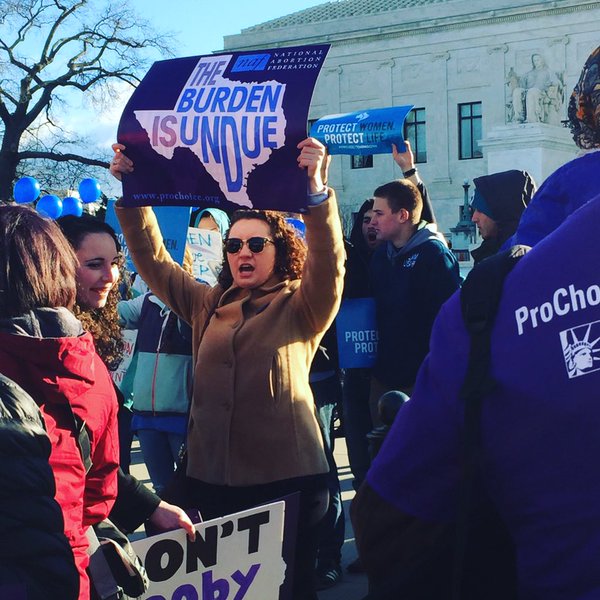
The touchstone for the justices, who now number only eight since the death last month of Antonin Scalia, was the standard established by the high court in its 1992 ruling Planned Parenthood v. Casey, which found that abortion restrictions may not place an “undue burden” on women seeking to terminate a pregnancy.

At issue in the current case, known as Whole Woman’s Health v. Hellerstedt, is a package of abortion restrictions passed by the GOP-controlled Texas legislature in 2013. During oral arguments Wednesday, the eight justices seemed divided along predictable ideological lines. The Court’s four conservatives challenged whether the Texas restrictions impose an “undue burden” on women, and its four liberals questioned the medical necessity of the restrictions.

In Casey, the court ruled 5-4 that states may legally pass restrictions on abortion access so long as those restrictions do not create unreasonable obstacles for women who seek to exercise their constitutional right to safely terminate a pregnancy. InHellerstedt, reproductive rights supporters have set out to prove that Texas’s new restrictions indeed violate the standard established under Casey.

The Texas law, known as HB2, requires that all abortion providers in the state obtain admitting privileges at a local hospital, and that clinics meet ambulatory surgical center (ASC) building standards. A key argument from the plaintiffs challenging HB2 is that these requirements have led to the closure of roughly half the state’s abortion clinics.

Chief Justice John Roberts and Justices Samuel Alito and Anthony Kennedy all questioned whether there was sufficient evidence to make that claim. Stephanie Toti, the attorney representing Texas abortion providers, noted that in the five years prior to HB2’s passage, the number of abortion clinics in Texas stayed relatively constant. Once HB2 became law, however, eight clinics closed in anticipation of the restrictions, and 11 closed the day they went into effect.Toti argued that the timing of the closures, as well as testimony from the plaintiffs, provided ample evidence to show that the clinics closed as a result of HB2’s mandates. But the conservative justices seemed unconvinced.

The four liberal justices all pressed Texas Solicitor General Scott Keller on why the admitting privileges and the ASC requirements were medically justified. They pointed out repeatedly that Texas has not required other providers of such outpatient procedures as colonoscopies and liposuction to meet ASC standards, despite the fact that those procedures carry far greater medical risk. (The American College of Obstetricians and Gynecologists and the American Medical Association have also said there is “simply no medical basis to impose a local admitting privilege on abortion providers.”) Moreover, Justice Stephen Breyer noted that even if the Texas legislature thought it was improving women’s health care by putting these standards in place, there’s evidence that women now face more barriers to abortion access, which increases the likelihood for riskier late-stage or self-induced abortions.

Another disagreement centered on whether the few abortion clinics left in Texas are capable of providing service to everyone who needs reproductive care in the state. More than 70,000 women in Texas seek abortions each year, but Alito argued that it’s impossible to know for certain whether there are too few clinics because “we really don’t know” what the capacity is of the existing providers. Donald B. Verrilli Jr., the U.S. solicitor general, disagreed, arguing that it’s “common sense” that just eight, nine, or ten clinics in all of Texas would not be enough to meet the demand.

The case’s outcome rests largely with Kennedy, the justice who originally helped craft the vague “undue burden” standard in 1992’s Casey decision. If Kennedy sides with the state of Texas, that will presumably leave the high court deadlocked 4-4. That would leave in place the Fifth Circuit Court’s decision to uphold HB2. But it would also mean that the Hellerstedt ruling sets no new national precedent. Kennedy also signaled the possibility of sending the case back to the lower court for remand—or further fact-finding—to better determine whether the number of clinics left in Texas can meet the state’s demand for abortion. It’s possible that another version of Hellerstedt will return to the Supreme Court when a successor to Scalia is appointed. The Hellerstedt ruling is expected this summer.

Hundreds of reproductive rights supporters, dressed in purple, and anti-abortion activists, wearing blue, rallied energetically outside the Supreme Court this morning in the cold; holding up signs, chanting songs, and making speeches—at times drowning one another out. Some supporters camped outside the high court Tuesday night, while others arrived early in the morning by bus, from states like North Carolina and Georgia, and cities like Philadelphia and Cleveland.

California Teachers Unions Push for Cushion Before Upcoming SCOTUS Case

Originally published in The American Prospect’s Tapped blog on September 8, 2015.
——

This fall, the Supreme Court will hear arguments in Friedrichs v. California Teachers Association, a case that could severely weaken the power of public-sector unions. The justices will decide whether such unions can charge “agency fees” (also known as “fair share fees”) to individuals who wish to dissociate with their union’s political lobbying but still benefit from workplace collective bargaining.

These reduced annual dues help stave off “free riders”—those who enjoy the advantages of union membership without financially contributing to the union’s work. The case’s lead plaintiff, Orange County teacher Rebecca Friedrichs, insists her free-speech rights are denied by paying agency fees, and argues that unions won’t actually suffer if she wins in court. “It’s hard for me to describe,” she told The Washington Post. “I just want liberty. I want to stop this silencing of my voice and the silencing of millions of teachers out there.”

As the Prospect’s Justin Miller put it, “the Friedrichs case has the potential to overturn decades of legal precedent [since 1977] that has become intractably embedded in union strategy—and state law.”

In the meantime, The Sacramento Bee reported that teacher unions in California are pushing Governor Jerry Brown to embrace a last-minute measure that would permit unions to address all new teachers during their orientations. Such conversations could help unions recruit new members, and thereby mitigate the negative effects of an unfavorable ruling in Friedrichs. As reporter Christopher Cadelago wrote:

Up against the clock in the Legislature, the labor groups are pushing for a bill that could give unions some time—a half-hour—to meet with employees to voice the benefits of union participation. That, some believe, could prevent workers from fully withdrawing from their ranks if the court rules against fair share fees.

One version of the teacher unions’ bill is “nearly identical” to a California bill that grants unions up to 30 minutes to speak to new home health-care workers during their orientation period. That law was passed shortly after the Supreme Court’s 2014 Harris v. Quinn ruling, which said that Illinois home health-care workers could not be required to pay agency fees. (Harris v. Quinn avoided the free-speech questions that will be considered in Friedrichs.)

Groups like the Association of California School Administrators, the California Association of School Business Officials, and the California Special Districts Association say that bills like the ones proposed by the teacher unions should be considered only after the Supreme Court makes its final decision in Friedrichs, and only when there is more time available for public comment.

I’d guess that if California legislators were planning on supporting a bill like this, they’d wait until after the Friedrichs decision came down, just as the home health-care worker bill passed after the Harris case was decided. Either way, we won’t have to speculate for much longer, because California’s legislative session ends this week.