The anti-abortion movement insists everything is really fine

Originally published at Vox on August 24, 2023.
—–

The anti-abortion movement is at a political crossroads.

Last year, abortion rights won in all six states with abortion ballot measures, including in red states like Kentucky and Montana that otherwise elected Republican candidates. Earlier this month, activists suffered yet another defeat when Ohio voters cast ballots decisively against a referendum that would have made it harder for constitutional amendments, including an upcoming vote this November on abortion rights, to pass in the future. Abortion was not on the ballot, but anti-abortion groups campaigned heavily in favor of the Ohio measure, and they lost.

Even the Republican presidential primary, which the anti-abortion movement had been planning to dominate, has been something of a mixed bag, and there are signs that the movement’s influence is wavering. During Wednesday night’s GOP debate, Fox News moderator Martha MacCallum argued that “abortion has been a losing issue for Republicans since the Dobbs decision.” A recent New York Times/Siena poll shows that more than a third of Republican primary voters think abortion should be legal all or most of the time, and in a CBS poll this week, most didn’t think it was very important for Republican candidates to talk during the debate about their plans to restrict abortion.

Some candidates, including former Vice President Mike Pence, are still eagerly courting support from the movement, but others appear less willing to take their campaign cues from those anti-abortion organizations.

Donald Trump, for example, has resisted calls from the leading activist group, Susan B. Anthony Pro-Life America, to endorse a national 15-week ban on abortion. He’s also refused to say if he supports the type of six-week abortion ban that Gov. Ron DeSantis signed in Florida. Trump would say, however, that “many people within the pro-life movement feel that that was too harsh.”

And when DeSantis was dismissive of federal abortion restrictions in late July, saying he believed the anti-abortion movement would see more success from states and local communities, SBA Pro-Life America criticized his stance as “unacceptable.” DeSantis’s campaign didn’t seem to care, countering that the governor “does not kowtow to D.C. interest groups.”

Does that mean the anti-abortion movement is planning to rethink its own aggressive post-Roe strategy of trying to limit abortion as much as possible in as many places as possible? For now, the answer is broadly no. Instead, leaders argue that any losses they’ve suffered over the last year have not been because their agenda is unpopular, but because it hasn’t been pursued boldly and strategically enough. If anything, they say, winning will require an even stronger commitment to restricting abortion.

GOP presidential candidates are divided on federal abortion bans

Leading groups opposing abortion rights are divided on what they want to hear from federal candidates.

SBA Pro-Life America has said it will not support anyone who does not express at least a commitment to restricting abortion at the federal level after 15 weeks. Meanwhile Students for Life made clear that they oppose such a 15-week litmus test, given that more than 90 percent of abortions occur within the first 13 weeks. Instead, they asked each candidate to lay out their proactive vision for a post-Roe America, and emphasized that their own blueprint includes granting legal protections to unborn children, defunding Planned Parenthood, banning the distribution of medication abortion by mail, and reimposing other restrictions on abortion pills that were relaxed under the Biden administration.

During the first GOP primary debate, however, most candidates declined to do any of these things, and appeared divided on whether the federal government should limit abortion at all. DeSantis dodged a question on whether he’d support a six-week ban, former South Carolina Gov. Nikki Haley stressed the fact that there’s little chance of getting something through Congress, and North Dakota Gov. Doug Burgum claimed a federal ban would violate the 10th Amendment of the US Constitution. Of the eight candidates on stage, only Pence and South Carolina Sen. Tim Scott backed a 15-week restriction.

Yet while some GOP political consultants quietly worry about electoral backlash to abortion bans that voters consider too extreme, anti-abortion groups have urged candidates to stay the course, and to champion the post-Roe successes the movement has achieved so far.

“A year after Dobbs, 25 states have put pro-life protections into law — half the country,” SBA Pro-Life America stated after the Ohio election. Rejecting the idea that abortion rights were helpful to Democrats in 2022, they touted the midterm wins of Florida Sen. Marco Rubio, North Carolina Sen. Ted Budd, and Ohio Sen. J.D. Vance. Catherine Glenn Foster, president of Americans United for Life, offered a similar rosy post-midterms reflection, noting that public officials who backed or enforced abortion restrictions were reelected in nearly 20 states. “Democrats didn’t crack state governor, state attorney general, or state house seats in red states that have enforced abortion limits since [Dobbs],” she argued.

The movement against abortion rights isn’t admitting defeat

While the attempt to make it harder to pass ballot measures — known as Issue 1 — lost by 14 percentage points in Ohio, anti-abortion groups say that does not mean they’ll face a similar fate when abortion is actually on the ballot in November. The proposed Ohio amendment would restore the right to an abortion up to the point of fetal viability, and permit abortions beyond that point if a patient’s doctor deems it necessary to protect their life or health.

In their post-mortem memo, SBA Pro-Life America said they lost for two reasons: they didn’t start their campaign against Issue 1 early enough, and some voters were motivated to vote no because of concerns about democracy and other policies, like the minimum wage or legalizing marijuana. The group claims it does not see support for abortion rights as a key reason for Issue 1’s failure.

Anti-abortion groups have also blasted Republican elected officials and business leaders for not campaigning hard enough. “The silence of the establishment and business community in Ohio left a vacuum that was too large to overcome,” SBA Pro-Life America argued. “So long as the Republicans and their supporters take the ostrich strategy and bury their heads in the sand, they will lose again and again.”

Terry Schilling, leader of the conservative American Principles Project, likewise slammed GOP donors for not spending heavily enough on the Ohio election, and he blamed Republican presidential candidates and national party leaders for downplaying its importance. Another national anti-abortion group, Students for Life, made similar arguments, noting that being outspent by opponents almost 5 to 1 “certainly helped create the confusion about what was at stake.”

While groups supporting abortion rights frame the Ohio results as a clear-cut victory for their cause, election analysts caution we don’t yet fully understand who voted for Issue 1 and why, and it is possible that voters who cast their ballot against the Issue 1 referendum in August will also vote against expanding abortion restrictions in November.

Students for Life has recently launched a “3-step plan” for defeating the abortion rights amendment, largely by mobilizing youth voters. The group is arguing that voters in states like Kansas are experiencing “buyer’s remorse” for approving a state constitutional amendment for abortion rights last year, and they claim they’ll dissuade Ohioans from making the same mistake. When asked for evidence of such remorse, spokesperson Kristi Hamrick told Vox it’s based on her group’s “lived experience [and] talking with people on the ground.”

Early polls on the November amendment bode well for abortion rights supporters; one from June found nearly 60 percent of Ohioans support the idea of an amendment for reproductive freedom. But political researchers say it’s generally harder for affirmative ballot measures to pass, given what’s known as a “status quo bias.” To pass the Ohio amendment, advocates may copy the playbook from Michigan, where abortion rights activists framed their winning 2022 ballot measure around the idea of restoring the rights of Roe v. Wade — bringing back the reality Americans had known for five decades. Opponents, meanwhile, will claim activists are trying to radically expand rights.

Anti-abortion leaders are already running with this strategy, claiming that Ohio’s proposed abortion rights amendment’s language is so broad that it would create a new right to gender-affirming surgery, and therefore invalidate the state’s requirement for parental consent.

In its post-mortem memo, SBA Pro-Life America argued that advocates in Ohio must stick with “a simple message,” framing the upcoming referendum as “an attempt by ACLU to eliminate parental rights and legalize abortion on demand in the Ohio constitution.” The amendment would only permit abortions past the point of fetal viability to protect a patient’s life or health, but SBA Pro-Life America is urging advocates to claim it will “legalize unrestricted access to abortion until the moment of birth, paid for by Ohio taxpayers.”

Anti-abortion groups note that the ACLU has long opposed parental consent laws, and an ACLU Ohio lawyer in February said existing laws that conflict with a constitutional amendment “should not be enforced.” Still, Ohio case law generally requires parental consent for youth medical care, and the amendment could only affect parental consent laws if someone were to successfully challenge the rules in court as unconstitutional. Given that Ohio’s state Supreme Court is controlled by Republicans, legal experts think a more sweeping interpretation of the abortion rights measure is unlikely. Andrew Everett, an ACLU spokesperson, told Vox in July they “have no plans to challenge parental consent laws in Ohio.”

Even the most unapologetic anti-abortion groups recognize they need to work on the movement’s image

While leading national groups insist there’s no real proof candidates should back away from abortion restrictions, activists are talking more about the need to speak more compassionately to the needs of mothers and children — driven partly by media coverage showing pregnant women and new mothers have suffered under new anti-abortion laws.

SBA Pro-Life America urged lawmakers to support legislation that requires child support payments to begin when a fetus is in the womb, and to expand the child tax credit and parental leave support. Students for Life similarly emphasized the need to better support pregnant moms and parents on campuses. Route Fifty reported that at least four states have approved new tax exemptions for pregnant people and anti-abortion centers, and nearly a dozen more are considering them.

A few dissenting voices in the anti-abortion movement have recently urged more compromise. Schilling, of the American Principles Project, said candidates should stick with 15-week bans that allow for exceptions for rape, incest, and protecting the life of the mother. “Abortion limits need to be reasonable and popular,” he told Politico. “15 weeks, build a genuine culture of life, revisit,” echoed Duncan Braid, a staffer at the conservative think tank American Compass.

But for now these are minority voices, and the anti-abortion movement is broadly urging lawmakers to get bolder, lest they meet the same electoral fate as failed Republican Senate candidates Mehmet Oz in Pennsylvania and Adam Laxalt in Nevada — who SBA Pro-Life America claim ran from abortion in their midterm races and subsequently lost. “Going on offense is essential for any candidate who wants to win in 2024,” said the group’s president, Marjorie Dannenfelser, at the conclusion of Wednesday’s debate.
Q&A: The Abortion Battle’s Next Phase

Originally published in The American Prospect on July 12, 2016.
—–

In a landmark ruling last month, the Supreme Court struck down a package of Texas abortion restrictions known as Targeted Regulation of Abortion Providers (TRAP) laws. Such laws, which have proliferated around the country, typically restrict abortion access by imposing rigid and expensive hospital-style mandates on clinics. The Court’s ruling in the case, known as Whole Woman’s Health v. Hellerstedt, found that the restrictive Texas TRAP laws were unconstitutional because they placed an “undue burden” on women, and marked a major victory for the reproductive rights movement. The American Prospect’s Rachel Cohen spoke with Ilyse Hogue, the president of NARAL Pro-Choice America, which helped lead the challenge to the Texas TRAP laws, to ask about the ruling’s implications for abortion access and for the upcoming election. This is an edited transcript of that conversation.

Rachel Cohen: Now that the Supreme Court has struck down TRAP laws, what’s next on the agenda for anti-choice opponents?

Ilyse Hogue: Over the years, [abortion opponents] have realized that honesty can only get them so far in terms of achieving their goal of ending legal abortion. TRAP laws were really a way to deceive the public, cloaking their efforts around the idea of protecting women’s health. The Supreme Court just eviscerated the anti-choice posturing that TRAP laws are in any way about women’s health.

So one of their favorite tools just got taken away from them. They are reeling, but they are not the type to take their ball and go home. We’re anticipating them pushing forward on a number of different fronts. I think they will step up their harassment at clinics—harassing patients and doctors. And we’ve seen some really insidious things from state legislatures, like recently an effort in Missouri to force clinics to turn over their private medical records to the state. I think we’re going to see anti-choice opponents continue to pour resources into crisis pregnancy centers, which are just another way to deceive women.

How will the reproductive rights movement respond?

We are pushing back on their crisis pregnancy center efforts. In California last year, legislators passed the Reproductive FACT Act, which sets a national model for requiring all crisis pregnancy centers to be really clear with their patients about what they do and don’t do. Other states are looking at California’s law, and I think it’s very much at the top of legislators’ minds for the beginning of 2017.

We’ve also seen states where pro-choice legislators are filing to appeal TRAP laws that are already on the books, like Daylin Leach, a Democratic state senator, in Pennsylvania. And we’re working as a movement to step up litigation and public education to repeal the rest of those laws around the country. Importantly, we’re really moving to a position where we will not just fight anti-choice lies and deception, but where we can actively push for legislation that expands access to abortion. For example, a number of states are looking at medical abortion, and allowing nurse practitioners to provide abortion services. California already has that and other states are looking at it.

On top of this, we’ve got two pieces of federal legislation that are picking up momentum. The Women’s Health Protection Act, which would enforce and protect the right of a woman to decide for herself whether to continue or end a pregnancy, and the Equal Access to Abortion Coverage in Health Insurance Woman Act, which would repeal the Hyde Amendment and ensure that abortion services could be covered under federal health insurance.

NARAL recently released a statement calling the Democratic Party platform “the strongest platform for reproductive freedom we have ever seen.” What’s so significant about it?

The platform is a symbolic statement of values, as well as a navigation tool for what kinds of legislative and public policy remedies there are for the issues that we face. So the fact that it explicitly calls for the repeal of the Hyde Amendment, as well as the Helms Amendment, [which restricts U.S. foreign aid from paying for abortion services] is huge. It acknowledges that there have been discriminatory practices both here and abroad against women who want to control our own reproductive destiny.

The reproductive justice movement deserves an enormous amount of credit for getting us here. Reproductive freedom in the 21st century is acknowledging that we are whole beings. There is not one group of women who gets abortions, and others who go on to be parents. We are just the same women at different times in our lives, making the decisions that are best for us and our families. That the platform takes a step towards acknowledging that is a real testament to the economic and reproductive movements that have come together.

How long will it take Texas and the other states with TRAP-style restrictions to restore abortion access to women?

I’m really glad you asked that question. The answer is too long and it varies state by state. Texas is five times the size of other states, so it will take longer there. But what’s important in answering that question is acknowledging that in the minds of the extreme anti-choice minority, this was a scorched-earth strategy. They always knew they could lose at the Supreme Court, but the amount of damage they were able to do in the meantime, in terms of clinics on the ground, in terms of women who could not access services—that’s significant damage that can never be fully undone.

While it’s important to win, we can’t actually let them gain such ground in the future. We can’t just depend on Supreme Court strategies when it comes to ensuring women access to our basic rights.

That brings us to the election. What role do you expect abortion and reproductive health to play in state and federal races?

We have to be very focused, not only on getting our champion into the White House, but on the down-ballot races, because the harm is coming disproportionately from state legislatures.

We’ve been doing a lot to hold incumbents accountable for the unbelievable amount of times they’ve tried to restrict access to abortion. Their constituents did not elect them to do that, especially at the expense of all the important business that has not gotten done. In both the federal election and for local and state races, we’re making sure voters have the information to hold their officials accountable.

This is a long-term project. We’ve got to make gains in 2016, and come 2020 and 2022, I think we’re going to start seeing some of these state legislatures really shifting on these issues.

In the 2012 election, Todd Akin, a Republican candidate from Missouri lost his race, in large part because of his outrageous comments about “legitimate rape.” Are we seeing similar types of remarks from Republicans this year?

I think people have been trained to be more careful, because when they speak their truth they find themselves at odds with the majority of their constituents. These anti-choice candidates don’t want to talk about their position once they get to a general election because they know they’re on the wrong side, and they don’t win elections if they do. We saw that so clearly in 2014 when Scott Walker, three weeks before his Wisconsin election, ran an ad saying he supports legislation to provide women with more information and to leave the final decision to a woman and her doctor. This is coming from a man who had done more to legislate abortion out of existence than every previous governor before him.

But I think what’s changed between 2012 and 2016 is that back then, the pro-choice movement was able to leverage those off-the-cuff Republican statements. But we’re not going to wait for them now. We’re going straight to the voters to remind them about their officials’ records. We did that really recently in New Hampshire with an  ad campaign targeting Republican Senator Kelly Ayotte, reminding her constituents about all the anti-choice work she spent her time working on, when they didn’t want her to.

What about Donald Trump? He went so far as to say that women should be punished for getting abortions, but then quickly walked it back.

Donald Trump is not playing by the anti-choice or the GOP rulebook in any way, and we know that. One thing that’s super important to me from where I sit at NARAL, but also as an American, and as a mom, is just the way he’s giving voice and credibility to deeply-held misogynistic ideas. I think he will do tremendous damage whether he wins or not, because he has given permission to this very dark underbelly that does not represent what we need to be or what we can be. This is especially true when it comes to his misogyny, and his willingness to dehumanize women. I think particularly because he is facing a woman opponent we’re going to see a new wave of misogynistic activists who feel like they have the high ground.

How has Obama been on reproductive rights? NARAL endorsed Hillary Clinton in January. Might Hillary be different from him?

Obama has been a great backstop against the endless assault by the anti-choice majority in Congress. He has vetoed every bill we’ve needed him to veto in no uncertain terms. But what we need now is a leader in the White House who centralizes these ideas about reproductive freedom as human rights, integral to the health and security of women and families in America. That’s not really been the center of his presidency, and I think it will be the center of Hillary Clinton’s.

Future of Abortion Access Remains Unclear After Supreme Court Oral Arguments

Originally published in The American Prospect on March 2nd, 2016.

Cci7HgUUUAArYgnCci7ypuW8AAZiCcCci9T8bUAAEWco1

A deeply and now evenly divided Supreme Court heard oral arguments on Wednesday in the most consequential reproductive rights lawsuit to come before the high court in nearly 25 years.

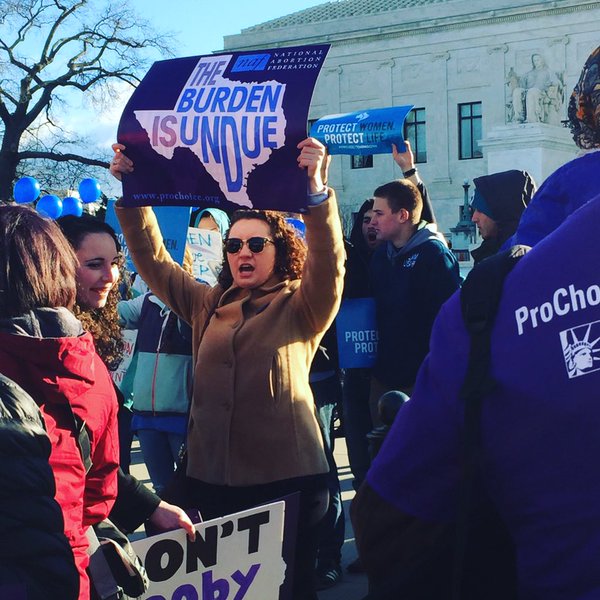
The touchstone for the justices, who now number only eight since the death last month of Antonin Scalia, was the standard established by the high court in its 1992 ruling Planned Parenthood v. Casey, which found that abortion restrictions may not place an “undue burden” on women seeking to terminate a pregnancy.

At issue in the current case, known as Whole Woman’s Health v. Hellerstedt, is a package of abortion restrictions passed by the GOP-controlled Texas legislature in 2013. During oral arguments Wednesday, the eight justices seemed divided along predictable ideological lines. The Court’s four conservatives challenged whether the Texas restrictions impose an “undue burden” on women, and its four liberals questioned the medical necessity of the restrictions.

In Casey, the court ruled 5-4 that states may legally pass restrictions on abortion access so long as those restrictions do not create unreasonable obstacles for women who seek to exercise their constitutional right to safely terminate a pregnancy. InHellerstedt, reproductive rights supporters have set out to prove that Texas’s new restrictions indeed violate the standard established under Casey.

The Texas law, known as HB2, requires that all abortion providers in the state obtain admitting privileges at a local hospital, and that clinics meet ambulatory surgical center (ASC) building standards. A key argument from the plaintiffs challenging HB2 is that these requirements have led to the closure of roughly half the state’s abortion clinics.

Chief Justice John Roberts and Justices Samuel Alito and Anthony Kennedy all questioned whether there was sufficient evidence to make that claim. Stephanie Toti, the attorney representing Texas abortion providers, noted that in the five years prior to HB2’s passage, the number of abortion clinics in Texas stayed relatively constant. Once HB2 became law, however, eight clinics closed in anticipation of the restrictions, and 11 closed the day they went into effect.Toti argued that the timing of the closures, as well as testimony from the plaintiffs, provided ample evidence to show that the clinics closed as a result of HB2’s mandates. But the conservative justices seemed unconvinced.

The four liberal justices all pressed Texas Solicitor General Scott Keller on why the admitting privileges and the ASC requirements were medically justified. They pointed out repeatedly that Texas has not required other providers of such outpatient procedures as colonoscopies and liposuction to meet ASC standards, despite the fact that those procedures carry far greater medical risk. (The American College of Obstetricians and Gynecologists and the American Medical Association have also said there is “simply no medical basis to impose a local admitting privilege on abortion providers.”) Moreover, Justice Stephen Breyer noted that even if the Texas legislature thought it was improving women’s health care by putting these standards in place, there’s evidence that women now face more barriers to abortion access, which increases the likelihood for riskier late-stage or self-induced abortions.

Another disagreement centered on whether the few abortion clinics left in Texas are capable of providing service to everyone who needs reproductive care in the state. More than 70,000 women in Texas seek abortions each year, but Alito argued that it’s impossible to know for certain whether there are too few clinics because “we really don’t know” what the capacity is of the existing providers. Donald B. Verrilli Jr., the U.S. solicitor general, disagreed, arguing that it’s “common sense” that just eight, nine, or ten clinics in all of Texas would not be enough to meet the demand.

The case’s outcome rests largely with Kennedy, the justice who originally helped craft the vague “undue burden” standard in 1992’s Casey decision. If Kennedy sides with the state of Texas, that will presumably leave the high court deadlocked 4-4. That would leave in place the Fifth Circuit Court’s decision to uphold HB2. But it would also mean that the Hellerstedt ruling sets no new national precedent. Kennedy also signaled the possibility of sending the case back to the lower court for remand—or further fact-finding—to better determine whether the number of clinics left in Texas can meet the state’s demand for abortion. It’s possible that another version of Hellerstedt will return to the Supreme Court when a successor to Scalia is appointed. The Hellerstedt ruling is expected this summer.

Hundreds of reproductive rights supporters, dressed in purple, and anti-abortion activists, wearing blue, rallied energetically outside the Supreme Court this morning in the cold; holding up signs, chanting songs, and making speeches—at times drowning one another out. Some supporters camped outside the high court Tuesday night, while others arrived early in the morning by bus, from states like North Carolina and Georgia, and cities like Philadelphia and Cleveland.

California’s New Crisis Pregnancy Center Law Creates a Roadblock for Anti-Abortion Activists

Originally published in In These Times on October 30, 2015.
——

Earlier this month, California Governor Jerry Brown signed the nation’s first statewide law to regulate crisis pregnancy centers (CPCs). CPCs are facilities that work to counsel women out of having abortions, offering them resources like diapers, baby formula and maternity clothes, but also often disseminating misleading or outright false medical information. Boosted by government funding under George W. Bush, they have proliferated over the past 15 years, with an estimated 3,500 nationwide—outnumbering real abortion clinics 3-to-1.

California’s Reproductive Freedom, Accountability, Comprehensive Care and Transparency (FACT) Act, which overwhelmingly passed the state assembly in May, is being hailed as a landmark victory in a nationwide effort to push back against the rise of CPCs.

The new law, set to take effect January 1, will govern California’s nearly 170 CPCs, about 60 percent of which operate with no medical license. The law requires unlicensed facilities to post a notice—in “no less than 48-point type”—stating that they have neither a state medical license nor licensed medical staff. Licensed CPCs, for their part, will be required to inform women about available public assistance for contraception, abortion and prenatal care.

Whether or not the law can withstand a court challenge, however, remains to be seen. The decades-old movement to regulate CPCs has been repeatedly thwarted by First Amendment challenges.

Although CPCs began cropping up in the late 1960s as individual states lifted their bans on abortion, the clinics flew under the radar until the 1980s and 1990s, when they became a subject of a heated debate that went all the way to halls of Congress. Detractors argued that CPCs’ strategies to lure in women—such as offering free non-diagnostic ultrasounds and staffing their non-medical volunteers in white lab coats—amounted to false advertising. Defenders said their actions were protected speech.

The passage of the Personal Responsibility and Work Opportunity Reconciliation Act in 1996—or “welfare reform”—increased federal funding for abstinence education and helped to fuel the expansion of CPCs, as In These Times reported in 2002. The law enabled the Bush administration to funnel $60 million in federal abstinence-only funds to crisis pregnancy centers between 2001 and 2005, often doubling or tripling the centers’ annual budgets.

In response, a number of investigations into CPC practices were launched. A 2006 congressional investigation, initiated by Rep. Henry Waxman (D-Calif.), looked specifically at CPCs that received federal funding, and found that most provided women with false or misleading medical information, which “often grossly exaggerate[ed] the risks.” (Federal funding for CPCs continues today, despite the Obama administration’s efforts to end it.) NARAL, a national pro-choice organization, has also been investigating CPCs for more than a decade, and has discovered that staffers routinely overstated the risks of abortion or simply lied—telling women that ending a pregnancy would lead to infertility, breast cancer or even suicide. A 2008 NARAL investigation into 11 crisis pregnancy centers across the state of Maryland found that “every CPC visited provided misleading or, in some cases completely false, information.”

Drawing on the Waxman report and NARAL’s investigations, in 2009, Baltimore passed the first-ever legislation designed to curb CPCs’ misleading advertising practices. Challenging CPCs from a false advertising perspective was, in part, a strategic decision. As Slate’s Emily Bazelon reported in 2009, “There’s a whole branch of law, commercial speech, to explain why false advertising gets less First Amendment protection.” The law required Baltimore CPCs to display signs—in both English and in Spanish—clarifying that they do not provide abortion or birth control referrals. Similar laws were soon passed in New York City, Austin, and San Francisco.

These ordinances were all challenged in court on First Amendment grounds. CPC backers argue that the regulations violate their religious freedom and their right to free speech. Baltimore’s law was struck down in 2011 and is still tied up in court appeals. Austin’s was overturned, as were key aspects of New York’s law. Given their free services and nonprofit statuses, judges have tended to see CPCs’ speech as “noncommercial”—a designation that generally receives greater constitutional protection than commercial speech. But San Francisco’s law, which passed in 2011, has thus far withstood legal challenge.

Pro-choice advocates in California treaded very carefully in drafting the FACT Act. “We paid a lot of attention to the bills crafted in other cities,” says Amy Everitt, the state director of NARAL Pro-Choice California. NARAL also enlisted the help of Attorney General Kamala Harris, a Democrat, to identify language that might be deemed unconstitutional.

Everitt explains that laws which require centers to post signs describing what they do not provide (such as abortion referrals) have tended to be more legally vulnerable than those that require facilities to distribute “neutral” information about available government services. So the FACT Act only requires licensed clinics to inform women of the many services available to pregnant women. In California, state Medicaid funds can cover the cost of an abortion, and millions of Californian women became eligible for Medicaid with the passage of the Affordable Care Act.

“In California, we have some of the best pro-choice policies in the whole country, but if women aren’t aware of what’s available to them, then they can’t use them,” says Everitt. “They need to find out about their options, and they need to find them out when they are actually out seeking care and information.”

Crisis pregnancy centers have already filed two suits against the Reproductive FACT Act. The law “is an outrageous and unconstitutional violation of both the right of free speech and the right of freedom of religion for our members in California,” said Thomas Glessner, the president of the National Institute of Family and Life Advocates, in an email quoted in Life News.“The Act unconstitutionally forces pro-life pregnancy centers, on pain of government penalty, to engage in government disclaimers that they would not otherwise provide.”

In response, Everitt notes that the state has a “public health interest” in ensuring that women can access high-quality reproductive care. “Women are seeking their options,” she says. “They are going online and they are looking for information to make their decisions about unintended pregnancy or pregnancy scares, and they were not getting the information they wanted in certain places like CPCs.”

Crisis pregnancy center advocates usually deny that CPCs mislead women, arguing that those who come to visit are well aware of the clinics’ anti-abortion slant. But investigations by reproductive-rights groups and Congress have found that CPCs often set up shop in close proximity to real reproductive health facilities and hide their anti-abortion agenda when women call seeking information. CPCs have also spent significant sums of money to advertise their services misleadingly in newspapers, on billboards, on social media and through Internet search engines.

While the fate of California’s new law remains uncertain, energized advocates are determined to build on their newfound political momentum. Everitt says she hopes their new law will serve as a model “for every state to pursue.”The new measures are “what it looks like to respect women,” adds Ilyse Hogue, the president of NARAL Pro-Choice America.“Empower us and trust us to make the best decisions for ourselves and our families.”