Solitary Confinement and Jewish Organizations

Published originally in New Voices Magazine on January 24, 2012 and reprinted in Solitary Watch.

If community is a foundation of Jewish life, what does Judaism have to say about solitary confinement, the forcible separation of a person from the community? A few months ago I began an internship with Solitary Watch, an investigative news organization dedicated to reporting on solitary confinement. Once I got started, I became interested in learning more about the work the American Jewish community organizes around this issue.

It turns out there is a lot of work being done, though it started quite recently. Beginning in 2012,T’ruah: The Rabbinic Call for Human Rights (recently renamed from Rabbis for Human Rights-North America), a coalition of 1,800 rabbis, and Uri L’Tzedek, a prominent liberal Modern Orthodox social justice organization, have both made the issue of solitary confinement a prominent part of their advocacy efforts.

Solitary confinement is a form of imprisonment where individuals are subjected to approximately 22-24 hours per day of isolated lockdown in tiny cells. Many Americans mistakenly believe that solitary confinement is used sparingly, only for the most dangerous or threatening prisoners. However, according the American Civil Liberties Union, there are more than 80,000 men, women and children currently in some sort of solitary confinement in United States prisons. Many have a mental illness or cognitive disability, and the majority has been placed there for nonviolent violations of prison rules.

The costs of solitary confinement are much higher than housing inmates in the general prison population. Mississippi recently reduced the number of prisoners it holds in solitary from 1,000 to about 150, and closed down their high-security Supermax unit. According to the ACLU, the reforms are saving Mississippi’s taxpayers approximately $8 million per year.

That economic perspective on solitary confinement is important, but there is a moral perspective to consider as well – and that is where the religious community can add a unique voice to the national conversation.

“We’re looking to provide some moral weight to the solitary confinement conversation by applying Jewish values,” said Shlomo Bolts, a prison consultant from Uri L’Tzedek.

“Sympathy for prisoners is not the most common sentiment amongst the American public. People do not want to be seen as weak or soft on crime,” said Rabbi Rachel Kahn-Troster, director of T’ruah: The Rabbinic Call for Human Rights. “In the Torah however, it clearly says that if someone asks for forgiveness three times and you don’t forgive them, then the onus is on you. In Judaism we believe in repentance and that punishments don’t go on forever.”

While Uri L’Tzedek and T’ruah approach the issue of solitary confinement from a distinctly Jewish perspective, the scope of both groups’ work on the issue extends well beyond the Jewish community.

“We don’t want to make this a Jewish issue. We want to make it an American issue. As Americans we’re allowing for it to happen, we’re paying for it with our tax dollars,” said Kahn-Troster.

“We want to apply the Jewish values we learn to help all people,” said Bolts.

The two groups are part of a growing movement against solitary confinement. A feeling that the status quo is simply untenable is circulating in religious communities and among the politically engaged in general; change, while it may not be imminent, feels inevitable.

“This is an exciting time. We really do see ourselves as being a force to help pass legislation to abolish or reduce solitary confinement,” said Bolts.

In June, Senator Dick Durban (D-IL) led a congressional hearing on solitary confinement, the first in American history. The hearing focused on the human rights issues associated with isolation, the economic implications of solitary confinement and the psychological impact on inmates during and after their imprisonment.

Both T’ruah and Uri L’Tzedek contributed written testimony to the hearings. They also participated in the National Day of Fasting, an interfaith effort to raise awareness of the significance of the congressional hearing.

“Fasting serves as a way to repent and bear witness. For me to be at the congressional hearing, sitting with a group of religious leaders fasting was a very powerful experience,” said Rabbi Kahn-Troster.

Fasting also serves as an act of solidarity with prisoners in solitary confinement, for whom hunger strikes are often the only available form of protest.

“I think about the hunger strikers at Pelican Bay [a California Supermax facility]. They get poor food, and then they refuse to eat it in order to draw attention to their situation. When I fasted it really hit home what these people must be going through,” said Rabbi Kahn-Troster.

T’ruah and Uri L’Tzedek are also working with the National Religious Campaign Against Torture. Founded in 2006 and comprised of more than 300 religious organizations, the campaign organizes protests against different forms of torture employed by the U.S., including those used at sites like Guantanamo Bay and Abu Ghraib.

Turning her organization’s focus toward solitary confinement now “seems like a natural outgrowth of our torture work,” said Rabbi Kahn-Troster.

Uri L’Tzedek and T’ruah now face the task of motivating American Jews to get more involved with the issue. Despite a history of involvement in a wide variety of social justice causes, the American Jewish community has generally avoided issues of prison reform.

“There is this misconception that Jews are somehow not incarcerated, yet Jews go to prison for the same reasons as everyone else,” said Chaplain Gary Friedman, chairman of Jewish Prisoner Services International, an organization that provides advocacy and spiritual services to Jewish prisoners and their families. Friedman estimates there are approximately 12,000-15,000 Jews in American prisons today, including some in solitary confinement.

Uri L’Tzedek’s approach to raising awareness is a mix of traditional advocacy combined with social science research led by the Tag Institute, a British-based think tank driven by Jewish social values. Among other things, Tag’s research seeks to generate quantitative survey data on the Jewish community’s perceptions of prisons and punitive punishment –and to find the most effective ways of organizing Jewish communities to advocate for humane alternatives to solitary confinement.

Meanwhile, T’ruah is mobilizing its network of 1,800 rabbis to raise the consciousness of members of their respective communities on the issue – and hopefully to inspire some activism about solitary confinement within their communities

As solitary confinement becomes an increasingly mainstream human rights issue, the work of the Jewish community is likely to grow and inspire further activism.

As it says in the Talmud (Ta’anit 23a), “Either companionship or death.”
Judaism and Politics

Originally published in New Voices on December 10, 2012

Image

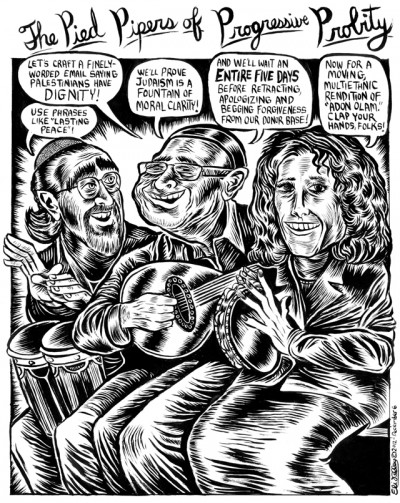
The Forward’s Artist-in-ResidenceEli Valley just published a comic about a recent episode at Bnai Jeshurun, a non-denominational, liberal synagogue in New York City. The rabbis had sent out an email to their congregants praising the U.N. Palestinian vote, and then, after intense media coverage and mixed reactions from the community, they later apologized and said they regretted their decision to send this email. The rabbis wrote that their original email “did not honor the diversity of viewpoints in their community.”

I had the opportunity to meet Eli at this year’s New Voices student journalism conference and learned about the general political lens through which he interprets current events. In his new comic he contends that while the rabbis certainly say that Judaism can be a guide for moral clarity, in the face of political pressure they find themselves, “retracting, apologizing, and begging for forgiveness from [their] donor base.”

If I were a member of Bnai Jershurun, I might feel uncomfortable or offended by this comic. It could be read as a personal attack on their rabbis, their congregants, or on the eccentric nature of their spiritual environment. But I am not a member of that synagogue and I did not read it that way.

I read it not about the rabbis of Bnai Jershurun, but about rabbis in general.  I don’t think this comic would be so evocative unless it captured a larger phenomenon that many more Jews, living outside of the Upper West Side, are also grappling with.

Rabbis are leaders of their Jewish communities, and so one could say that they need to profess views that are sufficiently representative of their congregants. One could maintain that Jewish leaders must make efforts to ensure that everyone feels safe and comfortable.

Community and comfort are really important. To feel alienated is lonely and confusing.

But I wonder if we have come to a point where we’re so fearful of alienating people that we are unable to take strong, moral positions during situations in which a response is needed. The recent silence from the American Jewish community on Netanyahu’s decision to build settlements in E-1 is an unfortunate, yet sobering example.

Maybe the tension stems from the fact that political leaders and Jewish leaders aren’t supposed to lead in the same way, and yet in so many instances, they do. I would expect, and demand that politicians work to represent the views of their constituencies. In the face of enormous political pressure, watching politicians cave can sometimes be beautiful examples of our democracy at work—a government by the people for the people.

But if rabbis are leading congregations based on the lessons they’ve internalized from their years of studying Jewish moral teachings, then political pressure or even communal discomfort are questionable, and unsettling reasons to cave.

I suppose one solution could be for us to say, “Well, synagogues shouldn’t be so political anyway. Jews hold different views, they are all relatively valid, and rabbis shouldn’t assume that they can speak on behalf of others.  Let’s create a safe space for people to come together, and let’s leave politics out of it.”

This is an understandable and tempting idea. And yet, I wonder if those same people would say synagogues should also refrain from encouraging support for the state of Israel. My guess would be no. But what if there are congregants who feel alienated by certain Pro-Israel statements? Then the question becomes which political statements will be tolerated in synagogues and which will not be. Who draws that line?

What are the roles of our Jewish leaders, really? To represent us? To teach us? Is Judaism meant to provide us with answers to the tough ethical and political quandaries we currently face? Can it?

I don’t quite know what role exactly Judaism plays in politics anymore. It seems as though everyone has their own opinions and perspectives, and every email sent out has to be crafted quite carefully so as not to offend individuals or cause anyone discomfort. The price we pay for this however, I’m not so sure.

The Importance of the Youth Vote

Originally published in the JHU Politik on 11/5/12

In 1971, Congress passed the 26th Amendment to the U.S. Constitution. This guaranteed that all American citizens ages 18 and older could vote in U.S. federal elections. Today there are 46 million people who fall into the so-called “youth voting bloc”—consisting of those between the ages of 18 and 29—and make up 21% of the eligible U.S. voting population. Take those numbers and compare them to the mere 39 million seniors who are eligible to vote.

In spite of our numerical advantage, youth are often disparaged for being apathetic and ill informed by politicians who do not believe in young peoples’ willingness to vote. However, the fact is that we represent a major subset of the electorate and should represent ourselves as such.

There is hope. Youth voting turnout has gone up in the past several election cycles. According to the Center For Information & Research on Civic Learning and Engagement, youth turnout in 2008 rose to 52%, an increase of 4 percentage points from the 2004 presidential election. We also know, thanks to research conducted by Richard Niemi and Michael J. Hanmer, that voting turnout among college students is traditionally higher than that of non-college educated youth. Despite these positive trends, youth turnout, college educated or not, still lags behind all other age demographics.

The question remains: Why? Why do so many young people choose not to not engage in our democratic process?

Some people argue that youth are engaging, albeit in different ways. For example, our generation volunteers in record numbers. According to a study conducted by the Corporation for National and Community Service, young people volunteer at nearly twice the rate of adults, 55% to 29%. Additionally, this study found that altruism is the driving motivator of youth volunteerism. Young people strongly agreed with statements such as, “I would like to help make the world a better place,” and “It’s important to do things for others.” We do want to improve our communities, but it seems that some want to bypass “politics” along the way.

For many young people who are volunteering but not voting, politics has come to be seen as something distasteful, smarmy, petty, and synthetic. Even readers of the JHU Politik, students that have an interest in politics, may still sympathize with the way many of our peers have come to view politics. Our political process is often characterized by financial corruption, thirst for power, and dishonesty.

Even if this position is understandable, it is not an excuse to disengage. For the sake of social change and for the sake of the survival of our democratic system, citizens have to take ownership of their responsibility to vote. The onus is partially on the politically active youth to do a better job of explaining to them why they should vote. However, ultimately as citizens it is our responsibility to participate.

As President Garfield said in 1877, “Now more than ever before, the people are responsible for the character of their Congress. If that body be ignorant, reckless and corrupt, it is because the people tolerate ignorance, recklessness and corruption. If it be intelligent, brave and pure, it is because the people demand these high qualities to represent them in the national legislature.”

The youth of this country need to demonstrate that if they want to change the world through altruistic aspirations, which we know they do, then it is impossible to do so without also engaging in the political process. Community service and volunteering is important, but, as the old truism goes, you cannot end world hunger by serving soup in a soup kitchen. We’ll never get stronger environmental conservation laws by cleaning up a park one day on the weekend. We’ll never shed the need for inner-city tutors unless we legislate serious educational reform. Those things have intrinsic value, but to make lasting changes we need to work within our existing, although imperfect, political system.

It is not only our responsibility to vote, but also to help make that message clear to all U.S. citizens. So tomorrow, please vote and help everyone you know to vote as well.

Re: The “History” of Marriage

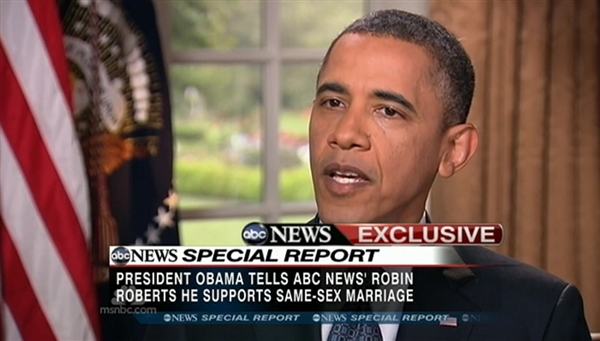
In the wake of President Barack Obama’s recent announcement that he supports same-sex marriages, quite a few reactions have flooded the opinion pages, cable networks and blog sites. Of course, people are entitled to their differing views on the subject; and President Obama’s announcement certainly can be seen as a divisive one. It angers not only many conservatives, but also groups that are considered at the base of the Democratic Party, specifically African-Americans and Latinos. However, at a time when Gallup polls report that 50% of all Americans support same-sex marriage, this public affirmation from the President of the United States marks an important moment in history.

Image

photo credit: msnbc.com

And yet, I almost refrain from using the word “history”, a term that opponents of same-sex marriage have so regularly abused and exploited. The word itself faces the threat of being rendered meaningless.

Republican Presidential nominee Mitt Romney declared in 2003, “I agree with 3,000 years of recorded history. I disagree with the Supreme Judicial Court of Massachusetts. Marriage is an institution between a man and a woman.” Recently Romney spoke at Liberty University, where he reaffirmed his position of nine years ago. He spoke of the “enduring institution of marriage,” one that defines itself as “a relationship between one man and one woman.”

He has other conservative supporters, of course. In January, Newt Gingrich boldly associated gay marriage with Paganism. Gingrich said, “It’s pretty simple: marriage is between a man and a woman. This is a historic doctrine driven deep into the Bible, both in the Old Testament and in the New Testament…the effort to create alternatives to marriage between a man and a woman are perfectly natural pagan behaviors, but they are a fundamental violation of our civilization.”

Conservative blogger, Erick Erickson writes, “In the past few decades, many people have decided that several thousand years of human history can be ignored in favor of unproven claims of happiness, fairness, progress, and an expanded notion of equality.”

It is imperative to do some fact checking of these ‘historical’ claims.

When Newt Gingrich invokes marriages from the Old and New Testament, is he counting the one where Jacob had two wives? Or where King David had eight wives? Or where King Solomon had 700 wives?

When Mitt Romney speaks about the “enduring institution” of marriage, does he mean the marriages of ancient Egypt where royal siblings would legally marry one another in order to keep their royal bloodlines pure? Or the marriages of the ancient Romans where daughters were human forms of currency, used to help form strategic alliances and strengthen the military position of the family?

Marriage is an evolving institution. It is both deceptive and manipulative to speak of the history of marriage as a stable, un-changing tradition. To be against gay-marriage is one thing; to depict marriage as a fixed institution is another.

Wedding vows, as we know them today certainly have not been around for “thousands” of years. The vows with the well known “to have and to hold, from this day forward, for better, for worse, for richer, for poorer” come from a man named Thomas Cranmer in 1549.

Society did not really even make the switch to marrying for love, a period known in sociology as “affective individualism”, until the Victorian Era. Prince Albert and Queen Victoria became the revered icons for a loving marriage. People began to grow distasteful of arranged marriages for economic purposes, and began to seek new meaning, namely love, in the institution of marriage.

When Erick Erickson argues that we’re ignoring “thousands of years of human history” I think the real question is which history is he referring to? Which marriage structure is he claiming we should fight to preserve? Arranged-marriages between a man and a woman? Polygamic marriages?

And if Erickson does mean marriages for love between a man and a woman—well, that is one of the most recent historical phenomena of them all.