Could Your Fitness Tracker Really Detect COVID-19?

Originally published in GQ on July 14, 2020

When professional golfer Nick Watney woke up on Friday, June 19, after playing the first round of a PGA tournament in South Carolina, he felt physically fine. But when he checked the WHOOP fitness tracker he’s worn on his wrist for the past year, he was startled to see a spike in his breathing rate while he was sleeping.

He had heard that could be a sign of COVID-19, so just to be safe, despite showing no other symptoms, he got a test. To Watney’s surprise, it came back positive. Over the next ten days, while he self-isolated in South Carolina, he never developed a fever, cough, or shortness of breath—though he did end up losing his sense of smell for a while.

A week after Watney tested positive, the PGA Tour announced it would be distributing WHOOP bands to all players and caddies, in the hopes that they too might be able to identify potential coronavirus infections early. The straps have since been credited with early detection for other PGA Tour golfers who have gone on to contract the virus. This comes on the heels of the NBA’s announcement earlier in June that it would be purchasing more than 2,000 Oura Rings, a similar fitness tracker, to help detect cases of the virus when the league re-starts in Orlando.

Whether it’s WHOOP and Oura Ring, or other fitness trackers like Fitbit and the Apple Watch, there’s increasing enthusiasm around fitness trackers among researchers as a first line of defense in the fight against coronavirus. While the science is still in its earliest days, the hope is these devices could alert individuals to changes in their health they might not otherwise notice. Early detection is particularly crucial for combating the coronavirus, which has the unusual characteristic of spreading “silently” from people who are not feeling symptoms. These devices use sensors to track a range of physiological markers—sleep patterns, heart rate, breathing rate, and temperature. For example, if your resting heart rate is normally 62 bpm, but jumps inexplicably to 75 bpm, you likely wouldn’t feel any different, but that jump could prompt your tracker to issue an alert to get tested. Of course, no researcher expects the tech to replace real diagnostic testing. At least right now, the best anyone can say about this right now is that, when combined with other coronavirus safety protocols, it doesn’t hurt.

Researchers also see potential to use wearable tech to study how the virus moves through large populations. If a cluster of people living in the same area all start to notice similar changes in their heart rate or temperature, that could help officials better respond to outbreaks and mitigate their spread. “If you and many of your neighbors are showing similar reactions—that’s when it becomes a signal rather than noise,” said Eric Topol, the director of the Scripps Research Translational Institute, which is leading one of the major ongoing fitness tracking studies. Topol’s interest in using fitness trackers to predict disease predates the current pandemic. In January he and his colleagues published a study that found by using de-identified heart rate data from Fitbit users, researchers were able to significantly improve their predictions of influenza-like illness when compared to using CDC data.

A built in advantage for fitness trackers is that millions of people already have them. In 2019 Gallup reported nearly 20 percent of Americans currently use one, and consumer analysts say the devices represent one of the fastest-growing sectors in global technology, especially smartwatches. Another benefit is that they work passively; they don’t require manually entering symptoms into an app, or sticking a thermometer under your armpit on a daily basis.

While researchers are optimistic about the potential, they caution that the existing knowledge base is very, very scant. There’s been almost no research, for example, on how wearables could be turned into reliable clinical tools. “Your average doctor doesn’t want to see your wearable data because they don’t know what to do with it or how to make sense of it any more than anyone else,” said Benjamin Smarr, a data science and bioengineering professor who is leading a University of California at San Francisco study on Oura ring data and COVID-19.

Smarr is among a handful of researchers who have been studying wearable tech data for the past decade. He said the overall assumption is that having lots of information health professionals wouldn’t otherwise have access to will prove to be useful in some way, even if they don’t know exactly how yet.

And while Harvard health policy professor Thomas Tsai supports the ongoing research—“it’s fascinating and important,” he says—from a public perspective, Tsai worries about the mixed messages these fitness trackers could be sending during the pandemic. “We’re working really, really hard to break the message that only symptomatic individuals should get tested,” he said. “That was true back in March and April, when we had a huge shortage of tests, but that’s not true anymore.”

Tsai also raised concerns that someone’s smartwatch could give them a false sense of security about their health. “The danger is that someone who needs to get tested may not want to because their wearable device says they are showing no symptoms,” he says.

Right now there’s at least four large-scale fitness tracker studies underway; the one at UCSF, the one at Scripps, a third at West Virginia University, and a fourth at Stanford. In late May the West Virginia researchers announced preliminary results from a study of 600 healthcare professionals and first-responders, which found that, using Oura Ring data and artificial intelligence models, researchers could predict COVID-19 symptoms three days in advance of their onset, with over 90 percent accuracy. That’s not a huge sample size, but they’re now scaling up their next phase of research to roughly 10,000 people. (Oura is not funding the West Virginia study, but is funding the trial at UCSF.)

Topol says he hopes that when (and if) we have high-quality coronavirus tests that people can administer from home, the fitness trackers could pair well with them, allowing infected people to self-isolate earlier than otherwise would have. “There are sixteen companies working on at-home COVID tests and we’re in discussions with five of them,” he said.

“These fitness tracker studies are going to lead to a really, really large amount of comparative physiological data,” Smarr added. “We don’t know yet what we’ll find— nobody has ever done something like this before.”

Elderly People Subject to Flawed Guardianship System Are More Vulnerable Amid Pandemic

Originally published in The Intercept on July 6, 2020.
—–

IN THE SUMMER of 2018, then-84-year-old Genyte Dirse was removed from her home — a motel she had owned and lived in for decades — and placed in an assisted living facility in St. Petersburg, Florida. This followed a relatively fast and bewildering legal fight between Dirse and a local real estate agent who argued that she wasn’t in her right mind to live independently. Ever since then, her closest living relative in the U.S., her great-nephew Gedi Pakalnis, had fought a losing legal battle to bring her back home.

Pakalnis’s fight to bring Dirse home ramped up this spring, as the coronavirus pandemic ravaged the globe. In the United States, residents of nursing homes and assisted living facilities have been particularly vulnerable, with more than 51,000 deaths reported nationally from those institutions so far. In Florida, like elsewhere in the country, the number of Covid-19 deaths at senior living facilities has grown at a much faster rate than the broader population and, by early May, accounted for more than a third of the state’s pandemic fatalities.

In late April, the virus struck Patrick Manor, where Dirse lived. For weeks prior, Pakalnis had been trying to reach his great-aunt’s legal guardian to get information about her health, raising concerns about the fast-spreading disease. After weeks of no news, Pakalnis finally learned that Dirse had been hospitalized with Covid-19 symptoms. Dirse’s guardian told Pakalnis that he could potentially visit her once the pandemic calmed down.

He never got the opportunity. On May 5, Dirse died of Covid-19, alone at St. Anthony’s Hospital. She was not the first Patrick Manor resident to be hospitalized with the coronavirus, and by mid-May, 11 Patrick Manor residents and two staff had tested positive with the disease.

The frequent deaths of elderly people in nursing homes and assisted living facilities has become a horrifying reality throughout the pandemic. But something was also different about Dirse’s death; according to her great-nephew and others who were involved in the guardianship process, she was confined against her will to Patrick Manor, where she faced a greater likelihood of getting sick — despite having family willing and able to take care of her.

For decades, adult guardianship has been a legally thorny issue, with independent watchdogs and journalists repeatedly finding that senior citizens are stripped of their rights and often financially exploited — with little government oversight. The cases often involve complex family drama and disagreements among siblings, but sometimes, as in Dirse’s case, it’s an outsider who gets involved, over the objections of the elderly person’s relatives. A court’s decision to appoint a guardian is usually final, as appeals are costly and complex, and appellate courts are highly deferential to the lower court’s initial findings.

The issue has taken on new relevance amid the pandemic. In a Covid-19 resource compiled by the National Guardianship Association, the American Bar Association, and the National Center for State Courts, advocates acknowledge the pandemic “will make it more difficult” for seniors to exercise the remaining rights they do have.

“In this pandemic we’re going to see abusive guardianships started over Zoom, with the virus facilitating the racket that’s already in place,” warned Dr. Sam Sugar, founder of Americans Against Abusive Probate Guardianship, a national advocacy group. “The difference with Covid-19 is we’re going to see wards dying in nursing homes faster, in weeks, rather than months, and a further decrease of any monitoring.”

LIKE MANY LEGAL guardianship cases, the story of how Dirse ended up at Patrick Manor is fraught with allegations of ulterior motives and complex family dynamics. It all started after a local real estate agent accused Pakalnis of exploiting his great-aunt.

Pakalnis, who is 37, is the great-great grandson of Dirse’s maternal grandmother. In the early 1990s, Dirse visited her relatives in Lithuania, where Pakalnis was being raised by his dad. Dirse invited him to come live with her in the U.S. He took her up on the offer in 2003, living with Dirse throughout high school, college, and graduate school. “My aunt has always been like my mother,” he said. “We were a happy family for 15 years, lived together, and loved each other.”

For several decades, Dirse managed her small motel business, Dirse Apartments and Motel. In 2017, in front of witnesses and a notary, she sold one of her three properties to Pakalnis for $50,000. Diana Sames, a local real estate agent who visited Dirse annually to pass out calendars and broach selling her property, was aghast at the transaction, which was for well below market-value.

Sames petitioned a court to appoint a guardian for Dirse, citing the property sale as evidence that she was not in her right mind. Though Sames denied doing so out of self-interest, she did tell local reporters that she “would have no problem” taking a commission from the sale of Dirse’s property if it were listed on the market. As the guardianship case proceeded, tenants said in sworn affidavits they repeatedly heard Dirse tell Sames that she had no intention of listing and had long planned to sell one building to her family. One recalled Dirse mentioning that she was “well prepared for retirement” and would “have more than enough for herself,” even with one less property. Pakalnis meanwhile scrambled to hire attorneys to provide evidence to the court and file complaints with local institutions.

But a few months later, a judge and a panel of professionals declared Dirse “incapacitated” and appointed an adult legal guardian to take over her affairs. The guardian, Traci Samuel, had no prior relationship with Dirse and was proposed to the court by Sames, the petitioner.

Samuel quickly filed a lawsuit to reverse the sale of Dirse’s property and moved Dirse against her will to an assisted living facility, Inspired Living in St. Petersburg. At first, Pakalnis was able to visit her there. After a visit on November 10, 2018, he filed an affidavit with the court saying that his great-aunt looked weaker, less healthy, had complained of untreated leg pain, and told him she wanted to go home. The guardian then barred Pakalnis from seeing Dirse again, claiming that Dirse didn’t want to hear from her great-nephew anymore.

Samuel, who later changed her name to Traci Hudson, was soon engulfed in scandal. In November 2019, she was charged with felony exploitation by the Pinellas County Sheriff’s Office and accused of stealing more than $500,000 from a 92-year-old man who she was also caring for. Investigators found that she had transferred nearly all his money to her bank accounts and used the funds to buy NFL tickets, new clothes and jewelry, and even a new house. She did not return requests for comment.

The court appointed a new legal guardian for Dirse in late November: Jean Farnan. In March, at the outset of the pandemic, Pakalnis contacted Farnan through a court filing, requesting information about his aunt’s well-being and said he was concerned “since nursing homes and assisted living facilities are vulnerable to fast-spreading Coronavirus.”

But he got no response. A month later, he learned via Farnan’s attorney, Hamden Baskin, that Dirse had been taken to the hospital. Farnan and Baskin declined to comment for this article.

Pakalnis filed another court petition on April 29 asking for more information about Dirse’s whereabouts and lamented to Farnan that he could have been caring for his great-aunt at home. “My aunt has educated family who never committed any crime and we have healthy environment and people who love her and can take care of her at any time at no cost,” he wrote in a court filing. He begged for his great-aunt to at least receive video and phone calls, stressing that she needed the emotional support.

The next day, Farnan wrote back claiming that she hadn’t received his earlier court correspondence. Attaching a photo of Dirse from January, Farnan wrote that Dirse is a “very pleasant lady” and said, “I am sure she is not feeling that well, and being in the hospital is always stressful.” Farnan ended her email by saying when the Covid-19 situation is under control, she’d like to allow Dirse to see whoever she wants.

Pakalnis wrote back on May 1, urging again for the opportunity to talk with his great-aunt on the phone and reiterating that Dirse could stay with him. “[P]lease remember that she has her home near the beach in ecological environment with her family that misses her,” he wrote. “[Not] being able to hear and see her for many months is unhealthy for both of us.”

Four days later, Baskin filed a brief asking the court to deny Pakalnis’s emergency petitions and prohibit any further communication from him. Dirse died later that day. Diana Sames, the realtor who started this whole process, defended her decision to petition for guardianship for Dirse. “She’s in heaven now. Why is there so much drama around this poor lady?” she asked The Intercept. “I don’t need to make money; I own my car, own my home, I have my own conscience.”

ADULT LEGAL GUARDIANSHIP is a process that has existed in the United States since colonial times, imported from a 14th century English legal principle known as parens patriae. The idea entails giving full rights and obligations to the state if an adult is deemed too vulnerable or “incapacitated” to care for themselves. A judge can appoint a guardian — often it’s a family member, sometimes it’s a third-party professional like Traci Hudson or Jean Farnan — and they have full legal authority to manage the individual’s health care decisions, their financial assets, or both. Many people can petition a court for guardianship if they believe an elderly person needs it: relatives, hospitals, government agencies, and even acquaintances like the realtor Diana Sames.

Adult legal guardianship varies by state, even sometimes county by county. However, in most places anyone 18 or older can nominate themselves to be a guardian, and few states require any sort of registration or licensing for the role. No good data even exists on how many seniors are currently living under guardianship. The National Center for State Courts estimated that based on the average of active pending cases in four states in 2008, there were 1.3 million cases nationwide, in control of roughly $50 billion in assets. This could be a low estimate, and as baby boomers get older, experts anticipate the numbers to rise considerably.

Though guardianship can at times be beneficial for the elderly, particularly if they really are at risk of being swindled or do need assistance, a growing movement over the last few decades has raised staggering examples of how mentally sound seniors lose their rights through this process, becoming totally isolated and forced to live in ways wholly contrary to how they want. In the worst cases, it’s the guardians themselves who exploit the senior, draining their assets, cutting off contact with friends and family, and confining them to expensive facilities when they just want to remain in their homes. Seniors have described the experience as living a “civil death” or being a “legal ghost.”

How widespread guardian abuse is remains unclear, but following a yearlong investigation, the U.S. Senate Special Committee on Aging said in a 2018 report that they “identified persistent and widespread challenges that require a nationwide focus” to ensure  that guardianship “works on behalf of the individuals it is intended to protect.” The committee acknowledged that in some cases, “more rights than necessary” may be taken from an individual and that with such minimal oversight “once a guardianship is imposed, there are few safeguards in place to protect against individuals who choose to abuse the system.”

Issues around guardianship have existed for decades, and efforts at reform really took off in 1987, following a six-part Associated Press exposé. The investigative series prompted a flurry of new state legislation and the formation of the National Guardianship Association to establish new standards.

Yet despite modest improvements, lasting and widespread change remains elusive, and media reports detailing guardian abuse have continued to emerge. The U.S. Government Accountability Office looked at guardianship in 200420102011, and 2016, each time identifying major issues and a lack of clear information to guide policy. In its 2010 report, the GAO “identified hundreds of allegations of physical abuse, neglect and financial exploitation by guardians in 45 states and the District of Columbia” since 1990.

Rick Black — who co-founded the Center for Estate Administration Reform with his wife in 2018 after dealing with a guardian who stole $200,000 from his father-in-law — blames “predatory attorneys” and a startlingly low burden of proof required to strip seniors of their rights.

Pakalnis described his experience dealing with the legal system as massively stressful and time consuming. When it first began, he thought that once he provided the court his great-aunt’s medical records, the matter would quickly resolve. He said he wishes people understood how difficult it is “when a strange person is in charge of your loved one and is ignorant to the family.” He thinks the pandemic has “opened up the sores” of guardianship and revealed that some assisted living facilities just can’t guarantee safe environments for people living there.

TIM REID AND his sister Donna O’Neil have also been grappling with the guardianship system amid Covid-19. On March 18, after years of unsuccessful attempts to bring her home from an assisted living facility in Fort Lauderdale, Florida, their mom, Margaret Estelle Reid, died.

“My attorneys and I tried everything legally and medically possible to show the court why my mother should have been allowed to live in her home,” O’Neil told The Intercept. “I presented the guardianship and court multiple plans to prove Mom would be better cared for at home, but no matter what we presented, it was always disregarded. She was moved almost an hour away into a lockdown facility with the very predictable result of her receiving much less visitation. She never again saw her neighbors or old friends, and visitation with family was destroyed.”

Margaret Reid ended up in guardianship after a 2014 dispute among Reid’s children about their mother’s future and estate plan.

Dr. Gregory Marsella, a psychiatrist in Boca Raton in South Florida, recalled speaking with Reid about the dispute shortly after it happened. (He had seen Reid several times between 2009 and 2014. He has also treated Tim Reid, the son, for years.)

“She raised concern in our last meeting about how the siblings would work together in the event that she was incapacitated, and she talked about how she planned to make edits to her advance health directives,” Marsella said in an interview. “She told me she wanted to stay in her home no matter what, that she wanted to die in her home. She gave me a handwritten note saying this for my records, which I still have, and she said she was going to review her advance health directives with her attorney too to make sure they underscored this.”

But shortly thereafter, her other daughter, Margaret Fallon, successfully petitioned a court for legal guardianship. The idea that Margaret Reid was incapacitated was “risible, ludicrous, absurd,” said Marsella, who had seen her earlier that month. He described the whole experience as “eye-opening” in seeing the way that “hired gun” doctors work with courts and attorneys to strip the elderly of their rights.

As an expert witness in Reid’s guardianship hearing in a Florida state court, Marsella testified about the risks of moving her to an assisted living facility or nursing home. Among other things, he testified that mortality rates go up 200 to 300 percent for patients in such institutions, compared to those kept and cared for in their homes. Ten to 15 percent of patients with dementia die within six months of their placement into assisted living facilities, he also told the court.

The court was not convinced. Margaret Reid was taken from her home in 2017 and moved to the Meridian at Waterways.

Reid’s guardianship process quickly ate up her assets. After an internal audit raised red flags, a Palm Beach County Inspector General investigation found that in just one year, guardianship costs amounted to nearly 22 percent of Reid’s net worth, with legal fees averaging $539 per day. The report also found “billing practices, invoices, and time entries for numerous of the attorney fee petitions were unconventional, unreasonable or unsubstantiated.”

In part distressed about visitation restrictions, when Covid-19 began to spread, O’Neil filed an emergency court petition about the risk her mom faced amid the pandemic. “I saw her alive the day before she died; she didn’t look good at all, she seemed to exhibit a lot of the symptoms of coronavirus and was fading so fast from when I had seen her a week earlier,” recalled Tim Reid.

Tim said he asked both a Meridian medical attendant and Fallon, his sister, to get Margaret Reid tested for Covid-19, which never happened. (Fallon denies ever hearing about a request for a Covid-19 test.) “It’s not uncommon for these institutions to avoid documenting things that could lead to charges of malpractice or negligence,” said Tim.

Randy Ramroth, executive director of the Meridian at Waterways, declined to comment on why Margaret Reid was not tested, to share how many positive coronavirus cases among residents there have been, and how, if at all, testing is handled. In an email, Ramroth cited the Health Insurance Portability and Accountability Act as to why he could not answer. Instead, he asked for some positive press for his facility. “I realize you are reporting a news story but if possible, please share some encouraging words regarding our staff members for their dedication and tireless work in keeping their residents and families safe,” he said.

“The tragedies of assisted living and nursing homes are not new at all. Well before Covid-19, you could talk to 80 percent of doctors in any specialty, and they would tell you these places are death sentences for Mom or Dad,” said Marsella. “They absolutely accelerate your demise.”

Fallon declined a phone interview but in an email told The Intercept that it had been “deemed medically necessary” to move her mother to an assisted living facility. She said all of her siblings’ legal claims related to her guardianship were “fully litigated” and that her siblings had “full opportunity” to call witnesses and present evidence to the court. (Tim Reid denies all of this.) Fallon’s attorney, Laura Burkhalter, told that The Intercept she believes Tim and Donna’s attempts to bring their mother home were rejected because they couldn’t show it was in their mom’s best interest. “I think she got high-quality care” where she was, said Burkhalter.

BLACK, THE ADVOCATE and founder of the Center for Estate Administration Reform, said he hopes that Covid-19 will help shine a light on the abuses of adult legal guardianship. “The pandemic has illuminated our long-term care crisis in general,” he said. “Many of these facilities do not have adequate staffing, and they don’t want the public to realize how so many of them are just built around making money.” A recent New York Times investigation revealed that some nursing homes have been evicting Medicaid-funded residents in favor of Covid-19 patients who can bring in more funds.

Marsella said he can’t imagine there won’t be some kind of public reckoning, given all the coronavirus-related deaths that have been reported recently in nursing homes. “We’re not so blind yet as a culture that something of this magnitude will be swept under the rug,” he said. “The first and best change to happen would be to sweep away this aspect of guardianship as it exists and is promulgated by attorneys and judges.”

Some advocates say the answer lies in less restrictive options. One such alternative, which grew out of the disability rights movement, is known as supported decision-making. Under this framework, an elderly person would keep their rights and work with trusted advisers to help them make decisions. Texas passed the country’s first law recognizing supported decision-making agreements in 2015, and since then eight more states have followed suit. Experts say it’s too early to know if this model is less prone to exploitation.

Nevada has also been leading the way on guardianship reform, following exposés that revealed massive guardianship corruption. (One notorious Nevada guardian, April Parks, was recently sentenced with up to 40 years for senior exploitation.) In 2017, following recommendations issued by a state commission, Nevada’s legislature passed a series of reforms, including granting all seniors facing guardianship the right to counsel, the creation of a new bill of rights, and the establishment of a State Guardianship Compliance Office that investigates fraud and abuse. Iowa also responded to a spate of guardianship scandals by passing new legislation in 2019 aimed at reducing elder abuse.

Not all recent reforms have led to real improvement, though. In 2016, after local media exposed widespread guardianship problems in Florida, lawmakers established a new Office of Public and Professional Guardians in the state’s Department of Elder Affairs. Black described this as “a strategic paper tiger by state leadership,” noting that the division lacks jurisdiction over local courts and has yet to involuntarily remove or successfully prosecute a single guardian. When the office’s top executive abruptly resigned last summer, the Orlando Sentinel reported that she had grown frustrated by her agency’s limited power to execute its mission.

Advocates say one reason that meaningful reform has inched along so slowly is because the federal government provides no real money or guidance to states that might otherwise improve their practices. In 2019 U.S. Sens. Susan Collins, R-Maine, and Bob Casey, D-Penn., introduced the Guardianship Accountability Act, which would expand federal demonstration grants to help states collect better data and improve their practices, yet its only other co-sponsor is Sen. Doug Jones of Alabama.

“I hope we can learn from this pandemic that we need to prioritize support and services for the elderly and people with disabilities,” said Dari Pogach, a senior staff attorney at American Bar Association Commission on Law and Aging. “And that must include funding for state adult guardianship reform.”
Does the Earned Income Tax Credit Deliver?

Originally published in The American Prospect on May 26, 2020.
—-

As tens of millions of American workers file for unemployment amid the global economic and public-health crisis, we are reminded of how much of the nation’s welfare system is tied to jobs. This is not only true with employer-sponsored health insurance and other benefits, but with a lesser-discussed feature: the Earned Income Tax Credit (EITC).

The EITC is the largest federal subsidy for low-income workers. It’s a refundable credit that workers generally get in an annual lump sum when they file taxes. For childless low-income workers, the benefit is pretty small; in 2019, it maxed out at $529. But for low-income parents with children, it can rise as high as $6,557, depending on how many kids they have and how many hours they worked. About 22 million workers received EITC benefits in 2018, and it’s credited with lifting 5.6 million Americans out of poverty.

The EITC is also distinctive for being unusually popular among both parties. Democrats are fans because it gets more money to the poor, while Republicans like it because it rewards work. During the recent Democratic presidential primary, all the major candidates except Andrew Yang supported expanding the EITC, and in Congress, almost every Senate Democrat has signed on to a bill that would bolster it. In 2017, Gordon Berlin, then-president of the think tank MDRC, told The New York Times that he sees expanding the EITC as the best policy to pursue if one wanted to cut poverty.

But while the political class continues to rally around the EITC, their enthusiasm overlooks an ongoing debate among left-of-center policy wonks that has picked up steam over the last year. Some new research finds significant shortcomings with the EITC as a poverty-reduction tool; others have rebutted that critique. With a potential Democratic majority poised to return to this framework for aiding the working poor, the debate could clarify whether there are better options to reach that goal.

Last summer in the Prospect, New School economist Teresa Ghilarducci and her graduate student Aida Farmand laid out one critique: They argued that while the EITC does increase labor participation among the poor, it also effectively acts as a subsidy to low-wage employers and bears responsibility for driving down American wages overall.

A few months later, Princeton economist Henrik Kleven made a very different argument, in a working paper published by the National Bureau of Economic Research. Kleven argued that, contrary to popular consensus, the EITC is not responsible for increasing labor force participation at all. Specifically, he argues that the large increase in employment among low-income women in the mid-1990s, which is generally attributed to the 1993 EITC expansion, was actually driven by contemporaneous welfare reforms and the decade’s booming economy.

Most EITC experts have dismissed the concern that the tax credit may exert downward pressure on wages. If true, it doesn’t outweigh its benefits, and just underscores the need for a robust minimum wage, the theory goes. “If you put a strong minimum wage and a good EITC you get the best of both worlds,” said Bob Greenstein, the founder and president of the Center on Budget and Policy Priorities.

But while the political class continues to rally around the EITC, their enthusiasm overlooks an ongoing debate among left-of-center policy wonks that has picked up steam over the last year. Some new research finds significant shortcomings with the EITC as a poverty-reduction tool; others have rebutted that critique. With a potential Democratic majority poised to return to this framework for aiding the working poor, the debate could clarify whether there are better options to reach that goal.

Last summer in the Prospect, New School economist Teresa Ghilarducci and her graduate student Aida Farmand laid out one critique: They argued that while the EITC does increase labor participation among the poor, it also effectively acts as a subsidy to low-wage employers and bears responsibility for driving down American wages overall.

A few months later, Princeton economist Henrik Kleven made a very different argument, in a working paper published by the National Bureau of Economic Research. Kleven argued that, contrary to popular consensus, the EITC is not responsible for increasing labor force participation at all. Specifically, he argues that the large increase in employment among low-income women in the mid-1990s, which is generally attributed to the 1993 EITC expansion, was actually driven by contemporaneous welfare reforms and the decade’s booming economy.

Most EITC experts have dismissed the concern that the tax credit may exert downward pressure on wages. If true, it doesn’t outweigh its benefits, and just underscores the need for a robust minimum wage, the theory goes. “If you put a strong minimum wage and a good EITC you get the best of both worlds,” said Bob Greenstein, the founder and president of the Center on Budget and Policy Priorities.

The debate got a new jolt last week when Matt Bruenig, the founder of the People’s Policy Project think tank, put out a new, highly critical paper on the EITC. Bruenig cites Kleven’s work to show that the EITC does not increase labor supply, and he also argues that the tax credit’s administrative costs have been understated (mainly because they don’t take into account the private administrative costs of tax preparers that the majority of EITC beneficiaries use), while its poverty-reduction impacts have been overstated (by 47 percent, according to his calculations). Bruenig cites a 2019 Census study that also found the EITC overstated its impact on reducing poverty. He argued in Jacobin that Democrats “should abandon their EITC fetish.”

Steinbaum praised Bruenig’s paper for “putting the received wisdom of the EITC in a more questionable light.” Claudia Sahm, the director of macroeconomic policy at the Washington Center for Equitable Growth, called Bruenig’s arguments “thought-provoking and dangerous.”

Not everyone was taken with Bruenig’s arguments. Some criticized him for treating Kleven’s paper as dispositive, and others argued that his estimate of the EITC’s administrative costs—11 percent—was dubious. A different Rothstein estimate, which also accounted for private tax prep, clocked EITC administrative costs at about 5 percent. John Wancheck, an EITC expert at the Center on Budget and Policy Priorities, said the data underlying the Rothstein estimate is likely more reliable and reflective of national trends.

Rothstein, Greenstein, and Edin all told the Prospect they believed Bruenig had overstated the importance of his mismeasurement critiques.

Bruenig argues in his paper that it’s problematic that the Current Population Survey—which is sponsored by the Census and the Bureau of Labor Statistics—counts EITC benefits received in the subsequent year as having been received in the current year. In doing so, he argues, the survey makes the EITC appear more perfectly targeted to those in poverty than it really is.

Greenstein told me he doesn’t find that objection “very important” and thinks it’s given too much weight in Bruenig’s paper. Edin agrees that “it’s a technicality that I don’t think means very much.” She said in order to believe it was important, one would have to believe there was a serious difference between those who are living just above and just below the poverty line. Rothstein echoed them in saying, “I have a hard time believing it matters.” The researchers also pointed to evidence not included in Bruenig’s paper, like that the EITC has had significant benefits for children, and that many beneficiaries like that they can use their tax credit as an annual forced-savings vehicle, rather than a monthly wage supplement.

In an interview, Bruenig defended the mismeasurement critiques, saying they directly challenge the idea that the EITC is a “well-targeted program.” He also said that how policymakers measure the EITC’s effectiveness contrasts with how they measure the effectiveness of other welfare programs like food stamps, which evaluate uptake in the current year. “The [evaluations] have to be comparable,” he said. “And if you want to defend the EITC on the basis that a lump-sum payment can be beneficial to the poor, well that’s different than saying it’s a well-targeted program.”

KLEVEN AND BRUENIG both cite one piece of evidence as a reason they believe the EITC has been overhyped when it comes to incentivizing work. They argue that there’s no real proof that low-wage workers who were already employed then increased their hours to access more of the benefit, or phased out their hours once they had reached the maximum benefit. In economics jargon, this is known as an “intensive margin effect.” Even Rothstein agrees there’s been little good evidence for this, though he notes it’s a bit harder to study.

“How can it be that the EITC influences whether people work or not but does not influence how much they work?” asked Bruenig. “Defenders just wave away this question and say it’s ‘informational frictions.’”

Edin, for her part, says that when she did her qualitative research for her 2015 book, It’s Not Like I’m Poor, she found that while very few low-income people could name the EITC, virtually everyone she met knew they got a tax refund that was associated with their kids and that they had to work to get it. “People generally understood the more you work the more you get,” she said, later adding that no survey she knows of has asked that question.

With millions now losing jobs or seeing working hours reduced, problems with the EITC are cropping up. First, households generally receive the EITC as a refund in February and March, meaning it’s not something people can turn to if they face an unexpected crisis later in the year. And if they’re unable to find work in a depressed labor market, they won’t receive any assistance at all.

“It’s targeted and very effective at raising people’s incomes for low-income taxpayers … but it is not designed to be an effective recession stabilizer for families,” said Hilary Hoynes, a professor of public policy and economics at UC Berkeley.

In the aggregate, researchers find that EITC usage doesn’t vary all that much across economic cycles. But Hoynes says this obscures what actually goes on. During recessions, low-income workers may lose all their earnings, and therefore all their EITC benefits. Meanwhile, higher-income households that were not previously eligible for the EITC may suddenly “drop in” to eligibility, as they face a reduction in their own earnings.

AWARE THAT MANY workers in poverty or on the brink of it could soon lose their EITC, House Democrats included a provision in their latest proposed stimulus package, the HEROES Act, that would allow workers to substitute their 2019 earnings in the 2020 tax year. In other words, a middle-class household that was newly eligible for the EITC could still claim it with their 2020 earnings, but a low-income worker who lost their job could claim the EITC using their 2019 income status.

Other temporary modifications in the HEROES Act include expanding the EITC for workers without children (by nearly tripling the maximum benefit to $1,437) and expanding age eligibility.

It’s not clear how hard Democrats plan to fight for these measures—they’ve already stated that the HEROES Act is just a starting point for negotiations with the Senate. But these are not the only poverty-reduction programs on the Democratic side that use the EITC model. The Working Families Tax Relief Act—a bill led by Sens. Sherrod Brown (D-OH) and Michael Bennet (D-CO)—would substantially increase the size of the EITC, and has nearly every Senate Dem signed on as a co-sponsor. Rep. Ro Khanna (D-CA) and Brown introduced an even bigger EITC expansion bill in 2017, the GAIN Act, and Sen. Kamala Harris (D-CA) has her own version, too, the LIFT Act.

“The EITC is one of the largest anti-poverty programs that exists in America and it also needs to be strengthened, which is why I introduced the Cost of Living Refund, which would lift millions more American families and individuals into the middle class,” said Rep. Khanna, adding that the EITC can’t stand alone and we need a higher minimum wage, stronger union protections, and other safety net programs. “This crisis underscores the dire need for more anti-poverty programs, and I’m reviewing the latest research on how we can make the EITC more effective and what other approaches we can pursue to combat the scourge of poverty.” The offices of Sens. Bennet, Brown, and Harris did not respond.

The debate over the EITC won’t be ending anytime soon, though all involved agree that improving the EITC alone, or scrapping it, would not be enough.

Kleven told Vox’s Dylan Matthews last year that even if the EITC doesn’t incentivize labor participation, that doesn’t mean it’s a bad policy, as it would also suggest the EITC is not driving down wages as Ghilarducci and Farmand argued. It would make the EITC “a pure money dump on the working poor that doesn’t come with any labor supply distortions,” he said.

But Bruenig says that if the EITC doesn’t actually drive labor force participation, then it’s even more immoral to phase in the tax benefit to the working poor, instead of giving it to all low-income households. He argues in his paper for replacing the EITC and the Child Tax Credit with a universal monthly child allowance, though he told me he’d also support an EITC that had no connection to the number of children one has. “It’s not ideal, but I would be OK with that,” he said.

Greenstein said his decades working in tax policy have given him no reason to think that scrapping the EITC will then drive more money to poor people with no earnings. Getting rid of it is not the answer, he argues, but he agrees there needs to be more money channeled to low-income families. Rather than a child allowance that extends to the top of the income scale, the Center on Budget and Policy Priorities backs bolstering the Child Tax Credit for families earning up to $200,000 or so. “We don’t have to choose,” Greenstein said. “We should do both.”

Washington Governor Vetoes Bill That Would Have Automatically Cleared Criminal Records

Originally published in The Appeal on May 19, 2020.
—–

When the Great Recession hit in 2008, the unemployment rate among the general public stood at 6 percent. But it stood at a staggering 27 percent among the formerly incarcerated, according to a study by the Prison Policy Initiative —“higher than the overall U.S. unemployment rate during any historical period, including the Great Depression.” As the nation now grapples with the novel coronavirus and tens of millions of newly unemployed workers, individuals with criminal records—upward of 70 to 100 million Americans—are bracing for an even more severe crisis, with heightened difficulties obtaining jobs, loans, and housing.

In that context, criminal justice reform advocates in Washington State were all the more disappointed in April when Democratic Governor Jay Inslee vetoed House Bill 2793. It would have initiated the process of automatically expunging criminal records in nearly 2 million eligible cases.

Advocates have pushed for this type of reform, dubbed “Clean Slate,” around the country. Although expunged records yield major benefits, the vast majority of people who are eligible to get an expungement—over 90 percent of them, according to a University of Michigan study published in 2019—don’t even apply, for a host of reasons ranging from cost and time to legal complexity and a lack of information. Clean Slate bills propose to remedy these obstacles by requiring states to automatically expunge people’s records for eligible offenses. Though specifications vary, these bills typically involve clearing cases promptly if they did not result in a conviction, and clearing convictions after some waiting period.

The economic downturn has amplified the issue’s importance. Applicants with criminal records can be half as likely to get a callback or job offer, research has shown, and nearly nine in 10 employers use criminal background checks when hiring. Even among those who do find jobs, employees with records generally face significant earning penalties, while those with expunged records typically see their wages spike.

Still, in his formal veto letter, Inslee cited COVID-19 to explain his decision to block HB 2793. He argued that given the health and economic crisis wrought by coronavirus, Washington could not afford to move forward with the bill. Despite the research showing automatic record-clearing boosts economic opportunity for vulnerable people and ultimately saves states money, he insisted, “we must prepare for the effects of the lost revenue that will result from this pandemic.”

“To have Inslee veto our Clean Slate bill was really devastating for all of us who worked so hard and continue to make progress toward the relief that so many individuals need help with,” said Tarra Simmons, director of the Washington-based Civil Survival Project, a criminal justice organization led by formerly incarcerated individuals, and the co-chair of Washington’s Statewide Reentry Council. “Austerity is not going to help us in the economic recession.”

Simmons herself was sentenced to 30 months in prison for theft and drug crimes back in 2011. Six years later, when she graduated from Seattle University Law School, the Washington State Bar Association denied her entry into the bar exam, citing her felony record, but Simmons got the state Supreme Court to affirm her right to take the test. Simmons is now a licensed attorney and is also running for the state House.

The final version of HB 2793 was watered down from what advocates had originally proposed. It would have authorized a pilot program of automatic record-clearing in just one county, as well as a study due in December assessing how to implement the policy statewide, given Washington’s decentralized court system. The total price tag, according to the fiscal note, was $1.2 million over two years.

When the coronavirus hit, advocates pressed Inslee to sign the bill even if he couldn’t authorize the funding. Though it was limited, supporters still saw the legislation as essential to get the ball rolling in the state. Major philanthropic organizations like the W.K. Kellogg Foundation, Arnold Ventures, and the Chan Zuckerberg Initiative have supported automatic expungement efforts, and Simmons said they were confident they’d be able to secure private resources for the study if needed.

“He could have passed the policy without the funding piece, and it would have at least compelled state agencies to come to the table and collaborate with us,” Simmons told the Appeal: Political Report. “We said we can still do the report and we’ll figure it out, the cost, as a coalition.”

Nevertheless, Inslee nixed the legislation in full.

Mike Faulk, the press secretary for Inslee’s office, told the Political Report that the governor believes record-clearing is “an important issue” and “would like to see work done to move this forward when there are resources to allow for the work.” Faulk noted that Inslee vetoed many bills that he endorsed to control the budget and emphasized that the governor supports Clean Slate, “regardless of whether it got his signature this time around.”

Washington’s setback stands in stark contrast to the wave of momentum reformers have seen over the past few years when it comes to automatic record-clearing.

Pennsylvania was the first state to pass a Clean Slate bill in 2018, with polling showing over 80 percent of Pennsylvanians backed the idea. The law has had a tremendous impact in a short amount of time: Since it went into effect in June 2019, more than 34 million cases have already been sealed, including more than 80,000 misdemeanor convictions.

Unlike in Washington State, Pennsylvania has a unified court system—meaning that the data was already consolidated from all 67 counties. This aided Pennsylvania’s swift passage of its bill. “It mostly required some programming to make the concept run, and I think the fact that it wasn’t going to cost much of anything was really key,” explained Sharon Dietrich, the litigation director of the Philadelphia-based Community Legal Services.

Then, in 2019, Utah became the second state to pass a Clean Slate bill. California followed suit in October, though unlike in the prior two states, its reform does not apply retroactively. Only eligible offenses that occur after 2021 will be automatically cleared.

California went further than Pennsylvania and Utah in another way, though. Its law will apply not just to misdemeanors, as in these other states, but to some felony offenses as well.

Michigan is also advancing a Clean Slate bill, which passed the state’s House in November; the Senate may still take it up this year. If that bill passes, Michigan would have the first Clean Slate law to clear prior felony offenses. Lawmakers have also introduced bills this year in California, which may expand on its 2019 reform, and in Connecticut.

Advocates are pressing states to speed up consideration of these measures, rather than use the pandemic as a reason to slow it down. Workers with criminal records tend to be among those first fired from jobs and last hired during economic crises, they stress.

“This kind of policymaking is going to be more important—it’s not something that should be left as a COVID-19 afterthought,” said Rebecca Vallas, senior fellow at the Center for American Progress, where she works on automatic expungement. “It needs to be part and parcel of our economic recovery or else we’ll just further compound the inequities we already have.”

Simmons agrees that discriminating against those with criminal records amid the pandemic puts Americans more at risk. “As the illness continues to spread, we need to beef up our essential workforce,” she said. “Folks with criminal records would be well equipped to step into these delivery and grocery roles.”

The federal government may be paying some attention. In 2019, Representatives Lisa Blunt Rochester, a Delaware Democrat, and Guy Reschenthaler, a Pennsylvania Republican, introduced legislation to automatically seal some people’s criminal records. Vallas says she has also heard of bipartisan interest in offering federal support to states that face greater financial and technological barriers to implementing automatic record-clearing than Pennsylvania did.

Reschenthaler told the Political Report in an email that Clean Slate-like legislation is important to battling “the revolving door to prison.” He added, “As we recover from the COVID-19 outbreak, eliminating barriers to employment will ensure formerly incarcerated individuals can fully participate and contribute to their communities to help us reopen America and reignite our economy.”

So far, the federal government has only made it more difficult for people with records to benefit from its economic stimulus package, though, by restricting access to forgivable business loans.

Small Farms, Already Stressed and Underfunded, Struggle for Coronavirus Relief

Originally published in The Intercept on April 29, 2020.
——

BEFORE CORONAVIRUS HIT, farmers in the U.S. were already hurting from years of falling food prices, severe weather, and, more recently, President Donald Trump’s trade war. “We’ve had a record number of farm bankruptcies [in the U.S.], total farm debt is at $425 billion, [and farmer] incomes have fallen by about half since 2013,” said Eric Deeble, policy director at the National Sustainable Agriculture Coalition, which supports small and mid-sized family farms.

Now, with the global pandemic closing factories and restaurants and disrupting supply chains, already stressed farms are grappling with lower demand and fewer markets to sell in, as well as a presidential administration that favors relief for big businesses over small. Small farmers in particular — those who sell directly to farmers markets, schools, and other local food hubs — are facing an existential crisis, as they face slim odds of accessing competitive federal stimulus money.

They have reason to be pessimistic. In recent years, federal subsidies to help struggling farmers have flowed almost exclusively to large corporate farms. Of the roughly $28 billion the Trump administration has distributed to food producers to offset losses from his trade wars, almost all went to big farms.

Advocates for small farmers say this is driven in part by the preference of Trump’s agriculture secretary, Sonny Purdue, who has encouraged farmers to get bigger farms if they wanted to stay in business. “Big get bigger and small go out … and that’s what we’ve seen,” he told a group of Wisconsin dairy farmers in 2018, echoing Richard Nixon’s agriculture secretary, who infamously told farmers in the 1970s to “get big or get out.” While 91 percent of U.S. farms are small — defined by the federal government as an operation with gross cash income under $250,000 — large farms account for 85 percent of the country’s farm production.

The public health crisis has already had a devastating impact on agriculture across the country. A report released in mid-March by the National Sustainable Agriculture Coalition estimated that small farms would see a $689 million decline in sales from March to May this year due to Covid-19, leading to a payroll decline of $103 million and a total loss to the economy of $1.3 billion. Now, as the pandemic shows no sign of slowing, the coalition worries that the impact for small farmers will be even more substantial — which could lead many small farms to permanently close.

Under pressure from groups like the National Sustainable Agriculture Coalition and the National Farmers Union, Congress did work to address some of the needs of small and direct-market farmers in the $2 trillion Coronavirus Aid, Relief, and Economic Security, or CARES, Act, signed into law on March 27. While lawmakers did not include all that advocates pressed for — like emergency food purchases from small processors and direct payments to small farms — the CARES Act did allocate $9.5 billion to farmers and said some (unspecified portion) of that amount should go to “producers that supply local food systems, including farmers markets, restaurants, and schools.”

But in the weeks following the CARES Act, farmers struggled to access any relief, as the agriculture aid stalled and many farmers found themselves ineligible for the Small Business Administration emergency loans. On April 10, 33 senators sent a bipartisan letter to Purdue, urging the USDA to follow the CARES Act and distribute federal aid to small farmers specifically. A week later, when the USDA finally announced how it planned to allocate the $9.5 billion from the CARES Act, it appeared that no money would be reserved specifically for small farmers.

In a statement provided to The Intercept, a USDA spokesperson said the department planned to provide assistance to “most farms” that experienced at least a 5 percent loss. To ensure that funding will help small farms, the USDA said it “is utilizing payment limits and [adjusted gross income] eligibility criteria that were used by Congress when developing the 2018 Farm Bill” — the same bill that left small farmers in the lurch over the last two years. The spokesperson also said that the USDA planned to use a $900,000 AGI limit for those who do not make 75 percent or more of their income from farming — a notably high threshold considering that small farmers earn between $1,000 and $250,000 from their farms.

“Bailout money always goes to the big farmers, the people who produce soy and crops and sell into commodity markets,” said John Peck, executive director of Family Farm Defenders, a national organization that supports sustainable agriculture. “This is all part of our country’s cheap food policy where we basically subsidize capital-intensive, large-scale industrial farming.”

Farmers who sell directly to consumers or participate in regional food hubs typically don’t rely on federal subsidies.

“Small diversified farmers are pretty effective at doing what they do, which is finding markets and filling them, and haven’t required a lot of support,” said Deeble. “But the flip side is if you’re usually good in normal times and don’t rely much on the government, it can be harder to get government help when you need it.”

J.D. Scholten, a Democratic House candidate running in Iowa’s 4th Congressional District, said there’s still a lot of uncertainty about how the federal stimulus money will be allocated, “but what we’ve seen [since the trade wars] is that Secretary Purdue gets to dictate who gets bailed out and who doesn’t, and there’s not a lot of oversight.”

Colby Ferguson, a small farmer and the director of government and public relations for the Maryland Farm Bureau, defended the bulk of federal subsidies flowing to large farms. “They should get most of the money since they generate the most volume of our food supply,” he said. “If we didn’t help the big guys, that would also affect the small guys.”

The Farmers Market Coalition, a nonprofit that supports local markets across the country, has also been pushing for emergency aid and a federal declaration that farmers markets should be allowed to operate as essential businesses. (California has deemed farmers markets essential, but other states have shut them down or left it more ambiguous.) Advocates say open-air markets can serve as a safer way to buy groceries during the pandemic.

“If farmers markets go out of business that means local farmers lose access to those consumers,” said Ben Feldman, executive director for the Farmers Market Coalition. While American food purchasing has swiftly shifted during the pandemic from restaurants to grocery stores, it is typically much harder for small farmers to sell their products to large grocery stores.

“I don’t want to be alarmist, because farmers market operators, like the farmers who sell to them, are very resilient and adaptable and do an incredible amount with very limited resources,” said Feldman. “But this could definitely force markets to close.”

According to the USDA, local food sales more than doubled between 2012 and 2017. But profit margins for small farmers remain low or nonexistent, and most small farmers also have other jobs.

Peck of Family Farm Defenders said he worries this pandemic will be exploited by big corporations to crush the local food movement and correspondingly wreak further damage on the climate. “To feed the world and cool the planet, we need to move away from industrial agribusiness,” he said.

Some advocates say they’re cautiously optimistic that the next stimulus bill could offer more help to small farmers and noted that there’s been growing public awareness of the risks posed by our global supply chain and the need to invest in a more resilient food system.

Scholten, who has been sounding the alarm for years about the risks of monopolized agriculture, said the pandemic exposes how “dangerously dependent” we are on imports. “We’ve had these ‘get big or get off the farm’ policies for years,” he said. “But I think there’s huge potential now to regionalize our food production, localize it.”

“In the 4th District of Iowa, the second-most agricultural producing district in the nation, we have only two farm-to-table restaurants; we have small towns losing their grocery stores because Dollar General is coming in and undercutting them, but they don’t sell fresh produce and meats, and we have farmers not making a dime,” he said. “So who are we doing this [production] all for?”

Anti-vaxxers are ready to pounce if the furious push for a COVID-19 fix runs into trouble

Originally published in The Daily Beast on April 12, 2020.
——–

Scientists are racing to develop a vaccine for the novel coronavirus, and anti-vaxxers are waiting in the wings.

COVID-19, the disease caused by the virus, is killing hundreds of Americans every day. So it was reason for optimism on Monday when Inovio Pharmaceuticals became the second U.S company to move a vaccine candidate into clinical trials, following Moderna, a biotech company which started clinical trials in mid-March.

“Getting [Moderna’s candidate] into phase one in a matter of months is the quickest that anyone has ever done literally in the history of vaccinology,” Dr. Anthony Fauci, director of the National Institute of Allergy and Infectious Diseases, testified before Congress last month.

Naturally, the global movement of vaccine opponents and skeptics—who organize under banners of “choice” and “informed consent”—reacted differently. In recent weeks, they’ve been raising the alarm over expedited development. Larry Cook, one of the top anti-vaccine activists on Facebook, has called COVID-19 a “plandemic” that governments are using to “usher in mandatory testing, tracking, and vaccination.” #ResistThePlan, he’s urged his followers.

Activists like Cook have amassed considerable political power over the last several decades, and scientists say their propaganda is a major reason the U.S. has seen a recent resurgence of measles. In 2019, the World Health Organization ranked “vaccine hesitancy” as one of the top 10 global health threats, and earlier this year Gallup found 84 percent of Americans said it was important for parents to vaccinate their children, down from 94 percent in 2001.

Dr. Fauci has said a vaccine could be ready for public distribution in the next year and a half or less, though the estimate may prove too optimistic. Typically vaccine clinical trials take 10 to 15 years, and require a significantly higher safety bar to clear than other drugs, since vaccines are injected into healthy people.

Urgent as the need is, public health leaders warn, moving too quickly could have disastrous consequences not only for reining in COVID-19, but for vaccines more broadly. If a vaccine is released that doesn’t work well or yields dangerous side effects—especially in the face of an historic pandemic—it could empower anti-vaccine activists and reduce support for other longstanding vaccines that have gone through rigorous and exhaustive testing.

“There have been times in the past where vaccines have been justifiably rolled out and they haven’t measured up,” said Dr. William Schaffner, a professor of preventive medicine and infectious diseases at Vanderbilt’s School of Medicine. “And that set vaccinology, vaccine acceptance, and confidence in government way back.”

Not exactly assuaging concerns is the fact that the Trump administration has dramatically reduced the role of science in federal policymaking over the last three years. The president holds a lot of power to waive various safety standards, and by invoking the Food and Drug Administration’s so-called Emergency Use Authorization, “the federal government has an incredible amount of latitude to accelerate the regulatory review,” according to Dr. Jason Schwartz, an assistant professor at the Yale School of Public Health who studies vaccine development.

Finding ways to hasten the process is a stated priority of the president, though Dr. Schaffner said that was not inherently a worrying thing. “Speeding things up does not mean cutting corners. You can try to run the quarter-mile faster,” he told The Daily Beast. “There are ways to do that, some of which are scientific, and some of which are simply expensive.”

Schwartz added that while “there can be interference and political intrusions in the scientific process” the day-to-day work is still being handled by “long-serving, dedicated career public servants” who believe in “evidence and rigor.”

Suffice it to say vaccine holdouts aren’t buying it.

Del Bigtree, CEO of the anti-vaccination group Informed Consent Action Network, told The Daily Beast he had grave concerns about the coronavirus vaccine process. “It’s one of the most dangerous things we can think of, injecting people with products where the science was rushed,” he said. Bigtree, who has no medical training, said if a vaccine proves safe, then it should be “made available” to high-risk individuals, but that everyone else should be permitted to “develop natural, stronger, more thorough herd immunity” to coronavirus without a vaccine.

The idea behind herd immunity is that people will develop broad protection thanks to inoculation or past infection in a critical threshold of the population. Perhaps most infamously, the government of British Prime Minister Boris Johnson appeared to embrace such hopes of immunizing people by allowing them to get infected with COVID-19. It’s a goal the government has since retracted, and Johnson later landed in the ICU with a coronavirus case himself, though he has since shown signs of recovery.

A spokesperson for another anti-vaccine group, the Pennsylvania Coalition for Informed Consent, pointed to Dr. Paul Offit, co-inventor of the rotavirus vaccine and a prominent critic of anti-vaxxers. Offit, who supports the development of a COVID-19 vaccine, has warned about moving too quickly. “The history of medicine is littered with tragedy,” he said in a recent interview. “I don’t think [it’s] going to happen, but I do think we need to prove that it doesn’t happen before we give this vaccine to tens of millions, or hundreds of millions.” Ideally, Offit said, a vaccine will be tested on tens of thousands of people before it is licensed.

According to a recent LX/Morning Consult poll, 75 percent of U.S adults said they’d likely get a coronavirus vaccine if it passed clinical trials. But whether that’s enough to provide herd immunity remains unclear. When it comes to measles, 90 to 95 percent of the population has to be vaccinated to guarantee sufficient protection, research has shown.

Elected officials have generally not yet weighed in on whether approved coronavirus vaccines should be mandatory. But any requirement to do so would surely be met with fights by the anti-vax crowd. In an interview, Denise, a volunteer with the Indiana Coalition for Vaccination Choice—who refused to give her last name because, she said, anti-vaxxers are attacked too much—promised resistance. She argued “best practices for medical care respect the inherent dignity and uniqueness of every individual.”

Best-case scenario, experts say, is a coronavirus vaccine is developed quickly, works well, is heavily promoted, and the anti-vax movement loses ground—reversing a decades-long trend. But that’s just one possibility.

As Dr. Schaffner of Vanderbilt summed it up bluntly: “The stakes really are high.”

Competitors or Collaborators: Some School Closure Orders Look to Restrict Virtual Charters to Protect Brick-and-Mortar Schools During Coronavirus Crisis

Originally published in The 74 on April 6, 2020.
—–

While virtual charters have typically earned headlines for struggling academic performanceallegations of enrollment fraud and influential lobbying, the coronavirus pandemic has put the online schools in a new position: as uniquely well-suited to provide education to students amid the global crisis.

Whereas most teachers across the nation are learning for their first time how to virtually educate children — confronting barriers like lack of home internet access and a dearth of online curricula — virtual charters have been able to operate largely unimpeded.

This familiarity with providing remote instruction has raised concern among some public education advocates that families might flock en masse to cyber charters, further disrupting the finances of brick-and-mortar public schools. So far, though, virtual charter leaders have not reported a major surge in enrollment and have stressed publicly that they’re not focused on capitalizing on the crisis. At least some schools, however, have been running new ads on social media, encouraging families to enroll.

As governors ordered public schools closed for the pandemic, most did so in ways that allowed virtual charters to continue operating. For example, Arkansas’s order clarified that just schools with “onsite instruction” will close, and Florida’s guidance shuttered only school “campuses.” Jeff Kwitowski, a senior vice president for K12 Inc., a publicly traded management company for virtual charters, pointed to hurricanes in Florida and Louisiana and wildfires in the West as past examples of when schools closed but virtual charters stayed open.

“It’s very difficult, if not impossible, to close brick-and-mortar school buildings but continue full operations, instruction and student services,” he said. “However, that is feasible for online schools.”

Yet in a handful of states, there was more confusion and outcry, with some closure rules that virtual education providers saw as overly blunt at best.

In Oregon, for example, the state education department announced that their governor’s public school closure order applied to virtual charters too, and it raised concerns about what would happen if too many families switched quickly to the online schools.

Oregon then clarified that its 20 virtual charters could continue their operations but could not enroll new students after March 26. Oregon Department of Education spokesperson Marc Siegel told The 74 that “the primary reason” for this is to ensure that students can access supports they need “without creating further school funding disruptions that would be created by the transfer of students from one school to another.” As of October, 14,047 students were enrolled in Oregon virtual charters, according to Siegel.

Some school choice advocates were outraged, disappointed that Oregon would deny families options at a critical moment — although at least some virtual charters in the state had already reached enrollment capacity by March 26 or were planning to close enrollment regardless.

Shawn Farrens, a vice principal at the Baker Web Academy in Oregon, told The 74 they were always planning to close enrollment by March 30. “Some virtual schools accept kids very late into the school year, but for us, with 10 or 11 years’ worth of experience, we find that if kiddos come in late, it’s not the best scenario for them,” he said. About 2,200 students attend Baker, and had the state not issued its moratorium, Farrens said, they would have accepted just 100 more.

Farrens applied to transfer his own 7-year-old son into Baker from a brick-and-mortar when the state’s closure was first announced in mid-March. “We wanted him to continue with formalized education because my kiddo is easily distracted, so for him to miss out on a few extra weeks of school would be detrimental,” he explained. Now that Oregon’s school closures have been extended even longer, Farrens says he and his wife are “really happy” with their decision and aren’t sure whether they’ll send their son back to his old school when the crisis ends.

Nicholaus Sutherland, the executive director of Oregon Virtual Academy, said his school had reached peak capacity due to 97 new students enrolling between March 16 — when Oregon’s school closure order first took effect — and March 26. Although their enrollment period typically extends to late April, Sutherland told The 74, “Even if enrollment had not been cut off by the state, we would have had to close it due to reaching capacity earlier than anticipated.”

The executive director of Oregon Connections Academy, Allison Galvin, said that “their enrollment pipeline grew quickly from 700 to 1,600,” but that does not mean all those families were then stymied by the moratorium since, as Galvin said, typically not all families complete enrollment. “Many start just because they are interested in exploring their options and want to find out what it takes to enroll. I will say the families that did enroll in the last few weeks seem to be just very engaged and already finding success with us.”

There was also outcry from virtual education advocates in Oklahoma, where the state closed public schools — including virtual schools — between March 17 and April 6. “We are a state system of public education, and we need to be operating together with a uniform approach and with a unified voice,” said State Superintendent of Public Instruction Joy Hofmeister.

But all Oklahoma schools began administering online instruction this week. Shelly Hickman, an assistant superintendent at EPIC, a virtual charter network in Oklahoma, said that while students will be dealing with increased stress at home, “fortunately we’ll be able to provide them with almost everything we’ve given them prior to the crisis.”

In Pennsylvania, the governor ordered all public schools to close on March 13, and virtual charters, which enroll roughly 37,000 students in the state, interpreted that to mean they could continue operating. The following week, the Pennsylvania Association of School Administrators lobbied the governor to place a moratorium on new virtual charter enrollment, with PASA’s executive director telling WHYY he worried how an abrupt loss of funds could hinder brick-and-mortar schools from responding to the pandemic.

So far no moratorium has been issued, but emergency legislation passed by the Pennsylvania legislature on March 25 does say that charter school tuition payments will remain fixed as of March 13, regardless of any additional enrollment.

Ana Meyers, the executive director of the Pennsylvania Coalition of Public Charter Schools, blasted PASA for trying to block families from enrolling in virtual charters. “I think it’s become obvious that a lot of school districts in Pennsylvania were fairly unprepared to continue to educate, and they should not try to prevent the schools that are ready and willing to do so,” she said.

The reports about PASA and Oregon’s funding concerns have led to a flurry of misinformation in subsequent online posts. The Wall Street Journal ran an editorial on March 31 falsely blaming “the Oregon Education Association and its labor allies” for pressuring the state into blocking new virtual charter enrollment. But an OEA spokesperson said the union didn’t lobby state officials on this, and even Sutherland of Oregon Virtual Academy said there was “no unionized uprising.”

On March 26, an analyst at Commonwealth Foundation, a conservative Pennsylvania think tank, accused the Pennsylvania State Education Association (PSEA) of lobbying to block money for virtual charters during the pandemic. It excerpted an email from an unnamed Northeast, Pennsylvania, union leader describing what the union was looking into on members’ behalf, including “how can we prevent mass numbers of students from enrolling in cyber schools.” The Commonwealth writer uses that anonymous email to say that it reveals union president Rich Askey’s “legislative intent.” Later that day, citing the Commonwealth’s post, a columnist for the conservative Townhall news site falsely attributed the email quote about blocking cyber charter enrollment to Askey, not to the unnamed union leader.

Chris Lilienthal, a spokesperson for PSEA, told The 74 the organization was “not involved” in lobbying to freeze charter funding. “We’re comfortable with the provision — it was to provide stability, but it was not something that was at the top of our list,” he said, adding that their focus was on waiving both standardized tests and the 180-instructional-day requirement and ensuring that school maintenance staff had proper protective gear.

For now, many virtual charters have not reported a surge in new students trying to enroll.

“I think most families in this country are really just dealing with Maslow’s hierarchy of needs,” said Hickman, of EPIC. Although students can enroll in Oklahoma virtual schools at any time, Hickman said her network, which enrolls nearly 30,000 students, is not encouraging that, and cited supply chain issues for laptops and other digital resources.

Chandre Sanchez-Reyes, executive director of Indiana Connections Academy and Indiana Connections Career Academy, said her virtual schools are not enrolling any new students this year and “not too many families” have contacted her about fall enrollment.

“It’s not going to be helpful to the school if all of a sudden you take a surge of 1,000 kids,” said Kwitowski of K12 Inc. “Teachers would be overloaded, and it’s not clear all those students will get funded.”

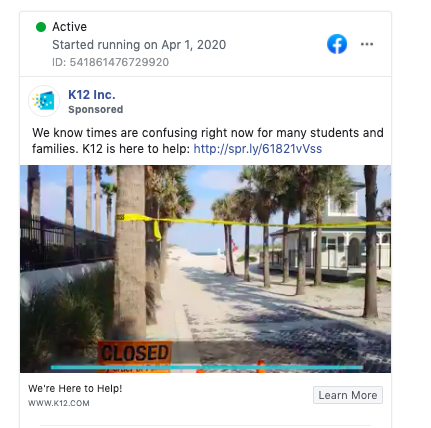
But some virtual charters have been running new ads encouraging sign-ups for their schools. On March 25, Century Cyber Charter School in Pennsylvania launched a new Facebook ad encouraging enrollment for this school year, and on March 30, the Virtual Learning Academy in New Hampshire started advertising, emphasizing that “there is NO admissions process [and] students can enroll anytime.” K12 Inc. has also been running new ads for fall enrollment.

“I haven’t seen a surge, but I’m pretty sure it’s coming,” said Sutherland, whose Oregon Virtual Academy is a K12 Inc. affiliate. “I think a lot of people will want to make a move to where their student can continue without disruption.”

Virtual charter leaders, for their part, are saying they want to use this opportunity to share what they know with brick-and-mortar schools and in no way profit off COVID-19. Many are offering free training and webinars to brick-and-mortar educators and complimentary access to their digital learning tools.

The lines can get blurry, though. One K12 Inc. ad, which launched April 1 and ran for several days last week, linked to a page with both free educational resources and steps to enroll in virtual charters. “We know times are confusing right now for many students and families. K12 is here to help,” the ad says, illustrated with a video montage about coronavirus school closures.

Last week, Sanchez-Reyes co-hosted a webinar advising Indiana charter colleagues on virtual compliance with special education laws, and this week she’s hosting another one on social and emotional learning.

“Most of us came from brick-and-mortars ourselves,” she said, “so it’s been nice to collaborate.”

Liberty University is resisting pressure from students to refund room and board costs during the coronavirus crisis

Originally published in Business Insider on March 27, 2020.
—–

Earlier this week, Jerry Falwell Jr., the president of Liberty University, announced that students would be welcome to return back to campus after spring break, despite the worsening COVID-19 pandemic. Classes will be held online, but academic and residential buildings are open.

“Our thinking was, ‘Let’s get them back as soon as we can—the ones who want to come back,” he said in a statement on Monday. About 1,700 students were on the Lynchburg, Virginia campus by Wednesday, according to a spokesperson.

Falwell’s move sparked immediate backlash from state and local officials, including Virginia Governor Ralph Northam, who has limited public and private gatherings in his state to ten people, and Lynchburg Mayor Treney Tweedy, who called the decision “reckless.”

Liberty University, a private evangelical college, is one of the largest Christian colleges in the world. More than 15,000 students are enrolled at its Lynchburg campus, with an additional 94,000 students enrolled virtually across the country.

Many observers, including Liberty University students, have argued that Falwell’s latest decision is politically motivated, as he’s long been one of President Trump’s most ardent and high-profile supporters. Two weeks ago Falwell went on “Fox and Friends” to suggest the media’s focus on the pandemic was just a new tactic to bring down the president. Earlier this week Trump made it clear he’d like to see America’s economy back up and running by Easter, in mid-April.

Yet recent statements from Falwell and other university officials suggest the decision might be less about standing in solidarity with Trump and more about protecting the university’s cash flow.

Across the country as colleges and universities have closed in response to COVID-19 and required students to go home, families have been calling for meal plan and housing refunds. While most higher-education institutions have signaled they won’t be refunding tuition since they’re still offering online instruction, many have said they will move to refund room and board where possible.

But so far, despite pleas from Liberty University families, Liberty has bucked pressure to offer any direct refunds.

On Sunday the school released a statement saying “there is no obligation to generally offer pro-rated refunds for unused room and board.” The university added that while officials are considering if and how Liberty could financially assist students, “many operational costs for the university do not decrease with fewer students on campus.” (On Friday this statement was taken down.)

Over the last week on a Facebook page for Liberty University parents, many have argued that Falwell’s latest move to open residential halls was designed to make it easier to reject calls to refund families the cost of room and board. They pointed to a campus-wide email sent on March 17, during Spring Break, by Liberty’s office of residential life. “While students are currently allowed to return to live in the residence halls, we are encouraging you to consider staying home,” the email said. However three days later, as The Daily Beast reported, the office sent a new email that said: “[T]he intent of encouraging students to consider remaining at home was to simply advise students to think carefully about their choice and discuss the matter with their parents. It was not an endorsement or recommendation of that particular course of action.”

“It seems as if they are leaving the loophole of ‘allowing’ students to come back just to be able to not give refunds saying that you ‘elected’ to stay home,” wrote Debbie Turkington Schoeffler, a Liberty University parent, on the Facebook page. “Saying ‘we’re open so it’s your choice’ to come back or not as a way to keep from refunding room and board fees is truly awful,” Kaysie Durden Routh added.

“We, as Christ followers, are to be examples of His love, generosity and compassion,” Melissa Burkholder commented. “In my opinion, this is horrible that the university stands to profit on this as they will have far fewer mouths to feed, rooms to heat/cool, perhaps lower labor costs all because of something that was not the fault of these students. LU, with its endowments and other funding received can stand to shoulder the burden of this far easier than many of the families.”

On Wednesday a verified Liberty University Facebook moderator responded to some of the concerns raised by parents, saying that, “LU is still considering things.” By Friday morning, the school announced it would give just a $1,000 credit toward the fall semester, and nothing to students who choose not to return in the fall. Housing and dining plans range between $8,700 and $12,450, according to the university website.

“I was not trying to be rude or start drama on the page it is just lots of families are asking about it and we were told they are just not giving any refunds,” Schoeffler, the mother of a Liberty freshman, told Business Insider. “These kids pay thousands and thousands of dollars to go to [L]iberty and a big chunk of that is room and Board which they are not even able to use for the last two months.” Routh and Burkholder did not return requests for comment.

Students mounting protest

Students on campus also have been organizing for refunds. Liberty student Nathan Todd launched a Change.org petition five days ago calling for a fall semester credit, like the one Liberty just agreed to, but also for a refund for those who do not return in the fall. Calum Best, a member of the Liberty University student government, posted the petition on his Facebook page and urged his college to “make the responsible, caring move and provide refunds to affected students.”

Liberty spokesman Scott Lamb did not comment on the concern that residential halls may be open so the university could more easily deny families refunds. A spokesperson for the university’s Student Service Center also did not respond to Business Insider.

In a statement released on Wednesday, Liberty said, “Our students are part of the Lynchburg community! They work jobs, have apartments, make economic contributions and pay taxes. That they should be banned or discouraged from choosing to utilize the shelter and food sources that they paid for in a time of crisis is unthinkable.” And on Monday Falwell told the Richmond Times-Dispatch that he believes “we have a responsibility to our students—who paid to be here, who want to be here, who love it here—to give them the ability to be with their friends, to continue their studies, enjoy the room and board they’ve already paid for.”

Robert Kelchen, a professor of higher education finance at Seton Hall University, told Business Insider that in general, colleges “with more money, more resources, will be able to offer refunds quickly.” Less wealthy private colleges and many public colleges may take longer to come up with the funds, or they may have to get approval from a governing board.

But all universities, he said, are trying to determine how to get through this crisis in the best financial position possible. “Colleges are concerned that even if things open back up as scheduled next year, will students want to go? Will they want to stay close to home?”

Falwell’s public comments suggest these concerns have influenced his decision to welcome students back to campus now. “We think Liberty’s practices will become the model for all colleges to follow in the fall if coronavirus is still an issue,” he said.

To Develop A COVID-19 Vaccine, Pharma And The Federal Government Will Have To Break Old Patterns

Originally published in The Intercept on March 27, 2020. Story was produced in partnership with the Open Markets Reporting Fund.
—–

IN 2016, AFTER years of effort and millions of dollars in government investment, a team of Texas scientists finally developed a promising vaccine for SARS, the deadly strain of coronavirus that had infected over 8,000 people worldwide in the early 2000s. But the outbreak that triggered the research had begun and ended, and no one was contracting new cases of the disease anymore. Private industry and governments responded to the request to fund the human clinical trials with unanimity: not interested. And so the SARS vaccine was shelved. “If investments had been made previously, we potentially could have a [coronavirus] vaccine ready to go now,” lead scientist Dr. Peter Hotez told Congress earlier this month.

Scientists are now racing to develop a vaccine for Covid-19, the strain of coronavirus that has quickly upended the world. At least a dozen companies have joined the effort, from multinational giants like GlaxoSmithKline, Sanofi, and Johnson & Johnson, to smaller biotech firms like Inovio and Moderna. The latter became the first to give its working vaccine to a healthy adult last week, entering clinical trials with unprecedented speed. The public discourse has revolved mainly around how soon a vaccine could feasibly be ready (at least 18 months) and how much it would cost (unclear).

But if and when a vaccine candidate does get approval from the Food and Drug Administration — or even multiple get approved — then what? Will distributing a vaccine resemble the embarrassing efforts to distribute coronavirus tests? Does the government even have the capacity to manufacture a vaccine as quickly and widely as needed? Sen. Mitt Romney, R-Utah, asked this question in a coronavirus hearing on March 3, and the answers weren’t encouraging.

Dr. Robert Kadlec, the Health and Human Services assistant secretary for preparedness and response, testified that the U.S. lacks the capacity for manufacturing the kinds of Covid-19 vaccines the federal government is currently pursuing. “We’d have a longer than a six-month wait to basically produce vaccines on scale,” he told Romney.

Dr. Anthony Fauci, director of the National Institute of Allergy and Infectious Diseases added that it will essentially come down to the pharmaceutical companies. “The federal government is not going to be able to make hundreds of millions of doses,” he said.

IN SOME WAYS, we’ve been here before.

In October 2004, as Americans began gearing up for flu season, Britain announced that it would be suspending the license for Chiron Corporation, one of just two flu vaccine manufacturers for the United States. British regulators had found bacterial contamination in Chiron’s Liverpool factory, just as the U.S. had been waiting for it to ship 48 million doses over the Atlantic. In one fell swoop, America’s vaccine supply was cut nearly in half. Policymakers were left scrambling, but there was little they could do. The director of the Centers for Disease Control and Prevention apologized and said the scarce supply would be prioritized for those who were at a particularly high risk of getting sick.

What came next was vaccine price gouging, long waiting lines for the elderly and chronically ill, and threats by the government to jail or fine doctors who vaccinated those deemed not high-risk. Federal prosecutors launched an investigation into Chiron, and the shortage became a late-stage crisis for George W. Bush on the campaign trail.

Relying on just two companies to produce the seasonal flu vaccine had left the U.S particularly vulnerable. (Britain, by contrast, used five different suppliers.) And despite warnings for years about the dwindling number of U.S vaccine manufacturers, the federal government had done little to intervene. According to a report released by the Institute of Medicine, in 1973, 25 companies produced vaccines for the U.S, but three decades later just five remained. It was a classic market failure: Many drug companies had decided that vaccines were not profitable enough — they were too costly to develop and too underpriced to sell.

Following the colossal 2004 shortage and pressure resulting from SARS, the federal government vowed to take action. In December 2004, Congress approved $99 million for flu vaccine production and in 2005, Congress passed a law to provide vaccine manufacturers with immunity from tort lawsuits. By 2006, Congress passed the Pandemic and All Hazards Preparedness Act, which created the new assistant secretary for preparedness and response in HHS, the same role Kadlec has today. It also established the Biomedical Advanced Research Development Authority, which works with industry to develop so-called medical countermeasures against public health and bioterrorism threats.

“The Bush-era initiatives to improve vaccine availability and medical surge capacity domestically were good starts but underfunded, as are most public health initiatives,” said Dr. Adva Gadoth, an epidemiologist at UCLA Fielding School of Public Health.

The weaknesses were evident by 2009, the next time the U.S. grappled with an embarrassing vaccine shortage. H1N1 — also known as swine flu — emerged that spring in Mexico, and the U.S government promised a vaccine would be ready by October to blunt a second wave of infections.

But when October rolled around, U.S. health leaders were only then waking up to the fact that their expected supply was not on schedule to arrive. CDC officials hadn’t realized vaccine yields were lower than expected, because the tests used to measure those yields had also been delayed. The new machines that manufacturers installed to put the H1N1 vaccines into vials also ended up being glitchy, which caused more bottlenecks.

The rollout was complicated further by the fact that patients were asked to get both the H1N1 flu vaccine, on top of their seasonal flu vaccine, which weren’t ready at the same time. And when it became clear that the H1N1 shipments would be delayed, manufacturers halted producing the seasonal vaccine to help ramp up H1N1 production.

“Having two flu vaccines to receive was confusing enough to patients — usually there’s only one cocktail vaccine delivered per season — and staggered timing in their availability made things worse,” said Gadoth. “We ended up with a lot of lopsided protection: Those who visited their doctors early in the season and couldn’t return were only protected against seasonal flu, and those who visited once the H1N1 vaccine became available could no longer access the seasonal flu vaccine.”

One of the major lessons of the H1N1 shortage, says Dr. William Schaffner, a professor of preventive medicine and infectious diseases at Vanderbilt’s School of Medicine, is to under-promise and over-deliver. “When the first batches of vaccine finally came off the line, the public health community was trying to communicate who should get it and where to go, but that message was completely drowned out because all the media focused on was that the vaccine was late,” he said. “It undercut the whole introduction and confidence in the government response.”

In August 2010, prompted by the vaccine problems from H1N1, President Barack Obama’s team of science advisers released a report outlining ways the government could speed up production in the future. This had come a year after Sen. Susan Collins, R-Maine, successfully stripped $870 million in flu pandemic preparation money out of the 2009 stimulus. The administration recommended spending roughly $1 billion per year for the next several years to implement its ideas, which included developing faster potency tests and better machines to do vial-filling. This joined a separate 2010 HHS review, which had concluded that the U.S. “lacks the domestic manufacturing capacity to rapidly produce and package a vaccine for the American public in the face of a pandemic.”

But many of those Obama-era proposals were never fully executed, and four new vaccine manufacturing sites the federal government did invest in beginning in 2012 have barely been utilized to respond to Covid-19. The Washington Post reported recently that two of the four sites are currently taking no role in developing a vaccine, and the other two only have plans to conduct “small-scale” testing.

The U.S. government has been relatively successful though in attracting more private vaccine manufacturers, through a combination of financial incentives and accelerated pathways to approval. “We tried to entice manufacturers who might have additional capacity that were manufacturing for other parts of the world, and we tried to make it easier for them to get FDA approval,” said Jesse Goodman, who served as FDA’s chief scientist between 2009 and 2014 and led the Obama administration’s H1N1 response.

In 2005, only three of the top 10 pharmaceutical companies had significant investments in vaccines. But by 2012, that was up to eight out of 10, including players like Pfizer and Johnson & Johnson. Companies began realizing they could bring more expensive vaccines to market faster.

Dr. Ken Kaitlin, director of the Tufts Center for the Study of Drug Development, said the increase in companies focused on vaccines was partly driven by the growth of immuno-oncology drugs, which target a patient’s immune system to fight cancer. “Those drugs stimulated broader interest among firms in the immune system, and scientists realized there were other diseases they could focus on using similar techniques,” he said. The Human Genome Project, which was finished in 2003, also spurred new interest. “That increased our understanding of disease and allowed scientists to search for vaccines in areas that previously seemed intractable,” Kaitlin said.

Yet more pharmaceutical companies being interested in vaccines is no guarantee that a Covid-19 vaccine would be affordable, as vaccine prices have soared over the years. While Democratic politicians are sounding the alarm, saying that any coronavirus vaccine should be free or very affordable, pharmaceutical execs have already been questioning that.

“Nobody is going to embark as a large company if there is not a certain return that you can get for your investment and the risks you have been taking,” said David Loew, an executive vice president at Sanofi, in an interview with Financial Times last week.

And given how little we currently know about Covid-19, if the outbreak peaks and panic wanes, investors and the government could lose interest in funding further stages of Covid-19 clinical trials, just as they did for SARS in 2016.

“We’re still very, very reactive when it comes to what we pour research dollars into and sustain,” said Dr. Jason Schwartz, a professor at the Yale School of Public Health who studies vaccine development. “When the immediate need dissipates, those research efforts can drop off quickly.”

ASSUMING THAT COVID-19 continues to spread, research dollars don’t disappear, and a vaccine or two or three is eventually approved, there are some things we can expect now about how that delivery process will play out.

One is that no matter how many pharmaceutical companies work to produce the coronavirus vaccine, and even if the federal government’s four manufacturing sites do end up assisting with production, there simply will not be as many doses as needed in the beginning. The vaccine will come in waves, in a series of shipments.

“Leaders will have to decide who gets it first, and where to send it, and whoever does that should do it very transparently,” said Schaffner.

While the federal government will likely set broad guidelines and principles, each state will be tasked with designing their own vaccine distribution system, a process spearheaded by the directors of immunization who work in each state’s health department.

Dr. Kelly Moore was working as Tennessee’s director of immunization during the H1N1 outbreak, a role she was particularly well suited for after having served for years as her state’s pandemic influenza planning coordinator.

The first step for vaccine distribution in an emergency, Moore said, is figuring out which medical providers will give it — including who wants to give it and who has clinics equipped to store it.

“Any vaccine that comes out for Covid-19 I anticipate will be distributed through existing federal vaccine distribution channels, namely the Vaccines for Children program,” Moore said. The Vaccines for Children program, administered by every state, provides federally funded vaccines to volunteer clinics to give to basically any child who doesn’t have private health insurance. “In an emergency we’d much rather build off what already exists than create something from scratch, and all states already manage partnerships with private clinics, health departments, and hospitals to give vaccines to children, so they’re already used to the ordering and the distribution,” she explained.

Each provider that participates in VFC typically orders vaccine doses through an online portal managed by their state, and Moore said it would not be difficult to add coronavirus vaccines to those portals.

But since right now only clinics that serve children are part of the VFC system, each state would need to enroll more adult providers and pharmacies that might be able to help administer coronavirus vaccines. In 2009, Moore had invited interested H1N1 vaccine providers to sign up on Tennessee’s online registry and also made separate distribution arrangements with big pharmacy chains like CVS and Walgreens.

Back then, using pharmacies to administer vaccines was relatively uncommon, and most people still went to their doctors’ office or state health department to get vaccinated. “But our experience of working with pharmacies was so great, and we realized how valuable it is for people to just be able to walk in without making an appointment,” said Moore.

In the decade since, most states have passed new laws to make it easier for pharmacies to administer vaccines — something physician groups had long fought for territorial reasons. “We have more than 360,000 pharmacists who have completed training in vaccinations and immunizations across the lifespan and are ready to help when a coronavirus vaccine becomes available,” said Mitch Rothholz, chief strategy officer from the American Pharmacists Association.

From an access point, pharmacies will surely play an important role in distributing any Covid-19 vaccine. Nearly 95 percent of the U.S. population lives within 5 miles of a pharmacy, and many people feel more comfortable walking into one than setting up a doctor’s appointment.

Some states may also opt for a more centralized vaccine distribution system compared to what was used in Tennessee. In 2009, for example, Rhode Island set up H1N1 clinics at every public school, and Chicago had mass clinics at its six city colleges. Dr. Bruce Y. Lee, a professor of health policy and management at the City University of New York who has studied vaccine supply chains said some states may decide that they need bigger channels to get the vaccine out, like churches or Central Park. “You can start preparing now,” said Lee. “You know where the population is and that some people will vary significantly in terms of how reachable they are.”

Immunization program managers began talking about these state distribution plans on a conference call last week, according to Claire Hannan, executive director of the Association of Immunization Managers. “We’re encouraging them to start looking into this, to determine what their coronavirus tracking system will look like, and to begin reaching out to providers who will help administer the vaccine.”

EARLIER THIS MONTH, reports emerged that President Donald Trump had offered a Germany-based biopharmaceutical company money to secure a Covid-19 vaccine that would be exclusively for the United States. The U.S denied the reports, but senior German government officials confirmed them and stressed that any vaccine would be for the entire world, not for individual countries.

While the U.S. does have some domestic manufacturers, most giant pharmaceutical companies — with the real muscular production capacity — are multinational. “If we need a large-scale rollout, how are those initial hundreds of thousands or millions of doses distributed?” asked Schwartz.

Past history doesn’t lend the most encouraging examples of equity, as rich countries have dominated the marketplace and most countries have prioritized national sovereignty over international fairness. In 2009, developed countries placed large advance orders on H1N1 vaccines and purchased nearly all the doses companies could produce, leaving low-income countries, including Mexico, in the lurch. Under pressure, a group of at least nine countries offered to donate a percentage of their H1N1 doses to poorer nations, but some then backtracked when faced with unexpected shortages. The U.S., for example, pledged in September 2009 to donate 10 percent of its 195 million doses, but about five weeks later said it would wait until all at-risk Americans had access first.

“Pandemics really call for global health solidarity, to determine where the outbreak is most active, and where those vaccine doses can do the most good and prevent the most suffering,” said Schwartz. “But it could be every country for itself.”