Learning from History: The Prospects for School Desegregation

Originally published in The American Prospect on May 10th, 2016.
—-

In a new book, Making the Unequal Metropolis: School Desegregation and Its Limits, Teachers College, Columbia University historian Ansley Erickson explores the legal and political battles surrounding the desegregation of public schools in Nashville. By 1990, almost no school within Nashville’s metropolitan school district had high concentrations of black or white students—making it one of the most successful examples of desegregation in the 20th century. However, since being released from court-ordered busing in the mid-1990s, schools have quickly resegregated, concentrations of poverty have intensified, and academic scores for black students in Nashville have suffered.

Erickson shows that desegregation was not all rainbows and butterflies, and it often created new challenges that families were forced to wrestle with. She also shows how school segregation had been no accident. Rather, it was a result of deliberate choices made by politicians, parents, real estate developers, urban planners, and school administrators—ranging from funneling subsidies to build schools in suburban areas, to privileging white families when making zoning and student assignment decisions.

And yet for all the challenges that desegregation entailed, Erickson also lets us hear the voices and positive experiences of students who went through desegregation—voices that were routinely ignored during the heated debates of the 20th century.

The point of recognizing the flaws within one of desegregation’s best-case scenarios is not, she says, to conclude that it’s ultimately a fruitless project. Rather, it serves as a guide for those who might want to figure out how to start anew. What follows is an edited transcript of our conversation.
——

Rachel Cohen: Your book makes the point that while desegregation challenged some inequalities, it also “remade” inequality in new forms. Are all inequalities equal, so to speak? Can we evaluate the challenges and still decide whether the needle moved overall in one direction or another in terms of progress?

Ansley Erickson: I think that desegregation absolutely was necessary, and I think that busing for desegregation was, in sum, a positive—and in some ways ambitious—effort to counteract persistent segregation. We can recognize that even as we notice desegregation’s limits and problems. I say this not only because of the stories that students who experienced desegregation tell, and not only because of the positive test score impact. It’s also because busing made segregation a problem within local political landscapes and put questions about historic inequality in front of people to grapple with.

RC: In the conclusion of your book you say that desegregation, mandated by a Supreme Court that recognized schooling’s crucial function in our democracy, has rarely been shaped by, or measured for, its potential impact on the making of democratic citizens. If it were to be, what could that look like?

AE: In Carla Shedd’s new book, Unequal City, she explores how students who attend segregated schools versus more diverse ones perceive inequality. She finds that those in more highly segregated schools have a less developed sense of inequality—they are less informed about it because they have less to compare their own experience to.

Schools are not just about whether you can read or calculate; they are about how robustly you perceive the world around you. Even if you go to high-performing schools, segregated white or segregated black schools, it can still be difficult for kids to understand the world they inhabit. They need to have some understanding of their community, and not just their immediate community, but in the broader sense. Work like Shedd’s points to how segregation can get in the way of that understanding.

Today, economic goals and justifications for schooling seem to be valued over all others. Nashville has invested very heavily in career and technical education. Its big comprehensive high schools have been redesigned as career academies, targeting jobs like being a pharmacist or working in hospitality. The goal is to help prepare kids for jobs, to sustain local businesses. At the same time, Nashville is a place that doesn’t have a local living wage, has a skyrocketing cost of living, an affordable housing crisis. Schools are clearly focused on helping to make students workers. But what is their responsibility in making citizens who can address big and pressing questions, including about the economy and about work? What’s a reasonable and just compensation for a person’s labor? What are workers’ basic rights? To me, helping kids be ready to participate in those debates matters just as much as helping students earn a certification in a certain vocational skill area.

RC: You wrote a lot about how “growth agendas” helped fuel inequality and new kinds of segregation. Can you talk a little bit about what that means and how it worked?

AE: This question connects to the themes we were just discussing. History can help bring some nuance to today’s often oversimplified rhetoric about how education and economic growth relate. It’s been popular recently to talk about schools as providing skills that leverage economic growth. But links between education and economic growth have worked in other ways, too.

In Nashville, in the name of economic growth, big urban renewal and public housing construction projects sharpened segregation in housing and in schooling. In the name of increasing property values, suburban developers appealed for segregated schooling by class as well as by race. And in the name of economic growth, schools focused on vocational education—often furthering segregation inside schools even as buses transported students for desegregation.

RC: While combining city and suburbs into one school district is not without its challenges—the dilution of black voting power was one you explored in the context of Nashville—do you think the benefits outweigh the costs?

AE: Nashville would not have had extensive statistical desegregation without consolidation. Nashville was highly residentially segregated and the old city boundary was quite small, like many U.S. cities. By the time busing began, the people living in the old city boundary were predominately African American. Had desegregation taken place only within the old city boundaries, the district would have had a much less diverse pool of students to draw on and a less diversified tax base. Having a consolidated city-county school district didn’t prevent “white flight,” but it did slow it and make it more onerous. But consolidation did not ensure equal treatment for all parts of the metropolis, either.

RC: In your book you show how back in Nashville in the ‘60s and ‘70s, some black communities felt as if advocacy for integration suggested that students of color are inferior and need to be around white kids in order to succeed. We see similar concerns today. Integration carries many important social and civic benefits for all students, but in modern education policy discussions the impact on student test scores gets the most attention—and that significant positive impact is by and large just for students of color. Though the test score gains are huge, could a narrow focus on student achievement dilute political support for integration?

AE: I think about this a lot, as I consider how history might inform today’s nascent conversation about segregation and desegregation. Other scholars have shown striking test-score improvements from desegregation. But if your ultimate goal is test score parity, then there will always be multiple ways to get there. If the goal is also preparing citizens for a diverse democracy, it’s harder for me to see how that happens without some measure of desegregation.

RC: You note that when it came to busing, residents decried state intervention as government overreach, an illegal intrusion into their private lives. But when it comes to the state playing a heavy role in facilitating economic growth, they welcomed the government’s help. Did you find there were people back in Nashville who were pointing out this contradiction?

AE: I didn’t find anyone who was pointing it out then. Then, as now, many people did not perceive how government action was shaping their lives, especially white suburbanites’ lives, in ways that benefited them but that they did not see. People wanted to draw sharp boundaries between what was public and private. White homeowners in particular liked to talk about their housing decisions as private choices they made within a free market. What they didn’t recognize was how enabled they were by their government-backed mortgage, their low-gas-tax subsidized commutes on new highways. Public policy supported what they wanted to cast as a private choice. When asked to recognize the segregation in their cities and schools, they wanted to call it “de facto segregation”—as if it had roots only in private action. But in fact, many layers of state action and policy were involved as well. There wasn’t a coherent small-government conservatism then. Like today, the question is what people thought government power should be used for.

RC: You explored school closures and the loss of black teaching jobs as a result of desegregation. Today we see similar trends, with schools closings, charter school expansions, and the increase in non-union jobs targeted to a whiter, and shorter-term teaching force. What, if any, historical lessons can we glean?

AE: There’s a lot of good scholarship on the history of desegregation and job loss—particularly by Michael Fultz and Adam Fairclough. I didn’t make that a huge focus in my book, but there is an important broader question here about how we think about education. Schools often account for around half of municipal budgets; they are huge municipal expenditures, and they do represent a big source of employment. Historically this employment has been an important step towards middle class existence for lots of American communities. Women of Irish, Italian, Jewish descent moved into the middle class by becoming schoolteachers in the early- and mid-20th century. Similarly, African American educators have attained, or preserved, middle class status through education jobs for a long time. Somehow we have been unable to find a way to talk about the teaching profession recognizing that it is both labor and employment that matters for communities and a crucial factor in students’ lives.

Teachers Look to Unionize at Another New Orleans Charter School

Originally published in The American Prospect on April 26, 2016.
—-

Earlier this month, teachers at Lusher Charter School, an arts-based K-12 school in New Orleans, went public with their intent to unionize. Sixty percent of teachers, teacher assistants, and other Lusher staff signed a petition in support, but over the weekend the Lusher board voted 6–5 against recognizing their union. Now the teachers will ask the National Labor Relations Board to hold an election.

If the teachers prevail, Lusher would become the third charter school to unionize in New Orleans, the city with the highest density of charter schools in the country. The first two—Benjamin Franklin High School and Morris Jeff Community School—formed their unions last year. Ben Franklin staff signed the first collective-bargaining agreement for New Orleans teachers since Hurricane Katrina.

Lusher teachers began organizing in secret about a year ago. They waited until they had a majority of teachers in support before they went public, they explain, because they worried they’d lose their jobs or face other negative consequences unless most of the teaching staff was with them.

“I’ve been in a union pretty much all my career and I think it’s a great way to give voice to teachers, and a great asset to a school,” says Julie Sanders, a Lusher social science teacher. This is Sanders’s second year at Lusher, and her 17th year teaching in Louisiana public schools.

Since going public, Lusher teachers have been working to explain to parents and community members why they feel a union is right for them. Some parents wondered if collective bargaining would disrupt Lusher’s unique school culture, or if students’ educations would somehow be harmed. Unionized educators at Ben Franklin and Morris Jeff have also been helping to assuage the concerns of Lusher parents by telling them what having a union has meant for their schools.

Michael Masterson, a teacher who serves as a union representative at Ben Franklin, attended a Lusher community meeting last week to share his experience. “When someone says there are teachers who may have been tricked into agreeing to a union, or someone else says this is going to hurt kids,” Masterson says, “I can raise my hand and say, well, at Ben Franklin we also had people who were really worried about unionizing and it’s turned out okay, the kids are fine, our fundraising is actually up, our applications are steady, nothing bad has happened, and things have been calm.”

Indeed, U.S. News and World Report recently ranked Ben Franklin as the 53rd-best public high school in the United States, and the nation’s 15th-best charter. Ben Franklin’s rankings actually went up 27 spots over the past year.

Lusher is also considered one of the best schools in the state, and Morris Jeff has received national recognition for its approach to creating a diverse student body. This has led some people to wonder why it’s New Orleans’s top schools that are opting to unionize, not others.

Peter Cook, a vocal education reformer based in New Orleans, wrote that it is “apparent that the AFT and its state and local affiliates have been quietly lurking on the sidelines looking for opportunities to eat the city’s charter schools, presumably in an effort to eat away at the city’s reforms from the inside out.” Noting that the American Federation of Teachers has invested nearly half a million dollars into New Orleans charter organizing over the past year, Cook wrote that “we shouldn’t fool ourselves into thinking” the union wouldn’t ruin all the progress reformers have achieved “if we gave them the opportunity to do so.”

Randi Weingarten, the president of the AFT, said in a statement to The American Prospect that the AFT is excited that three New Orleans charter schools “have formed unions and want contracts that give them a voice on the job, resources for their students and treat them fairly.” The AFT currently represents 225 charter schools in 15 states, and Weingarten says “we’re working with educators at other charters in the Crescent City and across the country who want a voice at their school.”

Masterson told the Prospect that “there are definitely other schools” in New Orleans that are organizing unions, but none of them are public yet.

When asked why they think it’s been the more elite, high-performing charter schools that have unionized in New Orleans, both Masterson and Sanders say they believe the stability at their schools plays a significant role.

“Schools with teachers that are stable with their employment are going to be the first to unionize,” says Masterson. “It’s not that the elite schools get to have a union and others don’t. It’s that stability is absolutely key to getting a majority, and having people feel comfortable to come together and not be scared.”

Schools with high teacher turnover—a condition that describes many New Orleans charter schools—can be difficult places to organize unions. “If teachers start having conversations with each other about unionizing, but the next year half the teachers are gone, then that process breaks down more easily,” Masterson says. Other charters, he adds, might be filled with teachers who are not necessarily looking to stay in the profession beyond a couple years, which can make it harder to motivate people to go through the unionization process.

Sanders notes that Lusher has far less turnover year to year than some other charters in New Orleans. She points to Richard Ingersoll, a University of Pennsylvania education researcher who has found that one of the main factors influencing whether teachers stay at or leave a school is how much voice they have in making decisions that affect their job. Increasing teacher voice, job security, and transparency, Sanders believes, will help to keep her school stable and strong.

“We’re trying to be proactive here; the union doesn’t come out of anger or spite,” she explains. “This is just teachers coming to together saying, ‘What would it take to attract and retain the best people?’”

Why DeRay Mckesson’s Mayoral Candidacy Will Be Defined Far More By Education than Policing

Originally published in Slate on February 12th, 2016.
—–

N
ews of mayoral runs usually don’t merit the attention that Black Lives Matter activist DeRay Mckesson got when he announced his candidacy for Baltimore’s top job last week. His campaign had leaked the story to the Washington Post, the New York Times, and the Guardian in advance, and within 24 hours, he had already crowd-funded $40,000.

National publications began speculating how Mckesson’s candidacy would elevate police reform onto Baltimore’s political agenda, the implication being that it wasn’t already a top priority in the race. It absolutely is: Nearly 10 months after the death of 25-year-old Freddie Gray in police custody, and after one of the most crime-ridden years Baltimore’s seen in decades, few topics are more prominent. So what, exactly, will Mckesson bring to the election?

Mckesson joins 12 other Democrats competing in April’s primary, the winner of which will almost certainly go on to win in November. But though Mckesson’s large Twitter following may be eager to see how he’ll carry his national Black Lives Matter work into Charm City, I suspect they’ll be in for a surprise. What’s going to distinguish Mckesson probably won’t be policing and criminal justice at all—it’ll be education.

Nationally, school reform is an issue that confounds political partisans, opening fault lines among progressive allies and uniting constituencies that typically never agree. Reform is even more complicated in Baltimore; the city stands as a distinctively unusual landscape for education politics next to other, similar urban centers.

Already, Mckesson has signaled that he plans to campaign on education, which isn’t surprising since that’s where the 30-year-old cut his professional teeth. After graduating college, he spent two years teaching sixth graders in Brooklyn followed by several stints with education nonprofits, reform organizations, and administrative district jobs. But Mckesson brings to the race some national baggage, which he’ll have to confront as he tries to make his case to Baltimore voters. Specifically, residents have already raised questions about his ties to national reform groups like TNTP and Teach for America, as well as his enthusiastic support for charter schools.

So far, Mckesson has largely dismissed these concerns. He’s reminded the public that he’s spent several years working with the Baltimore school district as an administrator focused on staffing personnel. Still, he’ll have to reckon with local education politics that have changed substantially since he left his job back in 2013.

For example, a few months ago a coalition of charter operators filed a lawsuit against the school district over funding—a highly controversial move that’s divided Baltimore public school families. The city is also in the midst of closing down more than two-dozen schools, and the next mayor will need to determine what becomes of the vacant buildings. Will they be sold off? Will they be leased to charter schools? Will they be repurposed into some other civic entity? These decisions are sure to intensify an already-fraught K-12 landscape.

The main thing to grasp about Baltimore’s education environment is that it’s pretty unique. All charter teachers are unionized, unlike most charter employees in other states. Moreover, Maryland charter schools—which are predominately mom-and-pop institutions, not larger charter-school chains—are subject to more oversight and regulation than charters elsewhere. While reformers say they’d like to see Maryland charters freed from these legal constraints, supporters of the status quo say that tougher oversight explains why Maryland charter schools have never wrought the kind of fraud, mismanagement, and abuse found in other jurisdictions.

What Mckesson will soon have to decide is whether he is committed to keeping Baltimore’s charter sector as is—with unionized teachers, a close relationship to the school district, and substantial oversight—or join the coalition of charter operators and national education reform groups that seek to significantly revamp chartering in Maryland. That decision may also force him to choose between competing groups that may try to back him. Some national charter networks have expressed disinterest in setting up shop in Baltimore, namely because they don’t want to work within the school district and employ unionized teachers. The National Alliance of Public Charter Schools, a D.C.-based organization, consistently ranks Maryland as the worst charter school state in the country, largely for these same reasons.

Yet within Baltimore, both traditional teachers and charter teachers alike strongly support Maryland’s charter law—and rallied together last year to protest reformers’ attempts to change it. The Center for Education Reform, another national group, hired lobbyists to push for loosening Maryland’s regulations. They were ultimately unsuccessful, but the fight is expected to resurface again soon.

On Friday, Mckesson released his education campaign platform—a substantive list of proposals ranging from expanding early childhood education to strengthening college and career readiness programs. He calls for increasing the school district’s transparency (a common theme among all the candidates) and more equitable state financing. He notably doesn’t mention anything about unions or charter schools, but Mckesson won’t be able to shy away from that charged debate for long.

When news broke that Mckesson would be running, some Baltimore activists, particularly those who have been fighting for police reform, protested on Twitter—a surprise to some outside the city, given his national stature within Black Lives Matter. Among other things, locals argue that Mckesson lacks sufficient relationships with the communities he now seeks to lead.

In many ways, their critiques mirror those that veteran public school educators level at Teach for America—that outside young teachers without roots in the cities they work in displace those who have more of a right, and need, to be there. And despite Mckesson’s early campaign efforts to brand himself as a “son of Baltimore,” some local activists have said they’ve rarely seen him fighting alongside them in the causes they’ve been invested in for years, like building independent black institutions and weakening the Maryland police union. (Mckesson defended himself against these charges, saying “there are many ways to engage in the work.”)

A few weeks ago, 11 Democratic candidates gathered together for a mayoral forum to discuss their political vision for Baltimore. One audience member asked the candidates, “How will you stop police from killing black people?” Answers varied somewhat, but all in all, they were broadly similar. The candidates spoke of strengthening civilian review boards, getting body cameras on all police, transforming the way Baltimore recruits and trains officers, establishing more transparent accountability systems, pushing for more police to formally live within the city, mandating cultural diversity training and regular psychiatric evaluations, and calling for convictions for those who break the rules.

In other words, Mckesson is entering a crowded field of candidates who likely share many of his police reform policy goals. Some hope that Mckesson’s candidacy will encourage others to articulate even sharper campaign proposals. Perhaps, and that would be a good thing. But it was already an issue that no candidate was really ignoring—and certainly one that no future mayor can expect to avoid.

So despite to Black Lives Matter’s national work, that aspect of his candidacy is unlikely to be too disruptive in the race. It’ll be where his campaign intersects with the school-reform movement, and specifically how local education politics rub up against his national ties, that could really shake things up.

Roots & Branches charter will remain open, but public school closures loom large

Originally published in Baltimore City Paper on February 3rd, 2016.
—-

Last night the Baltimore City school board voted to renew Roots & Branches charter school for another three years. It was a victory for the parents and teachersworking to save their progressive elementary, though many other local schools were not so lucky. In early January the school board voted to close four schools—Westside Elementary School, Baltimore Community High School, Maritime Industries Academy High School, and the Maryland Academy of Technology & Health Sciences, a charter school. These four, plus Roots & Branches School, another charter, were recommended for closure in early November.

“Every time you hit adversity you learn something, and I think we’re going to look at some of how we teach math across the board,” says Anne Rossi, the principal of Roots & Branches, which de-emphasizes testing in favor of an arts-infused curriculum. “I think we want to do some professional development, our math scores were not as good as our reading, but I am really optimistic that we are going to be able to show the district improved scores.”

The school closings come on the heels of a tumultuous year, both within the public school community and Baltimore City more broadly. Westside Elementary is located in Penn North, where the bulk of the Freddie Gray protests took place, and many felt shuttering a civic institution was the very last thing the beleaguered community needed.

“I will plead to you one more time please save Westside Elementary School,” state Del. Antonio Hayes asked the school board in November. “There [are] two major institutions in the Penn North community, that’s Westside Elementary School and a very thriving drug treatment center.” Students who would have enrolled at Westside will merge with students at another renovated school.

Alison Perkins-Cohen, the executive director of New Initiatives for Baltimore City Public Schools, says that when making decisions about school closures, the district thinks about which communities could most benefit from better facilities. “With Westside, I know the community was concerned about divestment, but for me it’s the opposite,” she says. “We’re really investing. Westside is closing because they’re getting a new school—we intentionally prioritized neighborhoods with challenges, so they are getting new buildings first.”

Nearly half of the city’s school buildings were built in the 1960s or earlier, and almost all require extensive repair, renovation, or replacement. According to industry standards, approximately 70 percent of the district’s buildings are considered to be in “poor” condition. And they were constructed at a time when the number of public school students enrolled in the district was much greater—upward of 200,000. Today, with roughly 85,000 public school students, there’s a lot of excess space. (Fewer students also means decreased funding, and the district has had some close calls with misreporting how many students are enrolled in the past.)

In 2010, the ACLU of Maryland published a report outlining the miserable state of Baltimore schools, citing things like damaged windows that don’t open, facility doors that don’t close, and badly lit hallways. “Depending on the season, teachers often struggle to engage drowsy children due to the excessive heat, and faulty boiler systems compel some children to wear coats during class in the winter,” the report stated. “Old lead plumbing has forced City Schools to restrict the use of water fountains and instead provide bottled water.” Decades of social science research has shown how unsafe and inadequate school facilities can negatively affect students’ academic performance—particularly when a school has poor temperature control, poor indoor air quality, and poor lighting.

Though advocates have been paying attention to the deteriorating school facilities for some time, inequitable state policy has made it difficult for leaders to take action. In 2004, the state reported that Baltimore had the greatest need among all Maryland school districts to bring its facilities up to acceptable levels of condition—yet legislators failed to target funding accordingly. Baltimore’s lack of wealth also inhibits it from borrowing money, while suburban districts can incur debt to fund capital improvement projects. So Baltimore not only has the greatest need, but also faces the most difficulty raising money. According to the ACLU, Baltimore’s capital budget “pales in comparison” to other large counties.

Following the report’s release, advocates who had been mobilizing for increased school funding—under the banner of the Baltimore Education Coalition—began to shift gears and focus more specifically on school facilities. The ACLU called for $2.8 billion to fund all the needed repairs and capital improvements. (It later revised this figure to $2.4 billion.) By spring 2011, the Baltimore Education Coalition formally joined the ACLU’s “Transform Baltimore: Build Schools, Build Neighborhoods” campaign, and together they pressured the city and state to pay for school improvements.

Baltimore, which is more dependent on state aid than any other district in Maryland, simply cannot fund enough capital improvements on its own. But state legislators worry about wasteful spending, and are loathe to invest in schools with too few students inside them.

“There is a statewide rule that says that any school building that is less than 60 percent occupied cannot receive state school renovation funds,” says Frank Patinella, an advocate with the ACLU’s Education Reform Project. “Some buildings might have broken boilers and inconsistent heat, but the state does not give money, no matter how poor the condition, if it is an underutilized building.” (“Underutilized” is the controversial term used to describe buildings that are deemed too large for the number of students enrolled. According to the district, Baltimore currently has a 79 percent school utilization rate—and its goal is to ultimately reach 86 percent, through school closures.)

“The state feels particularly strongly about the high number of Baltimore school buildings compared to student population and puts ongoing pressure on City Schools to close more and more buildings,” says Bebe Verdery, the director of the ACLU’s Education Reform Project. “I’ve never been to a hearing in Annapolis in which particular legislators did not rail against Baltimore City schools and the state agencies to require more closures faster.”

Perkins-Cohen says that in order to get state funding, the district had to develop a cohesive plan that indicated which schools would close, which would be renovated, and in what order.

Their efforts succeeded, and by 2013 the legislature passed the Baltimore City Public Schools Construction and Revitalization Act, which allows the state to leverage $1.1 billion in construction costs. This funding enables Baltimore to make headway on its “21st Century Plan“—a commitment to fully renovate or build roughly 50 schools, and to close 26 schools. The state, city, and school district have to each contribute $20 million annually over the next 30 years, though equity advocates say the state should be paying a greater share of these costs.

Many community members have raised concerns with the 21st Century Plan, and question the way it’s being implemented.

According to Jessica Shiller, an urban education professor at Towson University, some communities—like Penn North, Edmonson Village, and Hollins Market—will lose more than 40 percent of their classroom seats from the school closures. These communities all have poverty rates that exceed the citywide average.

“There needs to be an outcry, I take every opportunity I can in school board meetings to tell them they’re doing the wrong thing with these closures,” says Helen Atkinson, the executive director of the Teachers Democracy Project, a local group that engages teachers in public policy issues and social justice.

“One of the main things we find is that mobility is just bad for kids,” says Shiller, who has been doing independent research on school closures. “Moving kids around too much has a negative effect on their academic achievement, and closing a school exacerbates mobility, especially for poor kids.”

Another problem, Shiller notes, is that students often wind up in schools that are worse than the ones they left. Though the 21st Century Plan promises that all kids will attend superior, renovated schools eventually, observers note that children who used to attend the high-performing Langston Hughes Elementary School now attend worse schools, and the displaced students will be shuffled to yet another struggling school during the 2017-2018 school year. In addition, Shiller says kids frequently encounter bullying and violence at their new schools, and teachers are often ill-prepared to handle an influx of new students.

Perkins-Cohen says the district’s long-term plan is to provide professional development to teachers working in merger schools, and to focus on “creating cultures and climates” to help students transition more smoothly.

School closures have become a flashpoint in education reform debates across the country, evoking particularly heated opposition in cities like Newark, Philadelphia, and Chicago. Last year, parents in Chicago led a 34-day hunger strike to save a local high school that was slated for closure. Parents and community organizations have also filed federal civil rights complaints under Title VI of the Civil Rights Act of 1964, claiming that school closures in various cities have had a racially discriminatory impact on poor, black students. In December, the Office for Civil Rights at the U.S. Department of Education reached a groundbreaking resolution with Newark Public Schools to help those who may have been negatively impacted by Newark’s closures.

But school closings in Baltimore have not garnered the same kind of mobilized opposition.

Perkins-Cohen says she thinks the politics have played out differently in Baltimore because the district has worked really hard to engage the communities in a thoughtful way. The district’s comprehensive strategy, she says, involves publicizing the 21st Century Plan, making annual school closure announcements several months before the school board votes, organizing robocalls to parents, sending letters home, running ads in newspapers, holding meetings with both teachers and the community, and speaking at school board meetings.

Shiller says her research suggests the public is nowhere near as informed as the district thinks. “While the city did do public forums, they really glossed over this closure information. They said you know we’ll get you wireless internet and air conditioning, and we have to make sure that every school is fully utilized. But the way it was told was to really de-emphasize the closures,” she says. “When I did research it was very clear that it wasn’t communicated very well.”

As of now, it’s unclear what will become of the school buildings that get shut down.

When the district closes down a school, the buildings then return to the city, which owns them. Perkins-Cohen says the city is already thinking about uses for the buildings, in part by asking various city agencies if they might have an interest in the facilities. Sometimes charter operators try to use the newly vacant buildings for their charter schools.

“If you think about it as just a school, then yes it does make sense to close them. Maintaining buildings is hugely expensive, and a city like Baltimore doesn’t have the money to support expenses that are unnecessary,” says Shiller. “But if you think about it from an urban planning perspective, and ask what a school is to a neighborhood, then it’s a very different conversation.” She points out that for many students, schools are where students access food, counseling, after-school programming, and even health care.

Education advocates worry the community won’t have a say in what ultimately happens to these buildings. There are fears that the process will lack transparency, and that buildings may even be left vacant, if nobody wants them. Shiller thinks that right now is a real chance for individuals to speak up with ideas on how to repurpose the buildings, and maybe even figure out new strategies to turn them into hubs of social services.

“The new mayor will be the one really central to making those decisions, and so this leadership change is a really excellent opportunity” for people to get involved in shaping the future, she says. Although some community members tried to save Langston Hughes Elementary School last year, Shiller believes their lack of political capital ultimately crippled the effort. “There were some very inspiring marches, and it got good coverage, but they lacked that political support,” she says. “To stop school closures there really may need to be more aggressive direct action.”

Some wonder whether political capital played a role in helping Roots & Branches to stay open this year. “While I can’t speak to the details of the Roots & Branches case, the fact that it was allowed to stay open adds to the impression that many parents have that charters are treated not just differently, but better,” says Edit Barry, a parent involved inPeople for Public Schools, a new grassroots advocacy group in Baltimore.

Rossi, the principal of Roots & Branches, says the Maryland Alliance of Public Charter Schools did not help them fight their closure recommendation. “I think the charter coalition was understandably cautious and did not throw any weight behind us,” she says. “I don’t know if they didn’t want to show favoritism for us over another charter, or if it’s the [closure] process they wanted to be cautious about protecting, but I will tell you they weren’t part of this effort to save our school.”

Opening up more charters within buildings of closed traditional schools may exacerbate existing tensions between charter advocates and traditional public school parents. Some claim that these closures might even be pretenses for charter school expansions; Atkinson notes that multiple charter operators have been trying to open up schools in communities targeted with school closures, some even angling for the Langston Hughes Elementary School building before it shut down.

“I think people in Baltimore just feel like they will get screwed,” says Shiller. “That’s their go-to feeling—that it’s probably going to be bad—but maybe we can make it a little less bad.”

School Desegregation Lawsuit Threatens Charters

Originally published in The American Prospect on January 26, 2015.
—-

Alex Cruz-Guzman, who came to the United States from Mexico as a teenager, lives in a poor, minority neighborhood in St. Paul, Minnesota. Determined to provide his five children with a quality education, he and his wife were able to send their two oldest daughters—who are now in college—to desegregated St. Paul schools. But it’s become more difficult to find such schools in St. Paul today, and the Cruz-Guzmans were told they would likely be unable to send their three younger children to integrated institutions, even when they offered to transport their kids themselves.

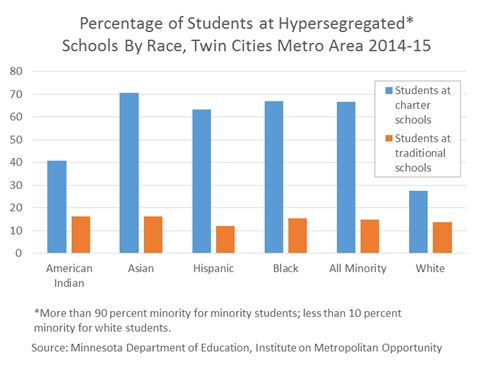
So Cruz-Guzman became a plaintiff in a lawsuit—one that may shape the future of American education. Filed against the state of Minnesota by two veteran civil rights attorneys, Daniel Shulman and his son John Shulman, the suit accuses the state of allowing schools with high concentrations of poor and minority students to proliferate. A 2015 Minneapolis Star Tribune analysis found that elementary school students in the Twin Cities attend more racially segregated schools than they have in a generation. Children who attend such schools, the lawyers argue, achieve far less than their peers in integrated institutions. The lawyers also say that the growth of charter schools, which are even more racially segregated than traditional public schools, have exacerbated these trends.

The Shulmans are seeking a metro-wide integration plan to satisfy what they argue is the state’s constitutional obligation to prevent segregated schooling. They cite the state constitution’s education clause, equal protection clause, due process clause, and the Minnesota Human Rights Act to make their case.

Not everyone agrees that this kind of integration is legally necessary or the best way to meet children’s needs. Some see the suit as a threat to parents’ right to choose the schools that would best serve their children. This is particularly true for parents of color, who sometimes send their children to charters in the hopes of avoiding what they see as hostile traditional schools.

John Cairns, one of the most experienced charter school attorneys in the nation, is working against the lawsuit. “If the state is going to do anything, then they’d have to attack parental choice,” says Cairns. “While the plaintiffs are inexplicit about what their remedy would be, in our view, they’re explicit that their remedy would address charter school enrollments. The only way they could do that is to have some conclusion that parental choice is unconstitutional.”

Daniel Shulman sees in this argument an echo of Plessy v. Ferguson. He thinks charter school advocates are arguing, in effect, that separate schools can be equal. “We don’t think that’s true or the law. If they follow the law, they’ll say separate is not equal, and not equal is inadequate,” he says. “All the data will support that … test scores, graduation
rates. School segregation is a national tragedy and disgrace.”


It’s fitting that this fight would take
 place in Minnesota
, which is both the birthplace of the charter school movement, and a longtime champion of civil rights.

Minneapolis enacted the nation’s first fair housing and fair employment ordinances, and Minnesota passed one of the first state laws banning housing discrimination. In 1948, it was an impassioned speech to the Democratic National Convention by Minneapolis Mayor Hubert Humphrey that led the Democratic Party to pass its first civil rights platform plank. In the early 1970s, under a court order, Minneapolis moved to integrate its public schools. This prompted the state to issue desegregation rules applicable to schools across the state. By the early 1990s, Minneapolis and St. Paul had not a single racially segregated school, and the Twin Cities metropolitan area was one of the most desegregated regions in the United States.

“We had no segregated schools because we had strong civil rights laws and we enforced them,” says Myron Orfield, a law professor at the University of Minnesota and the director of its Institute on Metropolitan Opportunity.

Today, the educational landscape looks quite different. While the number of people of color living in the Twin Cities metropolitan region—defined as Minneapolis, St. Paul, and the surrounding suburbs—has increased considerably over the past two decades, integration advocates say that demographic shifts alone are insufficient to explain the growth of segregated schooling in Minnesota.

And grown it has. Since 2000, the number of elementary schools in St. Paul educating more than 90 percent students of color grew from 2 to 18, while the overall percentage of students of color in the district rose only 11 percent. Similar shifts occurred in Minneapolis. In 1995, the Minneapolis School District was 63 percent nonwhite, but had only two elementary schools that were 90 percent segregated. Today the district has 13 such elementary schools, and 26 percent of district students attend schools with over 90 percent students of color.

MPS SPPS demograpic change chart FIXED.png

The demographics of the 164 charter schools in Minnesota—which roughly 50,000 students attend—have also impelled the state to argue, for the first time, that charters should no longer be exempt from state integration laws. (An administrative judge will rule on this separate dispute in late February.)

The resegregation of the region’s schools, critics say, was the product not just of demographic change but also of conservative pressure in the 1990s to weaken desegregation mandates, coupled with the rise of a charter sector that targeted specific races and ethnicities, thereby accelerating the isolation of poor and minority students. The growth of charter schools, they add, also created new opportunities for white children to congregate in separate schools. Charters attended by predominately white students grew by 40 percent between the 2007-08 school year and the 2012-13 one. Researchers found that more than half of these white charters are located in attendance zones with racially diverse traditional schools.

Opponents of the state’s proposal, and of the Shulmans’ lawsuit, argue that their proponents—state officials, Myron Orfield, and his allies—misapply the label of  “segregation” when talking about charter schools. “I find it offensive and insulting to compare parents of color making choices to send their kids to schools that are better addressing the academic needs of their kids with segregation, a system that was set up by white supremacists decades ago to force students of color to inferior schools,” testified Alberto Monserrate, the first Latino ever elected to the Minneapolis School Board, in early January.

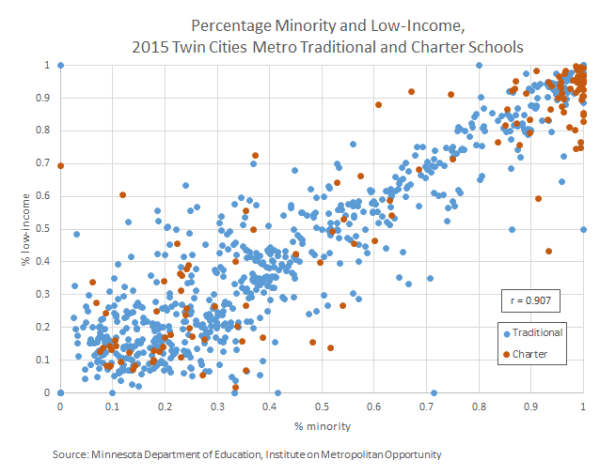
Whether or not one thinks these schools should be considered segregated, the rise of schools with high concentrations of racial minorities—both in traditional schools and in charters—means an increase in the number of schools serving high concentrations of poor students. Researchers at the Institute on Metropolitan Opportunity find the poverty rate at Twin Cities minority-segregated schools to be two-and-a-half times greater than the poverty rate at integrated schools, and five times greater than the poverty rate at predominantly white schools. They also find that math and reading test scores for black students at highly segregated schools are lower than test scores for black students at less segregated schools. Suspension rates, too, are substantially higher in racially segregated elementary schools than in less segregated ones.

IMO.png

“Yes, there’s a difference between segregation that’s imposed by the state versus segregation that is through choice, the first is worse than the second,” says Richard Kahlenberg, a senior fellow at The Century Foundation and a longtime researcher of school integration. “However, the negative effects of concentrated poverty obtain even when concentrated poverty is a matter of constrained choice.”


This is not Daniel Shulman’s first time filing a school segregation lawsuit against the state. In 1995, Shulman sued Minnesota, arguing that segregated schools in the Twin Cities metropolitan area violated both the state and federal constitutions. The case settled five years later, and as part of the settlement, Minnesota established a voluntary integration program between Minneapolis and ten neighboring suburban districts. Most participants were poor minority students who enrolled in predominately white suburban schools.

“But the segregation in Minneapolis and St. Paul is worse today than when I started the first case 20 years ago,” says Shulman. “That’s why I brought the case again, and I’m sorry I waited this long to do it.”

Shulman’s legal strategy rests on a theory that, at this point, is still very much untested. In the past few decades, it’s become increasingly difficult for civil rights advocates to win federal school desegregation lawsuits. Following the 1978 Supreme Court case Milliken v. Bradley, courts began to draw sharper distinctions between de jure and de facto segregation; the Supreme Court said unless it could be shown that a district deliberately sought to discriminate against students by race, it could not be held responsible for school segregation.

“Federal desegregation rulings are about racial discrimination, which looks at intent to discriminate,” says Derek Black, a professor at the University of South Carolina School of Law, who studies education law and policy. “Since the 1980s and 1990s, it’s become more and more difficult to prove intent, which means more and more districts have been released from their desegregation obligations.”

By suing the state, rather than the federal government, the Shulmans aim to bypass all those sticky questions about intent. “What they’re saying is that the actual existence of segregated schools creates an educational harm, and the state ought to correct that harm, regardless of why it came about,” explains Black.

Their strategy has been tried once before, in a 1989 Connecticut lawsuit known as Sheff v. O’Neill. The plaintiffs argued their constitutional rights were violated because the concentration of African-American students in a particular district was a violation of the state’s right to equal education.

The case made its way up to the state Supreme Court, and in 1996, the justices ruled that Connecticut had an affirmative obligation to provide its students with equal educational opportunity. This constitutional right, they concluded, necessitated providing students with integrated educations, and so the state moved to establish an array of voluntary integration options.

Though Sheff is not controlling law in Minnesota, it is expected that Minnesota judges would consider it if they adjudicate the Shulmans’ suit. “I think the more courts that say an idea is a good one, the more likely it is that courts that follow after them will agree,” says Black, pointing to school funding lawsuits as an example. However, Sheff was notably litigated before the rise of charter schools.

In 1993, Minnesota’s Supreme Court ruled that all students are guaranteed a fundamental right to an adequate education. In their new suit, the Shulmans seek to argue that no education could possibly satisfy the state’s adequacy requirement given the highly segregated environments.

Lawsuit opponents argue that “adequacy” should be measured not by the composition of student bodies, but by demonstrated achievement. “What we’re saying is the first thing to look at is whether kids are learning, not who is sitting in the classroom,” says Cairns, the attorney representing the charters. “And once you establish that kids are learning, then that’s the measure of an effective and adequate education.”

Derek Black says most states do consider achievement “outputs” when determining whether students are receiving adequate educations. Such outputs could be scores on standardized tests, graduation rates, or college readiness measures. Though variance exists from state to state, Black says most courts would look at both outputs and inputs. “The question would be whether the failure to provide certain inputs is the cause of an inadequate education, as measured by various outputs,” he says. If Minnesota’s judiciary takes up this groundbreaking case, they will have to decide whether racially and economically integrated schools are necessary inputs.

“I think there’s an increasing recognition that equal education is the constitutional responsibility of state governments, and therefore [states] have to promote policies to avoid racial and economic segregation,” says Phil Tegeler, the executive director of the Poverty & Race Research Action Council, and a leader in the National Coalition on School Diversity. Tegeler hopes lawyers in other states will follow the Shulmans’ lead. “We really need to see more creative, affirmative litigation,” he says.

“This is huge, you could potentially have 50 state lawsuits on this issue,” says Kahlenberg.

Opponents of the lawsuit, and of the state’s plan to include charters under statewide integration rules, say that there’s been a fundamental misinterpretation of what segregation is. They deny that charter schools targeting specific races or ethnicities are illegal or unjust. Rather, they say, these schools provide students with “culturally affirming” environments in which to learn.

Bill Wilson founded one such “culturally affirming” charter in St. Paul—known as Higher Ground Academy. Though Higher Ground’s student body is more than 90 percent East African immigrant and low-income, it’s one of the highest performing schools in the region. Advocates say the school’s success is due to its unique, and culturally sensitive education strategies. “I know people who brought this lawsuit against the state use the word ‘desegregation’ but let’s find the intentional action,” Wilson says. “I won’t call this segregation, I won’t call it racial isolation, because it’s not true.”

“It’s a false analysis that’s being applied to culturally specific charter schools, that tends to consider those schools to be segregated,” testified Nakima Levy-Pounds, the president of the Minneapolis NAACP chapter. “That flies in the face of civil rights history and also the fact that we have historically black colleges and universities around the country that are specifically designed to affirm, enrich, and enhance the educational experiences of African-Americans who we know have faced historical discrimination throughout our time in this country.”

Darrick Hamilton, an urban policy professor at The New School, says his research suggests there certainly could be instances where predominately black schools may be better learning environments for black students. Quoting W.E.B. Du Bois, he says, “The Negro needs neither segregated schools nor mixed schools. What he needs is Education.”

Even among those in the Twin Cities who advocate for integration, the civil rights community remains torn over how to think about charter schools.While the St. Paul NAACP welcomes the Shulmans’ new lawsuit, for example, its leaders have not taken a position on their charter school argument, or on whether charters should be exempt from statewide integration laws.

“It’s hard enough to get a broad coalition of people to say we want to integrate the schools, and when you add the charter school issue, the politics just become much more challenging,” says one Twin Cities civil rights leader. “There are definitely some advocates who say we should focus on desegregating the traditional schools, and if the districts can get their act together then demand for charters will [naturally] go down, because parents will trust that traditional schools can take care of their kids.”

But researchers at the Institute on Metropolitan Opportunity say that segregated charter schools perform even worse than segregated traditional schools. With the exception of a few high performing networks—including Bill Wilson’s Higher Ground Academy—they find that most charter schools that serve high concentrations of impoverished racial minorities produce poorer academic results than traditional schools, even after controlling for variables like poverty and race. The Minnesota Star Tribune also found that slightly more than half of all students in Minnesota charter schools were proficient in reading, compared to 72 percent in traditional public schools.

Defenders of “culturally-affirming” institutions don’t spend much time talking about white charter schools. Yet white charters are on the rise.

“One of the problems with allowing culturally-focused schools to become single-race enclaves is that, once you create a legal justification for these schools, it becomes very difficult to prevent white parents from adopting the same language to create white segregation,” says Will Stancil, an attorney with the Institute on Metropolitan Opportunity. “Integration isn’t about exposing kids to some magic aura of whiteness, it’s about the importance of universal inclusion in education: providing all children full access to the teaching, resources, and networks that the most privileged kids currently have.”

IMO Charters.png

Those who do support including charters in the lawsuit and under statewide integration rules point to a “Dear Colleague” letter that former Secretary of Education Arne Duncan sent around in 2014. Duncan’s federal guidance said charters must be included in court-mandated or state-administered desegregation plans.

“You just can’t exempt charter schools from the basic civil rights laws of the state, they’re supposed to be publicly funded public schools, and they should be subject to the same civil rights requirements as other public schools,” says Phil Tegeler. Myron Orfield says Minnesota is the only state that he knows of that explicitly exempts charters from its civil rights laws.

The rhetoric surrounding these legal battles will likely grow even more charged in the coming weeks and months. By the end of February an administrative law judge should make her final decision on whether charters will be exempt from statewide integration rules. However, if the Shulmans ultimately win their lawsuit, some say this could render any charter school exemptions moot.

“I think ultimately the lawsuit could trump the rule,” says Derek Black. “It could require the state to do a whole variety of things.

Daniel Shulman isn’t worried about what the judge will decide with regards to charters and the state rule. “It would be nice if there were a rule that effectively desegregated Minnesota’s schools—that’s one way the state could begin to remedy the result of its past constitutional violations,” he says. “But this rule is not going to effect the lawsuit.”

The state of Minnesota has filed to dismiss Shulman’s lawsuit, and a judge will consider this motion in a hearing in April. (A spokesperson for the Minnesota Department of Education told The American Prospect that they cannot comment on the case, but is “committed to helping every student achieve academic success.”) If the case is not thrown out—and it can be appealed, if it is—then the trial will likely be scheduled for late 2017.

“I know for a lot of leaders it’s convenient to not do anything or to not talk about these issues, but for the children who are kept separate, it’s wrong,” says Cruz-Guzman. “We feel we’re doing the right thing by bringing the lawsuit.”

Minnesota is not the first state to wrestle with the challenges of balancing school choice and desegregation. And it surely won’t be the last. Cairns, who serves on a litigation panel for the Alliance of Public Charter School Attorneys, says that he and his colleagues recognize the “wide-ranging implications” of this case. Though it’s not a federal suit, Cairns believes its outcome will be “hugely important to provide direction” to the rest of the country.

Charged with Firing Teachers for Organizing, a Chicago Charter Network Settles

Originally published in the American Prospect on January 12, 2016.
—-

The National Labor Relations Board finalized a settlement agreement this week between Urban Prep Academies, an all-male charter network in Chicago, and more than a dozen Urban Prep teachers who were fired abruptly back in June. The firings came less than a month after a majority of teachers at Urban Prep voted to unionize with the Chicago Alliance of Charter Teachers and Staff (ChiACTS). Urban Prep will pay over $250,000 in back wages and severance to 13 fired teachers, and two of the fired teachers were able to return to work on Monday. The others, who already had taken new jobs elsewhere, waived their right to reinstatement and settled for back pay.

Back in June, the union responded to the firings by filing two unfair labor practice charges with the NLRB. One alleged that Urban Prep fired three teachers for their union activism; the second charged Urban Prep with failing to bargain with the union over all the teachers’ terminations. Educators, parents, and community members organized protests, urging Urban Prep to rehire the teachers.

Urban Prep’s COO, Evan Lewis, said earlier this summer that “the suggestion that anyone was fired as a result of their organizing activity is both wrong and offensive. … We respect and support the right of our teachers to choose a union as their exclusive representative. … Many of the teachers returning next year were active in the effort to organize, and we look forward to continuing our work with them.”

However, the NLRB launched an investigation into the situation, and on November 20, the board issued a complaint, finding that one teacher was fired for union activity and that Urban Prep failed to meet their legal obligations by not bargaining over the teachers’ firings. The NLRB scheduled a hearing for January 13, which has now been cancelled since Urban Prep decided to settle.

“We’re glad we were able to settle the charges rather than having to continue a long legal fight, because if Urban Prep had lost at the hearing they could have appealed,” says Carlos Fernandez, an organizer with ChiACTS. “These kinds of charges can take years to settle, so [resolving this] in just a little over six months is pretty good.”

The teachers at Urban Prep have been meeting regularly with their employer since September to work out the terms of their first contract; the union says they’ve made “significant progress.”There are currently 29 other unionized charter schools in Chicago, and a growing number nationwide.

The total amount that Urban Prep has agreed to pay—$261,346—marks the largest unfair labor practice settlement for charter teachers to date. Back in June, the I Can charter network, based in Ohio, had to rehire four teachers and give seven teachers back pay for firing them during their 2013-2014 union drive. That settlement totaled $69,000.

“It’s unfortunate that these publicly funded schools often react so poorly when their teachers choose a union, and it’s even worse when they’re able to waste so much time and money union busting, something well outside the scope of the work the people of Chicago pay them to do,” says Brian Harris, a special education teacher in Chicago and the president of ChiACTS. “We often hear from charter operator groups that they’re ‘not anti-union but pro-teacher.’ One would assume that the ‘pro-teacher’ part would kick in after a mass illegal firing. Nonetheless, we’re very happy that we can move forward and finally begin to work on what is most important: making Urban Prep a better place to teach and to learn through empowering teachers.”


The Charter School Business

Originally published in The American Prospect on December 22, 2015.
—-

Rutgers University professor Bruce Baker is a longtime expert on charter schools, which are in the crosshairs of a nationwide debate over school performance standards. Recently, Baker, and his colleague Gary Miron, authored a study about the ways in which individuals, companies, and organizations profit through laws and regulations governing the charter school sector. In an interview with The American Prospect, Baker discusses some of the most egregious policy problems, and steps that governments could take to fix them. What follows is an edited transcript.

Rachel Cohen: Your report explores what you call, “The Business of Charter Schooling.” Has this been studied much before?

Bruce Baker: I don’t think it’s been systematically studied because I don’t think there are many unified data sources for this information—it’s more like investigative reporting. I had been repeatedly asked to look into charter school real estate deals and things like that but getting good data just isn’t easy. This was really just a first cut at summarizing the business practices and financial transactions occurring in the charter sector, and what policy structures encourage or permit these things to happen.

RC: You say that current laws and policies governing charters are increasing the privatization of public schooling. What do you mean?

BB: I want to be careful on this issue of ‘privatization’ because I don’t think the intent of our report was to say that public policy is promoting privatization, or that privatization is necessarily bad or good. But there is a long line of case law that carefully parses under what circumstances, and in what settings, certain activities of charter schools are public or private. I’ve coauthored law review articles where we discuss extensively how the charter school industry claims it is “private” when dealing with questions of employee rights, student discipline policies, student handbooks, or contracts, and “public” in other respects.

The idea put forth in our report is that there are certain policy structures, and in some cases lack of policy controls, that are permitting more extensive degrees of privatization in some states. Sometimes it just makes business sense for charter operators, good or bad, or it affords them a way to do something more quickly or cheaply. But I think that some actors in the charter world such as Imagine Schools, White Hat, and Charter Schools USA, are taking advantage of these opportunities in ways that are self-enriching and not in the public interest.

RC: What are some examples?

BB: Sometimes charter providers take actions that are illogical and inefficient from a public policy standpoint, but it might simply be what they have to do to get by. For example, sometimes charter providers create third-party entities, and then pay rent for the school facilities to these new entities. Since charters can’t directly purchase land themselves, these third-party entities allow them to take advantage of tax incentives and to carry revenue-bond debt to purchase property. Unfortunately, because they’re doing this through revenue bonds, they’re getting a crappier interest rate than a district might get and they have to spend a greater part of their operating funds to get facilities. That’s one example of how policy basically backs a charter school into engaging in inefficient activities.

In other cases, charter providers may engage in ethically suspect, but perhaps not illegal, behavior. For example Imagine Schools runs its own property acquisition arm, Schoolhouse Finance. Similarly, Charter Schools USA, a for-profit company, runs Red Apple Inc., and acquires properties to lease them back to the charter school. And in some cases it does actually become illegal. In Kansas City a court ruled that Imagine Schools went over the line with self-dealing, because they overcharged themselves so much in lease payments. [These leases are being paid for with public dollars.]

RC: You note that many public school districts have privatized services for years. What makes what’s happening in the charter sector different?

BB: The modern era of privatized contracted school management started out in the 1990s, as traditional school districts would engage in contracts with private organizations to run schools. But in these cases, the contracted manager works for a local board of education, and is paid through a district budget. So at least at the top level of the organization, the district and the board of education know the details of that private contract.

Whereas if you look at some states, sometimes it may be private entities that actually authorize charter schools, and charters are established through boards of private citizens who then might contract a private company to run their school. The opportunities to shield disclosure, at multiple levels of the hybrid, publicly funded, privately managed and governed system, are dramatically increased in the charter sector.

RC: You note that school districts, many of them starving for cash, have been selling off their public assets—such as school facilities and land—to the charter sector. If one day, the public sours on charter schools, and wants to return to traditional public education—might this not be possible?

BB: Yes, the turnaround would just be too expensive. Maybe 15 years down the line it will be different, but as it stands now, the case for spending sufficiently on a system of public schooling is just not strong. Despite the economic turnaround, most states are still spending less and less on schools.

If you start thinking how much short-run expense would be required to even acquire new urban land to educate students, and then to develop suitable facilities—well, it’s very high. And in some cases, the land and buildings that are being used by charter operators are actually owned by for-profit real estate investment trusts. They’re certainly not going to sell land and buildings back to cities below market value just to support the public good.

I think we do need to be paying more attention to the capital available to educate the children we’re responsible for educating. If we sell it off, and change our minds about charters down the line, we are screwed.

RC: You recommend instating far greater financial reporting requirements. How would this help?

BB: Any entity, private or public, engaged in the delivery of school services should have to report their expenditures. Right now we have to go fishing through IRS 990 forms—if the manager is nonprofit—and it gets very messy. I’d like to see charter financial data reported into a publicly accessible system. Some states do a much better job of this, but you really have to fish for these little pieces of information here and there to try and pull it all together. There’s got to be better accounting for the overlapping financial relationships, so that people can understand how money is being passed between interested parties.

RC: People often talk about charter networks like KIPP, but it seems like there are far bigger networks that slip under the radar. Your research suggests that these networks come with more problems or ethical concerns.

BB: There are certain charter schools we hear about in the media—like KIPP, Uncommon Schools, and Success Academy. And I have my own concerns about the pedagogy and compliance with students’ rights issues at those schools, but when you start looking nationally, what we see is that the dominant players operating charter schools in many states are Imagine, which has found itself in court for self-dealing, White Hat, which was just involved in an Ohio Supreme Court case, National Heritage Academies, Mosaica, Charter Schools USA … and in many states, and nationally in the aggregate, these are much bigger than KIPP or Achievement First, etc.

These networks are not the names we hear about when we hear about the next big study to show how well charters are doing. These are not the networks we hear charter advocates saying we need to expand. Rather we see advocates saying that if we just remove caps and deregulate we’ll see a lot more networks like KIPP. That’s not the case. It hasn’t been the case. And it won’t be the case.

RC: School choice advocates often say that more money is able to “get down to the classroom level” in charter schools, because we do away with large district bureaucracies. This was a common theme in Dale Russakoff’s recent book, The Prize. Is it true?

BB: It’s a complete mischaracterization. It’s one of those cases where the public rhetoric and the research that’s been done really over quite a long period of time are entirely at odds. There are numerous studies that have looked at the administrative overhead expenses of charters and found them to be very high. The vast majority of charters have relatively low total classroom instructional expenses, and studies have consistently found that the proportions spent on administration and other centralized expenses are much higher in charters.

My graduate student, Mark Weber, wrote about the misuse of data in Dale Russakoff’s book.

RC: What recommendations in your report do you expect to garner the most opposition?

I would expect to get significant pushback from the various types of private entities that have enjoyed their current opportunities to shield disclosure.

We also make the case for a centralized, publicly governed authority to manage facilities, or perhaps even all capital resources. Allocating public space to charter operators both reduces the potential for inefficient expense by charter operators and maintains the public’s interest in its public assets.

Some public school advocates, who are fairly anti-charter, have been opposed to the idea of “co-location” which is where a charter and a district school share space within the same building. It has led to some problems, but when I look at the big picture, it’s a hell of a lot better for the public to maintain the public facilities and allow charter operators to use them, rather than sell them off.

I fear this report is going to be seen as us saying all charters are evil, or bad, or money grabbing. What we’re saying is there are good charters but also bad ones, and the bad ones are bigger than you think. Charters represent a significant portion of our public school system system and we’ve got to figure out how to make them work better for the public interest.

Can Teachers Unions Help Online Charter Schools?

Originally published in The American Prospect on November 27, 2015.
—-

In a major win for the movement to organize charter schools, a California state labor board recently ruled that teachers working for the state’s largest online charter network could form a union.

Teachers for the network, known as the California Virtual Academies, have been battling since April of 2014 with administration officials who refused to negotiate. That’s when more than two-thirds of the so-called CAVA network’s teachers voted in favor of unionizing.

Roughly 15,000 students attend CAVA’s 11 campuses across the state. CAVA administrators had argued that teachers at those disparate campuses should form their own individual unions instead of organizing a single union that would represent them all.

In a 77-page legal decision, the California Public Employment Relations Board (PERB) rejected this argument—setting the stage for CAVA teachers to move forward with their network-wide union. The California Teachers Association (CTA), a state affiliate of the National Education Association, will serve as their exclusive bargaining representative.

To teachers who have been agitating for a union, gaining the leverage to improve working conditions is a key first step to boosting student performance—something the online charter sector greatly needs. The teachers’ labor victory comes on the heels of several recent reports concluding that online charter schools are performing extremely poorly. Some 200,000 students take online classes through such institutions nationwide.

“Academic benefits from online charter schools are currently the exception rather than the rule,” stated researchers in a report released by the Center for Research on Academic Outcomes on October 27. It was one of three different research studies released last month that arrived at similar conclusions.

Earlier this year, the progressive group In the Public Interest, which focuses on contracting and privatization, issued a report that looked specifically at problems within the CAVA network. It found evidence of poor academic outcomes, financial conflicts of interest, and insufficient supports for teachers, among other things.

CAVA is managed by K-12 Inc., a publicly traded company based in Virginia that made $55 million in profits last year. The K-12 Inc. schools offer classes to some 14,500 students across the country.

K-12 Inc. officials diputed the methodologies behind the critical reports. But the CAVA teachers who have been organizing for a union said the findings did not surprise them.

“I think those reports actually helped us because they just reinforced what we were already seeing with our own students,” said Stacie Bailey, a CAVA teacher on the organizing committee.“We’ve been trying to push the school to focus more on instruction for a long time.”

Bailey actually spent several years working as a CAVA administrator, until she grew so frustrated with how things were run that she went back into teaching.

“Personally, I joined the union drive because I just see that teachers do not have a voice at our school,” said Bailey. “It’s too top-town. I tried to give teachers that voice while working as an administrator, but I was not successful.”

Working for an online charter school poses some unique challenges for teachers looking to organize. “We engage in the workplace from our own homes, we are isolated, we do not see each other,” said Jen Shilen, a high school history and economics teacher who worked at CAVA from the fall of 2012 up until this past summer. “The process of building rapport with colleagues can be challenging.”

CAVA teachers say they grew interested in the idea of forming a union when their workloads and responsibilities spiked dramatically beginning in the fall of 2013—particularly when they were asked to perform more clerical duties. More paperwork meant less time to work directly with students, teachers say. Organizing talks kicked off at the end of 2013, and CAVA teachers soon approached the California Teachers Association for assistance.

“Some of us used to work for union protected schools, so we knew who to talk to,” explained Shilen. CTA helped the 700 teachers fan out across the state to coordinate with one another; helped them with press outreach, and connected teachers with legislators.

The union vote took place in the spring of 2014. “It was rather surprising that it was as successful as it was,” remarked Bailey. “We had to call every teacher, and send them a petition and they had to print it, sign it, and mail it back to us. That’s a lot to ask of someone, and we ended up getting a super majority voting for the union.”

But CAVA administrators rejected the petition, insisting that the teachers did not constitute one legal entity. “CAVA’s argument was that CAVA does not exist,” said Shilen, wryly.

What came next was a protracted legal battle, including five days of hearings in a state administrative court in February and March, with lawyers filing their legal briefs in May. In June, 16 teachers filed 69 complaints against CAVA on a variety of grounds, including violations student privacy laws, misuse of federal funds, and inadequate services to students with disabilities. CAVA’s senior head of schools, Katrina Abston, dismissed the complaints.

Teachers have waited since mid-May for the decision from the state Public Employment Relations Board, which arrived on October 30. “We were hoping the decision would come in July, about six weeks after the lawyers turned in their briefs,” said Bailey. “It took five months.”

CTA President Eric Heins praised the PERB decision in a statement and urged CAVA administrators not to appeal this “historic ruling.” Now, Heins stated, “teachers can begin to address the problems that are hurting their students, such as insufficient time spent on instruction, high teacher turnover, and too much public money going out of state.”

The CTA’s support for CAVA teachers has raised some eyebrows, particularly since the union has staked out some anti-charter policy positions over the past decade. As I reported in The American Prospect in June, the relationship between charter teachers and unions is evolving and complicated.

CAVA administrators, who did not return The American Prospect’s request for comment, have moved to appeal PERB’s decision.

“The ruling states CTA may seek collective representation of all teachers at all CAVA charter schools, notwithstanding that CAVA is not itself an established public school employer,” Abston told the San Bernadido Sun this month.

But CAVA teachers are unfazed.

“Even if they’re going to appeal, we’re still a union; it doesn’t stop our forward momentum,” said Bailey confidently. “We’re not worried about it.”


Tensions rise at City Council discussion of charter-school funding

Originally published in Baltimore City Paper on October 8, 2015.
—–

A large crowd of charter advocates convened at City Hall last night wearing orange T-shirts that read #SAVE THE CHARTERS BMORE. The City Council was discussing a resolution to withdraw a charter funding proposal that had already been withdrawn. The district’s proposal, introduced on Sept. 8, was scrapped on Sept. 22. Councilman Bill Henry, vice chair of the council’s education committee, introduced the resolution on Sept. 21.

Henry’s resolution called upon the school district to “reconsider its inequitable proposed public charter funding formula to ensure that adequate funds are allocated to all Baltimore students in accordance with state law.”

“All members of the Baltimore City Council co-sponsored this resolution,” said Henry at Wednesday’s meeting. “If we all sign onto it, it can’t be that controversial.” He went on to say that he recognized the proposal was already withdrawn, so “in a very basic but important way we already won.” His hope was to use the meeting as an opportunity “to step back” and think these issues through.

Earlier in the afternoon, before the City Council meeting began, Gregory Thorton, CEO of Baltimore City Public Schools, sent a letter out to families and staff with a district update on the charter-school funding situation. While Thorton expressed a commitment to working with the charter coalition, he said that when the district had originally withdrawn its proposal, it did so under the impression that the charter operators would withdraw their lawsuits too. The district believed this would allow “discussions between us, to be facilitated by former Mayor Kurt Schmoke . . . held publicly, in a spirit of collaboration, and with open dialogue not constrained by pending legal action.”

However, Will McKenna, executive director of Afya Baltimore Inc., an organization that governs charters, challenged the district’s assertion in his testimony last night, saying that none of the charter litigants ever suggested they would drop their lawsuit. “It feels dishonest to have to hear that,” he said.

Councilman Brandon Scott asked the district what evidence they had to suggest that charter operators ever intended to drop their lawsuit. As Dawana Sterrette, the district’s legislative liaison, tried to formulate an answer, parents from the audience tittered. “Honesty is the best policy!” one hollered. “Transparency!” shouted another.

Finally, Sterrette answered that there was “an intermediary” between the school system and the charter representatives, who informed them that the charters would drop their lawsuit if the proposal were scrapped. Sterrette did not name names or provide more concrete details, which was unsatisfying to the crowd.

When I spoke with Bobbi MacDonald, the executive director of City Neighbors Foundation, a few days ago, she told me the litigants had no intention of dropping the lawsuits, but would possibly consider putting their cases on hold.

Kate Primm, the founding principal of the Green School of Baltimore, testified at Wednesday’s meeting, reiterating that the nine operators involved in the litigation had no plans to drop their cases.

The audience was packed with people, mostly charter supporters, but just a few signed up to speak. Several-charter school parents gave speeches, as did a Patterson Park Public Charter School fourth-grader. Kim Truehart, a longtime citizen activist, also offered testimony, pushing the crowd to think more seriously about equity for all of Baltimore’s children.

When I approached Truehart after the meeting, she said she felt the whole evening was just “a publicity stunt” because the mayor, not the council, holds the real power over these issues. Truehart said it “shocked the heck out of her” when Mayor Stephanie Rawlings-Blake decided to intervene in the charter dispute given how hands-off she’s been with education issues generally.

It’s not clear where this all will lead, but several takeaways were evident. One is that the charter advocates aimed to send a message that they believe North Avenue is mismanaging money, which hurts both charter students and traditional students. While everyone acknowledged the need for more state funding, the charter leaders suggested there was more district officials could be doing to efficiently manage their money and get more funds down to the classroom level.

The mediation, led by Kurt Schmoke, will not be binding, but Alison Perkins-Cohen, speaking for the district, said they want it to be a public process, in a public setting, given the funding formula’s impact on the broader community.

It’s not yet clear what the terms of the mediation will be. It was not clear, based on last night’s testimony, whether public mediated talks are a major priority for the charter operators. It is also not clear how having litigation open at the same time as the mediation will impact the parties’ ability to be transparent.

“I don’t understand how Baltimore City Public Schools can be expected to negotiate in good faith with this lawsuit hanging over our heads any more than I can see how Baltimore charter schools can call themselves public schools without paying their fair share of public school costs,” said Ben Dalbey, a city schools parent.

Given that the charter funding formula impacts all district students, and considering that the charter operators are calling for a greater culture of accountability and transparency, finding a way to ensure that the mediation is open to parents, community stakeholders, and reporters seems to be a wise condition for any future effort.

Why the Administration Needs a Bolder Plan on School Integration

(Originally published in The American Prospect on September 23, 2015.)
—–

In late August I looked at the Obama administration’s record on school integration and found that, overall, Arne Duncan and his team at the Department of Education did not prioritize school diversity very much within its key initiatives, though they spoke often of its importance. Earlier this month, four education policy researchers published a new report assessing the impact of a little-known federal grant, the Technical Assistance for Student Assignment Plans (TASAP), which had been quietly earmarked in 2009 to promote school diversity. In light of a Supreme Court decision that significantly muddied the legal terrain around school integration, TASAP offered technical assistance to districts seeking to promote student diversity and combat segregation. But as the researchers find, the Obama administration’s failure to broadly promote integration on the federal level significantly impeded TASAP’s success. If the government is serious about integrated schooling, then concerted federal involvement is still very much needed.

Background on the Grant:

The impetus for TASAP followed the confusing 2007 Supreme Court decision, Parents Involved in Community Schools v. Seattle School District, where the justices both rejected student assignment plans that relied explicitly on race, and affirmed the state’s role in reducing racial isolation and promoting diverse public schools. This paradoxical decision, coupled with guidance from the Bush administration that discouraged race-conscious student assignment plans, perplexed district officials around the country.

The Council of Great City Schools (CGCS), an organization representing large urban school districts, and the NAACP Legal Defense and Education Fund (LDF) recognized that districts might need professional help if they hoped to maintain or promote diverse student assignment plans in the wake of Parents Involved. No district wants to risk an expensive lawsuit. According to the researchers, LDF and CGCS pushed for technical assistance funding within the 2009 Omnibus Appropriations Act for this reason.

But advocates wanted to avoid a top-down approach through bodies like the Equity Assistance Centers, entities funded by the Department of Education under Title IV of the 1964 Civil Rights Act. As the researchers put it, “In contrast to its history of forcing reluctant local officials to integrate their schools, and later of directly providing desegregation assistance, with TASAP the federal government endorsed the goal of diversity and financially supported technical assistance for district diversity efforts, without imposing a particular outcome or providing technical assistance itself.”

Twenty-one districts and one charter school applied for funding, and 11 districts were ultimately awarded TASAP grants. The grantees were diverse—most were relatively large districts, and all had engaged with racial, ethnic, and socioeconomic integration issues before—whether because they were formerly under a court-order, or because they had experimented with controlled choice programs like magnet schools, or both. Grantees included Boston, Portland, St. Paul, San Francisco, and Champaign, Illinois, among others.

Though funding was limited, and instructions were vague, advocates felt that promoting TASAP was better than nothing. TASAP also served as a symbolic statement by signaling to school districts that the federal government still backed school integration, even after Parents Involved. As researchers noted, TASAP “was a subtle sort of symbol, though. Rather than a high-profile act of Congress, it was an earmark to the Equity Assistance Center budget, authorized via a Joint Explanatory Statement.” This allowed the federal government to quietly support diversity, without angering political opponents.

What the Researchers Found:

The four researchers, Elizabeth DeBray from the University of Georgia, Kathryn A. McDermott from the University of Massachusetts, Erica Frankenberg from Pennsylvania State University, and Ann Elizabeth Blankenship from the University of Southern Mississippi, analyzed TASAP’s design, the Department of Education’s involvement, and how grantees ultimately used the federal funds.

In their report they explain why they felt studying TASAP was so important, despite it being “just a small, relatively invisible technical assistance program.” For them, it offers an opportunity to better understand what factors are most likely to help promote, or inhibit, successful diversity initiatives.

Overall, TASAP’s results were mixed. Despite all districts articulating a commitment to promoting diversity when they applied for TASAP funding, a majority did not end up using the money in a way that emphasized diversity. Districts often spent the funds on other local priorities, like balancing the budget.

Researchers found that federal officials did not have much of a strategy, other than generally feeling as though districts were better positioned than they were to determine appropriate forms of technical assistance. The Department of Education was unwilling to clearly define what “diversity” should mean and provided minimal oversight throughout the program.

While deferring to local districts sounds reasonable, researchers found that, in practice, other issues tended to “crowd out” diversity from the political agenda. Many of the districts were struggling with shrinking school budgets and faced pressure to reduce transportation costs. The researchers found that, “districts with current or past commitments to diversity could not necessarily sustain those commitments in the face of public indifference to diversity as a goal and of other pressing priorities, such as boosting test scores, implementing budget austerity, and attempting to recruit or retain middle-class and white students.”

Implementing TASAP proved to be particularly difficult for districts that wanted to design new diverse student assignment plans, compared to those that just needed help improving or maintaining their existing diversity schemes. Only one district, Champaign, was able to change its student assignment plan to encourage more diversity; it used the TASAP funds to hire a consultant who helped them create a more diverse student assignment algorithm.

Lessons Learned:

Federal involvement can provide political cover for districts that want to promote diversity but feel pressure to prioritize other things; federal involvement helps ensure that integration will not be “crowded out” from the political agenda. The four researchers point out that one problem with the “something beats nothing” TASAP approach was that six districts did not end up actually using their funds to promote diversity.

The researchers ultimately conclude that local technical assistance for diversity initiatives will be most effective if it comes alongside a larger federal strategy. The Department of Education must both provide strong and consistent supports for local communities, while also including diversity incentives within its own federal programs. This can help challenge the perception that diversity is just some optional bonus at best, or a distraction from more important improvements, at worst. Without clear federal commitments—matched by deeds as well as words—local politics are likely to impede integration reforms. And since the groups most likely to benefit from diversity initiatives are those most excluded from local politics, the researchers conclude, “leaving the use or interpretation of such policies up to local governments is likely to limit the extent to which they have their intended effects.”

This week, the National Coalition on School Diversity will be holding its third annual conference in Washington, D.C. to discuss the future of school integration efforts. (I’ll be reporting from the event.) While there exists a general feeling that the mandatory integration policies seen in the 20th century are unlikely to return any time soon, advocates also recognize that a strong role for the federal government is still clearly needed. This could mean increased federal support for controlled-choice programs like magnet schools or racially diverse charters, or withholding federal funds from states that permit discriminatory housing policies. As lessons from the TASAP program reveal, if policymakers are serious about promoting diverse local schools—something even the Supreme Court views as a compelling state interest—then tactical federal involvement is a must.