Why DeRay Mckesson’s Mayoral Candidacy Will Be Defined Far More By Education than Policing

Originally published in Slate on February 12th, 2016.
—–

N
ews of mayoral runs usually don’t merit the attention that Black Lives Matter activist DeRay Mckesson got when he announced his candidacy for Baltimore’s top job last week. His campaign had leaked the story to the Washington Post, the New York Times, and the Guardian in advance, and within 24 hours, he had already crowd-funded $40,000.

National publications began speculating how Mckesson’s candidacy would elevate police reform onto Baltimore’s political agenda, the implication being that it wasn’t already a top priority in the race. It absolutely is: Nearly 10 months after the death of 25-year-old Freddie Gray in police custody, and after one of the most crime-ridden years Baltimore’s seen in decades, few topics are more prominent. So what, exactly, will Mckesson bring to the election?

Mckesson joins 12 other Democrats competing in April’s primary, the winner of which will almost certainly go on to win in November. But though Mckesson’s large Twitter following may be eager to see how he’ll carry his national Black Lives Matter work into Charm City, I suspect they’ll be in for a surprise. What’s going to distinguish Mckesson probably won’t be policing and criminal justice at all—it’ll be education.

Nationally, school reform is an issue that confounds political partisans, opening fault lines among progressive allies and uniting constituencies that typically never agree. Reform is even more complicated in Baltimore; the city stands as a distinctively unusual landscape for education politics next to other, similar urban centers.

Already, Mckesson has signaled that he plans to campaign on education, which isn’t surprising since that’s where the 30-year-old cut his professional teeth. After graduating college, he spent two years teaching sixth graders in Brooklyn followed by several stints with education nonprofits, reform organizations, and administrative district jobs. But Mckesson brings to the race some national baggage, which he’ll have to confront as he tries to make his case to Baltimore voters. Specifically, residents have already raised questions about his ties to national reform groups like TNTP and Teach for America, as well as his enthusiastic support for charter schools.

So far, Mckesson has largely dismissed these concerns. He’s reminded the public that he’s spent several years working with the Baltimore school district as an administrator focused on staffing personnel. Still, he’ll have to reckon with local education politics that have changed substantially since he left his job back in 2013.

For example, a few months ago a coalition of charter operators filed a lawsuit against the school district over funding—a highly controversial move that’s divided Baltimore public school families. The city is also in the midst of closing down more than two-dozen schools, and the next mayor will need to determine what becomes of the vacant buildings. Will they be sold off? Will they be leased to charter schools? Will they be repurposed into some other civic entity? These decisions are sure to intensify an already-fraught K-12 landscape.

The main thing to grasp about Baltimore’s education environment is that it’s pretty unique. All charter teachers are unionized, unlike most charter employees in other states. Moreover, Maryland charter schools—which are predominately mom-and-pop institutions, not larger charter-school chains—are subject to more oversight and regulation than charters elsewhere. While reformers say they’d like to see Maryland charters freed from these legal constraints, supporters of the status quo say that tougher oversight explains why Maryland charter schools have never wrought the kind of fraud, mismanagement, and abuse found in other jurisdictions.

What Mckesson will soon have to decide is whether he is committed to keeping Baltimore’s charter sector as is—with unionized teachers, a close relationship to the school district, and substantial oversight—or join the coalition of charter operators and national education reform groups that seek to significantly revamp chartering in Maryland. That decision may also force him to choose between competing groups that may try to back him. Some national charter networks have expressed disinterest in setting up shop in Baltimore, namely because they don’t want to work within the school district and employ unionized teachers. The National Alliance of Public Charter Schools, a D.C.-based organization, consistently ranks Maryland as the worst charter school state in the country, largely for these same reasons.

Yet within Baltimore, both traditional teachers and charter teachers alike strongly support Maryland’s charter law—and rallied together last year to protest reformers’ attempts to change it. The Center for Education Reform, another national group, hired lobbyists to push for loosening Maryland’s regulations. They were ultimately unsuccessful, but the fight is expected to resurface again soon.

On Friday, Mckesson released his education campaign platform—a substantive list of proposals ranging from expanding early childhood education to strengthening college and career readiness programs. He calls for increasing the school district’s transparency (a common theme among all the candidates) and more equitable state financing. He notably doesn’t mention anything about unions or charter schools, but Mckesson won’t be able to shy away from that charged debate for long.

When news broke that Mckesson would be running, some Baltimore activists, particularly those who have been fighting for police reform, protested on Twitter—a surprise to some outside the city, given his national stature within Black Lives Matter. Among other things, locals argue that Mckesson lacks sufficient relationships with the communities he now seeks to lead.

In many ways, their critiques mirror those that veteran public school educators level at Teach for America—that outside young teachers without roots in the cities they work in displace those who have more of a right, and need, to be there. And despite Mckesson’s early campaign efforts to brand himself as a “son of Baltimore,” some local activists have said they’ve rarely seen him fighting alongside them in the causes they’ve been invested in for years, like building independent black institutions and weakening the Maryland police union. (Mckesson defended himself against these charges, saying “there are many ways to engage in the work.”)

A few weeks ago, 11 Democratic candidates gathered together for a mayoral forum to discuss their political vision for Baltimore. One audience member asked the candidates, “How will you stop police from killing black people?” Answers varied somewhat, but all in all, they were broadly similar. The candidates spoke of strengthening civilian review boards, getting body cameras on all police, transforming the way Baltimore recruits and trains officers, establishing more transparent accountability systems, pushing for more police to formally live within the city, mandating cultural diversity training and regular psychiatric evaluations, and calling for convictions for those who break the rules.

In other words, Mckesson is entering a crowded field of candidates who likely share many of his police reform policy goals. Some hope that Mckesson’s candidacy will encourage others to articulate even sharper campaign proposals. Perhaps, and that would be a good thing. But it was already an issue that no candidate was really ignoring—and certainly one that no future mayor can expect to avoid.

So despite to Black Lives Matter’s national work, that aspect of his candidacy is unlikely to be too disruptive in the race. It’ll be where his campaign intersects with the school-reform movement, and specifically how local education politics rub up against his national ties, that could really shake things up.

Roots & Branches charter will remain open, but public school closures loom large

Originally published in Baltimore City Paper on February 3rd, 2016.
—-

Last night the Baltimore City school board voted to renew Roots & Branches charter school for another three years. It was a victory for the parents and teachersworking to save their progressive elementary, though many other local schools were not so lucky. In early January the school board voted to close four schools—Westside Elementary School, Baltimore Community High School, Maritime Industries Academy High School, and the Maryland Academy of Technology & Health Sciences, a charter school. These four, plus Roots & Branches School, another charter, were recommended for closure in early November.

“Every time you hit adversity you learn something, and I think we’re going to look at some of how we teach math across the board,” says Anne Rossi, the principal of Roots & Branches, which de-emphasizes testing in favor of an arts-infused curriculum. “I think we want to do some professional development, our math scores were not as good as our reading, but I am really optimistic that we are going to be able to show the district improved scores.”

The school closings come on the heels of a tumultuous year, both within the public school community and Baltimore City more broadly. Westside Elementary is located in Penn North, where the bulk of the Freddie Gray protests took place, and many felt shuttering a civic institution was the very last thing the beleaguered community needed.

“I will plead to you one more time please save Westside Elementary School,” state Del. Antonio Hayes asked the school board in November. “There [are] two major institutions in the Penn North community, that’s Westside Elementary School and a very thriving drug treatment center.” Students who would have enrolled at Westside will merge with students at another renovated school.

Alison Perkins-Cohen, the executive director of New Initiatives for Baltimore City Public Schools, says that when making decisions about school closures, the district thinks about which communities could most benefit from better facilities. “With Westside, I know the community was concerned about divestment, but for me it’s the opposite,” she says. “We’re really investing. Westside is closing because they’re getting a new school—we intentionally prioritized neighborhoods with challenges, so they are getting new buildings first.”

Nearly half of the city’s school buildings were built in the 1960s or earlier, and almost all require extensive repair, renovation, or replacement. According to industry standards, approximately 70 percent of the district’s buildings are considered to be in “poor” condition. And they were constructed at a time when the number of public school students enrolled in the district was much greater—upward of 200,000. Today, with roughly 85,000 public school students, there’s a lot of excess space. (Fewer students also means decreased funding, and the district has had some close calls with misreporting how many students are enrolled in the past.)

In 2010, the ACLU of Maryland published a report outlining the miserable state of Baltimore schools, citing things like damaged windows that don’t open, facility doors that don’t close, and badly lit hallways. “Depending on the season, teachers often struggle to engage drowsy children due to the excessive heat, and faulty boiler systems compel some children to wear coats during class in the winter,” the report stated. “Old lead plumbing has forced City Schools to restrict the use of water fountains and instead provide bottled water.” Decades of social science research has shown how unsafe and inadequate school facilities can negatively affect students’ academic performance—particularly when a school has poor temperature control, poor indoor air quality, and poor lighting.

Though advocates have been paying attention to the deteriorating school facilities for some time, inequitable state policy has made it difficult for leaders to take action. In 2004, the state reported that Baltimore had the greatest need among all Maryland school districts to bring its facilities up to acceptable levels of condition—yet legislators failed to target funding accordingly. Baltimore’s lack of wealth also inhibits it from borrowing money, while suburban districts can incur debt to fund capital improvement projects. So Baltimore not only has the greatest need, but also faces the most difficulty raising money. According to the ACLU, Baltimore’s capital budget “pales in comparison” to other large counties.

Following the report’s release, advocates who had been mobilizing for increased school funding—under the banner of the Baltimore Education Coalition—began to shift gears and focus more specifically on school facilities. The ACLU called for $2.8 billion to fund all the needed repairs and capital improvements. (It later revised this figure to $2.4 billion.) By spring 2011, the Baltimore Education Coalition formally joined the ACLU’s “Transform Baltimore: Build Schools, Build Neighborhoods” campaign, and together they pressured the city and state to pay for school improvements.

Baltimore, which is more dependent on state aid than any other district in Maryland, simply cannot fund enough capital improvements on its own. But state legislators worry about wasteful spending, and are loathe to invest in schools with too few students inside them.

“There is a statewide rule that says that any school building that is less than 60 percent occupied cannot receive state school renovation funds,” says Frank Patinella, an advocate with the ACLU’s Education Reform Project. “Some buildings might have broken boilers and inconsistent heat, but the state does not give money, no matter how poor the condition, if it is an underutilized building.” (“Underutilized” is the controversial term used to describe buildings that are deemed too large for the number of students enrolled. According to the district, Baltimore currently has a 79 percent school utilization rate—and its goal is to ultimately reach 86 percent, through school closures.)

“The state feels particularly strongly about the high number of Baltimore school buildings compared to student population and puts ongoing pressure on City Schools to close more and more buildings,” says Bebe Verdery, the director of the ACLU’s Education Reform Project. “I’ve never been to a hearing in Annapolis in which particular legislators did not rail against Baltimore City schools and the state agencies to require more closures faster.”

Perkins-Cohen says that in order to get state funding, the district had to develop a cohesive plan that indicated which schools would close, which would be renovated, and in what order.

Their efforts succeeded, and by 2013 the legislature passed the Baltimore City Public Schools Construction and Revitalization Act, which allows the state to leverage $1.1 billion in construction costs. This funding enables Baltimore to make headway on its “21st Century Plan“—a commitment to fully renovate or build roughly 50 schools, and to close 26 schools. The state, city, and school district have to each contribute $20 million annually over the next 30 years, though equity advocates say the state should be paying a greater share of these costs.

Many community members have raised concerns with the 21st Century Plan, and question the way it’s being implemented.

According to Jessica Shiller, an urban education professor at Towson University, some communities—like Penn North, Edmonson Village, and Hollins Market—will lose more than 40 percent of their classroom seats from the school closures. These communities all have poverty rates that exceed the citywide average.

“There needs to be an outcry, I take every opportunity I can in school board meetings to tell them they’re doing the wrong thing with these closures,” says Helen Atkinson, the executive director of the Teachers Democracy Project, a local group that engages teachers in public policy issues and social justice.

“One of the main things we find is that mobility is just bad for kids,” says Shiller, who has been doing independent research on school closures. “Moving kids around too much has a negative effect on their academic achievement, and closing a school exacerbates mobility, especially for poor kids.”

Another problem, Shiller notes, is that students often wind up in schools that are worse than the ones they left. Though the 21st Century Plan promises that all kids will attend superior, renovated schools eventually, observers note that children who used to attend the high-performing Langston Hughes Elementary School now attend worse schools, and the displaced students will be shuffled to yet another struggling school during the 2017-2018 school year. In addition, Shiller says kids frequently encounter bullying and violence at their new schools, and teachers are often ill-prepared to handle an influx of new students.

Perkins-Cohen says the district’s long-term plan is to provide professional development to teachers working in merger schools, and to focus on “creating cultures and climates” to help students transition more smoothly.

School closures have become a flashpoint in education reform debates across the country, evoking particularly heated opposition in cities like Newark, Philadelphia, and Chicago. Last year, parents in Chicago led a 34-day hunger strike to save a local high school that was slated for closure. Parents and community organizations have also filed federal civil rights complaints under Title VI of the Civil Rights Act of 1964, claiming that school closures in various cities have had a racially discriminatory impact on poor, black students. In December, the Office for Civil Rights at the U.S. Department of Education reached a groundbreaking resolution with Newark Public Schools to help those who may have been negatively impacted by Newark’s closures.

But school closings in Baltimore have not garnered the same kind of mobilized opposition.

Perkins-Cohen says she thinks the politics have played out differently in Baltimore because the district has worked really hard to engage the communities in a thoughtful way. The district’s comprehensive strategy, she says, involves publicizing the 21st Century Plan, making annual school closure announcements several months before the school board votes, organizing robocalls to parents, sending letters home, running ads in newspapers, holding meetings with both teachers and the community, and speaking at school board meetings.

Shiller says her research suggests the public is nowhere near as informed as the district thinks. “While the city did do public forums, they really glossed over this closure information. They said you know we’ll get you wireless internet and air conditioning, and we have to make sure that every school is fully utilized. But the way it was told was to really de-emphasize the closures,” she says. “When I did research it was very clear that it wasn’t communicated very well.”

As of now, it’s unclear what will become of the school buildings that get shut down.

When the district closes down a school, the buildings then return to the city, which owns them. Perkins-Cohen says the city is already thinking about uses for the buildings, in part by asking various city agencies if they might have an interest in the facilities. Sometimes charter operators try to use the newly vacant buildings for their charter schools.

“If you think about it as just a school, then yes it does make sense to close them. Maintaining buildings is hugely expensive, and a city like Baltimore doesn’t have the money to support expenses that are unnecessary,” says Shiller. “But if you think about it from an urban planning perspective, and ask what a school is to a neighborhood, then it’s a very different conversation.” She points out that for many students, schools are where students access food, counseling, after-school programming, and even health care.

Education advocates worry the community won’t have a say in what ultimately happens to these buildings. There are fears that the process will lack transparency, and that buildings may even be left vacant, if nobody wants them. Shiller thinks that right now is a real chance for individuals to speak up with ideas on how to repurpose the buildings, and maybe even figure out new strategies to turn them into hubs of social services.

“The new mayor will be the one really central to making those decisions, and so this leadership change is a really excellent opportunity” for people to get involved in shaping the future, she says. Although some community members tried to save Langston Hughes Elementary School last year, Shiller believes their lack of political capital ultimately crippled the effort. “There were some very inspiring marches, and it got good coverage, but they lacked that political support,” she says. “To stop school closures there really may need to be more aggressive direct action.”

Some wonder whether political capital played a role in helping Roots & Branches to stay open this year. “While I can’t speak to the details of the Roots & Branches case, the fact that it was allowed to stay open adds to the impression that many parents have that charters are treated not just differently, but better,” says Edit Barry, a parent involved inPeople for Public Schools, a new grassroots advocacy group in Baltimore.

Rossi, the principal of Roots & Branches, says the Maryland Alliance of Public Charter Schools did not help them fight their closure recommendation. “I think the charter coalition was understandably cautious and did not throw any weight behind us,” she says. “I don’t know if they didn’t want to show favoritism for us over another charter, or if it’s the [closure] process they wanted to be cautious about protecting, but I will tell you they weren’t part of this effort to save our school.”

Opening up more charters within buildings of closed traditional schools may exacerbate existing tensions between charter advocates and traditional public school parents. Some claim that these closures might even be pretenses for charter school expansions; Atkinson notes that multiple charter operators have been trying to open up schools in communities targeted with school closures, some even angling for the Langston Hughes Elementary School building before it shut down.

“I think people in Baltimore just feel like they will get screwed,” says Shiller. “That’s their go-to feeling—that it’s probably going to be bad—but maybe we can make it a little less bad.”

Can Baltimore Recover from Its 2015 Murder Wave?

Originally published in VICE on January 6, 2016.
—-

For criminal justice activists, 2015 was an exhausting year. After high-profile police brutality incidents captured the public imagination at the tail-end of 2014, America had a new national conversation about racism to contend with. Protesters took to the streets across the country, chanting “Hands up, don’t shoot!” and “I can’t breathe!”; fresh instances of death and pain inflicted by police officers on (mostly) black civilians spread across social media every week; newspapers compiled databases of the number of people killed by cops; presidential candidates were asked to distinguish between “Black Lives Matter” and “All Lives Matter” on nationally-televised debates.

One of the responses to these protests from the law-and-order crowd was to ask if all this campaigning against police brutality was contributing to an increase in crime. This is the so-called “Ferguson Effect,” a theory suggesting that anti-cop rhetoric was creating a climate in which police could no longer effectively do their jobs. It remains a theory—the statistical evidence supporting a rise in crime rates is thin; last month, the Brennan Center for Justice, a public policy and law institute affiliated with New York University, published a report finding crime was roughly the same last year as it had been in 2014 in America’s largest cities.

That report, however, was scant comfort to Baltimore, a city where mistrust between the cops and the people they serve may have created some serious challenges. Charm City saw a per-capita record of 344 homicides in 2015, the highest total since 1993, when the city had 100,000 more people living in it, as the Baltimore Sun reported this month. In April, 25-year-old Freddie Gray died while in police custody, sparking weeks of Baltimore protests and unrest. In five of the eight months following Gray’s death, homicides surpassed 30 or 40 a month. Before the unrest, according to the paper, Baltimore had not witnessed 30 or more homicides in one month since June 2007.

All told, there were some 900 shootings in Baltimore last year, up some 75 percent from 2014—a violent crime spike unparalleled among the 30 largest cities in America, according to the Brennan Center’s analysis. Though Baltimore’s police and political leadership insist they are determined to make last year’s crime statistics an aberration, whether they’re planning to do so through tougher policing in 2016 remains to be seen. And with high-stakes local elections coming up, along with a legislative season where police reform will most certainly be on the table and months of trials left for the six officers charged with the death of Freddie Gray, Baltimore residents are not expecting closure to the unrest any time soon.

Speaking to the Sun, Police Commissioner Kevin Davis recently said he plans to pressure the state legislature to make possession of illegal firearms a felony, rather than a misdemeanor, and for police to hunt down gun traffickers. He also said he’s ramping up recruitment efforts for 200 vacancies in the police force, and trying to coax retired cops to come back to the department. Davis wants to increase street patrols, focus more on residential burglaries, and partner with other city agencies to prevent and solve crime. These priorities reflect some ugly statistics: The BPD’s homicide clearance rate dropped sharply in 2015; police solved only about 30 percent of all cases, and according to theSun, their 2015 clearance rate was less than half the 2014 national average—as well as some 15 percentage points below the BPD’s own average in recent years. Experts suspect that the lack of trust between the police and the community is a major contributing factor behind the low clearance rate. (The Baltimore Police Department did not return repeated requests for comment for this story.)

Peter Moskos, a former Baltimore City Police Officer and professor at John Jay College of Criminal Justice, thinks that until the cops on trial for Freddie Gray’s death are acquitted, the BPD is not going to be able to do its job effectively. “It isn’t that these officers did something bad and got caught. It’s that they did exactly what they were told to do and are being prosecuted for it,” he says. “As long as cops feel like they can get criminally prosecuted for doing their job, you shouldn’t expect cops to be proactively policing.” He adds that winter offers a sort of natural reset button for communities, since crime tends to go down when the temperature drops. “It gives them an opportunity to feel like, OK, we’re starting over,” he says. “But the department is still understaffed and morale is in the tank.”

Tara Huffman, director of Criminal and Juvenile Justice Programs at Baltimore’s Open Society Institute (OSI), says her organization has been working closely with Commissioner Davis and Baltimore’s police to help them identify and reduce discriminatory practices within their department. This would hopefully help to restore some trust between the police and Baltimore residents. OSI will also be providing seed funding for a policing pilot program this year where officers will send people who appear to be suffering from an underlying drug addiction into a community-based treatment center rather than arresting them. The Law Enforcement Assisted Diversion program, (LEAD) was first developed in Seattle, and it helped to keep low-level offenders out of the criminal justice system while also getting them the aid they needed.

When asked whether she thinks the city has responded in a serious enough way to the unrest and its aftermath, Huffman acknowledged that there’s “a lot of talking” going on, including dialogue between people who don’t normally speak to each other. “There is room for progressive ideas and solutions that wouldn’t have gotten the same audience eight months ago,” she told me. “But we’re not seeing the fruit yet. I think we still have a ways to go until we see the fruit.”

The question of whether the city and state will be willing to make serious investments in poor Baltimore communities, a critical factor for reducing gun violence long-term, remains an open one. Just last month, the NAACP Legal Defense and Education Fund filed a federal complaint over the cancellation of a long-planned transit project in Baltimore, which would have primarily benefitted low-income blacks who lack quality transportation options. Maryland Governor Larry Hogan cancelled the project and diverted money to roads and highways elsewhere in the state. The city also massively underfunded its Operation Ceasefire program, a violence-reduction initiative that proved highly successful (if also controversial) in cities like New York. Baltimore’s Operation Ceasefire director resigned last spring in protest, citing insufficient resources and support. In addition, following the Freddie Gray protests, Governor Hogan cut Baltimore City’s public education funding by 3.3 percent.

Yet on Tuesday the governor traveled to West Baltimore to announce a nearly $700 million plan to tear down vacant buildings throughout the city and bring in new development over the next four years.

“I don’t see us policing ourselves out of this crisis. That has never worked before,” says Alex Elkins, a visiting historian at the University of Michigan who studies the police. “We need sustained engagement with hard-hit communities in order to establish a different pipeline, toward civic inclusion rather than banishment to jail and prison. To achieve that, a policy that attacks root causes is essential, ethically and strategically.”

“People are generally angry about a variety of things, and we have a community that makes promises but no real substantive investments,” adds Dayvon Love, co-founder of Leaders of a Beautiful Struggle (LBS), a grassroots organization that advocates for the interests of black people in Baltimore. “This year we’re gonna see a lot more of what we saw in 2015. It won’t be an anomaly. We’ll continue to see a lot of the same.”

City residents are not expecting an end to the unrest any time soon. The six officers on trial for Freddie Gray’s death will take the stand over the next several months; the first officer’s first trial, which ended in a hung jury, has already been rescheduled for June. The pretrial hearing for the second officer, Caesar R. Goodson Jr., began Wednesday. Goodson faces a number of charges, including second-degree depraved heart murder, a crime carrying a maximum 30-year sentence.

On top of the trials, 2016 is set to be an intense year for state and local politics. The state legislative session kicks off in Annapolis next week, and activist leaders will be pressuring legislators to pass police reform measures, like body cameras and changes to the Law Enforcement Bill of Rights—or a list of ways cops can evade scrutiny. On top of that, a new Baltimore mayor and City Council will be elected in November; Huffman thinks the current City Council could turn over more than 50 percent in the next cycle.

Love says he and other activists will continue to pressure leaders to invest directly in the people living in the beleaguered communities—a more effective and sustainable way, he argues, to create safe and thriving neighborhoods.

Elkins agrees. “Anything we try will be expensive—rather, anything that is worth trying ought to be expensive,” he says. “The spike after Gray’s death and the riots does seem anomalous at the same time that it is cause for concern. Yet we shouldn’t be distracted by the dispute over the Ferguson Effect—which essentially asks, who’s to blame? That’s a sideshow to the real issue of economic justice. Because of the way our criminal justice system favors the rich over the poor, we should be trying to empower the poor.”

OSI’s Huffman adds that it remains to be seen whether the powers that be are ready to do what the city needs.

“There’s definitely political will to stop the bleeding, but whether or not there’s a real recognition of what the underlying problems are, I’m not sure,” she says. “The city is still in transition, but we have a lot of opportunities right now to get this right.”

Baltimore Can’t Rely on ‘Judge Judy’ to Protect Renters

Originally published in Next City on December 9, 2015.
—-
Every year, more than 6,000 Baltimore renters and their families are evicted. Across the U.S., only Detroit has a higher percentage of residents facing that same fate. While it’s been all too easy for Baltimore officials to chalk this grim reality up to the wretched effects of poverty, a new report tells a more complete story.

“Justice Diverted,” issued by the Public Justice Center (in collaboration with the Right to Housing Alliance and scholars from Johns Hopkins University and the University of Baltimore) is based on a study of Baltimore tenants called to rent court. Housed in the District Court of Maryland, the court is where landlords take renters who are late on their monthly payments. Through examining hundreds of surveys, in-depth interviews, court records and city data, the researchers discovered that the court systematically “prioritizes efficiencies which privilege the landlord’s bottom line.”

While activists and legal experts previously suspected that rent court had a disproportionate impact on black families in Baltimore, advocates are now armed with concrete data to make a political case for reform. The study found that most people who are called to rent court — and ultimately evicted — are black women living near the federal poverty line and raising at least one child. Though black women make up 34 percent of Baltimore’s population, they comprised 79 percent of those surveyed in the rent court study.

Although rodent infestations, plumbing leaks and peeling paint could all be grounds for withheld rent, most tenants summoned to court were unfamiliar with their legal rights. Some tried to prepare by searching the Internet and watching movies and “Judge Judy,” but 73 percent of those surveyed did not know they could raise a defense if their house or apartment had serious defects. Indeed, nearly 80 percent reported at least one housing health or safety threat when they showed up to court. Nearly 60 percent cited insect or rodent problems, 37 percent cited plumbing leaks, and 41 percent cited lead poisoning anxieties due to chipping paint.

Unlike Baltimore’s foreclosure crisis — which elicited a sense of public emergency and outcry — the eviction crisis has largely been ignored. But in 2009, in the midst of the housing market crash, Baltimore’s eviction rate actually exceeded the rate of ratified mortgage foreclosures; by 2013, Baltimore’s eviction rate exceeded that of foreclosure filings.

One reason for the lack of attention: There’s no system to track data about who is being evicted, and when and why. “It is essential that the city direct funds to creating and disseminating data on rent eviction so that homelessness prevention strategies and housing policies reflect the real indicators of city renters’ hardship,” the report concluded.

The report makes more recommendations for reforming rent court and ameliorating the city’s eviction crisis. To reduce the number of eviction cases filed annually (currently 150,000), the city could instate a mandatory pre-filing period, like those that exist in the vast majority of states. Requiring pre-filing notices enables most rental disputes to be resolved without resorting to litigation.

The court could also more closely investigate whether landlords who file claims are properly licensed and compliant with lead paint laws. The researchers found that a majority of landlords presented the court with incorrect or incomplete registration and licensing information — but were not caught or held to account. Baltimore could also expand its licensing and property inspection requirements, because the current legal protections fail to cover the full range of rental units that tenants reside in.

Other recommendations were focused on leveling the playing field for tenants inside the courtroom and helping families avoid the traumatic hardship of losing their homes overall in the city. The authors call for increasing tenant legal representation, court assistance and funding for eviction prevention programs.

Judge John P. Morrissey, the chief judge of the Maryland District Court, told the Baltimore Sun that many of the recommendations outlined in the report would require a legislative response from lawmakers in Annapolis. Which is why the report was timed to coincide with the launch of the 7,000 Families Campaign — a political effort to stop the “housed-to-homeless” pipeline for poor Baltimore families and push for local reforms.

“We can correct some of this through legislative fixes at the state and city level, but that’s going to take some muscle,” says Jessica Lewis, an organizer with the Right to Housing Alliance. “It’s going to take a unified renter-led movement, and growing our collective power. More than half of the population of Baltimore City are renters, and it’s time that the eviction crisis, and the role that rent court plays in it, is taken seriously.”

How Baltimore Is Reacting to the Start of the Freddie Gray Trials

Originally published in VICE on December 1, 2015.
—–

how-baltimore-is-reacting-to-start-of-the-freddie-gray-trials-1130-body-image-1448944852-size_1000

Photo Credit: Rachel M. Cohen

It was cloudy and chilly outside the Mitchell Courthouse in Baltimore on Monday morning at the opening of the trial for William G. Porter, one of the six police officers charged for the April death of 25-year-old Freddie Gray. The other five implicated officers will have their own trials over the next several months; the prosecution reportedly sees Porter as a “material witness” who could be useful against the others. Baltimore State Attorney Marilyn Mosby charged the six officers in May after weeks of protests and riots that upended the city.

The trials begin at a fraught time for the city, as Baltimore has seen a dramatic spike in homicides this year, with 311 murders so far in 2015—100 more than the city saw in all of 2014. Meanwhile, police killings of people of color continue to generate outrage across the country, leaving Baltimore activists to wonder exactly how much they’ve accomplished since Gray’s death and the tumult that followed.

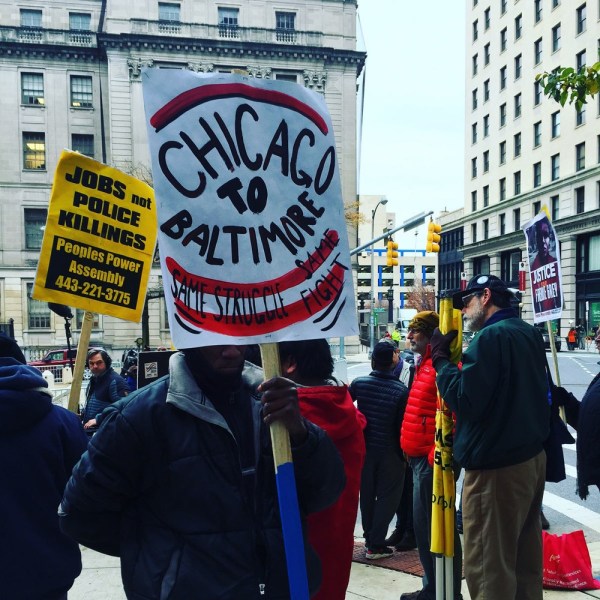
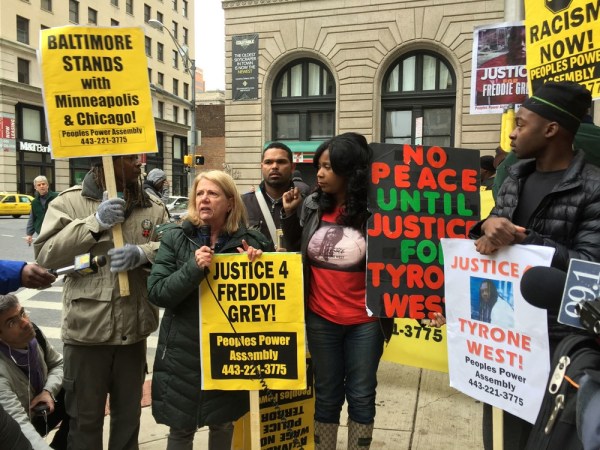
The “Baltimore Uprising”—as local activists call it—began just over a year ago, on November 25, 2014. That’s when protesters gathered downtown to protest Darren Wilson, the white police officer who shot and killed Michael Brown in Ferguson, Missouri, not getting indicted. Local activists recognize that the death of Freddie Gray carries as much significance for the national Black Lives Matter movement as other high-profile killings, and on Saturday, they held their own rally in solidarity with activists in Minneapolis and Chicago.

It’s been challenging for Baltimore activists to keep up their energy and momentum over the past seven months, but residents and public officials are bracing for a new wave of energy as the trials for the officers accused of ending Gray’s life heat up.

“The people from West Baltimore’s poorest communities are still reeling from how the Freddie Gray incident was handled by the powers that be,” says Perry Hopkins, an organizer with Communities United, a local grassroots organization. “The majority want justice, but openly say [that] if officers only get a slap on the wrist, this city had better be prepared to experience another thwack on the hand. They mean it.”

When I asked Hopkins if he thinks that means the community will begin protesting again if the officers are not convicted, he said, “Yes they’ll protest…and in many different fashions.”

A few handfuls of activists convened with signs and banners at the courthouse Monday, where metal barricades blocked off the areas protesters typically use to congregate. Some grew angry at what they felt were attempts by city officials to thwart their First Amendment rights. Still, those within the courtroom could hear protesters’ chants from the street.

how-baltimore-is-reacting-to-start-of-the-freddie-gray-trials-1130-body-image-1448944976-size_1000.jpg

Photo Credit: Rachel M. Cohen

Sharon Black, a leader with the Baltimore People’s Power Assembly, told me that it feels like there’s a great deal of confusion right now, even among some of the most committed activists in town. “We’ve been phone-banking, and our sense is that people are a little bit confused about what’s actually going on,” she said. This makes sense given the complicated legal process, and the fact that the presiding judge imposed a strict gag order last month on the lawyers involved in the case.

“People are sort of saturated with news, and there’s a bit of wearing down in terms of energy,” Black said. “The bigger response from the public may only come after the trials have concluded.”

Legal experts have expressed doubt that the officers will be convicted, and city officials are preparing for the likelihood that residents could revolt if they feel justice isn’t served. Police Commissioner Kevin Davis says his department has spent nearly $2 million on new police riot equipment—including vans, protective gear, shields, and helmets—since the unrest over Gray’s death this spring. Davis replaced the former Baltimore police commissioner, Anthony Batts, and the police department underwent a significant reorganization over the summer.

Mayor Stephanie Rawlings-Blake told the Baltimore Sun that city officials are having “constant conversations and planning sessions” to prepare for, and prevent, potential riots. “Community members certainly don’t want the city to erupt in violence again,” she said. More than 250 businesses were damaged after the April protests, almost 150 vehicles were burned, and roughly 60 buildings were set on fire.

“People in Baltimore still want to see justice for Freddie Gray, that has not changed one bit since April,” said Andre Powell, a protestor who stood outside the courthouse Mondaymorning. “Yes the mood was much more heightened directly after the incidents but people are closely watching what’s going on.”

Porter, the first officer on trial, has been charged with manslaughter, second-degree assault, reckless endangerment, and misconduct in office. Officer Porter reportedly asked Gray if he needed a medic while traveling in the police van, but thought he might be lying to avoid going to jail when Gray said yes. The officer is a 26-year-old Baltimore native who’s been on unpaid leave from the Baltimore Police Department since posting his $350,000 bail earlier this year.

A spokesperson for the Baltimore police union on Monday told VICE they were unavailable to comment on the trial. In general, however, the union has expressed outrage at the indictment of the six officers, and has called on State Attorney Marilyn Mosby to recuse herself from the case. The president of the union, Gene Ryan, called the city’s $6.4 million settlement deal for the family of Gray, approved in September, “obscene.”

On Monday, the court proceedings were focused on selecting a panel of impartial jurors for the case. Porter’s attorneys have argued that finding a truly fair jury will be impossible in Baltimore, and that the trial must be held elsewhere.

There is new evidence to suggest that Marylanders outside of Baltimore hold rather different views on the Gray protests than those who live within the city. A recent pollfound that Baltimore voters are more likely to say that racism and the lack of jobs are the biggest reasons for the unrest after Gray died. Voters across the state, on the other hand, are more prone to saying it was due to residents’ “lack of personal responsibility.” The same poll found that 63 percent of Baltimore voters supported Mosby’s handling of the case, compared to 38 percent of voters statewide.

The presiding judge, Judge Barry G. Williams, a black man who previously prosecuted police misconduct for the federal Justice Department, said he would reconsider moving the trial out of town only after the court makes a serious effort to find a fair crop of jurors within the city. Williams made clear that he thinks it’s important for people to be tried by “their peers.” And trying the officers within the city, many have noted, should help lend the court proceedings greater legitimacy. “One way to ensure that a community accepts a jury’s verdict is for the jury to reflect the entire community’s diversity,” University of Maryland law professor Douglas Colbert told the Sun.

Residents and civil rights leaders will closely monitor the proceedings, and the local NAACP chapter plans to have a court watcher in attendance for the full duration of the trial. A great deal is riding on the outcome of these trials, and for better or for worse, everybody in Baltimore knows it.


Can Affordable Housing Help Retain Teachers?

Originally published in The American Prospect on November 18, 2015.
——

On December 1, Allison Leshefsky, an elementary school gym teacher in San Francisco, will be evicted from the rent-controlled apartment she’s lived in for the past ten years. She and her partner pay $2,000 a month in rent, but if their place were put on the market, it would likely go for at least $5,000 a month—far more than any public school teacher could afford. As of August 2015, one-bedroom apartments in San Francisco rented for an average of $2,965 a month, and two-bedrooms for $3,853. Leshefsky’s landlord, who manages and partially owns nine San Francisco properties, has gained notoriety for evicting or allegedly forcing tenants out, in order to rent their units for more money.

Leshefsky has decided to finish out the school year teaching in San Francisco, even if that means paying jacked up prices for an air mattress she finds on Craigslist. “I’m making a commitment to get through the rest of the year regardless of whose couch I’m on or whose overpriced house I’m in,” she says. “I’m making a commitment to my students to finish this out.” But then, she says, she’ll have to leave.

In recent years, a growing number of researchers, policymakers, and philanthropists have directed their attention to the relationship between housing instability and student achievement. A great deal of evidence has shown how homelessness and housing insecurity can negatively impact a student’s behavior, which creates problems not only for them but for their classmates and teachers as well. A host of educational interventions are being tried in conjunction with local housing authorities, and some cities are even tying housing vouchers to specific struggling schools—in the hopes that such requirements will reduce student turnover and increase school performance.

Yet despite the perennial quest for top-notch teachers, less attention has been paid to the relationship between educators and their housing. It doesn’t require a great stretch of the imagination to think that teachers’ instructional capacities could be impacted by conditions they face outside the classroom, such as high rents, or unsafe housing. “There is no possible way the city can recruit talented people and maintain them with the housing crisis here,” says Leshefsky. “Students deserve teachers that are secure in their homes, and when a teacher is not secure, they can’t be the most effective educator.”

The city of San Francisco seems to agree. Last month, San Francisco’s mayor announced a new plan, formed in partnership with the school district and the teachers union, to provide housing assistance to some 500 public school teachers by 2020. Elements of the plan include forgivable loans, rental subsidies, housing counseling services, and the development of affordable housing specifically for teachers. This month, 73 percent  of San Francisco voters approved a ballot measure that will help make this plan a reality.

Across the country, other variants of teacher housing developments have cropped up, or are in the works—though the motivations for them, and allies behind them, differ from city to city. From San Francisco, to West Virginia, to Philadelphia, the efforts to attract, or retain, teachers through subsidized housing is growing more pronounced, and debates over how such projects impact their surrounding communities are likely to intensify in the coming years.

MATTHEW HARDY, the communications director for the San Francisco teachers union, says the union has a three-pronged strategy to deal with the city’s housing crisis. The first involves fighting for higher wages. In December 2014, the union negotiated a substantial salary increase for teachers and aides—a raise of more than 12 percent over three years. “But if we just limited ourselves to that, we’re not going to be successful,” says Hardy, which is why the union has also been pushing for teacher housing—using surplus district property—and for broader affordable housing policies for all city residents.

“Of course San Francisco is a wonderful place, and some people are willing to make immediate sacrifices to get their foot in the door, but it gets to a point where teachers start to wonder if they should continue paying $1,500 a month for a tiny room or move to the suburbs [where salaries are higher and housing is cheaper] and make $15,000-$20,000 more,” says Hardy. “We need to find ways to support teachers early in their careers, but also those who are more experienced and might want to start a family or buy a home.”

“If affordable brick-and-mortar teacher housing were actually here right now, and not several years in the future, then there would be no doubt in my mind that I would have continued to stay in the district,” Leshefsky said, wearily.

A very different sort of housing crisis plagues McDowell County, West Virginia—a poor, rural area, with a population that’s fallen by 80 percent since the 1950s. Teachers aren’t being priced out, but few want to move there, and those who might be so inclined struggle to find attractive housing options.

In 2011, former West Virginia First Lady Gayle Manchin asked Randi Weingarten, the president of the American Federation of Teachers (AFT), to help her figure out a way to improve McDowell’s school system. They started to organize a coalition of public and private organizations to tackle not only educational issues, but also regional poverty. In a speech given in 2012, Weingarten called this effort “solution-driven unionism.” Rather than shut down a school that’s struggling, she argued, unions can push to strengthen them with wraparound services. Then “learning improves, the school improves, community schools become more attractive than private or charter schools, people return to them with new confidence, home values increase and communities are renewed.”

Part of the McDowell plan includes not just wraparound services for community members, but also new apartments to attract teachers who might not otherwise want to move to McDowell County. As the lead coordinator involved in the teacher housing complex told Governing, “You can’t expect someone to leave life on a college campus for an isolated area where they live in the middle of nowhere and don’t know anybody.”

“What we’re constructing is the first multiple-story building in the area in decades,” said Weingarten in an interview. “The housing will address three big issues: the high teacher vacancy rate, the dearth of available housing, and the need for economic development.”

WHILE McDOWELL COUNTY’S “teacher village” won’t be the nation’s first, others are generally found in urban areas, and have been constructed largely without the involvement of the local teachers unions. In fact, partners more closely aligned to the educational reform movement have led them—those with ties to charter school networks and organizations like Teach for America.

In 2012, then-Mayor of Newark Cory Booker, New Jersey Governor Chris Christie, leaders from Google and Goldman Sachs, and others gathered to break ground on the Newark Teachers Village—a downtown Newark development that houses three charter schools, a daycare facility, more than 200 subsidized teacher apartments, and nearly two dozen retail shops. The project received tens of millions of dollars in tax credits. (The Wall Street Journal reported on the event with the headline: “Viewing Newark as a ‘Blank Canvas’”.) The real estate development group that spearheaded the project, RBH Group, is listed as a Teach for America corporate sponsor, and one of RBH’s founding partners, Ron Beit, is the chairman of the board of TFA’s New Jersey chapter.

The Newark Teachers Union, an affiliate of the AFT, originally backed the Newark Teachers Village—though Newark teachers say that their now-deceased president, Joseph Del Grosso, did so without consulting union members. The AFT is an affiliate member of the AFL-CIO, a federation of labor organizations that includes construction unions, and some think Del Grosso supported the plan because it carried the potential to create new construction jobs, not because it was actually in the teachers’ interest. However, despite Del Grosso’s initial support, the union was ultimately uninvolved with the project.

“They basically shut out the public school teachers and the public school union,” said Weingarten in an interview. “Just like they shut out the community from their reform efforts, they shut us out too. Initially we had conversations [about the Teachers Village], and then we were stonewalled.” Had the AFT been involved, then the union likely would have invested pension funds into the project, which may have broadened, and diversified, the project’s mission, and given more stakeholders a say in shaping its development. The union could have also pushed to bring on different types of asset managers, like the AFL-CIO Housing Investment Trust, which they used in West Virginia and San Francisco. Ron Beit did not return repeated requests for comment.

Over the past couple years, similar teacher housing projects have opened up in other East Coast cities. In 2009, the Seawall Development Corporation established Miller’s Court in Baltimore, using millions of dollars in local, state, and federal tax credits—and another, Union Mill, a few years later. The lead developer, Donald Manekin, was a former board member of Teach For America, and said he originally got the idea to build teacher villages when he saw 100 new TFA members arriving in Baltimore each year. “We’d sit at the end of these board meetings and say wouldn’t it be great if there was a great place for teachers new to the city?” He made these remarks to Newsworks in 2013, as his company prepared to build another teacher housing complex in Philadelphia.

Teach For America’s vice president for administration, Matt Gould, told The New York Times that his organization backs the projects because they “allow [teachers] to have safe, affordable housing. It’s a recruiting tool.” Teach For America is also reportedly looking into New Orleans and Washington as additional cities to expand teacher housing.

I spoke with Thibault Manekin, Donald Manekin’s son, and co-founder of Seawall Development Corporation, about his work building teacher housing. “Really our goal was to provide Class-A apartments and space for teachers doing the most important work in our city, which is helping kids get an education,” he said. To do this, the Manekins provide teachers with a free fitness center, free parking, reduced rent, lounge space, and other amenities that one might find in a more expensive apartment building. (Their website describes the buildings as “an urban oasis”.) Manekin says his company is in the middle of a similar project in Springfield, Massachusetts, and helping others think through comparable developments in other cities. “Yeah, I think you’ll start to see this spread more,” he said.

I asked him if he thought Baltimore teachers had struggled to find safe or affordable housing before he and his father embarked on their projects. “I think the challenge was that teachers, often new to Baltimore, and new to the classroom, weren’t living with like-minded people, and so might be making bad decisions on where to live,” he said. “As a result of that it makes the job that much harder. We just wanted to provide them with a world class space at a significant discount.”

While safe and affordable housing was available, he went on, “you wouldn’t really be living with people in the same boat as you.” They wanted to establish a space where teachers could lean on one another outside of the workplace.

Weingarten says the union was not included in the Philadelphia project, and was only cursorily consulted with for the Baltimore developments.

BRANDEN RIPPEY, a Newark public school teacher who has been working in the district for 18 years, said he acknowledges that Newark needs to build better housing to attract high-quality teachers. “Newark isn’t San Francisco. You do need to work to draw people in, and some of the housing we have here is in bad neighborhoods, and there is crime,” he says. As well, most of Newark’s teachers live outside of the city, so the idea of enabling teachers to establish roots as residents within the community is something he also likes. “I support the idea of creating good, affordable housing for working class people. The problem is that [the Newark Teachers Village] is clearly designed for white, young professional types, at a time when we desperately need more housing for poor people of color.”

Rippey notes that the Teachers Village is located close to other redevelopment projects in downtown Newark. “It’s just becoming a little yuppie commercial district,” he says. “The reality is they have a vision for gentrifying the whole downtown.” Rippey believes that these projects serve as a way to easily import TFA teachers, and by extension, weaken union power. Whereas developers like Beit and Manekin see the teacher housing complexes as positive ways to build communal spaces for local educators, Rippey thinks they can serve as a vehicle to isolate new and relatively young teachers from the union and the broader community. “It’ll keep those teachers residentially, and almost culturally, segregated,” he says.

IN A WAY, these Teachers Villages function as sort of a camp experience. You may be making a two-year commitment to live and work in an unfamiliar city, one that perhaps you, or your family, worry is unsafe. You know that you’re going to be working hard, long days—and so living in close quarters with people going through similar experiences might be quite comforting. All in all, it appears to be a pretty good deal—you’ll be afforded lots of amenities and discounts, you’ll live in a place you know is secure, and you’ll have the chance to develop friendships with other “like-minded” individuals.

In 2013, Mark Weber, a public school teacher and an education policy doctoral student, wrote some strong critiques about these new teacher housing projects.

It’s the perfect scheme: Beit and his private investors get tens of millions of dollars in tax credits to finance the development. He then turns around and rents his commercial units to charter schools, which drain tax revenues away from the neighboring public schools (which could sorely use the money to shore up their crumbling infrastructures). Those schools then pay their young teachers, recruited from TFA, who then turn around and pay rent to Beit. So Beit’s managed to develop three revenue streams—tax credits, charter school rents, and teacher residence rents—all made possible by the proliferation of charters and TFA.

And here’s the real beauty part: If the neighborhood gets gentrified and property values rise, the increases accrue to the property owners—like Beit—but not the people who actually live in the neighborhood. Think about it: If these teachers were buying brownstones and condos, the rising property values would accrue to them. But, because they’re renters, and not owners, they don’t see any of the increase. Their presence will raise the value of the neighborhood’s properties, but they’ll get none of the reward (assuming everything goes according to plan).

I called Weber to discuss some of his thoughts in greater detail. He sounded skeptical that these subsidized projects had much value at all: Will they really help attract lifelong educators into the profession, or will they just serve as a nice perk for young teachers who wouldn’t stay in the classroom beyond a few years anyway?

“If these charter schools need young people who are willing to work long hours and do the career for just a couple years, then things like teacher villages are almost custom-made, because you’re not going to be buying condos, and it’s close to your work,” he said. “Is that sustainable? I would argue no if we’re trying to build a workforce that sees teaching as a lifetime career. We could continue to build, or we can ask ourselves if we’re paying teachers enough money. If you can’t comfortably live here without staying in subsidized housing, maybe that’s a problem.”

Others have also questioned whether this whole subsidized housing deal isn’t just a misplaced way to avoid paying teachers significantly higher salaries. An individual used to feel more comfortable entering the teaching profession—despite its lack of prestige or big paychecks—given the relative stability if offered: a middle-class life, solid health care benefits, and a stable pension to live on during retirement. Today, however, those sorts of guarantees are beginning to fall by the wayside.

“If you’re not going to offer good health care benefits, what are you going to offer to get people to join the profession?” asked Weber. “Some modest rent control in hip neighborhoods? That’s not going to help the neighborhood much, and that’s not going to be much of an incentive to go into teaching.”

MAYBE SUBSIDIZED HOUSING that targets young professionals won’t be what it takes to help attract career educators, yet it’s clear that cities do want to help recruit and retain educators who actually live in the communities in which they serve—an effort that may require more than just a salary increase (though that would help.) Whether it’s a Teach for America participant looking for a supportive communal space, or a mid-career educator with a family who wants to live closer to his or her workplace, thinking about the intersections between housing and teaching is something that even the most progressive unionists, like Rippey, believe we should be doing more of.

Weingarten defended the AFT’s McDowell and San Francisco projects, and contrasted them with the ones in Baltimore, Newark, and Philadelphia. “We’re not looking to create a boutique pipeline for some people to work in different communities, it’s not that,” she said. “It’s about creating affordable housing so people can establish roots in the cities in which they live.”

Still, even teacher villages more closely aligned to the reform movement are helping young teachers, and local nonprofit organizations, forge better ties with the communities in which they serve. “The amount of teachers that have actually stayed in the classroom and in Baltimore, and then gone out and bought homes has been really inspiring to see,” said Thibault Manekin. Of the 30 homes he and his father have built in Baltimore, he says 20 have been sold to former tenants of Miller’s Court and Union Mill.

Would Leshefsky be willing to live outside San Francisco and continue working at her school with a longer daily commute?

“No, I would not be willing to do a two-hour commute just to serve a community that I don’t belong to,” she said. “I’m one of the most constant people in my students’ lives right now, and I don’t think someone who lives outside the city can necessarily connect with their students in the same way. We’re all going through very similar struggles.”
 

Tensions rise at City Council discussion of charter-school funding

Originally published in Baltimore City Paper on October 8, 2015.
—–

A large crowd of charter advocates convened at City Hall last night wearing orange T-shirts that read #SAVE THE CHARTERS BMORE. The City Council was discussing a resolution to withdraw a charter funding proposal that had already been withdrawn. The district’s proposal, introduced on Sept. 8, was scrapped on Sept. 22. Councilman Bill Henry, vice chair of the council’s education committee, introduced the resolution on Sept. 21.

Henry’s resolution called upon the school district to “reconsider its inequitable proposed public charter funding formula to ensure that adequate funds are allocated to all Baltimore students in accordance with state law.”

“All members of the Baltimore City Council co-sponsored this resolution,” said Henry at Wednesday’s meeting. “If we all sign onto it, it can’t be that controversial.” He went on to say that he recognized the proposal was already withdrawn, so “in a very basic but important way we already won.” His hope was to use the meeting as an opportunity “to step back” and think these issues through.

Earlier in the afternoon, before the City Council meeting began, Gregory Thorton, CEO of Baltimore City Public Schools, sent a letter out to families and staff with a district update on the charter-school funding situation. While Thorton expressed a commitment to working with the charter coalition, he said that when the district had originally withdrawn its proposal, it did so under the impression that the charter operators would withdraw their lawsuits too. The district believed this would allow “discussions between us, to be facilitated by former Mayor Kurt Schmoke . . . held publicly, in a spirit of collaboration, and with open dialogue not constrained by pending legal action.”

However, Will McKenna, executive director of Afya Baltimore Inc., an organization that governs charters, challenged the district’s assertion in his testimony last night, saying that none of the charter litigants ever suggested they would drop their lawsuit. “It feels dishonest to have to hear that,” he said.

Councilman Brandon Scott asked the district what evidence they had to suggest that charter operators ever intended to drop their lawsuit. As Dawana Sterrette, the district’s legislative liaison, tried to formulate an answer, parents from the audience tittered. “Honesty is the best policy!” one hollered. “Transparency!” shouted another.

Finally, Sterrette answered that there was “an intermediary” between the school system and the charter representatives, who informed them that the charters would drop their lawsuit if the proposal were scrapped. Sterrette did not name names or provide more concrete details, which was unsatisfying to the crowd.

When I spoke with Bobbi MacDonald, the executive director of City Neighbors Foundation, a few days ago, she told me the litigants had no intention of dropping the lawsuits, but would possibly consider putting their cases on hold.

Kate Primm, the founding principal of the Green School of Baltimore, testified at Wednesday’s meeting, reiterating that the nine operators involved in the litigation had no plans to drop their cases.

The audience was packed with people, mostly charter supporters, but just a few signed up to speak. Several-charter school parents gave speeches, as did a Patterson Park Public Charter School fourth-grader. Kim Truehart, a longtime citizen activist, also offered testimony, pushing the crowd to think more seriously about equity for all of Baltimore’s children.

When I approached Truehart after the meeting, she said she felt the whole evening was just “a publicity stunt” because the mayor, not the council, holds the real power over these issues. Truehart said it “shocked the heck out of her” when Mayor Stephanie Rawlings-Blake decided to intervene in the charter dispute given how hands-off she’s been with education issues generally.

It’s not clear where this all will lead, but several takeaways were evident. One is that the charter advocates aimed to send a message that they believe North Avenue is mismanaging money, which hurts both charter students and traditional students. While everyone acknowledged the need for more state funding, the charter leaders suggested there was more district officials could be doing to efficiently manage their money and get more funds down to the classroom level.

The mediation, led by Kurt Schmoke, will not be binding, but Alison Perkins-Cohen, speaking for the district, said they want it to be a public process, in a public setting, given the funding formula’s impact on the broader community.

It’s not yet clear what the terms of the mediation will be. It was not clear, based on last night’s testimony, whether public mediated talks are a major priority for the charter operators. It is also not clear how having litigation open at the same time as the mediation will impact the parties’ ability to be transparent.

“I don’t understand how Baltimore City Public Schools can be expected to negotiate in good faith with this lawsuit hanging over our heads any more than I can see how Baltimore charter schools can call themselves public schools without paying their fair share of public school costs,” said Ben Dalbey, a city schools parent.

Given that the charter funding formula impacts all district students, and considering that the charter operators are calling for a greater culture of accountability and transparency, finding a way to ensure that the mediation is open to parents, community stakeholders, and reporters seems to be a wise condition for any future effort.

Welcome to the Courtroom That Is Every Renter’s Nightmare

Originally published in Next City (with illustrations by Sky Kalfus!) on September 14th, 2015.
——–
Deborah Jennings lives in a house in East Baltimore with her daughter and granddaughter. When she first moved in nearly five years ago, she was working as a nursing support technician, helping to draw blood. Hours were long, but she was able to pay her bills. That changed two years ago, when she became disabled and had to stop working. Without a steady paycheck, 57-year-old Jennings has struggled to pay her rent, and each month, that means a trip to rent court.

Each courtroom visit, the same complaints are made, the same issues described, and the same ultimatum given: Jennings must pay her rent or risk eviction. Although the conditions of her house are poor — the basement sink had water running for two months straight, paint hangs from her roof and water has settled in the ceilings — Jennings is in no position to negotiate. “You can start talking, but then the judges say, ‘I understand, but we’re here in reference to this rent, do you owe this rent?’ They don’t want to hear whether or not you have any issues,” Jennings says. “They don’t want none of that.”

“I’m not expecting to live here free,” she adds. “I said bear with me, you’re going to get your rent.”

Each year, Baltimore landlords file roughly 150,000 cases in rent court, which is housed in the District Court of Maryland. The city has 125,000 occupied rental units. Many tenants, like Jennings, are taken multiple times per year.

Despite its undeniable public impact, rent court remains one of city’s least transparent institutions. Any public records are hard to come by and in an era of metrics and open data, analysis of courtroom verdicts appears to be nonexistent.

“People know about it, but there’s no interest to understand why this keeps happening year after year,” says Zafar Shah, an attorney with the Baltimore-based Public Justice Center. “The whole system just does not function as it should.”

In the neighborhood of Oliver, where Jennings lives, nearly a third of families live below the poverty line, many of them on blighted blocks checkered with vacancy. Yet Oliver, along with other sections of Baltimore, is slowly beginning to see population trends reverse and new investment trickle in. With new residents and development come higher rents and more pressure for tenants like Jennings to pay up or get out.

“There is a lot of development in Oliver, a lot of new homeowners, but there are still a lot of people without a lot of money here,” says Darryl Dunaway, office manager and community organizer with the Oliver Community Association. “We hear about rent court all day. From 9 a.m. to 12, I am sending people down to 501 East Fayette Street for eviction prevention. I sent someone there this morning.”

Dunaway says that the community association and others like it around the city help as many people as they can each month, but there is only so much that can be done. “If you can’t pay one month, there is help. You come back next month and you are on your own,” he says.

Originally created to provide a nationwide model of justice for landlords and tenants, Baltimore’s housing court today serves as little more than a state-run rent collection agency, financed by taxpayers and the beleaguered renters themselves who pay court fees for each judgment ruled against them.

“The court system is not for the tenant,” says Jennings wearily. “It just becomes a money thing. It’s no longer about human beings.”

A Court Designed for Tenants

In 1936, the Baltimore Sun published a series of articles that illustrated some of the horrific conditions of Baltimore slums — where 40 percent of the city then lived. With the highest proportion of substandard housing among America’s big cities, local Baltimore officials moved to take action. But by 1941, unsatisfied with the city’s slow progress, some individuals formed the Citizens Planning and Housing Association to apply more pressure. What emerged in Baltimore — a campaign for new building and sanitation codes, and stronger mechanisms for enforcement — would eventually influence the wave of urban renewal across the country, as well as Dwight D. Eisenhower’s Federal Housing Act of 1954.

The Baltimore Plan, as it came to be known, was based on a model of setting — and vigorously enforcing — minimum housing standards. The hope was to one day clean up all of Baltimore’s slums; if some delinquent properties had to be removed, so be it. Besides beefing up the number of housing inspections, reformers also wanted to create a special housing court designed to enforce the new standards. Even in the 1950s, regular courts were fairly overwhelmed, and disputes like rental issues were simply low-priority cases. The idea was to create a new space where both landlords and tenants could come in and expect a fair and thorough hearing. The courts would hold landlords accountable to health and sanitation standards, while landlords could expect the backing of the court if tenants were damaging their property or failing to pay rent. Baltimore’s rental housing court would become the first of its kind in the country. Today, most cities have similar systems in place.

“It was supposed to be about fundamentally changing the way property relations work,” says Daniel Pasciuti, a sociologist at Johns Hopkins University who studies Baltimore’s rent court.

By the late 1960s and ’70s, widespread tenants’ rights changes were taking place all over the United States. In 1968, the Fair Housing Act became law, barring housing discrimination. Six years later, the federal government launched the Section 8 program, offering rental vouchers so eligible low-income tenants could live in private buildings, and in turn, requiring landlords to afford federally subsidized tenants a new set of rights. Perhaps the most notable reform, however, came from a federal ruling in 1970, Javins v. First National Realty Corp., where the D.C. Circuit ruled that if a living situation is deemed uninhabitable, the tenant is freed from his obligation to pay rent. This establishment of “the implied warrant of habitability” was widely seen as a revolution in landlord-tenant relations; it set the precedent for treating leases as contracts between landlords and tenants, a change considered to be more modern and fair. Tenants would now have the right to introduce evidence of housing code violations if they were sued for late rent, and if the living situation were found unacceptable, the tenant would not have to pay.

But in recent years, housing courts look less like the guardian against slum conditions imagined by New Deal-era advocates and far more like other municipal courts that target low-level offenders and focus disproportionately on the poor.

After visiting rent court in the 1990s, University of Maryland law professor Barbara Bezdek concluded that, beneath “the veneer of due process,” litigants “who are members of socially subordinated groups” are systematically excluded. Though rent court was originally meant to be an accessible space where tenants and landlords could speak directly to a judge without a lawyer, the reality is that the arrangement favors the landlords. Bezdek found that differences in speech, the effects of poverty and the unduly high hurdles tenants were asked to overcome to even raise a defense prevented them from being truly heard. All in all, Bezdek described the legal dynamics as “a charade.” In the two decades since, not much has changed.

A Judicial “Charade”

On a typical day in rent court, the average number of scheduled cases ranges from 800 to 1,000. Shah says the court’s “dirty little secret” is that it depends on the overwhelming majority of summoned tenants to not show up — meaning default wins for the landlord — because there’s no way judges could ever hear as many cases as they schedule. Mark Scurti, associate judge at Baltimore City’s District Court, agrees they would not be able to handle as many cases as they schedule if all tenants were to appear. “It would put a tremendous strain on our current staffing and judges,” he says.

For tenants who do show up to court, it’s not much better. “The court really operates like a giant black box. I have a friggin’ Ph.D. and I’m sitting there like, if this were me and I was actually there [for a case], I would have no idea what’s going on,” says Pasciuti. “There’s no direction, there’s nobody there to explain anything to you.” While some legal aid groups try to offer assistance, their availability is minimal, and most tenants go in without professional help. On days with full dockets, a case can easily receive less than 30 seconds of judicial review.

Rent court is one of the few courts in Maryland’s judiciary system for which no digitized records are available. Whereas all other court cases are filed online, no similar computer system has ever existed for these housing disputes; everything must be manually processed and gets filed away into a vault. Relatedly, no court records are available to determine things like the number of judgments ruled in the landlords’ favor, or how many times an individual tenant is brought to court annually. “I think those are critical numbers to know, and I’m all about watching statistics and watching trends,” says Scurti, who hopes the court will be included in a statewide electronic court filing initiative that is being rolled out over the next couple years. “Why we’ve never been electronic before, I don’t know,” he says. “I suspect it has to do with funding.”

Obtaining data on the number of evictions is similarly difficult. While the sheriff’s office tallies monthly eviction stats for rent court stakeholders to review, it does not make the data easily accessible to the public. It took several weeks for the city to agree to share with me that they had a total of 6,309 evictions in 2014. Housing advocates say the number has hovered around 7,000 evictions annually for the last 10 years. An Abell Foundation report published in 2003 found that the chances of eviction are greater if one rents in Baltimore than in comparable cities like Washington, D.C., Philadelphia and Cleveland.

Rent court is easily one of the state’s speediest judicial proceedings. Landlords can file for trial a mere one day after rent is late, no matter what the reason. In other states, like New York, landlords must serve tenants with a “rent demand” that gives them three or five days to pay overdue rent before an eviction case is started. New York tenants who do not receive these notices can raise that as a defense in court, says Jenny Laurie, executive director of Housing Court Answers. There is no similar pre-filing period required in Baltimore, leading to, what Shah describes as, “an enormous amount of unnecessary litigation.”

Such a rapid system also gives tenants little time to prepare their defenses, but from the landlord’s perspective, the process has to be quick. “On a large commercial scale [court speed] is not such an importance because they have an ability to withstand not getting rent, but when you’re not a commercial landlord and you have maybe just three, four units, or just one unit, plus a mortgage on the property, [not getting] your rent is a big deal,” says Dennis Hodge, a lawyer who has been representing landlords in the Baltimore area since the mid 1980s. “Most landlords do not want to do evictions, they prefer just to get their money,” he adds.

But when tenants are unable or unwilling to pass over that money, the courtroom’s speed comes into play again. With hundreds of cases to hear in a day, the judges have little time to hear the details of a tenant’s situation. And without professional legal assistance, tenants are generally unable to defend themselves against common chicanery like landlords tacking on additional charges veiled as rent.

Judges often ask tenants why they don’t just move if a rental is uninhabitable or too expensive. “People can’t afford to just pick up and move!” exclaims Detrese Dowridge, a 30-year-old single mother who has gone to rent court three time since May 2013. Dowridge’s Northwest Baltimore home had cracked walls and windows, scurrying mice and roaches, and a leaky ceiling. “And even if they can move,” she says, “then the person who comes in after them will still be stuck with the [same] landlord getting away with whatever.”

“There’s a lot of blaming and shaming the poor in the courtroom,” explains Shah. “I think the spirit with which the court operates is that you have to deserve your housing.”

Reforming Rent Court

Without a jury or many headline-making cases, civil courtroom proceedings have typically flown under the public’s radar. That is beginning to change. A Department of Justice report issued in the wake of police officer Darren Wilson’s deadly shooting of Michael Brown in Ferguson singled out the Missouri municipal court for “constitutionally deficient” procedures that “undermine the court’s role as a fair and impartial judicial body.”

Now attorneys at the Public Justice Center have teamed up with the Right to Housing Alliance (RTHA), a Baltimore-based human rights organization, and Jews United for Justice (JUFJ), a local activist group, to try and change the frustrating realities of rent court. With $280,000 in grant funding from the Abell Foundation, they hope to lead a court reform initiative and promote greater awareness about housing evictions around the city.

“The bare minimum allowable for any human dignity in the rental housing system is for this court to be fixed,” says Jessica Lewis, an organizer with RTHA.

“Our members that go through rent court are just defeated,” she adds. “They feel there is no dignity. It’s just really, really dehumanizing for them.”

Pasciuti, with a team of Johns Hopkins students, has been helping the three organizations conduct surveys and analyze their quantitative data. The goal is to collect meaningful information about what actually happens in rent court. “Our theory is if the public narrative about low-income renters was articulated, presented with numbers, substantiated in a really sound way, and we got it out to the right people, then we can get to a point where there is the political will, and even maybe the business interest to fix this system,” says Shah. The groups hope to go public with a completed dataset of over 300 tenant surveys, augmented by information from the court proceedings and regulatory agencies, later this fall.

In addition to bringing tenant voices into the public discussion, the Public Justice Center also aims to launch a legal strategy, in order to get sufficient clarity about what “rent” means in a residential lease context. Shah says they are considering either a class-action lawsuit or litigating through the appeals process to investigate tricky lease clauses that landlords often use to get more money or to evict tenants.

The activists’ timing might be just right. Scurti, the Baltimore judge frustrated by the lack of good data collection in his court, says he also wants to move toward a formal evaluation of docket patterns to see how the court can operate better. “I want to understand the process and to reevaluate it,” he says. He is particularly interested in figuring out how technology might help the court function more smoothly.

Ultimately, all sides agree that the court today is a flawed and inefficient operation. “You’re not going to encounter a judge, or a landlord, or an advocate for tenants who will tell you things are going well,” says Shah. The problem, however, is that improvement means different things for everyone involved. Despite the relative speed at which these cases move, Baltimore landlords, for instance, still feel the whole legal process should be adjudicated much more quickly and with less bureaucracy. Tenant advocates, on the other hand, want increased procedural accessibility and due process.

A promising place to look may be Massachusetts, which has one of the best housing court models in the country. First established in the 1970s, housing court officials in Massachusetts have prioritized creating a system that is accessible to both landlords and tenants.

In addition to a robust legal services community, Massachusetts employs court staff to serve as mediators between landlords and tenants and help them solve disputes without going directly before a judge. According to Paul J. Burke, deputy court administrator, the majority of rental disputes are settled this way. The typical length of a mediation session is around 30 minutes, which can provide a greater sense of dignity than Baltimore’s hasty proceedings. In some cases, mediations can even last for several hours.

Ultimately it comes down to fairness. “From day one back in the early ’70s, it was anticipated that many people would be self-represented, would perhaps be lower-income, and perhaps not have the highest level of educational training,” says Burke. “The policies, the processes and the forms in our courts have always been set up with that in mind.”

Details Emerge for Baltimore’s Plan to Privatize Public Housing

Originally published in The American Prospect’s Tapped blog on September 9th, 2015.
———
A little over a year ago I reported on the Rental Assistance Demonstration (RAD)—the federal government’s new plan to preserve public housing by turning units over to the control of private developers. Instead of Congress supporting public housing through direct subsidies to local housing authorities—a responsibility which they’ve persistently shirked for decades—RAD would enable private companies to rehab and manage public housing units in exchange for tax credits and subsidies. Developers would have to keep rents low, and their contracts would continually renew to prevent companies from turning affordable units into market-rate rentals.

Baltimore residents learned last summer that their city would be converting 40 percent of its public housing stock through RAD, but up until this weekend little was known about how exactly developers would be subsidized. On Saturday, Sun journalist Luke Broadwater shed some light, reporting that the city will issue tax breaks worth millions of dollars, and will sell its public housing complexes “for far less than their state-assessed value.” The nearly $100 million collected from the sales will be invested back into the city’s remaining public housing stock.

Through public record requests, Broadwater found that ten developers will be excused from paying $1.7 million in local taxes per year for at least the next 20 years. In addition to city tax breaks, each developer who buys a public housing complex will also receive millions of dollars from the federal government, through federal tax credits and “developer fees.”

Baltimore is one of the first cities to finalize its deals under RAD, and community members have mixed feelings about how officials pushed forward with the program. Housing advocates, tenants, and union workers have led protests, raising concerns of public housing loss, resident displacement, and middle-class job cuts. In general, the city has not been forthcoming with concrete details to assuage anxieties.

As Broadwater reports, Baltimore’s Board of Estimates approved the tax breaks—“without details publicly revealed or debated” in April by a 4-1 vote. Baltimore’s mayor, Stephanie Rawlings-Blake, controls three of the five board seats. The city comptroller and the city council president hold the other two.

The city council president, Bernard C. “Jack” Young, voted against the tax breaks, citing his general opposition to privatizing public housing. He also worried about the possibility of losing hundreds of public sector union jobs through RAD conversions, like maintenance workers and building monitors.

Carl Stokes, a local councilman, said he’s supportive of the deal because at least the incentives will support low-income people living in buildings that desperately need maintenance and repair. Baltimore has a history of awarding tax breaks to build flashy waterfront developments and tourist attractions.

Nationally, HUD Secretary Julian Castro has called RAD “the answer” to housing issues in many struggling communities. While Congress has so far approved just 185,000 public housing units to be transferred to the control of public developers—out of a total of 1.2 million units—public housing authorities, real estate companies, and other stakeholders have been lobbying Congress to lift the program’s cap. California Congresswoman Maxine Waters sent a letter to President Obama in December urging him to directly fund public housing rather than depend on private developers to save the units. “Put simply,” she said, “if the price of accessing private capital is to put public ownership at risk, then that price is too high.”

As Baltimore’s situation suggests, it might be cheaper for Congress to just increase direct funding for public housing, rather than rely on a costly mix of tax breaks, subsidies, and developer fees. Yet such a move is doubtful to happen any time soon. But while RAD appears to be the most likely way officials aim to preserve crumbling units in the near future, even the most optimistic experts cannot guarantee that it will protect the nation’s public housing units over the long-term.

Baltimore Is Bracing for the Freddie Gray Trials After a Deadly Summer

Originally published in VICE on September 3rd, 2015.
——-

On Wednesday, a local circuit court judge denied motions to drop the charges against the six officers indicted in the April death of 25-year-old Freddie Gray, and declined to recuse State Attorney Marilyn Mosby from trying the case.

Defense attorneys argue Mosby acted inappropriately when she dramatically announced criminal charges on May 1, but Judge Barry Williams dismissed that argument. He also ruled that each officer should be tried separately.

Next week, another hearing is scheduled to determine whether the trials—set for mid-October—will take place in Baltimore or in another jurisdiction.

The court proceedings come at a fraught time for Charm City. Nationally, the Black Lives Matter movement continues to flex its muscles. Activists held their first national conference in July, have been successfully pressuring presidential candidates to speak more directly about criminal justice reform, and just last week, the Democratic National Convention passed a unanimous resolution in support of the movement.

Locally, Baltimore activists have also continued to organize themselves since the Freddie Gray protests ended in the spring.

Amidst all this, the city has seen sharp increases in homicides over the past several months; 215 had been killed by the end of August, up from 138 at the same time in 2014. Forty-five people were murdered in July alone, the bloodiest month the city has seen since August 1972. Concerns about violence and unrest threaten to derail political momentum around criminal justice reform.

In the days leading up to Wednesday’s hearing, the Baltimore Police Department (BPD) cancelled officer leave in order to ensure that as many police officers as possible would be present throughout the day. Some police showed up in uniform, and others dressed in plainclothes to work undercover. Activist Kwame Rose was arrested in the morning,and one officer suffered minor injuries while assisting with the arrest, but by and large the demonstrations were relatively calm. Baltimore native DeRay Mckesson and Johnetta Elzie, both prominent figures within the national Black Lives Matter movement, attended the demonstration as well.

Speaking at an afternoon press conference, Mayor Stephanie Rawlings-Blake said demonstrators were “peaceful and respectful and an example of democracy in action.”

Peter Moskos, a former Baltimore City Police Officer and professor at John Jay College of Criminal Justice, says he expects the community protests to remain fairly calm in September, but that “the real shit is going to hit the fan” when the court issues its final verdicts for the officers. Charges range from second-degree assault—a misdemeanor—to the rather unusual charge of second-degree depraved heart murder. Moskos does not expect that the cops will be found guilty.

Though the community response is likely to escalate following the October trials, activists say they plan to ramp up protests relatively soon. Duane “Shorty” Davis, an activist with Baltimore BLOC, a local grassroots organization, told the Baltimore Sunthat they’re encouraging people to engage in nonviolent acts of civil disobedience over the next two weeks, particularly in the wealthier and whiter parts of town. “We’re not just going to go in the black community and wave our hands. We’re going to the white communities,” he told the paper.

City politics also remain chaotic. Mosby, who has been cleared to continue working on the Freddie Gray case, will be campaigning and fundraising for her own re-election at the same time. Her husband, Councilman Nick J. Mosby, has also announced that he is “seriously considering” a run for mayor. And in July, Rawlings-Blake fired the city’s police commissioner, Anthony Batts—citing the rising city violence. “We need a change. This was not an easy decision, but it is one that is in the best interest of the people of Baltimore,” she said at the time. The interim police commissioner, Kevin Davis, has been significantly reorganizing the police department over the past two months.

Dayvon Love, the co-founder of Leaders of a Beautiful Struggle, an organization that advocates for the interests of black people in Baltimore, tells VICE that he anticipates “a plethora of politicians and organizations” will try and use the Freddie Gray trials as a way to advance their own personal careers. “So that sucks,” he says. In the meantime, his group will continue to push for reforms to the police union contract, which they were doing well before Gray’s death. Specifically they have been focusing on changing the Law Enforcement Officers Bill of Rights, (LEOBR), which they see as a significant barrier to transparency and accountability. Other groups, including the NAACP and the ACLU of Maryland, have rallied for similar changes.

The police union, the Fraternal Order of Police, strongly opposes changes to LEOBR and worked hard to fight proposed reforms this past legislative season.

In the face of all the political maneuvering, the city’s activists will be waiting on the verdicts to determine whether justice has been served in a case being watched closely by reformers around the country.