The Future of Pro-Israel

Today J Street launched its new national campaign: The Future of Pro-Israel

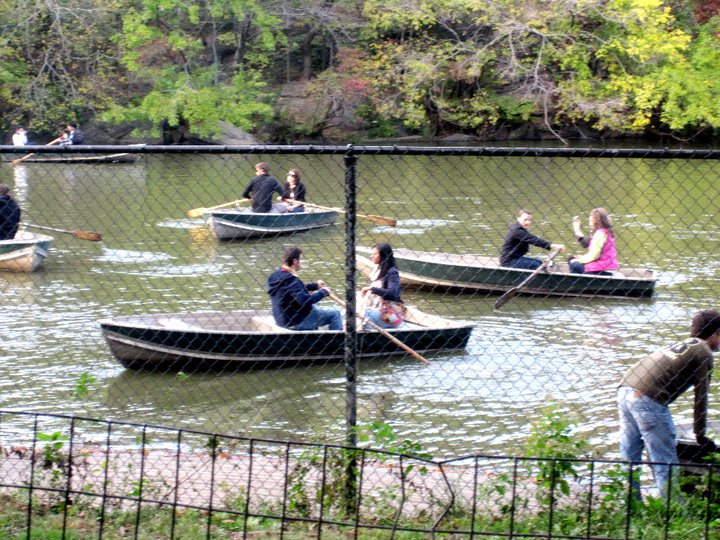
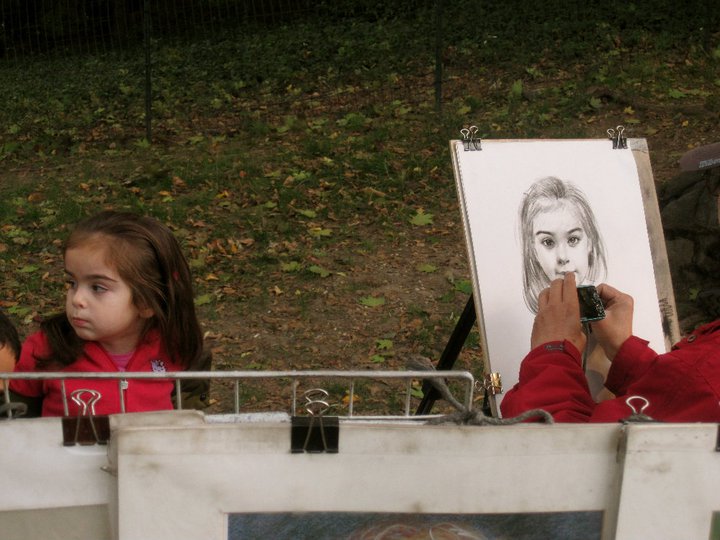
Photo Credit: Shereen Shafi

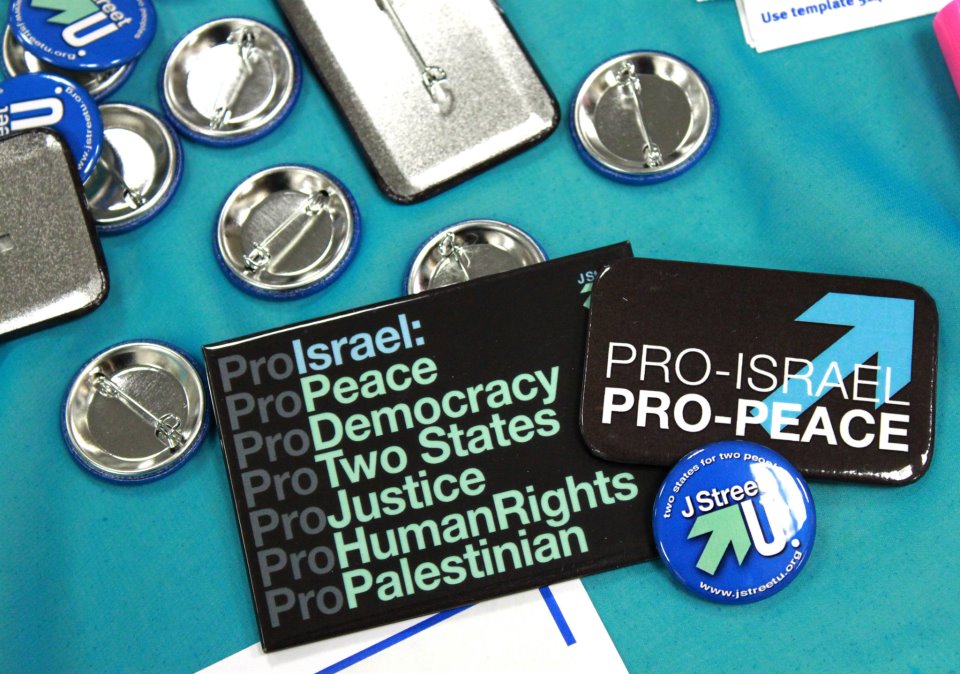
Hundreds of people, young and old, from all over the country, are writing short responses and recording videos about why they are the Future of Pro-Israel. Together we’re redefining the term. To be Pro-Israel no longer means you have to be “Anti-Palestinian” or place the conflict into a context of “good guys” and “bad guys”. People are smarter than that. People are tired of that. People know that for a complicated issue that has been going on for over sixty years, both sides have had their share of serious transgressions and mistakes. People want to start being intellectually honest, open and critical. People want to be Pro-Israel while still actively supporting a two-state solution.

Here are some videos from students I’ve met through my involvement with J Street U, that I’m proud to now call my friends. Maya Lee-Parritz from Bates college

Simone Zimmerman from UC Berkeley

Logan Bayroff from the University of Pennsylvania

Jenny Ferentz from Johns Hopkins University

Jacob Plitman from UNC

It’s incredibly important, empowering and necessary that J Street and J Street U are redefining what it means to be Pro-Israel in this politically frustrating country.

Race and the US Census

I’m a Sociology major, that means I just think about fun things like race, ethnicity, economic inequality, education, labor and immigration all day.

But seriously, I wanted to write this post because there are a lot of things I’ve learned about race in the past few years, that I previously never considered. I think people often don’t realize that race is so highly subjective and that its definition and meaning changes frequently, depending on the specific time period/social climate we’re living in. Race truly is a “social construct.” I’d guess that when people classify themselves into racial categories, they rarely realize that those classifications would have been drastically different decades earlier, and that they probably will be different in years to come.
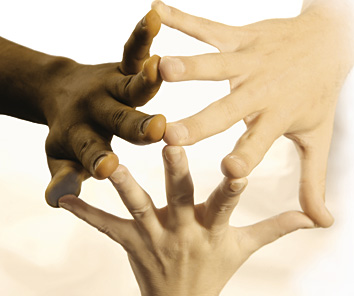
photo credit: dosomething.org

;

;

;

;

;

;

;

;

;

I’ll highlight some historical examples from past US Census questions.

Racial Categories in the Census in 1790:
Number of free white males under 16 years old
Number of free White males 16 years or older
Number of free White females
Number of other free persons
Number of slaves

^That was the entire Census. So to be clear, in 1790, there was no “black”, “Hispanic”, “Asian” “Native American” etc. The five categories listed above, according to the US Government, were the only categories Americans were to be grouped in.

Racial Categories in the Census in 1820:
This is the first time in US census history that the word “colored” was included as a category.

ex:
Number of male slaves under the age of 14
Number of free male colored persons under the age of 14

Racial Categories in the Census in 1850:
The Census was very different this year. For the first time in Census history, all free persons were listed individually, as opposed to being represented by the head of the household. There were two separate questionnaires in this census, one for slaves and one for free persons. On the questionnaire for the free persons, there was a question about color, where if the individual was White, they would leave the column blank. If they were Black, they would mark a “B” and if they were Mulatto (one black parent and one white parent) they would write “M.”

Racial Categories on Census in 1870:
The color question from 1850 was expanded to now include “C” for ‘Chinese’, a category that represented all individuals from East Asia, and “I” for American Indians.

Racial Categories on Census in 1890:
Because of the increase in immigration, this was the first year that the census made distinctions between different East Asian races, like Japanese and Chinese. This was also the first year that the term “race” was put into the questionnaires. Individuals were asked to write either “White” “Black” “Mulatto” “Quadroon” “Octoroon” “Chinese” “Japanese” or “Indian.”

Racial Categories on Census in 1900:
“Mulatto” was removed as a racial category

Racial Categories on Census in 1910:
“Mulatto” was added back
“Other” was added as an option. It had a line for unlisted races to be written in.

Racial Categories on Census in 1920:
Spots for Hindu, Koreans and Filipinos were added.

Racial Categories on Census in 1930:
This was the first and last year in Census history that “Mexican” was listed as a racial category. (After 1930, “Mexicans” were counted with Whites.)
Beginning this year, “Mulatto” was removed and from now on, if an individual had white and black ancestry, no matter how much white, they had to list themselves as “Negro.” This was known as the one drop rule.

Racial Categories on Census in 1950
The census removed the options of Hindu and Korean

Racial Categories on Census in 1960
Changed “Indian” to “American Indian”. Also created new categories like “Hawaiian” , “Part-Hawaiian” “Aleut” and “Eskimo”.
It also removed the “Other” option.

Racial Categories on Census in 1970
Readded the “Other” option, and “Korean.”
One option read as: “Negro or Black”

^This choice, ‘Negro or Black’ represented the social dynamics of 1970. In parts of the country, some people were still very much using the term ‘Negro’ while in other parts of the country that was no longer politically correct. It’s clear the US census was trying to balance that tension as well.

Racial Categories on Census in 1980
Added categories like “Vietnamese” , “Indian (East) Guamanian” and “Samoan”

Racial Categories on Census in 1990
When individuals marked the “Other” race option and provided a a multiracial answer, the response was recorded to whatever race was written first.
Ex: if someone wrote, “Black-White” they would be recorded as Black in the government system. “White-Black” would be White.

(note how the one-drop rule is no longer used in the data collection). The Census data of 1990 showed that the number of interracial families was growing at a very fast rate. White American and Asian American families made up 45% of these interracial families at the time.

Racial Categories on Census in 2000:
This year was a huge year for the US census. For the first time ever people could identify themselves as “Two or more Races”
It listed an option as “Black or African American”
It listed “Asian” and said that term referred to people having origins in the Far East, Southeast Asian, or the Indian subcontinent including, among others, Cambodia, China, India, Japan, Korea, Malaysia, Pakistan, the Philippine Islands, Thailand, and Vietnam.
It listed “Native Hawaiian” and “Pacific Islander” and defined that as people having origins in any of the original peoples of Hawaii, Guam, Samoa, or other Pacific Islands. It includes people who indicate their race as Native Hawaiian, Guamanian or Chamorro and Samoan.
The Census defined “Hispanic or Latino” as “a person of Cuban, Mexican, Puerto Rican, South or Central American or other Spanish culture or origin regardless of race.”

The ‘Two or more races’ option was a significant reflection of the growing diversity and increasing intermarriage rates in America.

Racial Categories on Census in 2010:
Because of growing social campaigns, the census made an effort to distinguish the Hispanic ethnicity as not being a race. It included a sentence that said, “Hispanic origins are not races.”
——————————————————————————————————————————————-

These were only a few of the many differences and alterations made in each US census about what race “is” and who is “what.” I think that’s important to keep in mind.

Last thought: Here’s an interesting story about Halle Berry and her ex-boyfriend fighting over what race their 2 year old daughter, Nahla, will be identified as. Halle Berry is the daughter of a white mother and black father. Her ex-partner, Gabriel Aubry, is French-Canadian and White. Halle Berry said about Nahla, “I feel she’s black. I’m black and I’m her mother, and I believe in the one-drop theory.” But essentially, what it really comes down to is that in the future, Nahla can choose to identify herself however she chooses. There are no real race rules. She can identify as “White” or as “Black” or, thanks to the changes in the 2000 census, if she wants she can identify herself as both “White” and “Black.”
Quotes from books I want to share

It’s strange but as I grow older, I find myself developing more optimism. I keep inching toward the point where I believe that it’s more difficult to have hope than it is to embrace cynicism. In the deep dark end, there’s no point unless we have at least a modicum of hope. We trawl our way through the darkness hoping to find a pinpoint of light. But isn’t it remarkable that the cynics of this world–the politicians, the corporations, the squinty-eyed critics–seem to think that they have a claim on intelligence? They seem to think that it’s cooler, more intellectually engaging, to be miserable, that there’s some moral heft in cynicism. But I think a good novel can be a doorstep to despair. I also think that real bravery comes with those who are prepared to go through that door and look at the world in all its grime and torment, and still find something of value, no matter how small.
-Let The Great World Spin, Colum McCann

I say that ambition is absurd and yet I remain in its thrall. It’s like being a slave all your life, then learning one day that you never had a master, and returning to work all the same. Can you imagine a force in the universe greater than this? Not in my universe. You know, even from earliest childhood it dominated me. I longed for achievements, to be influential–that, in particular. To sway people. This has been my religion: the belief that I deserve attention, that they are wrong not to listen, that those who dispute me are fools. Yet, no matter what I achieve, the world lives on, impertinent, indifferent, I know all this, but I can’t get it through my head.
-The Imperfectionists, Tom Rachman

He knew everything about literature except how to enjoy it.
-Catch 22, Joseph Heller

Without the poor to do awful work, we would spend our lives doing awful work. If the poor were not poor, if the poor were paid the way we’re paid, we couldn’t afford to buy an apple, a shirt, we couldn’t afford to take a trip, to spend a night at an inn in a nearby town.
-The Fever, Wallace Shawn

True enough, the Reverend Billing, when they caught up with him, turned out to be a thief, an adulterer, a libertine, and a zoophilist, but that didn’t change the fact that he had communicated some good things to a great number of receptive people. Billing went to jail, but no one ever arrested the good things he had released. And it doesn’t matter much that his motives were impure. He used good material and some of it stuck.
-John Steinbeck, East of Eden

Just because you’re an atheist, that doesn’t mean you wouldn’t love for things to have reasons for why they are.
-Jonathan Safran Foer, Extremely Loud and Incredibly Close

In order to sustain any activity, all people are obliged to regard what they are doing as useful and good. It follows that, whatever situation people may find themselves in, they will always work out an attitude to human life in general that accommodates their activity as something that seems useful and good. People usually imagine that a thief, a murderer, a spy, a prostitute, knowing their occupation to be evil, must be ashamed of it. But the very opposite is true. Men who have been placed by fate and their own sins or mistakes in a certain position, however irregular that position may be, adopt a view of life as a whole which makes their position appear to them good and respectable. In order to maintain this attitude people instinctively cling to groups of people who accept their concept of life and their place in it. We are shocked by thieves taking pride in their clever touch, prostitutes in their depravity and murderers in their callousness. But it is shocking only because the atmosphere of the circles they move in is restricted, and- what matters most- we are on the outside. But isn’t the same thing happening when rich men take pride in their wealth (which is theft), military commanders in their victories (which are murder) and rules is their power (which is violence) ? We do not see them as people who corrupt the concept of life, or good and evil, in order to justify their own situation, but only because the circle of people who share these corrupt concepts are wider, and we belong to them.
–Leo Tolstoy, Resurrection

Was everyone else really as alive as she was?…If the answer was yes, then the world, the social world, was unbearably complicated, with two billion voices, and everyone’s thoughts striving in equal importance and everyone’s claim on life as intense, and everyone thinking they were unique, when no one was.
-Ian McEwan, Atonement

Leave your opinions their own quiet undisturbed development, which, like all progress, must come from deep within and cannot be pressed or hurried by anything.
-Rainer Maria Rilke, Letters to a Young Poet

What has happened to Molly in her first eight years? More or less nothing. We have protected her from the world as best as we can. She has been brought up in a loving home, she has two parents, she has never been hungry, and she receives an education that will prepare her for the rest of her life; and yet she is sad, and that sadness is not, when you think about it, inappropriate. The state of the relationship between her parents makes her anxious; she has lost a loved one (and a cat); and she has realized that such losses are going to be an unavoidable part of her life in the future. It seems to me that the plain state of being human is dramatic enough for anyone; you don’t need to be a heroin addict or a performance poet to experience extremity. You just have to love someone.
-Nick Hornby, How To Be Good

And look at me, Little Igor, the bruises go away, and so does how you hate, and so does the feeling that everything you receive in life is something you have earned.
-Jonathan Safran Foer, Everything is Illuminated

But then Natasha committed the rookie mistake of trying to say something sincere and complicated at a party.
-David James Duncan, The Brothers K

Dignity is an affectation, cute but eccentric, like learning French or collecting scarves. And it’s fleeting and incredibly mercurial. And subjective. So fuck it.
-Dave Eggers, A Heartbreaking Work of Staggering Genius

And I urge you to please notice when you are happy, and exclaim or murmur or think at some point, “If this isn’t nice, I don’t know what is.”
-Kurt Vonnegut, A Man Without a Country

“‘Love is like falconry,'” he said. “Don’t you think that’s true, Cleveland?”

“Never say love is like anything,” said Cleveland. “It isn’t.”
-Michael Chabon, The Mysteries of Pittsburgh

Anything that goes wrong in other parts of the world can usually be attributed to the brutishness of foreigners. It’s a nice, simple world view.
-Jay McInerney, Bright Lights Big City

My trip to Canada

I just recently returned home from a trip to Canada where I visited Toronto, Ottawa and Montreal with the hopes of understanding more what the dynamics are in Canadian culture and politics–specifically relating to Canadian patriotism. I got to go, funded by Johns Hopkins, thanks to a fellowship I was awarded as an incoming freshman.

I learned a lot of interesting things. I remarked to a Canadian that I feel so ignorant that I had never known any of these things before about their country. He replied that frankly that sentiment is very common. He said Canadians view themselves through the metaphor of ‘an elephant and a mouse sleeping together in the same bed’ where the elephant never really pays any attention to the mouse, but the mouse is aware of the elephant’s every move.

Canadian patriotism is very interesting because it turns out it’s quite difficult to define what it means to be a Canadian. I asked everyone that I talked to what, in their minds, is a common ideal or symbol that Canadians unite over. Time and time again they sheepishly smiled and said, “That we’re not American.”  

I learned of this constant identity struggle Canadians have, where they want a distinct culture and identity, but the flood of American influence can’t be denied. Canada is a very big country with a relatively small population, and at least 90% of Canadians live within 200 miles of the border of America. American music blasts in their clubs, American businesses are established in their cities, and even American politics are often found on their front pages and news stations. Even if one makes the choice to watch Canadian TV, such as CBC, CTV, Global or Canadian specialty channels, American content will be well represented on those too. The book stores are filled with American magazines and authors. Fast food like Burger King, Pizza Pizza, Pizza Hut, Taco Bell, KFC,  Starbucks, Quiznos, McDonalds and Wendy’s can all be found in Canada.

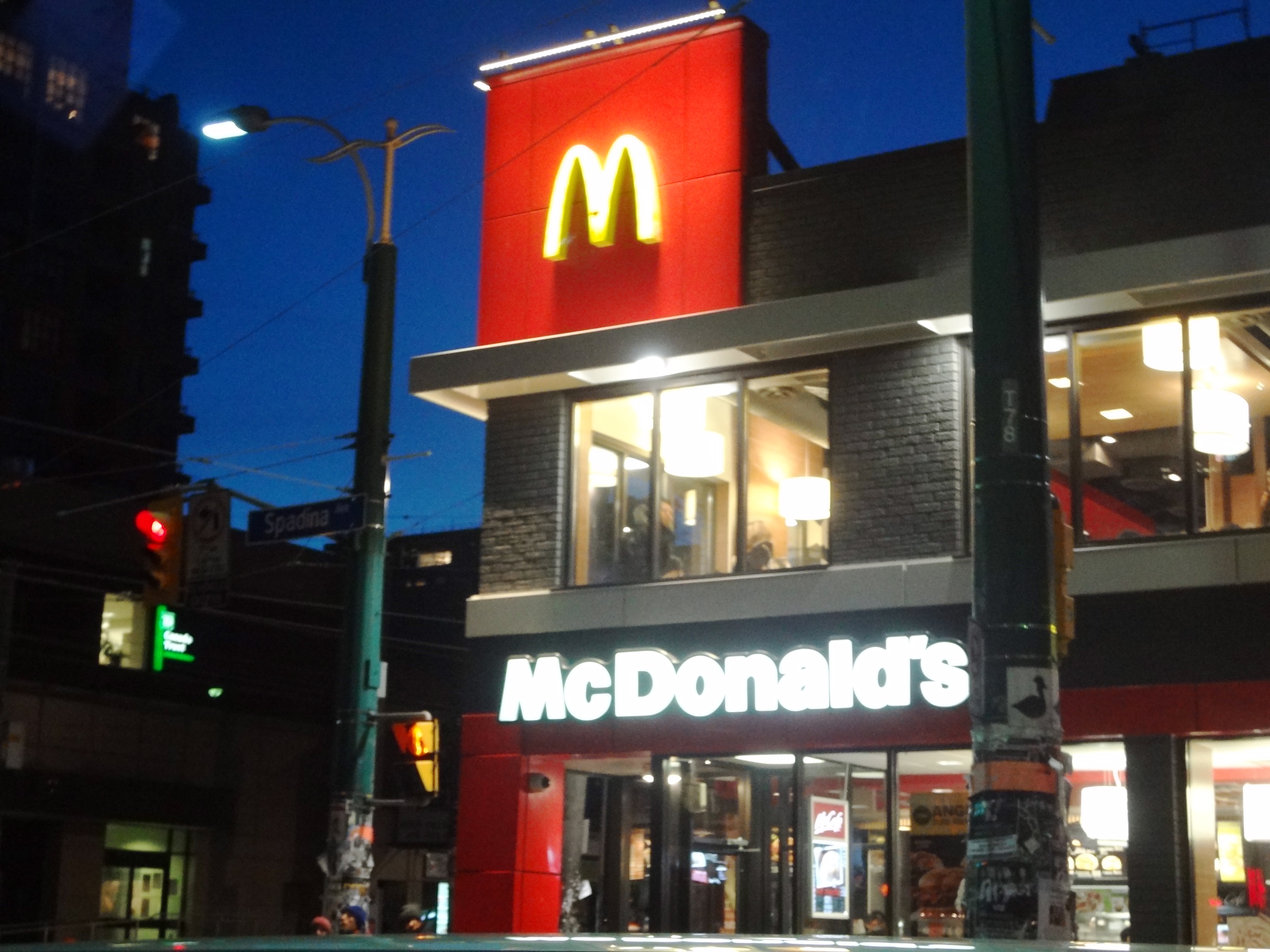
McDonalds in Toronto

It was common to see American flags flying next to Canadian flags. This is in Montreal

Canadians try and combat this issue with a variety of legislation meant to help Canadian businesses and artists and the like. It’s just often hard to compete with the power of big American chains like Costco, Sears etc. Target is expected to open 135 stores in Canada beginning in 2013 which retailers are really worried about.

While this is a problem throughout the entire country, the quest to distinguish itself from America seems even greater in Quebec, where the preservation of a french culture remains a constant struggle. The famous ‘Bill 101’ requires that signs in Quebec have to be listed in French, and if there is English on the sign French has to come first and dominate the sign. It also says that for companies that hire 50 or more employees, they are required to show that French is the primary language in the workplace in order to receive government contracts or funding. In some cases, with American chains, they might try to add a French word somewhere in the sign since they are not legally allowed to change the name of the industry.

Here's an example of an attempt to insert French culture to an American chain

I learned that there used to be a strong separatist movement that wanted Quebec to break off from the rest of Canada and form its own country. While there are still some separatist, super-nationalist Francophones who dream of a separate Quebec living there today, I gathered that the movement has generally died down in the past couple decades, and younger Canadians living in Quebec seem to recognize the global advantage to mastering English, as well as living in their beloved French culture.

So a big thing I must touch on in this post is ‘multiculturalism.’ This is a huge aspect of Canadian identity. Because Canada is made up of French peoples, British peoples, and First-Nations [what we’d call Native Americans], Canadians like to say they are a ‘mosaic’ rather than the American ‘melting pot.’ I met some people on my trip who definitely felt that this metaphor was true, and that Canada does a much better job than the US in helping people maintain different cultures and identities. The flip side is, I met a fair number of Canadians who told me that the metaphor is bullshit, and Canada hides behind these narratives that they are “peacekeepers” and “tolerant” when in fact their minorities suffer from prejudice and discrimination too.  I’m not totally sure what I believe, but I will say I felt Canadians too often tried to say that while there are many diverse cultures in Canada, Americans are simply one blended American culture. I find this inaccurate, there are pockets of  ethnic culture throughout the country. From the Chinatowns, to the Little Italy’s, to the Jewish communities, to the Christian towns, to the Irish villages to the Latino areas. There was definitely some oversimplification of what “Americans” are like.

With regards to multiculturalism and patriotism, so much of how Canadians view and understand themselves is based on what province they’re from. [There are ten provinces and three territories.]  In Canada, I met people who would tell me how while multiculturalism was revered in some provinces, Quebec for example has a lot of bad feelings towards Pierre Elliott Trudeau, the Prime Minister of Canada who enacted the multicultural legislation. [The Quebecers felt that in order to elevate other cultures and identities to an equal playing field in Canada, their French culture suffered a loss of status and prestige that they had been very proud of.]

This is pretty similar to how the American South often has very different historical understandings of what happened in the Civil War and antebellum period. Some people will celebrate Stonewall Jackson Day instead of MLK day, or refer to the Civil War as “The war of Northern Aggression” or venerate Confederate soldiers that are immortalized in statues in parks.

It’s interesting to think about what a national narrative can mask.

I'm a real Canadian now!

A 90th Birthday Party

Today I attended my grandfather’s 90th birthday party. It was an interesting experience, seeing a room filled with so many people spanning different generations. We had my 90-year-old grandfather holding my six-week-old cousin’s hand. And it made me wonder, how does 2011 look to someone born in 1921?

When I hear “1920” I think of abstract AP US history identifications. Flappers and stock market crashes. Nativism and Immigration bills. Wilson and World War 1. Not my real, breathing, brownie-baking grandfather.

I started to think about what it must have been like to witness all that he has. From the depression, to the New Deal, to fighting in the World War 2, to the Cold War, to the computer, to 9/11, to cell phone apps.

Now, I could be off the mark with this thought, but I think as my generation and I get older, the changing world will be a lot less scary and foreign for us in 70 years than it was for my grandfather. And I think it’s because we’re always expecting it to be. I understand that the world I’ve grown up in is changing at a much faster rate than in any other period in human history. Every time I find a new device or company that I love, I use it happily while also keeping the thought in the back of my mind that in 2 years it just might not exist.

I can recall so clearly 5 years ago when all my friends bought blackberries. Everyone wanted to BBM. If you had an upgrade, you were getting a blackberry. (Unless your parents didn’t want to pay for a data plan, which is understandable. But you were jealous.) Now no one is buying blackberries anymore and iPhones are dominating the cellular market. I use my iPhone4 knowing well that the iPhone 5 is coming out soon, and in a few years, developers will have created apps and features that won’t function on my future obsolete phone, even though for the moment, it’s state of the art.

Every program I use I know developers are working on an upgrade that will be released in a matter of time. Every technology I find convenient, I know brilliant computer scientists, businessmen, and engineers are out thinking of innovative new ways to beat that product. “Disruptive technology” was a term my friend Max said to me today as we were talking about this.

For the majority of the 20th century, disruptive technology just wasn’t something people had to deal with that much. When the television came out in the 50’s that was a big deal. People were outraged, scared and delighted. People were convinced the television had forever changed life as they knew it. And though hyperbolic, I can understand their hysterics. They had hardly any practice in adapting to disruptive technologies. But we are. We anticipate it in a way I don’t think ever has really been before.

So what does that mean for us? Well, I don’t really know. I by no means claim that we’ll be able to be compete in our old age with savvy twenty-year olds. They’ll most likely be sharper and cleverer than us. But…. I still have this feeling that we’ll look at our rapidly changing world not with an outsider’s eye. We’ll have grown up with the pace of the world, and it’s our pace. I’ll argue that it will be much harder to feel like foreigners to a pace we’ve always been conditioned to expect.

We shall see