Did The Koch Brothers Just Doom America to a Future of Crumbling Roads and Tunnels?

Originally published in The American Prospect on February 4th, 2015.
———–

It was never going to be easy for the Republican-controlled Congress to pass an increase to the federal gas tax—a tax that finances the Highway Trust Fund and pays for roads and bridges around the country. Last raised in 1993 to 18.4 cents per gallon, the tax has since lost much of its value, especially with the rise of fuel-efficient cars. With the Highway Trust Fund running huge annual deficits, plans for many infrastructure projects and repairs have been left hanging out to dry.

There were signs that raising the federal gas tax was possible, as when Republican Senators John Thune of South Dakota and chairman of the Senate Commerce, Science and Transportation Committee, said in early January that a gas tax increase couldn’t be ruled out, and Jim Inhofe of Oklahoma, who chairs the Environment and Public Works Committee, later agreed with him.

Well, forget it. Because last week more than 50 conservative groups, a number of them funded through the Koch brothers’ network, sent a letter to Congress expressing adamant opposition to raising the federal gas tax.

“Everyone knew it would be difficult, but you had a lot of senators and representatives saying privately that they would be open to raising the gas tax, so long as it could be framed in a certain way,” a high-ranking American Public Transportation Association official told me. “This letter just killed our momentum, I think permanently.”

While incredibly frustrating, this move is unsurprising given the rise of anti-tax groups committed to blocking serious public investment in national infrastructure. In addition to opposing the gas tax increase, the letter also calls for an end to all federal funding for biking, walking and public transit. Ever so disingenuously, the organizations claim they just want to look out for the needs of poor people.

As Angie Schmitt, a writer for Streetsblog USA, put it:

The billionaire-friendly coalition is trying to play the populist card. Raising the gas tax to pay for roads, they say, is “regressive” because poor people will pay more than rich people if the gas tax is increased. But eliminating all funding for transit, biking, and walking, which people who can’t afford a car rely on? Not a problem to these guys.

The first signature on the letter belongs to Brent Wm. Gardner, vice president of government affairs for Americans for Prosperity, the organization founded in 2005 by the billionaire brothers, Charles and David Koch. In my feature in the current issue of The American Prospect magazineI look at Chris Christie’s cancellation of a new rail tunnel desperately needed in the Northeast, and the role that the national Republican Party and anti-tax groups played in the New Jersey governor and prospective presidential candidate’s decision to kill the project known as ARC (Access to the Region’s Core). Now, in the wake of damage from Superstorm Sandy, civil engineers are unsure that the tunnels currently in use by hundreds of thousands of commuters between New York and New Jersey will hold out for another 10 years.

Building a new tunnel would have required Christie to raise his state’s low gas tax, a move that the New Jersey chapter of Americans for Prosperity has been rallying against for years. From my article, “Blind to the Future”:

Mike Proto, the New Jersey communications director for Americans for Prosperity, the Koch-funded anti-tax group, says that Christie’s decision to kill the ARC project “was one of the best he’s made.”

It’s unclear what it will really take to get this country to invest in its future. We should pray it’s not a big, preventable disaster that kills thousands of people. Building new tunnels, fixing broken bridges, and making America just generally safe to live in should be an urgent bipartisan priority for everyone.

It should be, and it used to be.

Blind to the Future: Chris Christie and the Republican Default on Public Investment

Originally published in the Winter 2015 issue of The American Prospect.
————

Some day not long from now, if you are traveling by rail in the Northeast, you may be stuck in a train waiting to enter a tunnel under the Hudson River between New York and New Jersey. Perhaps your grumbling seatmate curses Amtrak, New Jersey Transit, or politicians generally. But one leader in particular will deserve to be singled out on such occasions: Chris Christie, who, as governor of New Jersey in 2010, blocked a joint federal-state project to build a new passenger rail tunnel.

Today, few outside the New York metropolitan area know much about Governor Christie’s decision to veto the Access to the Region’s Core plan (ARC), a $9.8 billion project in the works for nearly 20 years that would have doubled cross-Hudson rail capacity, with a projected 2018 completion date. Christie gained notoriety for one Hudson River tie-up in September 2013, when his aides and allies closed traffic lanes at the George Washington Bridge as political retribution against a local Democratic official. But compared to “Bridgegate,” as that twisted tale came to be known, Christie’s veto of the new rail tunnel is a far more serious scandal. For the sake of short-term political gain, Christie sacrificed the long-term interests of his state and the nation. The story of the blocked tunnel is also evidence of a wider problem: Republican leaders’ refusal to deal with failing infrastructure for fear of raising taxes and antagonizing anti-tax groups on the right.

Transportation authorities have long agreed on the need for new rail tunnels under the Hudson River. Built more than 100 years ago, the two existing tunnels are inadequate to handle projected ridership growth and have suffered serious deterioration. Tunnel traffic already operates at 95 percent capacity during morning rush hour, with a train entering Midtown Manhattan from New Jersey every two minutes. As a result, the tunnels are the biggest choke point along the Northeast Corridor between Boston and Washington, D.C., limiting the potential for passenger rail to expand as the region’s population grows and congestion on the highways increases.

In October, Amtrak reported that the seawater that poured into the tunnels during Hurricane Sandy contained chlorides and sulfates that significantly damaged the concrete bench walls, the wiring in the signal, electrical, and mechanical systems, and the tracks themselves.

The tunnels’ age and deterioration also pose significant risks of disrupted travel in the near future. In October, Amtrak reported that the seawater that poured into the tunnels during Hurricane Sandy contained chlorides and sulfates that significantly damaged the concrete bench walls, the wiring in the signal, electrical, and mechanical systems, and the tracks themselves. Closing just one of the tunnels for repairs, however, would reduce tunnel traffic by a stunning 75 percent, since the remaining tunnel would have to accommodate trains running in both directions. No one knows for sure when that might become necessary.

Rail transportation between New Jersey and New York is vital to the economy of both states as well as the nation, not to mention the 160,000 passengers who ride trains through the tunnels every day, mostly to and from work. But in October 2010, without offering any alternative plan, Christie killed the ARC tunnel and used the $1.25 billion in state funds previously set aside for the project to plug a hole in his budget and avoid a tax increase. It was a move that served Christie’s presidential ambitions—as long as the public doesn’t understand just what he did and why it ought to disqualify him from national leadership.

The ARC of the Past

Construction of the ARC tunnel had already begun when Christie was elected governor in November 2009. The groundbreaking five months earlier was a rare moment of elation for transit advocates and policymakers who had been pushing for the project for nearly two decades. At the groundbreaking ceremony, Peter Rogoff, who had just been confirmed to lead the Federal Transit Administration (FTA), contrasted ARC with projects that previously had been “either debated to death or simply ignored.”

According to the Government Accountability Office, the project would have generated 44,000 permanent jobs as well as 5,700 construction jobs.

The new ARC tunnel would allow an additional 25 trains an hour to enter New York City and was projected to increase daily passenger trips between New Jersey and New York to 254,000. The tunnel’s economic benefits had long been documented. According to the Government Accountability Office, the project would have generated 44,000 permanent jobs as well as 5,700 construction jobs. Easy access to New York City, the region’s commercial hub, is critical to New Jersey’s economic growth. The Regional Plan Association, an urban research and advocacy organization for the New York metropolitan area, estimated that increased rail capacity would raise the value of homes within two miles of New Jersey train stations by a total of $18 billion, reducing pressure to raise property tax rates.

The costs of the ARC tunnel were to be split three ways. The federal government and the Port Authority of New York and New Jersey would each contribute $3 billion. (Jointly controlled by the two states, the Port Authority is a self-sustaining public authority, with revenues from its bridges, tunnels, airports, and marine terminals.) New Jersey would pay $2.7 billion since the tunnels were largely for New Jersey Transit riders and the state would reap sizable economic benefits. The federal contribution marked the largest funding commitment ever pledged for a transit project in the nation’s history.

When he became governor, Christie faced a choice. On the campaign trail, he had supported the ARC project and pledged to reduce taxes. But as governor, he would be unable to do both.

New Jersey’s dedicated Transportation Trust Fund was broke. The fund was designed in 1984 to finance roads, bridges, and other infrastructure projects by floating bonds that would be paid off with the proceeds of the state’s gasoline tax, tolls, and other earmarked revenue. But in 2010, New Jersey’s gas tax hadn’t been increased since the 1980s. At 14.5 cents per gallon, it was (and is) by far the lowest in the region. Pennsylvania’s gas tax, in contrast, is 41.8 cents per gallon, while New York’s is 50.5 cents. In 2009, New Jersey’s gas tax was 47th in a ranking from highest to lowest among the 50 states. (It is now 49th.)

Many had expected New Jersey to raise its gas tax to meet its obligations for the ARC tunnel and other transportation investments. But Christie was emphatically opposed. In January 2011, after killing the ARC tunnel, he declared, “With rising gas prices right before us, the idea of raising taxes in this economy is something that this administration simply will not do under any circumstances.”

At the time he killed the tunnel, Christie claimed that the project would force New Jerseyans to pay $2 billion to $5 billion in cost overruns. According to a 2012 study by the Government Accountability Office (GAO), however, the projected range of costs for the ARC project was effectively unchanged between the time Christie took office and when he canceled it. Federal and state officials had long said that costs might run from $9.5 billion to $12.4 billion. If costs did rise toward the higher figure, the GAO report concluded, there was no evidence that New Jersey would have to shoulder those overruns alone.

Despite bipartisan support for the tunnel, some criticized the design, which would take New Jersey Transit riders to a new station under Macy’s department store in Herald Square, a short walk from midtown’s Pennsylvania Station, the NJT trains’ current destination. The plan had been a compromise negotiated with state and city officials in New York.

fter Christie announced the cancellation, state and federal officials pressured him to reconsider, but he allowed only two weeks for further discussions. Federal representatives made several trips to New Jersey to try to work out a solution. Both New Jersey Transit and the FTA proposed ways to save the project, including trims to the project’s scope and alternative financing measures such as public-private partnerships. But Christie wouldn’t budge.

“Christie’s behavior was so rash, so hurried, and he was so unwilling to listen to other points of view, even from his own transit agency,” says Martin Robins, the initial ARC project director and director emeritus at the Alan M. Voorhees Transportation Center of Rutgers University.

Perhaps Christie was unwilling to listen because killing the ARC project had an additional advantage besides avoiding a gas tax increase. It also enabled him to redirect more than $3 billion that had already been put aside for the tunnel.

Diverting the Tunnel Money

In a commuter state like New Jersey, transportation spending is a hot political issue. Christie’s Democratic predecessor, Jon Corzine, had set off a political firestorm in 2008 when he tried to pass a plan that would have used dramatic increases in highway tolls over a 12-year period to cut the state’s $32 billion debt in half and pay for transportation improvements. Although the plan was defeated, Corzine did succeed in doubling tolls on the New Jersey Turnpike. While the revenue wasn’t enough to resolve the state’s long-term fiscal problems, it included $1.25 billion earmarked for the future ARC tunnel.

Christie took that money as well as $1.8 billion from the Port Authority’s ARC capital fund and used the more than $3 billion in total to pay for road and bridge projects in the state. Critics insisted that Christie did not have the legal authority to redirect those Port Authority funds to state infrastructure repairs, but he did so anyway. (The Securities and Exchange Commission and the Manhattan District Attorney are currently investigating the legality of the diversion.)

Christie’s use of the funds was part of a larger pattern regarding the Port Authority. He crammed more than 60 political appointees into what had long been a highly professional, independent agency. It was through those appointees that lanes on the George Washington Bridge were closed in 2013 to send a message to a local official who refused to endorse Christie for re-election.

Under the Port Authority’s rules, a governor of New York could have refused to go along with the diversion of the tunnel money. But Christie’s move came just as Andrew Cuomo was elected governor. “By January 2011,” Robins said, “the first thing on Cuomo’s desk was Christie’s demand to the Port Authority that $1.8 billion be given to New Jersey for highway projects, and [Cuomo] approved it.” The ARC tunnel was generally considered a New Jersey project, and Cuomo may have wanted Christie’s cooperation with projects such as rebuilding the World Trade Center in New York.

But the diversion of the tunnel funds meant that besides forfeiting $3 billion in federal money, New Jersey would no longer have Port Authority funds or its own capital set aside for a future tunnel. As the editorial board of the Newark Star-Ledger—New Jersey’s largest-circulation newspaper—put it this past August:

If this were about fiscal responsibility, New Jersey’s tunnel money would have been set aside until a better project came along. Instead, commuters and taxpayers are left with no tunnel, and no tunnel fund—and no solid prospects for building either one.

The implications of Christie’s decision go well beyond New Jersey because passenger rail development along the Northeast Corridor depends on expanding the Hudson River tunnels.

The implications of Christie’s decision go well beyond New Jersey because passenger rail development along the Northeast Corridor depends on expanding the Hudson River tunnels. Peter C. Goldmark Jr., who served as executive director of the Port Authority from 1977 to 1985, points out that except for the interstate highway system, America’s transportation infrastructure lacks a “systemic” owner. “Each piece of an artery like the Northeast Corridor needs the political and often financial support of the states,” says Goldmark. “So any single governor has a huge ability to slow down or shut down a ‘piece’ of what is really a system.”

“ARC was a carefully crafted project over two decades, two governors, and two mayors,” observes Richard Leone, who was chairman of the Port Authority from 1990 to 1994. “It’s tough to get a package approved by the state, and then approved in Washington, and whether right or wrong, [Christie] should have had to make a case that it was really worth abandoning, or that he had a better use for the funds. [The money] was essentially used to fill potholes in the budgets.”

And to help propel Christie’s rise onto the national stage.

The National Politics of Public Investment

Cancelling the ARC tunnel had national political ramifications. The federal funds for the project came partly from the stimulus program that President Barack Obama and congressional Democrats had passed in response to the Great Recession. “The Obama administration really wanted [the ARC project] to go on,” a senior New York transportation official recalls. “It was the definition of ‘shovel ready,’ so basically the poster project of the American Recovery and Reinvestment Act.”

Christie’s cancellation of ARC earned him points with the Republican Party and conservative anti-tax groups. “I refuse to compromise my principles,” Christie boasted to prominent Republicans at a conference hosted by the George W. Bush Institute in 2012. “No matter how much the administration yells and screams, you have to say no. You have to look them right in the eye, no matter how much they try to vilify you for it, and you have to say no.”

Mike Proto, the New Jersey communications director for Americans for Prosperity, the Koch-funded anti-tax group, says that Christie’s decision to kill the ARC project “was one of the best he’s made.”

The political advantages for Christie from cancelling the ARC tunnel reflect a deeper malady: the role of anti-tax conservatives in blocking public investment to meet future needs or even to maintain vital systems in good repair.

Today, the basic elements of America’s transportation infrastructure—roads, tunnels, bridges, and passenger rail lines—are in abysmal shape. According to the American Society of Civil Engineers’ 2013 Report Card, one in nine of the nation’s 607,000 bridges are “structurally deficient.” The Federal Highway Administration estimates that annual investments of $20.5 billion would be needed to eliminate the nation’s bridge backlog by 2028—$8 billion more per year than is currently spent.

Infrastructure spending as a percentage of GDP, according to the Congressional Budget Office, has dropped from 3 percent prior to the 1980s to less than 2 percent today. In addition, average state gas taxes, the most important source of state transportation funding, have not kept up with inflation. The Institute on Taxation and Economic Policy, a nonpartisan state and federal tax policy think tank, found that, on average, a state’s gas tax rate has effectively fallen by 20 percent since the last time it was increased.

Stagnant earnings for working-class and middle-income Americans have also undermined support for public spending and have created an opportunity for anti-tax groups to gain a greater following. Yet Americans were poorer during the 1930s than they are today, and the country still undertook public works on a massive scale. In fact, as the economic historian Alexander Field argues in his book A Great Leap Forward: 1930s Depression and U.S. Economic Growth, the infrastructure investments during that period had an enormous payoff in higher growth in subsequent decades.

Public investment has a long history in the United States, dating back to New York State’s construction of the Erie Canal (opened in 1825), federal land grants to support the transcontinental railroad (a project of the Republican Party in the 1860s), and federal financing of the interstate highway system (created under a Republican president, Dwight Eisenhower, in the 1950s). Until relatively recently, public investment in transportation has been an area of bipartisan agreement. Especially in the Northeast, many Republican officials in the tradition of former New York Governor Nelson Rockefeller joined Democrats in supporting the development of infrastructure, including public transit.

Nationally, however, the Republican Party of the 1860s, the 1950s, or even the 1980s is not the Republican Party of today. Since the 1994 Republican “revolution” under Newt Gingrich, many areas of policy that were previously bipartisan have become polarized, and one of those is transportation. With fewer Rockefeller Republicans and more Tea Party types, the efforts of transportation advocates to find Republican allies have become more difficult.

In September 2010, Republicans lined up against Obama’s $50 billion transportation stimulus package. Then the 2010 midterms brought a wave of Tea Party Republicans to Congress and state governments. Newly elected Republican governors in Wisconsin (Scott Walker), Ohio (John Kasich), and Florida (Rick Scott) positioned themselves against federally funded passenger rail projects, which they denounced as wasteful initiatives that would drain state budgets. All three governors proudly rejected millions of dollars in federal grants for rail projects that had been previously awarded to their states.

The shift of the Republican Party’s center of gravity from the Northeast to the South has also affected the party’s views of transportation.Public transit—passenger rail in particular—is far less developed in the South and has less support there than in the Northeast and urban centers in the Midwest.

As a result, Republicans have grown more opposed to projects like the ARC tunnel, which would help increase passenger-rail capacity in the Northeast. In 2012, House Republicans introduced a transportation bill (including cuts in Amtrak subsidies and increases in truck-weight limits) that Ray LaHood, secretary of transportation during Obama’s first term, called “the worst transportation bill I’ve ever seen during 35 years of public service.” LaHood himself had been a seven-term Republican congressman from Illinois before he agreed to serve in Obama’s cabinet.

The increased opposition to public transit in the Republican Party is the context for understanding Christie’s cancellation of ARC. Although his decision broke with the long tradition of Northeast Republicans, he was positioning himself well within the mainstream of today’s national Republican Party.

Derailing Passenger Rail

The partisan politics of transportation show up in differing policies and attitudes toward public transit and the automobile. Consider what happened to transportation costs and spending in New Jersey when the Corzine administration gave way to Christie’s. Corzine had raised highway tolls (and would have raised them more) to finance transportation projects, including the ARC tunnel. Together with Cuomo, Christie did approve an increase in tolls for vehicles on cross-Hudson bridges and tunnels. But he canceled ARC, used the bulk of the money for roads, and pledged not to raise the gas tax. Three months after Christie assumed office, New Jersey Transit raised its fares by 25 percent.

Nationally, passenger rail has recently undergone significant growth after a long period of decline that came with the rise of the auto and air travel. Between 1946 and 1964, the annual number of rail passengers dropped from 770 million to 298 million. By 1965, according to the GAO, only 10,000 rail passenger cars were left in operation, 85 percent fewer than in 1929. But that trend has reversed. Amtrak has now been carrying record numbers of passengers; ridership grew by 55 percent from 1997 to 2012.

Yet passenger rail still faces an obstacle in public opinion. Many people, particularly conservatives, have a double standard in judging subsidies for rail versus subsidies for roads. Americans are socialists when it comes to financing roads. Government is just expected to build them and make them free for people to drive on. Most streets and highways don’t even have tolls. Yet year after year, Amtrak gets criticized for needing substantial federal subsidies to maintain expensive—and obligatory—long-distance routes.

“We spend an awful lot of money building and maintaining a system for people to travel on with cars and trucks … but mass transit is always seen as this expensive add-on,” says Leone.

“We tell ourselves this little myth that our gas taxes fund everything,” says Phillip Longman, a policy expert at the New America Foundation. Indeed, as the Tax Foundation, a tax policy research group, found, gas taxes and tolls cover only a third of all state and local road spending.

Getting Rail Back on Track

In the wake of Christie’s decision to cancel the ARC tunnel, the challenges facing passenger rail in the Northeast are steep. As Amtrak officials point out, even if the ARC tunnel had been built to handle commuter rail between New Jersey and New York, Amtrak would have still needed additional capacity under the Hudson River to accommodate the burgeoning travel demand along the Northeast Corridor. With ARC, Amtrak wouldn’t have faced the same degree of time-sensitive pressure for tunnel construction, but the long-run need is for even bigger investments.
Amtrak’s proposed alternative, known as the Gateway program, would include a new two-tube rail tunnel under the Hudson River, with a price tag that could reach $16 billion. The full Gateway program also calls for an expansion of Penn Station and the development of other transportation arteries into New York and would not be completed until 2030. Amtrak estimates that the new tunnel could be built by 2025 if funds were appropriated immediately. Amtrak officials are not sure, however, whether the existing tunnels will hold up for another decade in light of the damage from Hurricane Sandy.

“We don’t yet know what the rate of deterioration will be for the existing tunnels in terms of reliability of service,” says Stephen Gardner, the vice president of Northeast Corridor development for Amtrak. “We can see the damage, but we don’t know what that will mean for future operations.” Currently, Amtrak says, repair work on the tunnels is being done during 55-hour weekend periods, but “longer-term closures cannot be avoided.

The damage from Sandy highlights a new issue that policymakers must take into account: the need to “climate-proof” infrastructure so that it can withstand future storms and rising sea levels. Climate-proofing will require even heftier investments than previously envisioned.

But there is another kind of climate—the political climate—that stands in the way of addressing these needs. Neither the federal government nor the state has committed the necessary capital for rail and other infrastructure development. The federal stimulus dollars are gone, the funds that New Jersey previously earmarked for ARC have been spent, and New Jersey’s Transportation Trust Fund has been depleted.

In New Jersey, the state government’s finances have spiraled downward under Christie’s leadership. New Jersey’s credit rating has been downgraded eight times. The state pension system has lost billions of dollars under management by one of Christie’s political appointees. After Christie withheld legally required state contributions to the pension fund, the fund’s trustees filed a lawsuit against the governor to demand that the payments be made. And Christie’s support at home has been slipping. A Rutgers University poll released last October found that more New Jersey voters held an unfavorable impression of Christie than a favorable one.

Still, many Republicans in the country consider Christie a real leader, a “tough guy” who stands up to big interest groups (like schoolteachers!). After friendly gestures toward Obama in 2012, Christie won re-election as governor the following year with 60 percent of the vote, including 32 percent of registered Democrats. Since then, Christie has been cultivating support from the Republican base. As chairman of the Republican Governors Association, he spent significant amounts of time throughout the 2014 midterm election season campaigning for Republicans in 37 states, all the while expanding his own personal national donor network.

Enthusiasm among Republicans for Christie may not be as robust as it once was, but he remains a serious contender for the party’s presidential nomination. After all, Republicans around the country are not going to ask why the governor of New Jersey canceled a rail tunnel under the Hudson River. And Christie will be long gone from state politics when people in the region are left to suffer the consequences of that decision.

In the wake of Christie’s decision to cancel the ARC tunnel, the challenges facing passenger rail in the Northeast are steep. As Amtrak officials point out, even if the ARC tunnel had been built to handle commuter rail between New Jersey and New York, Amtrak would have still needed additional capacity under the Hudson River to accommodate the burgeoning travel demand along the Northeast Corridor. With ARC, Amtrak wouldn’t have faced the same degree of time-sensitive pressure for tunnel construction, but the long-run need is for even bigger investments.


‘Housing First’ Policy for Addressing Homelessness Hamstrung By Funding Issues

Originally published in The American Prospect on January 27, 2015.
_________

In an era of shrinking financial resources, policymakers, providers, and activists who work on homelessness prevention and care in the United States have been forced to develop new strategies. There was a time when officials at the Department of Housing and Urban Development (HUD) saw it as their responsibility to provide both housing and supportive services for homeless individuals, but now HUD now is refocusing its budget predominately on rent and housing—with the hope that other local, state, and federal agencies will play a greater role in providing supportive care. However, whether other organizations will actually be able to pick up those costs and responsibilities remains unclear.

The first major federal legislative response to homelessness was the McKinney-Vento Act of 1987, which passed both the House and Senate with large bipartisan majorities. The McKinney Act—which Bill Clinton later renamed the McKinney-Vento Homeless Assistance Act—provided funds not only for emergency shelter, transitional housing, and permanent housing, but also for job training, primary health care, mental health care, drug and alcohol treatment, education programs, and other supportive services. The consensus was that homelessness is a complex problem whose solution requires more than simply a roof and a bed.

The statutory goal of the McKinney Act was to gradually move homeless people toward stable housing and independence—a model that came to be known as “Housing Readiness.” Though this sprung from well-meaning intentions, it eventually became clear that this “gradual” approach frequently led to unwise and unfair ways of distributing welfare.

“We had this system that said homeless people essentially have to earn their way to permanent housing,” explained Ed Stellon, the senior director of the Midwest Harm Reduction Institute, and someone who has worked within the substance use and mental health treatment systems for more than 20 years. “Homeless people had to earn their way into transitional housing, make progress on certain goals, and finally when they were deemed well enough, they would earn their spot in permanent housing.”

A different model, known as “Housing First”, has been gaining steam over the past decade. What at first sounded revolutionary now feels fairly obvious: The Housing First approach posits that the only requirement for housing should be homelessness—that shelter is a right, not a privilege. “Plus, if you have conditions like out-of-control diabetes, congestive heart failure, or schizophrenia, housing is actually part of the solution,” adds Stellon. “It’s hard to make any meaningful progress on these chronic conditions without stable housing.”

Though exact estimates are hard to come by, HUD recently reported that as of January 2014, the chronically homeless numbered some 84,291, with 63 percent of those individuals living on the streets. HUD says this number has declined by 21 percent, or 22,937 persons, since 2010—in large part because of the embrace of Housing First. (Some, however, have accused the federal government of using data gimmicks to paint a more cheery picture of progress than has actually been made.)

Nevertheless, the reality is that at the same time policymakers are embracing the idea of Housing First, fewer affordable housing units exist than ever before. According to the National Low Income Housing Coalition, federal support for low-income housing has fallen 49 percent between 1980 and 2003, and the Joint Center for Housing Studies found about 200,000 rental units are destroyed annually. Research also suggests that a supply of 8.2 million more units would be needed to house extremely low-income households, up from a gap of 5.2 million a decade earlier. Though Congress recently authorized funding for the National Housing Trust Fund—an entity that was created in 2008 to fund affordable housing proects—its budget is nowhere near large enough to meet the demand.

“We’re not doing enough to expand housing availability, and HUD can’t expand its services unless Congress allocates it more funding,” says Barbara DiPietro, the director of policy for the National Health Care for the Homeless Council.

Given the fiscal climate, HUD is looking for new ways to spend its increasingly limited budget. Consequently, the agency is moving away from the supportive services that, through the McKinney-Vento Act, once accounted for most of its spending. In 1998, for instance, 55 percent of HUD’s budget was spent on supportive services, and 45 percent was awarded for housing. By 2013, just 26 percent of HUD’s competitive homeless assistance funds went to supportive services, and 66 percent was spent on housing. According to Ann Oliva, director of HUD’s Office of Special Needs Assistance Programs, the department’s goal now is to help local communities become more strategic with existing resources and available opportunities.

To do this, HUD has been working closely with other federal agencies, especially the Department of Health and Human Services (HHS), the Department of Veterans Affairs (VA), and the U.S. Interagency Council on Homelessness. In 2008, a joint program known as HUD-Veterans Affairs Supportive Housing (HUD-VASH) launched, combining housing vouchers for homeless veterans provided by HUD, with case management and clinical services provided by the V.A. Experts agree that HUD-VASH has been quite successful in helping both vets and their families, and it’s typically held up as the poster child for future interagency collaborative efforts. However, the program came with additional appropriated dollars, and it is typically easier to convince Congress to fund programs for impoverished military veterans compared to other downtrodden groups.

One of the most significant recent changes to homelessness policy has come through the expansion of Medicaid—a key feature of the Affordable Care Act. Now that nearly all individuals with incomes up to 138 percent of the federal poverty level are eligible for health insurance in states that opt for the expansion, agencies are scrambling to enroll thousands of homeless people so that they may benefit from new streams of mandatory government spending.

But Medicaid is, at its heart, a program controlled by the states. And with some states still vigorously opposed to expanding Medicaid—despite the ACA’s mandate for the federal government to pick up nearly all of the tab for the expansion—let alone some of the flexible legislative adaptations that HHS is encouraging, consistent and widespread changes to supportive services seem unlikely in the near future.

Though Medicaid expansion presents great opportunities for providing services to the homeless, some are concerned that the more flexible federal dollars currently set aside to work with homeless people will eventually just be funneled into the larger health insurance pool, with little, if any, allocated to doing what it takes to bring those with no homes into the government support system, which is needed in order to provide preventive care.

“Going out four or five times to visit with a woman living alone under a bridge, just trying to form a relationship and build trust with her so she will feel comfortable coming in to get more help—those types of health encounters are not typically billable through health insurance,” adds Stellon, who says outreach can be one of the hardest things for him to fund. “In our current system, it’s easier to pay for someone’s amputated fingers than to build a human relationship.”

Ultimately, there is only so much the government can do to advance the goal of Housing First with a depleting stock of housing units and a shrinking budget for supportive services.

“It’s a big mistake to come up with a good solution like Housing First and then to hamstring it because we don’t actually have the money for it,” says Todd Stull, the clinical director at a JOURNEYS | The Road Home, an organization that provides services and shelter to families and individuals in Illinois’s North and Northwest suburban Cook County. “One of the worst things you can do is get someone into housing for a short period of time and then they lose it. Then they lose trust in the providers.”

“We have not done well as a nation taking on poverty and implementing policies needed to address homelessness,” says Dr. Sam Tsemberis, the founder and CEO of Pathways to Housing, a national organization that first pioneered the Housing First model in 1992. “So we end up taking care of homelessness out of desperation, but we’ll be taking care of homelessness forever if we don’t take care of poverty.”

“We need more money,” adds DiPietro. “Until then, we’re just rearranging the priority list.”

Chris Christie Counts on Public Amnesia

Originally published in The American Prospect on January 14, 2015.
__________

In 2010, New Jersey Governor Chris Christie took over $3 billion in revenue earmarked for a new rail tunnel under the Hudson River and used it to plug a hole in his budget —leaving the people of his state and the region with no tunnel, and no money left for one in the future. Now Christie has endorsed a new report that includes a recommendation for expanding rail capacity between New Jersey and New York, as if no one would remember that he killed an earlier federally subsidized project that would have accomplished that purpose.

In the Winter 2015 issue of The American Prospect, I report the story of Christie’s 2010 decision and its disastrous consequences, particularly in the wake of the damage that Hurricane Sandy did to the two existing rail tunnels built over 100 years ago that are currently the chokepoint for rail transportation in the Northeast.Though Christie backed building a new rail tunnel on the campaign trail in 2009, he cancelled the project after entering office, when it became clear that it would require him to raise New Jersey’s gas tax(the next-to-lowest in the country). Doing so carried risks of antagonizing local anti-tax groups and jeopardizing his national ambitions within the Republican Party.

Last May, Christie and New York Governor Andrew Cuomo convened a panel tasked with recommending how to improve the Port Authority of New York and New Jersey, a bi-state agency that controls river crossings, regional airports, and marine terminals. The move came amid a flurry of Port Authority political scandals. Though the two governors publicly endorsed the panel’s proposals, which were published in a 99-page report on December 27, they both vetoed bills their state legislatures had passed to reform the Port Authority, insisting that they would enact better measures on their own.

The panel’s report notes that cross-Hudson River travel has not kept pace with population growth and that passenger demand is projected to double by 2030. Accordingly, the panel recommended that the Port Authority lead a regional planning team in 2015 to explore, among other things, expanding rail capacity between New Jersey and New York.

This is all well and good, except that political leaders have known about these population projections and regional risks for over two decades.

As Christie gears up for a presidential run, the chances of his endorsing a tax increase to finance a new rail tunnel (and other infrastructure needs in his state) are vanishingly small. Catering to the anti-tax fervor in the Republican Party will have a big cost not only for the commuters in New Jersey but for the entire Northeast region.

On Teach for America’s Finder’s Fees

Originally published in The American Prospect on January 5, 2015. 
—————–

When public school districts hire teachers from Teach For America, they pay a greater upfront cost than if they hire traditional entry-level teachers. This is because TFA charges finder’s fees for every “corps member” they supply. In addition to the salary and benefits school districts pay each teacher, districts also must pay the national organization, typically between $2,000-$5,000 per corps member, per year. Though generally overlooked, these finder’s fees are salient to many of the key issues in the national debate over TFA’s harm and benefit to public education.

To put the finder’s fees in perspective: If one city’s TFA cohort, consisting of 200 corps members, comes with an annual finder’s fee of $4,250 for each teacher recruited from the organization—then that cohort’s two-year commitment will cost the district an additional $1,700,000 in dues to the organization. This is not a trivial sum for school districts experiencing massive budget shortfalls.

The TFA hiring contracts are generally non-refundable, even if a teacher turns out to be a serious problem or quits early. Takirra Winfield, the national spokesperson for TFA, says that while the organization has a “pretty clear” no-refund policy in its contracts, there have been some cases where TFA has made exceptions, such as providing a credit to the district for the upcoming year, or giving regional teams discretion as to whether to invoice districts for teachers who leave early.

Teacher retention

Finding excellent teachers who are willing to stay and work in low-performing schools—typically located in high-poverty areas—has been a challenge for school districts across the nation. As a result, the teachers most frequently sent into high-poverty school districts are young novice instructors who are more likely than more seasoned teachers to leave their positions soon after their hiring. This creates a cycle of inequality for the most disadvantaged students; studies have shown that high teacher turnover itself leads to lower quality instruction and lower student achievement, as well as an inability for schools to build up their own institutional capacity.

The Alliance for Excellent Education, an education policy organization, found thatabout half a million teachers leave their schools each year, and only 16 percent of this attrition is due to retirement. The remaining 84 percent can be attributed to teacher transfers between schools (most often transferring into schools with higher-income students) or leaving the profession altogether.

TFA, which is built on a model of two-year teaching commitments, presents a challenge for schools that are looking to recruit teachers who will remain in their classrooms for the long haul. In 2007, the National Commission on Teaching and America’s Future determined that teacher turnover costs districts millions of dollars annually, and has been getting more expensive over time. Nearly half of all new urban teachers leave the profession after their first five years of teaching.Though studies show 60 percent of TFA teachers stay for a third year, after that their the numbers significantly drop, with a little more than a quarter of all corps members remaining in teaching after five years. (And about 85 percent of those TFA recruits who do keep teaching after four years transfer out of their original placement school.)

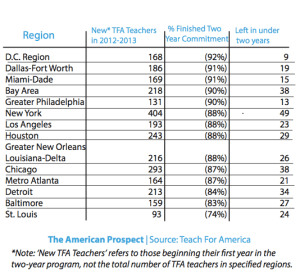
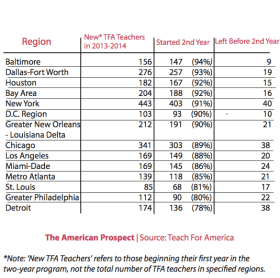
Teach For America reports that 90 percent of their corps members nationwide return for their second year. The American Prospect asked TFA for data on regional teacher retention, to get a better sense of what the story looks like in urban districts. TFA responded that they have only been tracking regional retention since 2012, which is surprising for a data-driven organization that is coming up on its 25th anniversary. Below is information based on the three years TFA was able to provide:

Screen Shot 2015-01-10 at 9.54.49 AM Screen Shot 2015-01-10 at 9.55.08 AM

Finder’s fee tradeoffs

The hiring contracts signed between TFA and school districts vary, and often depend on the level of bargaining power with which a district has to negotiate. For example, the Cleveland School District stipulated in a 2013 contract that it would pay TFA $4,000 for each recruit during his or her first year, and $5,000 per recruit for the second year. Chicago’s Board of Education signed a contract in 2013 committing to pay TFA $3,000 per teacher in the first year, and $2,500 per teacher in the second year. The contracts also vary within states.

TFA’s Winfield defended the finder’s fees, saying it’s a “nominal amount of what [TFA] invests in recruiting, training and placing corps members with the district.” She said the organization spends about $16,400 to recruit and select each new teacher, $7,000 to train them, and $14,000 per year during the two-year program. “Given the amount of investment in placing teachers with partners,” Winfield explains, “monetary or otherwise, we don’t refund the amount.”

In other words, a $51,000 investment into each corps member makes a $6,000 finder’s fee a reasonable deal for the school districts, according to TFA. However this presumes that cost is equivalent to value.

The peer-reviewed research remains mixed on the academic impact of TFA. Studies have shown that in the short term, TFA teachers generally perform as well as other non-credentialed novice teachers. In some areas, such as secondary math, TFA teachers have been shown to be more effective than traditionally prepared teachers. However, education researchers Julian Vasquez Heilig and Su Jin Jez found that TFA corps members perform less well overall than credentialed novice teachers, and significantly less well than veteran teachers.

So, if it’s not clear that TFA teachers are exceptionally better instructors, why are districts willing to pay hundreds of thousands of dollars in annual service fees to hire them?

One may argue that the fees are worth the cost because TFA corps members take jobs in schools that are hard to staff. And certainly, private and parochial schools often take advantage of headhunter agencies, whose recruits also come with finder’s fees. But such services are not commonly used in public school districts, and graduates of traditional teacher preparatory programs do not come with finder’s fees.

In recent years, TFA has been taking heat for securing jobs in areas where there are no real teacher shortages. In cities across the country, veteran teachers are facing layoffs and hiring freezes, and graduates from local teacher colleges are being passed over in the hiring process. For example, even though the Seattle School District received 138,000 teacher applications in 2009 for 352 full-and part-time jobs, TFA still worked to join their competitive job market in 2010. The Washington Post reported last year that hundreds of Connecticut residents who earned their teaching certification through local colleges and universities were being passed over for out-of-state TFA recruits. In Chicago, the number of TFA corps members is growing, despite Chicago Public Schools having laid off thousands of tenured teachers. (During the 2012-2013 school year, there was a TFA cohort in Chicago of 498 teachers, and by the 2013-2014 school year it had risen to 593.) Similar stories are playing out in places like Philadelphia and Newark.

Some critics contend that the hiring choices are political. They point out that in various school districts where TFA is expanding, school board members and superintendents have close ties to TFA, many of them being former alumni of the organization. (John White, the New Orleans school superintendent, and Paymon Rouhanifard, the Camden school superintendent, for example, are former TFA corps members.)

Another plausible explanation for school districts’ employment of TFA teachers is based on long-term economic calculations. Many districts are recognizing that investing in teachers who are unlikely to stay long in the classroom, even when factoring in the high cost of teacher turnover, can save them money down the line. If the bulk of teachers leave within two to three years, school districts will not have to worry about paying for the higher salaries and the state pension fund payments to which public school teachers with seniority are entitled. Even if 20 TFA teachers quit early, and the school district is not refunded the finder’s fees it paid to the organization, the district’s wasted $60,000 or so is relatively minor compared to the costs of paying for tenured and experienced teachers.

As Alexandra Hootnick laid out in The Hechinger Report, administrators and TFA’s national staff recognize that its recruits are less expensive in the long run than paying the salary and benefits for teachers with experience or advanced degrees. Hootnick reported:

Michael DeBell, a member of the Seattle school board, helped bring TFA to the district in 2010. It wasn’t a question of lacking qualified teachers, DeBell said, with between five and 100 people applying for every open teaching position. Rather, he said, “it was a simple matter of fiscal challenges and political optics…”

Ultimately, it may be cheaper for districts to continually cycle through novice teachers, but it comes at an expense that rubs against TFA’s stated purpose of providing better education to kids than they otherwise would obtain. Districts, their students, and their communities pay a high price to support TFA’s routine teacher turnover.

Will more training provide a fix?

Under new national leadership, TFA has launched a series of pilot programs in 12 regions designed to improve its overall teacher retention rate. Its hope is to scale up successful models nationally over time. Some of these initiatives, which include incentives for those who stay longer in the classroom, are geared towards teacher development training; others appear to be more political in scope.

For example in Connecticut, TFA is launching programs to help train alumni teachers to better support younger TFA corps members. They’re also working to “offer pathways to school administration.”

In Chicago, TFA is offering its teachers opportunities to attend monthly and weekly professional development trainings, as well as sessions to help teachers better understand their political and policy landscape. Takirra Winfield explained that the goal of the policy session “is for teachers to emerge with the skills to empower their students to challenge the laws, regulations, and practices that are impacting their education, and advocate for change.” How they envision mobilizing students politically is not yet clear.

It will be up to the public to decide whether TFA teachers are the right investment for school districts in the future. Though accounting for less than 1 percent of the country’s teaching force, the organization holds a disproportionate amount of political power when it comes to shaping education policy. The national organization receives millions of dollars from the government each year, and is increasingly funneling its recruits into charter schools. TFA reports that 33 percent of their recruits teach in charter schools, up from 13 percent in 2008. Many of these charter schools were founded by TFA alumni.

Research demonstrates that “insufficient compensation” is a key reason for why many teachers leave the profession or transfer into schools that serve students from higher-income families. Improving teacher retention in high-poverty neighborhoods is unlikely to be solved through a reliance on short-term novice teachers earning low-paying salaries. The impact of these new TFA pilot programs may perhaps change the dynamics on the ground. Some evidence suggests that TFA is open to change—particularly with regard to the new diversity of its recruits.

But while TFA reckons with its model and its future, the growing national debate is taking a toll on the organization. Over the past year, two large school districts,Pittsburgh and Durham, North Carolina, rescinded hiring contracts with TFA. In September, the national student labor organization, United Students Against Sweatshops (USAS) announced a campaign aimed at kicking TFA recruiters off college campuses. In a open letter sent to the CEO and board chair of Teach for America, USAS leaders wrote:

TFA’s shift from an organization providing volunteers to overcome teacher shortages to an organization that de­professionalizes the teaching career and displaces veteran teachers has forced us as students to ask our universities to reconsider relationships with Teach for America.

In December, TFA announced that it is having trouble recruiting candidates to teach in New York City schools—a problem organization leaders attribute, in part, to the “contentious national dialogue” surrounding TFA’s impact on school districts and the teaching profession. In anticipation of declining corps members, TFA plans to close its New York and Los Angeles training sites.

——-
Update and Correction:
TFA contacted The Prospect to clarify that corps members who leave for emergency reasons are not included in their retention data, so in some cases, the number of those listed as leaving [column 3] may be actually be higher than what is demonstrated in our charts. An earlier version of this story stated that as of January 2014, 42 percent of TFA recruits taught in charter schools. The correct figures are 33 percent of recruits, and 42 percent of alumni. Additionally, Takirra Winfield originally reported that TFA spends $9,000 to train each new teacher, and $11,000 on each teacher per year during the program. She has since provided new financial figures from the organization. TFA says it spends $7,000 on training and $14,000 on each teacher per year. The article has been updated to reflect these corrections.

In Baltimore, Protesters Demand Redress for Police Killings of Local Men

Originally published in The American Prospect on December 5, 2014.
____________
Protesters took the streets of Baltimore on Thursday night, following the announcement that Daniel Pantaleo, the white New York City police officer who used a chokehold to kill Eric Garner, a black man, would not be indicted. Garner’s death at Pantaleo’s hands was captured on video shot by a bystander, who recorded Garner gasping for air, saying “I can’t breathe.” The protests, which succeeded in shutting down the city’s annual holiday lighting event early, came three days after Baltimore’s mayor vetoed a bill that would have required police officers to start wearing body cameras.

Baltimore protesters marched not only for Eric Garner of New York, Michael Brown of Ferguson and Tamir Rice of Cleveland—but also for Tyrone West and Anthony Anderson, two unarmed Baltimore black men who died at the hands of the police in 2013. As in the cases of Garner, Brown and Rice, cops faced no charges following the deaths of West and Anderson.

Every Wednesday since July 2013, community members have gathered outside of Baltimore City Hall, calling for the police to be charged with the homicide of Tyrone West. While an independent review issued this past August concluded that the officers did not use excessive force, several witnesses insist they saw cops kick West in the head, spray him with mace, hit him with batons and pull him by his dreadlocks.

Tawanda Jones, Tyrone West’s sister, traveled to New York City earlier this year to meet with Eric Garner’s parents. When news broke on Wednesday that the officer who killed Garner would not be indicted, the weekly City Hall were protesters further riled.

“They had eyewitnesses in my brother’s case and they did nothing,” Jones told Baltimore’s local ABC affiliate on Wednesday night. “But I thought, O.K., [the Garners] have this video that went viral, that everybody saw all over the world, that something at least was going to get done.”

“One of our major demands is to indict killer police,” an organizer said to a crowd gathered by the Washington Monument on Thursday night. “It’s not enough just to put cameras on them. They have to be indicted.”

When the Maryland legislative session opens next month, Baltimore residents plan to head to Annapolis, the state capital, to pressure the state legislature to repeal key components of the Law Enforcement Officers’ Bill of Rights—a statute which many argue impedes meaningful civilian review of police and prevents the disciplining and firing of bad cops. On November 22, the city held a public hearing on law enforcement reform where community leaders, activists, citizens and cops spoke out for nearly three hours.As The Afro, a newspaper that serves the black community, reports, Diane Butler, the aunt that raised Tyrone West, spoke at the hearing and challenged the Baltimore police present in the room on their brutal behavior.

“When was the beating supposed to stop?” she asked. “My son was on the ground screaming for the beating to stop. Was the beating supposed to continue until he was no longer breathing? No longer moving? My son was dead, and your police officer still was kicking him in the back of his head, and he was cuffed.”

A recent Baltimore Sun investigation found that the city paid $5.7 million in judgments and settlements alleging police brutality and civil rights violations since 2011.

The two groups organizing Thursday night’s protests—the Baltimore chapter of Fight Imperialism Stand Together (FIST) and the Baltimore People’s Power Assembly—stressed repeatedly to the crowd that this was “a movement not a moment” and that police brutality will not be solved without fighting for a more equitable economic society. Earlier in the day, activists in more than 150 cities across the country engaged in one-day strikes and rallies as part of the Fight for 15 campaign.

Although Baltimore activists are still pushing for police to wear body cameras, a failure to indict despite the clear video evidence highlights the need to secure additional reforms.

The next Baltimore protest is scheduled for December 13th, followed by an organized “strike against racism” on January 15th—the birthday of Dr. Martin Luther, Jr.

Learning at a School With a Student Turnover Rate of 179 Percent

Originally published in Next City on November 17, 2014.

The Hilltop neighborhood in Tacoma, Washington is one of the poorest in the state — with many families living in poverty and struggling to maintain housing. Such instability inevitably impacts the public schools’ capacity to function; in 2006, Hilltop’s McCarver Elementary School witnessed a student turnover rate of 179 percent. This, as researchers at the Urban Institute have pointed out, is nothing unique to McCarver. Low-income students frequently move around, and family homelessness is a growing problem. A new report from the National Center on Family Homelessness reveals that one in 30 children experienced homelessness in 2013.

What is new is the policy solution being tested out by the Tacoma Housing Authority and Tacoma Public Schools — largely backed by the Gates Foundation — to see if traditional Section 8 housing vouchers can be leveraged to provide affordable housing and boost local school performance.

The Gates Foundation is investing in a host of suchexperimental partnerships to research the link between housing instability and educational achievement. With the potential to improve school performance, boost employment levels and reduce dependency on housing vouchers, these programs have decided political appeal. Yet while the Tacoma experiment offers a good model of cooperation among agencies, there’s little evidence that the approach can reduce poverty, as policymakers hope it will.

The McCarver Special Housing Program stipulates that in order to remain eligible for a housing voucher, parents must keep their kids enrolled in McCarver Elementary School throughout the five-year study, regularly demonstrate active involvement in their children’s education and attend a host of job training programs. With the help of local caseworkers, they must also achieve “economic self-sufficiency” (earning enough to afford a two-bedroom apartment, which is about $771 per month in rent) by the end of the fifth year.

For the first year, rent is massively subsidized — just $25 per month — and in each year thereafter it increases by 20 percent. The hope is that if housing can be a stabilizing force, especially in the first year, then parents can focus on their economic future and their children’s schooling.

So far, the McCarver program has yielded some interesting results. Across all participating households, average monthly income rose from $436 in 2011 to $836 in 2013. Student turnover within the experimental cohort is also significantly less compared to the rest of the school.

The program began with 49 families in 2011, joined by seven more in 2012. Of those 58 families, 39 are still participating.

Some departed for positive reasons, like finding a new job in a different part of town — but others for less encouraging reasons. “Some families really struggled and couldn’t complete the requirements, so the families were essentially dropped from the program,” says Justin Milner, an Urban Institute researcher who studied the McCarver project. (The McCarver program doesn’t count the 19 families that dropped out when calculating the cohort’s average monthly income increases.)

Although Tacoma is a relatively poor city, and even in wealthier areas, many highly educated people cannot find stable work, the McCarver program frames the economic issue as one where parents lack the skills and training necessary to obtain employment — not that there aren’t solid jobs to get. When I asked Greg Claycamp, an official with the Tacoma Housing Authority, what would happen if families were unable to pay full rent at the end of the five years because there are no decent employment prospects available, he could not confirm that families would continue to receive housing assistance. “I think we want to be very careful about not penalizing a household that turns out to have really complex challenges,” Claycamp says. “But for now no final decision has been made.”

Researchers Sendhil Mullainathan and Eldar Shafir, in their book Scarcity: Why Having Too Little Means So Much explain how many social policy designers “assume the problem is a lack of understanding or of motivation. So they follow up with attempts to educate or to sharpen incentives.” Mullainathan and Shafir have found that such carrot-and-stick approaches might actually lead to greater harm.

This highlights a central tension with these new partnerships. Exploring the relationship between education and housing is a smart thing to do — giving kids and parents the opportunity to learn in safe, caring and even rigorous environments is something that all democratic societies should be promoting. Leveraging these relationships as a means to reduce poverty and reliance on welfare, however, is quite another objective.

In mid-October, Claycamp joined housing authority officials from around the country in Washington D.C. to attend a conference at the National Council of Large Public Housing Authorities (NCLPHA) where this question of cross-collaboration between school districts and housing authorities was a major theme. Another NCLPHA conference devoted specifically to this question will be taking place in D.C. in February.

“Our focus on this started a couple of years ago, given the difficult environment in Washington and budget constraints,” says Sunia Zaterman, executive director of NCLPHA. “We’re serving at best a quarter of the households that are in need, so we want to reduce inter-generational poverty to free up resources for the next ones on the waiting list.” Gates-funded experiments are cropping up all over, from the Pacific Northwest to Akron, Ohio to New Haven, Connecticut. Not all follow the Tacoma model — some are focused on implementing early childhood learning initiatives and some are geared toward mentorship and tutoring. Right now, Zaterman says, housing authorities are just interested in expanding research studies to learn more about what these diverse partnerships are capable of doing, although she stressed no one-size-fits-all approach would be feasible or wise.

The Gates Foundation operates with the stated belief that quality education is “the best way to break the cycle of poverty.” Yet despite their strong embrace of metrics and data, this does not appear to be an evidence-supported claim. Tax and transfer programs, like that of Social Security, which reduced elderly poverty from 47 percent in 1967 to 15 percent today, have proven to be far and away the most effective poverty reduction policy.

Robust educational support and greater mentorship opportunities are good things, andhave been shown to lead to better educational outcomes. So exploring how to improve a child’s education by leveraging school and housing strategies is promising, and warrants further investigation. “Even in our days of doom and gloom, this has been very uplifting,” Zaterman notes.

But as more organizations, think tanks and working groups devote their energy to researching joint housing and education programs, it’s important to pursue these programs for the right reasons. Improving educational achievement is an important aim in and of itself. Democratic nations depend upon the presence of an active and educated citizenry. But in the absence of a strong economy and without an ample cash-transfer system that can assist the poor who lack wealth and savings, families are unlikely to break the cycle of poverty. There are great possibilities, and also practical limitations, to these new initiatives.

Minimum Wage Measures Pass Easily in Four Red States

Originally published in The American Prospect on November 5, 2014.
——

A
s devastating as Tuesday night’s election was for Democrats—Republicans took control of the Senate and won a number of key governor racesit was actually an encouraging night for the progressive economic agenda. In four red states—Alaska, Arkansas, Nebraska and South Dakota—minimum wage ballot initiatives all passed easily. In San Francisco, voters overwhelmingly passed a $15 minimum wage—with notably little opposition from the business community. And in Illinois, voters sent a clear message through a non-binding advisory initiative that they want lawmakers to raise the minimum wage, and fast.

Increasing the federal minimum wage from $7.25 to $10.10 has been a major economic priority for President Barack Obama, part of his effort to curb the nation’s rising levels of inequality. (Under Obama’s plan, year-round, full-time minimum-wage workers would go from making $15,080 per year to $21,008.) Yet ever since April, when congressional Republicans mobilized to block wage-hike legislation, progress on the federal level has gone nowhere.

In light of this, it’s interesting to see a state like South Dakota—a state that hasn’t supported a Democrat for president in decades—vote to raise the wage by a 53 percent margin. The initiative will result in 62,000 South Dakotans taking home higher paychecks. In an email to The American Prospect, Zach Crago, executive director of the South Dakota Democratic Party, said, “It’s about rewarding hard work with an honest wage. That message resonates with South Dakotans. Republican candidates oppose it at their own peril.”

Minimum wage initiatives were so popular among voters leading up to the election that even Republican candidates like Alaska gubernatorial candidate Dan Sullivan had to say they’d vote for a minimum wage increase. Sullivan did just that, despite his having opposed it before the primary. Alaska’s minimum wage initiative passed with nearly 69 percent of the vote. Ed Flanagan, a leader of the Alaskans for a Fair Minimum Wage campaign, told The American Prospect that while the campaign faced no real organized opposition, the conservative state legislature could still try and repeal the law in two years—a move they pulled on Alaskan voters back in 2002. But given the high percentage of Alaskans who voted to raise the wage, Flanagan hopes state lawmakers “will think twice about messing with the will of the people.”

In Arkansas, Republican U.S. Representative Tom Cotton, during his campaign for U.S. Senate, stayed mum for months on a potential minimum wage increase until it became so popular with Arkansas voters that he finally felt compelled to come out in September to back it. Cotton won his Senate race last night, but so did the minimum wage—with 65% of Arkansas voters supporting the ballot initiative.

Exit polls for states where minimum wage initiatives weren’t on the ballot also showed high levels of support for future increases. In Wisconsin, although Scott Walker was re-elected, and has consistently opposed increasing the minimum wage, a solid majority of Wisconsin voters said they’d like to see it raised higher than $7.25.

Undoubtedly, it was a damning night for the Democratic Party, but the picture isn’t entirely bleak for progressives. Exit polls reveal that 63 percent of voters believe the U.S. economic system favors the rich; this highlights a much larger national frustration for politicians to organize around. Arun Ivatury, a senior strategist with the National Employment Law Project Action Fund, told The American Prospect that, going forward, politicians who embrace economic populism “will run away from the pack in 2016, when the electorate looks much more like America. Those who don’t will be bypassed. It’s our job to make sure people know who is who.”

Jimmy John’s workers fight for a union

Originally published in Baltimore City Paper on October 28, 2014.
——–

On Sunday, Oct. 19, as Ravens fans meandered around the chilly Inner Harbor in advance of the game set to begin later that afternoon, about two dozen workers and community supporters formed a picket line outside the Jimmy John’s sandwich shop on Pratt Street to demand the right to form a union. “Ravens have a union!” the protesters chanted. “Why can’t we?” The Jimmy John’s employees claim that ever since their efforts to publicly unionize kicked off in early August, management has responded with clear efforts to intimidate them, including the firing of their co-worker James Hegler. Workers have responded by filing seven counts of illegal retaliation complaints with the National Labor Relations Board.

On Aug. 9, with support from the Industrial Workers of the World (IWW), a radical union founded in 1905 that gained a reputation for organizing across class, race, gender, and occupational lines, Baltimore Jimmy John’s workers presented their list of demands to management, which included one paid sick day per month, a transparent disciplinary system for both workers and managers, and wage parity with their landlord, the Hilton, that has unionized employees making between $10.75-$13 per hour. Wages at Jimmy John’s hover around $7.25.

The Baltimore fight comes at an interesting time as Jimmy John’s workers across the country have gained national attention for launching a class action lawsuit over the non-compete agreements all Jimmy John’s employees are forced to sign in order to work there. These contractual clauses require employees to promise not to work in any nearby sandwich shop for at least two years after they leave, so as not to give away “trade secrets.” In response, over 35 House Democrats recently signed a letter requesting the Department of Labor and the Federal Trade Commission to launch an investigation into this suspect labor practice. Though the Baltimore Jimmy John’s workers say they stand in solidarity with the class-action suit, they themselves are not presently involved.

The fight for a union also stands out as thousands of fast-food employees across the country have gotten involved with the Fight for 15 campaign, an effort to demand fast-food chains provide a $15 minimum wage and the right to form a union. Founded in Chicago in 2012, and largely backed by the Service Employees International Union, Fight for 15 includes employees at McDonald’s, Burger King, KFC, and Wendy’s who have taken to high-profile one-day strikes in order to send a message to their employers that they deserve better conditions in the workplace. Even President Obama has publicly cheered on the fast-food strikers’ organizing.

But despite the fast-food industry’s substantial presence in the Baltimore labor market, the Fight for 15 campaign just has not taken off here like it has in other cities. Some activists involved in the Baltimore and Maryland Workers Assembly marched in a “Walk 4 Justice” downtown in May and September, to support strikers in other cities, but by and large the local fast-food organizing efforts have been minimal.

“We’re the only union organizing fast-food workers in the city,” said Brennan Lester, a Jimmy John’s worker and IWW organizer. “But this is an idea whose time has come. We’re long overdue for unions. We’re precariously employed with no rights and no protections and we’re one of the only growth industries. It’s not just for kids anymore.”

Colleen Davidson, an activist with the Baltimore chapter of Fight Imperialism Stand Together (FIST), who came out to the Jimmy John’s demonstration, said organizing can be particularly difficult in Baltimore because “so many people are just in survival mode, juggling two to three jobs, raising kids, and grappling with gentrification and homelessness.”

Yet back in the early ’90s, there was a time when Baltimore was the national leader for low-wage organizing efforts—proudly standing as the first city to launch a “living wage” campaign, and ultimately being the first city to pass a “living wage” law. Activists called for a minimum wage of $7.70 per hour, a significant spike from the federal minimum wage of $4.25. Led by the church-based civic group Baltimoreans United in Leadership Development (BUILD) in conjunction with the American Federation of State, County and Municipal Employees (AFSCME), residents began organizing for higher wage standards after it became clear that even full-time workers couldn’t pay their bills. Activists campaigned with the theory that public subsidies and city contracts should not support private firms that paid poverty wages.

Going forward, Jimmy John’s workers have pledged to continue launching “a series of escalating direct actions” in order to pressure the company to recognize their union. Toward the end of the Oct. 19 protest, picketers marched inside the store, holding up signs, and calling for management to reinstate Hegler. “What do we want? Rehire James! When do we want it? Now!” In the end, four Baltimore City police came to break up the event.

Stephen Thompson, a 28-year-old adjunct math professor at UMBC, showed up to picket alongside the Jimmy John’s workers. “Compared with other labor-related protests I’ve been to in Baltimore, this one had a different feel. That’s what I really liked about it,” said Thompson, who noted that the IWW people are a “young ragtag kind of group” in contrast to the more professional organizers of other unions. In Baltimore, the IWW is also affiliated with the unions at Red Emma’s and Baltimore Bicycle Works. “They are very passionate,” Thompson added. “It made the picket more fun and exciting.”

We know College Feminists Care About Sexual Assault. What About Abortion?

Originally published in The American Prospect on October 24, 2014.
_____________________

In the past three years, more abortion restrictions have been enacted in the United States than in the entire previous decade. At the same time,85 colleges and universities are now under federal investigation for their handling of sexual violence. While these two issues are not divergent, campus feminists have devoted much of their energy to challenging their universities’ failure to adequately handle sexual assault cases—often at the expense of abortion rights advocacy.

But the growing threats to reproductive justice—like the Texas law that could shut down most of the state’s abortion clinics, and looming ballot measures in Colorado, Tennessee, and North Dakota that could result in women losing their legal right to terminate a pregnancy—have catalyzed the ongoing efforts of national pro-choice organizations to invest in student leaders. Campus activist priorities and national women’s rights goals might finally be aligning—sort of.

For many students attending schools in East and West Coast states, the legislative efforts to restrict abortion access commonly found in red states can seem quite distant from their own daily gender struggles. Changing local culture around rape and sexual assault, on the other hand, seems far more urgent.

“Campus activism tends to be reactionary, and women are generally kept on the defense,” says Sarah Beth Alcabes, a recent graduate of the University of California, Berkeley. “It’s hard to organize for coherent proactive action beyond the immediate threats we face. Maybe if campuses were safe for women, there would be energy for them to focus on places not in their immediate vicinity. But that’s not the case.”

At Johns Hopkins University in Baltimore, students have filed an anoymous Title IX complaint alleging that the school failed its responsibility to ensure the safety of students when it allowed a fraternity to continue throwing parties even after police began an investigation into an alleged gang rape that took place at the frat house. One of the complainants says that the focus of leaders on her campus has been the enforcement of federal sexual assault laws for a simple reason: “There’s no equivalent to those sorts of laws for abortion,” she explains, “so the pro-choice movement doesn’t occupy the same place as gender-based violence on the college campus.”

But geographic distance from the most pressing abortion battles and political momentum around sexual assault prevention are only part of the story. Even in those states where access is regularly threatened, many college feminists have avoided tackling the issue of abortion directly—in part because the abortion debate is so polarizing, and in part because many campuses are unwilling to institutionally support such activism.

At Texas Tech University in Lubbock, Sophia Dominguez, the president of the Texas Tech Feminist Majority Leadership Alliance (FMLA), says she believes that reproductive rights are an important feminist issue, but her group must “recognize the political culture of Texas and adapt [its] advocacy accordingly.” She says her peers feel “repressed in the ways in which to openly discuss and address reproductive freedom.” As such, Tech FMLA has been fighting Texas Tech’s rape culture, which students believe is a more immediate problem to tackle, even in light of the Texas legislature’s anti-abortion efforts.

Kierra Johnson, executive director of URGE, a national campus organization committed to reproductive and gender equity, says that the leaders of many URGE chapters tend to focus on sexual assault because there is less official support for abortion work, even when a group is affiliated with a campus women’s center. “We might be able to push for more access to contraception,” Johnson says. “But the more the conversation centers around abortion, the more uncomfortable the administration is with getting behind it. Regardless of how people feel about abortion, when you talk about it, it charges an environment, and that’s the last thing campus administrators want.”

Several national organizations—the Feminist Majority Foundation, Planned Parenthood for America, NARAL Pro-Choice America, and URGE—are trying to change these campus dynamics by building networks of college students who will advocate for reproductive justice and gender equality. While coordinated inter-campus solidarity is currently pretty minimal, efforts to build a larger college pro-choice infrastructure are growing.

But even with support from outside organizations, building a student pro-choice movement is tough. Molly Waters, a senior at Webster University in Webster Groves, Missouri, works as one of NARAL’s campus representatives for the Choice Out Loud campaign, an effort to help millennials engage in conversations about reproductive rights.

“I don’t think abortion is the first thing feminist students would organize around, just because it’s so polarizing and has such a stigma,” Waters says. “I understand it. I myself am a Christian. I think a lot of people are more tempted to discuss birth control or general reproductive rights and not so much abortion rights.”

NARAL donates supplies to campus chapters, organizes conference calls between campus representatives in different states, and facilitates national communication through Facebook groups. Yet Waters observes that many students just seem to have a general lack of interest in political activity. “One thing that can be really frustrating is just how many people don’t want to protest or be active as much,” Waters says. “And that’s understandable; we’re in college, we have a lot on our plates. But there does seem to be a lack of energy for action.”

Kaori Sueyoshi, a senior at the University of North Carolina at Chapel Hill, feels more optimistic. “The student movement here in North Carolina has been growing quickly with the Republican takeover of our state,” she explains.

In 2010, Republicans won the majority in the state legislature, and won the governor’s mansion in 2012. Since then, North Carolina has enacted a controversial set of abortion restrictions, as well as a stringent voter ID law. In turn, over the past two years, college students across North Carolina have gathered together to network, strategize, and advocate for reproductive rights in their communities. Sueyoshi has been involved with Planned Parenthood’s network of campus activists, known as Generation Action, and attended the Youth Organizing & Policy Institute, a national student conference that Planned Parenthood hosts in Washington, D.C. “I think the national college advocacy movement is growing much stronger,” she says.

She may be right. At Vanderbilt University in Nashville, Tennessee, Marlies Biesinger, co-president of the Vanderbilt Feminists, says that advocacy around abortion politics has never been a real priority for them. But for the first time, in light of the political buzz around Tennessee’s Amendment 1—which could give the state legislature, not the state Supreme Court, full authority to decide the legality of abortion—the Vanderbilt Feminists have started to hold educational events to raise awareness about the ballot measure’s implications and push students to vote this November. And at Rice University in Houston, Rice for Reproductive Justice formed just last year to campaign for gubernatorial candidate Wendy Davis and organize around a broad set of issues that inhibit reproductive freedom.

If threats to safe and legal abortion access continue to drive both college advocacy and the formation of relationships between student leaders, the questions then become: What can these activists actually do together? How, when anti-choice measures are primarily passed through state legislatures, can national advocacy play an effective role?

“The movement has shifted,” Johnson says, because anti-choice activity has moved from the federal to the state level. “For a long time there were lots of opportunities to engage on a national level. But we’re not going to mobilize people in Alabama to work on Texas. No matter how much noise you make, at the end of the day the elected officials only care how people are voting in their state and districts.” While broad-based online petitions exist, like those organized by Change.Org and Moveon.org, right now there just are not a lot of opportunities for pro-choice activists, in or out of college, to campaign on the federal level.

Despite the relatively limited array of federal policy opportunities, the need to mobilize and educate students about reproductive rights remains pressing. The All* Above All campaign, which is focused on lifting health insurance bans on abortions, is one possible avenue for students to pursue. “There’s just a real lack of awareness about what these abortion restrictions are, so we need to educate constituents and our elected officials,” Johnson says.

For Waters, the more progressive culture of her Missouri liberal arts college feels worlds away from the conservative southern Illinois town she grew up in, where mentioning abortion rights would “automatically make you a Satanist.” Coming to college and finding a new environment to educate herself, and later educate and agitate others, has been transformative. “You know, it’s taken a while for me to get there,” Waters says. “It takes a lot of education that many people just don’t usually have.”