Outsourcing Substitute Teachers in Philadelphia Gets Off to a Bad Start

Originally published on The American Prospect’s Tapped blog on September 11, 2015.
——
Last spring, officials from the Philadelphia School District announced plans to contract out substitute-teaching services, saying they could not effectively manage the responsibilities in-house. At the time, approximately 60 percent of substitute teaching jobs were filled daily, and officials said a private vendor would be able to fill more open positions. Naomi Wyatt, the chief talent officer for Philly public schools, said they paid more than $18.6 million annually for substitute teaching expenses, including reimbursement costs for traditional teachers who fill in when subs cannot be found.

The announcement effectively meant that the district would seek to use non-unionized substitute teachers that they could pay at “market-rate.” It eventually hired Source4Teachers, a New Jersey-based company that provides schools with substitute teachers, substitute paraprofessionals, and substitute support staff. The company works in nearly 200 districts throughout the U.S. and dozens locally, but Philadelphia School District is its largest client.

Though the cash-strapped urban district denied they were contracting out to save costs, the pay differences for substitutes between last year and this year are substantial. Source4Teachers pays between $75 and $90 per day for uncertified substitutes, and $90 to $110 for credentialed ones. By contrast, the district had paid $126.76 for uncertified substitutes, and $160.10 for credentialed ones. The biggest difference is for retired substitutes: the district had paid retired subs up to $242 daily, depending on their educational degrees and college credits; under Source4Teachers, retired educators receive the same rate of pay as all other teachers.

“They assured the teachers that their pay would be ‘similar’, that was the word they used,” said retired teacher Kenneth Schamberg to The Philadelphia Inquirer in July. “Since when is a 61.9 percent pay cut similar?”

The new academic school year started this week, and The Inquirer reported today that Source4Teachers is off to an embarrassing start. On the first day of school, it had filled only 11 percent of open substitute teaching positions, which meant 477 city classrooms did not have teachers. The rate and number of vacancies were roughly the same on Wednesday and Thursday, too.

Owen Murphy, a spokesperson for Source4Teachers, said they hope their “learning curve will soon go away” and that they will produce more teachers fast. So far, the firm has just 300 workers credentialed and ready to take on substitute teaching jobs, but Murphy says hundreds more are currently in the midst of applying. He also said he expected far more substitutes who worked for the district last year to apply to work with Source4Teachers, but so far that hasn’t happened. They hope to eventually have a pool of 5,000 substitutes ready to call on for work.

Wyatt said that other big urban districts like Baltimore, Cleveland, and Detroit also outsource substitute-teaching services.

The president of the Philadelphia Federation of Teachers, Jerry Jordan, suggested that district officials intentionally manufactured a substitute teaching shortage in order to outsource the jobs. He referenced a 2012 Boston Consulting Group report that recommended privatizing the positions. Jordan told The Notebook, a non-profit education news site in Philadelphia, that he knew of qualified substitute teachers who were not called in to work.

“It’s unclear how much money this move will save the School District. But we have no doubt that this will have a tremendous negative impact on educator morale, which is already at an all-time low in Philadelphia,” Jordan wrote. “These are the kinds of actions that, in the long run, will severely compromise the ability of our educators to create positive learning environments for our children.”

Details Emerge for Baltimore’s Plan to Privatize Public Housing

Originally published in The American Prospect’s Tapped blog on September 9th, 2015.
———
A little over a year ago I reported on the Rental Assistance Demonstration (RAD)—the federal government’s new plan to preserve public housing by turning units over to the control of private developers. Instead of Congress supporting public housing through direct subsidies to local housing authorities—a responsibility which they’ve persistently shirked for decades—RAD would enable private companies to rehab and manage public housing units in exchange for tax credits and subsidies. Developers would have to keep rents low, and their contracts would continually renew to prevent companies from turning affordable units into market-rate rentals.

Baltimore residents learned last summer that their city would be converting 40 percent of its public housing stock through RAD, but up until this weekend little was known about how exactly developers would be subsidized. On Saturday, Sun journalist Luke Broadwater shed some light, reporting that the city will issue tax breaks worth millions of dollars, and will sell its public housing complexes “for far less than their state-assessed value.” The nearly $100 million collected from the sales will be invested back into the city’s remaining public housing stock.

Through public record requests, Broadwater found that ten developers will be excused from paying $1.7 million in local taxes per year for at least the next 20 years. In addition to city tax breaks, each developer who buys a public housing complex will also receive millions of dollars from the federal government, through federal tax credits and “developer fees.”

Baltimore is one of the first cities to finalize its deals under RAD, and community members have mixed feelings about how officials pushed forward with the program. Housing advocates, tenants, and union workers have led protests, raising concerns of public housing loss, resident displacement, and middle-class job cuts. In general, the city has not been forthcoming with concrete details to assuage anxieties.

As Broadwater reports, Baltimore’s Board of Estimates approved the tax breaks—“without details publicly revealed or debated” in April by a 4-1 vote. Baltimore’s mayor, Stephanie Rawlings-Blake, controls three of the five board seats. The city comptroller and the city council president hold the other two.

The city council president, Bernard C. “Jack” Young, voted against the tax breaks, citing his general opposition to privatizing public housing. He also worried about the possibility of losing hundreds of public sector union jobs through RAD conversions, like maintenance workers and building monitors.

Carl Stokes, a local councilman, said he’s supportive of the deal because at least the incentives will support low-income people living in buildings that desperately need maintenance and repair. Baltimore has a history of awarding tax breaks to build flashy waterfront developments and tourist attractions.

Nationally, HUD Secretary Julian Castro has called RAD “the answer” to housing issues in many struggling communities. While Congress has so far approved just 185,000 public housing units to be transferred to the control of public developers—out of a total of 1.2 million units—public housing authorities, real estate companies, and other stakeholders have been lobbying Congress to lift the program’s cap. California Congresswoman Maxine Waters sent a letter to President Obama in December urging him to directly fund public housing rather than depend on private developers to save the units. “Put simply,” she said, “if the price of accessing private capital is to put public ownership at risk, then that price is too high.”

As Baltimore’s situation suggests, it might be cheaper for Congress to just increase direct funding for public housing, rather than rely on a costly mix of tax breaks, subsidies, and developer fees. Yet such a move is doubtful to happen any time soon. But while RAD appears to be the most likely way officials aim to preserve crumbling units in the near future, even the most optimistic experts cannot guarantee that it will protect the nation’s public housing units over the long-term.

California Teachers Unions Push for Cushion Before Upcoming SCOTUS Case

Originally published in The American Prospect’s Tapped blog on September 8, 2015.
——

This fall, the Supreme Court will hear arguments in Friedrichs v. California Teachers Association, a case that could severely weaken the power of public-sector unions. The justices will decide whether such unions can charge “agency fees” (also known as “fair share fees”) to individuals who wish to dissociate with their union’s political lobbying but still benefit from workplace collective bargaining.

These reduced annual dues help stave off “free riders”—those who enjoy the advantages of union membership without financially contributing to the union’s work. The case’s lead plaintiff, Orange County teacher Rebecca Friedrichs, insists her free-speech rights are denied by paying agency fees, and argues that unions won’t actually suffer if she wins in court. “It’s hard for me to describe,” she told The Washington Post. “I just want liberty. I want to stop this silencing of my voice and the silencing of millions of teachers out there.”

As the Prospect’s Justin Miller put it, “the Friedrichs case has the potential to overturn decades of legal precedent [since 1977] that has become intractably embedded in union strategy—and state law.”

In the meantime, The Sacramento Bee reported that teacher unions in California are pushing Governor Jerry Brown to embrace a last-minute measure that would permit unions to address all new teachers during their orientations. Such conversations could help unions recruit new members, and thereby mitigate the negative effects of an unfavorable ruling in Friedrichs. As reporter Christopher Cadelago wrote:

Up against the clock in the Legislature, the labor groups are pushing for a bill that could give unions some time—a half-hour—to meet with employees to voice the benefits of union participation. That, some believe, could prevent workers from fully withdrawing from their ranks if the court rules against fair share fees.

One version of the teacher unions’ bill is “nearly identical” to a California bill that grants unions up to 30 minutes to speak to new home health-care workers during their orientation period. That law was passed shortly after the Supreme Court’s 2014 Harris v. Quinn ruling, which said that Illinois home health-care workers could not be required to pay agency fees. (Harris v. Quinn avoided the free-speech questions that will be considered in Friedrichs.)

Groups like the Association of California School Administrators, the California Association of School Business Officials, and the California Special Districts Association say that bills like the ones proposed by the teacher unions should be considered only after the Supreme Court makes its final decision in Friedrichs, and only when there is more time available for public comment.

I’d guess that if California legislators were planning on supporting a bill like this, they’d wait until after the Friedrichs decision came down, just as the home health-care worker bill passed after the Harris case was decided. Either way, we won’t have to speculate for much longer, because California’s legislative session ends this week.

Baltimore Is Bracing for the Freddie Gray Trials After a Deadly Summer

Originally published in VICE on September 3rd, 2015.
——-

On Wednesday, a local circuit court judge denied motions to drop the charges against the six officers indicted in the April death of 25-year-old Freddie Gray, and declined to recuse State Attorney Marilyn Mosby from trying the case.

Defense attorneys argue Mosby acted inappropriately when she dramatically announced criminal charges on May 1, but Judge Barry Williams dismissed that argument. He also ruled that each officer should be tried separately.

Next week, another hearing is scheduled to determine whether the trials—set for mid-October—will take place in Baltimore or in another jurisdiction.

The court proceedings come at a fraught time for Charm City. Nationally, the Black Lives Matter movement continues to flex its muscles. Activists held their first national conference in July, have been successfully pressuring presidential candidates to speak more directly about criminal justice reform, and just last week, the Democratic National Convention passed a unanimous resolution in support of the movement.

Locally, Baltimore activists have also continued to organize themselves since the Freddie Gray protests ended in the spring.

Amidst all this, the city has seen sharp increases in homicides over the past several months; 215 had been killed by the end of August, up from 138 at the same time in 2014. Forty-five people were murdered in July alone, the bloodiest month the city has seen since August 1972. Concerns about violence and unrest threaten to derail political momentum around criminal justice reform.

In the days leading up to Wednesday’s hearing, the Baltimore Police Department (BPD) cancelled officer leave in order to ensure that as many police officers as possible would be present throughout the day. Some police showed up in uniform, and others dressed in plainclothes to work undercover. Activist Kwame Rose was arrested in the morning,and one officer suffered minor injuries while assisting with the arrest, but by and large the demonstrations were relatively calm. Baltimore native DeRay Mckesson and Johnetta Elzie, both prominent figures within the national Black Lives Matter movement, attended the demonstration as well.

Speaking at an afternoon press conference, Mayor Stephanie Rawlings-Blake said demonstrators were “peaceful and respectful and an example of democracy in action.”

Peter Moskos, a former Baltimore City Police Officer and professor at John Jay College of Criminal Justice, says he expects the community protests to remain fairly calm in September, but that “the real shit is going to hit the fan” when the court issues its final verdicts for the officers. Charges range from second-degree assault—a misdemeanor—to the rather unusual charge of second-degree depraved heart murder. Moskos does not expect that the cops will be found guilty.

Though the community response is likely to escalate following the October trials, activists say they plan to ramp up protests relatively soon. Duane “Shorty” Davis, an activist with Baltimore BLOC, a local grassroots organization, told the Baltimore Sunthat they’re encouraging people to engage in nonviolent acts of civil disobedience over the next two weeks, particularly in the wealthier and whiter parts of town. “We’re not just going to go in the black community and wave our hands. We’re going to the white communities,” he told the paper.

City politics also remain chaotic. Mosby, who has been cleared to continue working on the Freddie Gray case, will be campaigning and fundraising for her own re-election at the same time. Her husband, Councilman Nick J. Mosby, has also announced that he is “seriously considering” a run for mayor. And in July, Rawlings-Blake fired the city’s police commissioner, Anthony Batts—citing the rising city violence. “We need a change. This was not an easy decision, but it is one that is in the best interest of the people of Baltimore,” she said at the time. The interim police commissioner, Kevin Davis, has been significantly reorganizing the police department over the past two months.

Dayvon Love, the co-founder of Leaders of a Beautiful Struggle, an organization that advocates for the interests of black people in Baltimore, tells VICE that he anticipates “a plethora of politicians and organizations” will try and use the Freddie Gray trials as a way to advance their own personal careers. “So that sucks,” he says. In the meantime, his group will continue to push for reforms to the police union contract, which they were doing well before Gray’s death. Specifically they have been focusing on changing the Law Enforcement Officers Bill of Rights, (LEOBR), which they see as a significant barrier to transparency and accountability. Other groups, including the NAACP and the ACLU of Maryland, have rallied for similar changes.

The police union, the Fraternal Order of Police, strongly opposes changes to LEOBR and worked hard to fight proposed reforms this past legislative season.

In the face of all the political maneuvering, the city’s activists will be waiting on the verdicts to determine whether justice has been served in a case being watched closely by reformers around the country.

There’s Plenty of Evidence on the Value of School Integration

Originally published on the American Prospect Tapped blog on September 3, 2015.
—-
I read an exchange on Twitter yesterday between Maggie Severns, an education reporter at Politico, and CJ Libassi, a researcher at the Education Policy Initiative, an organization committed to “applied, policy-relevant research for improved educational outcomes.” They were discussing my recent piece about Obama’s record on school integration. I was struck in particular by this part:

I found it surprising, and worrying, that a prominent education journalist and an education policy researcher would both say that they have looked around and cannot find “any actual evidence” on the value of school integration.

School desegregation conversations are complex and difficult, which is all the more reason we should strive to make our discussions as informed as they can be. I have no idea what Severns’ and Libassi’s attempts to find evidence looked like, but given that perhaps there are other mainstream journalists and researchers who have faced similar issues, I decided it would make sense to quickly post some starting points:

1. The Spivack Archive is an accessible social-science database that explores the impacts of ethnic, racial, and socioeconomic integration. Its stated purpose is to “provide scholars, education rights attorneys, policy makers, and the general public with accessible state-of-the-art knowledge.” The archive has been an on-going project led by sociologist Roslyn Mickelson since 2005. It’s received funding from the American Sociological Association, the National Science Foundation, and the Poverty and Race Research Action Council.

2. The National Coalition on School Diversity, which formed in 2009, has published a series of short policy briefs on the benefits of school integration. The briefs explore impacts on academic achievement, on college attendance, on poverty reduction, on non-minority student impacts, and other areas. NCSD is a coalition of educators, policy advocates, and civil rights leaders.

3. The Civil Rights Project/ Proyecto Derechos Civiles has commissioned hundreds of studies on issues related to desegregation, racial diversity, racial disparities in school discipline and other related areas. CRP is a research and policy think tank that was founded at Harvard in 1996, and has been run out of UCLA’s Graduate School of Education and Information Studies since 2007.

This list is by no means comprehensive, but it’s a decent place to start if you’re looking to familiarize yourself with some of the quality research. I hope more people do, especially those writing and thinking about education.

//platform.twitter.com/widgets.js

Obama’s Mixed Record on School Integration

Originally published in The American Prospect on August 31, 2015.
——
As Congress debates competing revisions of the No Child Left Behind Act over the next several weeks, lawmakers are unlikely to spend much time looking at the growing problem of segregated schools. Despite strong academic and civic benefits associated with integrated schooling, and a unanimous Supreme Court decision which ruled that “separate educational facilities are inherently unequal”—American public schools have resegregated quickly by race and class over the past two-and-a-half decades.

Many advocates had hoped to see the Obama administration take steps to address rising school segregation, but so far its record has not been great. While the Department of Education has paid lip service to the need to promote integrated schools, and has included modest diversity incentives within a handful of federal grants, it refused to use larger education initiatives like Race to the Top to encourage states and districts to prioritize school diversity. In some cases, the department actually pushed policies that made segregation worse.

The Obama administration came to power at an interesting time for the integration movement. With the help of Reagan-appointed judges and justices, court decisions in the 1990s absolved many local districts from their legal obligations to desegregate schools. Between 1988 and 2006, the number of black students attending majority-white schools dropped by 16 percentage points. Between 2000 and 2008, the number of schools where at least 75 percent of students qualified for free or reduced-meals—a proxy for poverty—jumped from 12 percent to 17 percent.

But many districts were also interested in racial and economic diversity, even if they weren’t legally required to promote it. And so various voluntary integration experiments began cropping up around the country. These new efforts seemed promising but quickly faced legal challenge. In a pivotal 2007 decision, Parents Involved in Community Schools v. Seattle School District No. 1, the Supreme Court rejected voluntarily desegregation plans in Seattle and Louisville, on the basis that their particular student assignment strategies relied too explicitly on race. But the Court did clarify that, under certain conditions, districts can use race-conscious measures to promote diversity. Justice Kennedy even endorsed specific strategies to do so, including magnet schools and interdistrict plans.

The years immediately following the Parents Involved decision sparked confusion, largely thanks to the Bush administration. While the majority of Supreme Court justices said districts could consider race in school assignments, the Bush administration posted a federal guidance that suggested only race-neutral means of pursuing integration would be legal.

In 2009, shortly after President Obama took office, a group of educators, policy advocates, and civil rights leaders came together under the banner of the National Coalition on School Diversity (NCSD) to try and push the new administration to take action.

“Our very first goal was to get the Department of Education to take down the guidance from the Bush administration, which told schools they could not promote racial and economic diversity,” said Phil Tegeler, executive director of the Poverty & Race Research Action Council and NCSD coalition member. Their efforts were ultimately successful. By December 2011, the department posted a new guidance, which affirmed the Supreme Court’s decision and listed various ways school districts could pursue voluntary integration.

Other NCSD efforts met less success. One of their primary objectives has been to get the Obama administration to prioritize school integration within their competitive federal grant programs. While Secretary of Education Arne Duncan has repeatedly said that he supports school diversity and wants to reduce racial isolation, his department has not, for the most part, translated such support into its competitive programs.

Despite NCSD’s urging, the department declined to use its largest grant, the $4 billion Race to the Top initiative, to promote racial diversity. Duncan argued that including incentives for voluntary integration would have been too difficult to get through Congress. He also said that when it comes to successful integration efforts, we can’t “force these kinds of things.”

In 2013, Richard Rothstein, a research associate at the Economic Policy Institute,responded strongly to Duncan’s arguments, pointing out that “no education secretary has been as deft as Arne Duncan in creating incentives—both carrots and sticks—to get states to follow his favored policies that are technically voluntary.” Duncan used incentives to get states to adopt Common Core standards, to promote after-school programs and early childhood education, and even within Race to the Top, incentives were used to encourage states to adopt teacher evaluation systems tied to student test scores. But in the case of school integration, Rothstein noted, suddenly Duncan sings a different tune.

“Only in this area, apparently, does Secretary Duncan believe that progress must be entirely voluntary, unforced by carrots and sticks,” Rothstein wrote. There have been plenty of opportunities to incentivize racial integration, such as rewarding states that prohibit all-white suburbs from excluding poor people through zoning ordinances, or withholding No Child Left Behind waivers from states that allow landlords to discriminate against families using federal housing vouchers. “Adoption of such ‘voluntary’ policies could make a contribution to narrowing the academic achievement gap that is so much a focus of Secretary Duncan’s rhetoric,” Rothstein said.

Despite a frustrating first term, desegregation advocates have seen some progress in the last couple years. The Department of Education recently began to include diversity as a funding priority in several of its smaller grant programs like the preschool development grants and its charter school grants; it also announced that magnet-type integration approaches are eligible for the school improvement grants (SIG) program.

While modest, these changes have led to some important new integration experiments. At the end of 2014, New York’s education commissioner, John King, helped launch a socioeconomic integration pilot program to increase student achievement using newly available federal SIG funds. King has since moved to the Department of Education, where he now serves as Arne Duncan’s senior advisor.

Other advocates have capitalized on the Department of Education’s 2011 guidance. David Tipson, executive director of New York Appleseed, says it was an absolute game-changer for his work in New York City. “Getting that correct interpretation, with some real practical guidance for school districts, I can’t even emphasize how important that was,” Tipson said. “There was a very deliberate effort to misconstrue the 2007 [Supreme Court] decision and put fear into many school officials across the country. Everything we’ve been able to do to promote school integration has come in the wake of getting that new federal guidance in place.” New York Appleseed, along with community stakeholders, sought to design a zoning plan that would help keep a school located within a gentrifying Brooklyn neighborhood integrated. Officials resisted at first, but they eventually relented after advocates presented them with the federal guidance. Thus at the beginning of the 2013-2014 school year, Brooklyn’s P.S. 133 became the first school in Bloomberg’s administration to foster a specific mix of students based on socioeconomic status and English proficiency. At the school’s ribbon-cutting ceremony, the city’s school chancellor said he believed their innovative admissions model could be replicated elsewhere.

While advocates of desegregation are happy to see the administration beginning to prioritize diversity within its grant programs, some feel these gestures are too little, too late.

In a letter sent to Secretary Duncan last July, NCSD noted that while the Department of Education has included preferences for diversity within some grant programs, in practice, the department has “consistently underemphasized” these incentives. Many grants still make no mention of diversity at all, and in cases where they do, officials tend to weigh other competitive priorities far more heavily, rendering the modest diversity incentives ineffective. For example, in one grant, applicants could earn an additional five points if their school was diverse, but applicants could earn twice as many bonus points if their school would serve a high-poverty student population

The only federal education initiative to significantly emphasize integration is the Magnet School Assistance Program (MSAP), a program first launched in 1976. However MSAP has limited impact today due to the small amount of federal funding it receives. Even though charters are far more likely than magnets to exacerbate segregation, the department gave MSAP $91.6 million in 2014, compared to the $248.2 million it gave the Charter Schools Program.

Advocates have not given up. Next month in D.C., the NCSD will be hosting a national two-day conference, bringing together scholars, educators, parents, students, and policymakers to continue, “building the movement for diversity, equity, and inclusion.” John King will be speaking on a panel there about the progress they’ve made, and further challenges they face on the federal level. NCSD hopes that King’s new role at the Department of Education will motivate the government to take integration efforts more seriously. The department’s press secretary, Dorie Nolt, told The American Prospect that “we’ve taken meaningful steps, and we want to do more.”

Yet this administration has fewer than 18 months left. And the next secretary of education could quite easily end even the modest progress that NCSD has fought for. “Promoting voluntary school integration is an area where the department has a lot of leeway to act on its own, in terms of trying to encourage state and local governments to prioritize diversity,” said Tegeler. “But that also means the next department has a lot of leeway to not act.”

Oprah Is Not Your Friend: A Q&A With Nicole Aschoff

Originally published in Dissent on August 18, 2015.
—-

Nicole Aschoff, the Managing Editor at Jacobin magazine, is author of The New Prophets of Capital, a book that examines the modern mythmaking central to twenty-first century capitalism. It’s a short and agitating book that aims to critically examine some of the rhetoric espoused by “new prophets” like Oprah Winfrey, Facebook COO Sheryl Sandberg, Bill and Melinda Gates, and Whole Foods CEO John Mackey.

Rachel Cohen: Your book makes the point that capitalism has always needed, and will always need stories for people to grasp on to, to “get us out of bed in the morning and remind us where we are going.” Why is this? Does socialism have its own prophets?

Nicole Aschoff: Stories, as a vehicle for norms, ideas, and morals, are important to all societies, and capitalist societies are no exception. In capitalist societies there is a disjuncture between the things we value highly—family, community, fulfillment, education, culture—and the architecture of our economy, which prioritizes profit. Stories about “creative capitalism” and positive thinking told by people like Bill Gates and Oprah Winfrey matter because they smooth over this disjuncture. They help to convince people that capitalism is the best, or only possible, way to organize society.

Just as there have always been people whose stories bolster capitalism—from Ben Franklin to John Mackey—there have also always been voices that challenge capitalism and the existing hierarchy of power. In the United States we can think about the stories told by people like Eugene V. Debs, Emma Goldman, Martin Luther King, Jr., Ella Baker, and Rachel Carson, to name a few. However, if we look at the history of the labor, civil rights, feminist, and environmental movements, the importance of collective actions and voices, rather than a few powerful prophets or hierarchical leadership structures, is striking. Successful social movements are made up of empowered, critical, ordinary people, and I think this is something to strive for.

Cohen: You explore the popularity of Whole Foods and discuss the rise of “lifestyle politics” whereby people conflate consumer choices with politics and citizenship. You acknowledge that for so many individuals, given that social change often feels incredibly elusive, there’s an aspect of empowerment that comes with modifying one’s consumer choices—like buying organic produce or going vegan. What, in your view, is wrong with this idea and what might be a better way to think about consumer action and social change?

Aschoff: It depends on what you want to get out of lifestyle politics. If your goal is to eat healthier, or simplify your life by reducing your possessions, then buying better things—if you have the money—can be quite empowering. But if your goal is to impact bigger processes, like environmental degradation or global poverty, lifestyle politics is not the answer. Companies that produce nice things like organic food or sustainable furniture are like all other companies, and must constantly expand and produce more to generate profits.

This does not mean that making better choices is useless or that we shouldn’t challenge the way things are being produced. It is simply a call for different kinds of projects. The environmental crisis is ultimately a social and political crisis that can only be solved by collective action.

Cohen: One chapter looks at the rise of “philanthrocapitalists” like the Gateses, Waltons, Broads, and Buffetts. In an era of scarce resources and shrinking government budgets, why should we be concerned about the growing influence of philanthropists?

Aschoff: Periods of increasing activity by philanthropic foundations, or these days “philanthrocapitalists,” are historically a symptom of social crisis associated with rising inequality. On the surface this might seem positive. But we can’t expect big foundations to solve inequality, or poverty, or any number of other social ills.

Foundations distract from how wealth creation works, by making it appear that philanthropists are doing people a favor out of the goodness of their hearts. This hides the fact that the wealth they have amassed was not simply the result of their own cunning or ability—it was made possible by all the people who worked for them, not to mention the public infrastructure made possible by taxpayers. By presenting themselves as do-gooders or charitable institutions, foundations erase the last four decades of aggressive lobbying for financial deregulation and tax-cuts and the concerted attacks on working people and unions by businesses and elites.

Unlike taxes, when foundations make philanthropic donations, they are choosing which projects they want to fund. These projects often have some progressive effects—poor children get vaccines when they wouldn’t otherwise. But they also often contain conservative goals—for example, the Gateses favor commoditizing health care rather than supporting universal health care, and many foundations support privatizing public education and reducing the voice of parents and teachers in how schools are run.

Whether we like foundation projects or not makes little difference because people like Bill and Melinda Gates are incredibly powerful and essentially unaccountable. We have no say over how foundation money is used, even when it impacts people’s lives profoundly.

Cohen: You note that challenging these stories about capitalism “require a fundamental rethinking of our current way of life, a prospect that evokes fears of violence and disorder, and a deeper apprehension that in the process of transforming our society, we might lose ourselves and the essence of who we are.” How do we overcome these fears?

Aschoff: Capitalism is a stressful system. People use up most of their energy just keeping their head above water, so telling them to imagine a different kind of society might seem silly or off-putting. But when we look back at U.S. history—at slavery, child labor, the oppression of women, Jim Crow, homophobia—these things didn’t get better by themselves. People fought and died to make them better, and they continue that struggle today. Capitalism is a historical development; there is nothing “natural” or inevitable about it. As renowned author Ursula Le Guin said recently: “We live in capitalism, its power seems inescapable—but then, so did the divine right of kings.” Reminding ourselves how change has happened in the past is important if we want to think seriously about creating a different kind of society.

Cohen: One chapter of your book explores Facebook CEO Sheryl Sandberg’s particular brand of feminism. Your argument, which I’ve also seen made by writers like Sarah JaffeElizabeth Stoker Bruenig, Sarah Leonard, and Tressie McMillan Cottom, suggests that Sandberg’s approach of encouraging women to “lean in” may help a small slice of elite women access power, but ultimately won’t help women at the bottom of the economic ladder. Why does it have to be an either/or discussion?

Aschoff: Nearly everyone is dependent upon wages to pay for all the things they need to survive, but those wages come directly out of the profits of the businesses they work for. The job of a head of a company—whether male or female—is to maximize profits, and one way they can do this is by paying as little as possible in wages and taxes. This means the goals of women leaders are often at odds with the needs of working-class women. Having women at the top may help in the fight against sexism and smooth the way for other women to step into leadership positions, but the idea that women leaders will implement better conditions for women more broadly has little historical precedent.

Sandberg’s manifesto aligns perfectly with the needs of capital by encouraging women to map their dreams onto the growth trajectories of corporate America. Sure, seeing women in leadership positions can be aspirational, but turning this into the mechanism for achieving feminism hides the structural barriers preventing most women from achieving security and success, while simultaneously burnishing the meritocratic façade of big business. Real feminism—the idea that everyone, regardless of gender, should get decent pay and a voice in their workplace, dignity, respect, quality healthcare and childcare, the right to higher education and housing, and a robust support network for old age, illness, or disability—is incompatible with scaling the corporate jungle gym.

Cohen: When we hear about an anti-union company announcing they will raise their minimum wage, or give more flexible commuting options, or expand their paid maternity leave, how should we be thinking about these employers and business models? In an era where everything can seem bad and getting worse, how should we be thinking about these bouts of “conscious capitalism” in the marketplace?

Aschoff: Capitalism’s overwhelming power often inspires a feeling of helplessness or despair, so it is understandable to feel hopeful when businesses make small decisions that improve people’s lives, like raising wages or improving working conditions. At the end of the day, the goal of any political movement should always be about making people’s lives better. But there is a difference between gains granted by “conscious” companies and gains that are won through struggle.

Take for example the Fight for 15. Winning $15 an hour won’t change the fact these companies exist to make a profit—they can absorb higher wage costs and continue going about their business essentially unchanged—but that certainly doesn’t mean that $15 isn’t worth fighting for. It would represent a huge change for people living in poverty. Victories like the recent one in NY are exciting, and show that not only can workers win when they fight together, but also the potential of their struggles to build solidarity and confidence that can be channeled into a much broader, democratic movement for change.
Unionized Charter Teachers in Chicago Reject Merit Pay

Originally published on The American Prospect’s Tapped blog on August 17, 2015.
——

Last week, unionized teachers at three schools operated by Civitas—a subsidiary of the Chicago International Charter School network—negotiated a new contract that no longer has merit pay in it. This means 31 out of 32 unionized Chicago charter schools have now rejected merit pay. And the one unionized charter that still has it—Rudy Lozano Leadership Academy—is currently negotiating a new contract and teachers hope to remove it there as well.

Merit pay, a policy that ties teacher salaries and bonuses to student standardized test scores and evaluations, is one of the most controversial tenets of the education reform movement. The idea has been tossed around for decades, but has never really gained steam. Most teacher salaries are tied to their level of education and the number of years they’ve been teaching.

Michelle Rhee, former chancellor for Washington, D.C., schools, says merit pay is needed to create the kind of culture “where excellence is rewarded.” Proponents believe that this kind of policy would incentivize high-quality teachers to enter the profession. The Obama administration’s $4.3 billion Race to the Top program encouraged states to implement merit pay systems within their schools.

While teacher salaries are notoriously low, many teachers have generally opposed merit pay because they do not think the system in which they’d be evaluated could ever really be objective or fair. They also worry that it could have unintended consequences, like incentivizing cheating or teaching to the test.

Brian Harris, the president of the Chicago Alliance of Charter Teachers and Staff, said that when his school unionized in 2009, they first tried to improve their “really awful” merit pay scheme by negotiating more objective metrics into their evaluation system. Teachers aimed to reform merit pay, not remove it.

Over time, according to Harris, teachers began to feel increasingly frustrated with even their new-and-improved merit pay system. When I spoke to Harris in April as I was reporting my When Charters Go Union piece, he had told me, “the opposition to merit pay at my school has grown insane.” Four months later, it’s now gone.

I asked Harris if anyone in his union wanted to keep merit pay and he said he has no idea. “Nobody has been brave enough to tell me to my face that they like merit pay.” He did note that some who like the idea of paying teachers who work really hard more money, acknowledge that it is really difficult to do so fairly. “Even a lot of people who were evaluating us acknowledged that this stuff was unfair,” Harris said.

About eight months ago, their union released a document with guiding principles for contract negotiations. Beyond killing merit pay, other contract goals include advocating for smaller class sizes, increasing teacher voice, and securing protected time during the workday to grade, plan, and collaborate.

It will be interesting to see if the momentum that unionized charter school teachers have created in Chicago motivates other non-unionized charter teachers who are dissatisfied with merit pay to consider unions of their own. It will also be interesting to see if this creates any pushback from the public—a majority of public school parents say they support the idea of merit pay.

The Growing Movement to Restore Voting Rights to Former Felons

Originally published in The American Prospect on August 7th 2015.
—————–

Rachel M. cohen

SEIU 1199 

Rachel M. Cohen


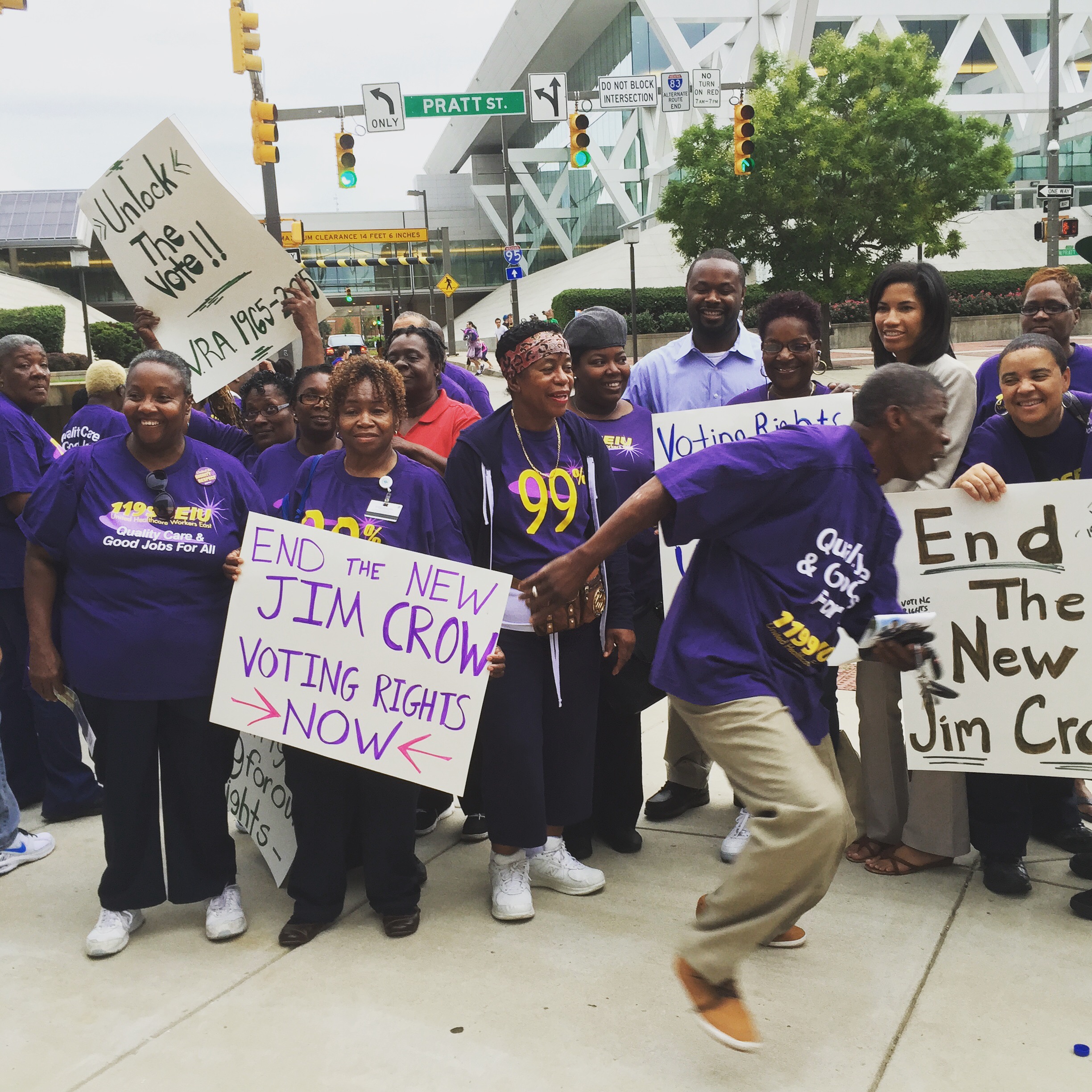
On August 6, the 50th anniversary of the Voting Rights Act, dozens of Baltimore ex-felons rallied and marched alongside community members to protest their disenfranchisement. In May, Maryland Governor Larry Hogan vetoed a bill which would have granted ex-felons the right to vote when they return home from prison, rather than making them wait until after their probation and parole sentences have been completed (some sentences can last for decades). Holding up signs that read, “We Want Taxation with Representation!” and “End the New Jim Crow!” protestors made clear that they understand the racial implications of the status quo. Had Hogan signed the bill into law, 40,000 more Maryland residents—a majority of them black Baltimoreans—would have been able to cast a ballot in the next election. “Override! Override! The veto! The veto!” protestors shouted together as they marched down the street.

The crowd, well over 100 people, eventually gathered around a statue of Thurgood Marshall, not far from Baltimore’s Inner Harbor. “We picked that spot because he’s one of the greatest symbols of justice and fairness,” explained Perry Hopkins, an ex-felon who now works as an organizer with Communities United, the social justice group that planned Thursday’s rally. Fifty-four-year-old Hopkins has never voted.

While Baltimore has made national headlines this year for its police brutality scandals and its spiking murder count, the gathered crowd recognized that these issues cannot be separated from the societal exclusion African-Americans experience every day.

One woman who came to the rally was Robinette Barmer, who has had two children and one grandchild locked up in jail. Barmer has been fighting for ex-felon voting rights all year, and traveled to Annapolis last spring to push for the bill’s passage. “I try to tell ex-cons that their voices do still matter,” she said.

Greg Carpenter, a 62-year-old black man who served 20 years in prison for an armed robbery, also has a 20-year parole sentence. Although Carpenter has been out of jail for 12 years now, he worries he won’t ever get to vote again in his lifetime.

Governor Hogan said that requiring ex-felons to finish their parole and probation sentences before voting “achieves the proper balance” between repaying one’s obligations to society and restoring citizens’ rights. Ex-felons point out that they are both working and paying taxes within their communities, and thus should also have the right to vote.

Social science research suggests that removing voting restrictions would provide positive benefits to both ex-offenders and society at large. The American Probation and Parole Association also says there is no credible evidence to suggest that disenfranchising people who have returned home from prison serves any legitimate law enforcement purpose.

According to the Sentencing Project, a criminal justice advocacy group, there are roughly 5.85 million disenfranchised American citizens with felony convictions, and 2.2 million of them are black. That’s one out of every 13 African-Americans.

The Voting Rights Act was passed in 1965 to end discriminatory voting barriers but the courts have disagreed on whether the VRA should apply to felon disenfranchisement laws. Maryland activists aren’t waiting around for the courts, though. At Thursday’s rally, organizers prepped the crowd for next year’s legislative season where they hope to push for an override. “We need you to show up and come out with us to Annapolis,” said Nicole Hanson, an ex-offender who works with Out4Justice, a group that politically mobilizes ex-offenders. “There’s only 90 days of [the legislative] session, so we’ll need you to make some sacrifices.”

Eighteen states considered loosening ex-felon voting restrictions this year, up from 13 states in 2014. But passing legislation, as Maryland activists witnessed first hand, is difficult. Only one state—Wyoming—ended up successfully loosening its restrictions.

Still, there has been demonstrable progress. The Sentencing Project estimates that nearly 800,000 citizens have regained the right to vote through voting reforms enacted between 1997 and 2010. Last month, President Obama even said that, “If folks have served their time, and they’ve reentered society, they should be able to vote.”

“This is a very peaceful rally, but this issue is personal,” Hopkins said in an interview. “We’re going to flip power, and we’re going to empower. We’re going to show the governor who’s the boss. We’re the boss! We’re the people.”

Rachel M. Cohen

Perry Hopkins at the podium                   

NLRB Rules Teach for America Members Have a Right to Unionize

Originally published on The American Prospect’s Tapped blog on August 5th, 2015.
——

In another interesting development for the movement to unionize charter schools, the National Labor Relations Board ruled last week that Teach for America corps members should have been allowed to vote in a Detroit charter union election earlier this year.

Detroit 90/90, a charter management organization for the University Prep charter network, said that Teach for America teachers shouldn’t be permitted to vote because they are not professional employees. Instead, they argued, TFA members should be viewed as long-term substitute teachers.

Patrick Sheehan, a Detroit TFA-er told MLive that he and his fellow corps members are really pleased with the NLRB’s decision. “U-Prep hired us to teach just like other teachers. Making the legal argument that we are not professionals means one of two things: Either Detroit 90/90 doesn’t respect the work we do with students or they lied to prevent us from organizing a union.”

Shaun Richman, the AFT’s deputy director of organizing told The Prospect that University Prep’s argument was an insult to all TFA corps members and alumni around the country. “Nobody would have dared to say that TFA corps members are not really teachers even a year ago,” said Richman. “But now that they want a union, suddenly those kinds of insults are apparently on the table.”

While Teach for America does not officially take a stance on unionization efforts, Takirra Winfield, TFA’s head of national communications, praised the NLRB’s decision. “We’re pleased that the National Labor Relations Board acknowledged that our teachers are professional, qualified educators who are deeply invested in their school communities and are able to make individual choices about their union membership,” she said. “As a TFA network, we know there is tremendous strength in the diversity of perspectives among our talented corps members and alumni as they work to help make certain that every child has access to an excellent education.”

There are roughly 11,000 current TFA teachers and more than 37,000 alumni around the country. About 60 percent of Detroit Teach for America corps members work in charter schools. Nate Walker, AFT-Michigan’s K-12 organizer and policy analyst, was a former Detroit TFA-er himself.

It’s likely that we’ll continue to see more union campaigns launched at charter schools, and more Teach for America members among them. Many TFA-ers are progressive and young, and national surveys find that young Americans are among the country’s most ardent union supporters. According to Pew, fully 55 percent of Americans aged 18 to 29 held a favorable view of unions, while just 29 percent held unfavorable ones.