New York City Tackles School Segregation

Originally published in The American Prospect on December 9, 2015.
—–

Six decades after the Supreme Court ruled that segregated schools are “inherently unequal,” integration may finally be coming to New York City.

With 1.1 million students, New York City is home to one of the nation’s largest public school systems; it’s also one of its most economically and racially segregated.

For decades, nobody in the city besides a few die-hard activists seemed to care much. Over the past year and a half, however, a perfect storm of provocative research studiesnews reportsrezoning fights, and public advocacy have forced public officials to take notice.

Last month the New York City Department of Education announced that at the start of the 2016-2017 school year, seven public elementary schools will participate in a new pilot program designed to diversify student bodies. Each of the seven schools will be permitted to set aside a certain percentage of seats to give priority enrollment to various student populations, including English language learners and those living in poverty.

Though some advocates have expressed concern that the pilot program is too little, too late, there are signs that that even bigger desegregation efforts are yet to come.

This pilot represents the first concrete step taken by New York City Mayor Bill de Blasio’s administration towards desegregating the city’s public education system. Despite de Blasio’s reputation as a progressive, his administration has so far failed to tackle the segregation issue head-on.

As an example of his administration’s half-measures, earlier this fall, New York City Schools Chancellor Carmen Fariña suggested that instead of desegregating schools in poor neighborhoods, public schools could diversify by pairing students in wealthy schools with kids in low-income schools to share resources, meet in person, and become pen pals. Fariña also said school diversity could be promoted by teaching students about world religions in their classrooms.

These proposals drew fire from school equity advocates, but de Blasio defended them, and suggested that promoting school choice and high-quality schools are more pressing priorities than desegregation. Critics faulted de Blasio for perpetuating the policies of his predecessor, Michael Bloomberg, who also did little to tackle segregation.

“The whole idea of us voting Bill de Blasio into office, with his mixed family, was for him to usher in a new agenda—a progressive agenda,” says Jose Vilson, a New York City math teacher and prominent social justice activist. “But what we’ve seen is that he still has to deal with the old politics defined by Giuliani and Bloomberg.”

De Blasio also took heat for failing to follow up on the few steps toward integration that Bloomberg’s administration did take. At the start of the 2013-2014 school year, P.S. 133, an elementary school located in a gentrifying part of Brooklyn, unveiled the city’s first-of-its kind admissions program to reserve spots for English language learners and low-income students. Bloomberg’s then-school chancellor, Dennis Walcott, hailed the innovative program as a potential model for other schools.

But de Blasio failed to follow through once in office, and officials within his administration told principals who wanted to establish diverse admissions policies that the city lacked the legal authority to approve their requests. School equity advocates cried foul—pointing to federal Education Department guidance posted in 2011, which affirmed school districts’ legal right to promote diversity through admissions.

Now that de Blasio has come around, advocates make sure to point out that they had been right all along. David Tipson, the executive director of New York Appleseed, an organization that promotes equity in schools, says that the de Blasio administration’s recent pilot announcement “represents a complete and utter rejection of those bogus legal arguments” that they had used for so long.

MOST SCHOOL INTEGRATION ADVOCATES have hailed the seven-school pilot program, but warn that de Blasio’s one-school-at-a-time approach has pitfalls. There are more than 1,700 public schools in the city, and if desegregation efforts are not carefully coordinated, then desegregating one school can have the adverse effect of exacerbating segregation at another.

To really foster school integration, advocates say, the city needs to adopt what’s known as “district-wide controlled choice”—a desegregation model used in other cities, such as Cambridge, Massachusetts, and Champaign, Illinois—that aims to balance parental choice with diversity. Parents rank their top school choices within a particular district, and then the district assigns students in a way that accounts for those preferences while also ensuring that each school has an integrated student body. (In New York City, this would mean assigning students within the system’s 32 separate school districts.)

“There’s always a fear with incremental change that the most recent increment is your last—that maybe this is as much as we’ll ever get, but I think this [pilot announcement] is really just breaking the seal,” says Tipson, who notes that this is the first time the de Blasio administration has acknowledged that gentrification must be managed at the school level, and not just through housing policy.

The school integration debate will only intensify in New York City, where gentrification and school overcrowding are both growing issues. This past May, the New York City Council passed a new law known as the School Diversity Accountability Act that requires the city to annually publish detailed student demographic data and make clear what steps it has taken to advance school integration. The first report generated by the new law will be published at the end of December.

“I think the pilot program is a good first step, and I hope more schools will do it, but I also agree that in a city with 1,700 schools we have a lot more steps to take,” says City Council member Brad Landers, a co-sponsor of The School Diversity Accountability Act. “We have to keep pushing forward, and the most important and most immediate next steps need to be moving towards district-wide diversity.”

Julie Zuckerman, a principal at Castle Bridge, a Washington Heights-based elementary school participating in the diversity pilot, says when she first founded Castle Bridge six years ago, nobody was interested in discussing integration. She tried to get the city’s permission to prioritize diversity in their admissions lottery, but officials were not supportive. Now under the pilot program, Castle Bridge will be able to ensure that at least 60 percent of its student body qualifies for free or reduced-price lunch, and that the school educates at least 10 percent of kids with incarcerated parents.

Zuckerman says she also plans to build off the momentum from this pilot program to push for district-wide solutions. She currently serves alongside a half dozen other principals on a city superintendents’ advisory panel, where she intends to make the issue a priority.

“This [pilot] is not even a drop in the bucket, and yet it’s the first acknowledgement by the city that it doesn’t have to be the tail wagging the dog on gentrification,” she says. “Let’s harness gentrification instead of being determined by it.”

The seven schools in the pilot program all happen to be progressive schools—that is, institutions that test innovative, often experiential curricula in ways that appeal to middle-class parents. Though many of the progressive schools started out with diverse student populations, teachers and administrators say they have recognized that their school demographics have started to shift in recent years, as more affluent families apply, and poorer families find they can no longer afford to live in the city.

Jia Lee, a teacher at The Earth School, another diversity pilot participant, notes that over the last few years, her school has grown “much more white and middle class” and that it no longer feels “reflective of the community.” She says the school’s new set-aside policy, which will reserve 45 percent of its seats for low-income students, will help ensure that their school can educate a diverse student body in the years to come.


ONE OF THE BIGGEST POLITICAL CHALLENGES for advocates of district-wide controlled choice is garnering support from parents who send, or intend to send, their children to public schools that already have mostly white and affluent students. Last month, de Blasio told Chalkbeat NY: “You have to respect families who have made a decision to live in a certain area oftentimes because of a specific school.” In effect, he suggested that given the investments parents have already made to send their kids to certain schools, it would be wrong to try and modify those institutions after the fact.

His comments immediately garnered pushback. “Is it not disrespectful, in fact, to tell low-income families that they can’t go to a certain school because they couldn’t buy a several million-dollar co-op?” wrote Donna Nevel, a local educator and activist in an open letter published in The Huffington Post.

Experts say that the set-aside policies will work to prevent more schools from “slipping”—a term used to denote formerly diverse schools that have become heavily gentrified. If fewer schools “slip,” then there may be less political opposition to larger, systemic policy change.

Dao Tran, a parent of a third grader at Castle Bridge, says that while she doesn’t believe desegregation is something that can be solved school by school, she thinks advocates “have to start by showing certain integrated models that work.” In that sense, Tran believes the success of this pilot program could help to persuade skeptical parents.

“To me, these are all steps along the way, and I agree if we just stopped with this pilot then we have not done anywhere near enough,” says Landers, of the City Council. In a statement, the city’s education department also said the pilot program “remains one piece of a larger effort” to expand diversity across city schools.

The next step, advocates say, will be building a political consensus behind real change.

“It’s almost easier to talk about police brutality than it is to talk about school integration,” says Landers, noting that a swirl of of guilt, resignation, parents’ concerns for their own kids, and racism all work together to make school segregation a tough issue for people to reckon with.

But Ujju Aggarwal, a New York City education researcher and activist, voices optimism. In her 15 years in the district, Aggarwal says she has never seen school integration discussed so broadly until now.

“What’s increasingly clear is that this city has to take a stand respond to the crisis of inequality and segregation that is particularly pronounced in our education system,” she says. “I’m hopeful that with the increased visibility of this issue the city will respond in a more systemic way.”

How Baltimore Is Reacting to the Start of the Freddie Gray Trials

Originally published in VICE on December 1, 2015.
—–

how-baltimore-is-reacting-to-start-of-the-freddie-gray-trials-1130-body-image-1448944852-size_1000

Photo Credit: Rachel M. Cohen

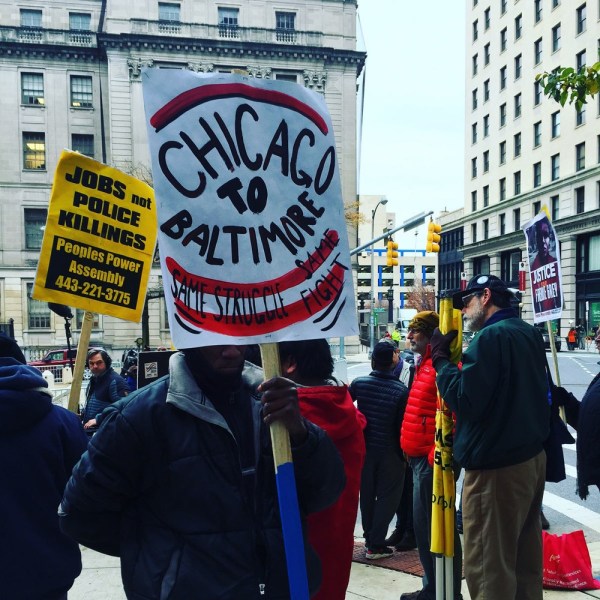
It was cloudy and chilly outside the Mitchell Courthouse in Baltimore on Monday morning at the opening of the trial for William G. Porter, one of the six police officers charged for the April death of 25-year-old Freddie Gray. The other five implicated officers will have their own trials over the next several months; the prosecution reportedly sees Porter as a “material witness” who could be useful against the others. Baltimore State Attorney Marilyn Mosby charged the six officers in May after weeks of protests and riots that upended the city.

The trials begin at a fraught time for the city, as Baltimore has seen a dramatic spike in homicides this year, with 311 murders so far in 2015—100 more than the city saw in all of 2014. Meanwhile, police killings of people of color continue to generate outrage across the country, leaving Baltimore activists to wonder exactly how much they’ve accomplished since Gray’s death and the tumult that followed.

The “Baltimore Uprising”—as local activists call it—began just over a year ago, on November 25, 2014. That’s when protesters gathered downtown to protest Darren Wilson, the white police officer who shot and killed Michael Brown in Ferguson, Missouri, not getting indicted. Local activists recognize that the death of Freddie Gray carries as much significance for the national Black Lives Matter movement as other high-profile killings, and on Saturday, they held their own rally in solidarity with activists in Minneapolis and Chicago.

It’s been challenging for Baltimore activists to keep up their energy and momentum over the past seven months, but residents and public officials are bracing for a new wave of energy as the trials for the officers accused of ending Gray’s life heat up.

“The people from West Baltimore’s poorest communities are still reeling from how the Freddie Gray incident was handled by the powers that be,” says Perry Hopkins, an organizer with Communities United, a local grassroots organization. “The majority want justice, but openly say [that] if officers only get a slap on the wrist, this city had better be prepared to experience another thwack on the hand. They mean it.”

When I asked Hopkins if he thinks that means the community will begin protesting again if the officers are not convicted, he said, “Yes they’ll protest…and in many different fashions.”

A few handfuls of activists convened with signs and banners at the courthouse Monday, where metal barricades blocked off the areas protesters typically use to congregate. Some grew angry at what they felt were attempts by city officials to thwart their First Amendment rights. Still, those within the courtroom could hear protesters’ chants from the street.

how-baltimore-is-reacting-to-start-of-the-freddie-gray-trials-1130-body-image-1448944976-size_1000.jpg

Photo Credit: Rachel M. Cohen

Sharon Black, a leader with the Baltimore People’s Power Assembly, told me that it feels like there’s a great deal of confusion right now, even among some of the most committed activists in town. “We’ve been phone-banking, and our sense is that people are a little bit confused about what’s actually going on,” she said. This makes sense given the complicated legal process, and the fact that the presiding judge imposed a strict gag order last month on the lawyers involved in the case.

“People are sort of saturated with news, and there’s a bit of wearing down in terms of energy,” Black said. “The bigger response from the public may only come after the trials have concluded.”

Legal experts have expressed doubt that the officers will be convicted, and city officials are preparing for the likelihood that residents could revolt if they feel justice isn’t served. Police Commissioner Kevin Davis says his department has spent nearly $2 million on new police riot equipment—including vans, protective gear, shields, and helmets—since the unrest over Gray’s death this spring. Davis replaced the former Baltimore police commissioner, Anthony Batts, and the police department underwent a significant reorganization over the summer.

Mayor Stephanie Rawlings-Blake told the Baltimore Sun that city officials are having “constant conversations and planning sessions” to prepare for, and prevent, potential riots. “Community members certainly don’t want the city to erupt in violence again,” she said. More than 250 businesses were damaged after the April protests, almost 150 vehicles were burned, and roughly 60 buildings were set on fire.

“People in Baltimore still want to see justice for Freddie Gray, that has not changed one bit since April,” said Andre Powell, a protestor who stood outside the courthouse Mondaymorning. “Yes the mood was much more heightened directly after the incidents but people are closely watching what’s going on.”

Porter, the first officer on trial, has been charged with manslaughter, second-degree assault, reckless endangerment, and misconduct in office. Officer Porter reportedly asked Gray if he needed a medic while traveling in the police van, but thought he might be lying to avoid going to jail when Gray said yes. The officer is a 26-year-old Baltimore native who’s been on unpaid leave from the Baltimore Police Department since posting his $350,000 bail earlier this year.

A spokesperson for the Baltimore police union on Monday told VICE they were unavailable to comment on the trial. In general, however, the union has expressed outrage at the indictment of the six officers, and has called on State Attorney Marilyn Mosby to recuse herself from the case. The president of the union, Gene Ryan, called the city’s $6.4 million settlement deal for the family of Gray, approved in September, “obscene.”

On Monday, the court proceedings were focused on selecting a panel of impartial jurors for the case. Porter’s attorneys have argued that finding a truly fair jury will be impossible in Baltimore, and that the trial must be held elsewhere.

There is new evidence to suggest that Marylanders outside of Baltimore hold rather different views on the Gray protests than those who live within the city. A recent pollfound that Baltimore voters are more likely to say that racism and the lack of jobs are the biggest reasons for the unrest after Gray died. Voters across the state, on the other hand, are more prone to saying it was due to residents’ “lack of personal responsibility.” The same poll found that 63 percent of Baltimore voters supported Mosby’s handling of the case, compared to 38 percent of voters statewide.

The presiding judge, Judge Barry G. Williams, a black man who previously prosecuted police misconduct for the federal Justice Department, said he would reconsider moving the trial out of town only after the court makes a serious effort to find a fair crop of jurors within the city. Williams made clear that he thinks it’s important for people to be tried by “their peers.” And trying the officers within the city, many have noted, should help lend the court proceedings greater legitimacy. “One way to ensure that a community accepts a jury’s verdict is for the jury to reflect the entire community’s diversity,” University of Maryland law professor Douglas Colbert told the Sun.

Residents and civil rights leaders will closely monitor the proceedings, and the local NAACP chapter plans to have a court watcher in attendance for the full duration of the trial. A great deal is riding on the outcome of these trials, and for better or for worse, everybody in Baltimore knows it.


Can Teachers Unions Help Online Charter Schools?

Originally published in The American Prospect on November 27, 2015.
—-

In a major win for the movement to organize charter schools, a California state labor board recently ruled that teachers working for the state’s largest online charter network could form a union.

Teachers for the network, known as the California Virtual Academies, have been battling since April of 2014 with administration officials who refused to negotiate. That’s when more than two-thirds of the so-called CAVA network’s teachers voted in favor of unionizing.

Roughly 15,000 students attend CAVA’s 11 campuses across the state. CAVA administrators had argued that teachers at those disparate campuses should form their own individual unions instead of organizing a single union that would represent them all.

In a 77-page legal decision, the California Public Employment Relations Board (PERB) rejected this argument—setting the stage for CAVA teachers to move forward with their network-wide union. The California Teachers Association (CTA), a state affiliate of the National Education Association, will serve as their exclusive bargaining representative.

To teachers who have been agitating for a union, gaining the leverage to improve working conditions is a key first step to boosting student performance—something the online charter sector greatly needs. The teachers’ labor victory comes on the heels of several recent reports concluding that online charter schools are performing extremely poorly. Some 200,000 students take online classes through such institutions nationwide.

“Academic benefits from online charter schools are currently the exception rather than the rule,” stated researchers in a report released by the Center for Research on Academic Outcomes on October 27. It was one of three different research studies released last month that arrived at similar conclusions.

Earlier this year, the progressive group In the Public Interest, which focuses on contracting and privatization, issued a report that looked specifically at problems within the CAVA network. It found evidence of poor academic outcomes, financial conflicts of interest, and insufficient supports for teachers, among other things.

CAVA is managed by K-12 Inc., a publicly traded company based in Virginia that made $55 million in profits last year. The K-12 Inc. schools offer classes to some 14,500 students across the country.

K-12 Inc. officials diputed the methodologies behind the critical reports. But the CAVA teachers who have been organizing for a union said the findings did not surprise them.

“I think those reports actually helped us because they just reinforced what we were already seeing with our own students,” said Stacie Bailey, a CAVA teacher on the organizing committee.“We’ve been trying to push the school to focus more on instruction for a long time.”

Bailey actually spent several years working as a CAVA administrator, until she grew so frustrated with how things were run that she went back into teaching.

“Personally, I joined the union drive because I just see that teachers do not have a voice at our school,” said Bailey. “It’s too top-town. I tried to give teachers that voice while working as an administrator, but I was not successful.”

Working for an online charter school poses some unique challenges for teachers looking to organize. “We engage in the workplace from our own homes, we are isolated, we do not see each other,” said Jen Shilen, a high school history and economics teacher who worked at CAVA from the fall of 2012 up until this past summer. “The process of building rapport with colleagues can be challenging.”

CAVA teachers say they grew interested in the idea of forming a union when their workloads and responsibilities spiked dramatically beginning in the fall of 2013—particularly when they were asked to perform more clerical duties. More paperwork meant less time to work directly with students, teachers say. Organizing talks kicked off at the end of 2013, and CAVA teachers soon approached the California Teachers Association for assistance.

“Some of us used to work for union protected schools, so we knew who to talk to,” explained Shilen. CTA helped the 700 teachers fan out across the state to coordinate with one another; helped them with press outreach, and connected teachers with legislators.

The union vote took place in the spring of 2014. “It was rather surprising that it was as successful as it was,” remarked Bailey. “We had to call every teacher, and send them a petition and they had to print it, sign it, and mail it back to us. That’s a lot to ask of someone, and we ended up getting a super majority voting for the union.”

But CAVA administrators rejected the petition, insisting that the teachers did not constitute one legal entity. “CAVA’s argument was that CAVA does not exist,” said Shilen, wryly.

What came next was a protracted legal battle, including five days of hearings in a state administrative court in February and March, with lawyers filing their legal briefs in May. In June, 16 teachers filed 69 complaints against CAVA on a variety of grounds, including violations student privacy laws, misuse of federal funds, and inadequate services to students with disabilities. CAVA’s senior head of schools, Katrina Abston, dismissed the complaints.

Teachers have waited since mid-May for the decision from the state Public Employment Relations Board, which arrived on October 30. “We were hoping the decision would come in July, about six weeks after the lawyers turned in their briefs,” said Bailey. “It took five months.”

CTA President Eric Heins praised the PERB decision in a statement and urged CAVA administrators not to appeal this “historic ruling.” Now, Heins stated, “teachers can begin to address the problems that are hurting their students, such as insufficient time spent on instruction, high teacher turnover, and too much public money going out of state.”

The CTA’s support for CAVA teachers has raised some eyebrows, particularly since the union has staked out some anti-charter policy positions over the past decade. As I reported in The American Prospect in June, the relationship between charter teachers and unions is evolving and complicated.

CAVA administrators, who did not return The American Prospect’s request for comment, have moved to appeal PERB’s decision.

“The ruling states CTA may seek collective representation of all teachers at all CAVA charter schools, notwithstanding that CAVA is not itself an established public school employer,” Abston told the San Bernadido Sun this month.

But CAVA teachers are unfazed.

“Even if they’re going to appeal, we’re still a union; it doesn’t stop our forward momentum,” said Bailey confidently. “We’re not worried about it.”


Can Affordable Housing Help Retain Teachers?

Originally published in The American Prospect on November 18, 2015.
——

On December 1, Allison Leshefsky, an elementary school gym teacher in San Francisco, will be evicted from the rent-controlled apartment she’s lived in for the past ten years. She and her partner pay $2,000 a month in rent, but if their place were put on the market, it would likely go for at least $5,000 a month—far more than any public school teacher could afford. As of August 2015, one-bedroom apartments in San Francisco rented for an average of $2,965 a month, and two-bedrooms for $3,853. Leshefsky’s landlord, who manages and partially owns nine San Francisco properties, has gained notoriety for evicting or allegedly forcing tenants out, in order to rent their units for more money.

Leshefsky has decided to finish out the school year teaching in San Francisco, even if that means paying jacked up prices for an air mattress she finds on Craigslist. “I’m making a commitment to get through the rest of the year regardless of whose couch I’m on or whose overpriced house I’m in,” she says. “I’m making a commitment to my students to finish this out.” But then, she says, she’ll have to leave.

In recent years, a growing number of researchers, policymakers, and philanthropists have directed their attention to the relationship between housing instability and student achievement. A great deal of evidence has shown how homelessness and housing insecurity can negatively impact a student’s behavior, which creates problems not only for them but for their classmates and teachers as well. A host of educational interventions are being tried in conjunction with local housing authorities, and some cities are even tying housing vouchers to specific struggling schools—in the hopes that such requirements will reduce student turnover and increase school performance.

Yet despite the perennial quest for top-notch teachers, less attention has been paid to the relationship between educators and their housing. It doesn’t require a great stretch of the imagination to think that teachers’ instructional capacities could be impacted by conditions they face outside the classroom, such as high rents, or unsafe housing. “There is no possible way the city can recruit talented people and maintain them with the housing crisis here,” says Leshefsky. “Students deserve teachers that are secure in their homes, and when a teacher is not secure, they can’t be the most effective educator.”

The city of San Francisco seems to agree. Last month, San Francisco’s mayor announced a new plan, formed in partnership with the school district and the teachers union, to provide housing assistance to some 500 public school teachers by 2020. Elements of the plan include forgivable loans, rental subsidies, housing counseling services, and the development of affordable housing specifically for teachers. This month, 73 percent  of San Francisco voters approved a ballot measure that will help make this plan a reality.

Across the country, other variants of teacher housing developments have cropped up, or are in the works—though the motivations for them, and allies behind them, differ from city to city. From San Francisco, to West Virginia, to Philadelphia, the efforts to attract, or retain, teachers through subsidized housing is growing more pronounced, and debates over how such projects impact their surrounding communities are likely to intensify in the coming years.

MATTHEW HARDY, the communications director for the San Francisco teachers union, says the union has a three-pronged strategy to deal with the city’s housing crisis. The first involves fighting for higher wages. In December 2014, the union negotiated a substantial salary increase for teachers and aides—a raise of more than 12 percent over three years. “But if we just limited ourselves to that, we’re not going to be successful,” says Hardy, which is why the union has also been pushing for teacher housing—using surplus district property—and for broader affordable housing policies for all city residents.

“Of course San Francisco is a wonderful place, and some people are willing to make immediate sacrifices to get their foot in the door, but it gets to a point where teachers start to wonder if they should continue paying $1,500 a month for a tiny room or move to the suburbs [where salaries are higher and housing is cheaper] and make $15,000-$20,000 more,” says Hardy. “We need to find ways to support teachers early in their careers, but also those who are more experienced and might want to start a family or buy a home.”

“If affordable brick-and-mortar teacher housing were actually here right now, and not several years in the future, then there would be no doubt in my mind that I would have continued to stay in the district,” Leshefsky said, wearily.

A very different sort of housing crisis plagues McDowell County, West Virginia—a poor, rural area, with a population that’s fallen by 80 percent since the 1950s. Teachers aren’t being priced out, but few want to move there, and those who might be so inclined struggle to find attractive housing options.

In 2011, former West Virginia First Lady Gayle Manchin asked Randi Weingarten, the president of the American Federation of Teachers (AFT), to help her figure out a way to improve McDowell’s school system. They started to organize a coalition of public and private organizations to tackle not only educational issues, but also regional poverty. In a speech given in 2012, Weingarten called this effort “solution-driven unionism.” Rather than shut down a school that’s struggling, she argued, unions can push to strengthen them with wraparound services. Then “learning improves, the school improves, community schools become more attractive than private or charter schools, people return to them with new confidence, home values increase and communities are renewed.”

Part of the McDowell plan includes not just wraparound services for community members, but also new apartments to attract teachers who might not otherwise want to move to McDowell County. As the lead coordinator involved in the teacher housing complex told Governing, “You can’t expect someone to leave life on a college campus for an isolated area where they live in the middle of nowhere and don’t know anybody.”

“What we’re constructing is the first multiple-story building in the area in decades,” said Weingarten in an interview. “The housing will address three big issues: the high teacher vacancy rate, the dearth of available housing, and the need for economic development.”

WHILE McDOWELL COUNTY’S “teacher village” won’t be the nation’s first, others are generally found in urban areas, and have been constructed largely without the involvement of the local teachers unions. In fact, partners more closely aligned to the educational reform movement have led them—those with ties to charter school networks and organizations like Teach for America.

In 2012, then-Mayor of Newark Cory Booker, New Jersey Governor Chris Christie, leaders from Google and Goldman Sachs, and others gathered to break ground on the Newark Teachers Village—a downtown Newark development that houses three charter schools, a daycare facility, more than 200 subsidized teacher apartments, and nearly two dozen retail shops. The project received tens of millions of dollars in tax credits. (The Wall Street Journal reported on the event with the headline: “Viewing Newark as a ‘Blank Canvas’”.) The real estate development group that spearheaded the project, RBH Group, is listed as a Teach for America corporate sponsor, and one of RBH’s founding partners, Ron Beit, is the chairman of the board of TFA’s New Jersey chapter.

The Newark Teachers Union, an affiliate of the AFT, originally backed the Newark Teachers Village—though Newark teachers say that their now-deceased president, Joseph Del Grosso, did so without consulting union members. The AFT is an affiliate member of the AFL-CIO, a federation of labor organizations that includes construction unions, and some think Del Grosso supported the plan because it carried the potential to create new construction jobs, not because it was actually in the teachers’ interest. However, despite Del Grosso’s initial support, the union was ultimately uninvolved with the project.

“They basically shut out the public school teachers and the public school union,” said Weingarten in an interview. “Just like they shut out the community from their reform efforts, they shut us out too. Initially we had conversations [about the Teachers Village], and then we were stonewalled.” Had the AFT been involved, then the union likely would have invested pension funds into the project, which may have broadened, and diversified, the project’s mission, and given more stakeholders a say in shaping its development. The union could have also pushed to bring on different types of asset managers, like the AFL-CIO Housing Investment Trust, which they used in West Virginia and San Francisco. Ron Beit did not return repeated requests for comment.

Over the past couple years, similar teacher housing projects have opened up in other East Coast cities. In 2009, the Seawall Development Corporation established Miller’s Court in Baltimore, using millions of dollars in local, state, and federal tax credits—and another, Union Mill, a few years later. The lead developer, Donald Manekin, was a former board member of Teach For America, and said he originally got the idea to build teacher villages when he saw 100 new TFA members arriving in Baltimore each year. “We’d sit at the end of these board meetings and say wouldn’t it be great if there was a great place for teachers new to the city?” He made these remarks to Newsworks in 2013, as his company prepared to build another teacher housing complex in Philadelphia.

Teach For America’s vice president for administration, Matt Gould, told The New York Times that his organization backs the projects because they “allow [teachers] to have safe, affordable housing. It’s a recruiting tool.” Teach For America is also reportedly looking into New Orleans and Washington as additional cities to expand teacher housing.

I spoke with Thibault Manekin, Donald Manekin’s son, and co-founder of Seawall Development Corporation, about his work building teacher housing. “Really our goal was to provide Class-A apartments and space for teachers doing the most important work in our city, which is helping kids get an education,” he said. To do this, the Manekins provide teachers with a free fitness center, free parking, reduced rent, lounge space, and other amenities that one might find in a more expensive apartment building. (Their website describes the buildings as “an urban oasis”.) Manekin says his company is in the middle of a similar project in Springfield, Massachusetts, and helping others think through comparable developments in other cities. “Yeah, I think you’ll start to see this spread more,” he said.

I asked him if he thought Baltimore teachers had struggled to find safe or affordable housing before he and his father embarked on their projects. “I think the challenge was that teachers, often new to Baltimore, and new to the classroom, weren’t living with like-minded people, and so might be making bad decisions on where to live,” he said. “As a result of that it makes the job that much harder. We just wanted to provide them with a world class space at a significant discount.”

While safe and affordable housing was available, he went on, “you wouldn’t really be living with people in the same boat as you.” They wanted to establish a space where teachers could lean on one another outside of the workplace.

Weingarten says the union was not included in the Philadelphia project, and was only cursorily consulted with for the Baltimore developments.

BRANDEN RIPPEY, a Newark public school teacher who has been working in the district for 18 years, said he acknowledges that Newark needs to build better housing to attract high-quality teachers. “Newark isn’t San Francisco. You do need to work to draw people in, and some of the housing we have here is in bad neighborhoods, and there is crime,” he says. As well, most of Newark’s teachers live outside of the city, so the idea of enabling teachers to establish roots as residents within the community is something he also likes. “I support the idea of creating good, affordable housing for working class people. The problem is that [the Newark Teachers Village] is clearly designed for white, young professional types, at a time when we desperately need more housing for poor people of color.”

Rippey notes that the Teachers Village is located close to other redevelopment projects in downtown Newark. “It’s just becoming a little yuppie commercial district,” he says. “The reality is they have a vision for gentrifying the whole downtown.” Rippey believes that these projects serve as a way to easily import TFA teachers, and by extension, weaken union power. Whereas developers like Beit and Manekin see the teacher housing complexes as positive ways to build communal spaces for local educators, Rippey thinks they can serve as a vehicle to isolate new and relatively young teachers from the union and the broader community. “It’ll keep those teachers residentially, and almost culturally, segregated,” he says.

IN A WAY, these Teachers Villages function as sort of a camp experience. You may be making a two-year commitment to live and work in an unfamiliar city, one that perhaps you, or your family, worry is unsafe. You know that you’re going to be working hard, long days—and so living in close quarters with people going through similar experiences might be quite comforting. All in all, it appears to be a pretty good deal—you’ll be afforded lots of amenities and discounts, you’ll live in a place you know is secure, and you’ll have the chance to develop friendships with other “like-minded” individuals.

In 2013, Mark Weber, a public school teacher and an education policy doctoral student, wrote some strong critiques about these new teacher housing projects.

It’s the perfect scheme: Beit and his private investors get tens of millions of dollars in tax credits to finance the development. He then turns around and rents his commercial units to charter schools, which drain tax revenues away from the neighboring public schools (which could sorely use the money to shore up their crumbling infrastructures). Those schools then pay their young teachers, recruited from TFA, who then turn around and pay rent to Beit. So Beit’s managed to develop three revenue streams—tax credits, charter school rents, and teacher residence rents—all made possible by the proliferation of charters and TFA.

And here’s the real beauty part: If the neighborhood gets gentrified and property values rise, the increases accrue to the property owners—like Beit—but not the people who actually live in the neighborhood. Think about it: If these teachers were buying brownstones and condos, the rising property values would accrue to them. But, because they’re renters, and not owners, they don’t see any of the increase. Their presence will raise the value of the neighborhood’s properties, but they’ll get none of the reward (assuming everything goes according to plan).

I called Weber to discuss some of his thoughts in greater detail. He sounded skeptical that these subsidized projects had much value at all: Will they really help attract lifelong educators into the profession, or will they just serve as a nice perk for young teachers who wouldn’t stay in the classroom beyond a few years anyway?

“If these charter schools need young people who are willing to work long hours and do the career for just a couple years, then things like teacher villages are almost custom-made, because you’re not going to be buying condos, and it’s close to your work,” he said. “Is that sustainable? I would argue no if we’re trying to build a workforce that sees teaching as a lifetime career. We could continue to build, or we can ask ourselves if we’re paying teachers enough money. If you can’t comfortably live here without staying in subsidized housing, maybe that’s a problem.”

Others have also questioned whether this whole subsidized housing deal isn’t just a misplaced way to avoid paying teachers significantly higher salaries. An individual used to feel more comfortable entering the teaching profession—despite its lack of prestige or big paychecks—given the relative stability if offered: a middle-class life, solid health care benefits, and a stable pension to live on during retirement. Today, however, those sorts of guarantees are beginning to fall by the wayside.

“If you’re not going to offer good health care benefits, what are you going to offer to get people to join the profession?” asked Weber. “Some modest rent control in hip neighborhoods? That’s not going to help the neighborhood much, and that’s not going to be much of an incentive to go into teaching.”

MAYBE SUBSIDIZED HOUSING that targets young professionals won’t be what it takes to help attract career educators, yet it’s clear that cities do want to help recruit and retain educators who actually live in the communities in which they serve—an effort that may require more than just a salary increase (though that would help.) Whether it’s a Teach for America participant looking for a supportive communal space, or a mid-career educator with a family who wants to live closer to his or her workplace, thinking about the intersections between housing and teaching is something that even the most progressive unionists, like Rippey, believe we should be doing more of.

Weingarten defended the AFT’s McDowell and San Francisco projects, and contrasted them with the ones in Baltimore, Newark, and Philadelphia. “We’re not looking to create a boutique pipeline for some people to work in different communities, it’s not that,” she said. “It’s about creating affordable housing so people can establish roots in the cities in which they live.”

Still, even teacher villages more closely aligned to the reform movement are helping young teachers, and local nonprofit organizations, forge better ties with the communities in which they serve. “The amount of teachers that have actually stayed in the classroom and in Baltimore, and then gone out and bought homes has been really inspiring to see,” said Thibault Manekin. Of the 30 homes he and his father have built in Baltimore, he says 20 have been sold to former tenants of Miller’s Court and Union Mill.

Would Leshefsky be willing to live outside San Francisco and continue working at her school with a longer daily commute?

“No, I would not be willing to do a two-hour commute just to serve a community that I don’t belong to,” she said. “I’m one of the most constant people in my students’ lives right now, and I don’t think someone who lives outside the city can necessarily connect with their students in the same way. We’re all going through very similar struggles.”


Goodbye Public Housing?

Originally published in The American Prospect on November 12, 2015.
—-

In 2013, the U.S. Department of Housing and Urban Development (HUD) launched the Rental Assistance Demonstration (RAD) program—a far-reaching effort to preserve the government’s affordable units by transferring them into the private sector. Rather than have Congress directly fund local housing authorities to support the program, RAD allows private companies to rehab and manage public housing units in exchange for tax credits and subsidies. The contracts, which are set to continually renew every 15-20 years, require developers to keep units affordable for low-income tenants.

While Congress initially authorized just 65,000 units to be transferred—roughly five percent of the nation’s 1.2 million public housing stock—it later upped the RAD cap to 185,000 units, under pressure from the Obama administration and a coalition of public housing authorities, real estate developers, and other stakeholders. In August 2014, I took a deep look at the RAD program, and explored the concerns that tenants and housing advocates shared about its risks.

Last week I spoke with Alex Schwartz, a professor of urban policy at The New School, who has been researching some preliminary RAD data. He presented his unpublished findings at the International Sociological Association RC43 Conference this past September.

One key assumption behind RAD is that public housing was never that politically popular to begin with, and that it’s unlikely it’ll become more popular in the near future. Due to its low level of political support, (despite residents who live there being relatively satisfied), Congress has financially starved the program for decades; HUD estimates that nearly $30 billion would be required to repair and rehab the units at this point. And the longer it takes to make such repairs, the more unsafe and uninhabitable the units will become. Each year, roughly 10,000 units are permanently removed from the public housing program, through demolition or dispositions.

Through RAD, public housing units are “converted” into Project-Based Section 8 rentals, thereby becoming eligible for debt financing, tax credits, and other private funding sources that can be used to help cover rehab and maintenance costs.

While Congress has decreased federal funding for public housing over the past two decades, it has increased funding for project-based rental assistance during this time. Between fiscal year 2005 and fiscal year 2015, appropriations for project-based rental assistance increased by 82 percent, and appropriations for public housing’s Capital Fund decreased by 27 percent.

In other words, by transferring the affordable units out of the public housing program into one that has received more political and financial support, RAD proponents feel they will be better able to preserve the physical units over the long haul, even if they become less “public” as a result.

In his paper, Schwartz explains that:

Historically, because project-based rental assistance is largely used to support low-income properties with subsidy contracts involving private owners, Congress has been reluctant to undermine these contracts by failing to appropriate adequate sums for the program. If appropriations for project-based rental assistance falls short of the need required by the subsidy contracts, the properties would be at risk of foreclosure. At times Congress has delayed its appropriations for this program, and sometimes it has provided funding for less than a full year, but it has seldom cut back support for project-based rental assistance by a substantial amount.

The biggest takeaway, for me, is that there’s a great possibility that public housing will ultimately end in the United States. While RAD is often framed as a way to “save public housing”—that’s not quite accurate. RAD is designed to help fund much-needed capital repairs, and provide financing options to keep the units habitable and affordable in the future. But the only way it works is by transferring the properties out of the public housing program, and into the Project-Based Section 8 world.

Schwartz thinks there are some units that are in such bad shape, located mostly in high-poverty neighborhoods, that not even tax credits, mortgage financing, and other RAD funding streams will be sufficient to attract private developers to fix them up. In light of this, the Obama administration requested that Congress appropriate $10 million to the RAD program, to help repair those units with particularly challenging needs. But Congress was adamant that RAD remain a “revenue-neutral” program, and refused to do so.

What this means is that if RAD expands, which it likely will, then we’ll see most affordable units transferred out of the public housing program, and those that remain will be the ones in the most abysmal shape.

“If people had a bad image of public housing before, it’ll just get even worse,” said Schwartz in an interview. “It’s analogous to the health insurance pool—where all the healthy people leave, and then you’re just left with just those who have the most expensive health needs.” Ultimately Schwartz thinks that whatever properties remain in the program will be left to decay until they are eventually demolished once and for all.

Judge Issues Restraining Order After an L.A. Charter Network Interfered with Teachers Union Drive

Originally published in The American Prospect on November 3, 2015.
—-

Drama has escalated for teachers organizing at the Alliance College-Ready Public Schools, the largest charter network in Los Angeles. Since the teachers, organizing with United Teachers Los Angeles (UTLA), first went public with their union drive in March, they allege the administration has erected illegal barriers to organizing, including intimidating their employees. (Alliance denies these accusations, though some of their leaked internal communications certainly suggest they are opposed to the effort. For example, one memo instructed management to keep their statements focused on “the potentially negative effects of UTLA and any union on fulfilling the school’s mission.”)

Union leaders have filed four unfair labor practice complaints against Alliance, claiming that that administrators have sought to spy on teachers who are organizing, and block UTLA organizers from coming on campus, among other things. Teachers also took issue with Alliance using “funds that could be used for student education to hire high-priced PR consultants, to create an anti-union website.” Towards the end of the 2014-2015 school year, the California Charter Schools Association started to pay Alliance alumni to call parents at home, in order to help galvanize them against the union effort. Part of the script that alumni were asked to read said, “We are asking parents to sign a petition in support of the Alliance as it is today…without UTLA. Will you please sign our petition?”

“Paying alumni to read a script designed to get parents to sign a petition against their own students’ teachers infuriates me,” said Michael Letton, an Alliance teacher, in an UTLA statement.

Alliance’s spokesperson, Catherine Suitor insists that everything the charter network has done in response to the union effort “is to the letter of the law” and says they would not seek to create a coercive or hostile environment.

Two weeks ago, California’s state labor board announced that it would be issuing an injunction, calling for Alliance administrators to quit interfering with the organizing efforts. Then on Friday, in a surprising move, a Los Angeles County Superior Court judge issued a restraining order against the Alliance administrators. The order says that Alliance cannot coerce or ask teachers about their positions on unionization, must allow organizers to come onto school grounds, cannot block emails from the union, and must stay 100 feet away from UTLA organizers.

This restraining order will remain in place until November 17, when the judge considers the state labor board’s injunction request. Union organizers will now be allowed to enter into school buildings after school hours.

In March, 70 teachers first announced their intent to join a union, and by June, 146 teachers had signed on in support. Shaun Richman, AFT’s deputy director of organizing, says the current number stands at 124 teachers, after losing some supporters over the summer who no longer work at Alliance. Forming a union will require 50 percent-plus-one of the charter’s roughly 600 teachers to sign on in support.

Earlier this fall, news leaked that the Broad Foundation seeks to enroll at least 50 percent of L.A. public school students in charter schools over the next eight years. Currently, about 16 percent of students in the district attend charters. Such an expansion would undoubtedly threaten the jobs of many unionized teachers in the district.

While the Broad Foundation’s charter expansion plan would require about 5,000 teachers, their documents make no mention of recruiting from teachers already working for L.A. Unified. It does discuss recruiting from Teach for America and other alternative teacher training programs. “While TFA is important, we predict they can provide just 15 percent of our total need,” the report stated. “In order to significantly narrow the teacher recruitment and training gap, we will need other providers like the Relay Graduate School of Education or TNTP (formerly known as The New Teacher Project to come to Los Angeles.” The report estimates that training for new teachers for their charter expansion plan will cost about $43 million over the eight-year period.

According to The Los Angeles Times, the number of teachers in the district has shrunk to about 25,6000 over the last six years, down from about 32,300. The district says that half that decrease is due to the growth of charter schools.

California’s New Crisis Pregnancy Center Law Creates a Roadblock for Anti-Abortion Activists

Originally published in In These Times on October 30, 2015.
——

Earlier this month, California Governor Jerry Brown signed the nation’s first statewide law to regulate crisis pregnancy centers (CPCs). CPCs are facilities that work to counsel women out of having abortions, offering them resources like diapers, baby formula and maternity clothes, but also often disseminating misleading or outright false medical information. Boosted by government funding under George W. Bush, they have proliferated over the past 15 years, with an estimated 3,500 nationwide—outnumbering real abortion clinics 3-to-1.

California’s Reproductive Freedom, Accountability, Comprehensive Care and Transparency (FACT) Act, which overwhelmingly passed the state assembly in May, is being hailed as a landmark victory in a nationwide effort to push back against the rise of CPCs.

The new law, set to take effect January 1, will govern California’s nearly 170 CPCs, about 60 percent of which operate with no medical license. The law requires unlicensed facilities to post a notice—in “no less than 48-point type”—stating that they have neither a state medical license nor licensed medical staff. Licensed CPCs, for their part, will be required to inform women about available public assistance for contraception, abortion and prenatal care.

Whether or not the law can withstand a court challenge, however, remains to be seen. The decades-old movement to regulate CPCs has been repeatedly thwarted by First Amendment challenges.

Although CPCs began cropping up in the late 1960s as individual states lifted their bans on abortion, the clinics flew under the radar until the 1980s and 1990s, when they became a subject of a heated debate that went all the way to halls of Congress. Detractors argued that CPCs’ strategies to lure in women—such as offering free non-diagnostic ultrasounds and staffing their non-medical volunteers in white lab coats—amounted to false advertising. Defenders said their actions were protected speech.

The passage of the Personal Responsibility and Work Opportunity Reconciliation Act in 1996—or “welfare reform”—increased federal funding for abstinence education and helped to fuel the expansion of CPCs, as In These Times reported in 2002. The law enabled the Bush administration to funnel $60 million in federal abstinence-only funds to crisis pregnancy centers between 2001 and 2005, often doubling or tripling the centers’ annual budgets.

In response, a number of investigations into CPC practices were launched. A 2006 congressional investigation, initiated by Rep. Henry Waxman (D-Calif.), looked specifically at CPCs that received federal funding, and found that most provided women with false or misleading medical information, which “often grossly exaggerate[ed] the risks.” (Federal funding for CPCs continues today, despite the Obama administration’s efforts to end it.) NARAL, a national pro-choice organization, has also been investigating CPCs for more than a decade, and has discovered that staffers routinely overstated the risks of abortion or simply lied—telling women that ending a pregnancy would lead to infertility, breast cancer or even suicide. A 2008 NARAL investigation into 11 crisis pregnancy centers across the state of Maryland found that “every CPC visited provided misleading or, in some cases completely false, information.”

Drawing on the Waxman report and NARAL’s investigations, in 2009, Baltimore passed the first-ever legislation designed to curb CPCs’ misleading advertising practices. Challenging CPCs from a false advertising perspective was, in part, a strategic decision. As Slate’s Emily Bazelon reported in 2009, “There’s a whole branch of law, commercial speech, to explain why false advertising gets less First Amendment protection.” The law required Baltimore CPCs to display signs—in both English and in Spanish—clarifying that they do not provide abortion or birth control referrals. Similar laws were soon passed in New York City, Austin, and San Francisco.

These ordinances were all challenged in court on First Amendment grounds. CPC backers argue that the regulations violate their religious freedom and their right to free speech. Baltimore’s law was struck down in 2011 and is still tied up in court appeals. Austin’s was overturned, as were key aspects of New York’s law. Given their free services and nonprofit statuses, judges have tended to see CPCs’ speech as “noncommercial”—a designation that generally receives greater constitutional protection than commercial speech. But San Francisco’s law, which passed in 2011, has thus far withstood legal challenge.

Pro-choice advocates in California treaded very carefully in drafting the FACT Act. “We paid a lot of attention to the bills crafted in other cities,” says Amy Everitt, the state director of NARAL Pro-Choice California. NARAL also enlisted the help of Attorney General Kamala Harris, a Democrat, to identify language that might be deemed unconstitutional.

Everitt explains that laws which require centers to post signs describing what they do not provide (such as abortion referrals) have tended to be more legally vulnerable than those that require facilities to distribute “neutral” information about available government services. So the FACT Act only requires licensed clinics to inform women of the many services available to pregnant women. In California, state Medicaid funds can cover the cost of an abortion, and millions of Californian women became eligible for Medicaid with the passage of the Affordable Care Act.

“In California, we have some of the best pro-choice policies in the whole country, but if women aren’t aware of what’s available to them, then they can’t use them,” says Everitt. “They need to find out about their options, and they need to find them out when they are actually out seeking care and information.”

Crisis pregnancy centers have already filed two suits against the Reproductive FACT Act. The law “is an outrageous and unconstitutional violation of both the right of free speech and the right of freedom of religion for our members in California,” said Thomas Glessner, the president of the National Institute of Family and Life Advocates, in an email quoted in Life News.“The Act unconstitutionally forces pro-life pregnancy centers, on pain of government penalty, to engage in government disclaimers that they would not otherwise provide.”

In response, Everitt notes that the state has a “public health interest” in ensuring that women can access high-quality reproductive care. “Women are seeking their options,” she says. “They are going online and they are looking for information to make their decisions about unintended pregnancy or pregnancy scares, and they were not getting the information they wanted in certain places like CPCs.”

Crisis pregnancy center advocates usually deny that CPCs mislead women, arguing that those who come to visit are well aware of the clinics’ anti-abortion slant. But investigations by reproductive-rights groups and Congress have found that CPCs often set up shop in close proximity to real reproductive health facilities and hide their anti-abortion agenda when women call seeking information. CPCs have also spent significant sums of money to advertise their services misleadingly in newspapers, on billboards, on social media and through Internet search engines.

While the fate of California’s new law remains uncertain, energized advocates are determined to build on their newfound political momentum. Everitt says she hopes their new law will serve as a model “for every state to pursue.”The new measures are “what it looks like to respect women,” adds Ilyse Hogue, the president of NARAL Pro-Choice America.“Empower us and trust us to make the best decisions for ourselves and our families.”

Pushing Civic Tech Beyond Its Comfort Zone

Originally published in the Fall 2015 print issue of The American Prospect.
———–

You’re walking down the street in New Haven, Connecticut, texting on your smartphone. As you turn a corner, you notice a big pothole in the middle of the road. Skimming through your cell, you log into SeeClickFix, an app for citizens to report non-emergency issues to local government. Snapping a photo of the pothole and geo-coding the picture with your GPS coordinates, you submit the report and continue walking, confident the relevant agency will tend to the matter. Other SeeClickFix users can also see that a new pothole has been reported, and where.

Potholes have symbolized the everyday problems that citizens call upon local and even national politicians to address. Senator Al D’Amato of New York was nicknamed “Senator Pothole” because of his reputation for tending to his constituents’ needs. It was a compliment—it meant he was available, responsive, and got things done, at least the small, concrete things his constituents cared about. But when it comes to taking action on local civic problems, there are now options besides contacting a public official. Tools like SeeClickFix allow citizens to gather local information and organize collectively based on what they learn. “If you as an elected official have established your power on the sole exclusive rights to that information, then our app is not something you’re going to be in love with,” says Ben Berkowitz, SeeClickFix’s CEO and co-founder.

SeeClickFix offers some interesting opportunities for citizens, such as allowing them to monitor whether the government has dealt with their concerns and “reopening” the complaint if they dislike how the government responded. “There’s an element of shifting power that’s baked into the code of SeeClickFix that makes it more of a service for people and less of a service for bureaucrats,” says Micah Sifry, co-founder of Personal Democracy Media, which focuses on intersections between politics and technology. SeeClickFix also provides useful services for governments—Jennifer Pugh, who works in the chief administrator’s office in the New Haven local government, said that her office’s adoption of SeeClickFix technology has allowed it to organize work orders more systematically. She hopes that in a few years, when a greater number of departments start to use SeeClickFix, they will be able to conduct new kinds of citywide analysis.

Moreover, in theory, SeeClickFix technology should one day allow journalists, political opponents, and independent groups to publish data comparing the responsiveness and performance of local governments, allowing citizens to see how well theirs stacks up in relation to others.

Some, perhaps hoping to stir up excitement, inflate the case for new technology—heralding it as the savior of government accountability and promoter of a more just democracy. “With these digital tools, citizens and their officials can revolutionize local government, making it more responsive, transparent, and cost-effective than it ever has been,” write Stephen Goldsmith and Susan Crawford in their book, The Responsive City: Engaging Communities through Data-Smart Governance. That exaggerated rhetoric about “revolutionizing” government shouldn’t be taken seriously; it only sets up people for later disappointment. But, in a more modest but still significant way, tools like SeeClickFix can help improve the accountability and performance of government—local government in particular. Accountability, however, is ultimately a political matter, and civic tech cannot simply steer clear of politics in the belief that technology will solve problems on its own.

The Obama Tech Letdown

Following his savvy 2008 campaign, Obama entered the White House with great expectations from the tech world. He was “the first Internet president,” as Omar Wasow, co-founder of BlackPlanet.com and now an assistant professor of politics at Princeton, called him. During George W. Bush’s second term, open-government advocates had begun to lay the groundwork for increasing transparency in the next administration, whichever party won the 2008 election. Their recommendations were just being finalized at the time of Obama’s victory. “We interacted quite a bit with the transition team and really conveyed to them that this was a bipartisan area the administration could take a lead on,” said Sean Moulton, the open government program manager at the Project on Government Oversight (POGO).

In his inaugural address, Obama declared that “those of us who manage the public’s dollars” will “do our business in the light of day, because only then can we restore the vital trust between a people and their government.” A day later, he issued two memoranda, one calling for greater government compliance with Freedom of Information Act (FOIA) requests, and another that committed his administration to bring about “an unprecedented level of openness in government.”

These memos sent expectations soaring in the worlds of civic tech and open data. Silicon Valley perked up its ears. “When the president of the United States says something like that, it becomes a big deal and a big business,” says Tiago Peixoto, an applied political scientist who researches democracy’s relationship to technology. We’ve seen the rise of for-profit companies—like SeeClickFix—that focus on improving government service delivery. “Civic hackathons” began to crop up in cities across the country and even at the White House, encouraging coders, entrepreneurs, and others to figure out ways to use technology for civic ends.

“[Obama’s administration] was the first time we ever had a U.S. chief information officer, a U.S. chief technology officer, and a U.S. chief data officer,” says Gary Bass, founder of the Center for Effective Government (originally called OMB Watch), a nonprofit organization committed to public accountability, transparency, and citizen participation. Suddenly government leaders were discussing how they could recruit top tech talent. The culture of the federal government seemed to be shifting.

But several years later, public trust in government has declined to historic lows. Much of that decline reflects the general hostility of conservatives to the Obama administration, not to its information policies. But even for liberals, the promise of an “open government” seems elusive. A 2015 Pew survey found that just 5 percent of Americans say the federal government shares its data very effectively. The civic-tech community, which had hoped to facilitate a democratic revival, is also puzzling over its lack of success. “I think civic tech started getting trendy with Obama, and it’s still trendy, but we haven’t had as big of an impact as we expected,” said Dan O’Neil, the executive director of the Smart Chicago Collaborative and one of civic tech’s early pioneers.

Local Experiments, New Tools

Still, there are plenty of examples of local governments experimenting with technology over the past few years to help increase its responsiveness and reduce government costs. With improved data analysis, New York City was better able to anticipate which buildings were at risk of catching on fire. Boston was able to speed up the time it took to deliver new recycling bins on request. Many companies, organizations, and individuals have also started leveraging government data to develop their own civic tools, from Waze, a crowd-sourced traffic-data company that provides users with timely and accurate travel information, to Nextdoor, a tool that uses census data to create private social networks for local neighbors to interact.

Apps like SeeClickFix offer a greater degree of civic opportunity than apps that allow you to track your packages in the mail or those that notify you when the next bus is expected to arrive. SeeClickFix users can earn “civic points” for utilizing different features, such as commenting on other people’s reports. Through the app’s “thanks” feature, citizens can send messages of gratitude to the government agency that addressed their complaint. Ideally these types of features can help to increase trust between citizens and government, an important ingredient for democratic participation.

One of SeeClickFix’s most admired features allows users to “reopen” a report they’ve filed if they’re not satisfied with how the government responded to it. People have praised the technology for empowering citizens with the last word.

I asked Jennifer Pugh, of the New Haven government, if there have ever been times when citizens reopen requests that her colleagues have closed, and she told me that it happened all the time. In many cases, she explains, the government is not able to provide what citizens are expecting, or the government does not agree with what an individual complainant has asked for. “We don’t have a lot of resources; we’re limited on money,” says Pugh. So New Haven often closes out requests on SeeClickFix, and if people reopen them, officials usually just leave them there. “The downside is that it looks like there is a lot of open issues out there, but in fact they’ve been dealt with. We just can’t come to an agreement about how to address it,” she says.

When citizens file complaints through SeeClickFix, there’s no guarantee that the government will do what the citizen has requested. These tech tools do not eliminate some of the basic challenges facing governments, like determining how to spend a limited budget of resources. But what SeeClickFix does offer is an easier way to raise issues, and a means for the public to better understand which requests have been addressed. This in turn creates new opportunities for activists and journalists to press for details on the government’s decision-making process. Why didn’t residents in this part of town have their pothole fixed? Why did you decline to put in the speed bump I requested when I am upset by the fast traffic on my block? Why did so many people from all over the city report vandalism on the same day? Such questions have become easier for the public to ask in the age of SeeClickFix.

Peixoto, who has been studying the intersections of democracy and technology for the past 14 years, thinks that when newcomers flooded the civic-tech space at the start of Obama’s first term, “there was no way to ensure that the critical mass of people would absorb the lessons we had already learned by then.” This has led to what Peixoto sees as “some naïve assumptions” repeated inside new civic-tech circles. Specifically, he points out that many civic-tech leaders overestimate what technology can do on its own. Some have encouraged technologists to dismiss the government entirely, or just treat it as a platform from which to launch civic projects independently. But researchers have learned that civic technology generally carries a far greater impact when it works in conjunction with the government, like SeeClickFix, rather than on its own. SeeClickFix’s government partnership helps to explain its steady growth and impact.

Why Civic Tech Isn’t Easy

It’s understandable why some civic-tech leaders feel unenthusiastic about dealing with the government. In Silicon Valley, technologists are encouraged to “fail fast, fail often.” But within the public sector, taxpayers don’t necessarily want their leaders taking big costly risks, and politicians in turn fear the backlash if innovations fail. The cultures are different.

There is also a talent pipeline problem—government simply does not have enough people coming to work for it who possess advanced technological skills. “You see so many agencies with so little knowledge and capacity around the technology, they don’t even know what they want or how to communicate with the contractors they hire,” said Moulton. The government bidding process itself is also notoriously difficult, precluding many smaller, and perhaps more talented, companies from competing for contracts.

Together, these issues create a government tech situation that is both expensive and dysfunctional. The best-known recent example was the disastrous rollout of the federal health insurance exchange website, Healthcare.gov. It not only went far over budget—originally estimated to cost $500 million, it hit $1.7 billion by its initial rollout in 2013, and exceeded $2 billion a year later—but the website also just didn’t work well at all. It continually crashed, stalled, and left customers unable to purchase health-care plans. Of course, once the website did start performing better later on, the news media had little interest in reporting on its successes.

In many ways, the embarrassing Healthcare.gov scandal served as a turning point for the Obama administration. “It was only after that that the alarm bell finally reached the Oval Office,” says Sifry. “This wasn’t working. You can’t just make good speeches. You also have to find good people who can deliver on those promises.” Since then, far more serious attention has been paid to federal information technology and government procurement.

In 2014, the administration created two new agencies in the executive branch—18F in the General Services Administration and the U.S. Digital Service (USDS) in the White House—both designed to improve the government’s technological capacity. The government has been trying to improve procurement issues for decades, but the tools and methods available today are different.

“From open-source tools to the refinement of methodologies like human-centered design and agile development, these are all things you wouldn’t have heard of two decades ago,” says Aaron Snow, the executive director of 18F. “These are all things that make it actually possible for us to accelerate the rate [at which] government improves its technological capacity.” While USDS technologists consult with agencies to figure out how to improve their work, the staff at 18F helps federal agencies become savvier about procurement. Speaking at the Personal Democracy Forum this past June—an annual conference for the civic-tech community—Haley Van Dyck, USDS’s co-founder, said her office has been deploying “hyper-networked teams across government” to disrupt and transform tech practices and agency cultures. And though 18F and USDS work specifically with federal agencies, they share their code freely online so that local governments can reuse and repurpose it for their own needs. At times, federal officials will use code first developed within local city agencies, too.

From Open Data to Accountability

In 2012, David Robinson and Harlan Yu, two technology consultants and open-government data theorists, published a law review article noting that the term “open government”—which was first used in the 1950s during debates that led to the passage of the Freedom of Information Act—has now blurred considerably and confusingly with the “open data” movement. “Today, a regime can call itself ‘open’ if it builds the right kind of website—even if it does not become more accountable,” they point out. Consequently, Yu and Robinson urge the public to distinguish more clearly between efforts to hold governments accountable and technology that enhances government services.

Tiago Peixoto built off of this analysis in an essay published one year later. For there to be government accountability, he argues, four things need to happen. First, government information must be disclosed—this is where open data would come in. Second, this disclosed information must reach members of its intended public. Third, citizens—not necessarily everyone, but a constituency large enough to influence government—must be able to understand the disclosed information and react to it. Fourth and finally, public officials need to respond to the public’s reactions or be sanctioned by the public through institutional means.

So with this in mind, can tools like SeeClickFix be used to create a more accountable government? In some cases, increased public transparency now exists within areas that were previously more opaque. That’s important.SeeClickFix users can compare how long they’ve been waiting for a streetlamp bulb to be replaced or for a pothole to be fixed. They can compare which parts of town had their requests answered more quickly. “It’s helpful to have a record of needs that are systematic and easy to measure,” says Robinson. News organizations can also launch investigations when reporters or watchdog groups notice that citizen complaints are going ignored.

Greg LeRoy, executive director of Good Jobs First, a watchdog organization that seeks to promote accountability for public programs subsidizing economic development, says he first understood how crucial transparency was for accountability back in the late 1970s, when he worked for National People’s Action (NPA), a grassroots social justice network. At the time, NPA pushed for the passage of the Home Mortgage Disclosure Act (1975) and the Community Reinvestment Act (1977). “There were allegations that banks were redlining communities of color, but there was no real evidence [before these laws were enacted] to prove it,” he said.

Technology on its own cannot get the government to disclose information, but it can prove extremely valuable for those who want to understand what is released. While LeRoy’s organization has been around since 1998, he says the rise of the Internet and data technology “has everything to do” with how his organization has changed over time. All states have their subsidy information in electronic form; they could share much or all of it online if they wanted to. The first state to do so, in small amounts, was Ohio in 1999. But governments have shown that without public pressure they will generally not disclose information or will release just small amounts of information to mollify critics. Good Jobs First has tried to overcome this resistance by conducting research, promoting public discussion, and encouraging activists to push for improved transparency laws. In 2007, they published their first national report card study—“The State of Disclosure.” By that time, 23 states had put some amount of subsidy information online. Three years later, when their next study was published, the number had increased to 37.

But “the data that states do put online,” LeRoy says, can amount to a “Tower of Babel.” States often hide information in obscure appendices, upload contracts in non-searchable PDFs, or publish audits that are impenetrable. As a result, Good Jobs First recognized that “transparency” could mean very little, in practice. But this is where new civic technology developed by third-party organizations has been invaluable. Good Jobs First was able to launch its comprehensive Subsidy Tracker tool in 2010 by compiling and organizing more than 100,000 records from across the country into one unified searchable database and getting additional subsidy program information through FOIA requests. “Technology has definitely been at the core of how we improve our data and make it more accessible for average citizens to understand,” LeRoy says.

The Center for Responsive Politics, another watchdog organization that focuses on money in politics, knows its ultimate objective is to move people into action—step three of Piexoto’s four-step process. “We use technology to provide information in lots of different ways,” explains Sheila Krumholz, the center’s executive director, because the group recognizes that presenting information in just one format won’t resonate with enough people. Krumholz thinks the organization has played a key role in educating citizens about the impact of money in politics, but says its challenge now is to figure out how to design the kind of “aha” moments that inspire people to act on what they learn, rather than simply tune out and disengage.

But inspiring people to act inevitably has political implications. Eric Liu, the CEO of Citizen University—a group that works with leaders, activists, and practitioners around issues of citizenship and organizing—says it’s not enough to make government more efficient. He encourages civic-tech leaders to reckon more with politics, power, and inequality. While it’s great to have an app that can help you find out when the next bus is coming, it would be even better, he argues, if you could activate the smarts and skills of people within civic tech to help push city leaders to develop a stronger public transportation system.

“Civic tech is excellent at transparency, civic tech is excellent at efficiency, civic tech is excellent at creating a sense of community,” said Liu in a speech at the Personal Democracy Forum this past June. “Civic tech is excellent at a lot of dimensions of what you might think of as customer service.”

The civic-tech community could help Americans create not only a more efficient government, but also a more politically accountable and fair one. Doing that would require the community to venture into political territory that it’s largely avoided up to this point. But if civic tech is going to make a big impact, there is no turning away from politics. It’s something investigative journalists have long understood: Making people with power uncomfortable is part of the job. It’s part of the job of civic tech, too.

Why Thousands of Recalled Volkswagen Cars May Not Be Repaired

Originally published in The American Prospect on October 22, 2015.
———
V
olkswagen is in huge trouble. Last month, news surfaced that the German car manufacturer has been selling diesel-fueled cars in the U.S. with illegal software designed to trick environmental inspectors. These cars, while marketed as environmentally friendly, actually emit up to 40 times more nitrogen oxides than what is permitted under the Clean Air Act. Volkswagen has since issued a recall for the nearly half a million diesel cars in the U.S., and millions more in Europe.

But here’s another problem. Many American car owners are ambivalent about taking their recalled Volkswagen vehicles in for repair. As Christopher Jensen reported for The New York Times, many question whether fixing their cars would be worth it if they have to then deal with decreased fuel performance.

One 2013 Jetta TDI owner quoted in the story said that if repairing his car would decrease his gas mileage by 25 percent, or if the repair somehow degrades performance “to the point where the car has a lot less torque and pickup”—then he might consider not fixing it at all.

And indeed, right now he wouldn’t have to. Although recalled cars present clear public health risks, no laws currently exist that would require owners to actually fix their vehicles. (Note: the manufacturer, not the owner, would shoulder the cost of the auto repair.)

Dan Becker, the director of the Safe Climate Campaign at the Center for Auto Safety, told Jensen that Volkswagen should figure out how to “incentivize” drivers to fix their cars. “Volkswagen made this disaster; it is its responsibility to fix it,” he said. This has precedent: General Motors offered car owners a $25 gift card last year if they brought in their recalled vehicles to be fixed. Still, many never did.

Volkswagen should certainly be required to compensate owners for their deception, but the government should also recognize that there are steps it can take to ensure that these recalled vehicles do get fixed.

The environmental risks posed by these diesel vehicles seem too great to allow their repair to rest upon an individual’s conscience or cost-benefit analysis.Volkswagen should certainly be required to compensate owners for their deception, but the government should also recognize that there are steps it can take to ensure that these recalled vehicles do get fixed.

In the fall 2014 issue of The American Prospect I published a story, “Recalled But Not Repaired” which looked at why so few vehicle owners actually take their recalled cars in for repair. In 2011, the Government Accountability Office found the annual recall compliance rate in the United States averages 65 percent—meaning that millions of unsafe cars are never fixed. In Germany, by contrast, the recall compliance rate is 100 percent. The difference is that the German government mandates that vehicle owners repair their unsafe cars, and officials refuse to renew vehicle registrations for owners who don’t.

As I argued last year, we could do this in the United States, too. We could make car registration renewal contingent on auto recall completion. This would be a relatively easy policy to administer, since DMVs can check online for recalls when owners come in to renew their registration.

Some states, like California and New Jersey, already employ a similar system for energy emissions standards. The sad irony, of course, is that we now know Volkswagen had been using secret software to manipulate those energy emissions tests all along.

A spokesperson for the New Jersey Motor Vehicle Commission was quoted in the Times story saying that it would be “premature and speculative” to consider applying a similar system to the Volkswagen recalls.

I’m not convinced she’s right, but even if she is, it’s important that we begin talking more seriously about mandating recalled cars to be repaired. There would be details to consider, certainly. Loaner vehicles may have to be supplied to those who don’t want to go temporarily without a car, and maybe some vehicle technicians would have to travel out to car owners who can’t get to a dealership. Yet all those details could be sorted out.

Ultimately, mandating that car owners repair their vehicles makes far more sense than simply trying to incentivize people to fix them through things like gift cards. The stakes are too high. And with more than 64 million recalled-but-not-repaired vehicles on the road today, it’s time we start pushing for more serious solutions.

We Don’t Know What Kind of President Hillary Clinton Would Be on Public Education

Originally published in The American Prospect on October 15th, 2015.
—–

Two topics were noticeably absent from Tuesday night’s Democratic debate: K-12 education and labor unions. The latter is much more surprising than the former, since most voters don’t cite education as their voting priority, and even those that do can usually be satiated by pledges to expand preschool and increase college affordability.

In June I wrote about Bernie Sanders’s positions on K-12 education. While he has a fairly progressive record, Vermont is an unusual state, and important questions still remain about what kinds of policies he’d seek to promote as president. Four months since I wrote my article, education is still not listed as an issue topic on his campaign website.

Hillary Clinton, despite having shored up endorsements from both the National Education Association and the American Federation of Teachers, is still somewhat of a mystery when it comes to K-12 issues. Many rank-and-file teachers were angered by their unions’ early endorsements, especially as other labor unions have either chosen to wait, or backed Bernie Sanders.

Yesterday Mike Antonucci, a writer with the Education Intelligence Agency, a site critical of teachers unions, published what he claims to be the questions posed by the NEA to Hillary Clinton when they were deciding whether to endorse her. Antonucci says he has 11 of the 13 questions, and Clinton’s answers, but doesn’t have a tape or transcript, so he “can’t personally attest to the full context.” Yet he says he’s “supremely confident” in his sources, who provided him with the insider information.

Education reformers are viewing her answers as evidence that she’ll be hostile to the kinds of education reform policies pushed under the Obama administration. Clinton allegedly said she would want NEA’s president to help guide her decisions in the White House, that she’s skeptical of reforms with a libertarian bent and those who seek to make profits off reform, and that with regards to Teach for America, “we’ve learned a lot about how difficult it is for people with six to eight weeks’ training to manage a classroom, to be able to really teach in a way that inspires and produces results.”

While it’s true that Hillary Clinton has a longstanding relationship with Randi Weingarten, the president of the AFT, she also has close ties with some of the billionaire philanthropists who have bankrolled education reform efforts over the past decade. During Hillary Clinton’s last presidential primary, both the Broads and the Gateses donated substantially to the Clinton campaign.

“Mr. Broad has long been a major political donor, primarily to Democrats, and has been particularly well known as a friend and supporter of Bill and Hillary Clinton,”The New York Times reported in 2007.

The Clintons also have ties to the Waltons, the family which oversees the education reform-friendly Walton Family Foundation. Hillary served on the boardof Walmart for six years, and former board members have said that she did not speak out at the time against their efforts to fight unionization. “She was not an outspoken person on labor,” said John E. Tate, who served with Clinton from 1988 to 1992. Despite these ties, Clinton has pushed for a range of social and economic policies opposed by the Walmart founders in the years since her board membership.

At the same time, the Gateses and Waltons have been prominent donors to the Clinton Foundation. Vox reported earlier this year that of the 181 Clinton Foundation donors that lobbied the State Department while she was Secretary of State, the top two were the Walmart/Walton Family Foundation and the Microsoft/Gates Foundation.

Still, some education reformers have already decided that Hillary Clinton will not be a friend to them if elected. After all of the Democratic candidates backed out of an education forum that Campbell Brown wanted to host in Iowa this month, Brown concluded that, “it looks like the progress made by the president will stop at a dead halt if one of [Obama’s] Democratic colleagues replaces him in the White House.”

I don’t think the fact that candidates would avoid talking about polarizing education issues during a primary season, not to mention at an event organized by Campbell Brown, a controversial figure amongst key constituencies the candidates are trying to court, is sufficient evidence to say that Hillary Clinton would not pursue education reform policies once in office. And despite whatever pledges she makes behind closed doors to union leaders more than a year out before the election, as teacher unions have seen during Obama’s term, it can be very difficult to hold Democratic presidents accountable to their campaign promises.

Michael Grunwald, a senior reporter at Politico said on Twitter that, “the candidate who’s beloved by reform critics & tells them she’s a reform critic is a reform critic.”

I disagree, though. If Hillary wins the White House, we really won’t know what kind of president she’ll be on education until she appoints her education secretary. Plus, it’s possible that whoever is next to lead in the Oval Office will be more hands off on federal education policy than either the unions or the reformers would like. As education journalist, and former Prospect writer Dana Goldstein predicts:

//platform.twitter.com/widgets.js

Hopefully K-12 will get more play in the next debate, but I wouldn’t bet on it.