Why “Pay for Success” Financing Could Cost Taxpayers More Than They Bargained For

Originally published in In These Times on May 30, 2017.
—–

With looming pension payments and a budget deficit of $129 milllion, the Chicago Public Schools (CPS) is in financial turmoil. Earlier this spring, Mayor Rahm Emanuel even hinted that CPS might be forced to end the school year three weeks early to save money.

Yet despite these financial woes, Chicago’s school district recently agreed to pay more than a million dollars to Goldman Sachs and other investors that fronted funds for an early childhood education program, part of a social experiment known as “Pay for Success.”

Under Pay for Success, described as an “innovative financing structure,” private investors such as banks and foundations put up money for social programs with measurable outcomes—for example, reducing chronic homelessness by 200 individuals per year. If the predetermined goals are met, the government will pay the investors back with interest.

Chicago’s Pay for Success project launched in 2014, and aims to improve students’ kindergarten readiness, boost third grade literacy and reduce special education services. Goldman Sachs, Northern Trust and the Pritzker Family Foundation invested $16.9 million into the program, with the potential to roughly double their investment over the next 18 years. The bulk of those returns would come from reducing special education services for the 2,600 program participants—about $9,100 per child.

Undergirded by narratives of wasteful government spending and market-driven accountability, a small group of philanthropists, financiers, and policy leaders have helped elevate the Pay for Success model quickly over the past few years. State and local governments have launched 16 such projects across the U.S since 2012, tackling a range of issues from foster care and education, to criminal justice and public health. Dozens more wait in the pipeline.

At its best, advocates say that Pay for Success could foster greater government accountability, fund needed programs in cash-strapped political climates and potentially save the public money down the line. “Innovative models like Pay for Success … shift the risk of achieving targeted outcomes away from the taxpayer and enabl[e] governments to pay only for what works,” said Andrea Phillips, the Vice President of Goldman Sachs’ Urban Investment Group.

But at its worst, Pay for Success can leave taxpayers paying substantially more than if their governments had just funded programs directly, cement narratives of fiscal austerity and incentivize misguided social outcomes.

The Trump administration has yet to embrace Pay for Success by name, and cut funding for a significant Obama-era program that promoted the model. Yet the underlying goals of Pay for Success—expanding public-private partnerships to tackle societal ills—fit comfortably with the new administration’s stated priorities. Though some supporters have expressed concerns about Pay for Success’s future under Donald Trump, there’s strong evidence to suggest it will continue to grow over the next four years, especially in the realm of education.

The roots of a new model

In 2010, the first Pay for Success project launched in the United Kingdom, a six-year pilot aimed to reduce recidivism from a prison in Peterborough. It was funded by “social impact bonds” and promoted by Social Finance UK, a group that had formed three years prior by Ronald Cohen, a man dubbed “the father of British venture capital.” Social Finance UK helped raise the upfront £5 million, mostly from the philanthropic sector. (The Rockefeller Foundation was the only U.S. institution to invest.)

Enthusiasm for and deep faith in Pay for Success’s innovative potential spread quickly across the Atlantic Ocean, long before the results of the Peterborough pilot were in.

Some U.S. groups were already organizing. New Profit—a “venture philanthropy fund” with a board that boasts Bain Capital executives and other investment leaders—launched an advocacy arm in 2007, innocuously named America Forward. When Barack Obama was elected president in 2008, the group recommended that his transition team establish a “social innovation fund.”

The Obama administration ran with the idea, and in early 2009 established the first-ever Social Innovation Fund, administered by the Corporation for National and Community Service, and the first-ever White House Office of Social Innovation—both of which mobilize private-sector partnerships and Pay for Success projects. Sonal Shah, an alum of both Goldman Sachs and Google, came on board to lead the new executive office.

“We’re very lucky that this [Pay for Success] concept really resonated with the White House, and Sonal Shah, she quickly saw that this tool combined many things that the Office of Social Innovation was trying to do,” says Tracy Palandjian, the CEO and founder of Social Finance, the U.S. sister organization to Social Finance UK. Shah, who left Obama’s administration in 2011, is now an emeritus board member of Social Finance.

In its short existence, Pay for Success has been championed by a small, interlocking group of actors within the Obama administration, financial institutions, advocacy groups and research institutes. Meanwhile, three foundations have played particularly significant roles: the Rockefeller Foundation, Bloomberg Philanthropies, and the Laura and John Arnold Foundation. In 2015, the Laura and John Arnold Foundation gave $8.4 million to the Urban Institute to launch an effort dedicated to advancing Pay for Success projects across the country. By 2014, the Rockefeller Foundation had spent nearly $10 million getting Pay For Success off the ground, from facilitating meetings with PFS supporters and the White House, to funding Center for American Progress promotional materials. And all three foundations have funded the Government Performance Lab at Harvard, established in 2011, that helps implement and expand Pay for Success initiatives. Jeffrey Liebman, who served in the Obama administration as the deputy director for policy at the OMB, runs the Harvard center.

Federal support for Pay for Success continued to mount steadily under the Obama administration. In 2015, Congress passed the Every Students Succeeds Act (ESSA)—the successor to No Child Left Behind—and changed the law to allow states and school districts to use federal dollars to fund Pay for Success projects. The move was applauded by groups excited about leveraging public money with private partners, and criticized by others for the same reason. Senator Orrin Hatch, (R-UT), largely responsible for the inclusion of Pay for Success in ESSA, said “rather than being limited by what federal bureaucrats at the Department of Education think best, funding should be more connected to local innovation and successful outcomes.”

Lexi Barrett, a former policy advisor in Obama’s DOE who also served on his Domestic Policy Council, left the executive branch in 2014 to work as the policy director for America Forward, where she pushed for Pay for Success’s inclusion in ESSA. Now she works as the director of National Education Policy at Jobs for the Future, which was recently awarded $2 million in Department of Education grants to spearhead Pay for Success projects in career and technical education.

“The fact is you have very senior level officials leave the federal government and then turn around to lobby and influence their former agencies,” says Craig Holman, the government affairs lobbyist at Public Citizen, which advocates for tougher restrictions on former federal employees.

The Obama administration laid the groundwork for Pay for Success, paving the way for its potential expansion under Trump—who has declared his intent to expand public-private partnerships across all sectors of government.

A bipartisan commission established last March by Speaker Paul Ryan (R-WI) and Senator Patty Murray (D-WA) will be issuing formal recommendations later this fall on how to grow the evidence-based policy movement. America Forward lobbied for this federal commission, and Jeffrey Liebman serves on it. And a bipartisan bill—the Social Impact Partnership to Pay for Results Act—was reintroduced this past January, which would direct at least $100 million to states and local communities to expand Pay for Success projects.

Meanwhile, in March, Trump announced the creation of the White House Office of American Innovation, charged with improving government and society in collaboration with the “private sector and other thought leaders.” With its stated plans to tackle areas like workforce development and the opioid crisis, PFS supporters have been eyeing the Office of American Innovation as a potential new base of federal support. Senior White House advisers, including Goldman Sachs alumni Gary Cohn and Dina Powell, were even tapped to help guide the new agency. Before joining the Trump administration Powell herself had led Goldman’s “impact investing” initiatives, a portfolio that includes Pay for Success.

Differing definitions of “success”

With its inclusion in ESSA and its relatively strong DOE support, investors, nonprofits, and policymakers have identified real potential for using Pay for Success in education.

Last September, Senators Hatch and Michael Bennet (D-CO) introduced legislation that would encourage schools to use Pay for Success to expand career and technical education. The two legislators introduced another bill earlier this month to include Pay for Success initiatives within the Higher Education Act, so that PFS could fund interventions around things like increasing college completion for low-income students.

Moreover, this past December, the federal education department awarded more than $3 million to eight government organizations to launch Pay for Success feasibility studies in early childhood education. The winners include the state of Minnesota, a charter school in South Carolina, a school district in California, and five local government agencies. The goal, the DOE said, will be to assess each program’s design with a “cost-benefit analysis showing the return on investment to the community.”

Yet despite the enthusiasm, there are reasons for wary. So far, just two Pay for Success preschool programs have launched, neither of which could yet credibly be called successful.

One was an early childhood education program in Utah, which was initially reported to help 99 percent of students in its first cohort avoid special education services. Goldman Sachs fronted $4.6 million for the project, and took home its first payment of $267,000 in 2015 for supposedly reducing the number of children who would have otherwise needed special education. But experts later questioned the program’s high success rate, and criticized its evaluation metrics for being designed in a way that could dramatically overstate the program’s impacts.

Specifically, a number of early education experts noted in The New York Times that the Utah program had far less funding than that of other high-quality programs, and those better-funded models generally see success rates of around 10 to 20 percent—not 99. Utah’s high rate was premised on an unfounded assumption that every child would need special education without the preschool intervention, yet there was little evidence to suggest that was true. Nevertheless, Pay for Success advocates—including Obama White House officials and DOE leaders—continued to point to Utah as evidence that the PFS model “works” and should be replicated.

The other ongoing PFS education project is Chicago’s, which has sparked opposition for using such an expensive financing tool—particularly amidst a local fiscal crisis—for such a non-risky investment. Critics note that Chicago’s PFS preschool model, Child Parent Centers, has boasted positive results for decades, and is well known to deliver improvements in student performance. The mayor’s office justified the Pay for Success investment by saying today’s students are Hispanic, whereas much of the earlier research was done with black students.

“It’s not a high-risk program for the investors because they have all these metrics and studies that show these programs have a positive impact on the measures they’re going to use to measure success,” Pavlyn Jankov, a researcher with the Chicago Teachers Union, told The Chicago Reporter in 2016. “They wanted to declare success a year from now and propel [social impact bonds] across other education endeavors. It’s very prescient, as investors know public education is struggling for funding.”

In 2016, Chicago’s program yielded an initial kindergarten readiness “success payment” of $500,000, and last month evaluators reported another $500,000 payment for the second cohort. Evaluators also recently reported an initial $17,597 payout for reduced special education services—a figure lower than investors anticipated.

But is reducing special education services a success?

“I’ve spent my entire career working on improving special education services, and school districts continually look for ways to not have to provide them because it’s expensive,” says Bev Johns, president of the Learning Disabilities Association of Illinois, who has been a vocal Pay for Success critic.

Denise Marshall, executive director of the Council of Parent Attorneys and Advocates, which fights to protect students with disabilities, says their members first started raising alarm when they heard Pay for Success was to be included in ESSA. They worry such projects can run afoul, or compete with federal special education law and civil rights law—specifically the “Child Find” under the Individuals with Disabilities Education Act, which obligates schools to identify and evaluate students who lag behind, and provide them with needed services.

“Incentivizing reduced referrals flies in the face of that [federal] obligation,” says Marshall. “Being placed in, or becoming eligible for special education services is not something that should be frowned upon, or looked at as a social problem.”

Their concerns were exacerbated by Donald Trump’s appointment of Betsy DeVos as education secretary, who demonstrated shocking unfamiliarity with the Individuals with Disabilities Education Act during her Senate confirmation hearing.

Nicole Truhe of America Forward defends using Pay for Success in education, and says they’re working on establishing “appropriate guardrails” to protect students with disabilities. The Department of Education also says they will require “proper safeguards” for the projects. Of the eight early childhood education pilots recently awarded federal grants, three included reductions in special education services as a rewardable outcome measure.

Some in the Pay for Success orbit are optimistic that the field will continually improve with more evidence and rigorous evaluation—ideally experimental models known as ‘randomized control trials’—but others, like those at Social Finance, put less stock on research evaluations, and urge leaders to focus primarily on results.

While Obama’s administration catapulted Pay for Success onto the national stage, the public-private model is likely to grow under Republican control. Supporters are quick to say that PFS is just “one tool in the toolbox” to advance social programs—yet there’s good reason to think it could become an awfully popular tool in the coming years. After all, with conservative themes of using the private sector to hold governments accountable, and with its invitation to enrich the rich further if they can advance some sort of social good—well, banks are likely to deem that deal quite a success.

This reporting was supported by the Leonard C. Goodman Institute for Investigative Reporting. 
Massachusetts Charter School Backs Off Exclusionary Hair Policies — For Now

Originally published in The American Prospect on May 25, 2017.
—-

The Mystic Valley Regional Charter School, a suburban Boston charter in Malden, Massachusetts, is under fire for its dress-code policy prohibiting hair extensions and afros, rules that critics say are racially discriminatory.

Despite protests from civil rights groups, the state’s charter school association, and even the Bay State’s Democratic Attorney General Maura Healey, Mystic Valley—which voted Sunday to suspend its policies for the remainder of the academic year—defends its dress code as critical for promoting equity and student academic success.

The school’s dress code sparked national attention earlier this month when parents of two African-American students at the school (15-year-old twins Deanna and Mya Cook) said their daughters received multiple detentions for wearing their hair in braids. They were also both barred from after-school sports, and Mya was banned from the junior prom. Though black students have worn hair extensions before, parents say Mystic Valley started cracking down on them in April.

Other Mystic Valley parents told The Boston Globe that their black children also received punishments for how they wore their hair. One mother said her daughter received detention for wearing braids. Then, when her daughter refused to remove them, she was suspended. Another mother told the Globe that an administrator called in her daughter, and 20 other girls, and asked them if they wore “fake” hair. Ten of those girls received detentions.

The school’s policy bans “drastic or unnatural hair colors or styles” and hairstyles that might be “distracting” to others. One example of an “unnatural” hair style is “hair more than two inches in thickness or height.” Black parents have noted that the school has taken no disciplinary action against white students who color their hair.

Mystic Valley originally defended its policy as necessary to minimize fashion expenses for enrolled students. “The specific prohibition of hair extensions, which are expensive and could serve as a differentiating factor between students from dissimilar socioeconomic backgrounds, is consistent with our desire to create an educational environment, one that celebrates all that students have in common and minimizes material differences and distractions,” Alexander Dan, the school’s interim director, said in a statement.

But civil rights advocates representing the Cook girls say the school’s explanation makes little sense. In a May 22 letter, the advocates—including the ACLU of Massachusetts, the National Women’s Law Center, and the Anti-Defamation League—wrote that “the assumption that wearing braids with extensions constitutes a marker of wealth is erroneous” because braids cost less than other hairstyles that are permissible under the school’s policy. Moreover, the civil rights groups note that Mystic Valley “imposes significant costs” on students who participate in athletic programs, potentially limiting those extracurricular activities only to students “who can pay to play.”

“The school charges kids to be in certain clubs, and you pay much more to be on an athletic team,” says Sarah Wunsch, the deputy legal director at the ACLU of Massachusetts, in an interview with The American Prospect. “So if they’re trying to even out any economic differences, it sure doesn’t look like it.”

The Boston Globe reported that braided styles using human or artificial hair can cost between $50 and $200 at Boston-area braiding salons. (Some individuals rely on family or friends to braid their hair at little to no charge.) The Cook girls have also worn chemically straightened hair styles; their parents said the price tag for both braids and straightened hair was about the same.

On May 15, the ACLU filed a complaint with the Massachusetts Department of Elementary and Secondary Education, saying that Mystic Valley’s hair policy “appears to be especially harmful to female students of color” and has been “enforced in a disparate manner against them.” This marks the second time the ACLU has filed a complaint against the charter school. In 2015, the civil liberties group contacted the state after Mystic Valley displayed signs that appeared to endorse a nearby Baptist church. The school quickly removed the signs.

Last Friday, even the head of the civil rights division in the state attorney general’s office informed the charter school that their hair and makeup policy “includes a number of prohibitions that are either unreasonably subjective or appear to effectively single out students of color.” The attorney general’s office is continuing to investigate the case, but called on Mystic Valley officials to “immediately cease enforcing or imposing discipline for violations” of their dress code as it pertains to hair extensions, afros, and shaved lines.

This past Sunday, the Mystic Valley board of trustees met privately to discuss the matter and ultimately voted to suspend the policies for the remainder of the school year. “The school will continue to work with the attorney general’s office to ensure that the uniform policy reflects our longstanding commitment to the rights of all our students,” said Dan, the school’s interim director. “Students who are either currently serving consequences or accruing them may immediately resume all before- and after-school activities.”

The Massachusetts Charter Public School Association praised the school officials’ decision but urged them to eliminate the policy altogether. “The Board took the right action to suspend its discriminatory policy, and now needs to rescind it permanently,” said Marc Kenen, the MCPSA’s executive director. “Charter schools aspire to develop cultural competence and achieve cultural proficiency. … Our students learn from each other’s differences.”

This week, the NAACP Legal Defense and Educational Fund (NAACP LDF), the ACLU of Massachusetts, and the Lawyers’ Committee for Civil Rights and Economic Justice announced they would be representing the Cook family and exploring legal action against Mystic Valley.

The civil rights groups criticized the charter school for failing to indicate how it would deal with the past punishments students received for dress-code violations, including whether the school would expunge students’ records of suspensions and detentions. They point to data from the state education department that shows black Mystic Valley students are nearly three times more likely to be suspended than white students, and for longer periods of time. And, according to the most recent U.S. Department of Education data, every girl suspended during the 2013–2014 school year was black.

In an interview with the Prospect, Rachel Kleinman, a senior counsel at NAACP LDF, said that the situation at Mystic Valley “goes way beyond just the braids ban” and reflects a national problem with aggressive disciplinary policies for minor infractions that disproportionally impact black students. While noting that laws vary from state to state, Kleinman says that “in general as we see a move towards so-called school choice, towards funding private schools and charter schools at the expense of traditional schools that are subject to greater accountability, we worry about [this] trend.”

Even though the school has suspended the policy, Mystic Valley officials have since doubled down on a defense of their dress code. In a May 21 letter to parents, the school claimed the code is “central to the success of our students” since it provides “commonality, structure, and equity to an ethnically and economically diverse student body while eliminating distractions caused by vast socio-economic differences and competition over fashion, style or materialism.” Mystic Valley officials also said they believe their dress code could withstand a legal challenge—though they do not wish to pursue one.

“I think they’re simply wrong about that,” says Wunsch of the ACLU of Massachusetts, in regards to Mystic Valley’s claim that their dress code is legally defensible.

Fixing Our Infrastructure? How About Schools?

Originally published in The American Prospect on May 23, 2017.
—–

Last year, amid the heated presidential primaries, national news outlets took a break from the contest to cover a public education issue that rarely gets attention. School teachers in Detroit, barred by state law from going on strike, staged a series of “sick outs” (where so many teachers call in sick that it forces the schools to shut down) to protest the condition of their dilapidated, underfunde­d schools. On one day in mid-January, 64 public schools were closed—more than half in the city—as teachers rallied together for more resources. From The New York Times and The Washington Post to CNN and Fox News, millions of Americans were confronted with jarring images of Detroit children wearing winter coats in class because their schools lacked functional heating systems, of severely damaged facilities, of mold and leaky ceilings, of roaches and mice crawling on the floors.

These problems extend far beyond Detroit. Public school facilities—mostly ignored in discussions of the nation’s crumbling roads, bridges, ports, and highways—face an urgent infrastructure crisis of their own. Indeed, it has been getting worse for decades: In 1995 the U.S. Government Accountability Office issued a report estimating that $112 billion was needed to repair and modernize the nation’s school facilities, and that as many as 28 million students attended schools deemed unhealthy, uncomfortable, and unsafe. The problem was most acute for poor students and racial minorities. In 1997, President Bill Clinton declared, “We cannot expect our children to raise themselves up in schools that are literally falling down. With the student population at an all time high, and record numbers of school buildings falling into disrepair, this has now become a serious national concern.”

But little progress was made, and inequities between rich and poor school districts grew wider. By 2013, the American Society of Civil Engineers gave public school facilities a “D+” grade on its national report card. The group found that school construction had diminished to approximately half the level spent before the Great Recession, even as public school enrollment continued to grow. By one 2016 estimate, it would take $145 billion a year to properly repair and maintain the nation’s school buildings.

Now, a small group of legislators and political consultants—mostly hailing from Virginia—say they have a policy solution to upgrade America’s old school buildings, one that’s actually ripe for advancement under President Donald Trump. The proposal? Tweak the tax code so that old school buildings can access federal historic preservation tax credits—a financing tool the president himself took advantage of when he transformed the Old Post Office in Washington, D.C., into a luxury Trump hotel.

Supporters of this approach estimate that between 15,000 and 20,000 school buildings—out of roughly 100,000 nationwide—would be eligible for the tax credit, and could therefore save school districts between 30 and 40 percent of their rehabilitation costs. The reason school districts haven’t taken advantage of this option, advocates say, is due to an arcane loophole in the tax code that prohibits historic credits from financing repairs unless the properties are transformed into something distinctly new. While this rule—dubbed “the prior use” rule—was originally created to prevent nonprofits from “double dipping” their tax savings, in effect, it means that rich businessmen can get help turning old federal buildings into luxury hotels, but cash-strapped communities can’t access the federal financing to modernize their crumbling schools.

DESPITE THE RULES PREVENTING school districts from accessing historic preservation tax credits to fund infrastructure upgrades, Virginia lawmakers have twice managed to convince the IRS to make exceptions—both times by making the case that a local public school would be transformed into a regional magnet school, something substantively different from what it once was. Advocates say that these successful examples of school renovation serve as proof that the historic tax credit approach could work to fix thousands of old school buildings across the country, if only the tax code were tweaked.

The Maggie L. Walker Governor’s School, a regional magnet school located in Richmond, Virginia, is regularly ranked as one of the top public high schools in the United States. But when this magnet program was founded in 1991—then named the Governor’s School for Government and International Studies—it was housed on the second floor of another Richmond school, Thomas Jefferson High. Learning conditions were cramped, and the promising program could barely exist, let alone grow.

Bob Mooney, a Richmond entrepreneur, had a son enrolled in the program and teamed up with other parents to see if they could find a new facility for the magnet school. The group approached Tim Kaine, then Richmond’s mayor, who now serves as a U.S. senator.

The building Kaine and the parents identified as a potential new home for the magnet program had been abandoned for years. It was formerly the Maggie L. Walker High School—named for the first woman, and the first African American, to charter a U.S. bank. The art deco-style school had opened in the 1930s, and, as mandated by the state’s Jim Crow laws, exclusively served black students. Though it was later abandoned, the building was on the National Register of Historic Places in recognition of its historical role educating black students during segregation.

“I was elected to the Richmond city council in 1994, that building was in my district, it was vacant, blighted, graffiti all over it—vandals had taken out the copper pipes,” recalls Senator Kaine. “It was also not perceived as being in a safe neighborhood, and it took me a long time to convince the 13 jurisdictions [that participate in the regional magnet school] that this was a good idea.”

But once Kaine persuaded all the localities to get behind moving the magnet program into the empty, old building, the next challenge was to fund its rehabilitation. Since the building was designated historic, federal historic tax credits seemed like a promising possibility, if only they could get around the “prior use” rule. What if lawyers could convince the IRS that a regional magnet school for gifted students, where at least 50 percent of students would come from outside of Richmond, was sufficiently “different” than the local public school it used to be?

The federal government bought the argument, and awarded the project historic rehabilitation tax credits for renovations, which began in August 1999. The combination of syndicated state and federal tax credits covered a third of the total $23 million investment; another third was picked up by the 13 jurisdictions that send students to the school, and the last third was paid for by private donations—a fundraising effort Bob Mooney spearheaded. Though the building had to be sold to private hands to access the tax credits, the school has since been sold back into the public sector.

Walking through Maggie L. Walker today, its historic charm and modernized feel is hard to ignore. Plaques of the various families, philanthropists and businesses that helped fund the school’s rehabilitation hang throughout the building. The new school is also touted as a model of successful community revitalization. Since its renovation, the surrounding Jackson Ward neighborhood has seen an increase in economic development and residential construction. “This school is still the best example of regional cooperation that we have in central Virginia,” Mooney told me, as we sat together in the building’s front office.


THE PERSON MOST RESPONSIBLE for promoting this tax-credit policy idea beyond the confines of Maggie L. Walker is Paul Goldman, a longtime Democratic political strategist in Virginia, who has championed this proposal’s merits for more than a decade. You could even say he’s obsessed.

In the late 1980s, Goldman managed the winning gubernatorial campaign for Doug Wilder, the nation’s first African American governor, and remained a close Wilder adviser throughout the 1990s. In 2004, Wilder launched a campaign for mayor of Richmond, and after winning, Goldman came on to work for him, tasked with “shaking things up.”

Goldman says that’s when he noticed many Richmond schools were in bad shape, and wanted to see if there was a way to improve them. Wilder warned Goldman that refurbishing schools is very expensive, but encouraged him to explore the options. That’s when Goldman learned about the rehabilitation of Maggie L. Walker.

At the end of 2005, Goldman met with Tim Kaine, then Virginia’s governor-elect, to discuss what Kaine had done as mayor with the Walker school. Goldman encouraged Kaine to think about changing the federal tax code, so jurisdictions all over the U.S. could do what he’d been able to do as mayor. A true believer in the idea, Goldman spent the rest of the decade bringing more Virginia politicos on board—including Republican governor Bob McDonnell, former Republican governor George Allen, and Republican House Majority Leader Eric Cantor.

Political momentum for the idea picked up in 2010, when Rutgers University and the National Trust Community Investment Corporation published the first annual report on the economic impact of the federal historic tax credit, finding it led to significant positive benefits in income, tax revenue, and job creation. Given the unemployment and slow economic growth following the Great Recession, the tax-credit school infrastructure proposal started to attract more notice.

In 2011, Kaine (then in-between his terms as governor and senator), Senators Jim Webb and Mark Warner, Representative Cantor and Governor McDonnell outlined their bipartisan support for the Rehabilitation of Historic Schools Act, a congressional bill that would grant public schools access to the rehabilitation tax credits. It didn’t pass, and they tried again in 2012, this time getting an endorsement from the National Education Association, which called it “a common-sense approach to addressing some of our school modernization needs.”

But the legislation again went nowhere, and supporters wouldn’t try again for another half-decade.

“There has been kind of a logjam in Congress, and for years people have been saying that comprehensive tax reform is just around the corner,” says Kaine. “So long as that’s true, there’s been a reluctance to take up narrow fixes to the tax code. People say, ‘just keep it on the table and we’ll get to it eventually.’”

But Goldman felt frustrated that more Democrats weren’t getting on board with the tax credit idea, given their stated desires to improve public education. He felt liberals were stubbornly resisting it because tax credits are more generally favored by Republicans, and because the proposal wouldn’t solve all of the nation’s school infrastructure problems.

Now, with Trump in office, and discussions of tax reform and infrastructure spending back on the table, Goldman and his allies see a fresh opportunity to push the idea forward. “We are going to fix our inner cities and rebuild our highways, bridges, tunnels, airports, schools, hospitals,” Trump declared in his first speech following the election. “We’re going to rebuild our infrastructure, which will become, by the way, second to none.”

A few weeks later, however, Trump said that America’s education system is “flush with cash.” Nevertheless, supporters got to work. In February, two rookie congressmen, Donald McEachin and Dwight Evans, co-sponsored a bill, the Rehabilitation of Historic Schools Act of 2017, which was included in legislative package the executive committee of the Congressional Black Caucus handed to Trump in March. (Though Evans is based in Philadelphia and most of the proposal’s supporters have been Goldman’s connections in Virginia, Evans says he’s known Goldman since the mid 1980s, when he helped in Evans’s race for lieutenant governor.)

Also in March, Goldman, George Allen, and Mark Rozell, the dean of George Mason’s public policy school, argued in Politico that the IRS rule barring public schools from accessing the historic tax credits “strikes at the heart of Trump’s campaign message: Washington is rigged for the well-connected while ordinary Americans are left behind.” They pointed to the 2016 Republican Party platform, which pledged to “remove legal roadblocks to public-private partnership agreements…that bring outside investment to meet a community’s needs.” The Democrats’ platform, they noted, called for new investments in infrastructure, including public schools.

This confluence of support makes Kaine optimistic. “The Trump administration likes the idea of funding things with tax credits, and they really like public-private partnerships,” he says. “So this is a tax reform that fits in right in with the philosophy that they’re describing.”

Last week Kaine and Warner took the plunge and introduced the School Infrastructure Modernization Act, which would waive the ‘prior use’ rule for school renovation projects that use historic rehabilitation tax credits.

Goldman believes that Trump’s history of using the credits could make him more amenable to using them for schools, too. But John Leith-Tetrault, the chairman of the Historic Tax Credit coalition, isn’t so sure. “I don’t think that because Trump used the credit that he’s necessarily inclined to protect them,” he says, noting that the one-page tax reform outline the Trump administration released in April says the president would pay for a reduction in corporate taxes by getting rid of “special interest” tax preferences, which could include historic tax credits.

Margaret Parsons, a tax credit consultant who has worked with Goldman on this issue, agrees there’s a chance that advocates are “rearranging decks on the sinking Titanic,” given that the historic tax credit program could be eliminated altogether.

DESPITE THE ENTHUSIASM FROM Goldman and his allies, the historic rehabilitation tax credit proposal has garnered some criticism and skepticism.

For one thing, critics note, these tax credit deals are very complicated, and public school districts could face huge economic risks as they navigate such transactions. Mary Filardo, the executive director of the 21st Century School Fund—a national nonprofit that advocates for improved school facilities—says while the use of historic tax credits could be a genuinely useful tool for some districts with old building stock, there are real changes that would need to take place on the state and local level to make it a truly viable option for schools, beyond just tweaking the federal tax code.

“In order for a school district to get the benefit of the historic tax credit, it has to enter into a sale and then lease back agreement with a developer,” says Filardo. “Neither school districts, nor states, currently have the in-house expertise to enter into or manage these types of public-private partnerships.”

Under the terms of the tax code, the sale-leaseback agreement requires transferring the public school to a private entity for at least five years. Donald Cohen, executive director of In the Public Interest, an anti-privatization nonprofit, says he doesn’t think it’s a good idea to give public schools over to private entities—“full stop.”

While the Maggie L. Walker school was sold back to the public sector after five years, critics note that there is no rule that says the private entity has to sell it back. Paul Goldman dismisses these concerns as “fake news” and says the private investors would have no interest in keeping the schools, and would very likely sell buildings back.

“People say, Paul, a lot of localities don’t know how to do this, they could get taken advantage of, but that’s a pretty low view of the locality,” he says. “They could hire an expert. It’s just the fear of change, and the resistance to doing something a different way.”

But another challenge that comes with using the tax-credit financing approach is that districts would still likely need to raise a significant amount of funds privately. “The PTAs can’t do this type of fundraising; you’d need to have people from the business community or from family foundations,” says Mooney, who helped raise $7 million for Maggie Walker. “We’re talking about contributions of $50,000, $100,000 up to $500,000. It’s a lot of money.”

Critics say that financing schools with tax-free municipal bonds, generally paid for over the course of 30 years, is a much safer way to finance school infrastructure. One critic called the historic tax-credit approach a “boutique fix.”

But supporters of the tax credit proposal generally waive off these concerns, accusing critics of letting perfect be the enemy of the good. “The will to help the non-white majority in public schools is key,” Goldman said.

ON MAY 17, ON THE 63RD anniversary of Brown v. Board of Education, House Democrats unveiled a new comprehensive school infrastructure bill—the Rebuild America’s Schools Act of 2017. The legislation, which combines a $50 billion grant program and a $50 billion tax credit bond program targeted at high-poverty schools, intentionally did not include anything about historic rehabilitation tax credits.

“The historic rehabilitation tax credit would not help all schools in need of repair—only those that are certified historic structures or were built before 1936,” says a Democratic aide involved in crafting the bill. “The purpose of the historic rehabilitation tax credit was not to ensure equity in school facilities, while that is the purpose of the Rebuild America’s Schools Act.”

Disagreements over the proper role for the federal government in fixing America’s public school infrastructure get at the heart of the debate.

When I asked Kaine if he supported the tax credit approach as a second-best option given the difficulty of directly appropriating funds, he said no, that he actually thinks it’s a very good approach for the federal government, since K-12 infrastructure has not been a federal priority in the past.

“If we were going to do something more robust at the federal level [for schools], it’d be a little non-traditional; there wouldn’t be much precedent for putting federal dollars into renovating K-12 facilities,” he says. “That’s a state and local responsibility. However the tax credit program already exists, so this could be a way to be consistent with earlier federal precedent. We could still be helpful but it would remain a local responsibility.”

Others argue that increasing the federal government’s role in directly helping districts meet the soaring costs of modernizing school buildings could go a long way towards helping schools, especially ones in districts that lack wealthy tax bases. Mary Filardo of the 21st Century School Fund thinks districts should be able to leverage up to 10 percent of their Title I funds to help pay for capital expenses—right now, Title I funds can only go toward operating spending. She also thinks the federal government should consider contributing at least 10 percent toward districts’ capital budgets, just as it contributes 10 percent to districts’ operating budgets. Filardo notes that in the decade following the GAO’s 1995 report, despite the growth in the U.S. economy, the nation’s most disadvantaged students still received about half the funding for their school buildings ($4,800 per student) as their more affluent peers ($9,361 per student). The risk of leaving school facility repair and maintenance up to state and local communities, she says, only ensures that the widening inequality between rich and poor districts will continue apace.

For now, advocates might just try to push forward every idea they can. “Yes, the historic tax credit idea may not be a solution for every public school; in some districts a bond election is a better decision,” says Parsons. “But the idea that there could be an option for historic schools that is not on the table now is powerful.”

Bernie, the Billionaires, and the School Board

Originally published in The American Prospect on May 12, 2017.
—–

Just 20 percent of eligible Los Angeles voters turned out to the polls on March 7 to vote for their city’s next mayor and school board officials, and turnout is likely to be even lower for Tuesday’s school board runoffs. And yet, this race that barely anyone will vote in has turned into a high-stakes battleground, complete with record-setting amounts of political spending and bitter negative campaigning. It has pitted some of the richest men in American against none other than Bernie Sanders, in a brawl over the future of public education in the nation’s largest state.

Incumbent board president Steve Zimmer, backed by labor, is running against the education reformer Nicholas Melvoin; in another district, labor-backed Imelda Padilla is facing off against the charter-backed Kelly Fitzpatrick-Gonez in an open race.

Los Angeles is last of the big-city school districts to hold elections for local school board members—mayors in cities like Chicago and New York appoint their school boards, and Washington, D.C., dissolved its local school board altogether in 2007, giving education decision-making power to the mayoral-appointed schools chancellor.

Despite the current showdown, Los Angeles is hardly anti-reform. With 279 charter schools, Los Angeles has more charters than any other city in the nation. According to the National Alliance for Public Charter Schools (NAPCS), roughly 156,000 LA public school students—24 percent of total enrollment—attended charter schools during the 2015-16 school year. The second highest city on NAPCS’s list was New York, which enrolled 93,610 students in charters that year.

But the ambitions of national reformers still far exceed the district’s appetite for change, at least thus far.

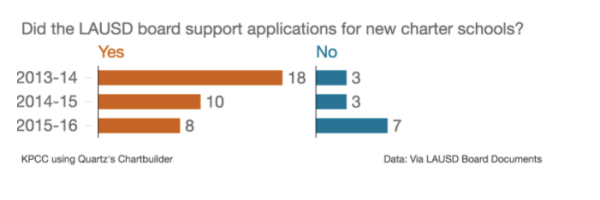
Although the LA school board has approved most petitions for new charters and charter renewals, charter advocates say they feel the board’s support for opening new ones is waning.

Screen Shot 2017-05-12 at 10.27.36 AM.pngScreen Shot 2017-05-12 at 10.27.29 AM.png

And in September of 2015 The Los Angeles Times published a confidential document from billionaire Eli Broad’s foundation, revealing plans to increase Los Angeles’s charter school market share to 50 percent over the next eight years. This transformation would require the creation of 260 new charters, at a cost of $490 million. The bombshell report sparked intense controversy.

By March of 2016, education reformers had toned down their public rhetoric and goals, emphasizing that they’d support expanding all types of high-quality schools, not just charters. The modified plan did little to tamp down tensions between charter supporters and opponents. A union-funded study released in May of 2016 reported that the city’s charter sector drains upwards of $500 million a year from the school district’s budget. The teachers union and its allies charged that unmitigated charter school growth “imperils the financial stability” of the district, and limits opportunities for those students who remain in traditional public schools.

Last month, in a 4-3 vote, the Los Angeles Board of Education voted to endorse three controversial bills in the state legislature that would place more oversight and restrictions on charter schools. The California Charter Schools Association strongly opposed the bills, and both Melvoin and Fitzpatrick-Gonez said they would oppose the measures if elected. (Zimmer voted in favor of endorsing the bills, and Padilla declined to take a position.)

Money from outside the city and state has been pouring into the two races. The previous record in outside donations for school board elections had been $7.4 million in 2013. As of April 29, outside spending had already reached $11.3 million, according to the city’s ethics commission campaign finance data. As LA Weekly put it, “To say the 2017 Los Angeles election for school board is the most expensive such race in the history of the United States is an understatement: It is the most expensive by more than 50 percent.” (And this is all for a job that pays $45,000 a year.)

Nationally, charter advocates often justify their reliance on the deep pockets of billionaire supporters as necessary to compete with the spending of local teachers unions. But other sources place reform spending at least in parity with union spending. As EdSource, a nonprofit education news site focused on California recently reported, “In past years, the teachers union far outspent the [charter] association on campaign contributions. Not anymore.”

In the Los Angeles school board race, the charter advocates have outspent the unions by roughly a third, with significant money coming from billionaire-donors like Eli Broad, Michael Bloomberg, Walmart heirs Alice and Jim Walton, Gap co-founder Doris Fisher, and Netflix CEO Reed Hastings.

And LA Weekly reports that $4.1 million has been spent on negative campaigning in the runoffs, compared to $1.1 million in the 2015 race, and under $1 million in 2013. Fifty-eight percent of the negative campaign financing has been directed by charter proponents against Zimmer.

The unprecedented escalation of the races has also attracted some high-profile, highly unusual endorsements from political leaders and celebrities.

“Billionaires should not make a profit off of public school children,” said Democratic senator Bernie Sanders in a statement earlier this month. “That’s why I’m supporting Steve Zimmer and Imelda Padilla for the Los Angeles School Board. They will fight against the Trump/DeVos agenda to destabilize and undermine public schools.”

Sanders’ endorsement—which links the education reform agenda of Melvoin and Fitzpatrick-Gonez to President Trump’s controversial education agenda—reflects a larger national strategy being pursued by advocates of traditional public education since Donald Trump was elected. It attempts to link charter advocates to a man Democrats despise. It also frames Tuesday’s choice as something larger than charter schools or traditional schools: an extension of a national debate about whether the public sector, including education, will be democratic and equitable, or privatized and outsourced to the lowest bidder.

Is it working? Time will tell, but Melvoin seems to be feeling the heat: in an article in LA School Report from March, he discussed pressure to dispel myths that he was a “Trump guy.”

Melvoin and Fitzpatrick-Gonez can claim support, however, from prominent Democratic charter backers. Both have received endorsements from Arne Duncan, the former education secretary under Barack Obama, while Fitzpatrick-Gonez formerly worked as an Obama administration education adviser.

Discrimination Is Not De Facto

Originally published in Slate on May 5, 2017.
—–

Do we know why racial segregation occurs? In 1973, the Supreme Court said no, and in doing so, dealt a crushing blow to the civil rights movement. In Milliken v. Bradley, the court ruled that the white suburbs of Detroit could not be included in Detroit’s school desegregation plan, because no real evidence existed to show that segregation in the region’s schools or neighborhoods was “in any significant measure caused by governmental activity.” The justices concluded black students were concentrated in Detroit because of “unknown and perhaps unknowable factors.”

De facto segregation, it came to be called, a name suggesting a natural racial geography, which policymakers discover rather than create. The question of segregation’s origins, it was implied, extended far beyond the mundanities of government and into the collective psyche of Americans. Understanding those origins required parsing the individual choices and prejudices of millions of citizens. This was a question for philosophers and sociologists, not for government officials.

Thirty-four years later, Milliken’s logic still had adherents on the court. In 2007, when rejecting school desegregation plans in Louisville and Seattle, Chief Justice John Roberts concluded that discrimination “not traceable to [the government’s] own actions” requires no constitutional remedy.

An essential new book takes square aim at these decisions and the very notion of de facto segregation itself. In The Color of Law: A Forgotten History of How Our Government Segregated America, Richard Rothstein of the Economic Policy Institute concludes that the court was wrong—and still is—when it described racial segregation as the product of private individual choices.

The Color of Law resurrects an older view that had proven instrumental in the movements of the 1960s: that American government has betrayed a commitment it made with the adoption of the 13th, 14th, and 15th Amendments, to ensure that black Americans could take their place as equal members in American society. The book describes the systematic violation of black Americans’ constitutional rights, through the aggressive enactment and enforcement of racially discriminatory policies. Rothstein notes that these facts were “knowable” all along; the Supreme Court even ignored evidence of government discrimination presented in Milliken’s lower court trial.

Rothstein persuasively debunks many contemporary myths about racial discrimination. He goes after, for instance, the resilient misconception that racial separation was only government policy in the Jim Crow South, and that black entrants into neighborhoods cause white homeowners’ property values to fall. In one powerful section on zoning policies, Rothstein traces how hazardous waste sites were concentrated in segregated black neighborhoods. The episode mirrors the displacement of black families by urban renewal and interstate highway construction in mid-20th century. Even though it has long been recognized that these policies were immensely destructive and racially targeted, hardly any compensatory assistance has ever been provided.

Rothstein’s arguments are framed in the language of the civil rights movement, once common but much rarer today. In that vein, he affirmatively argues for a return to the harder-edged moralistic terminology of decades past. He refuses to shy away from words like “ghettos” and “slums,” because, he says, no alternative comes close to showing how government action is implicated in their creation. Even more strikingly, he eschews the modern euphemism “people of color,” saying American segregation has been first and foremost directed at black families, something that shouldn’t be obscured.

Rothstein’s book comes at a turning point for civil rights. After decades of public skepticism for many of its signature solutions, like integrated schools and equal access to housing, many have started to question whether the way we talk about inequality and segregation has strayed off course.

In 2014, protests over police brutality erupted nationwide, and the Black Lives Matter movement grew as a major force in American politics. That same year Nikole Hannah-Jones published an award-winning series on school segregation and Ta-Nehisi Coates published his renowned Case for Reparations” cover piece raising questions of what, if anything, America owes its black citizens. In 2015, Hannah-Jones produced a much-discussed radio series on school segregation, which has helped restore the view, widely held until the 1980s, that segregation is perhaps the foundational flaw in American public schooling.

As the country began reckoning more openly with its history of racism and racial isolation, some began to wonder if the straightforward remedies backed by early civil rights activists—which had seemed blunt to modern policymakers—were actually more effective than previously realized. After all, the systemically discriminatory policies of the past were rarely subtle.

Policy developments also contributed to this momentum. In the summer of 2015 the Supreme Court issued an important ruling that the Fair Housing Act—one of the three major civil rights laws of the 1960s—forbade even unintentional discrimination, and the Obama administration implemented, after almost 50 years, rules requiring cities to affirmatively pursue racial integration. New research published in 2015 and 2016 also revealed that the original, 1960s campaigns for civil rights and racial integration were far more successful than many had believed them to be. For instance, in 2015, a team of Harvard economists published a blockbuster report that low-income children who moved to higher opportunity areas were significantly more likely to attend college, and earned far more as adults, than similar children who never moved.

Rothstein concludes by talking about history; specifically, how it’s taught. Looking at some of the most popular U.S. history textbooks in public schools, he highlights what little they have to say about segregation, especially in the North. This failure to teach children about their country’s history of discrimination, of redlining, of blockbusting, of income suppression leaves people comfortable to assume present inequality is the result of individual decisions and “unknown” factors, not government policy.

This is the view that Rothstein ultimately seeks to challenge. The segregation of and discrimination against black families is far more than the result of individual choices; after all, individual choices can be either supported or prohibited by government. “Under our constitutional system,” Rothstein writes, “government has not merely the option but the responsibility to resist racially discriminatory views, even when—especially when—a majority holds them.”

But since American schools don’t teach the true history of systemic racial segregation, Rothstein asks, “Is it any wonder [students] come to believe that African-Americans are only segregated because they don’t want to marry or because they prefer to live only among themselves?” Only when Americans learn a common—and accurate—history of our nation’s racial divisions, he contends, will we then be able to consider steps to fulfill our legal and moral obligations. For the rest of us, still trying to work past 40 years of misinformation, there might not be a better place to start than Rothstein’s book.


New Jersey Teacher Tenure Lawsuit Dismissed

Originally published in The American Prospect on May 5, 2017.
—-

Another legal effort to weaken teacher job protections through the courts has been dismissed, this time in the Garden State. On Wednesday afternoon, a New Jersey Superior Court judge tossed the latest case, ruling that the plaintiffs—six parents from Newark Public Schools—failed to prove that seniority-based layoffs harmed their students.

Partnership for Educational Justice (PEJ), a national education reform group that aims to challenge teacher job protections across the country, funded the New Jersey lawsuit. Originally filed in November, the case marked the third time PEJ has gone after tenure provisions. Their first case filed in New York in 2014, is currently before the state Supreme Court. In October, a Minnesota district judge dismissed PEJ’s second suit, filed there in 2016. That case has since been appealed.

A 2012 California lawsuit, the country’s first legal attempt to challenge teacher job protections, inspired PEJ’s litigation. Lawyers in that high-profile case, Vergara v. California, argued that the rules that help keep ineffective teachers in the classroom violated the equal protection clause of the state’s constitution. The problem, the attorneys argued, was even more serious given that poor and minority students are disproportionately likely to attend schools with bad teachers.

A Los Angeles County Superior Court judge ruled in favor of the plaintiffs in 2014, finding that five long-standing teacher job protections, including a two-year probationary period for new teachers and a layoff system based on how many years one’s been teaching, violated students’ constitutional right to an equal education.

However, in a unanimous 2016 decision, a three-judge panel on California’s Court of Appeals struck down the lower court ruling and the state Supreme Court declined to hear the case.

These decisions have not deterred PEJ leaders. But their other Vergara-style lawsuits have run into similar legal hurdles—namely, the plaintiffs have failed to prove that teacher tenure and seniority directly cause the problems that the plaintiffs say exist.

The California appeals court judges concluded that the plaintiffs “failed to establish that the challenged statutes violate equal protection, primarily because they did not show that the statutes inevitably cause a certain group of students to receive an education inferior to the education received by other students.”

Likewise in Minnesota, the district judge said that the plaintiffs failed to establish that they had been harmed in any way by the statutes, but even if they had, “because Plaintiffs’ alleged harms are not fairly traceable to the teacher tenure and the continuing contract provisions they challenge, a decision by the Court to strike those laws would not redress the harms.”

In the New Jersey case, the judge said that she does not “see any link other than speculation and conjecture between the LIFO statute and the denial of a thorough and efficient education to these twelve children.”

It is not yet clear whether the Newark plaintiffs will appeal Wednesday’s decision. Naomi Nix, a journalist with the education news website, The 74, reported that a lawyer for the plaintiffs said they may appeal the dismissal or replead the case.

“We are very pleased that the judge saw through this transparent attempt to undermine New Jersey’s seniority statute by making false claims and denigrating Newark’s dedicated educators,” said New Jersey Education Association (NJEA) President Wendell Steinhauer, in a statement. The NJEA, along with the American Federation of Teachers, had filed a motion to dismiss the suit.

David Sciarra, the executive director of the New Jersey-based Education Law Center, a legal advocacy organization, told The American Prospect that Newark’s State Superintendent Chris Cerf supported the plaintiffs in the case, claiming that state law tied his hands when cutting the district’s budget. “This is a huge distraction,” Sciarra argues. “Newark students don’t need more layoffs. They need Mr. Cerf to stand up and call on Governor Chris Christie to increase state funding so Newark can hire back the hundreds of teachers and support staff lost over past five years.”

Q&A: The American Parent Trap

Originally published in The American Prospect on May 2, 2017
—-

Sarah LeVine and her husband Robert LeVine have spent decades traveling the world studying global parenting styles and surveying mothers and fathers. The Harvard anthropologists published their conclusions in Do Parents Matter? Why Japanese Babies Sleep Soundly, Mexican Siblings Don’t Fight, and American Families Should Just Relax. The LeVines found that despite significant advancements in public health and Western medicine, American parents remain the most anxious moms and dads in the world, in part, because they tend to muddy the traditional family hierarchy. In a political climate where policymakers worry about the so-called “decline of the American family”—a deeper understanding of family relationships in other cultures can contribute valuable insights to this national conversation. Rachel Cohen spoke with Sarah LeVine about their research. This conversation has been edited and condensed.

Rachel Cohen: Let’s start with the title of your bookDo Parents Matter?

Sarah LeVine: Of course they do, but not as much as American educated parents seem to think they do. What particularly interested my husband and me, because we’ve worked in many places around the world, was the tremendous anxiety that new American parents have about babies, and even second-time American parents have. They seem to carry this conviction that there’s only one right way to do almost anything—whether it’s to sleep or not sleep with them, to breast feed them or not breast feed them, or feed them solids or not feed them solids, etc. I have done a great deal of work studying how people raise babies in different places, and the range of parenting behavior was just so tremendous, yet the children turned out just fine.

Why do you think American parents are more anxious?

One very important thing is that educated women in America tend to have babies awfully late—in their 30s, or even in their 40s. They often have had rather intense careers before they have children, and as a result, they have very high expectations of themselves for performance, which they then carry over to raising children. So they read tremendously, and there are masses of books of how to raise children—in my days, there was Dr. Spock and T. Berry Brazelton and that was about it—but now there are books on every possible aspect of raising children.

Another thing is people often have no support from their mothers because their mother might live very far away, and there aren’t other older people around. Maybe these new mothers have worked for 15 years and all of a sudden they have a child—they get out of the hospital and they’re home with this infant and they’re terrified because they don’t have any support.

Your book explores parenting practices that are extremely normal in other countries but that are stigmatized in America, such as sleeping with your baby.

Ninety percent of the children that are being born nowadays are born in non-Western countries, and in non-Western countries, the vast majority of people sleep with their babies. But even in Japan, which is an incredibly modern country, mothers sleep with their children, sometimes until they’re teenagers.

I worked in Mexico for many years—I was working with working class people and lower-middle class people, and my assistants were university educated young women—and everybody slept with their children. People would build houses with several bedrooms, and I discovered the bedrooms were used as storage space, because everyone was sleeping in the same room. Upper-class Mexicans were the only people who didn’t sleep with their children, but they had nannies and the nannies slept with the children.

The American Academy of Pediatrics discourages sleeping with children, and you say they’ve been “dragging their feet” on this—refusing to look at cross-cultural studies. Why is this?

They think children sleep better, and, perhaps they do, but for the mother this definitely isn’t the case. The fact is if you sleep with your child, and most people in the non-Western world not only sleep with their children but nurse their children, it’s much easier to do if you’re in the same bed—because then you don’t even notice.

My husband was trained as a psychoanalyst and I was trained as a child therapist at the University of Chicago, and in those days, in the ‘60s and ‘70s, there was the Freudian idea that if you have children, they should never be exposed to their parents having intercourse, because that would be absolutely traumatic.

Once when I was working with some peasant communities in South America where everyone slept in the same room, I asked them, well what are you going to do about intercourse? They laughed at me and said “well, we have it!” If [American] parents are terribly anxious about it, because they’re familiar with the Freudian notion, then their children might very well get anxious too, because they would get the sense they were seeing something they shouldn’t be seeing. But other societies don’t feel that way—and people see sexual relations as absolutely natural. Moreover, in peasant societies, it’s almost sort of a duty because there’s a sense that you should have as many children as possible.

You’ve seen some things that really shocked youlike force-feeding. Globally, corporeal punishment is going down, out of a much broader sense that it’s bad for kids. How did your cultural and academic biases affect your work?  

Even though I can always speak the language of [the people] I was observing, and I would read whatever literature I could find, I was terribly prejudiced. I really was. That’s not just because I was a Westerner. It was because I had been trained at the University of Chicago that there were right ways and there were terrible ways of doing all kinds of things—because that’s what developmental psychology was like. So when I saw things that I had been trained to believe would be disastrous, it was shocking, even though I knew enough to know that perhaps every child in that culture was treated that way and I could see that older children and teenagers and young adults were warm, amusing, and competent.

For example, it used to be that if you were dealing with strange children in the U.S. who seemed to be on the autism spectrum, or sometimes they didn’t speak at all—in those days it was believed that cold and unyielding mothers produced those types of children. Of course, thank God, it’s now known that there are many factors that contribute to autism and Asperger’s. But the primary idea in the psychiatric profession was that these children are estranged because they had so-called “refrigerator mothers.”

I went to northern Nigeria to this very conservative Muslim society and I would see these mothers who absolutely never made eye contact with their children, never spoke to them. They nursed them and sometimes fed them when they got older, but they never spoke to them. I thought, my God these children are all going to end up on the spectrum. I knew why the mothers were behaving this way—it was a way of inculcating their moral values into their children. There’s a very strong value in most parts of Africa that children must respect their parents and parents must respect their children, and this necessitates degrees of distance.

However, it was quite different for those Nigerian children with their grandparents. While their mothers never spoke to them, those same children had a wonderful time with their grandparents who were very intimate with them. The point is, you can get affection and psychological nurturance from someone other than your mother, and one of the problems with American popular notions of parenting, which have been absolutely encouraged by the psychiatric and therapeutic community, is that the mother is the source of everything.

That was something that took me a long time to disabuse myself of, even though I myself was raised by a nanny and we all turned out pretty OK.

Other societies seem to have a much broader understanding of what a child needs in terms of love and support and family. American policymakers put so much stock into the traditional idea of a family headed by heterosexual, married parents. They even call them “intact families”and suggest any divergence from that arrangement could hurt a child’s chance for a successful life.

We need to recognize that what produces a well-adjusted child and a well-adjusted adult is not just growing up in a two-parent family. We don’t really know what it takes to produce a well-adjusted child, but one important thing is that someone loves them, and there is a whole host of people I know from my background where their nannies loved them, and their sisters loved them. There are perfectly obvious examples in plain sight nowadays of people not being raised in conventional families and they are outgoing and warm and sociable.

You explore how the government’s role in childrearing expanded after the Industrial Revolution. That is, adults were “infused with a concern for other people’s children” and reformers pushed governments to take on more responsibilities around education, work, and public health that before had been left to parents. The pendulum seems to be swinging in the other direction in the U.S., at least in terms of schooling. There is a growing school choice movement built around the idea of empowering parents who know what’s best for their kids.

The situation here in America is very different from northern Europe. Northern European countries are all fundamentally socialist, and even though the U.K. has a conservative government at the moment, the infrastructure of the state is the product of socialism and socialist ideas—which means the state has far more responsibility than is the case in the United States.

With the exception of the U.K., which has a long tradition of private schools, in continental Europe everyone goes to state schools—regardless of your social class. That’s because in Europe, schools are seen as the responsibility of the state to create citizens: It is simply a major focus of public education. In the U.S., there are many school districts that don’t even teach civics anymore, so this shift away from the general commons is less surprising.

We have some American schools structured on models of strict discipline. Some progressives worry these schools may harm students, emotionally or developmentally. What’s your view of that trend?

I haven’t any personal experience with these kinds of school in America. However I’ve spent a lot of time with strict schools in Africa and Haiti, where schools are models on old-fashioned British schools. I know so many adults who have come out of those systems: You listen to the teacher, and that’s it. It’s not the way progressive schools in the U.S. are structured where everything a child says is expected to be listened to and taken seriously.

I actually grew up in a school like this. Though we sort of complained, in middle and old age we realized how incredibly important the schools were in providing us the structure, which we can then rebel against later on. Although the discipline was a bit harsh, I think we all agree that we benefited from it. When everyone is focused on the same goals, and there is a peer group that you can relate to, especially if you come from chaotic homes, schools can provide children not just with a focus but with the tools to become self-respecting adults. It doesn’t suit all children, though.

Americans seem to want a much more egalitarian relationship with their children compared to other societies.

Parents in other countries have a much easier time raising children than Americans do, and that’s because in other societies there are clear distinctions between parents and children. Parents are responsible for the children, and there’s a clear hierarchy and everyone knows where they stand. In the U.S., parents want to be best friends with their children. But that can be confusing for children. It’s an illusion that children have the same power, they do not. The irony is that while things may be less egalitarian within the family in Europe, their larger societies are far more egalitarian.