My favorite work from 2016

Last December I did a roundup of the pieces I was most proud of writing in 2015. It was nice to take the opportunity to reflect on my year, and I decided to do the same for 2016.

***

1. Can Charlotte-Mecklenburg Desegregate Its Schools … Again?
In 1971, the Supreme Court legalized busing as a means to desegregate public schools in the landmark case, Swann v. Charlotte-Mecklenburg Board of Education. I covered this metropolitan school district grappling with school segregation 45 years later.

2. Under Armour’s Slam-Dunk Deal
I reported on a massive and controversial development project that Under Armour CEO Kevin Plank has been pushing for in Baltimore.

3. Rethinking School Discipline
I published a feature on racial disparities in school discipline, and the growing political pressures to address them in the age of Black Lives Matter.

4. School Desegregation Lawsuit Threatens Charters
I explored a new school desegregation lawsuit in Minnesota that involves charter schools and could impact education nationally.

5. United Workers Organize For Fair Development
For Baltimore City Paper I profiled an awesome organization that’s doing some of the most important social justice work across the city.

6. School Closures: A Blunt Instrument
In The American Prospect‘s spring 2016 issue I wrote about low-income communities fighting to save their schools from closure. I was lucky to travel to Newark and Chicago while reporting this story to meet with parents and activists.

7. The Complicated History of America’s First ‘Union-Backed’ Charter School Authorizer
I investigated the nation’s only “union-backed” charter school authorizer, and how it became such a bizarre scandal.

8. Can Baltimore Recover from Its 2015 Murder Wave?
I wrote this VICE piece in January, following a year where Baltimore saw a shocking 344 homicides in 2015. As of this writing, 316 individuals were murdered in Baltimore in 2016.

9. North Carolina Educators Fight Deportations of Central American Students
This story looked at how North Carolina teachers organized to protect their undocumented students from Obama’s deportation raids. Officials at the Department of Education actually invited one of the teachers I interviewed to D.C. following the article’s publication.

10. California’s Ed Reform Wars
This feature looked at the heated legislative fights in California over changes to their teacher tenure laws following the high-profile Vergara litigation.

11. How Cops Have Turned Baltimore into a Surveillance State
With a secret aerial surveillance program, a scathing DOJ report on Baltimore’s discriminatory policing, and the end of the Freddie Gray trials, Baltimore was left figuring out how to move forward with police reform.

12. The Afrocentric Education Crisis
I looked at the challenges faced by the dwindling number of Afrocentric schools, coupled with the rise of the education reform movement.

13. Fining Teachers for Switching Schools
I discovered a bunch of strange provisions in charter school employment contracts, like mandatory arbitration clauses and non-compete agreements.

***

As you can probably tell, the pieces I felt most proud of in 2016 dealt primarily with schools and Baltimore. Thanks for reading, and happy New Year!

Education Interviews, 2016

I published six education Q&As this year. I’d recommend all of them 🙂

1. Learning from History: The Prospects for School Desegregation9780226025254
 An interview with historian Ansley Erickson

2. The Economic Consequences of Denying Teachers Tenure
An interview with economist Jesse Rothstein

3. 
It’s Not the Cost of College — It’s the Price
An interview with sociologist Sara Goldrick-Rab

4. How to Stop For-Profit Colleges
An interview with sociologist Tressie McMillan Cottom

516yzaplyl-_sx332_bo1204203200_5. Pulling Back the Curtain on Education Philanthropy
An interview with political scientist Megan Tompkins-Stange

6. College, the Skills Gap, and the Student Loan Crisis
An interview with economist Marshall Steinbaum

CeEreKsWoAAnbjJ.jpg           9780226404349

The complicated history of America’s first ‘union-backed’ charter authorizer

Originally published in MinnPost on December 21, 2016.
—-

Despite its name, the Community School of Excellence in St. Paul has not distinguished itself with excellence. Instead, the Hmong-focused charter has become one of Minnesota’s most scandal-ridden schools. Battles between teachers and the administration have been common, with educators repeatedly reporting threats and retaliatory behavior. And since 2012, the school has been found not only to have suppressed multiple reports of suspected child abuse at the urging of its controversial superintendent, but also to have misdirected federal funds for subsidized student lunches — even after receiving a hefty fine for the practice.

Nor has the Community School of Excellence excelled academically. Since its inception, the school has produced poor test score results. In 2016, just a third of its students met state reading standards.

Yet these troubles have not prevented the school’s rapid expansion. When it opened in 2007, the CSE had 176 students; today, it’s one of the largest charter schools in Minnesota, with nearly 1,000 kids enrolled.

After a state investigation and reams of bad publicity — within just a few years the school had been investigated by the FBI, the Minnesota Department of Education, the federal Department of Education, the Department of Agriculture, local law enforcement, and the National Labor Relations Board — the powers-that-be had had enough. When efforts to jettison the school’s superintendent failed, the school’s legal backer abandoned it altogether, a move that could have effectively shuttered the flailing charter.

Instead, something else happened. The Community School of Excellence was bailed out — just hours before it would have been closed permanently — by an unlikely savior: The Minnesota Guild of Public Charter Schools, a nonprofit created by the local teachers union and funded in part by its national parent, the American Federation of Teachers.

A unique law

To understand what a union-backed group was doing rescuing a notorious charter school — and why that was so unusual — you have to dive into the little-noticed world of charter authorizing.

Charters aren’t unregulated, of course, but their monitoring system isn’t well understood, either. Across the country, charter schools are generally overseen by another organization: most often a public school district, but it could also be anything from a university to a state commission. This third party — called an authorizer — grants a charter the right to exist, and in turn, takes over much of the work of ensuring that the school complies with relevant laws and regulations. Authorizers are also tasked with monitoring schools’ academic performance. In theory, if a charter strays too far from the straight and narrow, authorizers are expected to shut it down.

Minnesota, long regarded as a leader in education reform, virtually invented the authorizer system when it opened up the nation’s very first charter school 25 years ago. By the early aughts, however, state officials recognized that they had accumulated an awfully high number of charter authorizers (then referred to as “sponsors”) that were not taking their oversight responsibilities very seriously, a situation that enabled some charter leaders to seek out especially lax authorizers.

In response, in 2009, legislators decided to increase the responsibilities assigned to Minnesota authorizers. When all was said and done, the reforms reduced the number of authorizers in the state from 51 to 13, and education reform advocates took the dramatic drop as an encouraging sign: an indication that bad actors were weeded out, or at least those not serious enough about monitoring school quality.

Greg Richmond, the president of the National Association of Charter School Authorizers, says Minnesota’s 2009 reforms were “certainly the most rigorous form of accountability for authorizers that has occurred anywhere in the country, then and today.”

But at the same time that Minnesota cracked down on negligent charter authorizers, state officials opened a new can of worms. Within the same 2009 legislation, lawmakers created what are known as “single-purpose charter authorizers” — unique nonprofits that exist nowhere else in the United States. Only two states, Ohio and Minnesota, currently have nonprofits authorizing charter schools, but these have traditionally been pre-existing entities like universities or social-service organizations.

A “single-purpose charter authorizer” was a new idea: a nonprofit that exists only to open, close, and monitor charters. The thinking was that such an organization could devote all its attention to diligently overseeing charters, thus boosting education quality more broadly.

An unusual alliance

Today, the Minnesota Guild is one of four single-purpose authorizers in the state, though that’s not the only reason it’s unusual. To see why, it’s important to know that teacher unions and charter schools have long had a fraught relationship. Most charter teachers are at-will employees, and the more students that charters attract, the less union jobs are likely to exist at traditional public schools.

And while a growing number of charter school teachers have received support from the labor movement to organize at their schools, teacher unions still generally lobby to limit charter expansion, pointing to negative fiscal impacts they have on traditional public schools, among other things.

The idea for the Minnesota Guild came from Lynn Nordgren and Louise Sundin, two former presidents of the Minneapolis Federation of Teachers, the AFT’s local affiliate. In 2010, they applied for an AFT Innovation Fund grant, money for local unions in pursuit of creative projects. Nordgren and Sundin proposed creating an authorizer that would open schools “in the spirit of Albert Shanker” — the former AFT president who originally propelled charter schools onto the national stage.

Shanker envisioned charters as small, independent schools, where teachers could experiment with new ideas, and bring the most successful ones back into traditional public schools.

At the time, Sundin and Nordgren said their plan would elevate teacher voices and secure unions a seat at the education reform table. An AFT press release called the Guild “a bold and unprecedented opportunity for teachers to approve charters.” Writing in the Star Tribune, Nordgren said it would “approve new, high-quality schools” and ensure that teachers “are respected and have a voice.” Arguing that unions want and need to be part of the charter school conversation, Nordgren stressed the Guild would “accelerate the oft-delayed process of opening schools that aim to close the achievement gap.”

In late 2011, the Guild was officially approved as a single-purpose charter authorizer, the new type of overseer the State of Minnesota had approved two years before. In its formal application to the state, the Guild pledged to open 35 charters during its first five years. 

A complicated relationship

It didn’t work out that way. The Guild was slow to get started, and two years in it had zero schools in its portfolio. Now, though, the Guild is opening new charters and taking over existing charters at a much more rapid clip. It is now the authorizer for 11 charter schools, five of which came under its control this fall. Eleven more are in the pipeline, and the organization says it’s still committed to its original plan of authorizing a total of 35 schools.

Though one might expect a union-backed authorizer to oversee a bunch of unionized charters, especially given its public comments at the time of its inception, that’s not the case. The Community School of Excellence is actually the only Guild charter school to have a union, and it was organized in 2014, two years before coming under the Guild’s auspices.

That made more sense after talking to Brad Blue, who has served as the Guild’s director since its inception. Blue is an eclectic figure: He’s played professional hockey, owns a farm, holds a Ph.D. in artificial intelligence — and, as it turns out, isn’t really so jazzed about unions. In fact, he goes to great lengths to emphasize how neutral he is on the subject. “We don’t work directly, or even indirectly, with unions, or locals,” he said. “We’re neutral about that — we’re neither for unions, nor against. It’s a school’s decision.”

Over the years, many have wondered if the Guild represents a subversive attempt to unionize charters. After all, one of its unique aspects is that it requires employers to stay neutral if teachers decide to launch an organizing drive. But Blue flatly rejects that notion. “How many Guild schools are even unionized?” Blue says. “Only one, and they just transferred in July. For us it’s a really moot point.”

For the past five years, the AFT has given the Guild roughly $500,000 in total grants. But when AFT representatives were asked if they thought it was an issue that so few of the Guild’s schools were unionized, officials said they weren’t worried, noting that charter teachers overseen by the Guild are well positioned to move forward with union campaigns. “There’s no way to wave the wand and make a union happen,” says Mary Cathryn Ricker, the AFT’s executive vice president. “There were no hard deadlines [for organizing unions]. It was more aspirational.”

Ricker also seemed unconcerned about Blue’s remarks regarding unions at the Guild’s schools. “The Guild has to approach authorizing with integrity,” she says. “If you look at the original purpose of the Guild, and the authorizing agreement, there is an effort to deliberately recognize the rights of workers to organize in their workplace. At the same time, the Guild cannot both authorize and organize them. At the end of the day, the organizing itself is our responsibility as current union members.”

Given the unprecedented nature of an authorizer like The Minnesota Guild, I asked Greg Richmond, the president of the National Association of Charter School Authorizers, if he thought it would violate authorizer norms if the Guild were openly pro-union. “I think it’s more than fine. It’s even good,” Richmond answered, noting that one of the benefits of having multiple charter authorizers in a state is precisely so they can encourage different types of schools.

Locally, the Guild has gained notoriety among traditional public school teachers, many of whom consider the schools it authorizes to be in direct competition with their own schools. Robert Panning-Miller, a 25-year veteran teacher of the Minneapolis public schools and a former MFT president, says there was absolutely no debate or discussion among rank-and-file members about whether their union should back a charter authorizer.

“The first time I learned our union planned to authorize charter schools was when Lynn Nordgren announced it in the Star Tribune,” echoes Valerie Olsen-Rittler, a high school social studies teacher who has been working in Minneapolis for 27 years. She now serves on the MFT executive board, and tries to find ways to protest the Guild’s activities.

Panning-Miller, Olsen-Rittler, and several others I spoke with told me emphatically that their local union has not invested time in organizing the Guild’s charter schools. The current president of the Minneapolis Federation of Teachers, Michelle Wiese, did not return multiple requests for comment.

For the Guild’s first several years of existence, the MFT provided the group office space, free of charge. “Those of us who are MFT members had no say in the creation of the Guild, and now we continue to subsidize our own demise,” Panning-Miller wrote in the winter of 2015. (The MFT voted to have the Guild leave its building before the start of the 2015-16 school year.)

Some members have also raised concerns about potential conflicts of interests between the Guild and the union. For a while, Lynn Nordgren was both the MFT’s president and a Minnesota Guild board member. Louise Sundin still serves as the MFT’s lobbyist in addition to being a Guild board member. Panning-Miller has floated the idea of taking legal action, saying that a union leader supporting the creation of nonunion schools should be seen as a violation of their fiduciary obligations.

From the ‘spirit of Albert Shanker’ to ‘financial pragmatism’

In theory, single-purpose authorizers are supposed to be better able to devote their attention to regulating and monitoring the charter schools under their purview. As Nordgren wrote when the Guild was founded, “In order to receive this approval, the Guild had to meet very high standards, established in Minnesota in 2009, that require authorizers to adhere to national standards for charter school oversight and quality.”

Yet unlike traditional nonprofit organizations that authorize charters, single-purpose authorizers are limited in their ability to fundraise. Aside from grants, they can only raise revenue from authorizing fees, which are paid by the schools being authorized on a per-student basis. In other words, if a single-purpose charter authorizer closes down a school, or turns down an authorizer-seeking charter school, it would be directly harming its own bottom line.

Blue, for one, has been upfront about the reason for the Guild’s ambitious goal of overseeing 35 charter schools: financial pragmatism. “We need to build a portfolio of schools that’s substantial enough for our expenses,” he says.

Blue says those expenses currently include office space, contractors to help review charter applications and monitor schools, an employee who manages the Guild’s projects and portfolio, and a web-based tool for authorizers, Epicenter. Those expenses also include Blue’s salary. In 2013 — before the Guild authorized any schools — he took home $110,000 in compensation from the organization, 72 percent of the Guild’s overall expenses that year. In 2014, the organization raised his pay to $128,000.

Yet Blue’s responsibilities with the Guild have not prevented him from serving in other positions in the charter sector. In 2013, in addition to serving as the Guild’s director, he founded a St. Paul charter school, where he was paid $33,000 in 2014. Tax forms also stated that Blue worked 40-hours per week for each organization. (The school, Upper Mississippi Academy, is not authorized by the Guild.) He has since left that school to found another charter, which will open in the fall of 2017.

“I’m a Canadian, I’m a social welfare guy at heart. I’m also a capitalist, which is why I live in America,” Blue tells me.

Performance issues

Often lost in the Guild’s complicated history is a fundamental question: How are its schools actually doing?

Five years ago, the union insisted the venture would enable it to open up high-performing charters that help close the achievement gap. Or as Nordgren wrote in the Star Tribune: “The Guild will ensure applicants’ proposals include a clear mission, detailed curriculum, high student achievement benchmarks, healthy governance and sound finances.”

In its drive to add schools to its portfolio, however, the Guild has become the authorizer of some of the worst achieving charters in Minnesota. Take the Augsburg Fairview Academy, a charter school that opened in 2005, and that the Guild added to its portfolio this past summer. According to state data, just 5 percent of the school’s students tested proficiently in math in 2016. Or College Prep Elementary, where just 17 percent of students met state reading standards, compared to 60 percent statewide. The state found 26 percent of College Prep Elementary students were on track for math success this past year, down from nearly 50 percent in 2012. Or Lincoln International High School, where just 2.7 percent of students met math standards in 2016, and 6 percent met reading standards.

And while it’s possible that these schools will improve under the Guild’s stewardship, the odds are against it. The National Association of Charter School Authorizers discourages authorizers from taking over low-performing charters, as there’s very little evidence to suggest that new authorizers can turn them around. In fact, such takeovers tend to help poor charters avoid closure and accountability, the very thing single-purpose authorizers were designed to curtail when the law was passed seven years ago.

If the Guild meets its goal of opening 35 charter schools, it would become one of the largest authorizers in the state, though there does remain one possible obstacle. Every five years, Minnesota officials are required to review the performance of charter authorizers, and the state’s evaluation of the Guild is set to be issued by the end of January.

It’s highly unlikely that the Guild won’t pass that evaluation, given the way those reviews are conducted. So far, most authorizers have passed, even if they receive low scores on important metrics, like their criteria for opening or closing a school.

And with each new school that it authorizes, the Guild becomes less financially dependent on the AFT; its most recent grant from the union was for just $50,000, as the Guild now earns sufficient revenue on its own through authorizing fees.

The irony underlying the country’s first “union-backed” charter authorizer is that it soon may not be backed by, or accountable to, any union at all.

How to Stop For-Profit Colleges

Originally published in The New Republic‘s January/February 2017 issue
——

Lawmakers are cracking down on them for shady business practices. But sociology professor Tressie McMillan Cottom says bigger forces are at play.

For-profit colleges have existed for centuries, but now they’re this new kind of beast. What’s changed?

There’s this great narrative about how many more people are going to college now, but that’s not actually true unless you account for the rise of for-profits. Historically, it’s mostly been women and blue-collar white men who enroll in for-profit colleges to obtain certificates for skilled labor. We can’t say that anymore. Starting in the mid-1990s, for-profit colleges really expanded due to financialization and shareholder investment. These schools now offer bachelor’s degrees and even graduate degrees. The pool of students is only going to grow as the economy continues to grow more precarious.

These schools market themselves as holding the keys to the future.

Yes, if you look at their advertising, much of it is about being “future oriented”—that they’re this new, cutting-edge way to go to school. The colleges themselves, especially the larger ones, trade on that idea. And students believe the marketing.

You call for-profit colleges a “negative social insurance program.” What do you mean?

We as a society send this message: Go to school to have a good, middle-class life—it’s the only way. What we don’t say is how. For-profits sell the idea that they can help students smooth over economic shocks. That’s what the social safety net is failing to do—we see that with the decline of welfare programs, our reticence to provide child care, the decimation of labor unions. So these schools are actually a form of social insurance—just not a good one.

Is the government “crackdown” on for-profit colleges the wrong response?

We need to go beyond focusing on whether for-profit colleges help graduates land a job. Why go after those job-placement statistics, for example, when these schools are legally allowed to generate up to 90 percent of their profits from federal student aid programs? If 90 percent of your profit comes from student aid, then you don’t have to invest in things like campuses or research that could help your students. The fact that we won’t even let the public know that that’s actually the issue—not gainful employment data—is again part of the problem.

Did you find that these schools are preying on vulnerable populations?

These students aren’t thoughtless victims. But the choices available to them are predatory. That’s actually not the fault of for-profit colleges as much as it’s a failure of government and politics and social policy. We can get rid of consumer demand for for-profit colleges within a year, simply by providing better social insurance for working-class people. Neither Democrats nor Republicans question what’s fueling the demand for these types of credentials, because to do that would require a much harder political conversation.

For-profit colleges disproportionately hurt poor people and minorities, but you argue that, ultimately, we’re all at risk. How so?

The fact is, many of us are struggling to fit job training into our lives and figure out how to subsidize it—taking an online master’s course here, or teaching ourselves how to code there. Politicians say American workers have to retrain for the jobs of the twenty-first century. But they never say how we’re supposed to do that, or who will pay for it. And that’s a problem for all of us. In this economy, we’re all vulnerable.


Ben Carson, the GOP, and Subsidized Housing

Originally published in T’he American Prospect on December 16, 2016.
—–

Last week, Ben Carson, Donald Trump’s nominee to lead the Department of Housing and Urban Development, gave a talk at Yale University. He told students that the rumors that he planned to end housing programs for the poor are “a bunch of crap” and there is “no way” he’d ever do that. But housing advocates shouldn’t relax just yet. Even if Carson and Trump decide not to axe entire programs, they could still implement policies that create all sorts of new hardships for the millions of low-income people who live in public housing and use federally subsidized housing vouchers.

Trump would not be the first president to go after federal benefits for the poor. In 1996, President Bill Clinton signed the Personal Responsibility and Work Opportunity Reconciliation Act, which dramatically upended welfare in the United States. The law mandated two significant changes: the imposition of time limits for cash assistance, and the requirement that welfare recipients seek employment.

The welfare reforms of the 1990s have decimated low-income families. Over the past two decades, the number of families living in extreme poverty increased by 159 percent, while the number of families receiving cash assistance plummeted. Though more single mothers entered the workforce, the low-wage jobs they managed to find did little to alleviate their poverty. Moreover, when the economy tanked during the Great Recession, roughly one-fifth of all poor single mothers could neither find work nor access welfare. In 2015, researchers Kathryn Edin and H. Luke Shaefer wrote that more than a million U.S. households with roughly three million children survive on less than $2 per day.

Carson, the retired neurosurgeon and failed GOP presidential contender who recently said that he felt unqualified to lead any federal agency, is likely to rely on congressional Republicans who have long sought to adapt Clinton’s welfare reforms to federal housing policy.   

In mid-November, Representative Jeb Hensarling, the Texas Republican who chairs the Financial Services Committee that oversees HUD, spoke at the Exchequer Club in Washington, D.C., and said the federal housing agency “symbolizes the left’s top-down, command and control, centralized planning approach” that measures compassion for the poor “based on how many programs Washington creates” and how much money it spends. He vowed to switch gears, and “bring new ideas to the table” to fight poverty.

Indeed, shortly afterward, in Dallas, he told the J. Ronald Terwilliger Foundation for Housing America’s Families forum that Republicans would “turn the page” on housing come January. “The new Congress will help lift the poor onto the ladder of opportunity by attacking poverty at its roots, starting with work,” Hensarling said. “We will reform our housing programs for the poor to reflect the value of work.”

He added that HUD rental assistance programs, such as Section 8 vouchers and public housing, while they may be helpful, “do not promote economic freedom” and actually stand in the way of upward mobility. He promised to align housing benefits with cash assistance for “work-capable” recipients in order to “encourage” individuals to move towards jobs, careers, and economic independence.

House Speaker Paul Ryan also endorsed these ideas in his “Better Way” policy agenda, released in June. He said the federal government should “expect work-capable adults to work or prepare for work” in exchange for welfare benefits. He also called for Temporary Assistance for Needy Families (TANF) benefits to align with housing assistance.

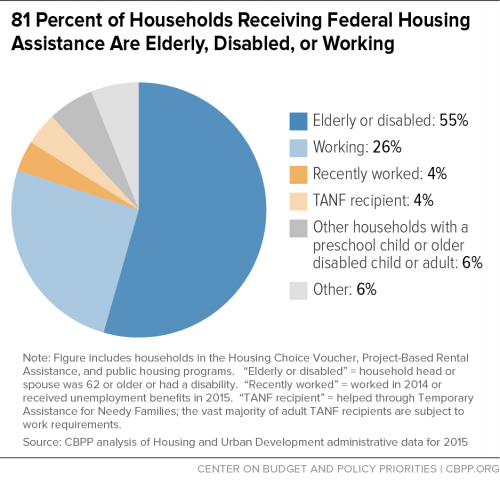
These conservative proposals would have a devastating impact on people who are unable to meet work-for-benefits requirements. According to the Center on Budget and Policy Priorities, more than half of all recipients who lived in federally subsidized housing in 2015 were elderly or disabled, and more than a quarter of all households had a working adult. Six percent had a preschool-aged child, or a disabled child or adult.

6-14-16hous-f1

While CBPP says there’s little evidence available on the effectiveness of work requirements in federal housing programs, there’s ample data to show that cash assistance work requirements have done little to increase employment over the long-term, and have even sunk families into deeper, more severe poverty. This is critical to note given the significant barriers low-income individuals face to accessing stable jobs. As CityLab’s Brentin Mock found, workplace racial discrimination, employment penalties associated with incarceration, entry-level jobs that go to college graduates, and increased automation have all made it even harder for the poor to lock down steady employment.

As Jared Bernstein, a CBPP senior fellow, told The Atlantic: “I cannot overemphasize the importance of this fundamental flaw in poverty policy, i.e, the assumption that there is an ample supply of perfectly good jobs out there that poor people could tap if they just wanted to do so.”

Diane Yentel, president of the National Low Income Housing Coaltion, took to Twitter last week to push back on Paul Ryan’s proposal to impose work requirements on public housing residents and federal voucher recipients. She urged the House speaker to invest his energy in devising strategies to make housing more affordable for low-income people. Only one out of four eligible low-income renter households even receive federal housing assistance, Yentel noted, and it’s those unassisted families in particular who are “one illness, job loss, or paycheck away” from homelessness.

Congressional Republicans’ interest in imposing work requirements and time limits on federal housing subsidies fit in well with the conservative rhetoric that Ben Carson has spewed over the past several years. During his presidential run, Carson insisted that welfare programs create cultures of dependency, harm poor families, and even “reward” people for having babies out of wedlock. Some have suggested that Carson’s lack of policy experience could mean he’d bring fresh blood and a “blank slate” to the housing agency. That’s doubtful. His dangerous ideas about welfare and work are already deeply ingrained, and, unfortunately, poised for prime time.

Vouchers, Home Schooling, Virtual Education — Conservatives’ Wish List

Originally published in The American Prospect on December 6, 2016.
—-

These are heady times for free-market education reformers. Republicans control Congress, GOP governors will lead 33 states, the vice-president elect is a champion of private school vouchers, and a conservative Supreme Court might soon have the power to thwart teacher union power irreparably. Best of all for the school choice crowd, billionaire GOP donor Betsy DeVos, a leading advocate of education reform, has been nominated to head up the Education Department.

The excitement of education advocates with conservative policy priorities was palpable last week at the annual reform conference hosted by the Foundation for Excellence in Education (FEE), a group founded by Jeb Bush, the former Florida governor and unsuccessful GOP presidential contender. More than 1,000 people from across the U.S. gathered at the Marriott Marquis hotel in Washington D.C. for two days of panels, plenary sessions, and networking.

“Be big, be bold, or go home,” urged Bush in a welcome speech that exuded the confidence and eagerness of his audience. A recurring conference theme and mantra was “choice.” But choice for these reformers revealed itself to be an ever-moving target. Some speakers said things like: “We’re not about school choice, we’re about education choice.” Others insisted that “instructional choice is the new school choice.”

This was all connected to another conference theme, the notion of schooling in a “post-facility” world. Indeed a major goal for conservative education reformers is to push so-called education savings accounts (ESAs), voucher-like subsidies that can fund not just private school tuition, but also things like tutoring and home schooling.

In theory, additional money to pay for educational expenses sounds like a great way to level the playing field between well-off and low-income students. Children from wealthy families take advantage of all sorts of costly educational opportunities outside of school, such as summer enrichment programs, sports teams, and private tutoring. But at least as they’re currently conceived, education savings accounts are more about  redirecting existing per-pupil funds away from public schools, not so much about supplementing public school students with additional money. In that sense, ESAs differ from cash supplements like child allowances, which are social security payments distributed to parents to help shoulder the cost of child-rearing.

Doug Tuthill, who leads an organization that helps administer education savings accounts in Florida, has touted such policies as a means to “customize” an education that parents deem most appropriate. In a 2014 article dubbed “The End of ‘School Choice,'” Tuthill wrote: “This shift from state control of education funds to parental control, combined with the movement toward customized teaching and learning, is going to revolutionize public education.”

This “customization” concept was spotlighted on an FEE conference panel. Participants were asked to imagine a buffet of educational options, where parents are “empowered” to design their child’s experience. For example, a parent may opt to use public dollars to homeschool their child for half the day, then send their kid to a traditional public school for two classes, and then maybe use the rest of the money for virtual tutoring.

For conservatives at the conference, this notion that parents can go outside the traditional public school system to tap a range of other options, whether in the form of charter schools, private schools, home schooling or virtual classrooms, is the holy grail of education reform. It’s also what makes teachers’ unions and progressive public school advocates worried about DeVos and Donald Trump. One brake on private-school vouchers, for example, has been the paucity of school options in rural communities. But broadly-expanded education savings accounts could help make such vouchers more feasible on a grand scale.

ESAs could also facilitate growth in home schooling, which according to the Education Department was limited to approximately 1,770,000 U.S. students, or about 3 percent of the school-age population, in 2013. The same goes for virtual education, a major priority for DeVos, who has founded and funded groups that promote its growth. This, too, alarms public school advocates, who point to multiple research studies that conclude virtual charter schools produce far worse academic outcomes for kids than traditional public schools. Unfortunately, some of FEE’s speakers downplayed those studies or called their findings into question.

Despite the conference’s upbeat tone, one session was markedly less optimistic. At a panel titled “The Politics of Education Reform,” an assemblage of free-market reform advocates discussed the implications of Trump’s victory, and the messaging challenges ahead. Andrew Rotherham, the co-founder Bellwether Education Partners, an education consulting firm, moderated the event.

Front and center was whether Donald Trump and his far-right nominee for education secretary will drive away Democratic support for a bipartisan education overhaul.

Front and center was whether Donald Trump and his far-right nominee for education secretary will drive away Democratic support for a bipartisan education overhaul. Rotherham asked it plainly: “How should the education reform community position itself and does [Trump’s victory] threaten to split and shatter existing coalitions?”

Martin West, an education policy professor at Harvard University’s Graduate School of Education, who tracks the politics of K-12 policies, noted that previous bipartisan education coalitions have floundered over the last decade amid growing political polarization. “There’s an unfortunate dynamic where we often decide whether we’re for or against something, based on whether someone else is for or against it,” he said.

West recalled how towards the end of George W. Bush’s presidency, Democrats turned against the bipartisan No Child Left Behind Act as it became more strongly associated with the Bush administration. The same thing happened, West said, with the Common Core standards—which once enjoyed bipartisan support, but which conservatives rejected when they became to be too closely associated with President Obama. If charters and choice become similarly associated with Trump, already skeptical Democrats could dig in their heels.

Nevertheless, one Democrat on the panel affirmed there’s room for both sides to work together. Shavar Jeffries, the president of Democrats for Education Reform, acknowledged his group’s stance that no Democrat should serve as secretary of education in Trump’s administration, but said that this doesn’t mean his organization won’t work with Trump’s administration on areas on which they can agree.

“We didn’t want one of ours working for him, but working for is very different than working with,” he said. “That doesn’t mean we can’t work together and collaborate on good policies, and we intend to do that.”

When Jeffries was asked what Democrats for Education Reform thinks of DeVos he said his group is “still trying to learn more about her, to be honest.” He later clarified that “the jury is out for us but we look forward to supporting her in anything that’s positive for kids.”

To be sure, Jeffries has something of a DeVos connection. His group has an affiliation with, and he is president of, a nonprofit known as Education Reform Now that has received funding from the American Federation of Children. The latter is a conservative school choice advocacy group that DeVos chaired until recently.

Moreover, some FEE conferees voiced confidence that they can broaden the school choice political coalition by appealing to suburban parents. Some conservatives have argued that it’s time to bring middle-class families on board a movement that until now has touted charters and vouchers as alternatives for disadvantaged students stuck in “failing” public schools.

In his opening remarks, Jeb Bush urged the audience to “focus on the moral case” for school reform, and to “avoid the economic details” or making “the technical case.”

Such moral appeals will almost certainly bring some families into the education reform camp. Conservatives have scored plenty of political points with their rhetoric about fighting for kids, empowering parents, strengthening schools, and broadening access to high-quality education.

But the bottom line as DeVos takes the helm of federal education in the Trump era will be dollars—how they get spent, and whether charters, private schools, home schooling, and virtual education come at the expense of families in traditional public schools. DeVos has yet to be confirmed, of course. But the newly emboldened conservative education movement has signaled that, for better or worse, big changes are ahead for public schools.

Redlining map project provides new way for researchers to rethink struggling urban areas

Originally published in the winter 2016 issue of Johns Hopkins Magazine
—-

After 25-year-old Freddie Gray suffered a fatal spinal cord injury in 2015 while in the custody of Baltimore police, the city erupted with protests, riots, and much subsequent soul-searching. Attention focused on Sandtown-Winchester, the neighborhood where Gray was arrested—one of the most impoverished and blighted areas in Baltimore. Local community leaders set up meetings to discuss what it would take to support and revitalize poor neighborhoods like Sandtown, where more than a third of the houses are abandoned and roughly 20 percent of working-age residents are unemployed. The subtext of these well-meaning conversations was that there must have been a time when these neighborhoods were more desirable, and that at some point, somewhere along the way, things went downhill.

In the mid-1990s, in what was one of the most ambitious neighborhood revitalization projects in Baltimore’s history, public and private sources poured more than $130 million into Sandtown-Winchester in a massive effort to transform it. Yet despite the influx of new housing, health services, and school enhancements, the investments were not enough to attract new businesses and jobs, or to suppress the flourishing drug trade.

Mapping Inequality, a new project created by three teams drawn from four universities, including Johns Hopkins, offers leaders and researchers a new way to think about persistently struggling neighborhoods like Sandtown. Launched in October, the project features unprecedented online access to maps and materials produced between 1935 and 1940 by the Home Owners’ Loan Corporation, a federal agency created as part of the New Deal. HOLC officials traveled to nearly 250 cities across America throughout the 1930s, developing color-coded maps to demonstrate each neighborhood’s risk and creditworthiness, factors that often reflected the community’s racial demographics. These influential documents helped standardize housing policy and real estate practices, and they were used by federal housing agencies until the late 1960s.

Sifting through Baltimore’s own HOLC map on the Mapping Inequality website, one can begin imagining how developers, bankers, real estate agents, and federal officials thought about each locality. Users can pore over the jigsaw puzzle–like breakdown of the city’s neighborhoods, clicking through to scans of each one’s “Area Description,” a document that includes information on the terrain, detrimental influences (“Obsolescence” and “Negro concentration,” for example), and racial makeup of residents. Each area was assigned a letter grade: A-rated neighborhoods, colored green, signified the best places to live; D-rated neighborhoods, colored red, were the worst.

“Part of what’s interesting about the project is just getting to think through what people’s popular narratives are today about segregation and redlining,” says Johns Hopkins historian N.D.B. Connolly, who worked on the Mapping Inequality project. “What do people know? And how can showing these HOLC maps add to that general understanding?” Connolly, an expert in the history of race and American cities, thinks the project can help people consider the longer historical trajectory of inequality.

“It also provides a way to think about racial inequality as far more of a problem of law and economics than of culture,” he says.

The HOLC maps and area descriptions are available for the public to download, so others can begin to pursue questions that even two or three years ago would have likely been too onerous to tackle. For example, what was the relationship between residential segregation and union membership? By collecting information from union membership rolls, you could now analyze union members’ living conditions. You could also determine what segregated neighborhoods looked like in terms of infrastructure quality, or how many homes had telephones, or the availability of grocery stores. “It gives you a way of taking a slice of American life and adding a whole host of new data points,” says Connolly.

On Baltimore’s HOLC map, Sandtown-Winchester was a redlined, D-rated area eight decades ago. Federal agents determined that it had “houses in very bad condition” and vandalized buildings in poor repair. They reported relatively equal numbers of white immigrants and black people living in the area, and when asked to assess the area’s “trend of desirability” over the next 10 to 15 years, HOLC agents predicted it going “downward.”

These maps challenge the narrative that healthy, thriving neighborhoods declined because of rioting in the 1960s or indolence. What they actually suggest, Connolly says, is that these Baltimore neighborhoods were always struggling, but more opportunities were given to white immigrants to get out. “These are not places that have ‘gone downhill,'” Connolly says. “Rather, they are places that were always full of environmental hazards, always considered poor and getting worse, and also the only option available to black families due to housing discrimination.”