‘Housing First’ Policy for Addressing Homelessness Hamstrung By Funding Issues

Originally published in The American Prospect on January 27, 2015.
_________

In an era of shrinking financial resources, policymakers, providers, and activists who work on homelessness prevention and care in the United States have been forced to develop new strategies. There was a time when officials at the Department of Housing and Urban Development (HUD) saw it as their responsibility to provide both housing and supportive services for homeless individuals, but now HUD now is refocusing its budget predominately on rent and housing—with the hope that other local, state, and federal agencies will play a greater role in providing supportive care. However, whether other organizations will actually be able to pick up those costs and responsibilities remains unclear.

The first major federal legislative response to homelessness was the McKinney-Vento Act of 1987, which passed both the House and Senate with large bipartisan majorities. The McKinney Act—which Bill Clinton later renamed the McKinney-Vento Homeless Assistance Act—provided funds not only for emergency shelter, transitional housing, and permanent housing, but also for job training, primary health care, mental health care, drug and alcohol treatment, education programs, and other supportive services. The consensus was that homelessness is a complex problem whose solution requires more than simply a roof and a bed.

The statutory goal of the McKinney Act was to gradually move homeless people toward stable housing and independence—a model that came to be known as “Housing Readiness.” Though this sprung from well-meaning intentions, it eventually became clear that this “gradual” approach frequently led to unwise and unfair ways of distributing welfare.

“We had this system that said homeless people essentially have to earn their way to permanent housing,” explained Ed Stellon, the senior director of the Midwest Harm Reduction Institute, and someone who has worked within the substance use and mental health treatment systems for more than 20 years. “Homeless people had to earn their way into transitional housing, make progress on certain goals, and finally when they were deemed well enough, they would earn their spot in permanent housing.”

A different model, known as “Housing First”, has been gaining steam over the past decade. What at first sounded revolutionary now feels fairly obvious: The Housing First approach posits that the only requirement for housing should be homelessness—that shelter is a right, not a privilege. “Plus, if you have conditions like out-of-control diabetes, congestive heart failure, or schizophrenia, housing is actually part of the solution,” adds Stellon. “It’s hard to make any meaningful progress on these chronic conditions without stable housing.”

Though exact estimates are hard to come by, HUD recently reported that as of January 2014, the chronically homeless numbered some 84,291, with 63 percent of those individuals living on the streets. HUD says this number has declined by 21 percent, or 22,937 persons, since 2010—in large part because of the embrace of Housing First. (Some, however, have accused the federal government of using data gimmicks to paint a more cheery picture of progress than has actually been made.)

Nevertheless, the reality is that at the same time policymakers are embracing the idea of Housing First, fewer affordable housing units exist than ever before. According to the National Low Income Housing Coalition, federal support for low-income housing has fallen 49 percent between 1980 and 2003, and the Joint Center for Housing Studies found about 200,000 rental units are destroyed annually. Research also suggests that a supply of 8.2 million more units would be needed to house extremely low-income households, up from a gap of 5.2 million a decade earlier. Though Congress recently authorized funding for the National Housing Trust Fund—an entity that was created in 2008 to fund affordable housing proects—its budget is nowhere near large enough to meet the demand.

“We’re not doing enough to expand housing availability, and HUD can’t expand its services unless Congress allocates it more funding,” says Barbara DiPietro, the director of policy for the National Health Care for the Homeless Council.

Given the fiscal climate, HUD is looking for new ways to spend its increasingly limited budget. Consequently, the agency is moving away from the supportive services that, through the McKinney-Vento Act, once accounted for most of its spending. In 1998, for instance, 55 percent of HUD’s budget was spent on supportive services, and 45 percent was awarded for housing. By 2013, just 26 percent of HUD’s competitive homeless assistance funds went to supportive services, and 66 percent was spent on housing. According to Ann Oliva, director of HUD’s Office of Special Needs Assistance Programs, the department’s goal now is to help local communities become more strategic with existing resources and available opportunities.

To do this, HUD has been working closely with other federal agencies, especially the Department of Health and Human Services (HHS), the Department of Veterans Affairs (VA), and the U.S. Interagency Council on Homelessness. In 2008, a joint program known as HUD-Veterans Affairs Supportive Housing (HUD-VASH) launched, combining housing vouchers for homeless veterans provided by HUD, with case management and clinical services provided by the V.A. Experts agree that HUD-VASH has been quite successful in helping both vets and their families, and it’s typically held up as the poster child for future interagency collaborative efforts. However, the program came with additional appropriated dollars, and it is typically easier to convince Congress to fund programs for impoverished military veterans compared to other downtrodden groups.

One of the most significant recent changes to homelessness policy has come through the expansion of Medicaid—a key feature of the Affordable Care Act. Now that nearly all individuals with incomes up to 138 percent of the federal poverty level are eligible for health insurance in states that opt for the expansion, agencies are scrambling to enroll thousands of homeless people so that they may benefit from new streams of mandatory government spending.

But Medicaid is, at its heart, a program controlled by the states. And with some states still vigorously opposed to expanding Medicaid—despite the ACA’s mandate for the federal government to pick up nearly all of the tab for the expansion—let alone some of the flexible legislative adaptations that HHS is encouraging, consistent and widespread changes to supportive services seem unlikely in the near future.

Though Medicaid expansion presents great opportunities for providing services to the homeless, some are concerned that the more flexible federal dollars currently set aside to work with homeless people will eventually just be funneled into the larger health insurance pool, with little, if any, allocated to doing what it takes to bring those with no homes into the government support system, which is needed in order to provide preventive care.

“Going out four or five times to visit with a woman living alone under a bridge, just trying to form a relationship and build trust with her so she will feel comfortable coming in to get more help—those types of health encounters are not typically billable through health insurance,” adds Stellon, who says outreach can be one of the hardest things for him to fund. “In our current system, it’s easier to pay for someone’s amputated fingers than to build a human relationship.”

Ultimately, there is only so much the government can do to advance the goal of Housing First with a depleting stock of housing units and a shrinking budget for supportive services.

“It’s a big mistake to come up with a good solution like Housing First and then to hamstring it because we don’t actually have the money for it,” says Todd Stull, the clinical director at a JOURNEYS | The Road Home, an organization that provides services and shelter to families and individuals in Illinois’s North and Northwest suburban Cook County. “One of the worst things you can do is get someone into housing for a short period of time and then they lose it. Then they lose trust in the providers.”

“We have not done well as a nation taking on poverty and implementing policies needed to address homelessness,” says Dr. Sam Tsemberis, the founder and CEO of Pathways to Housing, a national organization that first pioneered the Housing First model in 1992. “So we end up taking care of homelessness out of desperation, but we’ll be taking care of homelessness forever if we don’t take care of poverty.”

“We need more money,” adds DiPietro. “Until then, we’re just rearranging the priority list.”
Chris Christie Counts on Public Amnesia

Originally published in The American Prospect on January 14, 2015.
__________

In 2010, New Jersey Governor Chris Christie took over $3 billion in revenue earmarked for a new rail tunnel under the Hudson River and used it to plug a hole in his budget —leaving the people of his state and the region with no tunnel, and no money left for one in the future. Now Christie has endorsed a new report that includes a recommendation for expanding rail capacity between New Jersey and New York, as if no one would remember that he killed an earlier federally subsidized project that would have accomplished that purpose.

In the Winter 2015 issue of The American Prospect, I report the story of Christie’s 2010 decision and its disastrous consequences, particularly in the wake of the damage that Hurricane Sandy did to the two existing rail tunnels built over 100 years ago that are currently the chokepoint for rail transportation in the Northeast.Though Christie backed building a new rail tunnel on the campaign trail in 2009, he cancelled the project after entering office, when it became clear that it would require him to raise New Jersey’s gas tax(the next-to-lowest in the country). Doing so carried risks of antagonizing local anti-tax groups and jeopardizing his national ambitions within the Republican Party.

Last May, Christie and New York Governor Andrew Cuomo convened a panel tasked with recommending how to improve the Port Authority of New York and New Jersey, a bi-state agency that controls river crossings, regional airports, and marine terminals. The move came amid a flurry of Port Authority political scandals. Though the two governors publicly endorsed the panel’s proposals, which were published in a 99-page report on December 27, they both vetoed bills their state legislatures had passed to reform the Port Authority, insisting that they would enact better measures on their own.

The panel’s report notes that cross-Hudson River travel has not kept pace with population growth and that passenger demand is projected to double by 2030. Accordingly, the panel recommended that the Port Authority lead a regional planning team in 2015 to explore, among other things, expanding rail capacity between New Jersey and New York.

This is all well and good, except that political leaders have known about these population projections and regional risks for over two decades.

As Christie gears up for a presidential run, the chances of his endorsing a tax increase to finance a new rail tunnel (and other infrastructure needs in his state) are vanishingly small. Catering to the anti-tax fervor in the Republican Party will have a big cost not only for the commuters in New Jersey but for the entire Northeast region.

On Teach for America’s Finder’s Fees

Originally published in The American Prospect on January 5, 2015. 
—————–

When public school districts hire teachers from Teach For America, they pay a greater upfront cost than if they hire traditional entry-level teachers. This is because TFA charges finder’s fees for every “corps member” they supply. In addition to the salary and benefits school districts pay each teacher, districts also must pay the national organization, typically between $2,000-$5,000 per corps member, per year. Though generally overlooked, these finder’s fees are salient to many of the key issues in the national debate over TFA’s harm and benefit to public education.

To put the finder’s fees in perspective: If one city’s TFA cohort, consisting of 200 corps members, comes with an annual finder’s fee of $4,250 for each teacher recruited from the organization—then that cohort’s two-year commitment will cost the district an additional $1,700,000 in dues to the organization. This is not a trivial sum for school districts experiencing massive budget shortfalls.

The TFA hiring contracts are generally non-refundable, even if a teacher turns out to be a serious problem or quits early. Takirra Winfield, the national spokesperson for TFA, says that while the organization has a “pretty clear” no-refund policy in its contracts, there have been some cases where TFA has made exceptions, such as providing a credit to the district for the upcoming year, or giving regional teams discretion as to whether to invoice districts for teachers who leave early.

Teacher retention

Finding excellent teachers who are willing to stay and work in low-performing schools—typically located in high-poverty areas—has been a challenge for school districts across the nation. As a result, the teachers most frequently sent into high-poverty school districts are young novice instructors who are more likely than more seasoned teachers to leave their positions soon after their hiring. This creates a cycle of inequality for the most disadvantaged students; studies have shown that high teacher turnover itself leads to lower quality instruction and lower student achievement, as well as an inability for schools to build up their own institutional capacity.

The Alliance for Excellent Education, an education policy organization, found thatabout half a million teachers leave their schools each year, and only 16 percent of this attrition is due to retirement. The remaining 84 percent can be attributed to teacher transfers between schools (most often transferring into schools with higher-income students) or leaving the profession altogether.

TFA, which is built on a model of two-year teaching commitments, presents a challenge for schools that are looking to recruit teachers who will remain in their classrooms for the long haul. In 2007, the National Commission on Teaching and America’s Future determined that teacher turnover costs districts millions of dollars annually, and has been getting more expensive over time. Nearly half of all new urban teachers leave the profession after their first five years of teaching.Though studies show 60 percent of TFA teachers stay for a third year, after that their the numbers significantly drop, with a little more than a quarter of all corps members remaining in teaching after five years. (And about 85 percent of those TFA recruits who do keep teaching after four years transfer out of their original placement school.)

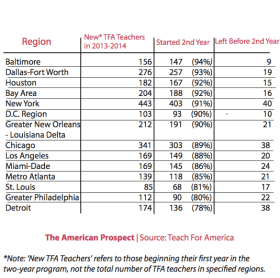
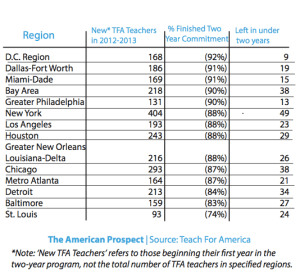
Teach For America reports that 90 percent of their corps members nationwide return for their second year. The American Prospect asked TFA for data on regional teacher retention, to get a better sense of what the story looks like in urban districts. TFA responded that they have only been tracking regional retention since 2012, which is surprising for a data-driven organization that is coming up on its 25th anniversary. Below is information based on the three years TFA was able to provide:

Screen Shot 2015-01-10 at 9.54.49 AM Screen Shot 2015-01-10 at 9.55.08 AM

Finder’s fee tradeoffs

The hiring contracts signed between TFA and school districts vary, and often depend on the level of bargaining power with which a district has to negotiate. For example, the Cleveland School District stipulated in a 2013 contract that it would pay TFA $4,000 for each recruit during his or her first year, and $5,000 per recruit for the second year. Chicago’s Board of Education signed a contract in 2013 committing to pay TFA $3,000 per teacher in the first year, and $2,500 per teacher in the second year. The contracts also vary within states.

TFA’s Winfield defended the finder’s fees, saying it’s a “nominal amount of what [TFA] invests in recruiting, training and placing corps members with the district.” She said the organization spends about $16,400 to recruit and select each new teacher, $7,000 to train them, and $14,000 per year during the two-year program. “Given the amount of investment in placing teachers with partners,” Winfield explains, “monetary or otherwise, we don’t refund the amount.”

In other words, a $51,000 investment into each corps member makes a $6,000 finder’s fee a reasonable deal for the school districts, according to TFA. However this presumes that cost is equivalent to value.

The peer-reviewed research remains mixed on the academic impact of TFA. Studies have shown that in the short term, TFA teachers generally perform as well as other non-credentialed novice teachers. In some areas, such as secondary math, TFA teachers have been shown to be more effective than traditionally prepared teachers. However, education researchers Julian Vasquez Heilig and Su Jin Jez found that TFA corps members perform less well overall than credentialed novice teachers, and significantly less well than veteran teachers.

So, if it’s not clear that TFA teachers are exceptionally better instructors, why are districts willing to pay hundreds of thousands of dollars in annual service fees to hire them?

One may argue that the fees are worth the cost because TFA corps members take jobs in schools that are hard to staff. And certainly, private and parochial schools often take advantage of headhunter agencies, whose recruits also come with finder’s fees. But such services are not commonly used in public school districts, and graduates of traditional teacher preparatory programs do not come with finder’s fees.

In recent years, TFA has been taking heat for securing jobs in areas where there are no real teacher shortages. In cities across the country, veteran teachers are facing layoffs and hiring freezes, and graduates from local teacher colleges are being passed over in the hiring process. For example, even though the Seattle School District received 138,000 teacher applications in 2009 for 352 full-and part-time jobs, TFA still worked to join their competitive job market in 2010. The Washington Post reported last year that hundreds of Connecticut residents who earned their teaching certification through local colleges and universities were being passed over for out-of-state TFA recruits. In Chicago, the number of TFA corps members is growing, despite Chicago Public Schools having laid off thousands of tenured teachers. (During the 2012-2013 school year, there was a TFA cohort in Chicago of 498 teachers, and by the 2013-2014 school year it had risen to 593.) Similar stories are playing out in places like Philadelphia and Newark.

Some critics contend that the hiring choices are political. They point out that in various school districts where TFA is expanding, school board members and superintendents have close ties to TFA, many of them being former alumni of the organization. (John White, the New Orleans school superintendent, and Paymon Rouhanifard, the Camden school superintendent, for example, are former TFA corps members.)

Another plausible explanation for school districts’ employment of TFA teachers is based on long-term economic calculations. Many districts are recognizing that investing in teachers who are unlikely to stay long in the classroom, even when factoring in the high cost of teacher turnover, can save them money down the line. If the bulk of teachers leave within two to three years, school districts will not have to worry about paying for the higher salaries and the state pension fund payments to which public school teachers with seniority are entitled. Even if 20 TFA teachers quit early, and the school district is not refunded the finder’s fees it paid to the organization, the district’s wasted $60,000 or so is relatively minor compared to the costs of paying for tenured and experienced teachers.

As Alexandra Hootnick laid out in The Hechinger Report, administrators and TFA’s national staff recognize that its recruits are less expensive in the long run than paying the salary and benefits for teachers with experience or advanced degrees. Hootnick reported:

Michael DeBell, a member of the Seattle school board, helped bring TFA to the district in 2010. It wasn’t a question of lacking qualified teachers, DeBell said, with between five and 100 people applying for every open teaching position. Rather, he said, “it was a simple matter of fiscal challenges and political optics…”

Ultimately, it may be cheaper for districts to continually cycle through novice teachers, but it comes at an expense that rubs against TFA’s stated purpose of providing better education to kids than they otherwise would obtain. Districts, their students, and their communities pay a high price to support TFA’s routine teacher turnover.

Will more training provide a fix?

Under new national leadership, TFA has launched a series of pilot programs in 12 regions designed to improve its overall teacher retention rate. Its hope is to scale up successful models nationally over time. Some of these initiatives, which include incentives for those who stay longer in the classroom, are geared towards teacher development training; others appear to be more political in scope.

For example in Connecticut, TFA is launching programs to help train alumni teachers to better support younger TFA corps members. They’re also working to “offer pathways to school administration.”

In Chicago, TFA is offering its teachers opportunities to attend monthly and weekly professional development trainings, as well as sessions to help teachers better understand their political and policy landscape. Takirra Winfield explained that the goal of the policy session “is for teachers to emerge with the skills to empower their students to challenge the laws, regulations, and practices that are impacting their education, and advocate for change.” How they envision mobilizing students politically is not yet clear.

It will be up to the public to decide whether TFA teachers are the right investment for school districts in the future. Though accounting for less than 1 percent of the country’s teaching force, the organization holds a disproportionate amount of political power when it comes to shaping education policy. The national organization receives millions of dollars from the government each year, and is increasingly funneling its recruits into charter schools. TFA reports that 33 percent of their recruits teach in charter schools, up from 13 percent in 2008. Many of these charter schools were founded by TFA alumni.

Research demonstrates that “insufficient compensation” is a key reason for why many teachers leave the profession or transfer into schools that serve students from higher-income families. Improving teacher retention in high-poverty neighborhoods is unlikely to be solved through a reliance on short-term novice teachers earning low-paying salaries. The impact of these new TFA pilot programs may perhaps change the dynamics on the ground. Some evidence suggests that TFA is open to change—particularly with regard to the new diversity of its recruits.

But while TFA reckons with its model and its future, the growing national debate is taking a toll on the organization. Over the past year, two large school districts,Pittsburgh and Durham, North Carolina, rescinded hiring contracts with TFA. In September, the national student labor organization, United Students Against Sweatshops (USAS) announced a campaign aimed at kicking TFA recruiters off college campuses. In a open letter sent to the CEO and board chair of Teach for America, USAS leaders wrote:

TFA’s shift from an organization providing volunteers to overcome teacher shortages to an organization that de­professionalizes the teaching career and displaces veteran teachers has forced us as students to ask our universities to reconsider relationships with Teach for America.

In December, TFA announced that it is having trouble recruiting candidates to teach in New York City schools—a problem organization leaders attribute, in part, to the “contentious national dialogue” surrounding TFA’s impact on school districts and the teaching profession. In anticipation of declining corps members, TFA plans to close its New York and Los Angeles training sites.

——-
Update and Correction:
TFA contacted The Prospect to clarify that corps members who leave for emergency reasons are not included in their retention data, so in some cases, the number of those listed as leaving [column 3] may be actually be higher than what is demonstrated in our charts. An earlier version of this story stated that as of January 2014, 42 percent of TFA recruits taught in charter schools. The correct figures are 33 percent of recruits, and 42 percent of alumni. Additionally, Takirra Winfield originally reported that TFA spends $9,000 to train each new teacher, and $11,000 on each teacher per year during the program. She has since provided new financial figures from the organization. TFA says it spends $7,000 on training and $14,000 on each teacher per year. The article has been updated to reflect these corrections.