At a Pivotal Moment, Democrats Failed to Modernize Elections

Originally published in The Intercept on April 1, 2022.
—–

THROUGHOUT 2020, as then-President Donald Trump issued baseless claims of voter fraud, local election officials called on the federal government to spend more to ensure a secure election season. Turnout was expected to break records; the pandemic had upended voting plans and safety protocols; and cybersecurity threats mounted. Leaders were acutely aware of the vulnerabilities in their aging election technology: Thousands of counties, for example, still ran their voting machines on Windows 7, an operating system so old it no longer receives routine security updates.

Congress did authorize $400 million to run elections in the Coronavirus Aid, Relief and Economic Security Act, with funds permitted for expenses like buying personal protective equipment and hiring temporary staff to process the increase in absentee ballots. But those funds ran out quickly amid the costly primaries. Election officials, national security experts, and business leaders nationwide sent Congress letters throughout the spring and summer stressing why that figure could only represent a down payment ahead of the November election. A study of swing states conducted by the right-leaning Washington, D.C. think tank R Street Institute found that the election support afforded by the CARES Act provided just a small fraction — 10 to 18 percent — of what was needed.

But Congress didn’t budge. And so in an unprecedented move, private philanthropy stepped forward to plug the holes. A Chicago-based nonprofit called the Center for Tech and Civic Life administered nearly $350 million in philanthropic grants during the 2020 cycle, reaching almost 2,500 counties across 49 states. A majority of that funding was donated by Facebook founder Mark Zuckerberg and his wife, Priscilla Chan, and every eligible election department that applied for funding was approved, according to the group. “Despite election officials basically begging our federal government for assistance, that money never came through,” Liz Howard, a senior counsel with the Brennan Center for Justice, said weeks after the election. “Congress really failed our election officials.”

Fortunately for democracy, soon after Democrats took control of Congress and the White House, the party was laying plans to provide robust funding for election infrastructure.

But now, more than a year later, the politics that surround election funding have changed dramatically, though the need for modernizing and securing election systems has not. Conservatives, angry and suspicious that Facebook and Silicon Valley tilted the scales to help Democrats, have moved to ban future philanthropic donations for elections. In Wisconsin, a special counsel appointed by Republicans released an interim report accusing Zuckerberg of breaking bribery laws with the grants. More than a dozen Republican-controlled states, including GeorgiaFlorida and Arizona, have passed new restrictions on private donations to election offices since November 2020, and more states are currently drafting similar legislation. Absent new sources of government funding, these bans could yield cuts to election locations and election workers in the midterms.

MOST READ
RIP Madeleine Albright and Her Awful, Awful Career

Jon Schwarz

Ukrainian Journalist Finds Charred Remains Where Alleged War Crime Was Filmed

Robert Mackey

I Want You Back: Getting My Personal Data From Amazon Was Weeks of Confusion and Tedium

Nikita Mazurov

In its recently passed $1.5 trillion omnibus spending bill, Congress included just $75 million for election security. That’s a fraction of what lawmakers authorized in 2020 and an amount experts say is nowhere near sufficient to address the needs ahead of the next election.

At the center of this failure is the Brennan Center, an influential liberal think tank and advocacy organization. Based in New York City, the Brennan Center rarely gets public scrutiny, but it plays an outsize role in the strategic direction of the movement pushing for voting rights and election reform. That flows partly from its massive war chest, which has skyrocketed over the last decade: Between 2010 and 2020, its net earnings grew from $196,000 to $58 million. Its assets jumped from $8 million to $90 million.

That financial firepower, coupled with the credibility in Washington that it has built over the years, gives the Brennan Center effective veto power over the voting rights advocacy coalition it leads. In Congress, revisions to election and voting laws are often met with the question, “What does the Brennan Center think?”

THE LEGISLATIVE DANCE has always involved inside players and outside pressure, but two interlocking trends have significantly walled off outsider influence and consolidated insider power. Partisan polarization means that there are few rogue bipartisan gangs to be pulled together, and the consolidation of power by congressional leaders has muted the influence of rank-and-file members and even committee chairs. K Street has rushed to fill that void — but so too have a select handful of major nonprofits, whose deliberations and strategic decisions have taken on exponential importance.

This made the Brennan Center’s decision to pull back on the effort to fund elections all the more consequential. Its political attention and lobbying shifted to passing the Free­dom to Vote Act, the Democrats’ comprehensive voting rights bill that would, among other things, expand voter registration, ban partisan gerrymandering, weaken state-level voter ID requirements, and restore preclearance, a key provision of the 1965 Voting Rights Act. The Brennan Center played a key role in crafting the omnibus legislation, including its earlier iterations like the “For the People Act.”

In a letter sent to congressional leadership in late July, a coalition of 19 national advocacy groups, including the NAACP, the Leadership Conference on Civil and Human Rights, and Mi Familia Vota, urged Congress to allocate $20 billion for election infrastructure, citing the hundreds of local election officials, mayors, and secretaries of state who had begged for that amount earlier in the month. “As the individuals and leaders closest to the administration of fair and secure elections, they have collectively called for federal support in meeting the immense needs they face,” the national groups wrote. “We write to add our voices to that important ask.”

The Brennan Center declined to sign.

“It was one of the most jaw-dropping moments of my professional life,” said one election reform lobbyist whose organization signed the letter and who requested anonymity to describe the coalition’s private discussions.

Michael Waldman, president of the Brennan Center, said his organization “felt that the dollar amount that the letter was asking for did not make sense based on our expertise and research and policy analysis … that it was too much,” though he could not say what a better figure would be. “My colleagues on this who are aligned certainly thought it was too much, and we thought the dollar amount was too high to be asking for at that time,” he added.

The timing of the ask also didn’t strike them as appropriate, Waldman said. “It was in the heat of the fight for the [For the People] Act, which we regard as the most important voting rights legislation in half a century. … I thought that [the request] was a distraction and a detour from the very hard fight needed to pass voting rights legislation.”

His comments about the size of the request for election funding reflected a departure from the Brennan Center’s previous public statements, a fact noticed by both this reporter and the organization’s press shop. The following day, a Brennan Center spokesperson, Alexandra Ringe, who had been listening in on our interview, called to ask if I would consider taking Waldman’s statements about the size of the election funding request off the record, saying they would not go over well with their coalition partners. I declined.

In a subsequent email, Ringe wrote that Waldman had “misremembered the decision-making related to the sign-on letter” and that fear of distracting from the Freedom to Vote Act was the sole factor in the Brennan Center’s decision not to sign. Waldman himself followed up to say that he had misspoken in our previous conversation, reiterating that the organization chose not to sign the letter “because of our concerns … that it would distract from the final push for voting rights legislation.”

BECAUSE OF THE wildly varying ways that counties tabulate their costs, the precise amount of funding election officials need is not clear. “What we do know from three years of surveys of local elections officials nationwide is that consistent and reliable funding is the most commonly mentioned issue,” Paul Gronke, the founder of the Elections & Voting Information Center at Reed College, told me. “We all recognize that what we are currently spending is far too low and funding is too irregular. … But hard numbers are difficult to obtain because of the diverse ways that budgets are managed.”

The last major federal investment in election funding was the Help America Vote Act of 2002, which authorized $3.5 billion for state upgrades. But it took years for that funding to get appropriated, and the costs and threats to elections have only gone up since then. A Massachusetts Institute of Technology study recently estimated that the “current level of spending puts elections at near the bottom of spending for public services, ranking approximately the same levels as spending by local governments to maintain parking facilities.”

Advocates for more funding say that reliable appropriations can go toward things like bolstering election audit systems, patching cybersecurity vulnerabilities, upgrading voter registration databases, and investing in equipment like ballot sorters and envelope stuffers. The advent of election official retirements expected before the 2024 cycle is adding even more pressure, as hiring and training new staff will get more expensive.

The Election Infrastructure Initiative, a project of the Center for Tech and Civic Life and the Center for Secure and Modern Elections, puts the tab to fully modernize U.S. elections at $53 billion over the next 10 years. The initiative has called on Congress to allocate less than half of that, $20 billion. That ask has been endorsed in letters by secretaries of statemayors, and election administrators. In a February poll by Data for Progress, nearly three-quarters of respondents supported congressional spending to upgrade state and local voting equipment and security systems.

Many local election leaders have struggled to understand why the Brennan Center — a group with the ear of influential Democrats in Congress — dropped prioritization of election funding over the last year, particularly after helping elevate their concerns during the pandemic. Moreover, while the Freedom to Vote Act would push many election reforms that are needed and overdue, those changes would not come cheap. Advocates worried that chaos could come from a slew of new unfunded mandates.

Jessica Huseman, one of the country’s leading voting rights journalists, detailed many of these concerns publicly last spring in a Daily Beast op-ed. The For the People Act “was written with apparently no consultation with election administrators, and it shows,” Huseman wrote, noting that it was packed with deadlines and obligations that would be impossible for election officials to meet. “The sections of the bill related to voting systems … show remarkably little understanding of the problems the authors apply alarmingly prescriptive solutions to.”

The Brennan Center quickly issued a defense of the bill it had helped draft, publishing a response to Huseman’s piece on its website. The center defended the amount authorized in funding for upgrades and maintenance. But “there have been millions in authorized funding that has never been appropriated,” Huseman, who currently serves as editorial director of Votebeat, told me. “Looking specifically to voting, the funding promised in the Help America Vote Act took 15 years to actually become appropriated, even though the states were on the hook for the requirements long before this. This is the origin of the anxiety for state election administrators, and I think it’s a well-founded concern.”

“Brennan Center gets way over their skis on election policy,” said one national election reformer who has partnered with the organization on research and requested anonymity because their organization shares some of the same funders as the Brennan Center. “They’ve been great [at] fleshing out the more liberal position on voting rights, but when it comes to election administration … they are not that connected to the election officials community … and they haven’t really wrestled with the implications of what they advocate for.”

“The charitable answer is they didn’t want to have a fight about money until after the bill had passed, but you can easily pass the bill and not win the money,” said the election lobbyist, who was shocked that the center didn’t join the July letter. “There’s a few folks who work there like Larry Norden [the senior director of Brennan’s Elections and Government Program] who have done good work on these issues, but they couldn’t get it through to their higher-ups.”

FOR THOSE HOPING that 2021 would yield new federal commitments for election funding, things took a turn for the worse late last summer.

Throughout July, as Senate Democrats prepared their $3.5 trillion social spending request, lawmakers assured state and local election officials that their proposal would include billions for election funding. A Politico story published just four days before the package was unveiled confirmed that lawmakers were eyeing as much as $15 to $20 billion for that purpose and felt confident that they could deliver, even as their voting rights bill remained stalled.

But at the eleventh hour the funding was pulled, at the urging of House Speaker Nancy Pelosi, D-Calif., who had “abruptly” changed her mind, as Huseman reported in a detailed ticktock of the negotiations. Rep. John Sarbanes, D-Md., the author of the For the People Act, had convinced Pelosi that authorizing election funding would reduce their leverage to pass his bill, the same argument the Brennan Center used to justify not signing the coalition letter.

Leading negotiations in the Senate, Amy Klobuchar, D-Minn., was angry. She felt blindsided by Pelosi’s move, per Huseman’s sources, even as spokespersons for both House leaders defended the last-minute cuts. The spokespersons told Huseman that election funding would require more “safeguards” to ensure it couldn’t be used for voter suppression, but top federal elections experts say there is no history of misspending those funds. “After all,” Huseman wrote, “it costs far less money to close polling locations and remove drop boxes, and state legislatures across the country have been doing this without any additional spending since the 2020 election.” (Klobuchar, Pelosi, and Sarbanes did not return The Intercept’s requests for comment for this story.)

“All of the money that’s been released has been for specific purposes,” Kathleen Hale, a political scientist who directs the Election Administration Initiative at Auburn University, told The Intercept. “It’s all been audited; I’ve been doing this for the last 15 years, and there’s absolutely nothing going on like that.”

While it was becoming too late in the negotiations process to pivot to funding elections in the infrastructure deal, the Democrats’ Freedom to Vote Act was looking increasingly doomed in the Senate. Sen. Kyrsten Sinema, D-Ariz., made it clear that she was not willing to gut the filibuster — a legislative move that would have been required to ensure the bill’s passage. A Punchbowl News survey of senior congressional staffers found that even among Democratic staff, just 12 percent thought the bill had a shot.

Some leaders urged Congress to push forward with a narrower bill, abandoning demands like public financing of elections, to which Senate Minority Leader Mitch McConnell, R-Ala., had expressed strong opposition. Others within the voting rights coalition faced immense pressure to stay quiet when they raised concerns about technical language in the statute, saying the Brennan Center in particular warned that even private deliberations could derail passage of the bill itself.

Noticing the deadlock on Capitol Hill, some groups began to discuss alternatives. In January, for example, the Bipartisan Policy Center released a report in collaboration with the centrist and right-leaning American Enterprise Institute, Issue One, R Street Institute, and Unite America.

Their proposals recommend federal funding to states that meet a series of minimum voting standards but eschew federal mandates, in the hopes of garnering GOP support. The coalition urged steady, annual funding for elections but left the door open on exactly how to determine the formula.

Others had been pushing a narrower bill since last spring. In March 2021, professor of law and political science Rick Hasen published an op-ed in the Washington Post urging for legislation to protect voting rights directly and abandonment of the “wish list of progressive proposals” that stood little shot of survival in the Senate. “At the moment, it seems more likely that nothing will become law before the 2022 elections than that H.R. 1 will,” Hasen wrote, referencing the For the People Act. Edward Foley, the director of the Election Law program at the Ohio State University, wrote another Post op-ed two weeks later, arguing that the “priority should be ensuring passage of what’s absolutely essential for securing federal elections that enable voters to choose the officeholders who get to exercise power.”

And still others noted that the For the People Act would do little to actually stop the most immediate threat to elections that arose from the 2020 cycle: subversion. The New York Times editorial board made this point in June, writing that “Democrats in Congress have crafted an election bill, H.R. 1, that is poorly matched to the moment.” The For the People Act, the Times board said, ”attempts to accomplish more than is currently feasible, while failing to address some of the clearest threats to democracy, especially the prospect that state officials will seek to overturn the will of voters.”

The Brennan Center rebuffed criticisms that the For the People Act was too big. The scope of the legislation, Waldman stressed, was what gave it its power. “It enabled a movement to form of diversity and breadth that we have not seen on this issue in my 40 years working on democracy issues,” he told me. “This was the most important civil rights legislation in half a century … [and it] doesn’t always succeed on the first try.”

Narrower bills have narrower constituencies of support, Waldman wrote in a Washington Post op-ed last spring. He dismissed both Hasen and Foley as “some pundits” and said that keeping the legislation his organization helped craft together was the best way to ensure its chances of becoming law. While Waldman noted proudly that the bill claimed support of “civil rights groups, good government groups, labor unions, many election officials, and others,” it was not clear who among those left-leaning constituencies he thought might disclaim backing if Congress had decided to pare it down.

But the Brennan Center’s stance on the savviness of avoiding compromise and standing in coalition with partners stood in tension with its reticence to make big funding asks, including for election security. The Brennan Center discouraged Congress from whittling down the voting rights legislation, even as experts warned of unfunded mandates that could create new security and logistical threats for election workers.

ADVOCATES FOR NEW infusions of election funding have turned their sights to the White House, in the hopes that President Joe Biden can pressure Congress to act quickly before the midterms.

In mid-December, a coalition of 14 secretaries of state — including from Pennsylvania, Michigan, Minnesota, and Arizona — sent a letter to Biden requesting that he include $5 billion for election infrastructure in his fiscal year 2023 budget, as part of a commitment of $20 billion over 10 years. (Last year Biden did not include funding for elections in his administration’s budget.)

In February, members of Congress joined in. Democratic Reps. Carolyn Bourdeaux of Georgia, Colin Allred of Texas, and Tom O’Halleran of Arizona led 43 of their colleagues in a letter to Biden requesting that he include $5 billion in his next budget. Thirty-three Democratic senators, led by Klobuchar and Richard Durbin of Illinois, followed suit two weeks later. Advocates also pressed Biden to mention election funding in his State of the Union address, to no avail.

Advocates were heard, sort of. On Monday, Biden released his 2023 budget and called for $10 billion over the next decade for election infrastructure upgrades — half of what activists requested. While hailed as a positive step, it offers no guarantees: Congress often ignores presidential budget asks.

Meanwhile, as the voting rights package remains in limbo, the new year has brought momentum to the issue of addressing election subversion, or the threat that the true winner of an election will not be declared the winner. While many defenses against election subversion happen at the state and local level, from a federal standpoint lawmakers could make tweaks to an 1887 statute known as the Electoral Count Act, which governs the end stages of a presidential election. At present, the Electoral Count Act could allow Congress to object to counting votes from a state, and it is also vague on the responsibilities of a vice president in counting electoral votes. McConnell has suggested that he’s open to tweaking the law, and a bipartisan group of senators have been meeting to discuss a path forward.

Election funding and election subversion are not unrelated issues. While immediate fears about subversion have been tied to rogue election clerks and state legislators, poorly funding elections heightens risk too. “Inadequately funded elections can lead to foreign or domestic actors tampering with our voting technology, voter registration databases, or machines that count ballots,” said Hasen. “And when funding is inadequate it creates opportunities for mistakes to happen and creates opportunities for people to try to manipulate things without oversight.”

The Brennan Center, for its part, hasn’t abandoned the election funding issue. In January, Gowri Ramachandran, a senior counsel for the Brennan Center’s Democracy Program, testified before the House subcommittee on cybersecurity about election risks and suggested that Congress could also provide support for the physical safety and security of elections personnel and elections offices, though she did not suggest a specific figure. Earlier this month, the Brennan Center published a resource estimating the cost of preventing insider election threats over the next five years to be about $316 million.

But the clock is ticking for more serious investments. Following the recent passage of the House budget on March 9, the Election Infrastructure Initiative issued a critical statement, blasting it for insufficiently funding physical and cybersecurity measures for local election departments. The $75 million that lawmakers approved was also far less than the $500 million the House included in its original spending proposal. The Brennan Center did not issue a statement on Congress’s allocation for election funding, though individual leaders, including Norden and Derek Tisler, an attorney for Brennan’s Democracy Program, criticized the $75 million amount as too small.

Waldman, the president of the Brennan Center, maintains that the organization took the right approach last year and will look for “every opportunity” it can this year to pass strong voter protections, “with eyes wide open about the challenges.”

“There’s this ‘Big Lie’ movement out there trying to undermine American democracy that is scary and alarming, but I think there is a democracy movement that has been formed in response … that is vibrant and diverse and angry,” Waldman added. “This movement is not done and this issue is not done. We push forward.”
Why Teachers Are Afraid to Teach History

Originally published in the April issue of the New Republic magazine, and online March 28.
————-

For a decade, Jonathan Greenberg, a social studies teacher at the Center School in Seattle, taught an advanced placement course for high schoolers called Citizenship and Social Justice. A broad-shouldered man with penetrating eyes and a warm manner, Greenberg brought in speakers to talk about their experiences of racism and invited his students to share, too. Sometimes, he separated them by race so they could consider questions more privately. In an exercise known as “affinity-based caucusing,” he might ask white students, “What’s the role of a white person in fighting racism at school?” Students of color, meanwhile, might share how they cope with discrimination they’ve faced.

Greenberg shaped his curriculum according to guidelines developed by Courageous Conversation, a group founded in 1992 to help teachers facilitate dialogues about race. The organization intends its discussions to be structured by four agreements: to stay engaged, to expect discomfort, to tell the truth, and to accept a lack of closure. Frank talk about encounters with racism, Greenberg believed, would help bring attention to the struggles of underrepresented populations at his majority-white public school, and help all his students link their present lives with the historical realities of race.

In December 2012, the parents of a white student in Greenberg’s class filed a complaint with the principal. Greenberg, they alleged, had not only created “an emotionally-charged classroom environment” and a “climate of fear,” he had fomented “racial hatred and prejudice.” The complaint made its way to the school district, and, within a month, Seattle Public Schools launched an HR investigation and told Greenberg that he could not teach the racism curriculum or a planned unit about gender before the investigation concluded. Besides the teen whose parents initiated the complaint, officials interviewed no students about their experience in the class. By mid-February, the superintendent wrote Greenberg that his lessons had created an “intimidating” atmosphere for the student and “disrupted the educational environment” for others. Students began circulating a petition demanding that the curriculum inspired by Courageous Conversation be reinstated; ultimately, they gathered more than 1,000 signatures. One day, as another teacher supervised Greenberg’s class, some students signed the petition. The parents who’d originally objected filed a second complaint, this time for harassment. Within months, the district transferred Greenberg to another school.

Nine years later, as states rush to pass laws banning “critical race theory,” a term that in popular usage on the right has come to mean nearly any curriculum that refers to systemic or structural racism, teachers around the country are wondering whether they’ll meet similar fates. By the end of January, more than 35 states had introduced bills or taken other steps that would restrict classroom discussions of race and gender, and at least 14 had passed laws or directives. The content of the laws varies somewhat from place to place. In Tennessee, for example, legislators banned 11 “concepts” from public school instruction. Educators aren’t allowed to promote “division between, or resentment of, a race” or suggest that individuals should feel “discomfort,” “guilt,” or “anguish” because of their race. In Iowa, lawmakers prohibit describing the state or the country as “systemically racist or sexist.”

For teachers, one of the most concerning aspects of the bills is their vagueness. Oklahoma’s law, for example, bans teaching the concept that one race or sex is inherently superior to another, but lawmakers declined to clarify how educators can teach about individuals who subscribed to these supremacist views. Texas’s law says any controversial issue must be taught “in a manner free from political bias” but doesn’t define what counts as controversial. Violating the new rules can bring about steep consequences: Teachers may be fired or lose their licensure; schools’ funding may be cut. Doubtless because the bills offer scant clarity about how one might comply, teachers have already begun self-censoring their lessons out of fear.

Their anxieties are not unfounded. In New Hampshire, the state’s education department created an online form to assist parents and students in filing complaints. The conservative group Moms for Liberty even pledged to pay $500 to the first person who “successfully catches” a New Hampshire teacher breaking the state’s new statute. Incoming Republican Governor Glenn Youngkin announced 10 days into his job that Virginia would offer a tip service for parents “to send us reports and observations” of teachers they believe are misbehaving. A group called Save Texas Kids—dedicated to “fighting CRT and any other form of woke politics”—emailed Dallas teachers asking for names of colleagues promoting critical race theory or “gender fluidity.” In December, Florida’s Republican governor, Ron DeSantis, proposed a bill that would allow parents to sue school districts that permit lessons allegedly rooted in critical race theory, and collect attorney fees for doing so.

For years, the school culture wars were waged over God and prayer, and how and whether to teach evolution and sex. But over the last decade, the fights have turned more toward how we frame our nation’s past, particularly how we characterize America’s histories of racism and colonization, and their relevance to today. In many ways, these debates are much harder to adjudicate; the law provides more clarity on the separation of church and state than on history curricula, and evolutionary theory offers more certainties than the vagaries of historical interpretation. For example, how should educators describe U.S. expansion of the West? Were the settlers bigoted imperialists or courageous pioneers? And is it possible for schools committed to anti-racism to embrace “color blindness,” or is that a contradiction in terms?

Public school theorists have long worried about the consequences of bringing heated matters into class. As far back as 1844, the famed educator Horace Mann warned against it. “If the day ever arrives when the school room shall become a cauldron for the fermentation of all the hot and virulent opinions, in politics and religion, that now agitate our community, that day the fate of our glorious public school system will be sealed, and speedy ruin will overwhelm it,” he wrote. Indeed, if there’s been one constant in the history of U.S. schooling, it’s the suspicion with which local communities respond when their teachers tackle controversial issues.

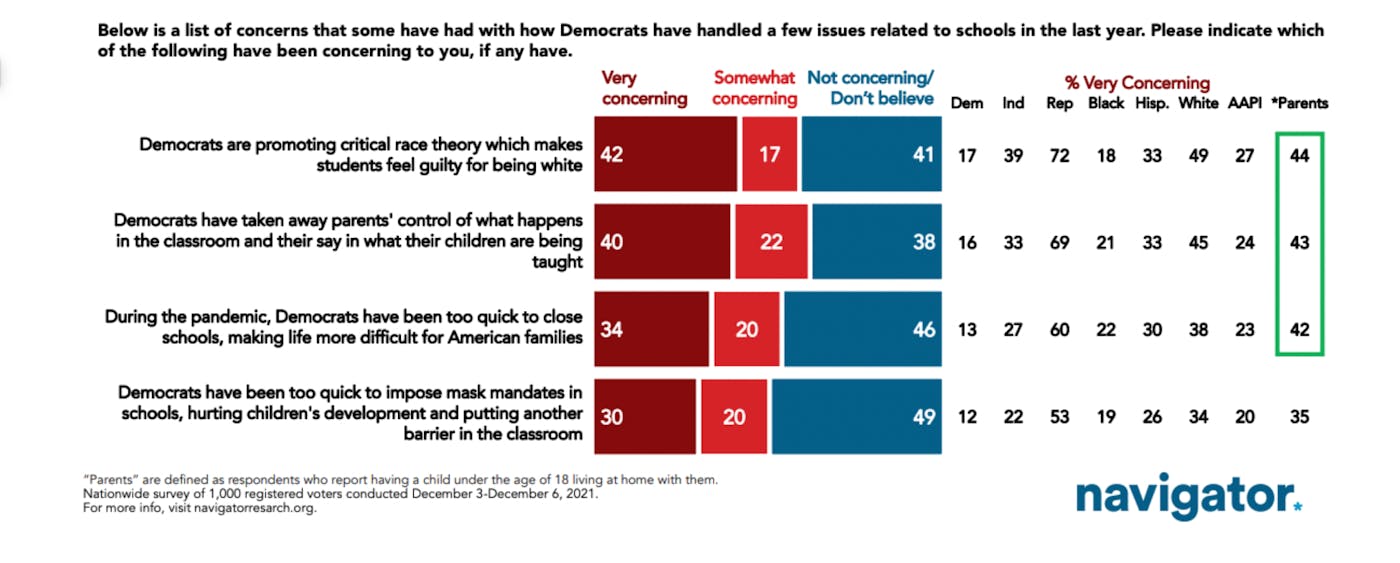
Parents’ fears notwithstanding, administrators stress that critical race theory is not taught in public schools; they are technically correct. As an academic field, CRT is a relatively obscure discipline that examines how laws and institutions harm or benefit people according to their race and relative power; its study is largely reserved to graduate programs. Yet parents who sense that change is afoot are also not wrong. Certain longstanding assumptions about identity and opportunity are being contested in K-12 classrooms around the nation—the same assumptions contested today in workplaces, in media organizations, and in the halls of Congress. The way these struggles shake out will have everything to do with how much control certain parents are able to exert in school districts and how well teachers can protect their autonomy.

Progressive groups and teacher unions have largely responded to critical race theory attacks with pleas that the public should trust educators to teach honest and accurate history. The appeal sounds reasonable enough, but what it means in practice is far from clear. Should teachers teach all perspectives on every issue? Is such a thing remotely possible within the constraints of a school year? What do young people need to know to thrive in a diverse, globalized, and democratic society? And who should get to decide?


On a Saturday morning in mid-November, just weeks after Glenn Youngkin won the Virginia gubernatorial election by campaigning on “parents’ rights” in education, an earnest and avuncular Colorado Springs high school history teacher named Anton Schulzki addressed a group of fellow teachers at the one hundred and first annual National Council for the Social Studies conference. Schulzki, the president of the council, acknowledged that the social studies curriculum has come under increasing scrutiny in recent years, particularly since The New York Times Magazine’s publication of The 1619 Project, a compilation of articles and essays asserting the centrality of slavery to any accurate story of the nation’s founding. “Time and time again,” Schulzki said, “teachers, administrators, and school boards have been accused of somehow indoctrinating their students.”

He noted the irony of history curricula dominating public debate around K-12 schooling when the hours of class time actually afforded to it—particularly at the elementary and middle school levels—have decreased precipitously over the last two decades. The primary result of the new rules passed by states and school boards, Schulzki argued, has been that teachers avoid certain topics altogether. But, he implored, they should try very hard not to. It is a time “for us to stand together in solidarity for social studies,” he said, “to use our collective voices in solidarity against ignorance, injustice, and indifference.”

The pressures around critical race theory shaped many other panel discussions throughout the weeklong virtual conference. One presentation—“Decentering Whiteness: One School District’s Approach”—explored the changes the Anoka-Hennepin School District, the largest in Minnesota, is making to the history curriculum to reflect the needs of its changing population. Like many other suburban areas, Anoka-Hennepin, which serves a large geographic region just north of Minneapolis that includes liberal inner-ring suburbs, conservative exurbs, and rural countryside, has grown markedly more diverse over the last 15 years; nonwhite students now represent a third of its student body. Some pockets of the district voted for Trump in 2020, others leaned toward Biden. Both the leftist Ilhan Omar and the far-right Tom Emmer represent parents from this area in Congress.

Dan Bordwell, the thick-bearded teaching and learning specialist in his mid-thirties who led the “Decentering Whiteness” presentation, described the work educators have done in his district since 2017 to incorporate more diverse voices into their social studies lessons. When students learn about Brown v. Board of Education, Bordwell asked, do they also learn about Linda Brown, the student who inspired the case, and her family? When they learn about the antebellum period, do they hear perspectives from Black lesbians? With the help of Keith Mayes, a historian of African American studies at the University of Minnesota, Anoka-Hennepin teachers worked to identify where they could “infuse” new discussions of race and racism into their curriculum, while still following Minnesota’s social studies standards, last updated in 2013. Anoka-Hennepin also established an honors-level Black history elective and ramped up professional development aimed at helping teachers incorporate narratives from underrepresented populations. It’s about “telling a more complete picture,” Bordwell explained.

Helping students see themselves in the curriculum, leaders in a growing number of school districts say, will lead to higher academic achievement and deeper learning for all. In 2019, Anoka-Hennepin issued an Equity and Achievement Plan, lending more support to the work its social studies department was already doing to bring perspectives of underrepresented groups to the forefront.

But not all families saw these changes as developments in the right direction. And over the last two years, as parents began mobilizing against the specter of critical race theory, much has changed in the district. In the Anoka-Hennepin Better Together Facebook group, which has more than 550 members, parents fulminate against excessively “woke” teacher trainings and other aspects of student learning. Krissy Erickson, the founder of the Facebook group, told me she started it after the principal of her kindergarten-age son’s school signed a “Good Trouble” pledge with other school principals in the Twin Cities metro. The pledge committed to “de-centering Whiteness” and “dismantling practices that reinforce White academic superiority,” such as tracking students. Erickson, who had never been involved in parent activism before, joked that “the mama bear just recently came out.” At a school board meeting in late August, she announced that she and her fellow parents were “done being bullied into silence” and criticized the “CRT-related ideologies” that have been presented to staff and “directly trickle down into students’ assignments.” Erickson stood “in full support of teachers,” she said, but insisted that “the only real privilege we need to reflect on is the privilege we all have to live here in the United States of America.”

Thousands of other, mostly white, parents across Minnesota have similarly been protesting proposed state social studies standards that for the first time would include ethnic studies as a core component for all students. The standards—which would take effect in 2026—reflect “a relentless fixation with Native American history” and replace “objective historical knowledge … with a fixation on ‘dominant and non-dominant narratives’ and ‘absent voices,’” according to a petition led by the Center of the American Experiment, a local conservative think tank. This past November, Anoka-Hennepin residents elected a school board member, Matt Audette, who ran on a fiercely anti-CRT platform.

Bordwell, whose emails have been subject to FOIA requests by suspicious members of his community, has felt the increased pressure acutely. He submitted the idea for his “Decentering Whiteness” panel in February 2020; had he crafted the pitch a year later, he said, he would likely have proposed a different name for his presentation. “We have teachers who are walking on eggshells worried that they’re going to have a picture taken by a student or parent, that they are going to be unfairly targeted for the work that they’re doing.”

At my request, Erickson asked other parents in her Facebook group what they make of teachers’ fears about retaliation. Some teachers, she told me, are “obvious activists who will stop at nothing to promote their own OPINION.” But she believed that most parents would be satisfied so long as educators are “presenting facts and multiple viewpoints.” Members of her group, she explained, feel that issues of race, sex, and gender have “been thrown at our children from every angle”; they want “to simplify things and get back to education and academia.” As a compromise, Erickson proposed making certain subjects elective, or providing families with a heads-up about unit discussions and allowing them to opt out if they disapprove. In this, she echoed a call common among the anti-CRT cohort, who argue that teachers should alert parents of any plans to include controversial subjects in their curriculum, and even let them review teaching material ahead of time.


If the members of Erickson’s group—and similar parents—are to be taken at their word that they would support the inclusion of multiple viewpoints, they should be reassured by the work of some nonprofit education groups aiming to help teachers tackle controversial issues. One such group is Close Up. Founded in 1971 initially to bring high school students on trips to Washington, D.C., Close Up encourages “deliberation” on heated policy questions as a way of helping students build consensus. A study of its model, published this past summer by professors at North Carolina State University and the University of North Carolina Greensboro, found that high school students felt more respected in classroom political discussions designed as deliberation rather than debate.

A class using Close Up’s approach might ask, for instance, what policies, if any, are needed to reform police practices. Students would read about the disparities between Black Americans’ encounters with the police when compared to other groups, explore different policy proposals to address the issue—banning the use of neck restraints, for example—and review the arguments supporters and opponents make for each idea. At the end, students would be asked to write about which proposals they favor, which they would change, and which they would reject, and could suggest other proposals.

At least in theory, it’s possible to imagine such an approach satisfying people across the political spectrum. But on certain deeply polarizing issues, such as rights for undocumented immigrants or the place for transgender students in school sports, some on the left have argued that it’s harmful even to have those discussions; normalizing certain perspectives, the thinking goes, can be destructive to the vulnerable people they’re about. And on the right as well, many parents find certain points of view too dangerous to debate; talking about transgender athletes, for example, legitimizes the gender categories these parents patently reject and believe could corrupt their children. Sante Mastriana, a curriculum design manager for Close Up, said the group doesn’t support deliberating on everything; certain topics, like white supremacy or the efficacy of fascism, are off limits. “There are certain arguments which we are not going to entertain as valid,” he told me. Of course, if some subjects are out of bounds, it’s impossible to claim that ideology doesn’t, at some level, govern the choice of study; some administrator somewhere is choosing what to include and what not to. Mastriana said that Close Up’s solution is to rely on multipartisan resources and facts. “Unless it’s the sort of argument that just categorically makes a supposition about the nature of things without actually providing any grounding,” he said, “then it is something probably worth addressing.”

Chris McDuffie, an eighth-grade civics teacher at Heathwood Hall, a private school in South Carolina, uses Close Up materials in his classroom. He likes their “fact-based, middle of the road” format. “I tell kids to wait at least three days, check at least three sources, and to enter a conversation with three pieces of information or three questions before they form an opinion about a current event,” he told me. “No one knows where I fall politically, and I pride myself on that.” But McDuffie, who has been teaching for 21 years, including 12 in public schools, acknowledged that it’s easier to tackle political issues in a private school, where he’s afforded a great deal of autonomy over lessons. When he worked at a public school, some administrators, wary of backlash, didn’t even support teaching current events.

Like the nonprofits, some state school board associations have been encouraging local school districts to better support educators teaching contentious issues, a risky move given the intense politicization of the National School Boards Association in 2021. Last year, the national group compared parents protesting critical race theory at school board meetings to “domestic terrorism,” which led 21 mostly GOP-controlled states to withdraw membership, participation, or dues from the organization. Nevertheless, in late November, in Loudoun County, the northern Virginia region that became a national epicenter of parents’ protesting CRT, school administrators recommended that their school board adopt a policy called “Teaching About Controversial and Sensitive Issues,” based on a model promoted by the Virginia School Boards Association.

Examples of such controversial topics, said Ashley Ellis, Loudoun County’s deputy superintendent for instruction, are slavery, colonization, immigration, and the Holocaust. “Schools are under more scrutiny for what they’re teaching,” Loudoun Now, a local paper, quoted Ellis as saying. “Our teachers have asked for support in how to approach these topics with confidence.” A spokesperson for the district declined to comment on the proposal.

Teacher unions, too, have been exploring ways to support educators who tackle controversial issues. The three million-plus–member National Education Association has been organizing to pass a model school board policy that affirms the value of Black and other ethnic studies courses and pledges to defend teachers who use materials “that incorporate diverse perspectives.” The unions have also been organizing to back candidates in school board elections. “We are preparing and training our educators to be involved in elections of those who have the power and authority to make the decisions,” Becky Pringle, the president of the NEA, told me.

But parents opposed to CRT have likewise stepped up their school board efforts. In 2021, the 1776 Project PAC, a national right-wing group, formed to elect school board members who are committed to “abolishing” critical race theory and The 1619 Project from public school curricula. The group backed 57 candidates across seven states, 41 of whom won. In 2022, its sights are set on 200 additional races.


Some of the current disputes over curricula can be traced to the beginning of the Obama period. The election of the nation’s first Black president led to new cultural and political backlash, including fights over how to teach about American identity in schools. As the education historian Jonathan Zimmerman has observed, critics began labeling ethnic studies courses as “divisive” and “un-American,” and by 2014, groups were lobbying against the College Board’s revised A.P. U.S. history course, which opponents alleged cast U.S. history in too harsh a light. For example, the revised guidelines described the idea of manifest destiny—the nineteenth-century doctrine that said the expansion of the United States throughout North America was both justified and inevitable—as “built on a belief in white racial superiority and a sense of American cultural superiority.” The Republican National Committee passed a resolution that year blasting the framework for its reduced focus on the Founding Fathers, the Declaration of Independence, and U.S. military victories. The framework “emphasizes negative aspects of our nation’s history while omitting or minimizing positive aspects,” the RNC said. (A year later, the College Board issued yet another revised framework, filled with edits that successfully quelled its conservative critics.)

Last spring, after state lawmakers began introducing bills banning critical race theory, the left-leaning Zinn Education Project sponsored a Teach the Truth pledge, garnering thousands of signatures from teachers. The National Education Association has its own Pledge to Support Honesty in Education. Both groups argue that CRT critics want teachers to avoid addressing topics like slavery and redlining, but conservatives insist that charge is a lie. Regardless, mainstream history textbooks do cover the nation’s disturbing history of racial violence better than they used to. A content analysis led by education historian Jeffrey Snyder found that leading contemporary texts depict in detail “everything from slave whippings and lynchings to race riots and church bombings.” According to Snyder, “it is not uncommon for textbooks to include even the most grisly of images, such as a photograph of the charred body of seventeen-year-old Jesse Washington, lynched in Waco, Texas, on May 15, 1916.”

Perhaps the fiercest debate is over whether to teach that the United States has overcome its dark legacy of racial discrimination, or whether, as The 1619 Project suggests, slavery’s harms continue to oppress Black Americans in the present. “White supremacy affects every element of the U.S. education system,” argues Learning for Justice, a national social justice nonprofit that provides free resources to educators and school districts, on the cover of its spring 2021 magazine. In a sponsored session at the National Council for the Social Studies conference—entitled “Teaching Honest History Through Critical Inquiry”—Learning for Justice facilitators asked participants, “How comfortable are you teaching about American enslavement, including the idea that it shaped the fundamental beliefs of Americans about race and whiteness?” They encouraged educators to avoid interpreting historical texts through a “white, Eurocentric” lens that would perpetuate stereotypes, and instead to teach students “resistant” readings, which in their definition lend themselves to anti-racist interpretation and challenge dominant cultural beliefs.

Part of what makes the fights over how to teach history and social studies so tricky is that, while virtually everyone says they oppose racism, enormous disagreement exists, within the broad left as well as between left and right, about what an ­anti-racist education should look like. Ibram X. Kendi, one of the most influential writers on anti-racism, argues against standardized tests, calling them “the most effective racist weapon ever devised to objectively degrade Black minds.” Others see testing as a key tool for leveling the playing field for marginalized students, allowing them to access opportunity and compete on merit, and they view moves away as discriminatory against Asians, who tend to perform better on the exams. Still others see the very ideas of competition and meritocracy as by-products of white supremacy. Tema Okun, a popular consultant on issues of diversity, equity, and inclusion, describes “a sense of urgency,” “perfectionism,” and “individualism” as values inherent to white supremacist culture. In Learning for Justice’s spring issue, an educator describing anti-racist teaching voiced a similar opinion: She sees white supremacy wherever there’s a “sense of urgency to meet particular deadlines that don’t necessarily speak to actual student growth.”

The Seattle parents who complained about Courageous Conversation, the curriculum Jonathan Greenberg was punished for incorporating, were not the last family to object to the ideas it encouraged. And even people who broadly agree with including discussions of racism in the classroom might object to certain arguments of Courageous Conversation’s founder, Glenn Singleton. One New York Times Magazine article, for instance, quoted Singleton as saying that valuing writing over other forms of communication is “a hallmark of whiteness” that harms Black students. (Brooke Gregory, the president of Courageous Conversation, argued that most critics of the program haven’t participated and misunderstand its goals. The point, she said, “is not to demonize anyone, it is not to create good and bad or right and wrong, it is to say that all of these voices have a need to be heard and understood.”)

Most parents organizing against critical race theory have been white, but not exclusively. Last spring, Shawntel Cooper, a Black mother of two, testified at a Loudoun County school board meeting that was picked up by national news, and has since spoken out in the media about teacher training materials she finds offensive, like one obtained via FOIA that contrasted “White Individualism” with “Color Group Collectivism.” Cooper said she did not identify with the values ascribed to the “Color Group” side, which didn’t include things like private property and independence. The trainings also asserted that “culturally competent professionals” do not embrace color blindness, and they “accept responsibility” for their own racism and sexism. “I don’t understand how you would not want to ban anything that is this divisive and divides each other because of color,” Cooper said.

When I asked Jalaya Liles Dunn, the director of Learning for Justice, how her group is contending with the possibility that educators will face political backlash if they incorporate their more radical resources, she said her members have been talking with teachers about how to develop materials that won’t get them in trouble. “We’re being really practical about what teachers can and can’t say, and can and can’t do,” she said. “We don’t create a finished product and say ‘This is what teachers need’…. They know what they need, they’re on the front lines.”


The claims of parents in Erickson’s Facebook group notwithstanding, the idea that concerned communities might be satisfied by teachers presenting multiple viewpoints on thorny subjects is not borne out by history. Even before the wave of anti–critical race theory bills, most public schools throughout our nation’s past have shied away from teaching controversial issues. In The Case for Contention (2017), co-authors Jonathan Zimmerman and Emily Robertson, a philosopher of education, note that, in general, communities have not wanted their schools to present “both sides” of an issue, much preferring teachers to reinforce local norms. Indeed, “the most significant restriction” on public school teachers tackling controversial issues, Zimmerman and Robertson conclude, has always been the public itself. Educators, who keenly feel this distrust, have generally chosen to stick to topics they believe will agitate no one.

The law offers K-12 teachers who do suffer backlash little protection. It’s been more than 50 years since the high point for teachers’ free speech. In 1967, the U.S. Supreme Court issued a landmark decision concluding that loyalty oaths, including anti-communist pledges, violated educators’ First Amendment rights. In 1968, the court ruled in favor of Marvin Pickering, a teacher who had written a letter to his local paper opposing a tax levy decision made by his school board and criticizing the board’s tendency to allocate funds to sports over academics. The board fired Pickering, but since his letter didn’t criticize the school employees with whom he worked on a daily basis and pertained to a matter of public concern, the court said his speech should be protected. And in 1969, the Supreme Court ruled in its famous Tinker v. Des Moines decision that neither students nor teachers “shed their constitutional rights to freedom of speech or expression at the schoolhouse gate.”

Since then, however, the courts have largely retreated from protecting teacher free speech at the K-12 level, both inside and outside the classroom. In 2006, for example, the Supreme Court ruled that when public employees speak in the context of their jobs, they’re “not speaking as citizens for First Amendment purposes,” and thus should not be insulated from employer discipline. Less than a year later, the Seventh Circuit upheld the firing of an Indiana schoolteacher who told her class that she had honked in response to a HONK FOR PEACE sign protesting the U.S. invasion of Iraq and she believed in peaceful solutions to conflict. “The school system does not ‘regulate’ teachers’ speech as much as it hires that speech,” the court ruled, asserting that she could not cover topics or advocate perspectives in class that depart from what the local school board approves.

There are nearly 14,000 K-12 public school districts across the United States, and almost all are governed by locally elected school boards. Turnout in these elections is notoriously low, often just 5 or 10 percent of eligible voters. Nonetheless, these representatives are legally empowered to set policy on virtually everything related to their schools, from budgets and bus schedules to curriculum and enrollment boundaries. The major limitation on their authority comes from state lawmakers, who can impose obligations on local districts to do with school vaccinations, standardized testing, or, of course, new rules curtailing discussions of race.

“The fact of the matter is we work with a captive audience,” said Steven Cullison, a high school economics teacher, in a National Council for the Social Studies presentation he led about free speech. “That is, the law requires students to come to school, and what’s more, we require the community to pay for it. That means that the community has a right to far greater say in what occurs in a public K-12 school than, say, in a college or in a private school.” Speaking this fall on a podcast, Alice O’Brien, the general counsel for the National Education Association, told educators that if they work in a state that passes a law against teaching that the United States is systemically racist, they must be particularly careful about how they craft curricula and answer student questions. “I wish I didn’t have to say that,” she said. “But the fact is we do have members who have gotten in trouble for appearing to promote a viewpoint in their classroom that is at odds with that prohibition.”

If educators cannot deny the stake lawmakers, parents, and other community members have in shaping school curriculum, political leaders certainly question parents’ interest at their peril, as Terry McAuliffe discovered this past fall in his failed Virginia gubernatorial bid. In a late September campaign debate, McAuliffe said a few words he would never live down. “I’m not going to let parents come into schools and actually take books out and make their own decisions,” he announced. “I don’t think parents should be telling schools what they should teach.” In the closing weeks of the race, Youngkin’s campaign made those remarks a centerpiece, running ads and circulating petitions proclaiming that “Parents Matter.” Post-election public opinion research showed that McAuliffe’s comments were highly influential, including among Biden voters who cast their ballots for Youngkin.

Though the fact often gets lost in contemporary media coverage, it’s never been only conservative parents who have disputed what’s taught in schools. Throughout the twentieth century, Black parents, with the assistance of the National Urban League and the NAACP, challenged school boards and book publishers about racist passages that they found in textbooks. The advent of ethnic studies courses, too, was driven by families pressuring their local leaders for more equitable representation in the classroom.

Perhaps surprisingly, not just parents think parents should have a say in curricula. In November, in a nationally representative EdWeek Research Center survey of district administrators and teachers, 63 percent of respondents said local parents should be involved in selecting the curriculum and materials, even though just 31 percent said parents are involved. And while it may be because they are so eager to avoid fights and criticism, more than 50 percent of educators said they supported letting parents opt their children out of classes, curricula, or units they disapprove of; 25 percent even said they “completely support” the idea.


In 2013, following the news that Greenberg would be transferred to another Seattle school, fellow teachers and former and current students rallied to his defense, shocked by how quickly administrators had caved to the grievances of a single family. More than 100 of his supporters showed up to a Seattle school board meeting decked out in green clothes, and at the school’s graduation ceremony that year, a senior delivered a speech demanding Greenberg’s reinstatement, after which his peers opened their gowns to reveal shirts with the letter “G” on chest plates. Although Greenberg was forced to spend the next year working at a middle school, an arbitrator eventually ruled that the school district had inappropriately used a transfer to punish him, and permitted him to return to his old job.

Greenberg, who still teaches high school civics in Seattle, has noticed changes in his two-plus decades in the classroom. “Students are so much more aware of systemic oppression than they used to be,” he remarked. When he used to ask his classes why people were poor, teens tended to invoke individual choice. “Now there’s a reluctancy to even mention individual choices,” he said. “I credit Black Lives Matter with so much of that. Back in the day, I might have just been happy to even discuss the concept of ‘white privilege’ with my class—now I feel like it’s not even a debate.”

Few teachers today, though, feel confident that they’d get their jobs back if they got on a parent’s bad side, and Greenberg himself suspects that his own race and gender played a role in the community’s defense of him. “I certainly feel like educators of color who get persecuted don’t get that showing of support,” he told me.

Keith Mayes, the University of Minnesota historian who helped Anoka-Hennepin social studies teachers include more Black history, sees community backlash to critical race theory as just a “foot in the door,” the first step in a project to eventually go after ethnic studies courses, racial equity initiatives, and broader discussions of racism. While he recognizes that the fear educators experience is real, Mayes thinks that what is most needed is backbone. “The real question will be how well-meaning white teachers and administrators stand up to this opposition,” he said. “That’s the fundamental question, and I’m always watching that.” Teachers, after all, are members of their communities, too; they can elect candidates for school board, testify at meetings, and advocate collectively for their interests.

In the end, as communities continue to spar, it will be students who pay the price for the laws, rules, and cultural pressures that deter educators from tackling so-called divisive subjects. A wealth of research, from both nationally representative samples of schools and individual schools, has shown that students who are encouraged to discuss controversial issues are more likely to develop civic tolerance, political interests, a sense of civic duty, and expectations of voting than their peers without similar classroom experiences. Teachers “cannot simply be mouthpieces for the state nor conduits for the majority beliefs in the local community,” Zimmerman and Robertson argue. But are we willing, on the left or the right, for teachers to be anything else?

Despite Federal Gains, Public Defenders Largely Missing from State Supreme Courts

Originally published in Bolts Magazine on March 22, 2022.
—–

Ketanji Brown Jackson’s past work as a public defender emerged as a focal point of her confirmation hearings this week as Joe Biden’s pick for the U.S. Supreme Court. If confirmed, Jackson would be the first former public defender on the high court in more than three decades, and also the first Black woman to join the court, carrying on the legacy of Thurgood Marshall, the nation’s first Black justice and the last with public defender experience. Biden has already tapped former public defenders for federal judgeships at a record rate. 

“You are standing up for the constitutional value of representation,” Jackson said during her hearings on Tuesday, defending her record from Republican attacks. Her supporters, meanwhile, have cheered Jackson’s experience as adding a much-needed perspective to the court. From the way this clash has unfolded, you’d think that judges with public defender backgrounds are part of the routine tit-for-tat of judicial nominations, a perspective that Democrats relish adding to the bench when they get the opportunity.

But in state supreme courts around the country, there is comparatively little momentum to install judges with public defense backgrounds, despite the great power those judges hold in interpreting criminal law. The vast majority of criminal cases are decided at the state level, and according to a study by the Brennan Center for Justice, as of 2021 only seven percent of state justices are former public defenders. More than a third are former prosecutors.

In the two most populous states with Democratic governors, California and New York, efforts by some advocates to convince recent governors to appoint public defenders have fallen short, and former prosecutors have been added to the bench instead.

“The high courts of every state and the U.S. Supreme Court are regularly confronted with novel questions about the interpretation of criminal statutes and procedure,” said Alan Lewis, the chair of the New York State Association of Criminal Defense Lawyers’s screening committee. “It is very much regrettable if the only kind of experience that all of the judges bring to the bench from their previous career as advocates is for one side—the prosecution—with no experience on the other, representing accused persons.”

“We’re all creatures of our own experience and it is profoundly important that the courts’ membership be diverse, including diversity in previous experience,” Lewis told Bolts

Some legal experts have stepped forward to articulate the value of having more public defenders in the judiciary. In a new study that analyzed millions of charges handled by federal district court judges, political scientists Allison Harris and Maya Sen found that former public defenders were less likely to issue sentences that involve incarceration, and when they do send people to prison, the sentences are shorter. The difference may stem from public defenders’ intimate understanding of how incarceration affects individuals and communities, the study’s authors wrote in The Washington Post last week.

Emily Hughes, a professor at the University of Iowa College of Law who is on the board of the National Association for Public Defense, told Bolts that she’s optimistic about increasing opportunities for “similar and needed” conversations on the state level. She pointed to Continuing Legal Education Programs and law schools that are increasingly prioritizing diversity equity and inclusion (DEI).

“There are DEI conversations happening at both ends of the spectrum, at the front end, at law schools training people who want to become lawyers, and on the back end, once you are lawyers to maintain your bar license,” she said. “This sets the stage for these discussions about professional diversity to then happen.”

One state where there has been a more pronounced public conversation is New York—though so far with little material results to show for it.

Of the three vacancies that recently opened on the state’s high court, known as the New York Court of Appeals, advocates were unsuccessful in securing a new judge with a public defense background. After former Governor Andrew Cuomo appointed a district attorney with a punitive record to the bench last year, criminal justice reformers mounted an unsuccessful effort to stop the nomination. After Cuomo’s departure, dozens of advocacy groups and progressive lawmakers urged Governor Kathy Hochul to nominate someone who formerly worked in public defense, to no avail.

New York passed a series of major criminal justice reforms in 2019, including revisions to its bail and discovery rules that the state’s prosecutor association fought fiercely. Implementing those reforms will now fall on the New York Court of Appeals, where four of the bench’s seven judges have backgrounds in criminal prosecution. Advocates worry that this imbalance may skew the court’s jurisprudence on criminal justice issues. On Tuesday, the court ruled against a plaintiff who had challenged the state’s practice of detaining people beyond the end of their sentence over a sexual offense if they haven’t obtained suitable housing. The four prosecutors joined the majority in the 5-2 decision. The dissenters warned that the ruling forces incarcerated people into a “dystopic game” of securing “compliant and affordable housing before their release date.”

Sam Feldman, a New York public defender who was involved in the efforts to add public defenders to New York’s bench, said Biden’s commitment to greater professional diversity on federal courts helped motivate local advocates. “I think some people were pushing in that direction before, but [Biden] speaking of the importance of public defenders gave them something they could point to,” he said. More than a third of Biden’s judicial appointees over his first year in office were former public defenders.

Another factor driving the push in New York, Feldman said, was a greater recognition that, as the U.S. Supreme Court tilts further to the right, state courts must play a greater role in protecting civil rights. This has borne out in Washington State, where its state supreme court ruled last year to bar mandatory life sentences without parole for anyone under the age of 21, and struck down the state’s laws criminalizing drug possession. Washington is one of the few states to install a former public defender to its high court in recent years, via Democratic Governor Jay Inslee’s most recent nomination in 2020.

But in California, advocates have seen little success. The California Supreme Court hasn’t had a former public defender on the bench since 1986. Both of Governor Gavin Newsom’s appointees to the court so far have experience as prosecutors.

It’s fallen to a red state Democrat to go to bat for a judge with experience as a public defender. Kansas Governor Laura Kelly’s nominee for the state’s second-highest court was rejected by the GOP-run Senate last year, with some lawmakers expressing reservations about the appointee’s background as a public defender.

Geoff Burkhart, president of the National Association for Public Defense’s board of directors, told Bolts that there’s a strong belief among his colleagues that the judiciary would be better off with more judges trained in public defense.

“If you look at the bill of rights, four out of ten amendments are focused on protecting us if we’re charged with a crime, and that’s something that public defenders understand intimately,” he said. “I think public defense is one of the most important types of lawyering you can do. You’re serving as a counterweight to this awesome power of the government, and it really falls back to this concept—that while there may be a time when someone needs to go to jail or prison, in every case, we have to make sure they get a fair shake.”

Boston Emerges As a New Frontier For Noncitizen Voting in Local Elections

Originally published in Bolts on February 28, 2020.
—-

On the heels of New York City authorizing more than 800,000 noncitizens with legal status to vote in its municipal elections, Boston activists see their own opportunity to achieve noncitizen voting.

Chetan Tiwari, who has lived in Boston since 2015, says he would like the chance to weigh in on the local education policies affecting his family. He and his wife are from Canada, recently had their green cards approved, and have two daughters who are American citizens. “The level of education, the quality of education that my daughters are getting, is a conversation my wife and I have every single day,” he told Bolts. “Voting on those issues would make us very happy, it would be very important to us.”

This push gained new allies in November. Bostonians elected a new mayor, Michelle Wu, and new city councilors who said they support the effort. Now in power, they may pave the way for Boston to revisit the issue, and join a growing movement across Massachusetts. 

In recent years, the cities of Amherst, Brookline, Cambridge, Newton, Wayland, and Somerville, have all passed ordinances to enable noncitizens with legal status to vote in local elections, though their efforts have stalled due to this state’s peculiar rules. In Massachusetts, unlike in New York State, cities must file a home-rule petition and the state lawmakers and governor must approve it. The Democratic legislature has for now ignored these cities’ petitions. Proponents hope that a breakthrough in Boston can give them further momentum.

The state’s 2022 elections, in which voters will select their lawmakers and a new governor to replace the retiring Republican incumbent, could also clear their path further.

More than a dozen communities across the U.S. already allow immigrants with legal status to vote in local elections, including 11 municipalities in Maryland and two in Vermont. Chicago has given noncitizens the right to vote in local school council elections since 1989, and noncitizens in San Francisco have cast ballots for the local school board since a citywide referendum succeeded in 2016. (Undocumented residents were also included in San Francisco’s measure.)  New York City brought many more eyes to the issue last winter when it enabled residents to vote in all municipal elections such as for mayor and city council if they hold a green card, are authorized to work in the United States, or are part of the Deferred Action for Childhood Arrivals (DACA) program. San Jose’s city council also voted last month to study the issue.

This practice was once common in local, state and even federal elections. For the first 150 years of American history, white, male property owners—regardless of citizenship status—were allowed to vote in many states, though the tide began to turn following nativist backlash after the War of 1812. Arkansas was the final state to end noncitizen voting in 1926. Efforts to shut the door to local reforms have also grown in recent years; Alabama, Colorado, Florida, and North Dakota all passed ballot amendments to embed in their state constitutions that only U.S. citizens can vote in local elections. 

Boston’s city council also has dealt with the debate in the past before. In 2007, Felix Arroyo, the first Latino councilor ever elected in the city, proposed a measure to allow legal residents to vote in local elections but it failed. The issue faded after Arroyo lost his re-election bid. In 2018, then-City Council president Andrea Campbell organized a hearing to discuss the idea. 

Campbell’s proposal would have granted the right to vote in local elections to immigrants who hold green cards and work visas, and to DACA recipients. The Boston Globe estimated that the proposal would enfranchise 48,000 Bostonians, which is about 7 percent of the city’s overall population. 

Campbell said at the time that the reform  could be a way to empower local immigrant communities who felt threatened and marginalized by the Trump administration. The idea was backed by Ayanna Pressley, who was then a Boston councilor and has since joined the U.S. Congress. “Our immigrant communities contribute to our economies, they contribute to our tax base, contribute to the vibrancy of our communities,” Pressley said. “I believe they deserve a say in who represents them at the municipal level.”

But not all councilors were on board. Ed Flynn maintained then that voting “is a privilege reserved for U.S. citizens.” Michael Flaherty also opposed the idea, saying enfranchising noncitizens to vote in local elections runs “watering down” the benefits of citizenship, “by either allowing folks to come in the back door or cut the line or expedite the process.” 

Still, much has changed in the last four years and activists say the conditions are more favorable now. It’s also not unusual for this type of issue to take a few tries politically. In San Francisco, voters rejected noncitizen voting for local school board elections in 2004 and 2010, before ultimately approving it in 2016. 

Beginning in 2019, Progressive Massachusetts, a statewide grassroots advocacy group, began asking local candidates in Boston if they would support noncitizen voting if it came up at the council. Ricardo Arroyo, Kendra Hicks, Ruthzee Louijeune, and Julia Mejia have all newly joined Boston’s city council since 2020 after telling Progressive Massachusetts that they support it. Wu said the same during last year’s mayoral race.

“I think you could get 10 out of 13 votes on the Council [today],” said Jonathan Cohn, political director for Progressive Massachusetts, who helped run those questionnaires. His experience resembles that of Beth Huang, executive director of the Massachusetts Voter Table, a voting rights group that has asked candidates around the state in 2021 for their views on noncitizen voting. “Eighty out of 126 candidates who responded to our questionnaire said they supported it,” she said. 

Boston is currently experimenting with other measures meant to bolster local democracy. In November, more than two-thirds of Boston voters approved a ballot question to overhaul the city’s budget process, which contained a provision to  establish a new participatory budgeting process for a portion of the budget. Wu, the new mayor, also supported participatory budgeting.

On the same day, nearly four out of five Boston voters also backed a nonbinding referendum to switch their appointed school committee to one elected by city residents, adding new pressure on the government to democratize local school decisions. This change would require a home-rule petition, though.

Carolyn Chou, executive director of the Boston-based Asian American Resource Workshop, says the successful local organizing for an elected school committee and participatory budgeting is creating new opportunities to promote noncitizen voting. “Immigrant organizing groups and SEIU32BJ have been focusing on this, and I’m hopeful that with this new city council we may be able to move it along,” she said.

Kathy Henriquez Perlera, a community organizer with Neighbors United for a Better East Boston, also told Bolts her grassroots group would absolutely support noncitizen voting. Members of her organization have recently been exploring the idea of getting the city to grant municipal IDs for all city residents, similar to a program that exists in New York City.

Some immigrants’ rights activists have major reservations, however. 

During the 2018 debate in the Boston city council, Veronica Serrato, then executive director of Project Citizenship, said her group had worked with two immigrants in Massachusetts who had mistakenly voted in an election, disqualifying them from future citizenship. Allowing immigrants to vote in some elections may lead to errors—for instance, if poll workers give them the wrong ballot and they vote in an election they were barred from voting in—with potentially major consequences.

Mitra Shavarini, the current executive director of Project Citizenship, told Bolts this remains a worry for her organization, though she said they would abstain from taking a stance this time if a new bill came up in Boston. “We also aim to safeguard green card holders against possible issues that may jeopardize their ability to naturalize,” she said. “We therefore believe that it’s far more important to remove obstacles that impede immigrants from naturalizing than to solely push for voting rights.” 

Huang pushes back against this worry, noting that she heard a similar concern when voting rights proponents in Massachusetts were pushing automatic voter registration (AVR). “That was not a good reason not to do AVR, and it’s also not a good reason to oppose noncitizen voting,” she said. “Of course we also need to have crystal clear expectations and communications.”

To address these risks, cities that have enabled non-citizen voting often set up separate processes, including alternative local registration forms and voter rolls that are specific to voters who should only have ballots for local elections. They may also offer to provide residents a letter to submit alongside a naturalization application, as Takoma Park does. Local governments have also partnered with immigrant advocacy groups, to distribute non-citizen voting information in multiple languages.   

Damali Vidot, a city councilor in Chelsea, has championed the issue  in both her own city and statewide. “I tried to introduce a conversation on this on the city council a few years ago and people voted down a discussion, but at the beginning of last year, with Trump finally out of office, I decided to try again,” she told Bolts. She reached out to city councilors in Cambridge, Somerville, Brighton, Lawrence, and Boston to talk about the idea, and connected with a local immigrant rights group in her city, La Colaborativa. “I thought, wouldn’t it be nice if we could get a consortium of resolutions or get different municipalities to pass it all at once?” she said.

Huang said noncitizen voting has not been a “front-burner priority” for local groups that are in coalition with the one she leads; groups are more focused right now on getting driver’s licenses for undocumented residents. But she says there is growing support for the idea in cities with high concentrations of immigrants and working-class people. “We’re talking about the post-industrial cities that have now been inhabited by a lot of refugees,” she said, naming Worcester, Springfield, Lowell, New Bedford and Chelsea as examples. 

Huang stresses that keeping noncitizens from voting significantly skews the electorate toward white residents, especially in cities where the population that is eligible to vote is majority white but not the overall population. “That was not quite clear to me until I looked at the data community by community,” she said, in reference to census estimates updated last year.

The city of Lynn, for instance, has an overall population of more than 90,000 residents that is barely a third white. But of the residents who are eligible to vote, the majority is white. Latinx residents make up more than 40 percent of the city’s population, but only about 25 percent of the electorate. 

This pattern is very prevalent in the dense stretch of municipalities between East Boston and the North Shore, Huang added. “I think that presents a really good case for why we absolutely need non-citizen voting,” she said.   

For proponents of expanding the franchise, the biggest barrier they cite is the state legislature. Its Democratic leaders have not brought the home-rule petitions of recent years to the floor. Advocates in the state have long complained that state lawmakers have shied away from strengthening immigrants’ rights.During the Trump years, advocacy organizations like Progressive Massachusetts kept pushing for the “Safe Communities Act,” which would have limited how local and state law enforcement could enforce imigration law, to no avail. Three of the chamber’s leaders, state Senate President Karen Spilka, House Majority Leader Claire Cronin or House Speaker Ronald Mariano, did not respond to a request for comment.

State lawmakers are all up for re-election in 2022, and so activists see new opportunities to apply pressure on them. Cohn, of Progressive Massachusetts, also noted that voting for immigrants with legal status was included in the state Democratic Party platform last year for the first time, thanks to the rising organizing around the issue.

But the upcoming governor’s race is what may give the issue the most impetus if an ally is elected and uses their pulpit to support the local ordinances. The wide-open race has drawn a crowded field, yet so far, few are willing to comment. Bolts did not hear back from Democratic candidates Danielle Allen, Orlando Silva, and Sonia Chang-Díaz. Maura Healey’s campaign declined to comment. 

Josh Caldwell, a socialist running for governor in the Democratic primary, told Bolts that he strongly supports enfranchising noncitizens. “The fact of the matter is, that not giving representation to those that participate in taxation seemed to be a core argument to a certain historical revolution,” he said. “Our systems have and will always find a group to otherize.”

Keeping up local pressure will be key, proponents say. Vidot, the Chelsea councilor, is confident the issue is moving forward. “Progressive politics basically means we’re ahead of ourselves,” she said. “It will happen and we just have to keep pushing.”

Wall Street’s New Foe

Originally published in The New Republic‘s March print issue
—–

In late March 2015, just one month after 15 graduates of the for-profit Corinthian Colleges announced the first-ever student debt strike, a group of those activists traveled to Washington, D.C., to meet with federal regulators.

They’d been invited by Rohit Chopra, the student loan ombudsperson of the Consumer Financial Protection Bureau, a federal agency that had opened its doors just four years prior. The strike was against the Department of Education, but the CFPB had been investigating Corinthian for its predatory lending, and Chopra wrote that he’d like to discuss ways to address the activists’ burden.

At the CFPB’s offices across the street from the White House, Astra Taylor, co-founder of the Debt Collective—a national debtors union founded in the wake of Occupy Wall Street—remembers watching Treasury and Education Department officials shift uncomfortably in their seats, while Chopra remained friendly and curious. It was unusual, she said, to have someone in his position treat pressure from the grassroots as “not a threat but as a legitimate force with essential leverage.”

Chopra ended up leaving the agency a few months later, spending the last year of the Obama administration at the Education Department, an agency he had publicly critiqued for belittling the harms of the student loan crisis, followed by a post under Donald Trump at the Federal Trade Commission. But with a Democrat back in the White House, the CFPB needs fixing after a ruinous four years, and President Joe Biden tasked Chopra to return to his old agency. He’s been leading the CFPB since the Senate confirmed him as director in late September.

Chopra, who turned 40 at the end of January, served as student body president while an undergraduate at Harvard, where he earned a reputation for taking on campus administrators. “Chopra is not afraid to be combative with those in power … [and] has made the often overlooked council a force to be reckoned with,” reported The Harvard Crimson in 2003. “There’s no advantage to being a pushover,” Chopra told the student paper back then. He followed his Wharton MBA with a Fulbright in South Korea and a stint working for McKinsey. But by his late twenties he had switched to government, working at the Treasury Department to help launch the CFPB before it was an official agency. And along the way, he became a close ally of Elizabeth Warren, whose views he’s expected to revive at a CFPB that became captured by the GOP’s pro-bank dogma under Trump.

Born out of a 2007 essay published in Democracy, the CFPB’s mission, conceived by then-professor Warren and later enshrined in the Dodd-Frank Act after the Great Recession, is to regulate tricks and traps in the credit industry and make finance safer for regular people. “Financial products should be subject to the same routine safety screening that now governs the sale of every toaster, washing machine, and child’s car seat sold on the American market,” Warren wrote at the time.

In its first decade of operation, the CFPB emerged as one of the most admired and hated divisions in government. In 2017, President Trump called it a “total disaster,” and a week later Politico dubbed it “the most powerful and consequential new federal agency since the Environmental Protection Agency opened its doors nearly half a century ago.” The EPA comparison is a bit overstated, but since its founding the consumer watchdog has gone after all sorts of predatory actors, from large financial institutions to debt collectors. Under its first director, Richard Cordray, the CFPB returned almost $12 billion to tens of millions of Americans, extracting from companies a combination of consumer refunds and canceled debts.

That changed after Cordray’s resignation. During the Trump years, employee attrition spiked—with nearly 11 percent of staff leaving in 2018—and there was also a marked decline in investigations into potential lawbreakers. The New York Times Magazine ran a feature in 2019 exploring how Trump’s picks to lead the CFPB—first Mick Mulvaney, followed by federal budget official Kathy Kraninger—had quietly crippled its operations. “Where Mulvaney or his successor have allowed cases to go forward, lenders have often settled with lowered fines or none at all,” the magazine reported. Instead of a watchdog, Trump’s CFPB became a welcoming home for bank lobbyists. In 2020, a divided U.S. Supreme Court ruled that the president could fire the CFPB’s director without cause, a victory for its conservative critics who claimed the director’s independent five-year term was too unaccountable. While initially a win for Republicans, that same decision allowed Biden to immediately oust Kraninger.

Chopra returned to his old employer last fall, just as Covid-19 relief programs were winding down. By the end of June 2021, Americans owed $15 trillion in debt—roughly $800 billion more than at the end of 2019. “In many parts of the country and in many individual neighborhoods, conditions remain fragile,” Chopra acknowledged before the U.S. Senate Banking Committee in late October.

Those are the conditions out in the world. Inside the agency itself, he is taking over a department that has been rocked by staff protest, including charges dating back to the Obama years of racial discrimination and promotions based on favoritism. The president of the National Treasury Employees Union, Tony Reardon, offered cautious support, saying his union is “pleased that CFPB’s new leadership is working with us to use this opportunity to close the pay gaps for employees of color.”

Three weeks after he was confirmed as director, Chopra ordered tech titans such as Apple, Amazon, and Google to disclose details of their proprietary payment systems, to better understand what kinds of data they collect and what protections consumers have. It was an extension of the Big Tech inquiries he was fond of in his last job as a Democratic representative at the FTC. He followed up shortly after by announcing that the CFPB would potentially seek consumer protections for the $131 billion stablecoin market, a largely unregulated cryptocurrency that’s grown quickly in the last year.

“We are focusing on large market actors that are causing the most widespread harm, especially companies that exploit their dominant market position to take advantage of consumers and their law-abiding competitors,” Chopra told The New Republic. “You can also expect a sharper focus on repeat offenders.… Stopping that is going to require real deterrents, not just fines that are absorbed as a cost of doing business.” Asked what is meant by “real deterrents,” an agency spokesperson pointed to a 2018 memo Chopra wrote at the FTC, recommending measures like holding individual executives accountable and issuing bans on adjacent business practices. “He’s not someone who is going to be content with tinkering around the edges, and he can look down the road to see where things are headed,” said Lauren Saunders, the associate director at the National Consumer Law Center.

Since its founding, the CFPB has faced pressure to crack down on the payday lending industry—the businesses that offer cash-strapped individuals small loans with high interest rates and fees. The CFPB started collecting borrower complaints in 2013, reporting by 2014 that 80 percent of payday loans get rolled over or renewed within two weeks, a clear signal of a debt trap. In the last year of the Obama administration, the CFPB proposed a rule requiring payday lenders to verify that borrowers were financially capable of paying back their loans on time. It was finalized in October 2017, before Cordray resigned.

But it was blocked by litigation and the Trump White House. His administration’s alternate version—issued in 2020—had no such requirement. In effect, little has yet changed for payday loans. Chopra will not only have to wade back into this debate but also have to contend with the ways these small loans have continued to evolve.

Over the past decade, a suite of new companies cropped up to allow workers to get advances on their paychecks, in exchange for a fee. Under Trump, officials recommended that these so-called earned wage access products not be regulated as credit, but consumer and labor groups have urged Chopra to revoke this guidance, which they say creates dangerous payday loan loopholes. Chopra told me the CFPB will “be looking closely” at it, and that more broadly he’s concerned about the rise of employer-driven debt, such as workers taking out loans for training, equipment, or leads. “This is a troubling trend,” he said, “and as the distinction between consumers and workers blurs, we are going to be increasingly active in this space.”

Thanks to his early days at the CFPB, Chopra has spent years as a close ally of Elizabeth Warren. “I have no doubt you are the right person to lead the bureau at this moment,” the senator said at his confirmation hearing last year. Thanks to that friendship, progressive advocates have been optimistic about the direction Chopra will take the agency. “He’s extraordinarily progressive, but was also one of the very few registered Democrats to get confirmed through the McConnell gauntlet in the Trump years,” noted Felicia Wong, president of the Roosevelt Institute, a think tank where Chopra worked briefly as a fellow.

Still, as the payday lending jockeying illustrates, enacting reforms that can actually last will not be easy, which may partly explain why Chopra’s early actions have been focused on shinier Big Tech issues like Apple Pay or cryptocurrency. National consumer groups have granted trust to the CFPB’s new director, thanks to his background, but that goodwill may have also led to muddled silence on the agency’s new debt collection rule, which was issued in the final stretch of the Trump administration and took effect in November.

Advocates blasted the rule, which clarifies how debt collectors can communicate with borrowers, when the Trump CFPB finalized it in late 2020. They noted that it could open the floodgates to more daily harassment and revive obligations for payments individuals were no longer on the hook for. Yet when it became clear the Biden administration would not withdraw or delay it, advocates went generally silent.

Chopra didn’t directly answer why the CFPB was moving forward with the rule, but told me he agreed that it “didn’t solve most problems in the debt collection market,” and that debt collection “continues to be one of the top topics for consumer complaints.” According to an agency spokesperson, the CFPB received an average 80,000 consumer complaints each month in 2021, up a stunning 75 percent from 2020.

How long the CFPB’s new grace period will last among its more sympathetic allies remains to be seen, especially with credit card debt going back up and foreclosures looming. The CFPB at least embarks on its next chapter with more aggressive regulators heading up other critical agencies, including Lina Khan at the FTC and Gary Gensler at the Securities and Exchange Commission. And thanks to his job at the CFPB, Chopra serves as a board member at the Federal Deposit Insurance Corporation. In December, Chopra and his fellow Democratic board members battled FDIC Chair Jelena McWilliams, a Trump appointee who refused the board members’ decision to ask for public comment about bank mergers. “This approach to governance is unsafe and unsound. It is also an attack on the rule of law,” Chopra said in a statement at the time. On New Year’s Eve, McWilliams abruptly announced that she’d be resigning, giving Biden the opportunity to appoint yet another consumer-minded regulator.

Democrats in Congress are also leaning more aggressively into strengthening consumer protections, proposing to crack down on things like bank overdraft fees and exorbitant interest rates, which could give Chopra more room to act politically, even without new statutory powers. Not to mention the student loan landscape has changed dramatically since Chopra’s old days at the CFPB. The Education Department has canceled billions of dollars in loans since the Corinthian graduates first went on strike, and activists are ramping up pressure on Biden now to cancel student debt entirely. In late December, the White House announced it would push back the return of mandatory student loan repayments, originally to resume in February, until May.

The seeds at the CFPB, at least, are ripe. Maybe the agency’s next decade will leave a more lasting mark than its first.

Student Vaccine Mandates Are The Next Political Crisis

Originally published in The Intercept on February 6, 2022.
—-

IT WASN’T SUPPOSED to take this long to fully approve Covid-19 vaccines for the nearly 17 million U.S. adolescents ages 12-15 and the 28 million children ages 5-11.

Back in early August, Lee Beers, the president of the American Academy of Pediatrics, sent a letter to the U.S. Food and Drug Administration urging the agency to move faster and questioning its request for extra follow-up data before emergency authorization. “We urge the FDA to carefully consider the impact of this decision on the timeline for authorizing a vaccine,” Beers wrote. “There is no biological plausibility for serious adverse immunological or inflammatory events to occur more than two months after COVID-19 vaccine administration.”

New York Times columnist Michelle Goldberg put the situation more bluntly. “The problem is that the F.D.A. won’t be blamed for avoidable Covid cases the same way it would be blamed for unexpected vaccine side effects,” she wrote. “All of its institutional incentives therefore point toward excessive wariness.”

That excessive wariness has dragged on as summer bled into fall, fall into winter, and winter into a new Covid spike from the omicron variant, which infected school-aged children at a much higher rate. The FDA finally granted emergency authorization for Pfizer shots for those ages 5-11 in late October, but the vaccines are still not fully approved. Groups fighting vaccine mandates have taken advantage of the regulatory stall, preparing legal battles that heighten doubt not only in Covid-19 shots but also in public health and government more broadly.

The slow-walking by the FDA has also set the stage for student vaccinations to become the next major Covid-related crisis for the Biden administration. Schools have mandated pediatric vaccinations for hundreds of years, but states and school districts have been fearful of provoking yet another polarized debate around public schools, following pandemic battles over school closures and masks. While the FDA maintains the vaccines, including those under emergency authorization, are safe and effective for children, many parents now say they worry about the expedited process and question whether it’s worth it for kids not at high risk of severe disease. Republicans, looking ahead to the midterms, are taking note.

Most states have avoided calling for students to get vaccinated against Covid-19, and those that have, like California and Louisiana, have said rules won’t take effect until next school year, and then only if the vaccines receive full authorization by the FDA. Already 17 states, mostly GOP-controlled, have passed legislation banning student Covid vaccine mandates — and one piece of litigation challenging vaccine requirements in California is now a contender for Supreme Court consideration. The hope among vaccine proponents is that by September 2022, more youth vaccines will be fully approved and communities will have had more time to build buy-in from hesitant families.

Public health experts have watched this hesitancy with dread, worried about the opportunities vaccine skeptics have now to undermine other routine mandatory vaccinations, as opponents insist that inoculation should be about personal choice and autonomy. Dr. Peter Hotez, co-director of the Texas Children’s Hospital Center for Vaccine Development, supports student vaccine requirements and fears those opposed to vaccines — who have been heartily embraced by conservatives — are getting emboldened by the Supreme Court striking down President Joe Biden’s employer mandate. “Over the last two years we’ve seen a lot of movement with the anti-vaccine movement, and we’re going to see spillover to other vaccines,” he said. “I think we’re already seeing that with the HPV vaccine for teenagers.”

Biden, meanwhile, has avoided taking a clear position on student vaccine requirements and nonpartisan state health officials have largely stayed quiet, even as a patchwork of conflicting new local policies have emerged. This represents a departure from his support of school staff vaccination requirements; in September, he called on governors to mandate vaccines for all school staff, and he’s also endorsed vaccine mandates for workers across the country. But thus far, the Biden administration has demurred weighing in, endorsing instead voluntary strategies like encouraging schools to host their own vaccine clinics. In December, Biden announced new plans, including allowing parents to schedule family vaccination appointments at pharmacies, and establishing mobile family vaccine clinics through FEMA.

The White House’s efforts to avoid clarifying its position on student mandates have grown more conspicuous, accentuating a general void in leadership on Covid-19 response. The Intercept asked the White House if it would support schools requiring Covid-19 vaccines for students if the vaccines had received full FDA approval. Matt Hill, a Biden spokesperson, said the question should be directed to the FDA. An FDA spokesperson told The Intercept the question “about the Biden administration is best suited for the White House.” Hill did not respond to additional requests for comment. The Department of Education did not return requests for comment.

BECAUSE HARDLY ANY student Covid vaccine requirements have gone into effect, no one quite knows what will happen when they do. Policymakers feel understandably hesitant to impose any rules that could keep vulnerable students — particularly Black and Latino students — out of in-person learning for even longer than they’ve already endured.

Like school reopenings and mask requirements, many local policymakers have been waiting to see what neighboring jurisdictions do on student vaccines before taking action themselves. Recently New York City Mayor Eric Adams announced he would consider a Covid-19 vaccine mandate for K-12 students to take effect by the fall, a move that would affect the largest public school district in the nation and surely add pressure on states elsewhere. “In this country, we do vaccinate for smallpox, measles, and other things,” Adams said on CNN. “And so, we need to engage in a real conversation of how to educate, use the time before the fall to educate our parents to show the importance of it.”

Some individual school districts tried to impose vaccine mandates that would take effect this winter rather than next fall, but nearly all have pushed their deadlines back under pressure. Los Angeles Unified School District, the second largest in the nation, was one of the earliest to issue a Covid-19 vaccine requirement for students, saying in September that students 12 and older must be fully vaccinated by January 10 or switch to online schooling.

Yet while 87 percent of eligible LA students had at least one dose of the vaccine by mid-December, the school board voted to delay its vaccine deadline to the fall, given that 30,000 eligible students were still unvaccinated. Shifting all of those young people to virtual learning at once, district officials reasoned, would have been too difficult to manage — not to mention the racial equity concerns. LAUSD Board President Kelly Gonez said their decision was “not about conceding to a vocal minority of anti-vaxxers.” Still, those who oppose mandatory Covid vaccines hailed the delay as a major victory for their movement.

Up north in Oakland, California, the school board passed a similar vaccine requirement in late September for eligible students — about 15,400 of the district’s total 34,000 students — with a deadline of January 1. But by early December, the school board announced it would delay its requirement to January 31 to give parents more time to comply. Officials began ramping up efforts to get shots in teens’ arms, yet by mid-January, more than 6,000 students remained unvaccinated. School board members have since pushed back the mandate a second time, to August.

In late December, Washington, D.C., councilmembers voted overwhelmingly in favor of legislation requiring all eligible students to get vaccinated against Covid-19, one of the few such mandates on the East Coast. The bill sets a vaccination deadline for March 1, though enforcement is delayed until the start of the next school year, a concession to help keep students in school this spring uninterrupted. At the time, just over 40 percent of D.C. children ages 12-17 had received their two shots.

“For so long with Covid we’ve been playing catch up, trying to catch up to a virus that has wreaked havoc on communities and families,” said Councilmember Christina Henderson, the lead sponsor of the bill. “If we know vaccines can really be part of what keeps people out of the hospital, why wouldn’t we add this to the list of other things we do?”

Henderson acknowledged that passing new rules means there will have to be more counseling and conversations, particularly with vaccine-hesitant communities between now and next school year. “Passing mandates pushes responsibility on us and community leaders,” she said. “That means we have to step up to the plate.”

STUDENT VACCINE MANDATES that do take effect at the start of next school year will come head-to-head with Republicans looking to capitalize on parent frustration before the November midterms. Recent polling shows that by a 2-to-1 margin, parents oppose schools from requiring Covid-19 vaccines for eligible students, and conservatives may aim to campaign on that opposition, particularly targeting those suburban voters who have protested the continuation of pandemic-related restrictions in schools. Social scientists have found many parents — particularly, though not exclusively, white Republican and Independent mothers — now avoid reading news about risks Covid could have for children, satisfied with earlier information they consumed about low risks. Republican Glenn Youngkin recently won the governorship in Virginia campaigning hard on a message of “parents rights,” and GOP strategists nationwide have been crafting plans to replicate his victory in the midterms.

Roughly two weeks after D.C. approved its student vaccine requirement, Republican Sen. Ted Cruz announced his intent to overturn it, following up with a tweet blasting Covid mandates, “Schools have no right to FORCE you to get your 5-year old vaccinated.” A Cruz spokesperson declined The Intercept’s request to clarify the Texas senator’s position on mandated pediatric vaccines.

On the eve of the January 6 anniversary of the U.S. Capitol riot, Donald Trump blasted Biden for “talk” that his administration might enforce a vaccine mandate for school children and urged “MAGA nation” to rise up against any such requirements. (Again, the Biden administration has not discussed any student vaccine requirements.)

A national conservative Catholic law firm with ties to Trump’s legal team and which filed multiple lawsuits challenging the results of the 2020 election is also now helping to lead an anti-vaccine fight that could reverberate for schools across the nation. A 16-year-old San Diego high school student and her family filed a lawsuit in October over the district’s Covid-19 vaccine mandate, which did not allow for exemptions over religious belief. The San Diego school board president said they didn’t provide an exemption for personal belief because families may abuse the option.

The student claimed her opposition to abortion means she can’t take the vaccine, because the vaccines approved for emergency use allegedly used materials from stem cell lines in aborted fetuses. Her case is being litigated by Paul Jonna, an attorney from the Thomas More Society.

In a 2-1 panel ruling in December, the 9th U.S. Circuit Court of Appeals upheld the school district’s mandate, ruling that requiring the vaccine was a legitimate health measure that didn’t interfere with the student’s religious practice. The plaintiffs appealed for a review by all the 9th Circuit judges but failed to get majority approval from the 29 active judges. However, 10 judges and one jurist dissented, an unusually high number which could set the stage for the U.S. Supreme Court to take up the case. Jonna has already asked the high court for an emergency injunction, while California state lawmakers are now considering eliminating religious exemptions altogether.

Parent organizations have also taken up the anti-mandate cause, filing lawsuits with mixed success. In Los Angeles, a judge denied two parent groups’ request to block the school district’s vaccine requirement, but out in San Diego, Let Them Choose — a parent group fighting both mask and school vaccine mandates — won a recent court victory, as a San Diego Superior Court judge confirmed in January that San Diego public schools cannot proceed with its student Covid-19 vaccine requirement, even for sports and extracurriculars.

ENCOURAGINGLY, PUBLIC OPINION for the youth vaccines has ticked up over time. After several stagnant months, Kaiser Family Foundation found the share of parents who say their 12-to-17-year-old has gotten at least one Covid shot increased from 49 percent in November to 61 percent in January. A third of parents of 5-to-11-year-olds now also say their child is vaccinated, up from 16 percent in November. Far fewer people in both groups now report they need to “wait and see” before making a decision, and of those who haven’t vaccinated their children, some say they just haven’t been able to find the time. Black and Hispanic parents were about twice as likely as white parents in KFF’s research to say they worried about missing work to get their child a shot or deal with side effects.

More discouragingly, significant partisan splits have emerged, with about half of Republican parents saying in December they would not get their teen or child vaccinated. And even few Democratic politicians have so far been willing to go to bat for requiring the shots, aware that many of the liberal and moderate parents who elected them have been ambivalent themselves. The emotionally charged battles around masks, vaccines, and remote instruction partly reflect the more libertarian drift of public school politics.

Megan Bacigalupi, an Oakland parent who founded OpenSchoolsCA last winter to pressure elected officials to reopen California schools for in-person learning, told The Intercept her organization doesn’t have a clear position on student vaccine requirements and that for now her approach is to encourage parents to talk to their pediatricians. She understands school board members’ rationale for requiring student vaccines but believes comfort level among parents will go up over time and, given the low risk of severe illness among children, worries the consequences outweigh the immediate benefits.

“This is a really complicated issue, and I think you have to meet those vaccine-hesitant people with strategy rather than force,” she said. “While I think a lot of us parents got vaccinated really quickly and got our kids vaccinated quickly, and I fall into that boat, I think a mandate could potentially do more harm than good right now. I don’t think it’s right to kick those kids out of in-person school.”

Omicron cases have been spreading rapidly among young people: The American Academy of Pediatrics reports that of the 11.4 million child Covid-19 cases since the onset of the pandemic, 3.5 million child cases were reported in January alone. Yet some parents say they don’t feel pressure to get their kid vaccinated, since omicron cases tend to be less severe.

“People have different perceptions of risks, some people who look at the data say, ‘only 800 children have died,’ while others look at the same date and say ‘but 800 children have died,’” said Leana Wen, a professor of health policy and management at George Washington University. Hotez, of Texas Children’s Hospital, also warned of “more subtle morbidities” and the fact that long-term risks to neurodevelopment are still not clear. He pointed to a large U.K. study released in September led by University College London and Public Health England, which found as many as 1 in 7 children may have symptoms linked to Covid-19 months after testing positive.

Let Them Choose — the parent group fighting both mask and school vaccine mandates — has been encouraging families to send letters to their school district leaders, saying, “I am not anti-vax, but I am pro-choice when it comes to this very new vaccine for a virus that our children are extremely resilient to.” The letter falsely claims “there is no reason” to vaccinate kids to protect more vulnerable populations and maintains that parents want to see more long-term studies before making any decisions.

The Biden administration, for its part, is just hoping everything all works out.

The Bogus Claim That School Closures Will Doom Democrats

Originally published in The New Republic on January 25, 2022.
————

If you’ve read any national news stories over the past few months about the political implications of pandemic-induced school closures, you’ve likely come across Brian Stryker’s name. He’s become the go-to source for reporters and commentators—particularly those at The New York Times. The paper ran a Q&A with him in early December titled, “A Pollster’s Warning to Democrats: ‘We Have a Problem.’” His work has been cited in subsequent op-eds of The New York Times and was featured prominently in a recent Times piece built around the idea that more omicron-induced school closures urged by teachers’ unions could spell disaster for Democrats next fall. On the basis of a survey Stryker’s firm conducted of 500 Virginia voters, the Times stated unequivocally that “polling showed that school disruptions were an important issue for swing voters who broke Republican—particularly suburban white women.”

Stryker, a partner at the Democratic polling firm Anzalone Liszt Grove Research (which announced it’d be changing its name to Impact Research last week), gained this prominence following a widely circulated memo he and his colleague Oren Savir published in mid-November, which analyzed Republican Glenn Youngkin’s victory in Virginia’s gubernatorial election. The memo reported findings from an online focus group of 18 suburban Biden voters in Northern Virginia and the Richmond metro area, and states that while concerns over “critical race theory” were a problem for voters, school closures were a bigger factor. Perhaps most ominously, their memo quoted a Biden voter who cast her ballot for Youngkin as saying her vote “was against the party that closed the schools for so long last year.”

Democrats have plenty of reasons to fret about the upcoming midterm elections. While Joe Biden won by over seven million votes nationally in 2020, Democrats were devastated down the ballot. The party failed to flip any of the dozen state legislative chambers it had targeted and lost 13 seats in the U.S. House of Representatives. Election analysts attribute Biden’s victory in large part to suburban women who loathed Donald Trump, but Trump won’t be on the ballot in November, plus midterms have historically been bad for the party of first-term presidents. Voters are concerned about inflation, and Joe Biden’s approval rating hovers, roughly, at a troublingly low 40 percent.

Yet one much weaker midterm theory, curiously, has gained traction among the political elite, especially following the rise of the omicron variant. The slow pace of school reopenings in the 2020–21 school year, we’re told, still represents a significant political liability for Democrats, one that could grow even worse as some school districts close temporarily this month due to Covid-19. Blaming teachers’ unions and Democrats who ally with those unions is also part of this cautionary tale. Alexander Nazaryan, a Yahoo News reporter, went so far as to call Chicago’s teacher strike this month a “Reagan vs. air traffic controllers moment.” If Biden doesn’t “stand up to” teachers’ unions on school closures, Nazaryan warned, “he loses credibility at a critical time in his presidency.”

Perhaps because many of the people who lead these conversations are frustrated parents themselves, the idea that school closures will come to haunt Democrats is something that to many of them feels true or, at the very least, highly plausible. Life remains logistically and emotionally challenging for parents in countless ways, especially those with kids under 5, and so there’s a sense that surely something’s got to give.

Throughout the first six months of the pandemic, many of those same voices also warned that Democrats would pay a steep political cost. That didn’t bear out in the 2020 election. The loudest critics have insisted that Democrats will push for a full return to remote learning—despite the truth that most politicians and union leaders have suggested only temporary accommodations as the country weathers the quickly rising and quickly falling omicron wave of infections.

Instead of a practical debate, online discourse creates an artificial dichotomy, in which one can only belong to one of two camps: an adherence to complete lockdown until we achieve “Covid-zero” or a complete return to pre-pandemic normalcy. But outside Twitter and op-ed pages, many surveys and studies have shown that actual parents and voters hold much more nuanced views. They can hate the harms of distance learning while determining when the pandemic has altered how they want to live and school their children. They can express frustration with their circumstances but maintain that not all problems have immediate resolutions and clear villains.

The latest eruption of the school-closure debate has been defined by a bout of amnesia, one that has erased the bountiful evidence of public sentiment from the 2020–21 school year.

Throughout the pandemic, including during the first few months of 2021, poll after poll showed that most parents and most voters—including the majority of Democrats and independents—were not in favor of sending kids back to K-12 schools full-time, at least until teachers and seniors were vaccinated.

In mid-February last year, 74 percent of Democrats and 54 percent of independents told Politico/Morning Consult that states should wait to reopen until teachers had received the coronavirus vaccine. A separate Quinnipiac poll from the same time period found just 27 percent of adults thought schools were reopening too slowly, with 47 percent of adults saying they felt reopenings were taking place at the right pace, and 18 percent reporting schools were reopening too quickly. Another February 2021 poll from YouGov/HuffPost found just 27 percent of adults thought schools should be completely reopened, with 29 percent backing partial reopening and 30 percent supporting virtual learning.


The findings were consistent when pollsters talked to just K-12 parents. The University of Southern California asked a nationally representative sample of parents in late January 2021 how their child was learning—in person, remotely, or hybrid—and then asked what they would want for their child if they could choose any option. USC found that 75 percent of parents said their child was receiving the type of instruction they wanted. A separate poll, released by the National Parents Union, found that in mid-January, about two-thirds of public school parents were getting the kind of schooling they preferred for their kids, with about 20 percent wanting more in-person instruction and 10 percent wanting less. EdChoice, a national school choice group, polled U.S. parents monthly, beginning in May 2020, about their comfort level sending their child back to school. Parental comfort levels didn’t break 60 percent until April 2021.

This was all true despite millions of parents and voters expressing deep dissatisfaction with virtual learning, concerned about its toll on academic progress and children’s emotional and social well-being. Seventy-two percent of voters told RMG Research last February that they saw in-person learning as better than virtual instruction, and 57 percent of parents told Yahoo!/YouGov last January they thought their child had fallen behind academically. Sixty-four percent of parents whose children were learning remotely in October 2020 told Pew they were concerned about their child maintaining friendships and social connections, compared to just 49 percent of parents whose kids were attending school in person.

But it doesn’t require any great intellectual leap to bridge these two divides. One could easily favor in-person learning in the abstract, hold real worries about the implications of virtual school, and yet still determine that remote learning is the right call at that time given the risks of the pandemic. Individual families inevitably have different risk thresholds based on resources and other factors. Low-income, Black, and Latino families were more likely last year to prefer remote learning even as studies showed those children suffered greater learning losses in subjects like math and reading from virtual school compared to their white peers.

David Houston, an education policy professor at George Mason University and the survey director for the annual EdNext survey, told me that was indeed consistent with public opinion research. “We asked parents in spring 2020, fall 2020, and spring 2021, ‘Do you think your kid is learning more or less or about the same?’ Folks aren’t fools, they certainly don’t think their kids were doing as well as they would have under normal conditions,” he said. “But simultaneously we asked a question about satisfaction with the instruction and activities provided by their child’s school, and the rates were really pretty darn high.”

When kids returned from summer break in the fall of 2021, life looked quite different in most parts of the country. Things were far from the “normal” of what classrooms of 2019 looked like—delta was circulating, kids were often wearing masks, and individual classes would shut down for a period after a string of positive tests—but the vast majority of children were back learning in school buildings full-time.

Parental attitudes also lifted. Reputable polling has shown broad satisfaction among parents with having their kids back inside schools and no increase in negative views toward teachers’ unions. Surveys have also shown that voters—particularly Democrats and independents—are not holding Democrats responsible for last year’s school closures.

The University of Southern California’s Understanding America Survey surveyed parents four times during the pandemic: October 2020, when 29 percent had fully in-person school; April-May 2021, when 50 percent were in person; June 2021, when 79 percent were on summer break; and October 2021, when 93 percent were in person. The researchers found that parents’ concerns about their child’s learning had gone down significantly last fall. When asked about their school’s efforts to meet their children’s needs—including academically, socially, and mentally—82 percent to 91 percent of parents were satisfied in each area. “This level of positivity was consistent across subgroups,” they reported, “including by race/ethnicity, household income, parental education level, region of the country, urbanicity, partisanship, and grade levels.”

Likewise, in a nationwide poll conducted in early December by Global Strategy Group and GBAO, researchers found just 13 percent of Democrats and 27 percent of independents described Democrats closing schools as a “very concerning” school-related issue to them, compared to 60 percent of Republicans. More Democrats and independents—17 and 39 percent, respectively—said they were very concerned that Democrats were promoting critical race theory in schools.

In a national survey of public school parents registered to vote conducted last month by Hart Research Associates and Lake Research Partners, pollsters found 78 percent of parents expressed satisfaction with their school’s overall handling of the pandemic, and 83 percent reported satisfaction with their school’s efforts to keep students and staff safe. Moreover, just 22 percent of parents said they felt their school waited too long to resume in-person instruction, while three-fourths felt their school struck a good balance between safety and learning (48 percent) or actually moved too quickly to reopen (26 percent).

Although repeated efforts to pit parents against teachers were never successful, the national conversation shifted back to the artificial construct once journalists and talking heads began analyzing how Republicans retook Virginia’s governorship and gave New Jersey’s Democratic Governor Phil Murphy a much more competitive reelection than anyone anticipated. 
The ALG survey and focus group provide useful insights. Focus groups, like the best journalism, can be particularly valuable for drawing out further hypotheses to test. But treating that research as dispositive is a mistake, particularly when other high-quality surveys have found evidence that conflicts with or complicates ALG’s findings.

Geoff Garin, a longtime Democratic pollster and president of Hart Research Associates, did some polling for Terry McAuliffe during the election, followed by an in-depth postelection survey of more than 2,400 Virginia voters after the election on behalf of the Democratic Governors Association. “It’s very clear that education was a dominant factor in driving the outcome of the race, but there’s really no evidence that the question of school closures was an important part of that,” he told me. Garin’s research found that 9 percent of Biden voters switched to Glenn Youngkin in 2021 and that education was indeed a top-cited issue for this pivotal subset.

But rather than school closures, Garin said, these people talked exclusively about Terry McAuliffe’s comments surrounding parent involvement in school. In a late-September gubernatorial debate, McAuliffe declared, “I’m not going to let parents come into schools and actually take books out and make their own decisions,” adding, “I don’t think parents should be telling schools what they should teach.” Youngkin’s campaign made those deeply unpopular remarks a centerpiece of his campaign in the closing weeks of the race, running ads and circulating petitions and fliers stressing that “Parents Matter.” Under the umbrella of parental involvement, Youngkin’s campaign also leaned on other issues agitating parents like mask and vaccine mandates, transgender rights, and racial equity initiatives.

In the ALG memo, Stryker and Savir argue that, yes, McAuliffe’s gaffe resonated, but it really hit home because it played into existing frustrations parents had over school closures and feeling “that Democrats didn’t listen to parents when they kept the schools closed past any point of reason.”

Garin says his research showed no such thing. “It was completely clear in the surveys from the last few weeks of the election and postelection that voters were reacting to McAuliffe’s comments,” Garin told me. “Youngkin put that quotation front and center with an enormous amount of advertising; he and his campaign never related it to school closures.” Among the Biden-Youngkin voters, Garin’s research found 54 percent said McAuliffe’s position on the role of parents in schools influenced their vote, and 41 percent said his position on the teaching of critical race theory influenced their vote.

These aren’t entirely separate matters. As opposition to CRT becomes heavily associated with Republicans, liberals and moderates who also feel racial and social justice causes have “gone too far” are more likely to glom onto another slogan that allows them to express the same idea without feeling it’s so conservative. Christopher Rufo, the Manhattan Institute activist who got Trump to take notice of CRT in the fall of 2020, has embraced calling their legislative crusade against diversity, equity, and inclusion a “parent’s movement” and describes their efforts as a push for “parental transparency” on curriculum.

Mario Brossard, a senior research vice president at the Democratic polling firm Global Strategy Group, who conducted polling in October on CRT, told me, “It is clear that the discussion or the talking points around having parents have more input into the curriculum” is being used as a euphemism for CRT. “The folks who are anti-CRT are fairly well entrenched, and they hold those sentiments quite strongly,” he said.  “What Christopher Rufo is trying to do is make it more palatable to a broader cross section of voters, parents, and Americans generally by talking about parental input into the curriculum.”

In the ALG focus group memo being widely cited as evidence that CRT is just not as big an issue, the researchers did say that participants, even as they conceded critical race theory wasn’t formally taught in schools, talked about feeling “like racial and social justice issues were overtaking math, history, and other things” and “worried that racial and cultural issues are taking over the state’s curricula.”

Fox News Voter Analysis survey conducted by NORC at the University of Chicago, which polled over 2,500 Virginia voters after the election, found a stunning 72 percent of respondents said the debate over teaching CRT in schools was “an important” factor to them, with a quarter calling it “the single most important” factor.

This doesn’t fully discount the school-closure explanation. The Fox survey also found 27 percent of voters ranked “the debate over handling Covid-19 in schools” as their single-most important issue. But of that cohort, two-thirds cast their ballot for Terry McAuliffe. Given that the aforementioned Covid-19 debate could encompass masks, vaccine requirements, and virtual schooling, it’s hard to parse out exactly what’s going on. But the fact that voters who said it was the most salient for them broke heavily for McAuliffe goes against the conventional narrative.

Michael Hartney, a political scientist at Boston College, did a postelection analysis for Chalkbeat, where he found Youngkin made slightly larger gains in regions where schools took longer to fully reopen, controlling for the share of Trump voters and white voters in a given area.

He also found that Youngkin did no better in places that had a school district staff member dedicated to diversity, or that mentioned equity in its mission, proxies he designed for CRT. 

“The analysis was by no means perfect, but I do think it showed that there is little systematic evidence that Youngkin ran up vote share (relative to Trump) in districts which have more heavily emphasized diversity, equity, and inclusion initiatives,” Hartney told me via email, stressing he was doing “merely an exploratory analysis.” Hartney added that he’s waiting on getting some postelection micro-survey data to analyze and tease out some of these patterns more carefully.

Brian Stryker, the ALG pollster, told me he doesn’t know why school closures didn’t come up in Geoff Garin’s postelection survey but maintained they were a big deal in his research. He stressed the importance of candidates and elected officials showing more empathy for the hardship families have faced and continue to face around schools.

“Going to remote learning is deeply unpopular, it just feels like that’s in the ether, it’s the thing that you hear from parents all the time,” he said. (Stryker lives in Chicago, where schools closed earlier this month.) “That’s not a very scientific thing to say,” he added, “but the focus groups and surveys are backed up by every parent that I talk to in my life, and they’re all furious about the closing and all worried their school is going to be next.”

On Twitter earlier this month, Stryker shared a Suffolk/USA Today poll showing 66 percent of the country and 52 percent of Democrats oppose shifting schools to remote learning to contain the spread of omicron. “Hard data to back up what we’re all feeling—closing schools, on top of being an educational disaster, is a political disaster for Democrats too,” Stryker tweeted.

But when I brought up that polls showed most voters, including parents, were not in favor of fully reopening schools before vaccines came out, he agreed that “minds changed around the vaccine, once teachers were getting vaccinated, once grandparents were getting vaccinated.”

Has he found any evidence that leads him to conclude voters will hold Democrats responsible in November for schools that close during the omicron wave?

“I think 10 months is a long time, and I think parents are pretty understanding of the fact that people are very sick right now; nobody wants teachers to go to school with the coronavirus,” he said. “Should there be another wave that looks like omicron, we may have to reassess, but in 10 months, if this isn’t still happening, I don’t think it will be a huge voting issue.” 

As States Build Barriers to Racial Justice Teaching, Educators Fight Back

Originally published in Rethinking Schools on January 3, 2022.
—–

Heather Smith is a middle school technology teacher in Youngstown, Ohio. In late May she watched in horror as Republicans introduced House Bill 322, legislation that would restrict how educators like her could teach about racism.

“No teacher or school administrator . . . shall approve for use, make use of, or carry out standards, curricula, lesson plans, textbooks [or] instructional materials” that suggest “slavery and racism are anything other than deviations from, betrayals of, or failures to live up to the authentic founding principles of the United States,” the bill read.

Backed by national conservative organizations, more than 25 other states have introduced similar bills that would require educators to pare down or even eliminate their lessons around systemic racism. As of December, nine of those states — Idaho, Oklahoma, Tennessee, Texas, Iowa, New Hampshire, North Dakota, Arizona, and South Carolina — had enacted their bills into law. In other states, including Florida, Georgia, and Utah, state education boards have introduced guidelines and resolutions to restrict teaching about racism in schools.

The advent of legislation and rumblings of more to come have created an intimidating environment for educators, who already felt embattled after a year of pandemic teaching. Threats of legal retribution abound. In New Hampshire, the conservative group Moms for Liberty pledged in November to pay $500 to the first person who could catch a public school educator “breaking” their new state law. In December, Florida’s Republican Gov. Ron DeSantis introduced a bill to allow parents to sue school districts that teach lessons about race they object to.

In response to the new rules and guidelines, district administrators have started pulling books from school libraries and reconsidering what educators can permissibly say in their classrooms. In October, one Florida school district ordered the removal of a 5th-grade reading text that depicted a child and father attending a Black Lives Matter protest in Atlanta in 2020. The school district required it be replaced with a narrative that was similarly constructed but that took place in 1963 instead, during a Civil Rights Movement march. The contemporary anecdote “contained content that may be controversial and in conflict with [Florida Department of Education] requirements,” the school district wrote in a letter to parents. The problem with the text, in other words, was the suggestion that racism is not confined to the past.

Recognizing the danger this sort of censorship poses to students and society, teachers nationwide have been standing up to register their resistance and solidarity, organizing rallies, supporting school board candidates who reject these bills, and doubling down on their own efforts to learn and teach about race.

Pledging to “Teach Truth” Across the Country
When Smith heard about the national day of action educators were organizing on June 12 in response to these types of bills, she felt relief, and looked to find something local she could attend. But when she realized that no one was planning anything in Youngstown, she thought, “Well, why don’t I just try to do it myself?”

She reached out to Penny Wells, the director of the Mahoning Valley Sojourn to the Past, which takes high school students on immersion trips to southern Civil Rights Movement landmarks. The Zinn Education Project (coordinated by Rethinking Schools and Teaching for Change) had called for the day of action, and was encouraging organizers to hold events at the kinds of historic sites that teachers would have to lie about or omit entirely from their curriculum if the oppressive bills became law. So in Youngstown, Smith and Wells invited activists to gather at a local swimming pool that was segregated throughout the 1940s. At the rally, they explored the history of segregated pools and an Ohio State Board of Education member, despite what the state legislature was doing, read the board’s official resolution against racism and hate.

Smith is not alone in feeling the pull of action and responsibility. In Providence, Rhode Island, 3rd-grade teacher Lindsay Paiva felt worried as Republicans introduced House Bill 6070 in her state legislature — to ban teaching so-called “divisive topics” in public schools. Although the bill ultimately died in committee, conservative groups have continued to organize for its reintroduction. So when Paiva saw the call to action for educators in June, she too felt compelled to organize. They held their local rally at the DeWolf Tavern in Bristol, which formerly held enslaved people between auctions. Michael Rebne, a teacher in Kansas City, Kansas, heeded the call too, and with his chapter of Showing Up for Racial Justice helped organize a roughly three-mile march of educators from a historically Black high school to the Black Archives of Mid-America in Kansas City, Missouri. “We wanted our rally to be a message to push back against all the white parents and community members in the suburbs who have been protesting CRT [critical race theory] at school board meetings,” he explained.

Rebecca Coven and Ari Abraham, two Chicago educators, teamed up to plan a local rally in late August with the support of the Chicago Teachers Union. Their city has a strong community of anti-racist activists, and Illinois is doing far better than most states in encouraging inclusive curriculum. This past July, Democratic Gov. J. B. Pritzker signed the first law in the nation requiring public schools to teach Asian American history, and a month later he signed another bill to ensure that contributions of LGBTQ+ people are represented in classrooms. Still, Coven said, there is not always enough time and resources for educators looking to teach about systemic racism.

“In Chicago, what we wanted to do was stand in solidarity with fellow educators who live in states that are fighting bans on teaching truth, and we also wanted to create a community of educators here who are committed publicly to teaching truth and empowering our students,” Coven explained. They gathered together at the 1919 Chicago Race Riot marker, near where Eugene Williams, a Black teenager, was stoned to death by a white man while he was swimming in Lake Michigan. Coven herself made a pledge that day to not only teach the difficult parts of U.S. history, but also to teach more about joy and resistance among Black people, Indigenous communities, and other individuals of color. “Education can be a tool for liberation by centering our shared humanity,” she said. “But our schools don’t spend as much time as they should uplifting our students and the contributions of people who look like them.”

Like Coven and Abraham in Chicago, Lena Amick, a high school teacher in Maryland, also felt it was necessary to help organize an event in a blue state. “Not because there’s a huge threat of those anti-CRT laws happening in Maryland but because the rhetoric behind those laws is what’s dangerous in this area,” Amick said. “The rhetoric is just one more tool used to undermine public education and undercut teacher autonomy.” About 70 people attended her local Teach Truth rally, where they gathered near the historic East Towson neighborhood, a community founded by formerly enslaved peoples in the 1850s.

Fighting Back Against a History of Classroom Censorship
The contemporary wave of bills attacking teaching about systemic racism and so-called “divisive topics” is not, by any means, the first time that educators committed to social justice have had to battle efforts to censor content in the classroom.

Back in the 1930s, conservative groups like the Daughters of the American Revolution ginned up opposition to leading school textbooks that encouraged exploration of American racism, exploitation, and inequality. (Anti-capitalist critiques had grown more prevalent and pronounced following the stock market crash of 1929 and subsequent Great Depression.) In the 1950s, conservative groups like the American Legion and National Council for American Education targeted so-called “unpatriotic” textbooks and teachers, accusing educators throughout the McCarthy era of teaching students disloyalty. Fights around textbooks and appropriate curriculum grew even more contentious in the years following desegregation and the Civil Rights Movement.

But educators don’t have to look back decades to find antecedents to the most recent backlash. More recently has been the wars around ethnic studies, which sparked major resistance beginning in 2010, when conservative Arizona lawmakers banned the Mexican American ethnic studies program in Tucson public schools. (The Rethinking Schools publication Rethinking Columbus was one of the banned books.) The lawmakers claimed the program had “radicalized” and “indoctrinated” students. In fact, the objections to ethnic studies then sounded almost identical to critiques leveled at “critical race theory” today: that the curriculum makes white students feel bad about themselves, that the lessons are too focused on race, that the material should be taught only at the college level.

The Tucson ethnic studies program launched in 1998, and efforts to shut it down ended up galvanizing new efforts to promote similar programs across the country. In 2020, Democratic Gov. Gavin Newsom signed Assembly Bill 1010, which will require every public school student in California to take an ethnic studies course before graduating.

Momentum to diversify teaching, pursue equity initiatives, and push ethnic studies further accelerated during the Trump era, when immigrants faced heightened threats of deportation and the movement to end police brutality against Black Americans picked up steam.

Many teachers point to September 2020 as a turning point, when Trump attacked the New York Times’ 1619 Project, calling it a “crusade against American history” that “will destroy our country.” He kept up his public criticisms, and shortly before he left office in January 2021, he established a commission to counter the idea that “the United States is not an exceptional country but an evil one.”

Following his lead, state lawmakers began introducing their bills targeting educators last spring. More than 7,500 educators responded in turn by signing the Zinn Education Project’s Pledge to Teach the Truth. The pledge endorses Martin Luther King Jr.’s declaration that one has a moral responsibility to disobey unjust laws. Pledge signers also promise to “refuse to lie to young people about U.S. history and current events.”

Signing that pledge carried consequences for some teachers. The Daily Wire, a conservative news outlet, reported on the pledge and call for action, and numerous educators who signed publicly said they were subjected to harassment, intimidation, and physical threats. Other teachers and administrators have resigned or been threatened with firing over the last year due to their classroom lessons and public advocacy.

Jennifer Lee, a high school educator in Killeen, Texas, worked to support teachers in her state who faced threats from The Daily Wire’s attention. Lee spoke with educators facing retribution and encouraged them to contact the Texas State Teachers Association, her teacher organization and the state affiliate of the National Education Association. “One Texas teacher got a letter from her superintendent saying that they did not appreciate her signing the Teach Truth pledge, and so we talked through the process to join TSTA,” Lee said. The organization, as well as its parent union and the American Federation of Teachers, have all promised to defend educators who face punishment for doing their fundamental jobs.

Lee herself has also been organizing local rallies in defense of teaching un-sanitized history. She describes her community as “very Republican” and “passionate about certain kinds of history” — namely Confederate history. In her town of Killeen, there have been multiple protests dedicated to keeping Confederate statutes up.

Given this local context, Lee and her colleagues decided to organize a Teach Truth rally in front of their county courthouse, where a Confederate monument still stands on the lawn. Lee acknowledged that those in favor of Confederate memorabilia also use the “teach truth” language in their advocacy. “They would say they also want history to be taught but correctly,” she said. “Correctly to them means that you don’t bash slave owners.”

As summer break transitioned into the fall, some activist teachers acknowledged that the new school year brought about barriers to organizing against attacks on anti-racist teaching, especially as educators contended with new staff shortages and shoddy COVID-19 safety protocols.

“When our governor put a mask mandate ban in place — even as COVID cases were skyrocketing — our organizing energy shifted to that,” said Lee. Still, the group of Texas activists who came together over the summer to organize their rally has not dissolved. “We now have a Facebook page, we have Zoom meetings, a group text, and we can pivot again [after COVID-19] to other things,” Lee said.

Paiva, in Rhode Island, also said educators have had to slow their work down since the new school year started. “There’s a lot of school-based organizing that pops back up and union organizing also resumes,” she said. Amick in Maryland highlighted the additional barrier of burnout. “Our staffing shortage has forced us all into enormous stress this year,” she said. “When you literally do not have enough adults to put into the classrooms with the students, you start to lose valuable time and energy.”

Study Groups and School Boards
Yet another avenue educators have embraced to register their resistance has been through study groups. Teachers are joining new study groups and attending online classes and professional development focused on deepening their commitments to racial justice.

Rebne from Kansas is involved with one of the Zinn Education Project’s Teaching for Black Lives study groups, which explore anti-racist perspectives to teaching. His cohort is using the associated readings to plan the first Black Lives Matter Week of Action at their high school, organized in collaboration with student groups and the student council.

Rebne says his own learning has made him a more conscious educator during periods like Thanksgiving. “Even in physics class, we spend some time dispelling these myths and featuring Indigenous mathematicians and scientists,” he said, adding there’s also now a greater focus on connections between racism and the underrepresentation of people of color in STEM fields.

Amelia Haynes Wheeler, a former public school teacher who is now a graduate student in the Social Studies Education program at the University of Georgia, helped plan a new series of professional development modules this year for teachers called “Teach the Truth Thursdays.” The sessions consisted of eight weekly workshops hosted by the Athens Anti-Discrimination Movement, a civil rights nonprofit, and Haynes Wheeler helped design the curriculum. Their goal, she said, is to support classroom teachers “in whatever place they are in their journey to become anti-racist educators.” A similar series is being planned for the spring.

School board elections are another ripe domain for organizing. Earlier this year the 1776 Project PAC, a right-wing national group, formed to elect school board members who oppose critical race theory, racial justice teaching, and lessons that could make white students feel uncomfortable. Any endorsee from this group must agree to restore “honest, patriotic education that cultivates in our children a profound love for our country.” Rebne and his colleagues have been working to support school board challengers who reject these ideas, though it’s been something of an uphill climb. In November, seven of the 10 Kansas candidates the 1776 Project PAC backed won their elections.

In New York, Vanessa Spiegel has also been keeping her pulse on upcoming school board elections. Like many educators, Spiegel reflected during the pandemic about what role she could play in the movement for racial justice. “As a teacher in a New York City Title I school, it was easy to think I was doing enough just by showing up at work,” she said. “But I realized that I needed to be more affirming and purposeful in my efforts to fight racism.”

In her home community of Westchester, Spiegel began organizing other parents to counter the rhetoric coming from Save Our Schools for Westchester Children — a parent group formed to fight lessons about systemic racism. Spiegel is a founding member of Teach the Truth – Westchester, which helps mobilize parents to support diversity, equity, and inclusion initiatives in local schools. “In Westchester it really runs the gamut of very liberal and very conservative school districts, and I think I was living in a bubble before that these attacks [on anti-racist teaching] couldn’t happen here,” she said.

Pushing Forward for Students
Anthony Downer, a teacher in Atlanta, is optimistic about the future of educator and student organizing for racial justice, but acknowledged the consequences for teachers doing so right now are real. Downer, who emerged as a leader in his former school district in Gwinnett County, Georgia, advocating for initiatives like more culturally responsive courses, anti-racist professional development, and restorative justice training, was not invited back to teach this year. He’s happy now in Atlanta Public Schools but was discouraged by what he felt was the message the Gwinnett leadership sent.

“I’ve been hesitant to share my story because I don’t want educators to be scared off, and my story is the ultimate fear,” he said. “This is why teachers worry about getting involved. We need more assurances that we won’t lose our jobs.” Downer says he remains hopeful nonetheless, because “so many teachers are saying ‘I’m going to organize anyway, come hell or high water.’” Activists in Georgia are now looking to push local school boards to pass more job protections for educators like Downer, and they have their eyes long term on the state level to push new requirements around multicultural curriculum.

Georgia so far has not passed a law restricting the teaching of racism and other “divisive” topics, but Republican Gov. Brian Kemp urged the Georgia Department of Education to get involved. In response, in June 2021 the state board passed a non-binding resolution declaring that the United States and Georgia are not racist. The resolution also says students should not be taught that racism or slavery are anything but exceptions to the country’s “authentic founding principles” — language echoed in other statutes, including Ohio’s House Bill 322.

Haynes Wheeler said the Georgia resolution has had a chilling effect on her friends teaching in predominantly white, affluent school districts. “Though the resolution is not law, the discourse they’re hearing from administrators is very much emphasizing that so-called ‘neutrality’ is the gold standard for teaching,” she said. “Parents have a tremendous amount of influence and teachers are told no one should know their own political beliefs. All it would take is for one kid to go home and say a teacher made them feel uncomfortable and it then blow up and the teacher receive very little support.”

In other Georgia school districts though, Haynes Wheeler says there’s been “a doubling down” of teaching about racism in the face of the state resolution. Dawn Bolton, a middle school teacher in Decatur, is one such Georgia educator doubling down. She says even with the state board resolution, she’s not afraid to lead real conversations about racism in her classroom. “I feel fortunate that in the city schools of Decatur, we are given a certain amount of autonomy to teach the truth,” she said. “I know that’s a rarity, for teachers in other districts.”

A critical role Bolton sees for herself in this moment is helping young people learn how to effectively fight for their rights and for change. “It’s important to me to teach students how to identify issues and have the courage to address them in an intelligent and informed way,” she said. “Because this orbit of discrimination and inequity and racial bias is just picking up velocity — it’s just spiraling — and I think as adults we even sometimes forget that.”

Ultimately these efforts of resistance and solidarity by teachers are in the service of students, who see the daily battles around racism and history reflected in their own lives. Bolton and Downer both say they’ve noticed new energy in their classrooms, with students asking new kinds of urgent questions about race and equity. “Students are standing up independently of us educators,” said Downer.

Bolton’s goal, she stressed, is to let students know that adults are here to support them as they navigate an unjust world. “The thing is, we adults need them as well,” she said. “But students need to know they don’t have to stand alone.”

How electric vehicles have helped labor and climate groups team up

Originally published in The Guardian on December 23, 2021.
—–

As the Biden administration attempts to increase incentives for the production of electric vehicles, labor unions and climate groups have teamed up to push for better wages and working conditions for autoworkers – and leave the door open for the nascent EV industry to unionize.

Last month, leaders from some of the largest environmental groups in the country sent a letter to top executives at Toyota, lambasting the automaker for appearing to support the electric vehicle revolution all while lobbying against a proposed tax credit for union-made electric cars.

The tax credit would give $4,500 to consumers who buy electric from unionized US plants – currently just Ford, General Motors and Stellantis NV would qualify – and has been hotly opposed by companies like Tesla, Honda, Hyundai and Nissan. But Toyota went a step further and began funding ads in papers like the New York Times, Wall Street Journal and trade press claiming the federal bonus would hurt non-union autoworkers. (All electric vehicles, union or not, would remain eligible for an existing $7,500 tax credit.)

Representatives from 12 groups – including the Sierra Club, the League of Conservation Voters and Evergreen Action – blasted Toyota for “greenwash[ing] its image” and called its lobbying “extensive and unacceptable”. The organizations rejected Toyota’s claim that incentivizing electric vehicles with union labor would hurt the nation’s climate targets, and said its “manipulation of the political system and undermining action on climate is not limited to the United States”.

This came on the heels of another letter from prominent climate groups, urging electric vehicle start-up Rivian to respect workers’ wishes should they decide to unionize, and permit what’s known as a card check process. Rivan, which went public last month in the biggest US IPO since Facebook, is poised to ramp up vehicle production in the next year.

Ten climate groups, including Friends of the Earth, Greenpeace USA, Sunrise Movement and 350.org, signed on to the letter – and said therein that they had reached out to Rivian privately in August. After two months with no response, the groups decided to take their demand for labor peace public. The president of the United Auto Workers announced in the spring that his union was planning to organize EV workers.

As lawmakers in Congress continue to hash out a wide-ranging social spending bill, labor unions, climate groups and prominent liberal thinktanks have joined forces to make the case that reducing emissions while creating unionized manufacturing jobs in the US is not only possible – but better for consumers and manufacturers alike.


This isn’t the first time that labor and climate groups have found common ground – but it represents a revitalized alliance that could help strengthen both the fight for reducing emissions and for bolstering worker rights.

Transportation is the largest source of pollution in the country, and the growth of non-union auto work has been accompanied by a nearly 20 percent decline in wages in the auto industry since 1990. “The fight for environmental and economic justice –the right for every American worker to not just survive but to thrive – are inextricably linked,” wrote UAW president Ray Curry and Center for American Progress founder John Podesta in a joint-op-ed this summer.

Rivian is not the only vehicle manufacturer that green groups have been targeting, according to Katherine García, who leads the Transportation for All campaign at the Sierra Club. “Behind the scenes there are other vehicle manufacturers we’re working with on labor peace,” she told the Guardian, adding that they’ve been holding one-on-one meetings to make their case.

While environment and labor groups have not always seen eye-to-eye, the two have a history of shared interests. Josiah Rector, an urban historian at the University of Houston who has studied the 20th century environmental movement, noted that the UAW has previously fought against toxic chemicals and pollution in auto plants.

But in the 1970s, says Rector, automakers viewed the fight for cleaner air and other environmental standards as yet another threat to their bottom line, at a time when they were already hurting from two major oil crises, intensifying deindustrialization, and the closing of manufacturing plants. Automakers began to play “environmental blackmail” against their workers, insisting that any further regulation from the government would force companies to cut even more jobs. “UAW, under threat of job blackmail, helped the companies lobby for a weaker Clean Air Act, which really strained tensions with the environmental movement,” said Rector.

Erik Loomis, a labor historian at the University of Rhode Island, also noted that the decline in industrial unions has especially hurt the unions that were more progressive to begin with – widening the gap between climate progressives and labor. “That left you with the longtime more conservative unions, and as environmentalism has become more of a rich person’s movement it also became disconnected from working-class culture,” Loomis said.

“I think the reality is climate groups have now realized that’s politically untenable and they need to build working-class coalitions if they want to get climate change legislation passed,” he adds. In other words, Loomis said, whether the modern-day solidarity is an alliance of deeply shared values or of convenience, the fact is that “neither are particularly strong enough on their own to get laws passed.”

Jason Walsh, executive director of the BlueGreen Alliance, a coalition of labor unions and national environmental groups, attributes the work they’ve been doing recently to many years of relationship building, but credits the Build Back Better Act for catalyzing their efforts in 2021.

“That has focused everyone’s attention, and there’s an understanding that we need to reverse this trend of offshoring and de-unionization that’s hollowed out communities across the country,” he said.


The White House has set an ambitious goal of making half of all new car sales electric by 2030. Even with the united front from labor and climate groups, and the strong backing of a unionized EV sector from Joe Biden, it’s not clear the union-made tax credit will make it through the Senate. West Virginia senator Joe Manchin has voiced opposition to the subsidy, saying that taxpayer dollars shouldn’t be used as an incentive for consumers. Republican governors with non-union auto facilities have also urged Congress to reject the tax credit, and Elon Musk, the CEO of Tesla, called Biden a “UAW … puppet” on Twitter. (Brian Rothenberg, a spokesperson for UAW, declined an interview, saying their focus is on passing the Build Back Better Act.)

For now labor and climate groups are scrambling to get the bill over the finish line, and make the case that in order to compete effectively in the global electric vehicle revolution, the US needs to invest more in the workers who make the cars on American soil.

Sam Ricketts, co-director of Evergreen Action, said while there have been signs of solidarity between unions and environmental organizations in recent years, the steps being taken in the electric vehicle debates, like climate groups pressuring companies directly and publicly, represent something new and more concerted. “This is new work happening in civil society, with groups recognizing that organizing can happen in the commercial sphere, not just the halls of Congress,” he said. “It’s leading-edge in that way.”

Rector, the University of Houston historian, said that if climate and labor groups want to surmount the problems that have plagued their solidarity efforts in the past, they’ll need a plan to defeat arguments that climate goals are zero-sum for union workers. “To solve the environmental blackmail problem, you need to have strong policies that undercut the argument coming from corporations and today from politicians like Joe Manchin,” he said. “And to do that, you need a strong coalition to push those policies through.”

Biden’s Infrastructure Czar Comes With Friendly Record on Fossil Fuels

Originally published in The Intercept on December 17, 2021.
—-

EIGHT YEARS AGO in New Orleans, an independent levee board created after Hurricane Katrina announced a lawsuit against 97 oil and gas companies, seeking damages for their part in destroying Louisiana’s coastline. By that point in 2013, the state had lost roughly a quarter of its wetlands, accounting for an area about the size of Delaware. Even scientists working for oil and gas conceded that at least 36 percent of the damage was due to their industries’ activities.

The case — which the New York Times would later call “the most ambitious environmental lawsuit ever” — was hailed as a monumental step in holding fossil fuel companies to account. Two parishes neighboring New Orleans, Jefferson and Plaquemines, followed with their own suits. The oil industry blasted the litigation, insisting that the levee board had gone rogue. One local leader seemed to have the industry’s back: Mitch Landrieu, then the mayor of New Orleans.

“Mitch Landrieu would never sue,” said Anne Rolfes, founding director of the Louisiana Bucket Brigade, an environmental justice group based in New Orleans. “During his tenure, there were all these calls for him to join the lawsuits, but he wouldn’t.” (The city’s current mayor, LaToya Cantrell, sued oil and gas companies over coastal erosion in 2019, in a case that’s still pending.) Landrieu had said that he preferred negotiation over litigation, but as Nola.com reported, “his proposals, including one for new oil and gas taxes, were quickly rejected by the industry.”

Climate activists like Rolfes were dismayed when President Joe Biden announced in November that Landrieu had been selected to oversee the dispersal of new funds for the $1.2 trillion infrastructure bill now signed into law. It’s a high-visibility role that will allow Landrieu to travel around the country and build his profile as he eyes even greater national political power. But more importantly, they warn, his new post could tilt the scales in favor of fossil fuel interests as companies gun for new billion-dollar contracts to build roads, bridges, and pipelines. Landrieu did not return The Intercept’s request for comment for this story.

Landrieu said recently that climate will be his No. 1 priority for infrastructure implementation, but activists say this rhetoric is not reflected in his record from eight years as mayor. They point to his family’s close ties to the oil and gas industry; his weak, nonbinding climate plan released in his final year in office; his silence over a new gas plant approved for construction in a predominately Black and Vietnamese neighborhood; and his full-throttled defense of drilling.

“I think oil and gas production is good,” he told MSNBC in 2015. “People are gonna keep driving, and we need fossil fuels, and we need to make sure that we keep drilling.” In 2010, he urged the Obama administration to lift its ban on offshore drilling. “It is not a zero-sum game,” he insisted. “We must drill and restore.”

LANDRIEU, WHO SERVED as New Orleans mayor from 2010 to 2018, comes from a powerful political family in Louisiana that is sometimes called the “Cajun Kennedys.” His father, Maurice Edwin “Moon” Landrieu, served as mayor of New Orleans from 1970 to 1978, followed by a three-year stint as secretary of housing and urban development under President Jimmy Carter. One of his sisters, Madeleine, is the dean of Loyola University Law School and formerly was a judge on the 4th Circuit Court of Appeals. His brother, Maurice, works as an assistant U.S. attorney, and his other sister, Mary, was the last Democrat to serve as a U.S. senator from Louisiana from 1997 to 2015.

While in the Senate, Mary Landrieu was a close ally of the fossil fuel industry. In a 2014 review of her record, the climate-focused news outlet Grist noted that she was more conservative than some congressional Republicans on environmental issues. She voted for an amendment that would reverse the Environmental Protection Agency’s decision to label carbon dioxide a pollutant under the Clean Air Act, against a bill to end tax loopholes for big oil companies, and for an amendment that would have opened up large areas of coastline to offshore drilling. She was the primary sponsor on a bill to approve construction of the Keystone XL pipeline and received over $1.7 million in contributions from the oil and gas industry while a senator.

MOST READ

After Deadly Warehouse Collapse, Amazon Workers Say They Receive Virtually No Emergency TrainingKen KlippensteinStartup Pitched Tasing Migrants From Drones, Video RevealsSam Biddle“Don’t Look Up” Is as Funny and Terrifying About Global Warming as “Dr. Strangelove” Was About Nuclear WarJon Schwarz

Upon losing reelection, Mary Landrieu went straight to the Washington, D.C.-based lobbying firm Van Ness Feldman, which advocates on behalf of oil, gas, and coal companies, including Royal Dutch Shell, Cheniere Energy, and the Coal Utilization Research Council. In her time there, she’s personally lobbied for fossil fuel interests, according to Senate lobby disclosures. She did not return The Intercept’s request for comment.

In a statement to The Intercept, a White House spokesperson said: “The Biden Administration is committed to maintaining the highest ethical standard, including Senior Advisor and Infrastructure Implementation Coordinator Mitch Landrieu. As a White House employee, he will comply with the Biden Administration’s Ethics Pledge and all White House ethics and conflict of interest rules. He has received rigorous counseling on his ethics obligations, including avoiding any potential conflicts of interest. He is also required to recuse from particular matters involving his sister Mary Landrieu and any clients of hers.”

One way Mitch Landrieu could exert his influence is by steering infrastructure contracts to fossil fuel companies. Activists point to the $5 billion Clean School Bus Act, a provision of the bipartisan infrastructure package, as one example of how this could play out. That program allocates $2.5 billion for new zero-emission school bus purchases and another $2.5 billion for “low-emissions” buses, a broad category that could include compressed natural gas and propane.

“On paper, a lot of these programs are being sold as clean energy projects, but when you get down to the details, things like compressed natural gas and enhanced oil recovery can qualify,” said Lukas Ross, a senior policy analyst at Friends of the Earth. “There are neutral programs that could be corrupted, and someone like Landrieu can co-opt funds, because a lot of this stuff is left up to administrative discretion.”

“For formula-funding grants and competitive grants, it can really come down to who he decides to email back, who he is taking calls from, who can get a meeting,” added Dorothy Slater, a senior climate researcher at the Revolving Door Project, which scrutinizes executive branch appointees. Throughout his political career, Landrieu took at least $134,000 in campaign contributions from oil and gas interests, per campaign finance data from the Louisiana Ethics Administration Program.

Ross and Slater also point to New Democracy, an effort launched by centrist leaders in 2017 to expand Democratic appeal in red and purple areas, for which Landrieu served on an advisory board. “[New Democracy’s] mission is to expand the party’s appeal across Middle America and make Democrats competitive everywhere,” reads the group’s website. “These pragmatic Democratic leaders need room to maneuver, not purity tests and threats to ‘primary’ incumbents who deviate from left-wing orthodoxy.”

Ahead of the 2018 midterm elections, Paul Bledsoe, a strategic adviser for the centrist Progressive Policy Institute, published a New Democracy memo urging swing state candidates to “vocally support the shale natural gas boom that has been overwhelmingly good for American consumers, workers and the climate” and to point out that President Barack Obama “presided over America’s largest ever oil and gas boom.” A spokesperson for PPI said that Landrieu had nothing to do with its climate recommendations.

IN LIEU OF hard policy change, some of Landrieu’s more memorable political accomplishments have been symbolic, like ordering the removal of Confederate monuments in New Orleans and traveling to Paris in 2015 to talk about the role of U.S. mayors in stemming climate change.

Rolfes said that it was always hard for local climate groups to criticize Landrieu when his climate plans fell short, given the even more hostile political environment they were dealing with on the state level. “In a way, it was really politically shrewd of him to engage the groups who were worried about climate because he could also neutralize them,” she said. “Groups tried to walk that line and relationship diplomatically so they could maintain his ear.”

Elizabeth Gore, senior vice president of political affairs for the Environmental Defense Fund, a national organization, called Landrieu an “excellent choice” to lead on the infrastructure plan. “Environmental Defense Fund has had the privilege of working with Mayor Landrieu on community resilience, coastal protection and other climate smart projects, and we have seen firsthand his deep experience with disaster management after Hurricane Katrina at the state and local level, and his resilience planning response as Mayor,” she said in a statement.

Restore the Mississippi River Delta — a coalition of “Big Green” groups like the Environmental Defense Fund, the National Audubon Society, the National Wildlife Federation, the Coalition to Restore Coastal Louisiana, and Pontchartrain Conservancy — also praised the selection.

“Louisiana desperately needs more investments in its coast, particularly through projects in the Coastal Master Plan,” said Kimberly Reyher, executive director at Coalition to Restore Coastal Louisiana. “Mitch Landrieu understands this, so his appointment is great news for Louisiana. As Mitch said in his address at the 2018 State of the Coast conference, ‘South Louisiana is one of the most vulnerable places on the globe, making our work on long-term restoration even more important.’”

Landrieu’s elevation among national political commentators escalated in 2017 when he ordered the removal of four Confederate statues, something local activists had been organizing around for years. Leaning into the spotlight, Landrieu then published a bestselling book, “In the Shadow of Statues: A White Southerner Confronts History,” and by 2019 went on to become a national political commentator himself, joining CNN.

New Orleans journalist Michael Stein observed that the national love for Landrieu seemed to arise overnight. “When I went to sleep, Mitch Landrieu was the mediocre mayor of New Orleans, facing lethargic public support and intense local disapproval,” he wrote in The New Republic in 2017. “When I woke up, he was a future leader of the Democratic Party and a 2020 presidential contender.” (Landrieu did not end up running for president.)

Mary Frances Berry, a professor of history and social thought at the University of Pennsylvania, criticized Landrieu for taking so much credit for the removal of the statutes. “Mitch is a nice guy. His father was a nice guy. They’re all good people,” she told NBC last year. “But he took advantage of all the work that activists in New Orleans did to demand that the city remove those statues. … Mitch was forced into the position he took. Then he hijacked the credit in a systematic way, wrote a book promoting the idea that he was brave.”

For now, Landrieu is leaning into his new gig, speaking with mayors, governors, and local media nationwide. Last week, Politico noted that sources inside and outside the administration have said that the former New Orleans mayor has been “building a power center in the West Wing” to potentially “positio[n] himself well for a future spot in the president’s inner circle and, perhaps, in a post-Biden Democratic Party.” As one administration official quipped, “Mitch Landrieu is a machine.”

Slater said the climate community was blindsided by Landrieu’s appointment. “Revolving Door Project follows all these sorts of things, we often get intel and whispers, and yet we did not hear anything about this before it was announced,” she said. “Now in hindsight it seems like the meetings may have been happening but that they were not leaked, so there really wasn’t an opportunity for climate groups to pressure the Biden administration, and it was really sprung on people right before Thanksgiving. I think that timing was intentional.”