Fear Is Not a Good Principle

Originally published in Jewish Currents on July 25, 2019.
—–

FOR THE FIRST TIME in many years, court-ordered desegregation is generating national headlines. The most heated moment of the June 27th Democratic presidential primary debate in Miami came when Kamala Harris unapologetically criticized Joe Biden for his past efforts to derail integration. Harris, who is black, noted that she herself was bussed as a young girl as part of an effort to integrate Berkeley public schools.

Reporters immediately dug in, analyzing the social science research on segregation, the available legal options for pursuing integration, and the stubborn historical myths about how it worked in the past. But while many Americans are just waking up to the topic, squinting and bleary-eyed at what they could have sworn was just a 20th century footnote, one woman living in Minnesota is hardly fazed.

Tucked away in the cozy Bryn Mawr neighborhood of Minneapolis lives 84-year-old Barbara Bearman, who has been actively working on school desegregation for more than five decades. She’s been involved with three separate lawsuits to integrate her city’s public schools, with the latest one filed in November 2015. The plaintiffs for that ongoing case, Cruz v. Guzman, scored a victory last summer at the Minnesota Supreme Court, and are now in mediation.

“Barb was with us when we filed our Minnesota desegregation case in 1995, and the one we filed in 2015, twenty years later, she helped us find people willing to be plaintiffs,” says Daniel Shulman, the lead attorney on both suits. “You can’t do anything more important than that. She’s been in constant communication with us, she always has ideas. If I had one word to describe her and civil rights it’s ‘indefatigable.’”

Bearman’s tireless focus is wrapped up with her complicated Jewish identity. Growing up in Minneapolis, she remembers being active in United Synagogue Youth, attending “Council Camp” (run by the National Council of Jewish Women) during the summer, and being reprimanded regularly by her Hebrew school teacher. “I just wouldn’t shut up and apparently I wasn’t a dedicated Hebrew learner,” Bearman says with a laugh.

She didn’t stay involved with Jewish organizations as she grew older, but says she feels Jewish to her core, and expresses her religiosity through ethics and civil rights.

“You want to know who my Jewish idol was? The only thing I can remember from Sunday school?” she says. “Abraham breaking the idols.”

While Bearman’s Jewishness has undergirded her activism, Jewish groups in the Twin Cities never got very involved in school desegregation, a fact that both Bearman and Shulman recount with frustration. “It’s a disappointment,” says Shulman.

“Jews weren’t involved,” says Bearman. “I don’t associate it with Jews.”

It was the assassination of Martin Luther King Jr. in 1968 that propelled her own involvement. That year, Bearman help co-found the Committee for Integrated Education, a volunteer group that worked with the local NAACP chapter to pressure the Minneapolis School Board to desegregate its public schools. When their efforts for voluntary action failed to gain traction, they recruited an attorney, Chad Quaintance, to file suit against the district.

Quaintance was a civil rights lawyer who had previously litigated desegregation cases for the US Department of Justice in Alabama and California. He had recently moved to Minneapolis, where he lives to this day.

“She was fantastic, high-energy, very smart and hardworking,” Quaintance tells me, describing how Bearman helped him gather and analyze research about the city’s school system. “Maybe the lawsuit would have happened without her, but she was a very significant part of the case.”

That lawsuit was Booker v. Special School Dist. No. 1, and in 1972, Minnesota’s Supreme Court ruled in favor of the plaintiffs, finding the Minneapolis school district in violation of the 14th Amendment for its segregated schools. The segregation was partly due to residential housing patterns, but was also caused, the judge found, by intentional decisions from school district leaders. For example, the school district continued to add classrooms to overcrowded and predominantly black schools, while nearby white schools remained under-enrolled. While nonwhite students then amounted to less than 10% of Minneapolis’s student population, they comprised more than 70% of the enrollment in just three schools. More than 11,000 students were eventually bussed as part of the court order, which remained in effect until 1983.

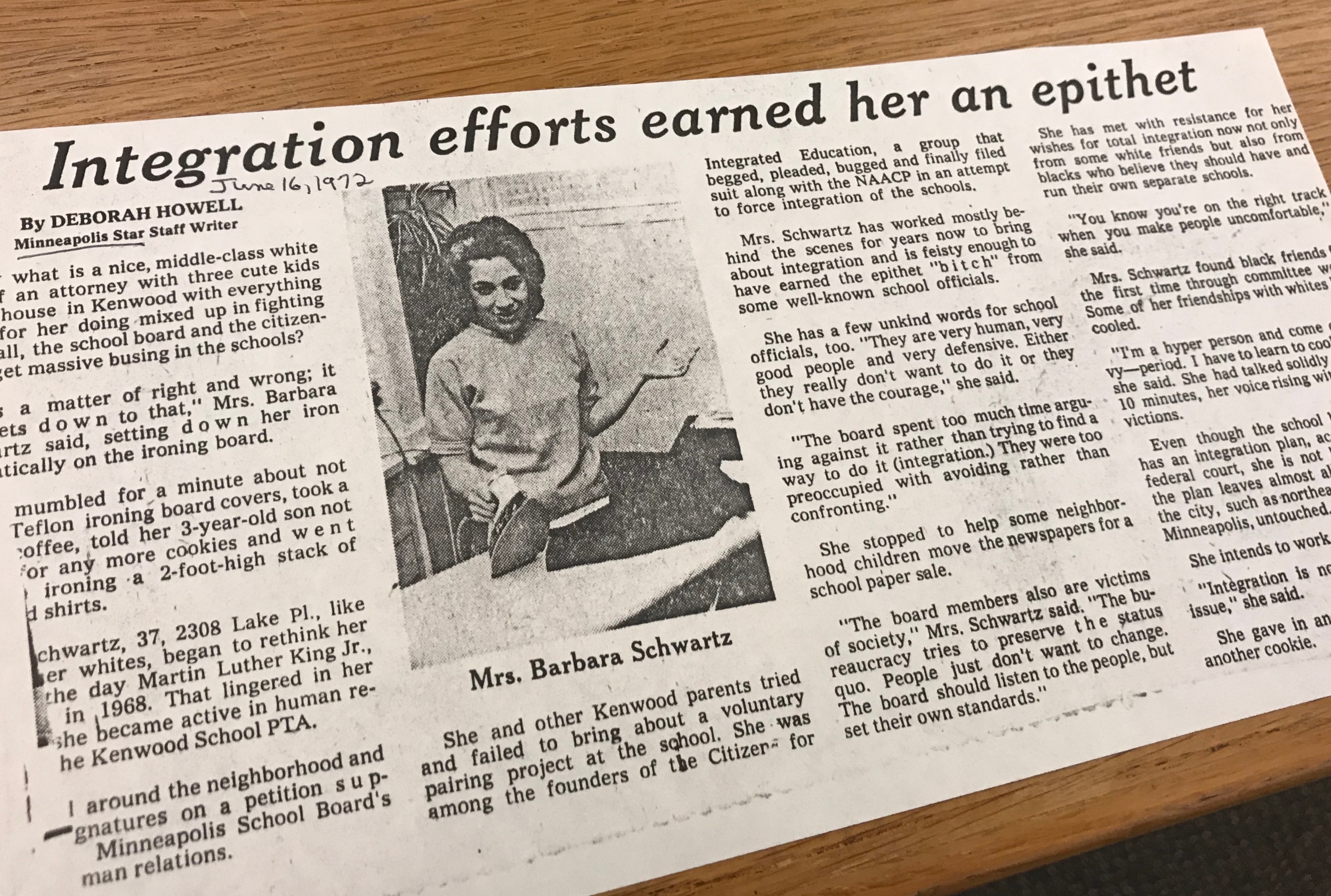
To some, Bearman’s commitment to school integration was perplexing, even exhausting and irritating. “Now what is a nice, middle-class white wife of an attorney with three cute kids and a house in Kenwood with everything going for her doing mixed up in fighting city hall, the school board, and the citizenry to get massive busing in the schools?” a 1972 Minneapolis Star article began. The piece reported that local school officials often called Bearman a “bitch” because of her advocacy.

Bearman regularly wrote letters to newspapers, collected petition signatures, convened meetings, and escalated political pressure wherever she could. Some of her friends eventually grew tired of this and stopped talking to her.

“I don’t know, I just had this drive, and that’s why I was called a bitch,” she tells me. “I had a big mouth, I know I came out like a sledgehammer to everybody, I’m sure. But you just don’t compromise on this one.”

Boxes at the Minnesota Historical Society in St. Paul contain records upon records documenting Bearman’s involvement with local desegregation efforts—from legal correspondence linked to the Booker case, to school board meeting minutes, to a host of district planning documents and reports. Bearman also spent decades as an active member and officer of the city’s NAACP chapter. When Minneapolis schools started to resegregate, beginning in the 1990s, due to lawmakers easing up on civil rights enforcement and elevating school choice policies, Bearman worked with the NAACP to file another suit.

Most of the racial justice activists Bearman worked most closely with have since passed away, and when she reflects on her life, she says she recognizes her dedication to desegregation sometimes caused her to miss out on other things going on in her home and community.

“But if I wasn’t being headlong . . . well this takes a lot of energy—it takes a lot of psychic energy to keep going against all odds,” she says. “If you stop too much and consider walking away, well, that’s not how I was operating. Throughout my life, I could be a slow starter, but once I started, then I boarded in.”

For Bearman, even to walk away now, as the Cruz v. Guzman case marches on, would amount to a betrayal of herself. “I’m not perfect, but I’m most proud of the things I’ve stayed true to,” she explains.

As to whether she’s surprised that school integration has resurfaced in our national politics, she shrugs. “It’s like antisemitism,” she says. “These issues never really go away, they just exist right under the surface, and certain things can bring them into focus.”

What’s needed now, Bearman says, is what’s always been needed—courage. She hopes our political leaders will educate themselves and buck up. Racial integration “gets to the very heart of what this country is and what we say this country stands for,” she says. “At the end of the day there is just so much fear, and fear is not a good principle on which to live.”

The Future of the Forward

Originally published in Jewish Currents on July 31, 2019.
——

The Jewish Daily Forward recently announced that Jodi Rudoren, one of the highest-ranking women at the New York Times, would serve as its next Editor-in-Chief. Rudoren, who joined the Times in 1998, served as its Jerusalem bureau chief between 2011–2015, and has also worked as its Chicago bureau chief, as an editor on the Metro desk, and as a correspondent on the 2004 presidential campaign. Contributing writer Rachel Cohen talked to Rudoren about her vision for the Forward at this tumultuous moment for journalism, for the American Jewish community, and for the nation. This interview has been lightly edited and condensed.

Rachel Cohen: What are you most excited about coming to the Forward?

Jodi Rudoren: The last couple of years I’ve been working in strategic roles at the Times, focused on digital transformation and audience engagement and just really thinking about what the newsroom of the future is all about. And the New York Times is in a really good place in that landscape—we have a model that seems to be working. There are a lot of challenges ahead, and we all face an industry that’s constantly in flux, but the Times is in a pretty good place. I’ve just grown increasingly aware that the really urgent crisis in journalism is finding new models for local outlets. The Forward isn’t really a local news organization—it’s nationally focused—but it’s local in the sense that it’s niche, community-based, and identity-based. I just started realizing that that’s the place in journalism that needs the most attention, creativity, and ambition. I am really energized by that challenge

The Forward has made an incredibly bold choice to end its print version altogether, to really face the digital moment. That was courageous and risky and complicated, but I felt it was a clear sign that its board and CEO were serious about reinvention. The Jewish world is in such an interesting and challenging moment, the American Jewish story is so interesting and urgent. The rise of antisemitism and the collapse of civil debate around Israel—it’s an incredibly challenging time for journalism and also a real opportunity.

RC: It’s no secret that the Forward has faced financial challenges recently. Why do you think Jewish philanthropists are less likely to fund journalism than say, Birthright or an art museum renovation? 

JR: I’m new to this space, and there are some people who know more about Jewish philanthropy and journalistic philanthropy than me, so in some sense I’m just hazarding a guess. But it’s probably a confluence of things.

The idea of nonprofit journalism is not that well established. In the print era, people paid for a newspaper, it wasn’t something they thought required philanthropy. There were a few models, like NPR, but there weren’t that many nonprofit models before ProPublica came along, and their model has spawned a huge movement. We are very much still in the process of either teaching readers or learning from readers about how journalism is going to be supported in the future.

The New York Times is a leader in the idea of paying for news, but I don’t think that’s the only model, and I think there will be a new model of local and identity-based news supported by philanthropists who say, this work is vital to our community and should be supported, like the opera or after school programs. I think we have to keep making the clear case that the Forward has a real financial need, but also that there’s a need of the Jewish people for the Forward, that it can make the Jewish world better by [making it] more informed and engaged.

I’m also glad you mentioned Birthright. It’s a very complicated organization but one of its basic value propositions is that it adopts the broadest possible definition of Jewish identity and tries to bring everyone one step closer to their Judaism by bringing them to Israel. I’m not sure that’s how Steinhardt would put it but I think that’s one way of interpreting it. And I think that same value proposition is central to the future of theForward too: to use the broadest possible definition of Jews and people interested in Judaism and bring them one step closer to what they define as Judaism. That’s also a lot less expensive than bringing people to Israel for ten days, and I do think that should appeal to Jewish philanthropists.

RC: In 2017 you gave an interview where you noted that journalists can sometimes come under attack by pro-Israel groups for frank and honest coverage of Israel, which can then distort the language reporters use and negatively impact the overall quality of the debate in the United States. I imagine these dynamics will be present for you at the Forward, if not more intensified now that you’re likely in a fundraising role.

JR: My job is not fundraising, my job is to keep our editorial content ambitious, fair, and creative. I am going to be involved in fundraising and I’m happy to evangelize about the cause of investing in the Forward but we have a development department and a publisher.

What I want to say is that while Israel will be a serious part of our coverage and something we will be super engaged in, the bigger crisis I think right now for American Jews is our inability to talk civically to each other about it. When I was the Jerusalem bureau chief, after working in journalism for years, I found the decline in civil discourse around the conflict to be completely unique, unlike anything else I had ever covered before. And then I came back to the United States, and now it’s like every issue is the same as the Israeli–Palestinian conflict. People are reading different sources, having different narratives, and not talking to each other.

And many, many American Jews are very troubled about the decline in civil discourse as it pertains to American politics. But I think they should be equally concerned about our debate around Israel. A lot of my friends, and people I go to synagogue with, are having this happen in their very own families, with their own college-aged children. They’re having trouble finding common ground, and their sources and framing are so starkly different.

RC: Yeah, it’s definitely a mutual feeling. I know a lot of people who dread going home for the holidays for fear that Israel may come up at the dinner table. But how can theForward help?

JR: This is the very crisis the Forward is poised to address. We can be a place where people come and share their views and [access] fact-based reporting. That is my profound goal, to create a forum for serious civic engagement. That’s the thing I’m most qualified to do, and it is urgent. It’s not okay the way people talk past each other and over each other.

RC: Piggybacking off of that, this past May, Nylah Burton, a black Jewish writer and past contributor to the Forward wrote an essay for Jewish Currents about how the practice of publishing all viewpoints can also come at a real cost, especially for writers of color. She recounted an explosive twitter exchange between the Forward’s opinion editor Batya Ungar-Sargon and Representative Ilhan Omar. Sargon charged Rep. Omar with antisemitism and compared her to David Duke, and the Forward soon ran a fundraising email endorsing Ungar-Sargon’s charge. The congresswoman was bombarded with abuse.

This was not under your leadership, but it’s a context you’re walking into. And since this happened, the bigotry against Rep. Omar and others has only intensified, with President Trump telling lawmakers of color to “go back where they came from” and continuing to attack Rep. Elijah Cummings and Baltimore. How are you thinking about these criticisms and the role of the Forward in covering both real concerns of antisemitism while also recognizing how the institution’s work and staff can be used to further racism and Islamophobia in this very fraught political moment?

JR: So I am not talking about that incident because I don’t have the facts and I am just starting my relationship with the staff. A lot of people in the last two weeks have told me both how great they think Batya is, and other people have raised concerns that she has positioned the Forward way too far to the left. And now you’re talking about criticisms of her from the left. There’s some version of this where that is a sign of a good opinion department. But the version of it where people are not feeling comfortable writing is not okay. I want people to feel comfortable writing and I want to be known most of all as a place that publishes a range of opinions respectfully.

I do think you are right that concerns around antisemitism have played into this Trump conflict with Ilhan Omar in particular and “The Squad” more generally. This morning theForward published Peter Beinart on the ways in which the right wing is invoking Israel against The Squad. There are all these ways in which Jews and Israel are being played off one another in this debate over race and immigration. I haven’t thought about this in terms of an argument, but it’s not disconnected from the “Ferguson is Palestine” movement that has divided a lot of young Jews from their natural constituencies or historic relationships on campus with people of color. So those cleavages of how liberal Jews and people of color, are uniting and dividing over issues of race, immigration, race politics, and antisemitism, I feel those are really ripe issues for the Forward to cover both in the news space and the opinion section. And it’s also super fraught.

But you know, the real challenge of a great opinion section is how do you truly have a big tent that publishes a ton of super challenging opinions from all over the map without offending people so much that they then don’t read it. Offending people does not help. Clearly I do not want to offend people and I do not want people to turn away. I do want to feature provocative opinion writing and be cutting edge.

RC: I think a particular issue from that episode was how the Forward sent out a fundraising email that seemed to take a very clear position on Rep. Omar’s comments, and land on one side of a very polarized debate.

JR: The Forward doesn’t have a house editorial opinion. It can certainly be hard for news readers sometimes to distinguish between news and opinion, and we should do our best to make really clear lines for readers, including looking at our fundraising emails and how they relate to news content.

On the other hand, activist Jews, left-wing Jews, they were among the people up in arms about whether the New York Times should be labeling Trump’s tweets as racist. And one of the interesting things in that debate at the Times was to look back at how we characterized Ilhan Omar’s comments. Our headlines said that her comments “had been condemned as antisemitism.” And the very people who were telling us that “condemned as racist” is not strong enough said nothing about “condemned as antisemitism.” Often what seems like a debate about language is actually about where you line up on the political map.

The Forward’s role is to help Jews think through this complicated situation. What do you do if you support Ilhan Omar and you’re uncomfortable by what she said—how should you think about that? We should have opinion writers saying how they think about it, who may then help people learn and think and understand why exactly it was offensive to so many, and also help Ilhan Omar understand why, what are the triggers, what is the context.

I want to push people, make people react, but not turn away. Anything that makes that wall go up says to me that was not a successful piece of journalism.

RC: When I think back on some of the most impactful work of the Forward over the last few years I think of its reporting around Sebastian Gorka and his Nazi ties, and Josh Nathan-Kazis’s reporting on the anti-BDS movement on college campusesThe Forward has unfortunately laid off and lost a lot of its veteran reporters. I know it was recently awarded a $500,000 gift from Craig Newmark. Are you looking to expand the Forward’s reporting capacity?

JR: So Josh left after nine years, and I’m sorry he left because I think he’s great, and I do hope he continues to grow in his career and do great stories elsewhere. But we are hiring behind him and we have great candidates—I have an interview for that later today—and we’ll continue doing that kind of reporting. The Forward has gone through very difficult financial circumstances while maintaining its strong commitment to reporting. It’s run by people who care about strong independent journalism. And I’m really excited about how smart and creative and ambitious the reporters and editors that we have now are.

But the Forward is not in a position to be on a big hiring spree now. I have some promises about some growth over the next couple years, but I’m just being realistic, I don’t think our short-term goals are going to be about adding more journalists. I think we’re going to do some things differently with the resources that we have, and I think we are going to expand in some new ways that will not be about additional reporting but will be about other ways to engage people in the conversation.

RC: Like events?

JR: Like events, new reader engagement initiatives, some user-generated content. There’s a lot of ways to use the platform to collect and share information, and to use our audience. We really need to grow our audience significantly and do deep engagement with them. I think we have a lot of work to do and we don’t need more reporters to do that kind of work, we need to work on our distribution.

That’s not very sexy sounding, but it will make a big difference. I think if we do this, we will attract investment, we’ll grow the audience, people will be excited, and then we’ll be able to hire more people. Some of those will be investigative reporters, and some will be podcasters, or event programmers, or cartoonists. We’ll try a lot of things to broaden who the Forward reaches.


The Just Transition for Coal Workers Can Start Now. Colorado Is Showing How.

Originally published in In These Times on July 24, 2019.
——

This past May, Colorado’s Democratic governor Jared Polis signed a series of new environmental bills into law, with the enthusiastic backing of the state’s labor movement. Legislation ranged from expanding community solar gardens to establishing a “Just Transition” office for coal-dependent communities.

Organized labor in Colorado hasn’t always been an ally in the fight against climate change, but beginning in 2018, a Democratic messaging bill that called for 100 percent renewable energy by 2035 forced local unions to start having some tough conversations.

“Republicans controlled the Senate, so the bill had no chance of passing, but it forced the conversation on our end as to what do we need to do to get behind these bills in the future, instead of just blocking them or delaying,” explained Dennis Dougherty, the executive director of the Colorado AFL-CIO, which represents approximately 165 unions representing more than 130,000 workers. “It was really the first time we asked ourselves, well what’s our game plan?”

In February 2018, Colorado activists launched a state-based affiliate of the Peoples Climate Movement, a coalition of community, faith, youth and environmental groups focused on promoting an equitable response to climate change. Dougherty, who worked for years as a federal mediator before joining the labor movement, soon became co-chair of the Colorado coalition. “This was the first time labor has really stepped out in leadership on climate,” he told In These Times.

What followed were a series of organized talks between unions and environmental groups. With resources from its parent organization, the Peoples Climate Movement Colorado even hired a skilled facilitator from the Institute for the Built Environment at Colorado State University to help guide its conversations. The work culminated in a Climate, Jobs and Justice Summit last September.

Democrats won a majority of seats in the state Senate after the 2018 midterms, giving them trifecta control over Colorado politics, and the ability to pass many climate-related bills this year. Those bills included two pieces of legislation advocates hope can serve as a model for climate, jobs and justice organizing in other states.

One is HB-1314, which establishes a Just Transition Office in the Colorado Department of Labor and Employment. The first-of-its-kind office, which will have both a dedicated staff and an advisory committee of diverse stakeholders, is charged with creating a equitable plan for coal-dependent communities and workers as the state transitions away from fossil fuels. The goal is to mitigate the economic hardship that will accompany this energy transition. A draft plan is due by July 2020, and by 2025, the state will start administering benefits to displaced coal workers, and provide workforce retraining grants to coal-transitioning communities like Pueblo, Larimer, Delta, Morgan and others.

As part of the legislation, labor unions successfully pushed for language around “wage differential benefits” for those workers who end up in jobs that may pay less than the jobs they currently have in the fossil fuel industry. The Just Transition office would provide “supplemental income” to cover “all or part of the difference” between a coal worker’s old job and their new one.

Dougherty said they pushed for an office precisely because they thought it would be stronger than an advisory board or a task force. “I’m not worried it will be something without teeth,” he said. “There’s also so much groundswell to keep up pressure.”

The second bill, SB-236, includes language to authorize the so-called securitization of coal plants, as a way to hasten their retirement and to bring additional funds to coal-dependent communities. The idea is to allow a utility company to swap its remaining coal plant debt for a ratepayer-backed bond. Twenty other states have bond securitization laws, and they have been used by governments to close a nuclear plant in Florida and a coal plant in Michigan. The twist in Colorado is to use some of the millions of dollars in savings from securitization to reinvest back in workers and vulnerable communities.

The bill sponsor, Democratic State Rep. Chris Hansen, first introduced the idea in 2017. While his bill passed the House, it died in the then-GOP-controlled Senate.

Labor and environmental groups supported the securitization bill this year, though Dougherty emphasized that the savings it could generate would not be enough on their own to fund the kind of just transition they’re looking to see. “We see it as just one funding mechanism for communities and workers,” he said. (A separate bill also passed this year by Colorado lawmakers enables the state’s public utilities commission to distribute some of the securitization savings to vulnerable communities.)

According to the Colorado Mining Association, Colorado is the 11th largest coal-producing state, with six active coal mines, employing a little over 1,200 mine workers. The National Mining Association estimates that nearly 18,000 people across Colorado are employed directly by the state’s mining industry.

For both the Just Transition office and the coal plant securitization bill, leaders say key to passage was a lot of education, research and tough, honest dialogue.

Rep. Hansen, who has a PhD in resource economics and worked in the energy sector before running for office in 2016, said getting his bill passed was a multi-year process of stakeholder engagement. “I also really had to educate my own colleagues about securitization,” he told In These Times. “Some folks in Colorado thought this was a giveaway to the utilities industry, but it’s really the opposite of a bailout because for the securitization to work the companies have to walk away from significant amounts of revenue.”

Rep. Hansen said he’s been trying to be honest with people that major economic transitions are coming, and the best thing leaders can do is proactively plan ahead. “There will be dislocation and disruption but the alternative is to let what we’ve typically had happen in this country which is just kind of a free-fall for transitioning communities with no real help from government,” he said. “I much rather try and prepare then be reactive after-the-fact.”

Within the Just Transition office, Dougherty said labor unions plan to push for the wage differential benefit to cover a transition of up to three years. For example, if someone was earning $100,000 in a coal-industry job, and retrains for another position that pays $60,000, labor wants to see the state cover that difference for several years.

Dougherty said at first unions thought a “just transition” could mean demanding jobs at the same level of pay and benefits that workers are currently earning in perpetuity, but after doing research into the issue and assessing the political realities, they modified their demands.

“We hired someone to research every ‘just transition’ that’s been done across the world,” he explained, adding: “We said, okay, well what can we realistically do at the state level that we think is fair while also not coming out and demanding something that’s never going to happen?”

“I think what happened in Colorado is really, really important,” said Paul Getsos, the national director of the Peoples Climate Movement. “It’s a real example of union leaders who are really willing to educate other union leaders about the issues to see how they can move their institutions forward.”

Getsos added that Colorado’s experience reflects how successful legislative victories are not won overnight. “It takes a lot of relationship building,” he said. “A lot of trust.”

A California Bill Could Transform The Lives of Gig Workers. Silicon Valley Wants Labor’s Help To Stop It.

A BILL WITH potentially huge implications for the so-called gig economy is making its way through the California state legislature this summer, laying bare cleavages within the labor movement. Companies like Uber and Lyft are seeking a workaround to the legislation, which would classify their drivers as employees rather than independent contractors, opening the door to a host of employment benefits. Some prominent labor unions, meanwhile, have been in talks with Silicon Valley, even as they voice their commitment to securing workers’ rights.

Sponsored by Lorena Gonzalez, a Democratic assemblywoman from San Diego, the bill, known as AB 5, seeks to codify and expand Dynamex Operations West, Inc. v. Superior Court of Los Angeles. The landmark 2018 California Supreme Court decision made it much more difficult for companies to classify workers as independent contractors rather than employees, who have access to workplace protection laws like minimum wage, overtime, unemployment insurance, and the right to join a union.

At the center of the debate over AB 5 is its impact on “gig economy” companies like Uber and Lyft, though it would also affect older, more established industries like retail and trucking. There’s a practical reason for California to enact the legislation: The state estimates it loses $7 billion in payroll tax annually due to companies misclassifying employees as independent contractors.

Uber and Lyft have been forthright about their desire to come up with some sort of compromise deal, under which they could continue to classify their workers as independent contractors, in exchange for some additional driver benefits. They insist that the flexibility that attracted drivers to their companies in the first place would vanish if all those people were to claim employee status.

Gig economy workers who support the legislation view it as a necessary step toward their ability to collectively organize. Both the Service Employees International Union and the Teamsters union have played leading roles in advocating for the legislation. They have publicly said they will fight a watered-down AB 5, but a series of private meetings between labor leaders and tech companies have raised suspicion that the unions are more open to leaving gig workers as independent contractors than they’ve formally let on.

Opponents of AB 5 recognize its proposed classification standard could extend well beyond the Golden State and have been lobbying hard —both in California and Washington, D.C. — to stop it. Sen. Bernie Sanders introduced a bill in the U.S. Senate after Dynamex came down to narrow the definition of independent contractors, legislation that is backed by other leading presidential candidates Sens. Kamala Harris and Elizabeth Warren.

AB 5 passed the California State Assembly in May, and last week the state’s Senate Labor, Public Employment and Retirement Committee passed the bill, moving it on to the Senate Appropriations Committee for further revisions. It’s unlikely to reach the full Senate floor until late August or September, and both sides are planning to ramp up their advocacy in the coming weeks.

The Dynamex decision laid out a three-prong test to separate independent contractors from employees. Under the court ruling, independent contractors are workers who have relative independence from the entity paying their wages, whose work is separate from the type of business the entity is typically engaged in, and who typically do the type of work that the entity hired them to do. Uber and Lyft’s pursuit of a carve-out under AB 5 is part of a larger fight over exactly which industries can claim exemption from that test.

A number of occupations already have. The bill originally exempted certain workers who set their own rates like licensed insurance agents, certain health care professionals, and some hairstylists and barbers. Last week, the state Senate labor committee added a host of additional categories for exemption, including freelance writers, grant writers, and private investigators.

California Gov. Gavin Newsom, a Democratic ally of both the tech industry and labor unions, has not taken a formal position on AB 5 but said on a podcast last month that he’s “into compromise” and has “been trying to seek it for many, many months.” The Los Angeles Times editorial board recently endorsed some sort of gig economy carve-out, calling AB 5 in its present form “overkill.”

SHORTLY AFTER THE Dynamex decision came down, the California Chamber of Commerce formed the I’m Independent Coalition to fight the new worker classification standard. Coalition members include the California Hospital Association, the California Restaurant Association, the California Retailers Association, Handy, Lyft, Uber, and Instacart. The Internet Association, a group that includes Google, Amazon, LinkedIn, and Facebook, is also a member.

As Bloomberg reported in August, the business groups mobilized to quietly lobby lawmakers for new legislation or executive action that could neutralize the consequential Dynamex decision.

At the same time, Uber and Lyft were gearing up to take their companies public, which meant they faced increased pressure to mitigate their labor costs. Barclays recently estimated that classifying California drivers as employees could cost Uber and Lyft, respectively, $500 million and $290 million annually.

In an April Securities and Exchange Commission filing, Uber bluntly wrote that reclassifying its drivers as employees “would require us to fundamentally change our business model, and consequently have an adverse effect on our business and financial condition.” Lyft laid out similar concerns in its March SEC filing, acknowledging that while “we continue to maintain that drivers on our platform are independent contractors in legal and administrative proceedings, our arguments may ultimately be unsuccessful.”

Pressure is also mounting as drivers of these ride-hailing services ramp up their own activism, in response to falling pay rates and rising expenses. The tech giants anticipate this to continue. In its SEC filing, Uber wrote that “driver dissatisfaction will generally increase” going forward, as they “aim to reduce Driver incentives” to boost their financial performance.

Konstantine Anthony is one of those dissatisfied drivers. He’s been working full-time for Uber over the last 4 1/2 years in Los Angeles County, and when he first started out, he said, he used to make almost $26 an hour before expenses. That figure has now fallen to about $22. Anthony has gotten involved with the SEIU-backed Mobile Workers Alliance to support both AB 5 and the right of drivers like him to form a union.

He doesn’t buy Uber’s line that they’re trying to protect drivers who wish to work just a few hours a week. “The way they reward you on the app is you get higher and higher bonuses when you drive 60 or 70 hours a week,” Anthony said. “They’re giving lip service about protecting part-time workers, but their actual practices are about incentivizing those driving 40+ hours a week.”

IN A STUNNING example of how much pressure the ride-hailing companies are under, Dara Khosrowshahi, Uber’s chief executive, and Logan Green and John Zimmer, the co-founders of Lyft, collectively wrote a June op-ed in the San Francisco Chronicle saying their companies are “ready to do our part for drivers.” While the tech leaders argued against reclassifying drivers as employees, they said they were open to amending existing law to allow independent contractors access to benefits like paid time off, education stipends, and retirement planning, as well as better rates for time spent driving passengers (but not time spent transitioning between passengers). And rather than a union, the tech executives said they’re open to some sort of “driver association” that can advocate for the needs of workers.

To bolster their case, Uber and Lyft say that most drivers don’t actually want to be classified as employees, as most just drive occasionally to pick up some extra, flexible income. The companies point to a 2018 statewide survey of California independent contractors, which found that only 7 percent of independent contractors wanted to be classified as employees. That poll, notably, was conducted by EMC Research and sponsored by the Chamber-backed I’m Independent Coalition. It included a sample size of 1,040 respondents, including 387 gig economy workers, a majority of whom had not heard about the Dynamex decision.

A 2018 nationwide poll yielded similar results. The Rideshare Guy blog surveyed approximately 1,200 Uber and Lyft drivers and found about 76 percent of respondents said they’d prefer to remain independent contractors, including a majority of full-time drivers.

A spokesperson for Lyft said 91 percent of their drivers across the country drive fewer than 20 hours a week, and 76 percent drive less than 10 hours. They said they suspect their California-specific numbers “are the same or very similar” to their national figures.

Uber and Lyft warn that the flexibility drivers say they highly value would be lost if they were no longer independent contractors — adding that they’d likely need to limit drivers’ hours and institute shifts. They also say wages could fall further. “Lyft would only need a fraction of the drivers it has now if it moved to an employment model, meaning thousands would lose their opportunity to earn with Lyft entirely,” a company spokesperson added.

Uber did not return multiple requests for comment.

While it may be true that most drivers who sign up for Uber and Lyft drive just a few hours per week, industry researchers say the full-time drivers account for most of the revenue generated for the companies. Recent data collected by the JPMorgan Chase Institute found that almost 57 percent of transportation platform earnings go to the top 10 percent of earners.

“These data and other combine to make me believe that the majority of TNC trips are provided by drivers who rely on TNC earnings for most or all of their income,” transportation policy expert Bruce Schaller told The Intercept over email, using the initials for “transportation network company,” an industry term for ride-booking companies.

Anthony, the Uber driver, doesn’t buy the argument that he’d lose his flexible work schedule if he were classified as an employee and calls that a “false narrative.” Treating workers fairly, he argues, doesn’t inherently change the nature of a flexible business. “If Uber and Lyft tried to take that flexibility away, I don’t know any driver who would still work with them,” he said. “And there are a dozen companies that are coming up that will maintain that flexibility and pay workers as employees.” (Via is an example of a ride-sharing company that pays its drivers an hourly wage.)

Other pro-AB 5 advocates concede that some things about Uber and Lyft’s business models would likely change, but they say these changes would ultimately be for the better. For example, it’s true that the companies might employ fewer people, since the cost per trip would increase. The upshot is that the companies could also create a more environmentally-friendly business. Having fewer drivers on the road could also increase earnings for workers. The JPMorgan Chase Institute found that the growth in supply of online platform transportation drivers between 2013 and 2017 led earnings to fall by 53 percent.

The National Employment Law Project, a union-backed legal advocacy group, also notes plenty of examples of flexible work environments where workers are classified as employees. “Cake decorators, home researchers, nurses, couriers, and restaurant workers have all been found to be employees, despite the fact that they could choose their own schedules,” a recent NELP fact sheet says. “Laws don’t force workers into choosing between having basic workplace protections and having flexibility; companies do.”

Uber and Lyft’s “status as employers is really quite clear,” according to David Weil, who led the U.S. Department of Labor’s Wage and Hour Division during the Obama administration. While there are some cases where companies really do have workers operating in an ambiguous space between employees and contractors, he wrote in a recent LA Times op-ed, “Uber and Lyft are not among those close, gray area cases.”

GIG ECONOMY WORKERS backing AB 5 have been calling both for AB 5’s passage and the path for them to form a union under state law, particularly in light of barriers recently erected by the federal government. In May, the Donald Trump-appointed general counsel at the National Labor Relations Board issued a memo saying Uber drivers are contractors, not employees. The U.S. Department of Labor came to a similar conclusion in April, in an opinion letter saying gig workers are contractors.

“It’s really hard to organize under federal labor law, and if federal law says the drivers are not covered then they could be covered under state law,” said Ken Jacobs, chair of the Labor Center at the University of California, Berkeley. “California has established its own protections for agricultural workers, so there does seem to be that precedent.”

Representatives from SEIU and the Teamsters have been meeting with tech companies and lawmakers over the last several months to discuss the proposed legislation.

Late last month, the New York Times reported that the AB 5 meetings organized by the tech companies “have created deep rancor within the labor ranks and set unions against one another.” Some workers have raised alarm at the prospect their unions may be selling them out.

The unions have defended themselves against critics who are wary of those talks. The companies emphasize that they were just invited to attend the meetings, did not organize them themselves, and were not there to negotiate any sort of watered-down proposals. As part of their efforts to support gig workers, Bob Schoonover, president of the SEIU California, told The Intercept over email that they and other labor leaders have been working “across government, labor, private, and non-profit sectors to open the door for robust conversations and the sharing of ideas and concepts.” He stressed that “these are just ideas and concepts that have been used to collaborate with partners on how we might be able to help workers find the best path forward – they are nothing more and should not be misconstrued as such.”

Doug Bloch, the political director for the Teamsters Joint Council 7, which represents 23 locals in Northern California, has also been in meetings with Uber and Lyft to discuss AB 5. He did not return requests for comment.

Though labor is taking pains to say they’re not negotiating any sort of compromise, the tech companies have depicted the meetings in different terms.

“We’ve been working with lawmakers and labor leaders on a different solution to AB 5 so drivers can continue to control where, when, and how long they drive,” a Lyft spokesperson said.

“Industry is at the table with labor and ready to find a path forward to modern protection for independent contractors that preserve their ability to work independently,” added Courtney Jensen, the executive director for California and the Southwest for the trade group TechNet.

In June, Héctor Figueroa, then president of SEIU 32BJ in New York, co-wrote a New York Daily News op-ed criticizing his state’s labor federation for backing a bill that would let unions collect dues from gig workers without giving those workers full rights as employees. He called the New York proposal “a giveaway to gig companies” and then went on to criticize his colleagues in California for “working to cut a backroom deal” that would also exempt app drivers from employee status. Last week, at age 57, Figueroa unexpectedly died from a heart attack.

The day after his death, Caitlin Vega, the legislative director for the California Labor Federation, tweeted about honoring Figueroa’s legacy, and noted that he used his power to stand with vulnerable taxi workers, gig workers, and immigrant workers.

In an interview with The Intercept, California Labor Federation spokesperson Steve Smith explained that representatives from SEIU and Teamsters have met with the tech companies, and then have come back to share with other unions in their federation what they learned and how those conversations went.

“SEIU and the Teamsters are not at a point of some imminent deal, the discussions that we’ve had have been primarily about some outlines of the proposals that SEIU and the Teamsters have been discussing with the tech companies,” he said. “We’ve had some honest and open discussions in labor, and I think generally people have been appreciative of the SEIU and the Teamsters for being able to share with other unions what is happening and the progression of those discussions.”

Smith said the labor movement is “completely unified” around efforts to pass AB 5, but he suggested that unions may be open to alternative paths for drivers of ride-hailing apps specifically. “AB 5 is much broader than just TNCs, and we understand, as I think those unions do, that AB 5 serves a purpose that’s much bigger than anything that happens with the TNCs,” he said.

While there are different ideas on the table, Smith said labor “wants to make sure we’re giving workers the opportunity if they so choose to join a union and that we’re setting a floor — not a ceiling — for the rights they’re entitled to.”

He dismissed the idea that there’s a serious divide in the labor movement over this. “I think that’s been overblown to an extent,” he said. “Obviously we’re a big movement, and we have a lot of thoughts and opinions, sometimes strong opinions, but our goal is always to come together as a movement to do what’s best for the largest amount of workers that we can.”

DRIVERS ON BOTH sides of the issue are expected to ramp up their advocacy as the bill continues to make its way through the state Senate. In late March, hundreds of Uber and Lyft drivers in Los Angeles went on strike(and turned off their apps) to protest Uber’s recent 25 percent per-mile rate cut. Drivers launched another one-day strike on May 8, timed with Uber’s IPO, and were joined by fellow drivers in Boston, Minneapolis, Philadelphia, D.C., San Diego, San Francisco, and Chicago.

Then last week, hundreds of drivers from across California went to Sacramento to rally for and against AB 5. Drivers who came out to protest the bill were reportedly offered up to $100 in extra pay from Uber and Lyft, the Los Angeles Times reported. Recode previously reported that some drivers felt misled by in-app messages and emails sent by Uber and Lyft urging them to sign petitions or call their legislators to protest the legislation.

One driver who went to Sacramento to support AB 5 was Ann Glatt, who drove for Lyft for four years before recently quitting due to burnout from falling wages. Though Glatt, who is 62, is looking for other jobs now, she’s stayed involved with Gig Workers Rising, an organizing group in Northern California backed by SEIU and the Teamsters.

Glatt said she doesn’t trust any sort of Uber and Lyft compromise deal. “I don’t take much credence in what they say; they’re not for drivers, their business is not to have drivers make a living wage,” she said. “They come out in the media and stay stuff, but they’ve never offered to meet with us. If they say they’re willing to give us a living wage, then do it now. You don’t have to have AB 5 passed to just pay the living wage you were paying us a few years ago.”

How Morgan Harper’s Ohio Primary Challenge Explains The House Democratic Meltdown

Originally published in The Intercept on July 16, 2019, with Ryan Grim.
—–

WHEN MEMBERS OF the Congressional Black Caucus took aim last week at New York Rep. Alexandria Ocasio-Cortez and the organization that boosted her primary campaign, Justice Democrats, there was no mystery as to the motive: It’s about the primaries.

Senior members of the CBC who have served in Congress for decades are suddenly facing challenges, or looking over their shoulders at one, disrupting the smooth, biennial tradition of effectively unopposed reelections.

On Friday morning, The Hill published a story quoting multiple members of the CBC, and anonymous staffers, accusing Justice Democrats of targeting members of color up for reelection.

That was followed Friday night with a controversial tweet blasting Ocasio-Cortez’s chief of staff, Saikat Chakrabarti, a co-founder of Justice Democrats. The tweet was sent from the account controlled by Rep. Hakeem Jeffries, who replaced his mentor, the ousted Joe Crowley, as chair of the House Democratic Caucus. Jeffries, a CBC member, has been the subject of a reported primary effort by Justice Democrats, but no one has yet to materialize (and the group denies it was recruiting anyone).

It capped off a week in which House Speaker Nancy Pelosi singled out Reps. Ocasio-Cortez, Rashida Tlaib, Ilhan Omar, and Ayanna Pressley for criticism in an interview with New York Times opinion columnist Maureen Dowd, and followed it with a condemnation of Chakrabarti in a private caucus-wide meeting. Over the weekend, Democratic leaders leaked polling numbers purporting to show that Ocasio-Cortez and Omar were deeply unpopular with white, non-college-educated voters and putting the House majority at risk.

If Pelosi’s goal was to diminish the Squad and elevate the rest of her caucus, it backfired. President Donald Trump picked up on the poll, and Pelosi’s criticism, and suggested the four members of Congress all “go back” to a different country. “I’m sure that Nancy Pelosi would be very happy to quickly work out free travel arrangements!” he tweeted.

Party leaders who won back the House on a pledge to resist Trump are instead feeding him ammo to fire at members of their own party. The strange behavior is only explicable in the context of deep anxiety around the vulnerability of incumbency. To get a sense of just why incumbent Democrats are lashing out so wildly, the case of Columbus, Ohio, is instructive.

DURING THE 2010 tea party wave, Republicans won what was then a swing seat from freshman Democratic Rep. Mary Jo Kilroy. Republicans then gerrymandered the state, packing as many Democrats as they could into Ohio’s 3rd Congressional District, which includes most of Columbus, and giving the Republican incumbent a new, safer seat. Kilroy and Joyce Beatty both ran in the redrawn 3rd District in 2012, with Beatty coming out ahead in the primary, with 38 percent of the vote to Kilroy’s 35. She went on to easily win the general election.

Though it’s a safely Democratic district, Beatty, who is a member of the CBC, became a fast ally of the banking industry after winning a seat on the House Financial Services Committee — known as a “cash committee” for its ability to raise corporate PAC money for its members. So far this cycle, the industries that make up her top five donors are insurance companies, commercial banks, real estate, securities and investments, and finance/credit companies, according to data compiled by the Center for Responsive Politics. She’s taken more than $2 million in corporate PAC money over her four terms.

Beatty’s funding is part of a K Street strategy that exploits the large wealth gap persisting in many majority- or plurality-black districts — a gap that makes it much harder for CBC members to raise from wealthy donors the kind of money needed to safely stay in Congress. That, in turn, makes corporate PAC money attractive to fill the gap. CBC members privately bristle when Democrats from wealthy districts announce pledges to forswear corporate PAC money, but still fill their coffers with max-out checks from local millionaires and billionaires in San Francisco or Seattle.

By the old rules of Democratic Party politics, Beatty has done everything right. She got into Ohio politics in 1999, taking over her husband’s seat in the state House, and steadily rose through the machine, becoming the first female Democratic House leader in the state’s history. During that time, the Ohio Democratic Party largely collapsed, with the state moving from purple to red, but Beatty continued to rise, becoming a top official at Ohio State University, and by the time she’d arrived in the U.S. House, her seat appeared to be hers for life.

But now Beatty, who is 69, is facing a primary challenge from Morgan Harper, a 36-year-old progressive who leapfrogged the usual path to a seat, threatening the fragile machinery constructed in Ohio to guide and constrain party politics. If the elected official toward the top of the ladder isn’t safe, all of a sudden the lower rungs start to seem less reliable. If the party machinery and its business allies can’t deliver a House seat to a loyal politician who has paid her dues, the rationale for the machine itself begins to evaporate.

Harper is running on her own, without any assistance from Justice Democrats or other national progressive groups. But back in Washington, incumbent Democrats privately suspect that Justice Democrats and Ocasio-Cortez are behind it.

THE CHALLENGER IS a dangerous one for the machine. Born in Columbus, Harper spent her first nine months in foster care. She was eventually adopted and grew up in Berwick, a predominantly working-class, black Columbus neighborhood, and received financial aid to attend a local private school. Harper, who is black, would write later she “developed an intense commitment to fighting inequality after seeing how opportunities open up, no matter your upbringing, once you’re equipped with resources.”

She left Ohio for college: With more financial aid, she went to Tufts, then attended Princeton for a master’s in public affairs and Stanford for law school. She went on to become a senior official at the Consumer Financial Protection Bureau, whose first permanent head, Richard Cordray, is a protege of Sen. Elizabeth Warren and lost a bid for Ohio governor in 2018. Harper left the CFPB in February 2017 to take a job with Local Initiatives Support Corporation, a national community development financial institution. This past December, she moved back home to Columbus.

She launched her campaign on July 1, her birthday, with a progressive platform that includes universal child care, tuition-free public college, Medicare for All, reparations, affordable housing, and a Green New Deal. Her website says she “care[s] about nothing more than ending economic segregation” and she’s “convinced we need a new generation of bold leadership in Congress” to ensure her story is not an anomaly.

Harper said that her platform is driven by her experiences as a child in Columbus. “When you have experiences early in life when you see how much your parents are stressed for money, juggling bills, it doesn’t really leave you,” she said.

“It’s hard to ever feel like you’re all good when it’s a single parent who’s a public school teacher and there’s two kids involved,” she said of her mother, who raised her and her brother. “But my mom worked very hard with that income to try to make opportunity for us and sacrificed quite a bit, prioritizing education so that we could get scholarships, but also she could contribute to send us to private school.”

Harper wasn’t recruited by local or national groups, and while her campaign has reached out to Justice Democrats, no decision on an endorsement has been made. Other local progressive groups like Yes We Can: Columbus Working Families and Democratic Socialists of America haven’t endorsed Harper, though are considering it.

Tammy Alsaada, a top organizer with the Columbus-based People’s Justice Project, said that when Harper announced, political figures from around the city called to see what they could find out. “This was really surprising to a lot of folks,” she said. “I’ve been getting a lot of calls from folks saying, ‘Did I know this was happening?’”

Alsaada said that one of the group’s co-founders, Aramis Sundiata, was supporting the Harper campaign, but that she herself was taking a wait-and-see attitude and planned to meet with her soon. Neither Beatty nor Harper have been outspoken yet on policing, she said, which, along with community investment, is the issue she hears about most from the public.

Beatty, Alsaada added, has deep connections in the community, while Harper has been away and is largely unknown. “She’s very young, very new, and a lot of people don’t know her. … That’s gonna be something she’s gonna have to overcome. This district is a district of relationships that are long established,” Alsaada said. “Joyce has supported a lot of things in our community and built lots of strong relationships.”

But, Alsaada continued, things are in flux, and Columbus could be open to somebody new who’s willing to fight. “Joyce Beatty is from this community; I have to say, personally, that she has been a person in the community that’s been respected, but we need people who will take a bold stand,” she said. “You can’t count on folks to blindly vote party line.”

THE FRANKLIN COUNTY Democratic Party, which overlaps with the 3rd Congressional District, has been chilly to progressive challengers in the past. In 2017, when a slate of candidates aligned with the Working Families Party ran for City Council and school board, Jen House, the chair of the county party’s endorsement process, told the Columbus Dispatch the candidates were trying to undermine the work of the local party. She later expressed frustration to The Intercept at those “who call themselves Democrats standing out there and refusing to acknowledge” the positive work Democrats are achieving. She added that “being constantly negative” contributes to an attitude, prevalent in Columbus and throughout Ohio, that government can’t succeed.

That lefty uprising fell far short of its goals, with incumbents easily reclaiming their seats and progressive challengers attributing their losses to lack of funding. “The incumbents raised over a million dollars for this race,” a spokesperson for the Yes We Can slate said in the days following the election. “We were outspent 10-to-1. And yet we still garnered tens of thousands of votes across the city.”

But the progressive movement in Columbus has grown stronger over the last two years. Yes We Can continued to build its base and the Columbus DSA chapter significantly grew its membership, now claiming a much more robust electoral organizing component. The Columbus teachers union, under new leadership, has also been taking more vocal, progressive stances and recently threatened a strike. In 2017, the union took a vote of “no confidence” in the city’s seven-person Democratic school board.

During the 2016 primaries, Hillary Clinton beat Bernie Sanders in the district, 60,000 to 44,000. Beatty ran unopposed, and only about 80,000 people bothered to fill in her bubble. The March 10, 2020, primary is a ripe opportunity for Harper, given the stakes of the presidential contest; presuming Sanders and Warren are still in the race, progressive turnout could be especially high.

The Harper campaign believes it can win by turning out 100,000 voters — which would be a significant increase in the number of votes cast in the district — through a volunteer-fueled ground game. Ohio’s 3rd Congressional District is more than one-third African American. As Harper recently noted, the median age in the district is 32, with many people moving into the city from other places. Already around 200 people have signed up to volunteer, and the local press has been closely following the campaign: a break from the traditional media blackout that often greets primary challengers in other districts. “We’re getting a lot more coverage of it than we expected,” Harper told The Intercept.

The coverage is driven partly by an unexpected shake-up to what was to be a sleepy congressional primary and Harper’s compelling life story. But the attention is also likely related to her ability to operate fluently in elite spaces, something an insurgent like Ocasio-Cortez, who was a full-time bartender, initially lacked. Harper’s time at elite colleges and universities, as well as her successful career, coupled with her fiancé’s political background and his job with the Clinton-connected global consulting firm Teneo, gives her access to a universe of contributors that may help get a campaign off the ground fast, before a small-dollar network can be built. Where Ocasio-Cortez was on a shoestring budget until just weeks before the primary, Harper’s campaign expects to raise more than $250,000 this quarter.

The combination of her potential resources, connections, and progressive policy platform, which could activate a local grassroots army of support, makes Harper’s challenge highly credible. It also makes it all the more threatening to incumbents in Washington — not because it’s being driven by national agitators like Justice Democrats, but precisely because it isn’t.

Ocasio-Cortez’s victory has created a permission structure that Harper is relying on to launch her bid, but otherwise, she sees the opening, and she’s doing it herself. “No one put me up to this,” Harper said.

HARPER SAID THAT she sees elected officials like Pressley, Omar, Ocasio-Cortez, and Tlaib as role models. “I most closely identify with the women who are pushing for the bold policies that we’re going to need to make sure people are OK, and we build a United States that works for everyone,” she said.

But, as Pelosi frequently notes, their numbers in the House are small. Expanding to a size where they can be more than a leadership punching bag will require bringing a dozen or two Morgan Harpers to Congress. They’ll have to fight the CBC to do it.

In 2018, when Pressley, D-Mass., now a Black Caucus member, ran against white Democrat with the endorsement of Justice Democrats, prominent CBC members got behind the white incumbent. Over the weekend, Pressley took what some saw as a veiled shot at the CBC while at Netroots Nation, a progressive political conference, telling aspiring candidates there that if they get to Washington, they need to be true to what brought them there:

I don’t want to bring a chair to an old table. This is the time to shake the table. This is the time to redefine that table. Because if you’re going to come to this table, all of you who have aspirations of running for office, if you’re not prepared to come to that table and represent that voice, don’t come, because we don’t need any more brown faces that don’t want to be a brown voice. We don’t need black faces that don’t want to be a black voice. We don’t need Muslims that don’t want to be a Muslim voice. We don’t need queers that don’t want to be a queer voice. If you’re worried about being marginalized and stereotyped, please don’t even show up because we need you to represent that voice.

Omar, D-Minn., who was also supported in 2018 by Justice Democrats, distanced herself from the CBC’s recent attacks. “I have not seen a collective statement from the Congressional Black Caucus. As you’re aware, I’m a member,” she told The Intercept. “Individual members can and are free, I suppose, to share their opinions on how they feel about things, but that really is not in line with how I think about the statements [Ocasio-Cortez] has made. And I really think that this back and forth is a hindrance to the integrity of our caucus as we work to resist detrimental policies that are coming from this administration.”

She added that the House Democrats tweet targeting Ocasio-Cortez’s chief of staff was “bizarre.”

No matter how clear it is that Harper’s choice to run was all her own, some incumbents and local party leaders will see a nefarious national plot, another orchestrated attempt to knock out a veteran black lawmaker.

“It just seems strange that the social Democrats seem to be targeting members of the Congressional Black Caucus, individuals who have stood and fought to make sure that African Americans are included and part of this process,” Rep. Greg Meeks of New York, who replaced Crowley as chair of the Queens Democratic Party, told The Hill. (Meeks is facing a primary from first-time candidate Shaniyat Chowdhury.) Beatty was mentioned by CBC members in The Hill’s article last week as somebody Justice Democrats may target, along with Anthony Brown, D-Md., and Yvette Clarke, D-N.Y.

“I don’t know if Beatty is like a [Joe] Crowley in Washington but she’s certainly one of a handful of people who are a party boss in local politics,” a Columbus progressive told The Intercept. They suspect the reaction from establishment Ohio Democrats will be similar to the recent protests against primarying 10-term Rep. Lacy Clay, a CBC member from Missouri who was also challenged by a black woman, Cori Bush. Bush fell short in 2018 but is running again.

A spokesperson for Beatty did not return The Intercept’s requests for comment, and Michael Sexton, the executive committee chairman for the Franklin County Democratic Party, also did not return requests for comment about Harper’s candidacy.

In the meantime, Harper said she’s run up against some challenges already. ”It’s been tough to find a compliance firm,” she said, referring to the consultants who help campaigns file disclosure forms with the Federal Elections Commission. “People are nervous about being associated with a primary race. We had one and then we lost it.”

But she found a new firm and is plugging ahead. “This is a country that’s been based in competition,” she said, “in having open voices and people being able to express their opinions. To think that in our politics we wouldn’t give room for that, and space for that, to people who are trying to represent different perspectives — I don’t really understand it, and I think any attempt to try to suppress that is only going to backfire.”

The Charter School Primary

Originally published in The American Prospect on July 15, 2019.
—–

When Bernie Sanders, the Vermont senator running for president, released his wide-ranging education plan in mid-May, most of the media coverage focused on his proposals around charter schools. Commenters specifically focused on his calls to ban for-profit charters, which represent about 15 percent of the sector, and to halt federal funding for new charter schools until a national audit could assess the impact of charter growth in each state.

Many education policy experts suspect that such an audit would eventually lead to banning all new charters, but the Sanders campaign says they are just taking their cues from the NAACP. In 2016, the civil rights group called for a moratorium on new charters until existing ones were brought under the same transparency and accountability standards as traditional public schools.

Derrick Johnson, the president of the NAACP, told The New York Times that his organization loves that Sanders’s plan adopts their language around charters. “If we have a problem with the delivery of our education system, you don’t create ancillary systems for some of the children and not address the comprehensive problem,” he said.

To fight back, many charter supporters have sought to cast Sanders as uniquely extreme on the issue, especially in his efforts to link charter schools with segregation. But it’s hard to target Sanders as extreme when the entire 2020 field has joined and even surpassed Sanders on the issue. The charter school movement’s complete loss of clout in the Democratic Party is one of the more surprising stories of the election cycle.

At the start of July, the National Alliance for Public Charter Schools released an open letter, imploring Sanders to withdraw his call for a moratorium and “back away from calls for additional regulations that are not in the best interests of schools or students.” The 244 signatories defended the results from charters, citing a 2015 report from the Center for Research on Academic Outcomes, and stressed that charters are in high-demand among families of color. “District-operated public schools have systemically failed students of color for generations,” they wrote.

While the letter didn’t specifically cite Sanders’s call to ban for-profit charters, the signatories included Fernando Zuleta, the president of the for-profit charter management company Academica, and seven board members of National Heritage Academies, another for-profit charter company that operates over 80 schools across nine states.

Sanders isn’t the first mainstream Democrat to criticize charter schools—while campaigning in 2016, Hillary Clinton came out against for-profit charters, as did the Democratic Party platform for the first time. Even many charter leaders, including the president of the Democrats for Education Reform, have condemned for-profit charter schools in recent years.

The pressure to ramp up the rhetoric against charters stems not only from a fierce competition to court teacher unions—an influential Democratic constituency long hostile to charters—but also due to dwindling support among white Democratic voters. According to polling from Education Next, 50 percent of white Democrats now oppose charters, and support among white Democrats fell from 43 to 27 percent between 2016 and 2018. By contrast, charter support among black and Hispanic Democrats remained steady over those two years, and more of both groups support charters than oppose them.

Similar results were found in a recent poll commissioned by Democrats for Education Reform. The group found that 58 percent of black Democrats are favorable towards charters, while 31 percent are opposed. Among Hispanic voters, 52 percent supported charters, while 30 percent opposed. But among white Democrats, 26 percent were favorable, and a whopping 62 percent were opposed.

The candidates’ critical positions seem to be responding in part to this new political landscape. And as Education Secretary Betsy DeVos remains a staunch champion for both school vouchers and charters, Democrats see distancing themselves from education reform as an easy way to contrast themselves with the deeply unpopular Trump administration.

Earlier this month, at a presidential forum hosted by the National Education Association (NEA), New York City Mayor Bill de Blasio came out swinging against charters, which educate 10 percent of public school students in his city. While de Blasio has long been known as a charter school skeptic, and has battled with Eva Moskowitz, the leader of New York City’s largest charter network in the past, he also has sought to assure voters that he does not outright oppose charter schools, and can negotiate compromises with them.

At the forum he made clear he was no longer seeking such nuance or compromise. “I am angry about the privatizers,” he told the crowd. “I hate the privatizers and I want to stop them.” When asked a question about standardized testing, he responded, “Get away from high-stakes testing, get away from charter schools. No federal funding for charter schools.” His last point goes beyond what what Sanders has called for.

Meanwhile, Jay Inslee, the governor of Washington state, released his education plan this month, which also called for an end of federal funding to new charter schools. He made no mention of a study or even a moratorium. Inslee also called for improvements in charter accountability and transparency, and bolstering diversity at existing charter schools.

Inslee has been critical of charters in his home state, where just a dozen currently operate. In 2012, when he first ran for governor, he opposed a ballot initiative to allow the creation of charters and in 2015 he emphasized that his position remained unchanged. “I opposed the initiative that created charter schools because I did not believe that public money belongs in schools that lack public oversight and accountability,” he said.

Hours after Sanders’s education plan was released, Elizabeth Warren told reporters that she agreed for-profit charters are “a real problem.” She has not yet released her own K-12 plan. While the Massachusetts senator has supported charter schools in the past, in 2016 she came out against a high-profile ballot initiative that would have allowed charters to expand much more quickly in her state. The measure ended up failing, with 62 percent of voters siding against it.

South Bend Mayor Pete Buttigieg also came out to say he supports Sanders’s proposal to ban for-profit charter schools, though he affirmed a month earlier that charters “have a place” in the education landscape “as “a laboratory for techniques that can be replicated.”

Beto O’Rourke, who opposes a national moratorium on new charters, told the NEA presidential forum that “There is a place for public nonprofit charter schools, but private charter schools and voucher programs—not a single dime in my administration will go to them.” O’Rourke has supported charters in the past, and his wife is a former charter school leader who now sits on the board of a local education reform group that supports expanding charters in El Paso.

Kamala Harris has not yet released any plan on charter schools, though in January a spokesperson for her campaign told me that the senator is “particularly concerned with expansions of for-profit charter schools and believes all charter schools need transparency and accountability.” California lawmakers passed a ban on for-profit charters last fall, and passed new transparency measures this year. As attorney general, Harris launched a probe into K12 Inc., a for-profit charter school company, alleging it used false advertising, saddled its California schools with debt, and inflated its student attendance numbers to collect additional state funds. K12 ended up settling with the state for $168.5 million.

Even Joe Biden has made unusually critical comments about charter schools, notable as the Obama administration was very supportive of them and the former vice president generally seeks to align himself closely with Obama on the campaign trail. “I do not support any federal money for for-profit charter schools, period,” Biden said at a Houston town hall hosted by the American Federation of Teachers. He also added that “there are some charter schools that work.” His education plan does not actually mention charters.

Cory Booker, the Democratic candidate most closely associated with supporting charter schools, has also tamped down some of his charter rhetoric. While he continues to defend the educational reforms he led in Newark, including an expansion of charter schools, on the campaign trail he’s also sought to distance his hometown from charter experiments elsewhere.

“I’ve seen charter school models that are outrageous and unacceptable. I’ve seen charter laws propagated by Republicans that just outright dangerous. And so I understand those people, I’m one of them, that wants to stop those kind of movements,” he told the Washington Examiner in response to a question about Sanders’s education plan. “But I’ve also seen in places like Newark, New Jersey, and other places where local leaders are making decisions that elevate the best educational possibilities of their children, and local leadership should be allowed to do that.”

The turn against charter schools within the Democratic primary does not offer the industry an easy way to separate Sanders or Warren from the rest of the 2020 field. It’s part of a larger sea change on education within the party, though one that’s unevenly reflected so far across racial groups.

Will Bernie Sanders Stick With a Carbon Tax In His Push for a Green New Deal?

Originally published in The Intercept on July 3, 2019.
—-

A DEFINING FEATURE of Sen. Bernie Sanders’s political career is his consistency. The economy is rigged against the working class, the independent senator from Vermont charges, and bold political action is necessary to remedy that. His approach to tackling the climate crisis has long reflected that mindset, with Sanders ignoring the advice of the Democratic consultant class to champion taxing the nation’s largest polluters and redistributing the bulk of the earned revenue back to consumers and vulnerable people.

Now, as the 2020 presidential candidate prepares to release his climate change plan, a key element to watch out for is whether Sanders will abandon the tool he’s heralded for years to combat global warming, or integrate it into his push for a Green New Deal. As he makes this decision, Sanders is wading into an increasingly contentious debate among environmentalists about the right role for market-based solutions in progressive policy.

Sanders has long argued that a carbon tax “must be a central part of our strategy for dramatically reducing carbon pollution,” and he’s often touted the consensus behind it from economists across the political spectrum. He’s called a carbon tax “the most straight-forward and efficient strategy for quickly reducing greenhouse gas emissions” and has urged his colleagues “to catch up with the scientific community and with the rest of the country.”

But over the last year, some influential groups on the left have soured on a carbon tax, pointing to a recent ballot measure that failed at the polls in Washington state and also the yellow vest protests in France over rising fuel prices — sparked by taxing carbon. And as more conservatives and business leaders have warmed to the idea of a carbon tax, some progressives have grown correspondingly distrustful — skeptical that Republicans will really do anything other than undermine the bold action that is needed.

Sanders, an original Senate co-sponsor of the Green New Deal resolution, has been touting a Green New Deal often on the 2020 campaign trail but has so far been silent on taxing carbon. His campaign website, unlike in 2016, says nothing about it, and in June, a Sanders speechwriter told E&ENews, an environmental trade publication, that a forthcoming Green New Deal speech does not say anything about a carbon tax, though he added that doesn’t mean Sanders might not tackle the issue in the future.

“While Bernie has, in the past, introduced federal carbon pricing legislation in the Senate, the IPCC report makes clear that our window for action is closing,” Sarah Ford, the deputy communications director for the Sanders campaign, told The Intercept, referencing a landmark 2018 report from the U.N.’s Intergovernmental Panel on Climate Change that underscored the urgency of the crisis. “So, if we are to solve the issue of climate change, a price on carbon must be part of a larger strategy and it must be formulated in a way that actually transitions our economy away from fossil fuels and protects low-income families and communities of color.”

The campaign pointed to Sanders’s Senate office, which is in the process of drafting new climate legislation. A spokesperson for his Senate office told The Intercept over email that “all I can say is that we’re still in the legislative development of our climate policy and GND, which we hope to unveil soon, and we still need to review, get input, etc.” In June, Keane Bhatt, a spokesperson for Sanders’s Senate office told E&E that he foresees his boss’s Green New Deal bill to be “focused primarily on public investment.”

Where the Vermont senator lands on the issue could be a bellwether for what’s to come.

SANDERS HAS NEVER supported a carbon tax as the exclusive measure needed to tackle the climate crisis, but he has insisted it’s an integral one. To protect families from potentially increased energy prices, a 2013 bill he introduced with then-Sen. Barbara Boxer, D-Calif., stated that 60 percent of the carbon tax revenue would be rebated, per capita, to every legal U.S resident. He and Boxer also promoted a number of other ideas, including weatherizing 1 million homes per year, funding worker retraining programs, and making massive investments in clean energy research and development. Sanders called it “the most comprehensive climate change legislation in the history of the United States Senate.”

In 2015, after Sanders had mounted his bid for the White House, he used his support for a carbon tax as a way to distinguish himself from the more piecemeal climate proposals pushed forward by his primary opponent, Hillary Clinton. Her advisers, many of them still bruised from the failed cap-and-trade fight from 2010, urged her to steer clear of anything resembling a tax, which they said could leave her vulnerable to Republican attacks of raising energy prices.

But Sanders, who has never been very fearful of potential Republican smears, leaned into the policy idea he believed in. On the campaign trail, he called for a carbon tax, banning fossil fuel lobbyists from the White House, and ending subsidies to fossil fuel companies. He also called for increased federal investment in wind, solar, energy efficiency, electric cars, biofuels, high-speed rail, and public transit — items that will likely be central to any Green New Deal.

“Bernie will tax polluters causing the climate crisis and return billions of dollars to working families to ensure the fossil fuel companies don’t subject us to unfair rate hikes,” his plan stated. “Bernie knows that climate change will not affect everyone equally. The carbon tax will also protect those most impacted by the transformation of our energy system and protect the most vulnerable communities in the country suffering the ravages of climate change.”

One major success of his 2016 campaign was getting language included in the Democratic Party platform in support of a carbon tax. The platformstated that Democrats “believe that carbon dioxide, methane, and other greenhouse gases should be priced to reflect their negative externalities” and that Democrats should “support using every tool available to reduce emissions now.”

ONE OF THE most prominent voices in the environmental movement to turn against a carbon tax is Jay Inslee, the Democratic governor of Washington state and the presidential candidate who is running primarily on tackling climate change. Inslee has strongly supported taxing carbon in the past (an idea sometimes called imposing a “carbon fee”), but bills in favor of the proposal never made it out of his state legislature, and related ballot initiatives failed in 2016 and 2018. (The fossil fuel industry spentmore than $31 million to beat the 2018 initiative, more than twice the amount spent by supporters.)

In January, Inslee announced that he had grown wary of relying on a carbon tax to reduce emissions. “To actually get carbon savings, you need to jack up the price so high that it becomes politically untenable,” he told NBC News, adding that he was more interested in taxing the rich to fund a Green New Deal. His aggressive proposals on the 2020 campaign trail also do not include taxing carbon.

Sen. Jeff Merkley, the original Senate sponsor of the Green New Deal resolution, also pointed to Washington’s failed carbon tax ballot measure as reason to not hold much hope in a similar national effort. “If it can’t pass in Washington state right now, I’m not sure that says that there’s much of a pathway at this moment nationally,” he told Politico in December.

Other proponents of the Green New Deal have argued that a carbon tax just shouldn’t be a primary focus. A set of talking points released — and then retracted — by Rep. Alexandria Ocasio-Cortez’s office in February emphasized that any carbon tax “would be a tiny part” of a Green New Deal. A carbon tax generally “misses the point and would be off the table unless we create the clean, affordable options first,” the fact sheet said. Ocasio-Cortez also wrote on Twitter that ideas like a carbon tax can’t be the premier solution to tackling the climate crisis.

Paradoxically, the successful grassroots organizing led by environmental groups like the Citizens’ Climate Lobby, which has been building bipartisan support for a carbon tax and dividend since 2007, has now sparked wariness among other environmental activists who say Democrats can’t afford to compromise with a party that denies climate science and answers too often to the fossil fuel industry.

Others on the left have been increasingly skeptical of relying on any sort of market-based solution to tackling the climate crisis. In January, more than 600 advocacy groups including Friends of the Earth, the Sunrise Movement, Food & Water Watch, Indivisible, and People’s Action signed a letter pledging to “vigorously oppose” any climate legislation that promotes “market-based mechanisms and technology options such as carbon emissions trading and offsets, carbon capture and storage, nuclear power, waste-to-energy and biomass energy.” This kind of language kept eight of the largest environmental groups off the letter, including the Sierra Club, the Natural Resources Defense Council, and the Environmental Defense Fund.

Erich Pica, president of Friends of the Earth, separately criticized Democrats for “still seem[ing] fixated on the half solutions of cap-and-trade or a carbon tax.” He argued that “market pricing schemes should no longer be the centerpiece of a comprehensive climate strategy.”

Aside from signing the congressional letter, the youth-led Sunrise Movement has also signaled it’s not very interested in a carbon tax. While Sunrise’s political director, Evan Weber, has said a carbon tax “has the potential” to be part of a Green New Deal, he’s also dismissed the idea that it’s an important tool for tackling the problem. “There’s been a predominant conversation in Washington, D.C., that’s been led by economists and politicos that have tried to frame a carbon tax as the only way,” he told Politico. “It’s proved time and time again to be not politically popular, and we haven’t even priced the policy at where economists say it needs to be. The idea that [a carbon tax is] the way out of this mess is something we need to be pushing back on.” Neither the Sunrise Movement nor Weber returned The Intercept’s request for comment.

SUPPORT, HOWEVER, STILL exists for a carbon tax, even among environmental groups that have embraced the Green New Deal framework. The Environmental Defense Fund and the Citizens’ Climate Lobby have endorsed both bold public investment and a carbon tax as ways to combat climate change. New polling from Data for Progress, a progressive polling organization, also recently found strong support among Democratic voters for both approaches to tackling the crisis.

solid-Screen-Shot-2019-07-01-at-10.12.16-AM-1562096942.jpg
Many congressional supporters of the Green New Deal also agree there’s room and need for both. Rep. Ro Khanna, D-Calif., an original co-sponsor of the resolution, has said a price on carbon has “got to be part of the solution.” Sen. Brian Schatz, D-Hawaii, a vocal supporter of a Green New Deal, has also argued that it’s perfectly compatible with a carbon tax.

Rep. Pramila Jayapal, D-Wash., another original Green New Deal resolution co-sponsor, has also pushed back on the idea that the failed carbon tax ballot measure in her state means it’s too politically unpopular to pass anywhere — pointing to the large sums of money the fossil fuel industry had to spend to defeat it. “I am not in the camp that thinks it failed because of a carbon tax, I don’t believe that,” she told E&E“I think it failed because industry really doesn’t want it to succeed.” She acknowledged that the progressive movement has been “a little bit all over the place” when it comes to carbon taxation.

Climate change experts also continue to vouch for a carbon tax. In its report issued last October, the IPCC endorsed pricing carbon to reduce emissions and recommended imposing prices of $135 to $5,500 per ton of carbon dioxide pollution by 2030 to keep global warming in check. But an OECD report from last September found that few countries that do have carbon taxes are setting them at levels high enough to meaningfully curb emissions — highlighting the political challenge at hand.

IN MANY RESPECTS, there is more legislative traction around carbon pricing than there’s been in years, and Republicans are increasingly warming up to the idea. While groups like the Koch-backed Americans for Prosperity still adamantly oppose it, other conservative businesses and even fossil fuel companies have come out behind it, though sometimes with conditions that progressives would unlikely support — like environmental deregulation or immunity from any lawsuits.

In May, the U.S. House of Representatives’ powerful Ways and Means Committee heldits first climate-related hearing in over a decade, and in late November 2018, three Republicans and three Democrats in the House introduced the Energy Innovation and Carbon Dividend Act, the first bipartisan carbon tax proposal in Congress in almost 10 years. Known colloquially as the “Deutch proposal” after one of its Democratic authors, Rep. Ted Deutch, it would direct proceeds from the tax back to consumers in the form of monthly rebate checks. The legislation has been described by experts as a “highly progressive” proposal, given that high-income households would pay a disproportionate amount of the tax, yet the resulting revenues would be distributed equally to all households. Under this bill, a family of 4 with two adults would take home an annual dividend of $3,456 by 2025. The Citizens’ Climate Lobby said it “may be the strongest and most comprehensive climate bill ever submitted to Congress,” though the group also stressed that “no one should expect any single policy to solve climate change by itself.”

There are other carbon pricing proposals on the table. One, known as the “Baker proposal,” has earned the endorsement of many in the business community, and it embraces a carbon tax in exchange for repealing other environmental regulations and limiting legal liability on the energy industry. Another bill, known as the “Whitehouse proposal,” would redirect most of the carbon revenue generated to reduce the employee portion of the payroll tax. Named after Sen. Sheldon Whitehouse, the proposal was co-introduced by Sen. Kirsten Gillibrand, another presidential candidate and original co-sponsor of the Green New Deal resolution.

The idea of a carbon tax came up briefly in last week’s Democratic presidential debates, when “Meet the Press” host Chuck Todd asked Rep. Tim Ryan how he would fund climate projects “if carbon pricing is just politically impossible.”

As Time’s energy reporter Justin Worland noted, the question itself confused the point of a climate tax, which is meant to make polluting the environment more expensive, not primarily finance green projects. Ryan didn’t reference any carbon pricing in his answer, yet former Rep. John Delaney, who co-sponsored the Deutch proposal last November, picked up on the opportunity to tout his work pushing the bipartisan solution. “My proposal, which is put a price on carbon, give a dividend back to the American people — it goes out one pocket, back in the other,” Delaney said. “I can get that passed my first year as president, with a coalition of every Democrat in the Congress and the Republicans who live in coastal states.”

In the second debate, South Bend, Indiana, Mayor Pete Buttigieg called for “aggressive and ambitious measures” to tackle climate change and cited a carbon tax and dividend as one he’d support. “But I would propose we do it in a way that is rebated out to the American people in a progressive fashion so that most Americans are made more than whole,” he said, invoking bills like the Deutch proposal.

Some commentators online criticized the way Democrats fail to adequately explain how a carbon tax and dividend work to voters.

https://twitter.com/mtsw/status/1144071891474247680?ref_src=twsrc%5Etfw%7Ctwcamp%5Etweetembed%7Ctwterm%5E1144071891474247680&ref_url=https%3A%2F%2Ftheintercept.com%2F2019%2F07%2F03%2Fbernie-sanders-climate-change-policy-carbon-tax%2F

Though Sanders was not asked anything about a carbon tax and dividend in the debate, he has for years demonstrated how to promote the idea in clear, progressive terms — highlighting the need to make wealthy polluters pay for their planetary destruction, while protecting working people and vulnerable communities from rising energy prices.

In 2016, though not a single question was asked in the general election presidential debates about climate change, Sanders seized on a question in the primaries about fracking to push his opponent on the need for a carbon tax.

“The truth is, as secretary of state, Secretary [Hillary] Clinton actively supported fracking technology around the world,” Sanders said. “Second of all, right now, we have got to tell the fossil fuel industry that their short-term profits are not more important than the future of this planet. And that means — and I would ask you to respond — are you in favor of a tax on carbon, so that we can transit away from fossil fuel to energy efficiency and sustainable energy at the level and speed we need to do?”

Three years later, it’s not yet clear how Sanders will proceed. Does he still believe taxing carbon is worth fighting for, or will he eschew consistency in favor of a new approach to tackling the climate crisis?