Conservatives Are Nudging The Supreme Court to Dismantle Affordable Housing Policies

Originally published in The Intercept on June 25, 2019.
—–

WHEN IT COMES to conservatives and the U.S. Supreme Court, abortion and labor rights are often considered among their prime targets. Brett Kavanaugh’s ascension to the court last fall, though, opened the road for a host of other challenges for which conservatives have quietly been laying the groundwork for years. This month, the Pacific Legal Foundation, a conservative law firm based in California, made moves on one of those fronts, asking the Supreme Court to take up a case challenging the constitutionality of inclusionary zoning — a popular tool cities and states employ to increase affordable housing and promote residential integration.

Inclusionary zoning generally works by requiring real estate developers to reserve a certain number of units in new housing complexes for tenants who live on more modest incomes; some jurisdictions also allow developers to alternatively pay a fee so the city can construct more affordable housing elsewhere. Conservatives argue that the policy effectively violates a provision of the Fifth Amendment that says private property cannot be taken without just compensation.

This is the Pacific Legal Foundation’s third attempt to bring an inclusionary zoning challenge before the Supreme Court. Its previous efforts, in 2015 and 2017, were both dismissed, but legal experts say that with Kavanaugh now seated on the high court, it is more likely the case will find an audience — and be resolved in favor of conservatives.

The law firm is representing an elderly couple — Dart and Esther Cherk — in Marin County, California, who wanted to divide their 2.79 acres of land into two developable lots. They hoped to sell half of their land to supplement their retirement. In 2000, they applied for a permit, and in the time it took to get their permit, the local law changed such that the couple now had to pay Marin County $40,000 as an affordable housing fee to proceed. They paid, but then demanded a refund, calling the payment unconstitutional.

“Rather than respect property rights and allow a free market in land use, Marin County (and other California cities) have concocted counterproductive ‘affordable housing’ programs by which they collect fees from people like the Cherks (who are actually trying to create new building lots) and stuff it into government coffers for government programs that will allegedly make housing more ‘affordable,’” wrote Larry Salzman, a Pacific Legal Foundation attorney leading the case.

Inclusionary zoning is a land-use policy, first developed in Montgomery County, Maryland, in the 1970s, as a way to foster mixed-income communities. Since it was enacted, the inclusionary zoning policy in Montgomery County has been used to build more than 11,000 new affordable units. By the end of 2016, according to Grounded Solutions Network, 886 jurisdictions in 25 states and Washington, D.C., had also adopted inclusionary zoning policies. And it’s still spreading: This past spring, the New Orleans City Council passed a mandatory inclusionary zoning law to boost affordable housing in the city’s most desirable neighborhoods.

Some real estate developers and economists bemoan inclusionary zoning, arguing that it actually decreases housing affordability by making it more expensive to build market-rate units. This is a concern leaders take seriously, especially in places like California, which is grappling with soaring housing costs driven largely by a scarcity of available units. Still, other experts say that fear is overblown, or can be mitigated with careful program design.

THAT THE PACIFIC Legal Foundation is trying to eliminate a legal tool used by policymakers to promote residential diversity comes as little surprise to those in the civil rights community. The Pacific Legal Foundation has challenged a host of liberal policy ideas in court, including affirmative actionthe Voting Rights Actbilingual education, and school integration.

Their case, as Salzman explains, is built on the idea that Marin County’s inclusionary zoning program violates Supreme Court precedent that protects property owners from being forced to pay extortionate permit fees. Since the couple splitting their lot wouldn’t be exacerbating the local affordable housing crisis — and arguably would be helping to ameliorate it since they’d be increasing supply in an area that desperately needs more housing — “they can’t lawfully be charged a fat fee to solve the region’s so-called ‘affordable housing’ problem,” argues Salzman.

Thomas Silverstein, a fair housing attorney at the Lawyers’ Committee for Civil Rights Under Lawsaid it’s likely the Supreme Court will eventually take up an inclusionary zoning case, even if not this one. “It seems it’s just part of Pacific Legal Foundation’s agenda to be consistently developing a pipeline of potential challenges, bringing them up and bringing them up, and hoping one day they’ll crack through,” he said.

In 2015, Justice Clarence Thomas signaled his interest in taking up a future inclusionary zoning case, writing a concurrence that stated the inclusionary zoning case they were denying to review “implicates an important and unsettled issue under the Takings Clause.” Kavanaugh’s record on property rights and the Takings Clause is more limited, in part because he was previously on the bench at the D.C. Circuit, where those kinds of cases came up far less often. Still, his notorious record on civil rights was flagged by the NAACP Legal Defense and Educational Fund at the time of his nomination. Last summer they warned that confirming him to the Supreme Court “would threaten the government’s ability to use race to promote diversity and halt discrimination.”

This is the final week of the Supreme Court’s current session, and the court won’t decide whether to hear the zoning case until it reconvenes in the fall. The court’s decision could rest on whether it finds the facts of the case to be representative of questions around inclusionary zoning writ large, Silverstein noted. On the one hand, the Pacific Legal Foundation picked a case with a relatively sympathetic set of plaintiffs; it’s not some rich real estate developer building a high-rise tower but rather a couple looking to retire who would not be hurting Marin County’s affordable housing crisis by splitting up their land. “I think the flip side of this is, you could also imagine the court looking at these facts and saying this is a really unique situation, and if we’re going to take up the issue of whether inclusionary zoning is constitutional, it makes more sense to do it when the facts in front of us are more typical,” Silverstein said.

A KEY CONSTITUTIONAL question for the court, Silverstein said, will be whether inclusionary zoning amounts to a constitutional regulation of how property is used or an unconstitutional taking of property from a property owner. Another question will be whether past legal precedent applies to legislative ordinances, as opposed to ad hoc or administrative decisions. The three big Supreme Court cases that the Pacific Legal Foundation is basing its new argument on — Dolan v. City of Tigard, Nollan v. California Coastal Commission, and Koontz v. St. Johns River Water Management District — were all centered on administrative decisions.

In the 5-4 Koontz decision authored by Justice Samuel Alito in 2013, the U.S Supreme Court ruled that a water management district in Florida had imposed illegal conditions on an entrepreneur’s application to build a shopping center. The proposed shopping center was to be located on a swath of wetlands, and the water management district said the entrepreneur could either reduce the size of his project or spend money on wetlands restoration efforts to mitigate the project’s environmental impacts. The entrepreneur refused, calling the conditions unreasonable, and the Supreme Court agreed.

In the dissent, Justice Elena Kagan objected to the idea that a requirement to pay money to repair public wetlands amounts to a taking of private property, and noted that the court has already held that taxes do not amount to a violation of the Fifth Amendment. “Once the majority decides that a simple demand to pay money—the sort of thing often viewed as a tax—can count as an impermissible ‘exaction,’ how is anyone to tell the two apart?” she wrote. “In short, the District never made a demand or set a condition—not to cede an identifiable property interest, not to undertake a particular mitigation project, not even to write a check to the government. Instead, the District suggested to Koontz several non-exclusive ways to make his applications conform to state law. The District’s only hard-and-fast requirement was that Koontz do something—anything—to satisfy the relevant permitting criteria.”

Pacific Legal Foundation appears to be modeling its legal argument around the decision in Koontz. The group “has been very careful to frame their cases around a fee; they want it to seem as much like Koontz as possible, where it’s considered an unconstitutional fee from the start,” said Silverstein. “But if you say instead that there’s a requirement to provide affordable housing, and if you don’t want to provide affordable housing, you can get out of that obligation by paying a fee, that makes their case look much less like Koontz and more like a land-use regulation that might be permitted under Euclid v. Ambler, which effectively upheld zoning. If a fee is seen instead as an opt-out, it’s almost like you’re doing a nice thing for the property owner.”

Even as conservatives have raised constitutional challenges to inclusionary zoning in recent years, cities and states have not held back on moving forward with inclusionary zoning out of fear of their laws being struck down on the federal level. A Supreme Court dismissal of the new petition would reinforce the message that the proactive steps many jurisdictions have already taken to use inclusionary zoning are lawful and legitimate. Alternatively, if the court did take up the case and ruled in Marin County’s favor, that would also send a strong signal that jurisdictions can continue to pass inclusionary zoning mandates.

“The problem,” said Silverstein, “is we have a Supreme Court that is very skewed toward the petitioners in this case, and there’s a real risk they would decide the case the other way and upset the applecart.”

We Have To Finance A Global Green New Deal — Or Face The Consequences

Originally published in The Intercept on June 24, 2019.
—–

AS POLITICIANS TALK more about ramping up their commitments to reducing carbon emissions — over the weekend, even Vice President Mike Pence squirmed when pressed on his climate denialism and said the U.S. is making progress on that front — one key aspect of the crisis remains conspicuously absent from most U.S discussions: so-called climate finance. The question of how much money the U.S. and other wealthy, industrialized nations will transfer to poor, developing countries so that they can effectively reduce their own carbon emissions has gone largely unaddressed, even as it grows in importance. Developing countries already account for more than 60 percent of the world’s CO2 emissions and are expected to contribute nearly 90 percent of emissions growth over the next two decades.

The amount of money needed for “climate finance” is one of the most hotly debated issues between countries and represented one of the most contentious aspects of the Paris Agreement in 2015. Poorer countries have repeatedly said they could make steeper emissions cuts if they were adequately supported by wealthier nations in the process.

new report from the People’s Policy Project, a socialist think tank, argues that industrialized countries should contribute $2 trillion annually to help developing nations stave off the effects of climate change. An investment of that size would be 20 times larger than existing global commitments, which developed countries are already struggling to meet.

There is also an ideological debate behind the purpose of climate finance. Proponents of environmental justice argue that the U.S. has a moral and ethical responsibility to help less prosperous countries deal with the threat of climate change because so much of the U.S.’s own development and economic growth has contributed to suffering around the globe. Politically speaking, though, the issue is largely framed in terms of national security: The United States will be safer and better off if climate disasters don’t go unmitigated in other parts of the world.

The needle on climate finance has moved slowly since 2009, when then-Secretary of State Hillary Clinton announced at international climate negotiations in Copenhagen that by 2020 the U.S and other developed nations would “mobilize” $100 billion per year from public and private sources. The figure was selected to convey political will and was not based on any scientific analysis. As part of that $100 billion commitment, the U.N. established the Green Climate Fund, designed to finance climate mitigation and adaptation projects in developing countries like securing the water supply in South Tarawa, Kiribati, and restoring degraded ecosystemsin El Salvador.

The fund’s governing board includes equal representation between developing and developed nations, and its first round of funding began in 2013, when 43 countries pledged to raise $10.3 billion for projects. Of that amount, the U.S. pledged to contribute $3 billion over four years.

As countries and experts debate how much climate aid is needed to raise over the long term, the amount of money raised and spent so far is also a matter of great dispute. One reason for that, according to Kevin Adams, a researcher at the Stockholm Environment Institute, is that countries generally self-report what they’re providing, and so what developing countries say they receive can differ from what developed countries say they have contributed. “This can be due to factors like exchange rates and currency fluctuations, fees paid to consultants or other service providers, as well as the financial instrument used, such as grants versus loans,” he explained.

In 2015, for example, the Organization for Economic Cooperation and Development released a report stating that wealthy countries had already mobilized $57 billion in climate aid, but leaders from developing nations argued that those figures were dramatically inflated. Indian officials called the OECD’s estimates “deeply flawed” and just “partially correct at best.” A 2018 Oxfam report also argued that climate-specific assistance to developing countries was likely overstated by a “huge margin.”

There’s also disagreement over what formally constitutes climate finance, an umbrella term that generally refers to climate mitigation, adaptation, and reparations. The “climate finance” term, according to Adams, is supposed to signify new and additional funding that goes above what countries are already spending (or supposed to be spending) on international development.

Adams said the rhetorical separation between “developmental aid” and “climate aid” is important so countries don’t just “relabel existing funds” they were already contributing. Though in practice, he explained, the distinction between the two can be much more tenuous, “particularly in the case of adaptation [funding] where climate vulnerability is so closely tied to poverty, access to services, and institutional capacity.”

Leonardo Martinez-Diaz, the global director of World Resources Institute’s Sustainable Finance Center, agrees the gap between development finance and climate finance is fairly porous. “There was always an overlap, and the reality is, the distinction is starting to break down,” he said. “These days, people recognize you can’t really do proper development without thinking about climate change and that we need to be talking about it as climate-informed development.”

Despite the growing consensus over the overlap between the categories, the Paris Agreement and other climate conventions have been designed using various methodologies and accounting systems that do not include development finance. “In some ways, we’re kind of stuck in this system we’ve created, where for a while we’ll have to move forward on these parallel tracks,” said Martinez-Diaz. “On the one hand, we’ll have a system to measure climate finance for [the] Paris [Agreement] and the $100 billion pledge, and on the other hand, we need to try and incorporate climate change into our water programming and our food security programming and our health programming. Even though some of that money cannot be counted as climate finance under the current rules, it still matters.”

THE CONVERSATION AROUND climate finance has been more robust outside the United States, yet President Donald Trump’s reneging on prior U.S. commitments has raised serious questions about how international targets can be met. Late last month at the R20 Austrian World Summit, U.N. Secretary-General António Guterres emphasized how important climate financing was for tackling the crisis, stressing the need to meet the $100 billion goal by 2020 and “a full replenishment and an effective functioning” of the Green Climate Fund.

International climate talks are taking place this month in Bonn, Germany, and in July, the Green Climate Fund will hold its next board meeting. The next round of fundraising for the Green Climate Fund is provisionally planned for the fall, but right now leaders don’t know how much they’ll be able to raise without the help of the United States. In 2017, Trump announced that he was ending U.S support for the Green Climate Fund, even though the U.S. had yet to pay $2 billion of the $3 billion it had previously pledged. (The U.S. had transferred $1 billion to the fund under President Barack Obama.) Last fall, under its newly elected far-right prime minister, Australia said that it too would no longer be honoring its pledge to the Green Climate Fund.

Advocates see the challenge of mobilizing more money in this next round of funding as critical for establishing legitimacy and trust in the climate financing project and the Paris Agreement more broadly. If poor countries can’t rely on wealthy nations to help them industrialize in sustainable ways, then they may conclude they have little choice but to develop their economies along the same carbon-heavy trajectories that North America, East Asia, and Europe already took.

Encouragingly, both Germany and Norway have already announced their plans to double their previous commitments to the Green Climate Fund in the upcoming round of resource mobilization. Martinez-Diaz said WRI estimates that an ambitious replenishment goal should be about $14 billion if the U.S. does not participate, and about $22 billion if the U.S. does.

IN THE PEOPLE’S Policy Project report, published earlier this month, author Jacob Fawcett lays out a plan for what he calls a “Global Green New Deal,” under which developed countries would contribute $2 trillion annually, with the U.S. raising $680 billion of that, which amounts to 3.5 percent of the U.S.’s GDP.

The report suggests three ways for the U.S. to raise that money. One possibility would be a one-time issuance of open market treasury bonds, like selling $10.8 trillion worth of bonds into the open market and giving the earned cash to an investment fund managed by the U.N.; it would be difficult for a future president to repeal something like that, but it could spike interest rates. Another option is a one-time issuance of special treasury bonds, which could alleviate the interest rate risk but would be a little easier for a future administration to default on. The last proposed option is for Congress to pass a law authorizing annual mandatory spending, which would avoid the sticker shock of a one-time government debt issuance but also be the most vulnerable to political repeal.

The premise of Fawcett’s argument is that estimates for climate finance thrown around by world leaders are not actually based on what is necessary to confront the climate crisis. He notes that there are reputable climate finance models that project a cost of hundreds of billions and trillions annually; those figures fluctuate depending on what’s included and how they weigh various public and private financing methods.

“I want to see more attention paid to just how big this funding issue is, and I think it’s really a big fight,” he said, “with the amount of funding needed just several orders of magnitude beyond what people have been discussing.”

IN 2015, the England-based Centre for Climate Change Economics and Policy issued a report calling for up to $2 trillion in annual climate financing. Another estimate by the Intergovernmental Panel on Climate Change calls for $2.38 trillion in annual funding for energy sector development alone. Another 2015 report, produced by the World Bank and consultancy firm Ecofys, said financial transfers “could reach up to US$100–400 billion annually by 2030, possibly increasing to over $2 trillion dollars by 2050.” A 2011 U.N. estimate put the “annual financing demand to green the global economy” in the range of $1.05-$2.59 trillion. The World Economic Forum estimated in 2013 that there needs to be at least $700 billion in green infrastructure spending per year by 2020, separate from the $5 trillion annual investment in traditional industries.

While there are several multilateral funds aimed at climate finance, the People’s Policy Project recommends that the U.S. contribute the entirety of the $680 billion to the Green Climate Fund, which is the one most deeply rooted in the principles of the Paris Agreement and the U.N. Framework Convention on Climate Change. The paper assumes that it’s the global institution with the most capacity to handle that much money responsibly, and that it’s more secure once it’s in the hands of the U.N.

The Green Climate Fund’s ability to handle that level of investment is another question. “The Green Climate is good at upscaling ideas, and it’s crucial that the approaches it is developing are closely linked to the principles of the Convention, but you’d have some practical issues to it handling that much funding,” said Adams of the Stockholm Environment Institute. “While the replenishment is currently ongoing, scaling it up 200 times to $2 trillion would be an enormous institutional challenge.” Indeed, the Green Climate Fund’s capacity to review projects is limited, and it can only distribute money to countries that apply with a robust project to pursue — not a quick or easy task.

Adams said industrialized countries should “do more and contribute more” toward the effort of climate finance, which is more important than a focus on the exact figures needed. “While $2 trillion might be in line with the scale of the climate challenge, it is so far beyond the $100 billion goal currently enshrined in the Paris Agreement and which contributor countries are struggling to meet, it’s hard to see that figure gaining much political traction,” he said.

Oscar Reyes, an Institute for Policy Studies fellow focused on climate and energy finance, said the $2 trillion figure is in line with the costs of retooling large swaths of infrastructure and creating new infrastructure, which can escalate quickly, especially in economically disadvantaged nations where energy systems with proper access to electricity are being developed for the first time. Still, he said, aiming to raise $2 trillion — especially considering corruption in the international development space — is not necessarily the way to go.

“What probably makes more sense to me at the moment is, let’s get the Green Climate Fund to $20 billion, or $30 billion, and build the organization up in a sustainable way,” he said. “If you throw out a lot of money, it’s really difficult to see how that’s done, though maybe that’s my lack of imagination.”

The U.N., meanwhile, is working to develop a better sense of what’s needed. The UNFCCC’s Adaptation Committee is seeking proposals to better determine what is needed to address adaptation funding gaps. The committee aims to compile results in late 2020 or early 2021.

THERE IS ALSO a debate over the role of public versus private climate funding. The People’s Policy Project operates from an assumption that the public sector should cover the entire cost and not rely on businesses or philanthropists to shoulder the responsibility. Most other climate financing plans rely on a mix of public and private sources, though typically with public funding acting as a sweetener for hefty private investment. The 2015 Centre for Climate Change Economics and Policy paper Fawcett cites in his report argues that “private finance is potentially the most important source of funds for climate mitigation investment.”

Fawcett said he isn’t wholly opposed to private investment, citing carbon-capture technology as one example that he’d feel more comfortable with. He cautioned, though, against the potentially more exploitative situations, like companies that rent out solar panels to poor villages. He thinks predatory situations could be more easily mitigated if the U.N. had control over the aid.

Advocates and world leaders face the challenge of striking the balance between a wealthy, developed country’s moral obligation to helping poorer, developing countries and framing the climate finance conversation in terms of national self-interest.

When Trump announced he would no longer contribute the rest of the United States’ pledge to the Green Climate Fund, he wrongly claimed it was “costing the United States a vast fortune.” Matthew Kotchen, an Obama administration official, responded in the Washington Post that U.S officials had “vigorously advocated for a fund that served the interests of the United States.” Kotchen also noted that encouraging other countries to reduce their emissions helps create a more stable and secure world, and reduces economic costs for many sectors of the U.S. economy. He made no mention of environmental justice or the nation’s ethical obligation.

Even as he calls for greater climate finance flows, Adams acknowledged “there is a tension between trying to help contributor countries recognize their own vulnerability to climate change in a globalizing world, and,Feliza at the same time, recognizing that contributing to climate finance should not only be about individual interest.”

THE GREEN NEW Deal, considered among the boldest proposals to tackle climate change in the United States, is rooted in the principles of economic justice. The resolution commits to promoting a “just transition” for all communities and workers, and prioritizes job creation and social benefits for “frontline and vulnerable communities.” Still, it is very domestic in focus, and some commentators have urged legislators to think more deeply about climate finance.

Last month, Ben Adler, an editor at City & State, argued in the Washington Post that while many conservatives claim the Green New Deal is too big, its sparse focus on the United States’ international obligations suggests that the plan might not be nearly big enough. The Green New Deal resolution contains one sentence that gestures at climate finance, endorsing the “international exchange of technology, expertise, products, funding and services, with the aim of making the United States the international leader on climate action, and to help other countries achieve a Green New Deal.” Earlier this month Rep. Alexandria Ocasio-Cortez, D-N.Y., said she expects her Green New Deal climate plan to cost at least $10 trillion, though she did not specify how much of that she envisioned for international funding, if any. Her office declined to comment on specifics about climate finance. Massachusetts Democrat Ed Markey, the original Senate co-sponsor of the Green New Deal resolution, also did not return requests for comment.

Looking toward 2021, which is the soonest a Green New Deal plan could feasibly be passed, Democratic presidential candidates have so far steered clear of very large climate financing figures. Joe Biden promised to rejoin the Paris Agreement and use “America’s economic leverage and power of example” to get other countries to increase their emission reduction goals. His plan doesn’t say anything specific about climate aid. Jay Inslee, the candidate who has centered climate change most prominently in his campaign, did pledge to double the United States’ investment in the Green Climate Fund. And Elizabeth Warren proposed a $100 billion “Green Marshall Plan” to fund projects in poor, developing nations — though the projects would require countries to purchase American-made energy technology for the work. Projects funded out of the Green Climate Fund do not come with similar restrictions.

Ultimately, with Green Climate Fund replenishment talks coming up soon, the political will for tackling the climate crisis on the rise, and Green New Deal details yet to be formalized, it’s in many ways a ripe time for the U.S. to begin thinking more seriously about its role and responsibility to other nations grappling with the climate crisis.

“I think there is an international dimension of the Green New Deal that’s missing,” said Adams. “But at the same time, I think it’s a helpful policy approach because it moves the conversation to a space where climate change is inextricable from our economies and the way our societies are structured, as opposed to treating it like a one-off externality.”

How Unions and Climate Organizers Learned To Work Together in New York

Originally published in In These Times on June 10, 2019.
—–
Several years before Rep. Alexandria Ocasio-Cortez (D-N.Y.) elevated the climate, jobs and justice framework to the national level, a coalition of labor, environmental and community groups joined together to push for a pioneering climate bill in New York.

The idea for the legislation came in the immediate aftermath of the 2014 People’s Climate March, when organizers decided to build on the momentum of the historic demonstration. In 2016 the Climate and Community Protection Act(CCPA) was born, an expansive bill that would require New York to generate half of its electricity from renewable sources by 2030, and eliminate all greenhouse gas emissions by 2050. The bill would also mandate that 40 percent of New York’s climate funding go towards projects in low-income, vulnerable communities, and require all green projects to have high labor standards, including the requirement for a prevailing wage.

“It’s among the most aggressive decarbonization proposals in the nation,” said Arielle Swernoff, the communications coordinator for New York Renews, a coalition of over 170 state groups backing the legislation. “The only state that has really done something comparable is Hawaii.”

New York Renews offers an encouraging example of how labor and environmental groups can work together to act on climate change. The coalition has the backing of unions like 32BJ Service Employees International Union—a property service workers union, the New York State Nurses Association, the New York State Amalgamated Transit Union, Teamsters Joint Council 16 and the Communications Workers of America Local 1108. It also has the support of a vast number of environmental groups, including the Sierra Club, Environmental Advocates of New York and GreenFaith.

The bill’s strong language around labor—such as requiring that government contracts include mechanisms for resolving disputes and ensuring labor harmony—has helped quell opposition from building trade unions that typically fight robust climate proposals. The New York AFL-CIO, a labor federation representing 3,000 state affiliates, has notably stayed quiet on the bill.

Nella Pineda-Marcon, the chair of the Climate Justice and Disaster Relief committee with the New York State Nurses Association, told In These Times that it was an easy decision for her union to back the CCPA. Her union, which represents 43,000 nurses statewide, got very involved with the climate crisis following Hurricane Sandy in 2012. The following year, Pineda-Marcon traveled to the Philippines as a first-responder to Typhoon Haiyan. “We are on the front lines of this crisis, we see first-hand the destruction it has,” she explained. “And the massive amounts of pollutants in our air are driving up rates of chronic asthma in our most vulnerable communities… We need to lead now and the rest of the world can follow us.”

The politics of the CCPA are coming to a head as the deadline for passage ends June 19. The bill passed the state Assembly in 2016, 2017 and 2018 — and last year a majority of state senators signed on in support. But the Senate Leader never allowed it to come to the floor for a vote. After the 2018 midterms, however, when progressive Democrats ousted a group of centrists who often caucused with Republicans, advocates felt the stars were aligning more favorably for the CCPA’s passage this year.

Indeed, in January the new Senate Majority Leader Andrea Stewart-Cousins released a statement calling the CCPA “the main vehicle through which we will address climate change.” The state senate held its first-ever hearing on climate change in February, led by Sen. Todd Kaminsky (D), the new Environmental Conservation Committee chairman.

Various scientists testified, including Mathias Vuille, a professor of climate and atmospheric sciences at the University of Albany and a member of the Intergovernmental Panel on Climate Change. Vuille explained that the most significant impact resulting from a changing climate in New York so far has been the rise of intense storms, which have increased in frequency in the Northeast more than any other region in the United States. Sea levels along the mid-Atlantic and New England coasts have also risen much higher than the global average, he said, pointing to a rise in New York sea levels by 280 millimeters over the 20th century, compared to a global average increase of 170 millimeters.

While Vuille cautioned that he’s neither a renewable energy specialist nor an economist, he said “we owe it to future generations” to continue leading the transition off fossil fuels, and emphasized a need to reduce emissions in the transportation sector in particular. “I think this can be done if we really have the will,” he said.

Some labor advocates, like Mike Gendron, the executive vice president of Communications Workers of America Local 1108, also testified in support of the CCPA. “As we transition from fossil fuel based energy to renewable energy, we must make sure that the jobs created, are good paying union jobs with proper training, for both new workers and transitioning workers,” he said. “The New York State Climate and Community Protection Act will help make that happen.”

Other unions offered more qualified support, endorsing specific sections of the legislation. Ellen Redmond, representing the International Brotherhood of Electrical Workers (IBEW), testified that her union does in fact believe the CCPA contains commendable language around workers’ rights. “We do believe the labor protections are strong,” she said, though suggested it could be even better if there were more teeth and real dollars behind it. IBEW represents about 50,000 members in New York, many of whom work in the utilities industry.

Mark Brueggenjohann, a spokesperson for the IBEW, told In These Times that his union didn’t have anything new to add to Redmond’s February testimony and doesn’t “anticipate any further statements” this month.

State senators also heard from industry groups that raised concerns, like Mitch Paley, testifying on behalf of the New York State Builders Association. Paley said while his colleagues support some aspects of the CCPA, they object to the prevailing wage requirements which would, by their own estimate, increase residential projects by 35 to 45%. The mandated solar requirements for new homes, he added, could increase the cost of each project by $10,000. This would “dramatically affect the ability to promote affordable homes in our region,” he argued.

Darren Suarez, the senior director of government affairs for the Business Council of New York State testified against the bill, arguing that the proposed legislation would “increase energy costs, operational costs, and create uncertainty, compromising the global competitiveness of energy-intensive, trade-exposed industries.” He insisted the bill’s goals are not practical, and that the manufacturing sector should be included in developing the state’s climate policies.

A study by the Political Economy Research Institute at the University of Massachusetts – Amherst found that New York transitioning to a 100 percent renewable economy could support 160,000 direct and indirect jobs initially and an average of about 150,000 in each year over the first decade. The institute also estimates that New York’s fossil fuel workforce is relatively small, comprised of roughly 13,000 individuals, out of a statewide workforce of around 9 million.

A threatening factor for CCPA supporters is that the state’s governor, Andrew Cuomo, has introduced his own more moderate climate bill—the Climate Leadership Act. His legislation calls for the electricity sector to be carbon-free by 2040, but does not lay out a concrete plan for other sectors that emit greenhouse gas, like transportation. The two bills are dividing Democrats in Albany. Advocates for CCPA say Cuomo’s bill does not go far enough, and it’s imperative to legislate specific climate goals, so they are not “at the whim of the executive” anymore.

Swernoff of New York Renews says the governor’s office has expressed discomfort specifically with the prevailing wage standard for all green projects, the 40% investment into vulnerable and low-income communities, and setting a timeline for the whole economy, as opposed to just for electricity.

New York federal legislators are ramping up pressure on state lawmakers to pass the CCPA. On June 4, eleven Congressional representatives from New York, including Reps. Ocasio-Cortez and Nydia Velázquez, sent a letter in support of the bill. “We believe the people-led Climate and Community Protection Act before you in Albany presents…an opportunity for New York,” they wrote. “An opportunity to cure the injustices of the past and to secure, with intent, a just transition into the future.” On June 5, New York senator Kirsten Gillibrand sent her own letter in support of the bill.

Maritza Silva-Farrell, executive director of ALIGN, a steering committee member of New York Renews and the New York affiliate of Jobs with Justice, said she knows lawmakers are taking the CCPA very seriously right now, and she’s “hopeful this year its passage will become a reality.”

When it comes to the governor signing the bill, Silva-Farrell says she is less sure. “You never know where he’s going to be on an issue,” she said. “But one thing that is very clear is that if he wants to leave a strong legacy for his family, for his kids, and his grandkids, he should get behind this.”

The Radical Teachers’ Movement Comes to Baltimore

Originally published in The Nation on June 7, 2019.
——

In mid-May, 37-year-old Diamonte Brown won her bid to lead the Baltimore Teachers Union, defeating Marietta English, who has led the nearly 7,000-member union for most of the last two decades. The shakeup in Charm City school politics marks a victory not just for Brown, a middle-school English teacher, but the Baltimore Movement of Rank-and-File Educators (BMORE), a social-justice caucus that has been organizing since 2015.

Yet English, who was seeking her ninth term in office, says she cannot “in good faith concede” and has demanded a re-vote—alleging Brown and the slate of candidates she ran with committed a series of election violations, like illegally campaigning on school grounds. Critics say the incumbents have their own campaign missteps to account for, including writing rules that discourage challengers and trying to suppress the vote.

The American Federation of Teachers, the national parent union for the BTU, is stepping in, and plans to hold a formal hearing to adjudicate the complaints next week. The election drama reflects a stark departure from what are typically sleepy Baltimore affairs.

Still, with roughly 500 more ballots cast this cycle compared to last, observers say the increased interest in the election should not go ignored, regardless of what happens when the AFT concludes its investigation.

BMORE says that no matter the outcome they’re here to stay, joining a national movement dedicated to using teacher unions as a vehicle for broad social change. This movement first caught fire with the Chicago teachers strike in 2012, an eight-day protest of educators, parents, students, and community members who called for increased funding for public services. Similar radical caucuses have since emerged in cities like Philadelphia, Los Angeles, Seattle, and St. Paul and now they’re banding together to help those in Baltimore.

BMORE’s story begins with Natalia Bacchus, an ESOL teacher who moved to Baltimore in 2013 after teaching in suburban Maryland for nine years. Bacchus was bewildered by the bureaucratic hurdles she encountered at nearly every turn.

“When I worked in Montgomery County, I didn’t know anything about our union, I was just like, I’m a public-school teacher, I’m a public servant, I have a unionized job, that’s cool,” she said. “Then I came to Baltimore, and I was like, wow—everything is a hassle every step of the way. And what do you mean kids can’t drink from the water fountain? And kids have to go to bathroom in groups? All these restrictions that would never fly in Montgomery County.”

Bacchus didn’t know many other Baltimore educators, and didn’t know if she was alone in feeling this way. Eventually she met Helen Atkinson, the executive director of the Teachers’ Democracy Project, a local education advocacy group. In 2014 Atkinson invited Bacchus to become a TPD fellow, where she would research progressive teacher unions around the country.

The next year Bacchus and Atkinson started traveling to different cities to learn from activist teachers. In August 2015, they went to Newark, New Jersey, for the annual United Caucus of Rank and File Educators conference, and began asking more practical questions about what launching a union caucus might look like.

“I was like this could be big, and Chicago’s social-justice caucus was called CORE and New York’s was MORE—we should call ours BMORE!” Bacchus said.

That fall, Atkinson introduced Bacchus to two other radical educators she knew in Baltimore—Cristina Duncan Evans and Corey Gaber. Bacchus was then working at a traditional public elementary school, Gaber was a charter middle-school teacher, and Duncan Evans was teaching at a specialized high school for the arts. Their diverse experiences struck them as a powerful opportunity.

Together they started a book club, reading texts like How to Jump-Start Your Unionabout the Chicago Teachers Union, and The Future of Our Schools, by education scholar Lois Weiner. Later that year they traveled to Chicago, to meet the CORE educators in person. That summer Samantha Winslow from Labor Notes, a media and union activism organization, came out to Baltimore to lead an organizing workshop, and five Baltimore educators went to Raleigh, North Carolina, in August for UCORE’s next conference. Leaders describe BMORE’s beginnings as “a lot of slow, but really deep” organizing.

In the fall of 2016 the newly formed BMORE steering committee decided to launch their first campaign—a petition drive to allow absentee voting in BTU elections. That winter they held their official BMORE launch party at a local barbecue restaurant, and wondered if anyone would even show up. Nearly 70 people did. “We knew then that this type of connection and work was resonating with people,” said Gaber.

Amplifying black leadership and centering racial equity, they stressed, would be at the core of their efforts. They created a closed Facebook group for members, and began holding regular meetings at different schools. By April 2017 they formally met with their union’s leadership, receiving guidance from Philly’s social-justice caucus on how to approach that conversation. The BTU, they said, was surprisingly receptive to their group.

“Marietta even offered to come to our meetings, but we said no that’s not how we operate,” said Bacchus. “We’re from the rank-and-file.”

BMORE’s organizing got an unexpected jolt the following winter, when local and national media on Baltimore students trapped in freezing classrooms with broken heaters. Some schools never even opened due to malfunctioning boilers, while others sent children home early. BMORE quickly organized and sent a list of demands to the school board and school district CEO, signed by more than 1,500 supporters. The school CEO, Sonja Santelises, wrote BMORE back with gratitude for “fiercely advocating for solutions,” and the school district largely adopted their recommendations. The next month BMORE joined 20 other cities in hosting a Black Lives Matter at School Week of Action, demanding things like more culturally competent curriculum and the hiring of more black educators.

Last summer BMORE leaders started discussing running their own candidates in the next union election—something that happens every three years. They decided to team up with another young social-justice group, the Caucus of Educators for Democracy and Equity (CEDE), and run jointly under the banner of The Union We Deserve. Diamonte Brown would run for president, and they’d run additional candidates—including Gaber and Duncan Evans—for the executive board. The Union We Deserve slate would compete against the Progressive Caucus, a slate that included Marietta English and which has held power in the union for years.

The insurgent candidates admit there are some things the BTU already does well. Baltimore teachers have some of the highest salaries in both Maryland and the nation, and their health-care benefits are notably strong. “At a time when people are going on strike over low wages and poor health care, the Progressive Caucus has pushed for even more salary increases and our good health care to get even better,” said Corey Debnam, the Progressive Caucus chair and a Baltimore educator for the last 19 years.

Still, the teachers with The Union We Deserve say they want more than an effective service union, and to prioritize more than just good pay, benefits, and professional development. They want to mobilize teachers into a political force for students and communities—through the ballot box, at the bargaining table, and through direct action.

“I taught American government for nine years, and 6,000 organized voters can really have a big impact on electoral politics when you look at the turnout in some of our races,” said Duncan Evans. Baltimore is a deep blue city, and in the last Democratic primary for mayor, the winner emerged with less than 2,500 votes.

Whether the new social-justice educators maintain control of the Baltimore Teachers Union will likely be resolved later this month.

Marietta English did not respond to a request for an interview, but sent a statement saying she is glad the American Federation of Teachers is coming to oversee an investigation. “As I have said numerous times, there were egregious violations throughout this campaign process,” she said. “I am confident that this investigation will allow all members to have their voices heard and restore the integrity of our elections.”

Sandra Davis, the chair of the union’s chapter for paraprofessionals and school-related personnel (PSRPs), and a member of the Progressive Caucus, told The Nation that this election is extremely unusual, and that in her 30 years as a Baltimore educator she’s “never seen anything like this.” If Brown’s presidency is upheld, Brown would serve over a joint-executive board—with the teacher chapter chaired by Duncan Evans, and the PRSP chapter chaired by Davis. “At this point, no one is including us,” said Davis. “We don’t have a clue what’s going on—we’re just in limbo.”

Davis and Debnam said union members contacted them to object to BMORE/CEDE supporters canvassing at their homes this past spring. The union’s election guidelines prohibit the BTU from sharing members’ personal contact information, leading some to view the canvassing as a violation of their privacy, even if BMORE/CEDE didn’t get the home addresses from the union itself.

“We have people who are really offended that someone late at night—at 6 or 7 PM, is coming to their home to campaign about an internal election,” Debnam said. “That’s just something we would never do.”

The Progressive Caucus is not just accusing BMORE/CEDE of wrongly canvassing at people’s homes. They also accuse them of illegally campaigning on school grounds. With additional election rules like prohibitions against teachers leaving campaign literature in educators’ mailboxes and sending campaign literature on work email accounts, candidates are left with few ways to actually reach prospective voters. Critics say that’s by design, to protect those already in power. Bacchus, who resigned in 2018 and now works with the Teachers’ Democracy Project full-time, said The Union We Deserve’s main goal throughout the campaign was to spread awareness about the upcoming election. “Most teachers don’t even know that every three years there’s an election for BTU leadership,” she said.

BMORE/CEDE, for their part, say the BTU leadership tried to suppress the vote before and during the election, in part by limiting voting hours, removing a voting location, and denying a bulk of absentee ballots. On Election Day, local media also covered complaints from educators who said the ballots on their voting machines were designed in a confusing way, formatted as if to encourage re-electing the incumbents. Debnam of the Progressive Caucus said all candidates had the opportunity to meet with the elections vendor beforehand to see how the ballot would be formatted. “We have no say in how the machine looks, that’s Elections USA, and now there’s this really disturbing narrative that it’s we who have done wrong when in reality we ran a fair and honest campaign,” he said.

Duncan Evans says she isn’t entirely surprised their caucus’s victory is being contested.  “The BTU has challenged elections in the past,” she said. “So I certainly knew this was in the realm of possibility.”

BMORE leaders say if the election results are upheld, then they hope to begin meeting with individual members, to revamp their union website, and to bring full-time organizers on staff.

“I’m looking forward to people understanding more about how a union works, but I think a large part of transparency means us listening,” said Duncan Evans. “This is all long overdue.

Conservatives Pushed a Strategy to Weaken Home Healthcare Unions. The Trump Administration Bit.

Originally published in The Intercept on May 31, 2019.
——-

EARLIER THIS MONTH, the Trump administration announced a new rule barring home health care workers from paying union dues through their Medicaid-funded wages. The new Department of Health and Human Services rule, which will impact more than 800,000 workers and was immediately met with a legal challenge, followed years of planning by anti-union activists to promote such measures in states across the country, and, more recently, on the federal level.

In anticipation of a crushing blow to public-sector unions by the U.S. Supreme Court last summer, conservative groups ramped up their efforts to bring the federal government’s attention to the issue of Medicaid-funded union dues, according to an audio recording obtained by The Intercept and Documented.

On an invitation-only call with donors last June, leaders with the State Policy Network — a corporate-backed umbrella group of right-wing think tanks across the country — raised the issue of directly deducting union dues from Medicaid-funded paychecks, what they call “dues-skimming.” Vinnie Vernuccio, a labor policy adviser to the State Policy Network told donors that its plan was to end this practice by getting “an administrative rule passed at Health and Human Services” and passing federal legislation with the assistance of Rep. Cathy McMorris Rodgers, R-Wash.

The legislation has not yet come — despite a promise from McMorris Rodgers announced at the start of 2018 that she would introduce a bill to this effect. The Department of Health and Human Services, however, announced less than two months after the call that it would consider amending its Obama-era rule, which it ultimately did this May. On the call, Vernuccio touted that the State Policy Network “is the only group that’s driving this effort at a national level.” A spokesperson for McMorris Rodgers did not respond to requests for comment.

Others on the call were Rebecca Painter, the vice president of development for SPN; Tracie Sharp, the president and CEO; Todd Davidson, the senior director of strategic development for the network; and Jennifer Butler, an SPN senior policy adviser. None of the five call leaders returned The Intercept’s requests for comment. Instead, SPN spokesperson Carrie Conko reached out and said she would address any inquiries. She wrote in an email that her coalition plans to keep fighting in Washington “on behalf of those who would rather not see their hard earned money siphoned from their paychecks and into big union’s political and lobbying activities.”

The 45-minute call came about two weeks before the Supreme Court’s ruling in Janus v. AFSCME, which struck down public-sector unions’ ability to charge fees to nonmembers who benefit from collective bargaining. SPN leaders voiced optimism that the case would bring them positive results.

“I want you to know that later this month, or any day now, the chances are good that we may actually have this unprecedented opportunity with the Janus Supreme Court case decision,” Sharp told her donors. “If it comes down on our side, of course, it makes every state a ‘right-to-work’ state. And so we have the opportunity to change the way the left funds everything that you and I disagree with.” At a different point on the call, she said, “Once this ruling comes down — and we do expect it to come down in our favor — everything will change. The door to pass a dream list of free-market reforms is going to swing open for us.” Vernuccio agreed. “Once the government union barrier is removed, everything else that matters to everyone on this call so much is that much closer within reach,” he said.

With a Janus victory in sight, an emboldened State Policy Network looked ahead to next steps, particularly taking the dues-skim fight from the states to Washington, D.C. SPN could “devolve power back to the states, communities, and most importantly, back to individuals,” Butler explained to the donors. “By harnessing all our expertise and all the resources at the federal level, we can stop this nationwide,” Vernuccio added. “So nothing really illustrates the power of SPN and the network better than what[‘s] gonna soon be a victory on the dues-skim.”

THE STATE POLICY Network’s first win on the dues-skim came in early 2013, just as Michigan became a “right-to-work” state. The SPN organization in Michigan, the Mackinac Center for Public Policy, convinced state lawmakers and Republican Gov. Rick Snyder to eliminate the ability of child care providers and home health care workers to deduct union dues from their paychecks.

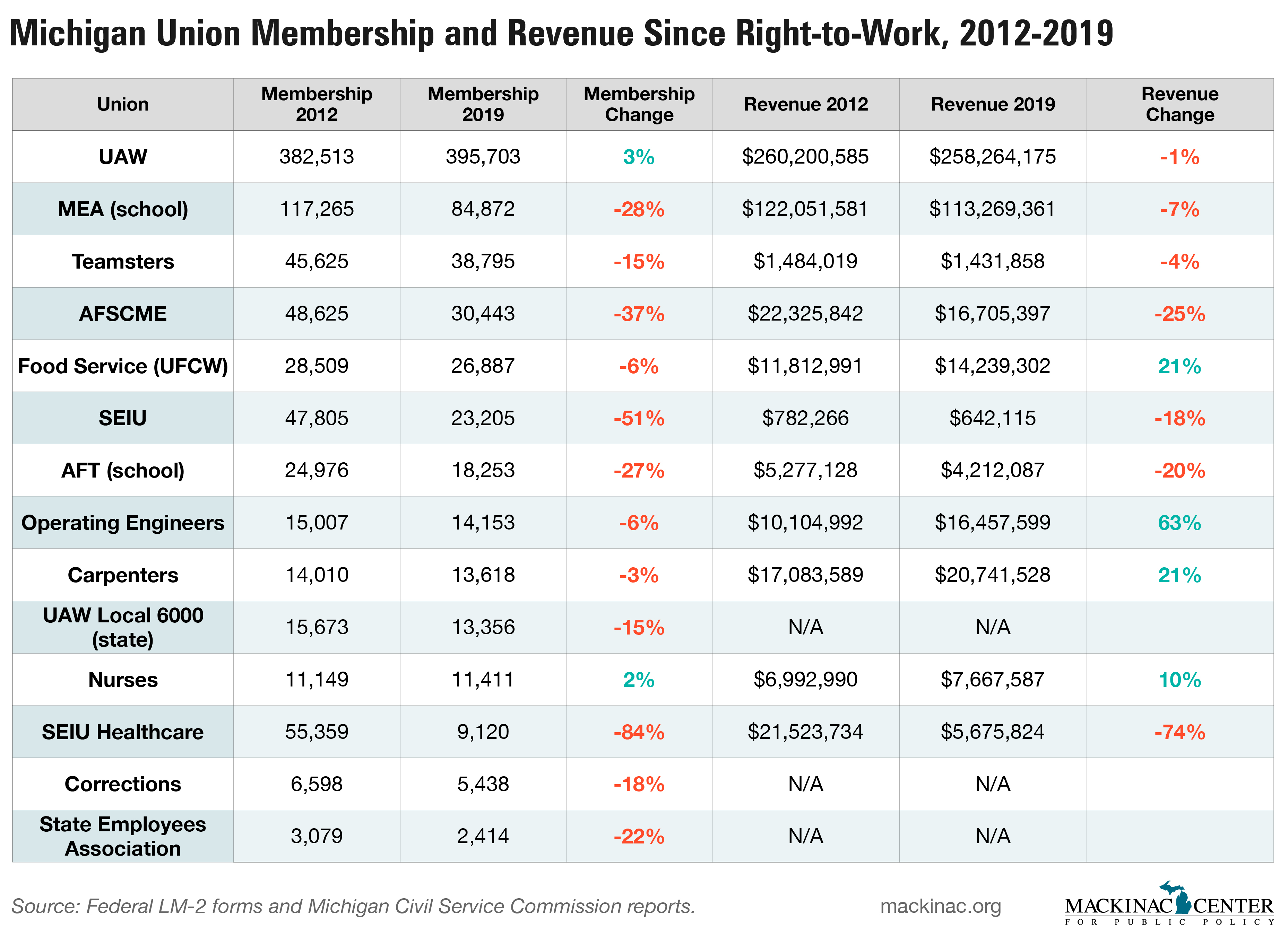
The financial result has been devastating for unions: In the past seven years, SEIU Healthcare Michigan has seen an 84 percent drop membership and a 74 percent drop in revenue. Its political spending has also seen a major decline, from $3.5 million on lobbying and politics in 2012, to just $290,000 in 2016.

SEIU Healthcare Michigan spokesperson Adam Bingman told The Intercept that the rollback of protections for home health care workers has exacerbated the care crisis in his state. He’d recently gotten “two different calls from independent providers” who said they’re struggling to find qualified home health care workers. “The lack of union membership and the assault on home care workers, and those who rely on those services, has really hurt the ability to attract dedicated qualified home care professionals,” he said. According to Bingman, many home care workers have left to go work in nursing homes or find alternative employment.

While Michigan provided conservative activists a proof point of what’s possible with regards to weakening home health care unions, Republicans soon realized that passing similar measures in other states would not be as easy. “In Michigan, the Mackinac Center hit it out of the park; they stopped it,” said Vernuccio on the donor call. “But in a lot of other states, the political winds just simply didn’t align.”

Facing state-level opposition, the same conservative activists known for railing against federal intervention decided the time was necessary for federal intervention. Vernuccio explained how SPN “saw an opportunity to … harness everything that we learned” in Michigan and other states around stopping the so-called dues-skim and to bring that knowledge to D.C. “This means that states like California, Washington, Illinois that would need a huge political sea change to stop the skim at the state level will now have it stopped in D.C.,” he told the donors. “It also means that we’re focusing the firepower of the donations of people on the call and across the country — that instead of fighting an uphill battle in these states, we can win more quickly and more easily in Washington, D.C.”

Butler then shared that she had been taking caregivers to Congress to tell lawmakers how they’ve been affected by the dues-skim and unions. She cited a nearly half-hourlong meeting they had with Sen. Tim Scott, R-S.C., a few months prior. Federal disclosures show that Butler, on behalf of SPN, has lobbied the Senate, the House of Representatives, and Health and Human Services with the stated goal of ending the Medicaid dues-skim.

In April 2018, Sen. Ron Johnson, R-Wisc, chair of the Senate Committee on Homeland Security and Government Affairs, sent a letter to Centers for Medicare and Medicaid Services Administrator Seema Verma requesting that she look into the dues-skimming situation. His letter said that unions in 11 states were able to skim an estimated $200,000 in Medicaid payments each year, a statistic he attributed to a 2017 Mackinac Center policy brief. By August, Verma had announced that her agency was reconsidering the rule, and both Johnson and McMorris Rodgers submitted comments in favor of changing it.

The Mackinac Center cheered the Trump administration’s new rule, finally announced on May 2. “Ever since the Mackinac Center learned a decade ago of unions skimming funds from those caring for society’s most vulnerable — and in many cases, their own ailing family members — we began to actively seek to end this abhorrent practice,” said Joseph Lehman, the center’s president, in a statement. “This illegitimate action, negotiated between government and big unions, cost Michigan caregivers tens of millions of dollars. We were proud to litigate and bring an end to this practice for Michigan residents providing care to the disabled. Now, we celebrate with caregivers across the country who are finally afforded the same relief.”

A POWERPOINT PRESENTATION prepared by Heart+Mind Strategies for the State Policy Network in October 2017, and obtained by The Intercept and Documented, details carefully tested message research to help Republicans craft their talking points on this issue for lawmakers and the public. The research was conducted through a 25-minute online national survey between October 5 and 13, 2017, with over-samples in Texas, Illinois, Ohio, and Pennsylvania.

A “key messaging takeaway,” the consultants advised, was to be sure to not attack unions directly, as “they are seen positively by Americans” and most respondents “describe unions as fighting for higher wages and better benefits.” Only a minority of respondents, the consultants found, associate unions with “negative descriptors like corrupt, harmful, and dangerous.”

While the consultants acknowledged that “government labor unions” was the most effective way to negatively describe unions, even then they admitted that support for “government labor unions” was more positive than not. Still, the consultants said, “there are large groups of neutral Americans who can be moved on the issue.”

When it came to the dues-skimming issue, the consultants reported encouraging results for the Republican activists, saying that more than half of Americans oppose direct dues payments for government-funded home care workers and child care providers, and just half had existing knowledge of the policies. They found that most Americans have negative associations with the phrase “dues-skimming” — even before learning what it means.

To successfully fight direct union payments from child care workers and home care workers, the consultants advised activists to use messaging that included phrases like “as a condition of employment” or “forced to pay.” They also recommended focusing on language about taking money dedicated to people with disabilities and to avoid language around “growing the union’s treasure chest.” Coincidentally or not, the Department of Health and Human Services issued its new rule on similar lines, denying that it would interfere with voluntary union dues and insisting that it “in no way prevents” health care workers from paying dues to a union.

The Heart+Mind Strategies consultants also polled support for going through Health and Human Services to end the practice of union workers directly deducting their dues, and respondents supported the idea of the department sending a letter to states demanding that they end the practice by a 12-to-1 margin. This resembles the course of action the federal government ultimately pursued.

Conko, the SPN spokesperson, told The Intercept that the research from the PowerPoint presentation shows “that the general public agrees with us” about “right-to-work” laws and the Obama-era rule that allowed health home care workers to deduct union dues from their paychecks. Conko said the research was shared with state think tanks across the country and on SPN’s website, along with stories of workers “who wanted policymakers and others to know how the union’s practices were unfair and not always transparent.”

The messaging tips were consistent with SPN’s practices that The Intercept has previously reported on. The network has advised its member groups to avoid lodging direct attacks on unions because unions remain highly popular. Instead, SPN urged its state affiliates to stress that their efforts are about protecting workers’ “First Amendment rights of free speech and freedom of association.”

Bingman of SEIU Healthcare Michigan said the dramatic attacks on workers’ rights have “ultimately underlined that elections have consequences.” He pointed to the election of Democratic Gov. Gretchen Whitmer in November and said that his union, “along with organized labor, are really looking forward to changing things both here in Michigan and on the federal level.”

Credder Hopes To Crowdsource Away Fake News

Originally published in Columbia Journalism Review on May 31, 2019.
——–

AS FACEBOOK AND TWITTER grapple with misinformation and conspiracies on their platforms, a new crop of startups have emerged to try and use Yelp-like ratings to identify and amplify trusted stories.

These user-powered sites include Our.News andTrustedNews. Last year, even Elon Musk pitched the idea of creating a site he called “Pravda”—a media credibility site for ranking journalists and outlets.

Credder (they “dish out credibility”)—which launched its public-facing beta on Monday—is perhaps the most developed. “We were the first ones here,” co-founder Chase Palmieri says. And they did start thinking about this idea before the 2016 election, when fake news became more of an issue. “Pravda was an idea on Twitter, that’s all it’s been. Elon is a pretty busy guy.”

The Credder team wants to provide readers a solution to clickbait and sensationalism that “doesn’t involve outsourcing their critical thinking” to an algorithm or another person—like a Facebook moderator. They say that having news outlets and social media platforms censor untrustworthy content on readers’ behalf strikes them as fairly draconian.

When Palmieri and his two co-founders Austin Walter and Jared Fesler graduated from California State University, Chico, they knew they wanted to start a business, but didn’t know what kind. They kept in touch, pitched each other on ideas, and worked other jobs.

Palmieri moved to Italy, but also continued to own a restaurant back in Petaluma, where he managed its Yelp page from abroad. He liked the way the reviews got him to change his business’s behavior. At the end of 2015, alarmed by the “rising amount of clickbait,” they set about making a product to evaluate the “trustworthiness” of news articles in a similar way. They want news producers to “compete for trust, not clicks”—and aspire to help drive traffic and revenue “to the people who are winning that game.” Their first adviser was Patrick Lee, the co-founder and former CEO of Rotten Tomatoes. Instead of a tomato icon, Credder uses a picture of cheddar cheese.  (Golden cheese for most trustworthy, moldy cheese for least.)

Users assess individual articles by ranking them between one star, for least trustworthy, and five stars for most. The next step is to decide whether an article was “credible”, “illogical”, “biased”, a “mistake” or “not credible.” Each of those five then has additional options. “Biased” prompts new choices like “Hit Piece,” “Religious Bias,” or “Financial Incentive.” Users then can explain their review in a text box before submitting.

The co-founders wanted it to be more nuanced than a five-star rating system, but still convenient enough that people would actually use it. Like Rotten Tomatoes, you can read reviews both by the general public and by professional journalists.

Unlike Yelp, where restaurants are reviewed, but not individual dishes, Credder users rate articles, not the outlet as a whole. But outlets and journalists are then also given their own composite scores.

Credder’s founders hope journalists will use the reviews to inform their writing, and be motivated to increase their trust score. If a journalist gets feedback that their headlines are too sensational, and their editor won’t change their practice, well, Palmieri says, “maybe the journalist might think about working for a different outlet.” He also hopes Credder will “protect, empower and connect news consumers on the go” by providing a way to warn each other about stories they should avoid or approach cautiously. Right now, they say, news consumers have little recourse to hold an outlet or reporter accountable for low-quality content.

As of last Friday, 2,619 users had created accounts on Credder, and 41 journalists. The co-founders expect distribution to be their biggest challenge.

But even if the idea takes off, it remains to be seen whether journalists will care about the feedback they get. As a writer often in progressive outlets, how would I know that people who rank my articles as untrustworthy aren’t just right-wing diehards looking to professionally damage journalists they blame for left-wing politics? After all, much of the erosion of trust in the media is rooted in partisanship; Democrats see most news as unbiased, while Republicans believe the opposite. And while trust in media is still down from earlier decades, it’s been making a comeback since it hit an all-time low in 2016.

Credder hopes to have a solution for this, too. It wants to hold reviewers accountable, allowing people to up-vote or down-vote reviews based on how helpful they found them, like comments on Reddit. And you can see when a user joined the site, how many reviews they’ve left in total, and how many of their reviews were up-voted as helpful.

Credder hopes to entice journalists to spend their time reviewing fellow journalists, too, by offering additional exposure and new audiences. More intriguing, however, Credder is planning to add a tipping feature, so readers could reward trustworthy writers, either one-time or on a recurring basis.

Another issue, as the editor of Monday Note, Frederic Filloux, pointed out, is that the number of movies and TV shows released last year in the United States is dwarfed by the number of news articles, making the comparison to Rotten Tomatoes somewhat distorted. The sheer number of reviews required to comprehensively evaluate the news is just a considerable challenge. Credder estimates they’ll need about 10,000 people to review an article every day, in order to get enough feedback to accurately rate most of the news produced from the world’s top 70 outlets.

The co-founders argue that journalists don’t really have meaningful ways to learn how individual articles were received. Reporters can look at the number of clicks, shares, time spent reading an article, and monthly site visits as a way to quantify success — but these are admittedly imperfect measures. And of course, people who respond to an article directly are disproportionately people who loved or hated it.

Still, as comforting as it is to think that a new tech tool may be just what readers need to navigate a confusing and deliberately misleading news environment, I can’t help but think of the doctored video of Nancy Pelosi slurring her words that Donald Trump circulated last week and Facebook refused to take down. As a top Facebook official put it, they wanted to empower users “to make their own informed choice about what to believe.”

There are no articles on Credder about that incident, and given the site’s infancy, it’s hard to know how that would have been assessed. But as New York Times tech columnist Charlie Warzel recently noted, “whether repeating the lie or attempting to knock it down, the dominant political narrative” for days after focused squarely on Pelosi’s health. No amount of fact checkers, negative Credder ratings, or “dislikes” can really counteract that millions of people have now seen the viral Pelosi hoax, and consciously or not, embedded those images in their brains.  

Which is to say, welcome Credder, it’ll be interesting to see where you go and how you grow. But to combat the powerful lies flooding the internet and shaping our discourse, titans like Facebook should still take responsibility.