Education Reform Democrats Look Ahead to Life After Obama

Originally published in The American Prospect on July 26, 2016.
—-
Lately on the campaign trail, Hillary Clinton has been talking about how she wants to end the “so-called education wars.” The Democratic presidential nominee wants to see the factionalism among education groups end and instead see new coalitions form to advance policies on which all can agree. Clinton took this message on the road to the National Education Association and the American Federation of Teachers conferences earlier this month, and her campaign proffered another education olive branch to the Democrats for Education Reform on Monday in downtown Philadelphia.

Virtually every speaker lauded President Obama’s education legacy, highlighting his support for charter schools and test-based accountability at the organization’s day-long Democratic National Convention forum. Shavar Jeffries, the president of Democrats for Education Reform, said he recognized that many have been feeling anxious and unsure about whether Obama’s successor will be as friendly toward their political agenda as he was.

Ann O’Leary, a senior adviser to Hillary Clinton, assured the school choice–supporting audience that the Democratic presidential nominee and the reformers have a “shared vision.” She said that Clinton touted “great charter schools” at both of those recent teacher union conferences. But Clinton notably did not lavish praise on charter schools when she appeared before the American Federation of Teachers last week in Minneapolis. After denouncing for-profit charters and vouchers, she said simply, “where there are public charter schools, we will learn from them.”

Kira Orange Jones, the executive director for Teach for America’s greater New Orleans region, said that she’s “profoundly concerned” that the Democratic Party may divert its attention away from protecting the rights of all children, especially the most disenfranchised. “That’s our party, that’s why I’m a Democrat,” she said.

Meanwhile, school integration also prompted a vigorous discussion among attendees. Kristen Clarke, the president and executive director of the National Lawyers’ Committee for Civil Rights Under Law, made an impassioned case for a deeper focus on integration. “We cannot turn our backs on Brown [v. Board of Education],” she said. “And, yes, I do think [Democrats for Education Reform] stands to play an important role in moving that project forward.”

Others made the case for successful segregated charter schools, and questioned whether a real political will exists to pursue new desegregation efforts. Surprisingly, attendees had very little to say about Clinton’s Democratic vice presidential pick, Tim Kaine, or his wife, Anne Holton. Holton, who recently stepped down as Virginia’s education secretary, was a strong supporter of school integration and had opposed the further expansion of charter schools. Her father, former Virginia Governor A. Linwood Holton, a Republican, championed school desegregation during his time in office in the early 1970s.

Though the forum focused on the future of the Democratic Party’s educational agenda, teachers unions, a core constituency within the party, received little attention. “Unions don’t get all the seats at the table,” said Ben LaBolt, a former Obama spokesperson who now heads a communications firm working toweaken teacher tenure and other job protections.

Tafshier Cosby-Thomas, a Newark parent who came down to Philadelphia for the discussions, told The American Prospect that she believed that teachers unions in Newark are “very territorial” and don’t want to collaborate. “They don’t want to even find out about what’s happening in the charter schools,” she said. “I don’t know if they’re unwilling or if traditionally they’re standoffish.”

While education reformers were clearly throwing their political weight behind Hillary Clinton—organizers passed out pins with Clinton’s picture on them to all the attendees—some audience members were still “feeling the Bern.” Kean University student Yasmine Veale, a member of the New Jersey Black Alliance for Educational Options told the Prospect that she’s been considering becoming an independent in the next election cycle. “I’d like to see Democrats become more progressive, and not stay in the center,” she said. Like many millennial women, Veale backed Bernie Sanders during the presidential primary.

“I’m glad that some of what Bernie wanted made its way into the party platform,” she said. “But I’d still really like to see free education for all. It’s crazy that I have to work three jobs … and I’m still going to have a whole bunch of debt.”

Joy Russell, a Washington parent who serves on the advisory board of the Democrats for Education Reform’s D.C. chapter, told the Prospect that she feels confident Hillary Clinton will continue to push for the education policies that Obama has backed, but that overall, “politics have been getting in the way” of ensuring high-quality education for all kids.

Liberal Governor, Divided Government

This article appeared in the summer 2016 issue of The American Prospect.

—-
In February, at the Pennsylvania State Capitol building in Harrisburg, first-term Democratic Governor Tom Wolf readied himself for his second budget address. These were not normal times for Pennsylvania politics: The state had been operating without a budget for eight months, an unprecedented crisis as the Republican-controlled General Assembly fought with the governor’s office over issues of taxation, spending, and pension reform. As the impasse dragged on, school districts and nonprofit organizations across the state were forced to borrow money, lay off employees, and reduce social services.

“My fellow Pennsylvanians: Our Commonwealth is in crisis. A crisis that threatens our future,” Wolf declared from the podium. “This crisis is not about politics at all. This is about math.”

Wolf went on to outline the dramatic consequences he foresaw if state legislators failed to pass a budget that included sufficient spending increases. Thousands of teachers and guidance counselors would lose their jobs, he said. Classroom sizes would grow, and tens of thousands of children would lose access to early childhood education. The state would lose nearly $200 million in services for Pennsylvania’s seniors, and $180 million for those with mental illness and learning disabilities. From slashed funds for child care to shuttered domestic-violence shelters, the negative outcomes went on and on.

“This is not a threat. This is not political posturing. This is simply what the math tells us will happen if this crisis is not resolved,” Wolf stressed. “I didn’t run for this office to be party to the corner-cutting and budget gimmickry that got us into this mess. We can’t afford to play political games.”

Wolf’s speech aside, the problem facing Pennsylvania is most certainly about politics—and particularly the challenges of democratic governance in an era of deepening party polarization. While Republicans and Democrats have long staked out different positions on issues of public policy, political scientists are finding that the parties are even further apart than they’ve been in at least 50 years; this polarization has extended to the general public, too, resulting in increasingly partisan communal institutions and news media.

The story of Tom Wolf is the story of how a progressive, liberal Democrat attempts to govern in such an era, at a time when split government means something quite different than it did even a decade ago. The challenges Wolf wrestles with in Harrisburg, with the state’s most conservative legislature in modern history, in one of the most ideologically divided states in the union, are growing increasingly common across the country. They also mirror the challenges President Barack Obama faces in Washington, D.C., as he navigates a Republican-controlled Congress whose leadership has shown unprecedented determination in obstructing Obama’s initiatives and any attempts to broker compromises.

Wolf’s dilemma, then, is both a product of polarized times, and intensely personal: How can he advance a progressive agenda given the political landscape he inherited? What tools are at his disposal? What blame, if any, does he shoulder for a failure to get things done?


IN 2014, WOLF WAS ELECTED
 governor with a margin large enough to claim a mandate. Not only was he the first person in four decades to defeat a sitting Pennsylvania governor, ousting Republican incumbent Tom Corbett, but he won by ten percentage points. And while the budget impasse has largely defined Wolf’s time in office—dragging on for nine months between July 2015 and March 2016—he also found ways to promote progressive policies amidst the stalemate.

The 67-year-old businessman from south-central Pennsylvania had never before held elected office. The way he emphasized “math” and deemphasized politics in his budget address reflected the way he often describes his vision and responsibilities—for better or for worse. On the campaign trail, Tom Wolf ran on a platform to restore cuts to education, and to do so by passing an extraction tax on natural gas in the Marcellus Shale. Though angering many environmentalists and progressives, Wolf opted to embrace the booming fracking industry in his state.

Soon after taking office, Wolf expanded Medicaid, transitioning away from the complicated alternative system his Republican predecessor had implemented. Five hundred thousand beneficiaries were enrolled within his first year—in a far more streamlined and straightforward program than had existed before.

Pennsylvania is not a state that you would think of as being at the forefront of health-care issues, but now with Wolf, it is,” says Drew Altman, the president and CEO of the Henry J. Kaiser Family Foundation, and a longtime friend of Wolf. “He stands out among governors when it comes to making health and health access top priorities.”

Wolf also signed a series of executive orders for political appointees and state workers, banning gifts to state officials and requiring that all state contracts with private-sector providers go through a bidding process. He declared a moratorium on the death penalty, granting temporary reprieves to 180 inmates on death row as a state task force formally reviews the policy. He also raised the minimum wage—mostly for state janitorial workers and part-time clerical staff—increasing their pay from $7.25 to $10.15 per hour. And in the wake of North Carolina’s passing a law that stripped rights from gay and transgender people, Wolf issued a pair of executive orders that expanded protections against discrimination based on one’s sexual orientation or gender identity. He wanted “to show the world that Pennsylvania is a welcoming place for everyone.”

But as G. Terry Madonna, the director of the Center for Politics and Public Affairs at Franklin & Marshall College, points out, Wolf simply “can’t make change for 12 million Pennsylvanians on his own.” His executive actions carry symbolic power, no doubt, but in practice they yield only limited impact. “For really big change,” Madonna says, “Wolf needs the legislature.”

And that’s where he runs into problems.


SHORTLY AFTER ENTERING
 office, Wolf introduced his budget proposal, which called for more than $1 billion in new education spending, a 5 percent natural gas extraction tax, property tax relief, and an increase to the state’s sales and personal income tax.

While widely seen as “ambitious,” this type of budget proposal, Madonna says, was not actually that unusual. “Governors don’t just put out their first-year agenda, they really try to put out a four-year-agenda,” he explains. “They’re laying out what they’re really trying to do now, and that could change by the end of the first year—you might have new issues, you could have a recession in the middle of your term, any number of things. But what he did was not unusual.”

The Republicans didn’t bite. When the GOP-controlled General Assembly sent Wolf its $30.2 billion budget bill late last June, they included no new taxes, and none of Wolf’s other stated priorities. Wolf struck it down—the first time a Pennsylvania governor vetoed an entire budget in modern history.

What followed were months of debates between lawmakers and the governor’s office over reforming the state’s pension system, the future of the state’s liquor system, tax redistribution, and education spending. As the impasse dragged on, school districts were forced to borrow roughly $900 million, and nonprofits across the state had to scale back.

“People were completely stressed out, and impact on morale was severe,” says Anne Gingerich, the executive director of the Pennsylvania Association of Nonprofit Organizations. “You had organizations with longtime staff that quit and went on to get other jobs because they couldn’t handle that instability.”

“Everyone has concerns about the state and health of our pension system—short- and long-term,” says Helen Gym, a Philadelphia City Council member and strong public schools advocate. “But that’s not an excuse. … If it weren’t pensions, honestly, it would be something else. The legislature is evading a central responsibility, and they hold our kids hostage as they fail to deliver required dollars to schools.”

Throughout Barack Obama’s presidency, he’s been criticized for being aloof, for not investing enough in interpersonal relationships with members of Congress. If Obama would just invite Republicans out to golf, to grab a beer, or to dine a few evenings at the White House, the thinking went, then maybe the toxic political atmosphere that seems to derail political compromise could change.

But a lack of schmoozing is certainly not Tom Wolf’s problem. From the very start of his time in office, he began hosting policy breakfasts and lunches with members of the legislature from both parties. He regularly brought people into his office, and dropped by theirs, unannounced, throughout the week.

“I’ve never seen a governor who did so much reaching out to all the members of the legislature,” says State Representative Dan Frankel, the Democratic Caucus chair in the Pennsylvania House of Representatives.

T.J. Rooney, the former chair of the Pennsylvania Democratic Party and a former member of the Pennsylvania House, says that Wolf and Obama are similar in that they are both progressive intellectuals. “But Governor Wolf’s approach with the legislature—and I say this in an endearing way—Tom’s approach was much more aggressive than the president’s approach,” he says. “I mean, literally, he spent weeks upon his inauguration walking from office to office to rank-and-file legislators to introduce himself and get to know them.” While Rooney acknowledges these entreaties have not yet “paid off in a big way,” he thinks that, over time, such gestures are not lost and forgotten.

But Stephen Miskin, the spokesman for the House Republican Caucus, views Wolf’s outreach as “absolutely insincere engagement.” While he admits that Wolf has gone and met with Republican and Democratic legislators more than Miskin has ever seen since he started in state politics in 1984, he argues that the governor’s courteousness and kindness just does not make up for doing “everything he can to undermine” Republicans.

As the stalemate stretched on, some pundits criticized Wolf, saying he was too beholden to unions and other progressive constituencies that helped elect him to office. Wolf certainly was no fan of the GOP’s proposals for pension reform. But by November, Wolf made clear that he would sign a pension-reform bill that included a traditional defined benefit plan for future state and public school employees combined with a 401(k)-style plan. The compromise framework also included large increases in education funding and made headway on restoring prior cuts to social services. The Senate passed this framework budget deal in December.

But Republican House leaders did not even let the bill come up for a vote. Mike Turzai, the House speaker—the same man who said that voter-ID laws would “allow” Mitt Romney to win Pennsylvania in 2012—canceled sessions twice before Christmas, and sent everyone home.

“We have legislation waiting for us to vote on. Yet, the House speaker decided not to hold session,” State Representative Ed Gainey, a Democrat, told thePittsburgh Post-Gazette in December. “It’s bewildering to me, especially when the impasse is wreaking havoc on social services, and schools are considering keeping their doors closed after the holidays. This is the height of irresponsibility.”

The unions had signaled that they would back the Senate budget framework, despite its pension-reform provisions. “SEIU members supported the overall budget framework reached by the governor and legislative leaders last year … despite strong reservations about some aspects of it, because it included significant investments in education and other priorities that are vital for our state’s future,” says Neal Bisno, the president of SEIU Healthcare Pennsylvania.

Turzai and his allies claimed they didn’t bring the budget up for a vote because it wasn’t clear how the spending bill would be funded. In fact, the leaders generally understood where the revenues would come from; they just didn’t like it. Still, with no final bill to sign, Wolf was forced to pass a stop-gap budget, as the talks dragged on.

Meeting with the governor in April, I asked him what has most surprised him about his time in office so far. “I was surprised when I thought we had a deal back in December,” Wolf told me. “I understood that when I wrote my first budget, … it was very ‘ambitious’—as the Republicans kept reminding me. I understood I wasn’t going to get all that. But when I got to the fall and I had gotten what I thought was a good compromise—I had made concessions and they had made some good concessions themselves—and it passed the Senate 43–7, I was surprised when the leadership pulled the plug and said, ‘We’re going to go home.’ Yeah, that was a surprise.”

The nine-month impasse finally ended in March, when Wolf allowed a budget to pass into law without his signature—a budget he said that adds to the deficit, and underfunds key programs throughout the state. “I cannot in good conscience attach my name to a budget that simply does not add up,” Wolf said at a press conference. “But to allow us to move on to face budget challenges of 2016-17, I am going to allow [it] to become law.”

Wolf’s problem is not only that he’s dealing with large Republican majorities in the House and Senate, but also with legislators who are markedly more conservative than the Republicans who preceded them. 

“Wolf can work with the Senate, there’s still sanity there—but the inability to deliver in the House is the biggest impediment that he faces,” says Rooney.

“I’m becoming particularly pessimistic that we’re going to get a budget that deals with the structural deficit,” says Frankel, the House Democratic Caucus chair. “I just don’t see Republicans cooperating to get a sustainable fix. I think we’ll get a smoke and mirrors budget.”

Indeed, while the General Assembly ultimately avoided another long budget impasse—House and Senate leaders came together to pass a budget that Wolf signed into law earlier this month—many of the state’s long-term fiscal issues remain unaddressed. While Wolf had initially proposed a $2.7 billion budget that would have reduced the state’s structural deficit, lawmakers ultimately approved a budget of just $1.3 billion, though it did include a new $1-per-pack cigarette tax, something few had expected to pass in an election year.


BORN AND RAISED IN York County, Pennsylvania, Tom Wolf grew up in a world of comfort. His wealthy family was well known locally: They ran a successful kitchen-cabinet business, regularly fundraised for political candidates, and donated often to charitable causes.

Wolf has a reputation for being an avid reader and a serious intellectual (when I met him, he was finishing up Jonathan Franzen’s Freedom). He sees himself as a “curious human being” and believes books help him ask better questions.

He went to Dartmouth for his undergraduate education, though he took some time off to volunteer with the Peace Corps in Orissa, India. He went to the University of London for his master’s, where he met Frances, his wife of 40 years. Next, he enrolled at the Massachusetts Institute of Technology for a doctorate in political science, where he wrote a national-award-winning dissertation on the structural change in the U.S. House of Representatives. Despite his love for learning, friends say it would be a mistake to think he just holed himself up in the library. “Tom was a revered graduate student, such a wonderful human, and so nice,” says Drew Altman, a fellow grad student from MIT who played intramural sports with Wolf. “He just had such a winning personality. It was sometimes even a little bit annoying to people.”

After graduate school, to the surprise of many of his academic colleagues, Wolf headed back to York to help run his family’s business. Seven years after his return, he and two cousins bought the company, WOLF, from Wolf’s retiring father, and over the next two decades the profitable business continued to expand—employing some 600 workers, who, as a consequence of the company’s unusually conscientious profit-sharing program, reaped between 20 percent and 30 percent of its profits. The company grew to become the largest supplier of kitchen and bath cabinets in the United States, and on the campaign trail, Wolf cited his successful business record and his generous management style as proof of his leadership credentials.

“Although he’s a very wealthy fellow, he really does not bring to the table some of the far-right-wing positions that wealthy Pennsylvanians and wealthy Americans tend to,” says David Fillman, the executive director of AFS-CME Council 13. “Governor Wolf is very labor-friendly, and it’s just been very refreshing.”

Friends and colleagues talk about Wolf’s “strong moral compass.” Raised in a household that taught him that his privilege obligates him to give back and work for the greater good, Wolf donates his entire government salary to charity. He speaks excitedly about democracy, and calls public servants “stewards of a grand democratic tradition.” He prioritizes ethics reforms like gift bans, increased government transparency, and campaign-finance overhauls. While he won every county in the Democratic primary, Wolf acknowledges that turnout of eligible voters was extremely low. His ultimate goal, he says, is to restore trust in government so more people will exercise their fundamental responsibility of citizenship.

In 2015, InsideGov, a government research organization, ranked Tom Wolf as the most liberal governor in America, based on a review of his public statements, press releases, campaign platforms, and voting records. But if you talk to Wolf, he doesn’t see himself as very ideological at all. He insists that his progressive values are just outgrowths of his pragmatic character, shaped by his years at MIT and in the private sector. Being a progressive, he says, is really just about doing the “smart” thing.

He cites his recent nondiscrimination executive order as an example. “That’s not a dogmatic thing; that’s just something that makes common sense,” he tells me. “When I’m in business and I want good talent in my company, why would I want to limit the talent pool by saying I’m only going to look at people who, say, look like me? You don’t do that. You want the best possible people you can [get]. If they work hard, they’re willing to take risks, you want that person.”

There’s a political logic to Wolf’s attempts to position himself as non-ideological, rather than as a liberal progressive. While Pennsylvania leans slightly Democratic, the western part of the state tends to be more culturally Midwestern and politically conservative. And, as Madonna explains, there are also a handful of Democrats in the southwestern region of Pennsylvania who represent districts that have been trending Republican over the past decade. These Democrats are not just conservative on social issues like guns and abortion, but increasingly on fiscal issues as well. Many of these constituents would have been in an uproar if their leaders backed the general tax hikes that Wolf put forth.

But sometimes Wolf’s claims of being above partisanship and ideology have felt grating, even insensitive. He regularly uses phrases like “let’s be honest with ourselves” and urges legislators to do the “right thing”—meaning the thing he thinks needs to be done. He describes his job as “helping people understand” the mathematical issues at hand. He tells me his international hero is Mahatma Gandhi, the leader of the Indian independence movement, because he really “took that idea of pragmatism, of goodness.”

“We have a governor who literally believes he is an emperor,” says Miskin, the GOP spokesperson. “He issues decrees and gets upset when people don’t agree with him.”

WHEN I ASKED WOLF if there were things he’d like to get done while in office in order to feel like his time there was a success, he said yes, but “done the right way.” For him, “transactional politics”—which he defines as the day-to-day work of being in office—are less important to him. “I care more about making lives better, making my home state a lot better, and taking advantage of all the great things we have here, than I do about whether this moves bills forward at this pace. I care more about making sure we do it right, and the math adds up.”

He looks at his margin of victory as evidence that the voters also want him to lead in this way. “It’s liberating. I can do what I think is right, and I think people voted for me because they thought that’s the kind of person I am,” Wolf says. “I’m not as concerned with what people think about me as I’m concerned if I’m doing the right thing—whether my daughters and my wife respect me after I make a decision. Those things are a lot more important to me.”

But not everyone is so pleased with Wolf’s confidence to move at his own pace. Cynthia Figueroa, the president of Congreso de Latinos Unidos in Philadelphia, a multi-service organization located in the poorest ZIP code in the state, witnessed firsthand how difficult it was to provide social services during the budget impasse. Figueroa’s organization had to furlough staff, reduce programming, and delay the start of other initiatives that normally would have been funded at the start of the fiscal cycle. Congreso de Latinos Unidos in Philadelphia has been around for nearly 40 years, and Figueroa says that while she spoke out and pushed state leaders to take action, a lot of other organizations “were suffering in silence” because they didn’t want to scare off their individual donor base, and worried their government contracts might be transferred to other people if they made an outcry.

When I asked her if she felt like leaders in Harrisburg really understood the ramifications of their failure to pass a budget, she said absolutely not. “It was a lot of men digging their heels in, a lot of ego,” she says. “It really felt like it was playing poker with poor people’s lives.”

Samantha Balbier, the executive director of the Greater Pittsburgh Nonprofit Partnership, a coalition of 420 nonprofits in Southwestern Pennsylvania, says that they found that nonprofits that were not Medicaid-reimbursable, with budgets less than $10 million, were hit particularly hard by the impasse—organizations such as senior-care service providers, domestic-violence shelters, and some drug and alcohol facilities. While Balbier’s organization is encouraged that Wolf recognizes both the importance of restoring human-services funding and how the impasse cost nonprofits money, she says there’s still a lot of concern that “there could be a precedent set where the budget is just never passed on time, and where Pennsylvania politics emulate what happens on the federal level.”

IN HIS FINAL STATE OF the Union address, President Obama issued a call to end gerrymandering. “We’ve got to end the practice of drawing our congressional districts so that politicians can pick their voters, and not the other way around,” he declared.

Pennsylvania is considered one of the most heavily gerrymandered states in the union. After the 2010 elections, Keystone State Republicans helped redraw the lines around competitive areas to make them swing more easily in their favor. In 2012, Republicans took nearly 75 percent of the state’s congressional seats—13 out of 18—though more than half of all votes cast in the state during that election for the U.S. House were for Democrats.

“Due to gerrymandering, our districts are not competitive, and so the legislatures are unaccountable—especially the leadership,” says Barry Kauffman, the executive director of Common Cause Pennsylvania. “They don’t feel the voters anymore. They know they will get re-elected, and they can be as ideologically pure as they want and refuse to negotiate.”

Common Cause Pennsylvania is part of a statewide coalition of civic groups advocating for redistricting reform. Their long-term goal is to establish an independent redistricting commission, which will prevent sitting legislators from drawing district lines for political gain. “We want it to be people who don’t have a specific dog in the fight, and who will ensure the districts are equal in population, compact, and contiguous,” says Kauffman. Creating more-competitive elections, advocates say, will lead to greater accountability.

The two states with model independent commissions are Arizona and California, and in both cases, voters won this reform through statewide initiatives. Since Pennsylvania has no such process, advocates anticipate a much longer, and tougher, fight.

Still, there is reason to think that Pennsylvania’s new era of polarization is rooted in factors that extend beyond gerrymandering. Democratic legislators in the southwestern part of the state, after all, have grown more conservative because their constituents have grown more conservative. Political scientists have measured the ideological position of congressional members and found that representatives in gerrymandered districts are not more extreme than those in others.

Today, there are 19 other states like Pennsylvania where control of the governorship, state Senate, and state House is split between the two parties. Republicans control both the executive and legislative branches in 23 states, compared with just seven Democratic-controlled states. The states that are entirely GOP-controlled have moved their policies sharply rightward; states like California and Oregon, which are controlled by Democrats, have grown far more liberal.

“Redistricting couldn’t hurt, creating more moderate districts would help, but I think more political scientists see this as a problem of where the voters in the two parties are geographically located,” says Paul Pierson, a political scientist at the University of California, Berkeley. Even if districts were redrawn, there’s reason to assume that many districts would still lean heavily Democratic and heavily Republican given where these voters tend to live.

So what is to be done? The challenges facing Wolf in Pennsylvania look a lot like the challenges facing the president in Washington, D.C. And on the federal level, there are various tools at legislators’ disposal, like the filibuster, that can make gridlock even more likely. Where possible, Obama has effectively opted to work without Congress during his second term, issuing presidential orders and letting the courts weigh in on whether his actions were appropriate uses of executive power.

“I’ve learned a lot from Obama,” Wolf tells me. “I think the executive order is something that I have the right to do, and I can exercise my veto pen.” Unlike the president, the governor can also use his line-item veto power to pick and choose which parts of the budget he likes. “The governor is not afraid to avail himself of the constitutional provisions of his office,” says Rooney.

Historically, American political parties were more ideologically diverse and diffuse; it was not uncommon to find more conservative Democrats and liberal Republicans in their ranks. “Now, the parties act much more like coherent teams, and they all take the same positions and back the same people and oppose the other side,” says Pierson. “It’s really hard to figure out how you get this process to go in reverse. A lot of political scientists are asking what would shift this and I haven’t heard a lot of good ideas.”

In January, seven months into the budget impasse, a Franklin & Marshall College poll found that two out of three Pennsylvania voters felt their state was on the wrong track. According to an analysis conducted by a local newspaper, this marked the highest voter dissatisfaction rate in the 21 years that F&M had conducted this poll. Poll respondents placed more blame on the state House and Senate for failing to pass a budget, rather than the governor. The legislature received a 15 percent voter approval rate, compared with Wolf’s 33 percent.

But a Quinnipiac University poll released in April found Wolf earning his worst approval ratings since he first took office. Among Republicans, 75 percent said they disapproved of Wolf’s job performance, and so did 49 percent of independents. Among Democrats, 59 percent approved of his performance. Whether the gridlock will weaken him to the point that he will face a serious challenge in 2018 remains to be seen.

Overall, these broad political dynamics do not bode well for liberals. The more that citizens think the system is rigged—either that their votes don’t really count because of gerrymandering or that nothing will ever get done because of gridlock—the greater is the likelihood that voters will disengage entirely, creating a downward spiral of popular engagement.

The effect of “this kind of dysfunction is not neutral between the parties,” says Pierson. “If I become alienated and think government is not working, on balance, I think that would be more advantageous to the anti-government party.”

Tom Wolf is caught in a hard place, in a tough moment for national, state, and local politics. But he says he’s enjoyed every minute of the time he’s been in office. It’s important to do more than “make the trains run on time,” he tells me, in a reference to Italian fascist leader Benito Mussolini. “You’ve got to make the trains run on times in the democratic context. You’ve got to do it right. I think we politicians today lose sight of that second dimension. We’re stewards of a grand democratic tradition.”
 

Indiana Court Overturns Purvi Patel’s Feticide Conviction

Originally published in The American Prospect on July 25, 2016.
——-

The Indiana Court of Appeals last week overturned the 20-year prison sentence for Purvi Patel, the first woman in the United States to be convicted under a feticide law for having an abortion. The 3-0 decision marks a victory for reproductive rights advocates, who argued that using feticide laws to convict women who end their pregnancies sets a dangerous precedent for abortion rights and criminalizing the procedure.

Legal experts warned that if the conviction were upheld pregnant women would be prosecuted for all sorts of things—from self-inducing an abortion to smoking cigarettes, or even slipping down the stairs. Feticide laws are on the books in 38 states, and were originally passed to protect pregnant women who were victims of domestic violence.

Indiana strengthened its feticide law in 2009, after a pregnant Indianapolis bank teller was shot during a bank robbery, and lost the twin girls she was carrying. In the appeals decision, the judges wrote, “We hold that the legislature did not intend for the feticide statute to apply to illegal abortions or to be used to prosecute women for their own abortions.” They called Patel’s conviction under a feticide statute “an abrupt departure” from earlier cases.

However, while Patel’s Class A felony charge was vacated, the judges did not drop the second charge in the case. She is still left with a neglect conviction—a felony offense—though the court said it should be reduced from a Class A neglect charge to a Class D one. The minimum sentence for a Class D neglect felony is six months, and the maximum is three years. Patel has already been sitting in jail for more than a year.

Attorneys for both sides continue to review the decision; neither has indicated whether they planned to appeal to the state’s Supreme Court.

Kate Jack, an Indiana-based attorney who has provided legal advice to the National Advocates for Pregnant Women, told The Indianapolis Star that while the issue is not entirely closed, she does think the decision “will really give pause” to anyone considering bringing future feticide charges against pregnant women.

The decision comes on the heels of the Republican National Convention, where Donald Trump picked Indiana Governor Mike Pence as his running mate. Reproductive rights groups have already been organizing against Trump’s incendiary rhetoric around women and abortion rights, and the selection of Pence as his vice president has only angered advocates further.

Aside from being the chief executive of the only state to convict a woman who ended a pregnancy under a feticide statute, Pence has also achieved notoriety for supporting other reproductive health-care limitations. While serving in the U.S. House of Representatives he backed an unsuccessful 2011 federal effort to defund Planned Parenthood. When Pence became governor of Indiana in 2013, he continued to attack the organization. By 2014, state funding for Planned Parenthood had been reduced by nearly half of its 2005 funding levels: Nearly a decade of cuts forced the closure of five clinics.

In March, Pence went even further, signing an omnibus bill that included some of the strictest abortion measures in the country, including a ban on women who wish to end their pregnancy if their fetus has genetic abnormalities, such as Down syndrome. The law also called for prosecuting doctors who provided abortion services to women suspected of wanting to terminate a pregnancy based on genetic problems. A federal judge blocked this law from taking effect last month, saying it was likely unconstitutional.

While reproductive rights groups say they are heartened that the court reversed Patel’s feticide conviction, they disagree with the judges’ decision not to drop the neglect conviction. Yamani Hernandez, the executive director of the National Network of Abortion Funds, issued a statement saying that the court’s new decision does not go far enough to restore full justice. By allowing the prosecutors’ argument that Patel could have prevented the death of her child to stand, Hernandez says, the judges have rejected “both medical science and compassion for a woman who needed medical care, not to be sent to prison.” She argued that ultimately people of color will “bear the brunt of unscientific laws and misplaced moral outrage.”

Patel remains in prison for now, and advocates are continuing to call for her release. Reproaction, a group focused on abortion access and reproductive justice, released a statement calling upon Mike Pence “to be pro-life for real and release her immediately.” They add that the state of Indiana “owes Purvi Patel a profound apology.”

Clinton Reframes Education Message, Attacks Trump

Originally published in The American Prospect on July 19, 2016.
—-

Cnr4hxFUEAABMZv

Photo Credit: Rachel Cohen

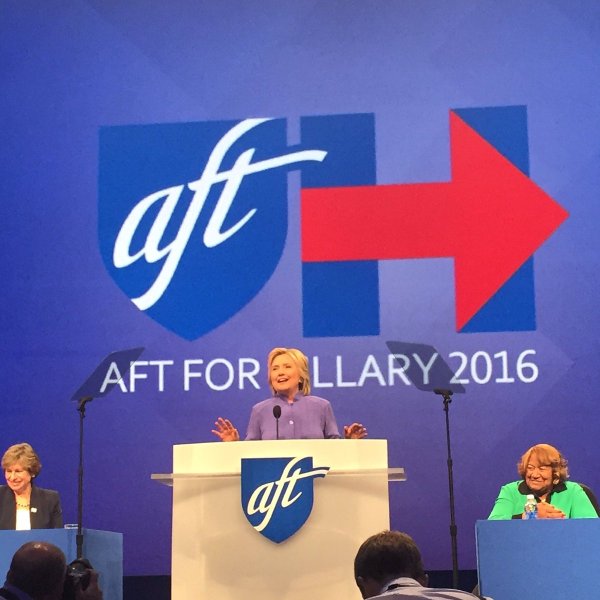
Hillary Clinton took advantage of a speech to the American Federation of Teachers this week to test out her party’s retooled K-12 education platform, and to hammer home important themes of her presidential campaign.

Clinton’s speech to more than 3,000 AFT delegates gathered for the group’s national convention in Minneapolis on Monday took place against the backdrop of a GOP convention centered heavily on anti-Clinton attacks. It was one of several campaign stops that Clinton is making this week, including an Ohio speech earlier on Monday to the NAACP, and an address to government workers scheduled for Wednesday.

Clinton’s Minnesota speech differed noticeably from a National Education Association address she gave in Washington, D.C., less than two weeks ago, in which she had stated early on that we should pay attention to “great schools,” including public charter schools. These comments had produced the loudest boos for Clinton at the NEA, prompting her to quickly pivot to denouncing for-profit charter schools.

At the AFT, Clinton actually opened her charter school discussion by condemning for-profit charters, then denouncing vouchers “that drain resources from public schools.” (Clinton had not mentioned private school vouchers at the NEA’s conference.) Following these comments, she merely told the AFT, “Where there are public charter schools, we will learn from them.” Nobody booed.

It was Clinton’s first education speech since party operatives last week made several substantive changes to the Democratic platform around K-12 education, beefing up some union demands and toning down some of the education reform rhetoric of an earlier platform draft. The changes prompted Shavar Jeffries, the president of Democrats for Education Reform, to issue a statement saying the platform had been “hijacked” and now constitutes an “unfortunate departure from President Obama’s historic education legacy.”

The new platform articulates support for parents who opt their children out of standardized tests, and opposes the use of test scores to evaluate teachers and administrators. The platform also is more conditional in its support for charter schools—stating that they must “accept and retain proportionate numbers of students of color, students with disabilities, and English language learners,” and that charters must not “replace or destabilize traditional public schools.”

This last point acknowledges the concerns of groups that are working in cities across the country to end or slow the expansion of charter schools. Critics argue that rapid charter growth is placing undue fiscal strain on traditional schools, destabilizing their finances and hurting their students. The platform’s new language largely seems to reject the argument that any destabilization districts face is due to the financial mismanagement of district officials alone.

Clinton’s AFT speech also took a knock at Donald Trump’s recent vice presidential pick, Indiana Governor Mike Pence, who is notorious among teachers’ unions for pushing market-focused education policies, raking in money from for-profit charter chains, and advocating for charters and voucher programs across his state. Over the course of the primary season, many more liberal education reform groups—those that promote test-based accountability and charter schools—have largely sought to distance themselves from the incendiary GOP nominee. Trump’s selection of a second-in-command who is so vocally supportive of their reform agenda, however, presents an interesting new challenge for these advocates. The American Federation of Children, a more conservative education reform group that promotes charters and vouchers, has already lauded Trump’s VP choice.

Clinton opened her AFT speech with declarations of support for both African Americans recently killed by police officers and for the officers recently shot and killed in Dallas and Baton Rouge.

“We cannot let this madness continue,” Clinton said. “This violence cannot stand.” When she started to speak about Philando Castile, the 32-year-old school cafeteria worker who was killed earlier this month by police in suburban Saint Paul, not far from the Minneapolis convention center, local protestors marched into the plenary hall shouting, “Hands up, don’t shoot!” One activist repeatedly shouted, “Stop the deportations!” The audience sought to drown the disrupters out, chanting, “Hillary! Hillary!” until the protestors were quickly escorted out of the room. Clinton had met with Castile’s mother, sister, and two of his uncles earlier that day.

Clinton weaved references to police violence throughout her speech. Midway through her address, she referenced remarks made earlier this month by Dallas Police Chief David Brown, who said that society has placed too much on the shoulders of police.

Brown had said at the time: “Every societal failure, we put it off on the cops to solve,” from mental health funding to drug addiction to school failure to single parenting. Brown concluded: “That’s too much to ask. Policing was never meant to solve all of those problems.” Clinton told her AFT audience that teachers face many of the same challenges.

“We ask you to help right wrongs, from poverty and homelessness, to the legacy of racial inequities stretching back centuries,” Clinton said. We ask so much of you and we don’t give you enough in return.”

Clinton also devoted significant time to attacking Trump and Pence. “If you want to look at what kind of president Donald Trump will be just look at who he’s chosen as his running mate,” she told the teachers union, calling Pence “one of the most hostile public officials when it comes to public education.” She referenced the Indiana governor’s decision to slash funding for higher education, and to refuse tens of millions of federal dollars for expanding pre-K education. “Neither Mike Pence nor Donald Trump should be anywhere near our children’s education,” she said.

Following Clinton’s speech, AFT president Randi Weingarten commented on both the Democrats’ newly redrafted education platform, and on how Clinton’s Monday speech reflected those changes.

“I think that what she did today was a tremendous defense of public education and public services,” Weingarten told the Prospect. “In the platform itself, what happened was … the four corners of the platform were there, but we put more meat on the bones. Like when the platform before said ‘charters should have transparency and accountability’—we talked about how.”

Asked what she thought of the Democrats for Education Reform statement that the platform had been hijacked, Weingarten responded:

“I think that DFER better look at itself. When they think that saying that charters should not displace or replace public schools, or that charters should have, and take the same kids as other public schools, and they think that’s hijacked? They’re actually sending a big neon sign that they don’t care about public education.” She added that the platform is “leveling the playing field for charters and other public schools.”

The AFT was the first labor union in the country to endorse Clinton, months before other unions came out with their own endorsements. While there are strong Bernie Sanders supporters among the AFT’s rank and file, many of whom were angered by their union’s early primary endorsement, the convention crowd’s loud cheers demonstrated that the AFT is definitely getting “Ready for Hillary.”


Q&A: The Abortion Battle’s Next Phase

Originally published in The American Prospect on July 12, 2016.
—–

In a landmark ruling last month, the Supreme Court struck down a package of Texas abortion restrictions known as Targeted Regulation of Abortion Providers (TRAP) laws. Such laws, which have proliferated around the country, typically restrict abortion access by imposing rigid and expensive hospital-style mandates on clinics. The Court’s ruling in the case, known as Whole Woman’s Health v. Hellerstedt, found that the restrictive Texas TRAP laws were unconstitutional because they placed an “undue burden” on women, and marked a major victory for the reproductive rights movement. The American Prospect’s Rachel Cohen spoke with Ilyse Hogue, the president of NARAL Pro-Choice America, which helped lead the challenge to the Texas TRAP laws, to ask about the ruling’s implications for abortion access and for the upcoming election. This is an edited transcript of that conversation.

Rachel Cohen: Now that the Supreme Court has struck down TRAP laws, what’s next on the agenda for anti-choice opponents?

Ilyse Hogue: Over the years, [abortion opponents] have realized that honesty can only get them so far in terms of achieving their goal of ending legal abortion. TRAP laws were really a way to deceive the public, cloaking their efforts around the idea of protecting women’s health. The Supreme Court just eviscerated the anti-choice posturing that TRAP laws are in any way about women’s health.

So one of their favorite tools just got taken away from them. They are reeling, but they are not the type to take their ball and go home. We’re anticipating them pushing forward on a number of different fronts. I think they will step up their harassment at clinics—harassing patients and doctors. And we’ve seen some really insidious things from state legislatures, like recently an effort in Missouri to force clinics to turn over their private medical records to the state. I think we’re going to see anti-choice opponents continue to pour resources into crisis pregnancy centers, which are just another way to deceive women.

How will the reproductive rights movement respond?

We are pushing back on their crisis pregnancy center efforts. In California last year, legislators passed the Reproductive FACT Act, which sets a national model for requiring all crisis pregnancy centers to be really clear with their patients about what they do and don’t do. Other states are looking at California’s law, and I think it’s very much at the top of legislators’ minds for the beginning of 2017.

We’ve also seen states where pro-choice legislators are filing to appeal TRAP laws that are already on the books, like Daylin Leach, a Democratic state senator, in Pennsylvania. And we’re working as a movement to step up litigation and public education to repeal the rest of those laws around the country. Importantly, we’re really moving to a position where we will not just fight anti-choice lies and deception, but where we can actively push for legislation that expands access to abortion. For example, a number of states are looking at medical abortion, and allowing nurse practitioners to provide abortion services. California already has that and other states are looking at it.

On top of this, we’ve got two pieces of federal legislation that are picking up momentum. The Women’s Health Protection Act, which would enforce and protect the right of a woman to decide for herself whether to continue or end a pregnancy, and the Equal Access to Abortion Coverage in Health Insurance Woman Act, which would repeal the Hyde Amendment and ensure that abortion services could be covered under federal health insurance.

NARAL recently released a statement calling the Democratic Party platform “the strongest platform for reproductive freedom we have ever seen.” What’s so significant about it?

The platform is a symbolic statement of values, as well as a navigation tool for what kinds of legislative and public policy remedies there are for the issues that we face. So the fact that it explicitly calls for the repeal of the Hyde Amendment, as well as the Helms Amendment, [which restricts U.S. foreign aid from paying for abortion services] is huge. It acknowledges that there have been discriminatory practices both here and abroad against women who want to control our own reproductive destiny.

The reproductive justice movement deserves an enormous amount of credit for getting us here. Reproductive freedom in the 21st century is acknowledging that we are whole beings. There is not one group of women who gets abortions, and others who go on to be parents. We are just the same women at different times in our lives, making the decisions that are best for us and our families. That the platform takes a step towards acknowledging that is a real testament to the economic and reproductive movements that have come together.

How long will it take Texas and the other states with TRAP-style restrictions to restore abortion access to women?

I’m really glad you asked that question. The answer is too long and it varies state by state. Texas is five times the size of other states, so it will take longer there. But what’s important in answering that question is acknowledging that in the minds of the extreme anti-choice minority, this was a scorched-earth strategy. They always knew they could lose at the Supreme Court, but the amount of damage they were able to do in the meantime, in terms of clinics on the ground, in terms of women who could not access services—that’s significant damage that can never be fully undone.

While it’s important to win, we can’t actually let them gain such ground in the future. We can’t just depend on Supreme Court strategies when it comes to ensuring women access to our basic rights.

That brings us to the election. What role do you expect abortion and reproductive health to play in state and federal races?

We have to be very focused, not only on getting our champion into the White House, but on the down-ballot races, because the harm is coming disproportionately from state legislatures.

We’ve been doing a lot to hold incumbents accountable for the unbelievable amount of times they’ve tried to restrict access to abortion. Their constituents did not elect them to do that, especially at the expense of all the important business that has not gotten done. In both the federal election and for local and state races, we’re making sure voters have the information to hold their officials accountable.

This is a long-term project. We’ve got to make gains in 2016, and come 2020 and 2022, I think we’re going to start seeing some of these state legislatures really shifting on these issues.

In the 2012 election, Todd Akin, a Republican candidate from Missouri lost his race, in large part because of his outrageous comments about “legitimate rape.” Are we seeing similar types of remarks from Republicans this year?

I think people have been trained to be more careful, because when they speak their truth they find themselves at odds with the majority of their constituents. These anti-choice candidates don’t want to talk about their position once they get to a general election because they know they’re on the wrong side, and they don’t win elections if they do. We saw that so clearly in 2014 when Scott Walker, three weeks before his Wisconsin election, ran an ad saying he supports legislation to provide women with more information and to leave the final decision to a woman and her doctor. This is coming from a man who had done more to legislate abortion out of existence than every previous governor before him.

But I think what’s changed between 2012 and 2016 is that back then, the pro-choice movement was able to leverage those off-the-cuff Republican statements. But we’re not going to wait for them now. We’re going straight to the voters to remind them about their officials’ records. We did that really recently in New Hampshire with an  ad campaign targeting Republican Senator Kelly Ayotte, reminding her constituents about all the anti-choice work she spent her time working on, when they didn’t want her to.

What about Donald Trump? He went so far as to say that women should be punished for getting abortions, but then quickly walked it back.

Donald Trump is not playing by the anti-choice or the GOP rulebook in any way, and we know that. One thing that’s super important to me from where I sit at NARAL, but also as an American, and as a mom, is just the way he’s giving voice and credibility to deeply-held misogynistic ideas. I think he will do tremendous damage whether he wins or not, because he has given permission to this very dark underbelly that does not represent what we need to be or what we can be. This is especially true when it comes to his misogyny, and his willingness to dehumanize women. I think particularly because he is facing a woman opponent we’re going to see a new wave of misogynistic activists who feel like they have the high ground.

How has Obama been on reproductive rights? NARAL endorsed Hillary Clinton in January. Might Hillary be different from him?

Obama has been a great backstop against the endless assault by the anti-choice majority in Congress. He has vetoed every bill we’ve needed him to veto in no uncertain terms. But what we need now is a leader in the White House who centralizes these ideas about reproductive freedom as human rights, integral to the health and security of women and families in America. That’s not really been the center of his presidency, and I think it will be the center of Hillary Clinton’s.

Hillary on Charters: Yes and No

Originally published in the The American Prospect on July 6, 2016.
—–

On Tuesday morning, as the FBI issued a recommendation to not indict Hillary Clinton for her use of a personal email server while secretary of state, the presumptive Democratic presidential nominee came before more than 7,500 delegates at the National Education Association’s Representative Assembly in Washington, D.C., and praised public charter schools—to the audible dismay of some of the delegates—while condemning for-profit ones.

The moment of tension emerged when Clinton started to discuss replicating the success of “great schools”—including public charter schools. She noted there had been too much focus on so-called “failing” schools.

Though Clinton has been a long-time supporter of school choice, and her husband helped to catapult charters to the national stage when he was president, she took heat from charter school advocates in November when she remarked that “most charter schools … don’t take the hardest-to-teach kids, or, if they do, they don’t keep them.” Although an adviser emphasized shortly thereafter that Clinton remains a “strong supporter” of public charter schools, many reformers remained leery of her commitment.

But on Tuesday, Clinton gave charters a shout-out, resulting in the loudest boos she received the entire morning. “We’ve got no time for these education wars!” Clinton told the crowd. Facing the evidently anti-charter audience, Clinton quickly pivoted to denouncing for-profit charter schools, saying, “We will not stand for [them].”

The Representative Assembly is the annual conference for the NEA, the nation’s largest labor union, which gathers each summer to set its political agenda for the coming year. The union, with its nearly three million members, endorsed Clinton in October, following the American Federation of Teachers, which endorsed her last July. Throughout the campaign, Clinton’s ideas around public education have been much debated, with self-proclaimed reformers worried she would be hostile to their policies, while many rank-and-file teachers remained skeptical that Clinton would stand up for unions and fight efforts to privatize public schools. 

Despite these concerns, the mood in the plenary hall on Tuesday was overwhelmingly enthusiastic; members wore “Educators for Hillary” T-shirts, waved signs in support, and cheered with excitement.

“I want to say right from the outset that I’m with you,” Clinton told the audience early on in her speech. She promised that if elected, educators will “have a partner at the White House” and that they’ll “always have a seat at the table.”

Clinton framed her education policy proposals around the slogan of “TLC,” or teaching, learning, and community. She threw out a lot of ideas that met eager applause, from raising teacher salaries to reducing the role of standardized testing, to creating universal preschool for every child. She discussed “repairing crumbling schools” and making general investments in school facilities and technology.

Clinton’s rhetoric on charters mirrors language in the recently released Democratic Party platform, which says the party is committed to providing parents with “high-quality public school options” and expanding such options—namely neighborhood schools and charters—for low-income children. The platform comes out against for-profit charter schools, which it says are “focused on making a profit off public resources.”

According to the National Alliance of Public Charter Schools (NAPCS), a charter advocacy group, just under 13 percent of charters are run by for-profit companies, though in cities like Detroit, more than 80 percent of charter schools are run by for-profits. However, the distinction between for-profit and nonprofit is often messier than groups like NAPCS readily admit: Nonprofit charters can still hire for-profit management companies to run their schools.

Some states have begun banning for-profit charter schools, or passing laws that make opening them more difficult. Last year, California legislators tried to ban for-profit charter schools from operating in their state, but Democratic Governor Jerry Brown vetoed the bill, saying he did not “believe the case has been made to eliminate for-profit charter schools in California.” The momentum against for-profit schools has clearly grown more pronounced since then, and also reflects growing divisions within the education reform coalition, between those who champion market-based reforms, and those who push for greater accountability.

In her speech, Clinton also denounced her likely opponent, Donald Trump, who enthusiastically endorsed charter schools during a March primary debate and has said he opposes Common Core standards and “may cut the Department of Education.”

The NEA carries formidable political weight. According to the union, its members represent one out of every 58 general election voters. Rallying those teachers who preferred Senator Bernie Sanders for president to not only vote for Clinton in November but also help campaign for her will be a pressing priority for the union’s leadership.

Following the speech, the union released a statement saying that Clinton’s remarks “held no punches in articulating a clear and inspiring vision of opportunity for every student in America, regardless of ZIP code.”